
Electronic Monitoring in Community Corrections Introduction to Central

- Slides: 29
Electronic Monitoring in Community Corrections Introduction to Central Services Branch Building a caring correctional system that truly belongs to all Presentation to Portfolio Committee Date: Slide 1 04. 03. 2008
TABLE OF CONTENTS • • • Slide 2 ACRONYMS : SLIDE 3 ELECTRONIC MONITORING : SLIDES 4 - 18 INMATE TRACKING : SLIDES 19 - 29
Acronyms • • • • Slide 3 DCS EM GPS GSM ATD FMD ICT CSIR MTEF ATD PTD MATD A&R RDOMS SITA IJS Department of Correctional Services Electronic Monitoring Global Positioning System Global System for Mobile Communications Awaiting Trial Detainee Field Monitoring Device Information & Communication Technology Council for Scientific & Industrial Research Medium Term Expenditure Framework Awaiting Trial Detainee Personal Tracking Device Management of Trial Detainee Admission & Release Remand Detainee & Offender Management System State Information Technology Agency Integrated Justice System
HISTORICAL BACKGROUND • Slide 4 Department’s Principled Position Statement • Electronic Monitoring cannot be deployed primarily to alleviate overcrowding but encourage maximum community participation in crime prevention and rehabilitation • Department of Correctional Services believes that deployment of technology remains an enabler for improved service delivery
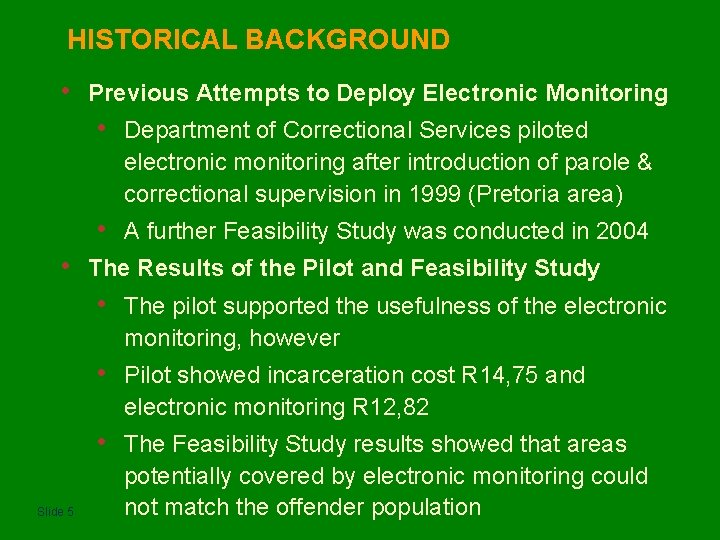
HISTORICAL BACKGROUND • • Slide 5 Previous Attempts to Deploy Electronic Monitoring • Department of Correctional Services piloted electronic monitoring after introduction of parole & correctional supervision in 1999 (Pretoria area) • A further Feasibility Study was conducted in 2004 The Results of the Pilot and Feasibility Study • The pilot supported the usefulness of the electronic monitoring, however • Pilot showed incarceration cost R 14, 75 and electronic monitoring R 12, 82 • The Feasibility Study results showed that areas potentially covered by electronic monitoring could not match the offender population
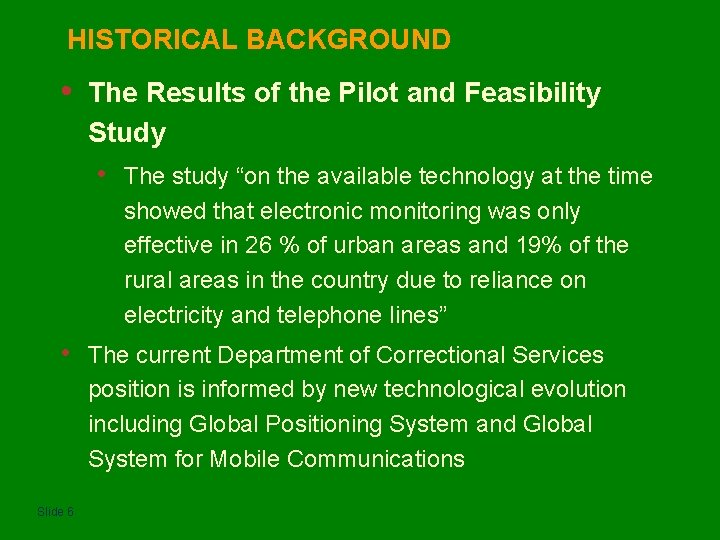
HISTORICAL BACKGROUND • The Results of the Pilot and Feasibility Study • • Slide 6 The study “on the available technology at the time showed that electronic monitoring was only effective in 26 % of urban areas and 19% of the rural areas in the country due to reliance on electricity and telephone lines” The current Department of Correctional Services position is informed by new technological evolution including Global Positioning System and Global System for Mobile Communications
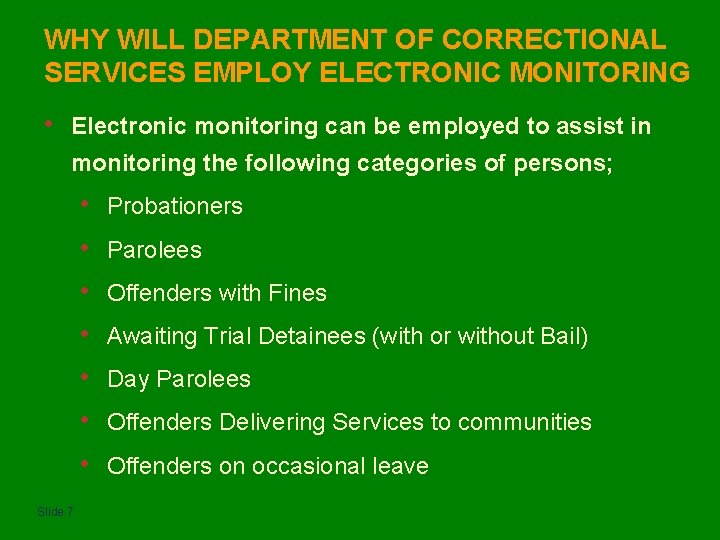
WHY WILL DEPARTMENT OF CORRECTIONAL SERVICES EMPLOY ELECTRONIC MONITORING • Electronic monitoring can be employed to assist in monitoring the following categories of persons; • • Slide 7 Probationers Parolees Offenders with Fines Awaiting Trial Detainees (with or without Bail) Day Parolees Offenders Delivering Services to communities Offenders on occasional leave
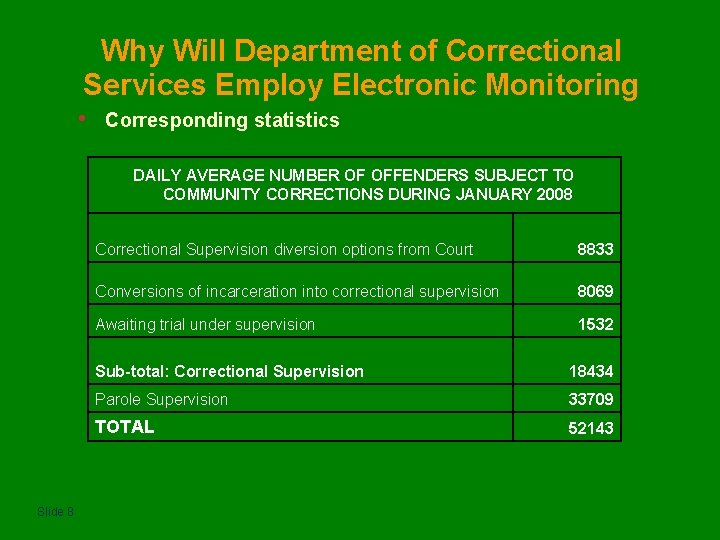
Why Will Department of Correctional Services Employ Electronic Monitoring • Corresponding statistics DAILY AVERAGE NUMBER OF OFFENDERS SUBJECT TO COMMUNITY CORRECTIONS DURING JANUARY 2008 Slide 8 Correctional Supervision diversion options from Court 8833 Conversions of incarceration into correctional supervision 8069 Awaiting trial under supervision 1532 Sub-total: Correctional Supervision 18434 Parole Supervision 33709 TOTAL 52143
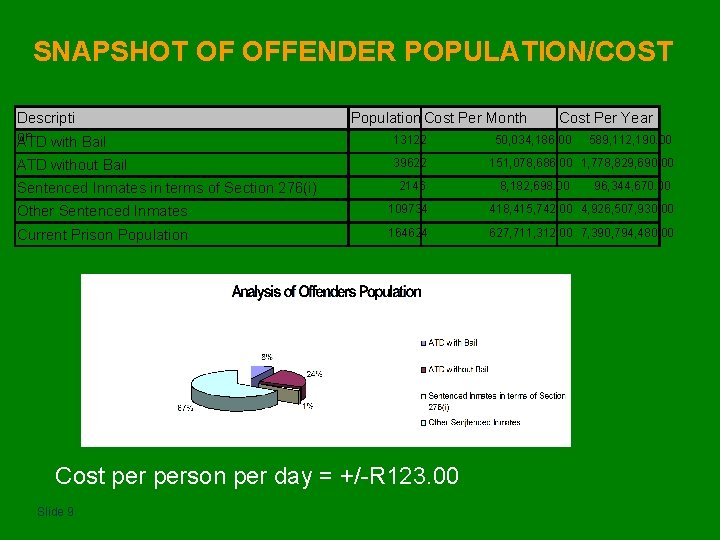
SNAPSHOT OF OFFENDER POPULATION/COST Descripti on ATD with Bail ATD without Bail Sentenced Inmates in terms of Section 276(i) Population Cost Per Month 13122 39622 2146 Cost Per Year 50, 034, 186. 00 589, 112, 190. 00 151, 078, 686. 00 1, 778, 829, 690. 00 8, 182, 698. 00 96, 344, 670. 00 Other Sentenced Inmates 109734 418, 415, 742. 00 4, 926, 507, 930. 00 Current Prison Population 164624 627, 711, 312. 00 7, 390, 794, 480. 00 Cost person per day = +/-R 123. 00 Slide 9
WHY WILL DEPARTMENT OF CORRECTIONAL SERVICES EMPLOY ELECTRONIC MONITORING • Reduce corruption and intimidation of Department of Correctional Services officials • Enhance family stability and community involvement in rehabilitation • • Reduce prison population • • Research indicates potential savings Afford Department of Correctional Services personnel more time for rehabilitation May be a favoured option by the judiciary Slide 10
WHAT IS ELECTRONIC MONITORING AND HOW DOES IT WORK? • Slide 11 Basic system: • A transmitter within anklet/bracelet attached to offender • Emits signals to a field monitoring device connected to a Communication System/Control Room • Field monitoring device register when offender moves outside of set boundaries / tamper with the equipment • Field monitoring device send alert to central control room for response
WHAT IS ELECTRONIC MONITORING AND HOW DOES IT WORK? • Slide 12 Active monitoring system • It is a system for monitoring an individual’s movement and compliance to time/location parameters 24/7/365 in real time. • The unit is programmable to remember zones that are off-limits and areas where the offender is required to be at certain times
WHAT IS ELECTRONIC MONITORING AND HOW DOES IT WORK? • Slide 13 Passive monitoring system • It is also a system for monitoring an offender’s movement and compliance with time/location parameters 24/7/365. • It continuously records location data throughout the day and is programmable to remember zones that are off limit. • At given intervals, the recorded information is downloaded to verify compliance. • Passive systems are usually cheaper than active systems and are ideal for applications that do not require immediate notification.
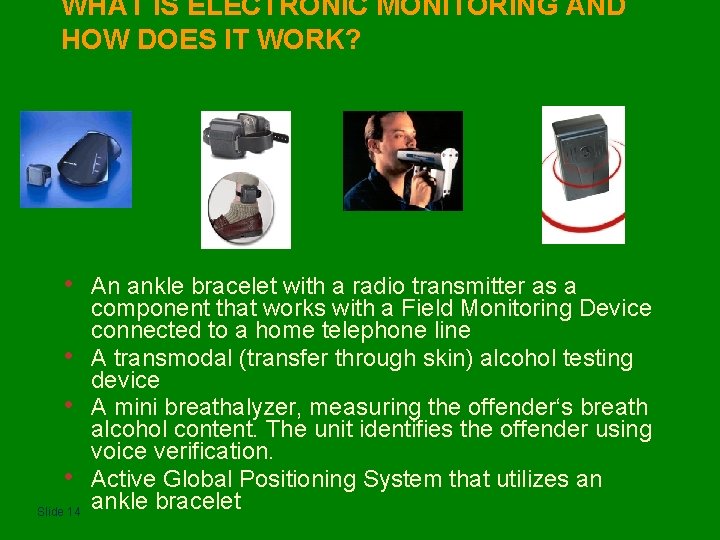
WHAT IS ELECTRONIC MONITORING AND HOW DOES IT WORK? • • Slide 14 An ankle bracelet with a radio transmitter as a component that works with a Field Monitoring Device connected to a home telephone line A transmodal (transfer through skin) alcohol testing device A mini breathalyzer, measuring the offender‘s breath alcohol content. The unit identifies the offender using voice verification. Active Global Positioning System that utilizes an ankle bracelet
EXAMPLES OF COUNTRIES WITH ELECTRONIC MONITORING • • • Slide 15 Canada United Kingdom Australia New Zealand Singapore
CHALLENGES • • • Coverage and reach of ICT infrastructure • Offender stigmatisation arising from anklet / bracelet • Public intolerance of people associated with criminal activities • Lack of support systems & residential addresses where offender can be physically supervised • Electronic Monitoring does not stop re-offending Lack of electricity & telephone infrastructure Currently Department of Correctional Services does not have specific budget for implementation Slide 16
IMPLEMENTATION AND WAY FORWARD • • • Partnership with CSIR • Complete the planning processes in time to allow for (inclusion in MTEF) budgeting for 2009/10 Slide 17 Undertake Best Practice review Cost Benefit Analysis (equivalent of the Regulation 16 requirements)
STATUS REPORT INMATE TRACKING Introduction to Central Services Branch Building a caring correctional system that truly belongs to all Presentation to Portfolio Committee Date: Slide 18 04. 03. 2008
OBJECTIVES OF INMATE TRACKING 1. Decrease detention cycle time of Awaiting Trial Detainees. 2. Optimise the management of facilities and population. 3. Assist in security management within the detention facilities. 4. Support the following processes: Admissions, Releases, Roll Calls, Bail and Visitations within the broader IJS. 5. Support detainee scheduling processes. Slide 19
BRIEF BACKGROUND • The system’s main purpose is to provide electronic tracking, including the biometric identification and verification of Awaiting Trial Detainees, within a Correctional Center. • The system was identified and sponsored by the Integrated Justice System Cluster • 2 pilot sites (Durban Westville Medium A & JHB Medium A ) were identified. • The system has been rolled out to both facilities at an initial value of R 28 m. Slide 20
EVALUATION COMMITTEE MANDATE 1. The pilot project of the Inmate Tracking System had to be evaluated as per the Request for Proposal Tender Specification document. 2. The Commissioner sanctioned the appointment of the Inmate Tracking System pilot Evaluation Committee. 3. The Committee evaluated the function, efficiency and sustainability of the system Slide 21
EVALUATION FINDINGS 1. Johannesburg Medium A Correctional Centre: a. Fully operational as per the tender specification and has proved to be successful in many areas as per the tender specifications, despite the challenges noted. 2. Durban Medium A Correctional Centre: a. The biometric identity verification functionality is being fully utilised and is of great value to the Correctional Centre. b. Mismanagement of stock and some of the PTDs were lost Slide 22
FINDINGS OF THE INVESTIGATION INTO MISSING PTDS • • Findings • The then Area Commissioner was not cooperative with investigations • • 3236 PTDs unaccounted for (R 2, 7 m) Recommendations • • • Slide 23 Some were discovered after investigation Unaccounted PTDs be written off No one be held accountable – inmates doings Disciplinary steps be taken against Area Commissioner
EVALUATION FINDINGS 1. The Inmate Tracking System at JHB Med A satisfies the project objectives – proven to be valuable and beneficial. 2. The identity verification functionality is readily deployable to other Correctional Centres & can be used independent of the broader Inmate Tracking System. 3. The Inmate Tracking System generates added value spinoffs, not only in terms of the ATDs but can also be utilized with sentenced offenders. 4. The PTDs used are inefficient, non-durable, bulky and therefore unsustainable 5. Involvement of local management and staff critical for effective roll-out of the project 6. Component suppliers and procurement difficult to manage Slide 24
RECOMMENDATIONS 1. The identity verification functionality be sustained at Durban & Johannesburg Medium A Correctional Centres. 2. The Inmate Tracking System project at JHB Med A Correctional Centre be extended for an additional 12 months with its full functionality, to bridge the identified gaps 3. Roll-out the Identity verification to 11 centres with higher ATD population 4. Develop local prototype of personal tracking device Slide 25
CURRENT STATUS • Personal Tracking Device Development • A User Requirements Specification has been completed for both the Development of the Prototype and the Integration of the Biometrics Identification and Verification Mechanism into the A&R. • SITA is finalizing requirements for the Magic software and the tender process will ensue before the end of the financial year Slide 26
CURRENT STATUS • Identity Verification Roll-out • The sites identified and correspond with the MATD project (and video arraignment) sites • Roll-out awaits completion of integration and upgrade of A&R Slide 27
WAYFORWARD § Integrate Biometric Identity verification into A&R and RDOMS completed § Roll out ID verification to 11 big sites – beginning of new financial year § Testing new prototype for new generation PTDs in Jo’burg Medium A Slide 28
THANK YOU Renewing our Pledge: A National Partnership to Correct, Rehabilitate and Reintegrate Offenders for a safer and secure South Africa Slide 29