
Electronic Money Electronic Money Institutions 1 1 a
- Slides: 20
Electronic Money & Electronic Money Institutions 1. 1 a 2, Association of E-money Institutions in the Netherlands Simon Lelieveldt (secretary)
Simon Lelieveldt g Postbank (1989 -1995) – project manager/strategy planner retail payments g De Nederlandsche Bank (1995 -2001) – – – g BIS 1996: security of e-money Supervision e-money (Chipper / Chipknip) BIS Retail Payments Reports (1999, 2000) BIS Electronic Money (Dutch overviews) European Payment Systems Observatory Independent consultant (2001 -. . ) © S Lelieveldt, 1. 1 a 2 Financial Services Authority December 16, 2002
Outline About 1. 1 a 2 g Position paper on Electronic Money g E-money : a functional approach g Premium Rate SMS in the Netherlands g Conclusions g © S Lelieveldt, 1. 1 a 2 Financial Services Authority December 16, 2002
About 1. 1 a 2 Draft supervision law: January 2002 g Role for representative organisation g – discussion of supervisory rules/regulations g Consideration: Distinct issues / problems for new players may require independent organisation Established: June 10, 2002 g 1. 1 a 2: article that defines emi-institutions g Banks set up NVEGI (for 1. 1 a 1 & 1. 1 a 2 issuers of e-money) © S Lelieveldt, 1. 1 a 2 Financial Services Authority December 16, 2002
Goals of 1. 1 a 2 g Information provision: – to share knowledge between members and with interested organisations/institutions on regulatory and market developments with respect to e-money g Representation: – to act as the representative organisation as defined in the supervision law – to represent the interests of electronic money institutions (1. 1 a 2) vis á vis the public, parliament, regulators, supervisors in general © S Lelieveldt, 1. 1 a 2 Financial Services Authority December 16, 2002
Members of 1. 1 a 2 (3) g All are operational since Spring 2002 – pre-paid m-payment solutions – also focused on paying for digital content g 2 larger e-money institutions: – Global Payways / Moxmo – Digipay Nederland NV g 1 smaller (technology provider): – New Media Communications Amsterdam © S Lelieveldt, 1. 1 a 2 Financial Services Authority December 16, 2002
Activities of 1. 1 a 2 so far g Informative seminar – E-money (institutions) / legal implications g Website for information distribution – http: //www. 11 a 2. nl g Comments on: – e-money consultation Dutch supervisor (DNB), FATF (review 40 rec); e-payments ECB g Position paper of November 15, 2002 – Electronic Money & Electronic Money Insititutions © S Lelieveldt, 1. 1 a 2 Financial Services Authority December 16, 2002
Position paper: background g Practical concern of members of 1. 1 a 2 – Will server-side pre-paid M-payments be considered E-money in UK (or any other EU country) but banking in NL ? If so, that would (negatively) affect the comparative business case and require reconsideration of business decisions (technical set-up, location of business, legal status … ) © S Lelieveldt, 1. 1 a 2 Financial Services Authority December 16, 2002
Electronic money g The definition of e-money as: – – a monetary value / claim on the issuer on an electronic device issued on receipt of funds accepted as a means of payment by others than the issuer allows many implementation choices © S Lelieveldt, 1. 1 a 2 Financial Services Authority December 16, 2002
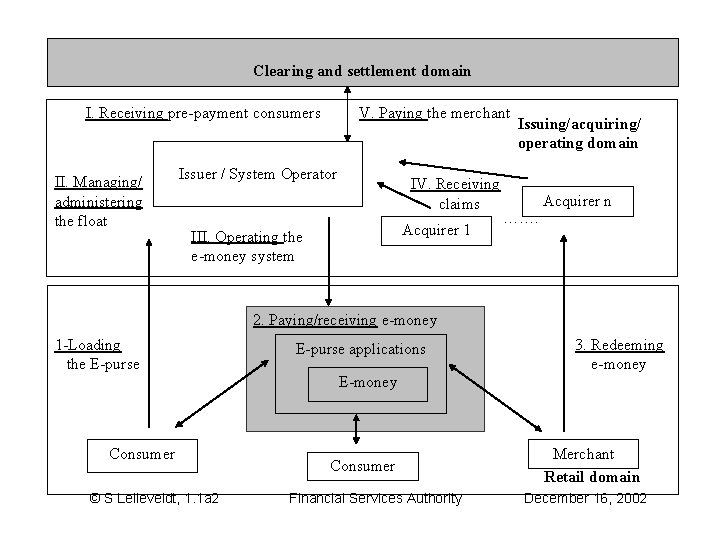
Implementation choices g All issuers of e-money decide in detail on: – their business model and market focus – the product features – the technical architecture g As a consequence the outward appearance of products may vary significantly …. . but the functional blueprint is quite similar © S Lelieveldt, 1. 1 a 2 Financial Services Authority December 16, 2002
Clearing and settlement domain I. Receiving pre-payment consumers II. Managing/ administering the float V. Paying the merchant Issuer / System Operator IV. Receiving claims Acquirer 1 III. Operating the e-money system Issuing/acquiring/ operating domain ……. Acquirer n 2. Paying/receiving e-money 1 -Loading the E-purse Consumer © S Lelieveldt, 1. 1 a 2 E-purse applications E-money Consumer Financial Services Authority 3. Redeeming e-money Merchant Retail domain December 16, 2002
Implementation choices g Business model & market focus – separate payment services or part of banking? – market focus (digital content, POS, etc. ) – home country and expansion strategy g Product features – branding, use of identifiers, risk limits, contract terms, instructions for use, equipment (PC, phone, mobile phone), integration in back-office, link to financial system (clearing and settlement). © S Lelieveldt, 1. 1 a 2 Financial Services Authority December 16, 2002
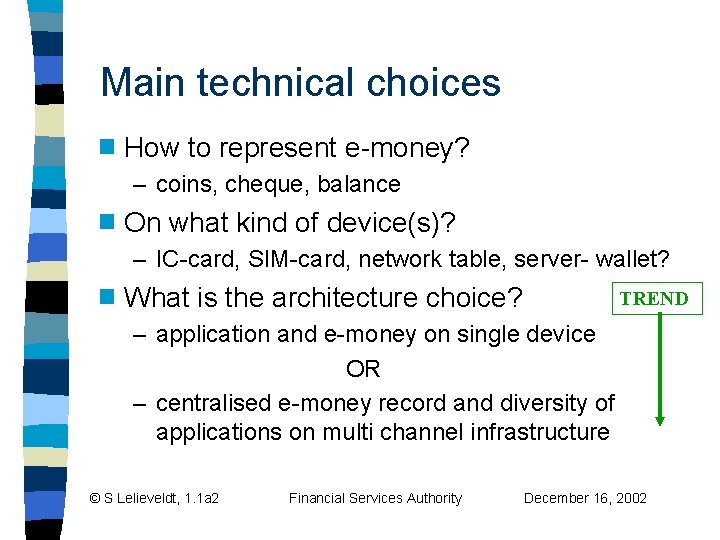
Main technical choices g How to represent e-money? – coins, cheque, balance g On what kind of device(s)? – IC-card, SIM-card, network table, server- wallet? g What is the architecture choice? TREND – application and e-money on single device OR – centralised e-money record and diversity of applications on multi channel infrastructure © S Lelieveldt, 1. 1 a 2 Financial Services Authority December 16, 2002
© S Lelieveldt, 1. 1 a 2 Financial Services Authority December 16, 2002
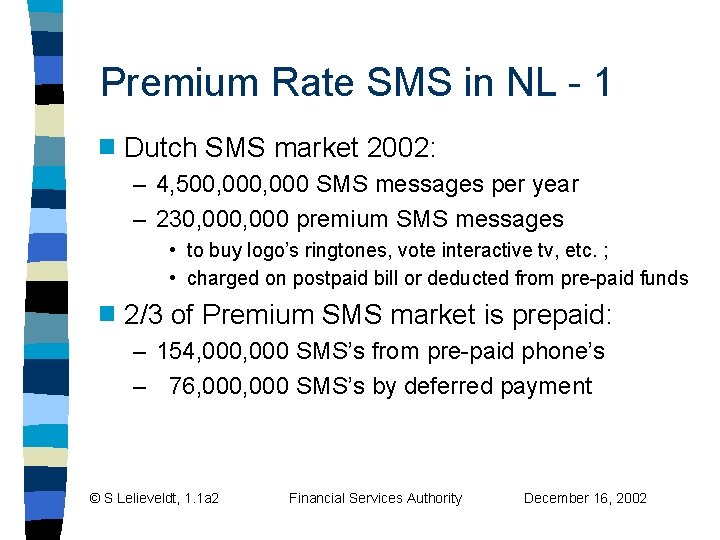
Premium Rate SMS in NL - 1 g Dutch SMS market 2002: – 4, 500, 000 SMS messages per year – 230, 000 premium SMS messages • to buy logo’s ringtones, vote interactive tv, etc. ; • charged on postpaid bill or deducted from pre-paid funds g 2/3 of Premium SMS market is prepaid: – 154, 000 SMS’s from pre-paid phone’s – 76, 000 SMS’s by deferred payment © S Lelieveldt, 1. 1 a 2 Financial Services Authority December 16, 2002
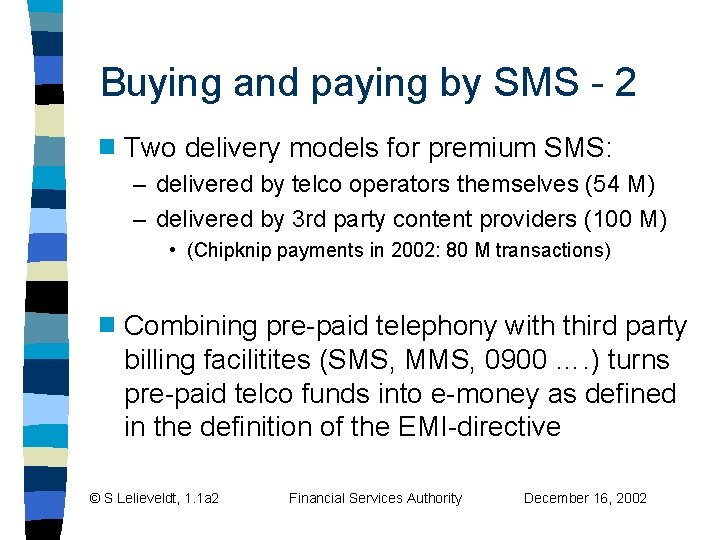
Buying and paying by SMS - 2 g Two delivery models for premium SMS: – delivered by telco operators themselves (54 M) – delivered by 3 rd party content providers (100 M) • (Chipknip payments in 2002: 80 M transactions) g Combining pre-paid telephony with third party billing facilitites (SMS, MMS, 0900 …. ) turns pre-paid telco funds into e-money as defined in the definition of the EMI-directive © S Lelieveldt, 1. 1 a 2 Financial Services Authority December 16, 2002
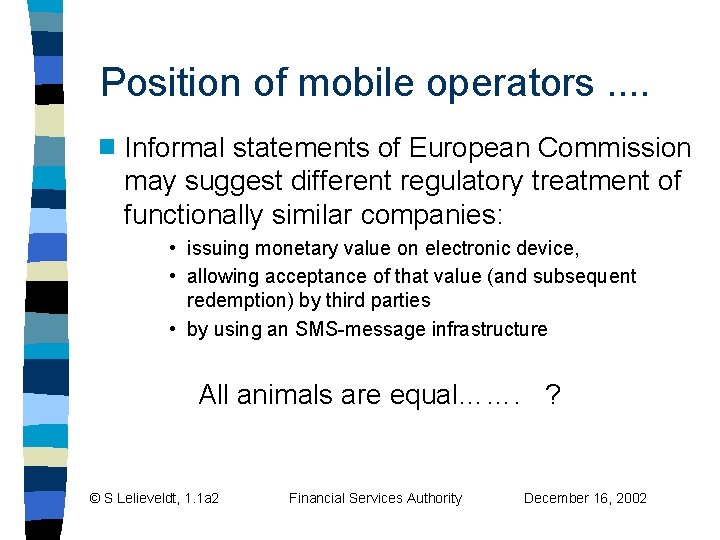
Position of mobile operators. . g Informal statements of European Commission may suggest different regulatory treatment of functionally similar companies: • issuing monetary value on electronic device, • allowing acceptance of that value (and subsequent redemption) by third parties • by using an SMS-message infrastructure All animals are equal……. ? © S Lelieveldt, 1. 1 a 2 Financial Services Authority December 16, 2002
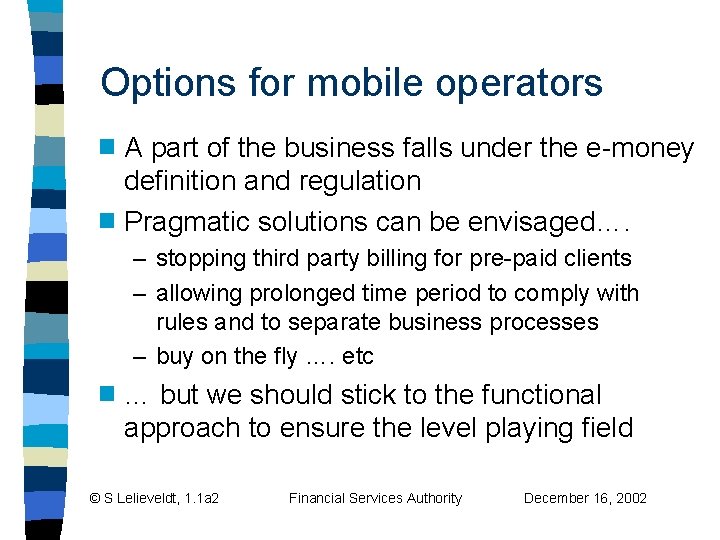
Options for mobile operators A part of the business falls under the e-money definition and regulation g Pragmatic solutions can be envisaged…. g – stopping third party billing for pre-paid clients – allowing prolonged time period to comply with rules and to separate business processes – buy on the fly …. etc g … but we should stick to the functional approach to ensure the level playing field © S Lelieveldt, 1. 1 a 2 Financial Services Authority December 16, 2002
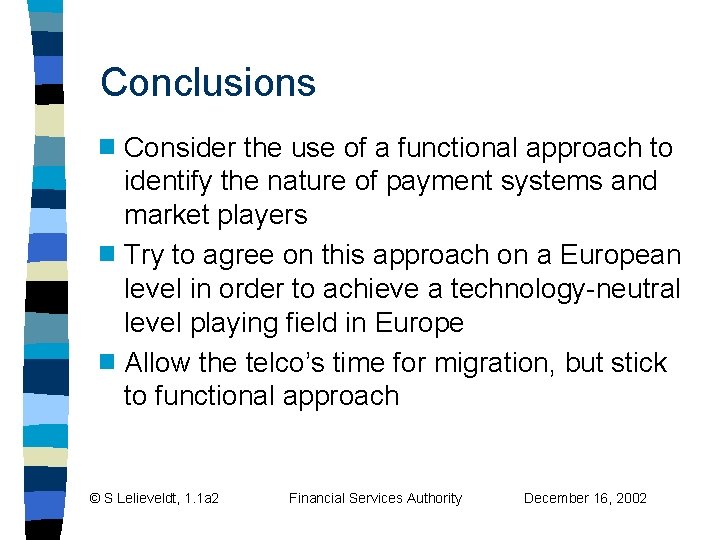
Conclusions Consider the use of a functional approach to identify the nature of payment systems and market players g Try to agree on this approach on a European level in order to achieve a technology-neutral level playing field in Europe g Allow the telco’s time for migration, but stick to functional approach g © S Lelieveldt, 1. 1 a 2 Financial Services Authority December 16, 2002
More information: Homepage: http: //www. 11 a 2. nl Position paper: http: //www. 11 a 2. nl/docs/empp 1511. doc/ Secretariat: © S Lelieveldt, 1. 1 a 2 +31 20 644 1807 info@11 a 2. nl Financial Services Authority December 16, 2002