
Electronic Money Concept Money exchanged eletronically involving microprocessors
- Slides: 14
Electronic Money
Concept Money exchanged eletronically involving microprocessors computer networks, internet and digital stored values. l l Two General Forms Card Based l Software Based l
First and Current Implementations l Smart Cards Generally defined as a portable data storage device with intelligence (chip memory) and provisions for identity and security.
First and Current Implementations l Some History… l l 1970 - First implementation of microelectronic devices in plastic substrate (Kunitaka Arimura) 1974 - First patent “An independent electronic object with memory” (Roland Moreno). 1979 – First smart card by Honeywell Bull 1980’s First Trials in France l l French Bank Card Association (Blue Card, Green Card, TA) University Cards in France Date Information took from The Changing Face of Money, Good Barbara
First and Current Implementations l Smart Card (Open System) l The scheme allows the value on the card to be used in the same manner as any other payments method or form currently in the specific place. l Problems for wide development: Need for terminal to process transactions, clearing and settlement system.
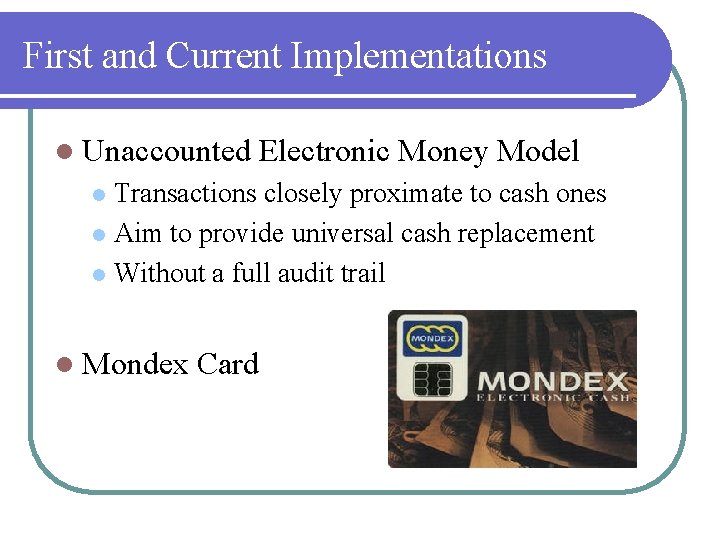
First and Current Implementations l Unaccounted Electronic Money Model Transactions closely proximate to cash ones l Aim to provide universal cash replacement l Without a full audit trail l l Mondex Card
First and Current Implementations l Accounted Electronic Money Model Provide a general audit trail l Archiving Functions l Does not permit the anonymity of incorporate it into the Web browsers l
First and Current Implementations l Smart Cards (Closed System) l A stored-value card that only can be used for one purpose or only in one determined environment.
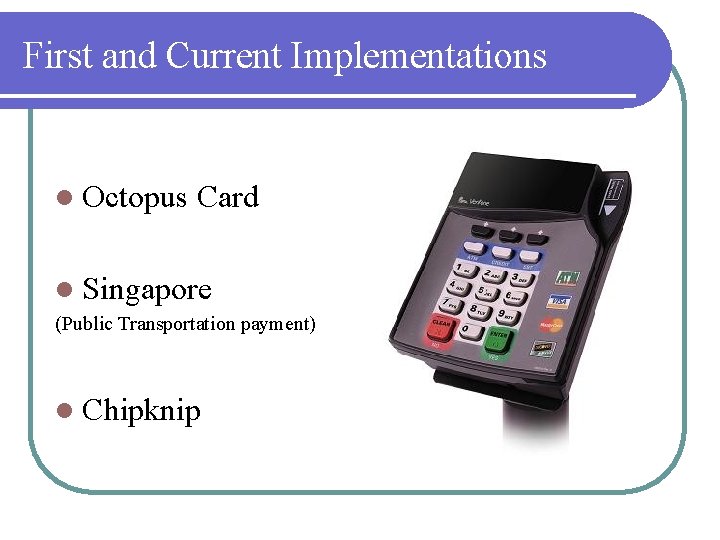
First and Current Implementations l Octopus Card l Singapore (Public Transportation payment) l Chipknip
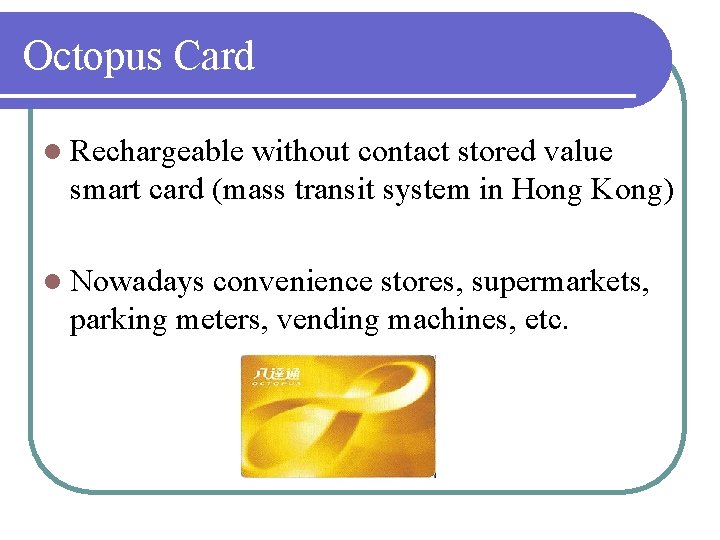
Octopus Card l Rechargeable without contact stored value smart card (mass transit system in Hong Kong) l Nowadays convenience stores, supermarkets, parking meters, vending machines, etc.
Off-line Electronic Money l The merchant does not need to interact with the bank before accepting a user’s coin. l Merchant guaranteed that the user’s e-coin will be accepted by the bank (the bank is able to identify cheating user).
Off-line Electronic Money l Blind Signatures to achieve unlikability between withdrawal and spend transactions. l Using cryptography Anonymous e-cash was Introduced by David Chaum
In General… l Advantages: Convenience l Privacy l Increased efficency of transactions l Lower transaction fees l New business opportunities l
In General… l Disadvantages How to levy taxes l Possible facility of money laundering l Exchange rate instabilities l Shortage of money supplies l