
Electronic Game Design Capstone Project Diane Brancazio Belmont
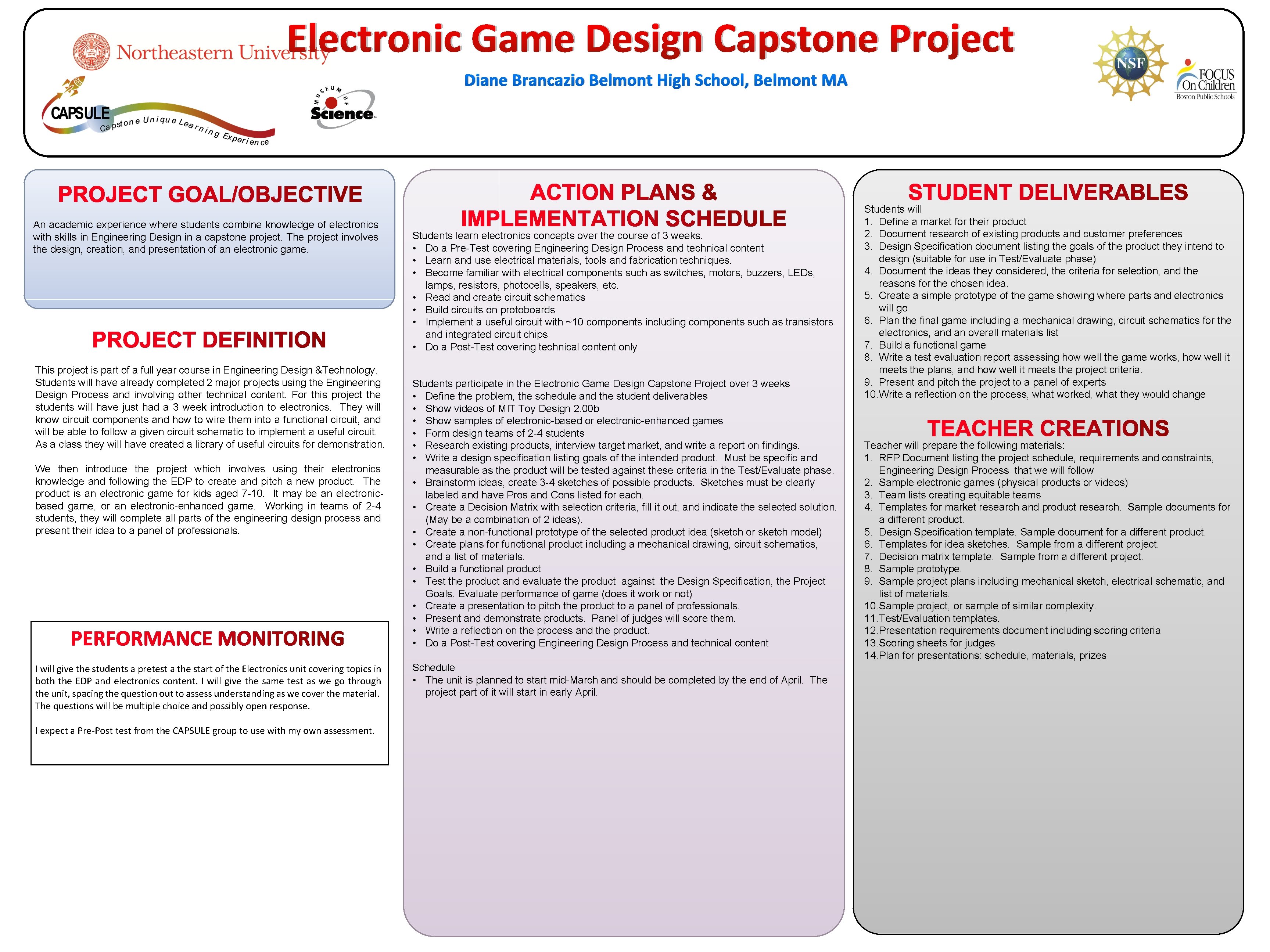
Electronic Game Design Capstone Project Diane Brancazio Belmont High School, Belmont MA An academic experience where students combine knowledge of electronics with skills in Engineering Design in a capstone project. The project involves the design, creation, and presentation of an electronic game. This project is part of a full year course in Engineering Design &Technology. Students will have already completed 2 major projects using the Engineering Design Process and involving other technical content. For this project the students will have just had a 3 week introduction to electronics. They will know circuit components and how to wire them into a functional circuit, and will be able to follow a given circuit schematic to implement a useful circuit. As a class they will have created a library of useful circuits for demonstration. We then introduce the project which involves using their electronics knowledge and following the EDP to create and pitch a new product. The product is an electronic game for kids aged 7 -10. It may be an electronicbased game, or an electronic-enhanced game. Working in teams of 2 -4 students, they will complete all parts of the engineering design process and present their idea to a panel of professionals. I will give the students a pretest a the start of the Electronics unit covering topics in both the EDP and electronics content. I will give the same test as we go through the unit, spacing the question out to assess understanding as we cover the material. The questions will be multiple choice and possibly open response. I expect a Pre-Post test from the CAPSULE group to use with my own assessment. Students learn electronics concepts over the course of 3 weeks. • Do a Pre-Test covering Engineering Design Process and technical content • Learn and use electrical materials, tools and fabrication techniques. • Become familiar with electrical components such as switches, motors, buzzers, LEDs, lamps, resistors, photocells, speakers, etc. • Read and create circuit schematics • Build circuits on protoboards • Implement a useful circuit with ~10 components including components such as transistors and integrated circuit chips • Do a Post-Test covering technical content only Students participate in the Electronic Game Design Capstone Project over 3 weeks • Define the problem, the schedule and the student deliverables • Show videos of MIT Toy Design 2. 00 b • Show samples of electronic-based or electronic-enhanced games • Form design teams of 2 -4 students • Research existing products, interview target market, and write a report on findings. • Write a design specification listing goals of the intended product. Must be specific and measurable as the product will be tested against these criteria in the Test/Evaluate phase. • Brainstorm ideas, create 3 -4 sketches of possible products. Sketches must be clearly labeled and have Pros and Cons listed for each. • Create a Decision Matrix with selection criteria, fill it out, and indicate the selected solution. (May be a combination of 2 ideas). • Create a non-functional prototype of the selected product idea (sketch or sketch model) • Create plans for functional product including a mechanical drawing, circuit schematics, and a list of materials. • Build a functional product • Test the product and evaluate the product against the Design Specification, the Project Goals. Evaluate performance of game (does it work or not) • Create a presentation to pitch the product to a panel of professionals. • Present and demonstrate products. Panel of judges will score them. • Write a reflection on the process and the product. • Do a Post-Test covering Engineering Design Process and technical content Schedule • The unit is planned to start mid-March and should be completed by the end of April. The project part of it will start in early April. Students will 1. Define a market for their product 2. Document research of existing products and customer preferences 3. Design Specification document listing the goals of the product they intend to design (suitable for use in Test/Evaluate phase) 4. Document the ideas they considered, the criteria for selection, and the reasons for the chosen idea. 5. Create a simple prototype of the game showing where parts and electronics will go 6. Plan the final game including a mechanical drawing, circuit schematics for the electronics, and an overall materials list 7. Build a functional game 8. Write a test evaluation report assessing how well the game works, how well it meets the plans, and how well it meets the project criteria. 9. Present and pitch the project to a panel of experts 10. Write a reflection on the process, what worked, what they would change Teacher will prepare the following materials: 1. RFP Document listing the project schedule, requirements and constraints, Engineering Design Process that we will follow 2. Sample electronic games (physical products or videos) 3. Team lists creating equitable teams 4. Templates for market research and product research. Sample documents for a different product. 5. Design Specification template. Sample document for a different product. 6. Templates for idea sketches. Sample from a different project. 7. Decision matrix template. Sample from a different project. 8. Sample prototype. 9. Sample project plans including mechanical sketch, electrical schematic, and list of materials. 10. Sample project, or sample of similar complexity. 11. Test/Evaluation templates. 12. Presentation requirements document including scoring criteria 13. Scoring sheets for judges 14. Plan for presentations: schedule, materials, prizes
- Slides: 1