
Electronic Frog Eye Counting crowd Using WiFi Wei



- Slides: 19
Electronic Frog Eye: Counting crowd Using Wi-Fi Wei Xi†, Jizhong Zhao†, Xiang-Yang Li∗, Kun Zhao† Shaojie Tang, Xue Liu§ , Zhiping Jiang† †School of Electronic and Information Engineering, Xi’an Jiaotong University ∗ Department of Computer Science, Illinois Institute of Technology Department of Computer and Information Science, Temple University § School of Computer Science, Mc. Gill University
COTENTS q Introduction q Methodology q Experiment results q Conclusion
INTRODUCTION q Robust crowd counting is an important task. q But, crowd behaviors may face various challenges because of unpredictable crowed behaviors. q Traditional crowd counting approaches are classified into two categories: image based recognition and non-image based localization.
INTRODUCTION q Image based methods have inherent drawbacks such as environmental contribution of smoke or lacking of light. q Non-image based methods use radio devices such as RFID tags, mobile phones, sensor nodes, etc. But, These device-based approaches require people to carry certain devices.
INTRODUCTION →employing RSS q But these method be affected by multipath propagation. q In this paper, FCC(device-Free Crowd Counting) approach based on Channel State Information(CSI) from OFDM-based system has is proposed. q Device –free approaches
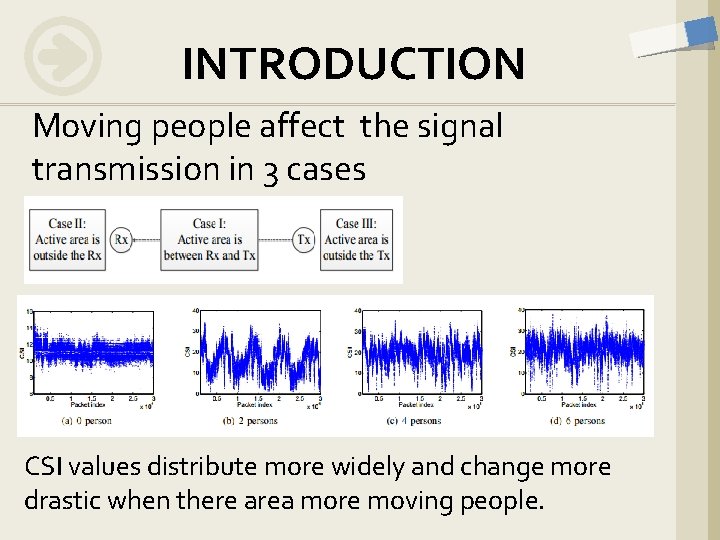
INTRODUCTION Moving people affect the signal transmission in 3 cases CSI values distribute more widely and change more drastic when there area more moving people.
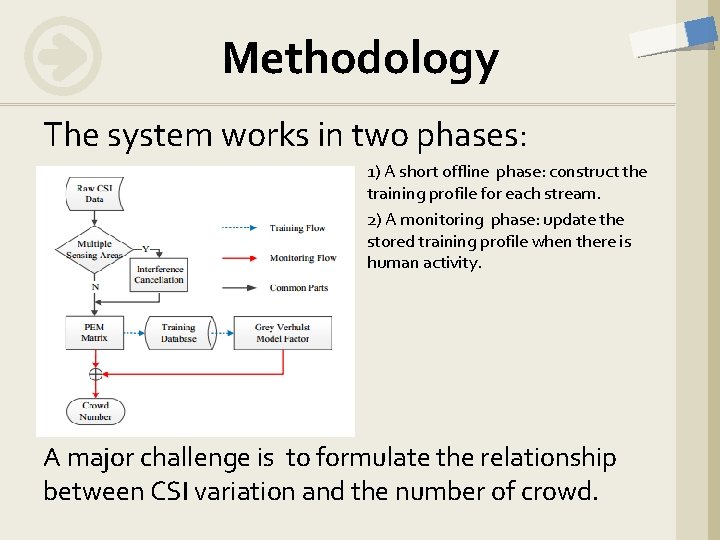
Methodology The system works in two phases: 1) A short offline phase: construct the training profile for each stream. 2) A monitoring phase: update the stored training profile when there is human activity. A major challenge is to formulate the relationship between CSI variation and the number of crowd.
Methodology If the sample points are expanded a certain sample size, the sample points will overlap with their neighboring points. → The overlapped area incurs intensity of the CSI variation. To reduce the overlapped area of sample point, PEM is used.
Methodology PEM(the Percentage of non-zero elements in the dilated CSI Matrix):
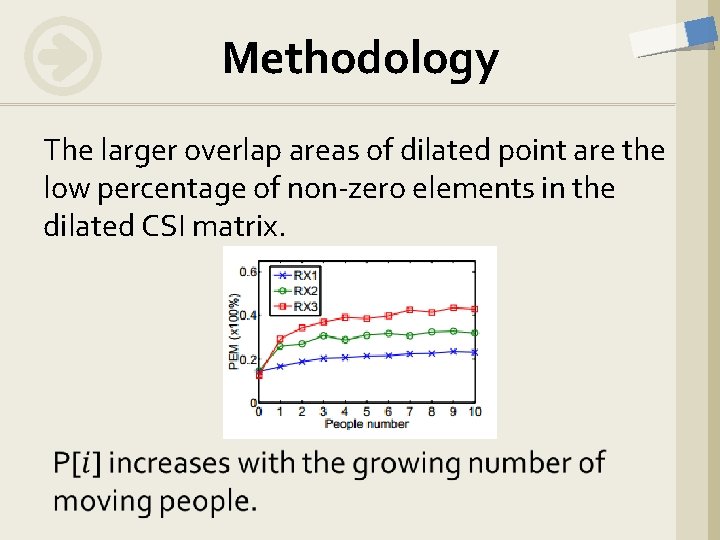
Methodology The larger overlap areas of dilated point are the low percentage of non-zero elements in the dilated CSI matrix.
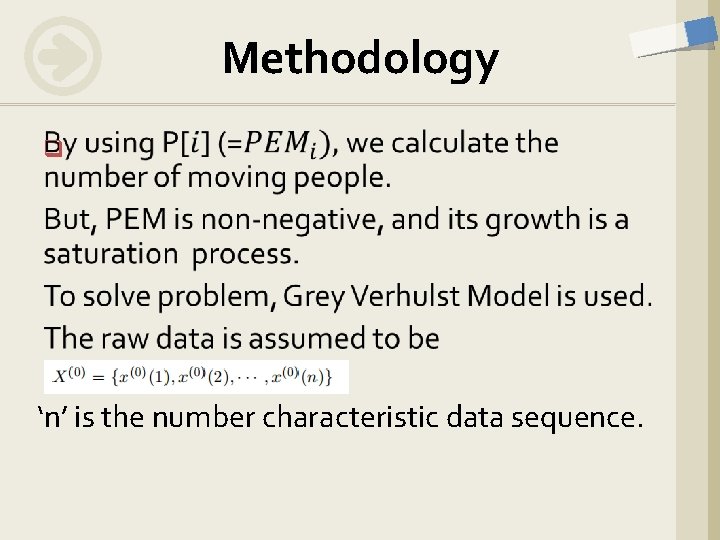
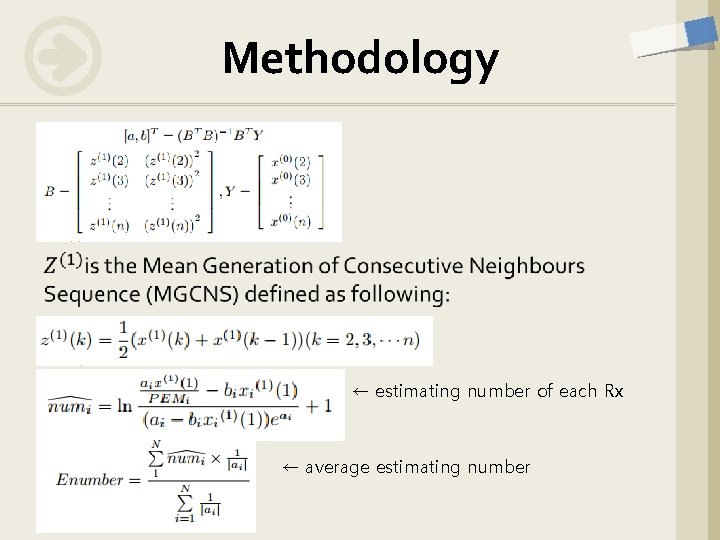
Methodology q ‘n’ is the number characteristic data sequence.
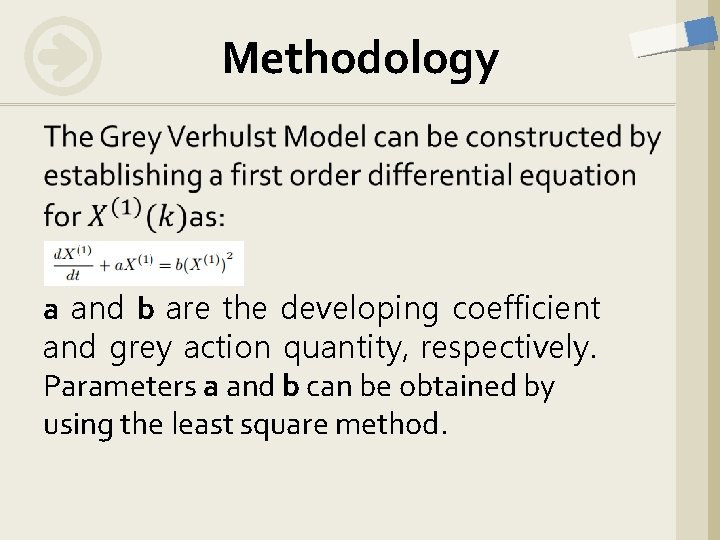
Methodology a and b are the developing coefficient and grey action quantity, respectively. Parameters a and b can be obtained by using the least square method.
Methodology ← estimating number of each Rx ← average estimating number
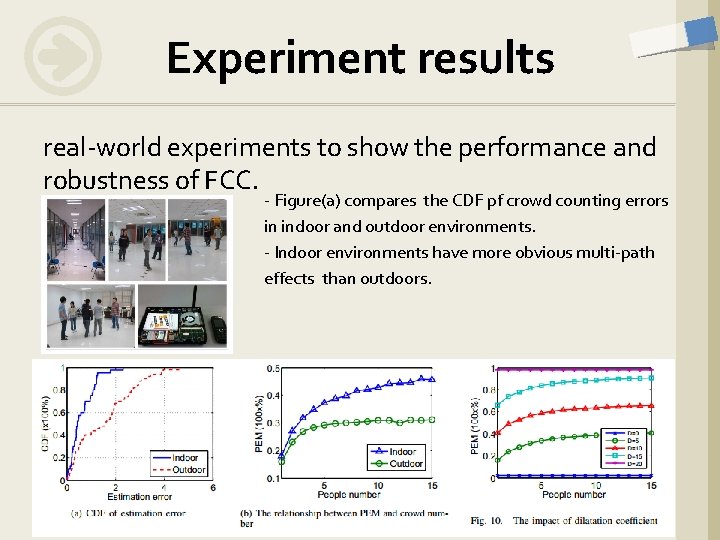
Experiment results real-world experiments to show the performance and robustness of FCC. - Figure(a) compares the CDF pf crowd counting errors in indoor and outdoor environments. - Indoor environments have more obvious multi-path effects than outdoors.
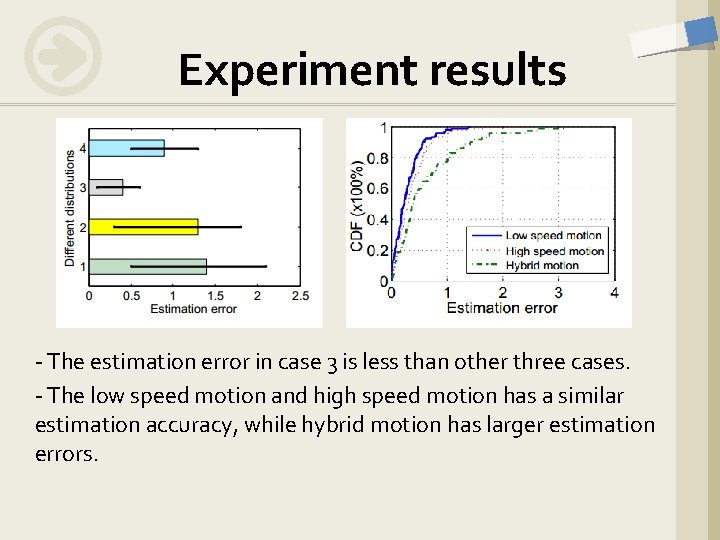
Experiment results - The estimation error in case 3 is less than other three cases. - The low speed motion and high speed motion has a similar estimation accuracy, while hybrid motion has larger estimation errors.
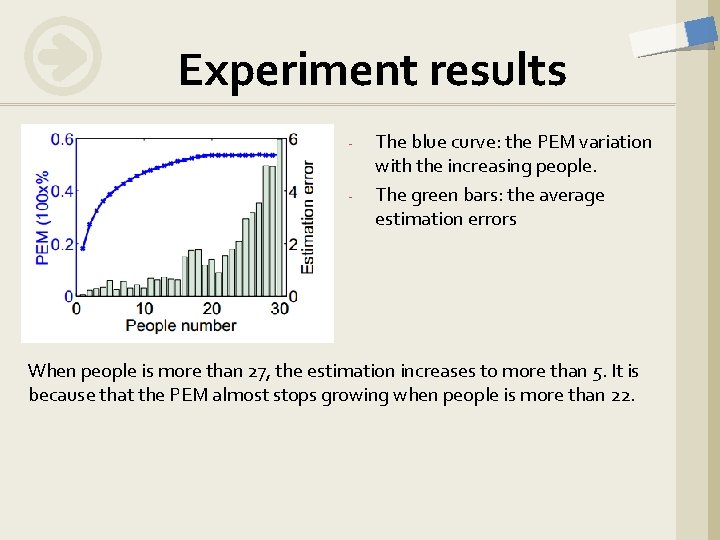
Experiment results - The blue curve: the PEM variation with the increasing people. The green bars: the average estimation errors When people is more than 27, the estimation increases to more than 5. It is because that the PEM almost stops growing when people is more than 22.
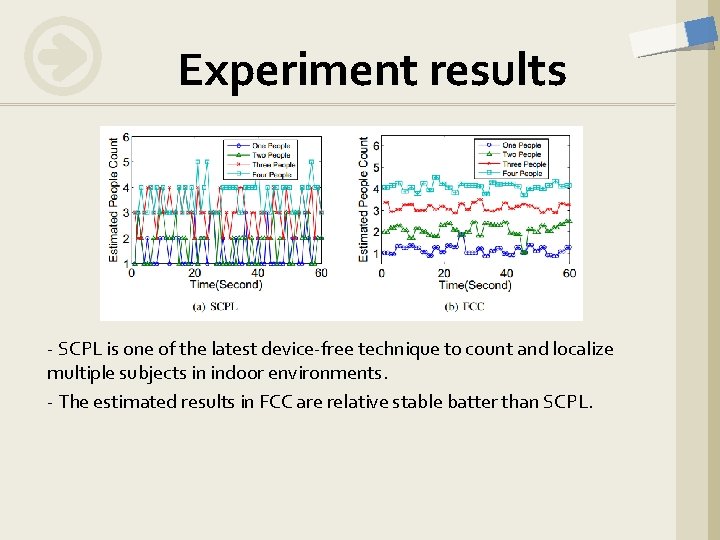
Experiment results - SCPL is one of the latest device-free technique to count and localize multiple subjects in indoor environments. - The estimated results in FCC are relative stable batter than SCPL.
Conclusion q Crowd counting is an important service needed by many applications. q Previous crowd counting approaches either rely on smart phone or RFID tag carried by users. q This paper proposed a novel device-free crowd counting method called FCC based on CSI measurements.
Conclusion q We propose a new metric PEM to extract the feature of CSI variation. q The relation between the PEM and the number of people can be leveraged by the Grey Verhulst Model to count crowd.