
Electronic Dispersion Compensation for optical communication systems NEC
- Slides: 9
Electronic Dispersion Compensation for optical communication systems NEC Labs America July 12 th, 2006
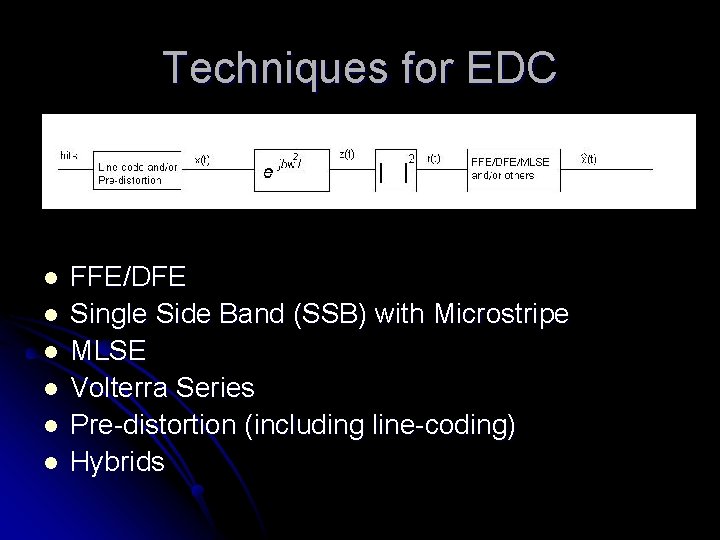
Techniques for EDC l l l FFE/DFE Single Side Band (SSB) with Microstripe MLSE Volterra Series Pre-distortion (including line-coding) Hybrids
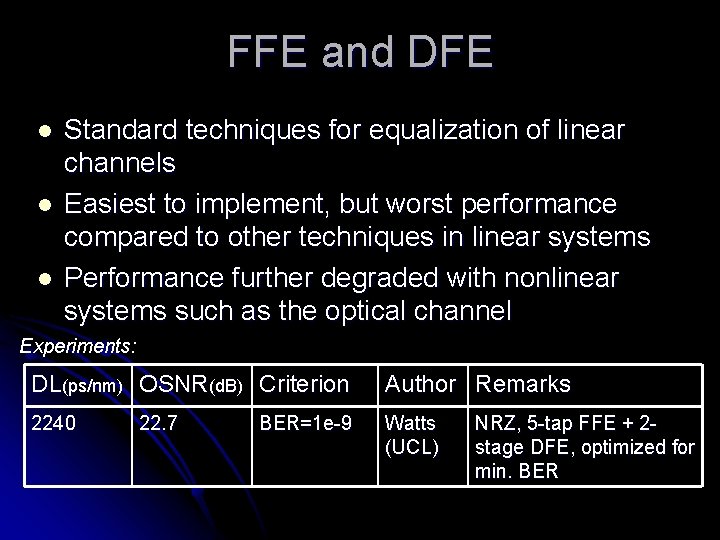
FFE and DFE l l l Standard techniques for equalization of linear channels Easiest to implement, but worst performance compared to other techniques in linear systems Performance further degraded with nonlinear systems such as the optical channel Experiments: DL(ps/nm) OSNR(d. B) Criterion Author Remarks 2240 Watts (UCL) 22. 7 BER=1 e-9 NRZ, 5 -tap FFE + 2 stage DFE, optimized for min. BER
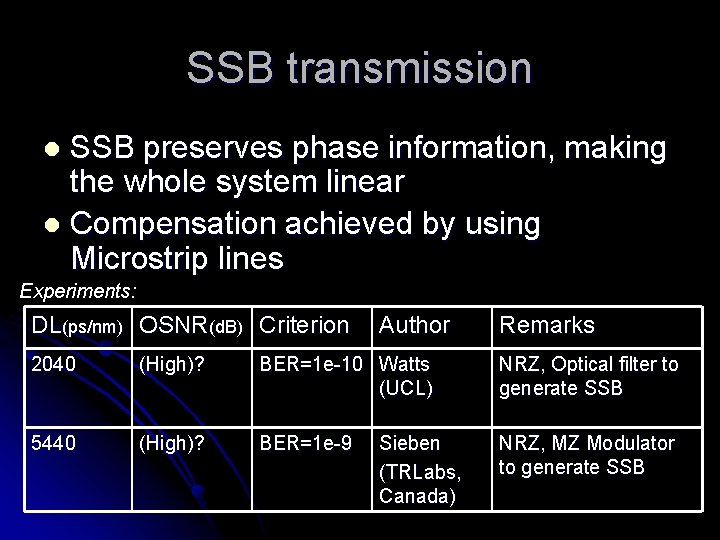
SSB transmission SSB preserves phase information, making the whole system linear l Compensation achieved by using Microstrip lines l Experiments: DL(ps/nm) OSNR(d. B) Criterion Author Remarks 2040 (High)? BER=1 e-10 Watts (UCL) NRZ, Optical filter to generate SSB 5440 (High)? BER=1 e-9 NRZ, MZ Modulator to generate SSB Sieben (TRLabs, Canada)
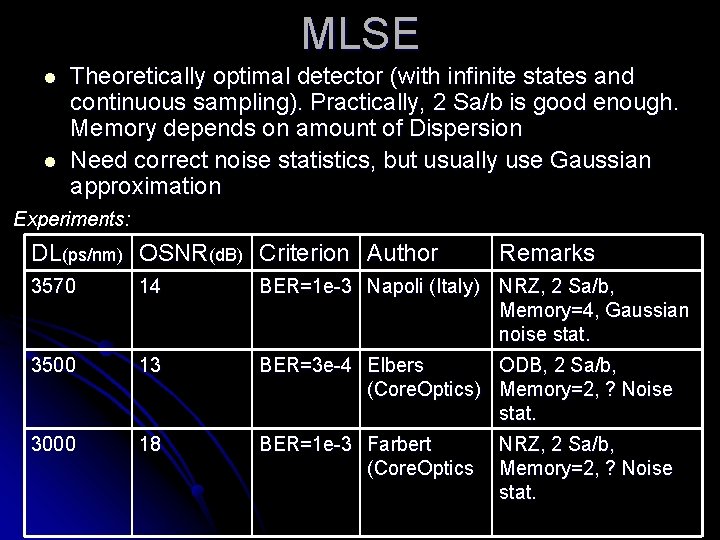
MLSE l l Theoretically optimal detector (with infinite states and continuous sampling). Practically, 2 Sa/b is good enough. Memory depends on amount of Dispersion Need correct noise statistics, but usually use Gaussian approximation Experiments: DL(ps/nm) OSNR(d. B) Criterion Author Remarks 3570 14 BER=1 e-3 Napoli (Italy) NRZ, 2 Sa/b, Memory=4, Gaussian noise stat. 3500 13 BER=3 e-4 Elbers ODB, 2 Sa/b, (Core. Optics) Memory=2, ? Noise stat. 3000 18 BER=1 e-3 Farbert (Core. Optics NRZ, 2 Sa/b, Memory=2, ? Noise stat.
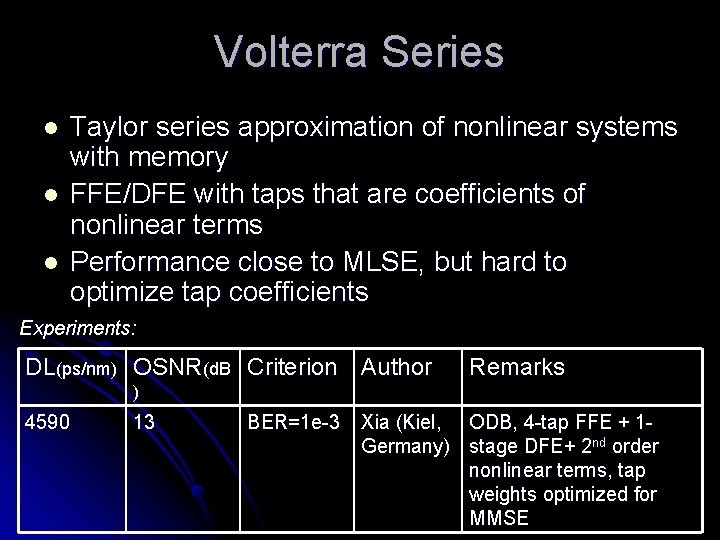
Volterra Series l l l Taylor series approximation of nonlinear systems with memory FFE/DFE with taps that are coefficients of nonlinear terms Performance close to MLSE, but hard to optimize tap coefficients Experiments: DL(ps/nm) OSNR(d. B Criterion Author Remarks ) 4590 13 BER=1 e-3 Xia (Kiel, ODB, 4 -tap FFE + 1 Germany) stage DFE+ 2 nd order nonlinear terms, tap weights optimized for MMSE
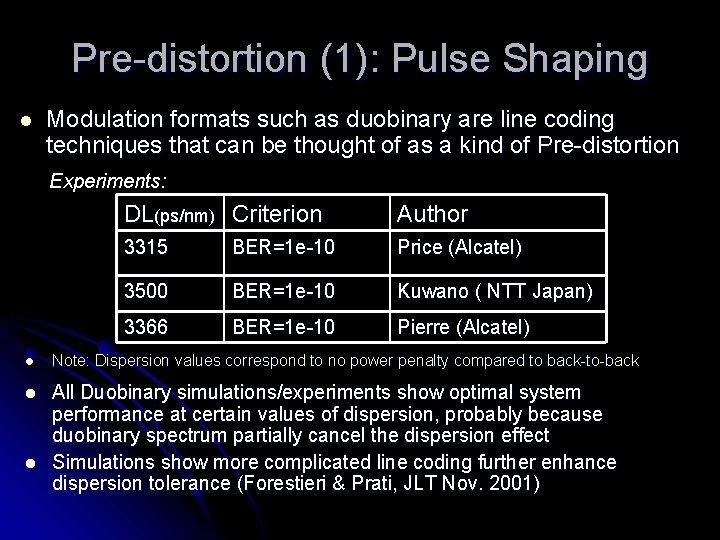
Pre-distortion (1): Pulse Shaping l Modulation formats such as duobinary are line coding techniques that can be thought of as a kind of Pre-distortion Experiments: DL(ps/nm) Criterion Author 3315 BER=1 e-10 Price (Alcatel) 3500 BER=1 e-10 Kuwano ( NTT Japan) 3366 BER=1 e-10 Pierre (Alcatel) l Note: Dispersion values correspond to no power penalty compared to back-to-back l All Duobinary simulations/experiments show optimal system performance at certain values of dispersion, probably because duobinary spectrum partially cancel the dispersion effect Simulations show more complicated line coding further enhance dispersion tolerance (Forestieri & Prati, JLT Nov. 2001) l
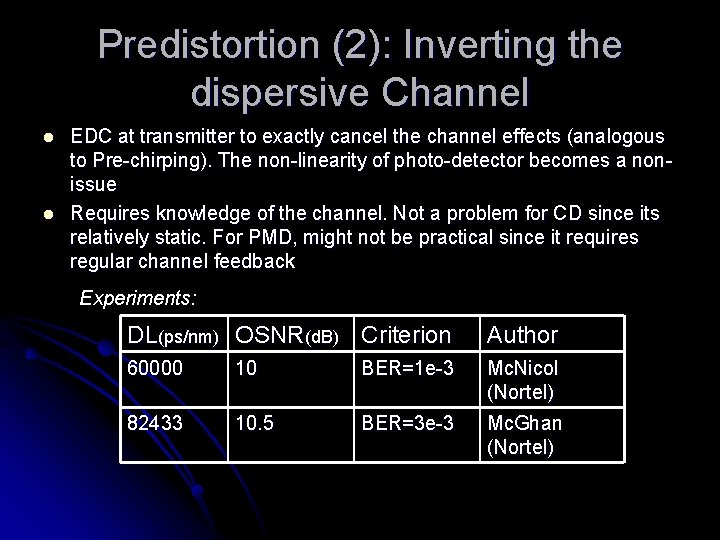
Predistortion (2): Inverting the dispersive Channel l l EDC at transmitter to exactly cancel the channel effects (analogous to Pre-chirping). The non-linearity of photo-detector becomes a nonissue Requires knowledge of the channel. Not a problem for CD since its relatively static. For PMD, might not be practical since it requires regular channel feedback Experiments: DL(ps/nm) OSNR(d. B) Criterion Author 60000 10 BER=1 e-3 Mc. Nicol (Nortel) 82433 10. 5 BER=3 e-3 Mc. Ghan (Nortel)
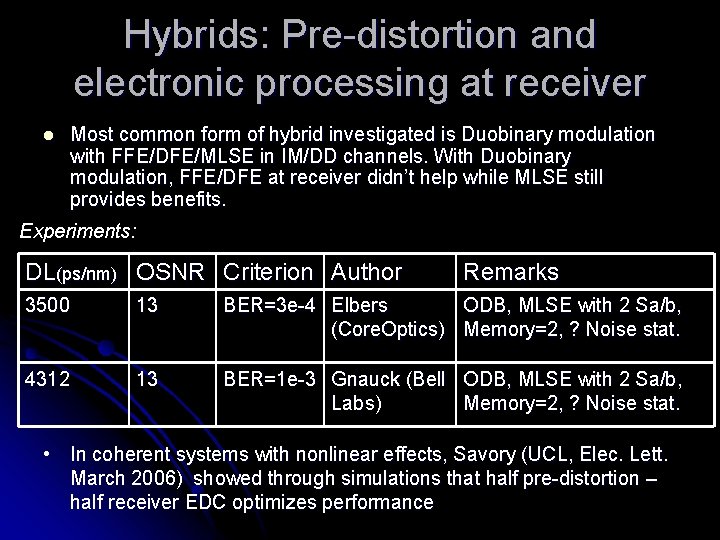
Hybrids: Pre-distortion and electronic processing at receiver l Most common form of hybrid investigated is Duobinary modulation with FFE/DFE/MLSE in IM/DD channels. With Duobinary modulation, FFE/DFE at receiver didn’t help while MLSE still provides benefits. Experiments: DL(ps/nm) OSNR Criterion Author Remarks 3500 13 BER=3 e-4 Elbers ODB, MLSE with 2 Sa/b, (Core. Optics) Memory=2, ? Noise stat. 4312 13 BER=1 e-3 Gnauck (Bell ODB, MLSE with 2 Sa/b, Labs) Memory=2, ? Noise stat. • In coherent systems with nonlinear effects, Savory (UCL, Elec. Lett. March 2006) showed through simulations that half pre-distortion – half receiver EDC optimizes performance