
Electronic Devices Eighth Edition Floyd Chapter 15 2008
- Slides: 36
Electronic Devices Eighth Edition Floyd Chapter 15 © 2008 Pearson Education, Inc. All rights reserved
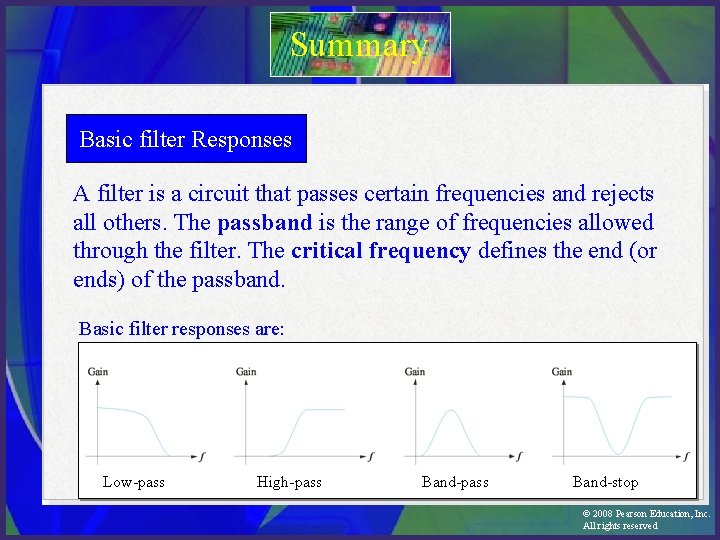
Summary Basic filter Responses A filter is a circuit that passes certain frequencies and rejects all others. The passband is the range of frequencies allowed through the filter. The critical frequency defines the end (or ends) of the passband. Basic filter responses are: Low-pass High-pass Band-stop © 2008 Pearson Education, Inc. All rights reserved
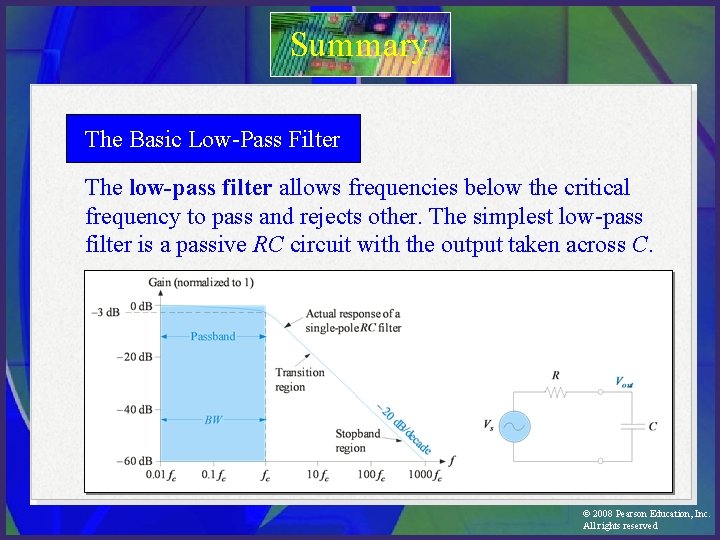
Summary The Basic Low-Pass Filter The low-pass filter allows frequencies below the critical frequency to pass and rejects other. The simplest low-pass filter is a passive RC circuit with the output taken across C. © 2008 Pearson Education, Inc. All rights reserved
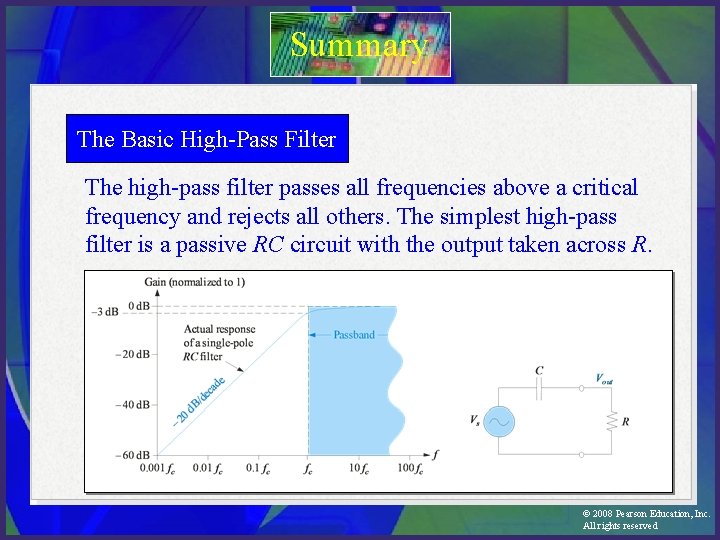
Summary The Basic High-Pass Filter The high-pass filter passes all frequencies above a critical frequency and rejects all others. The simplest high-pass filter is a passive RC circuit with the output taken across R. © 2008 Pearson Education, Inc. All rights reserved
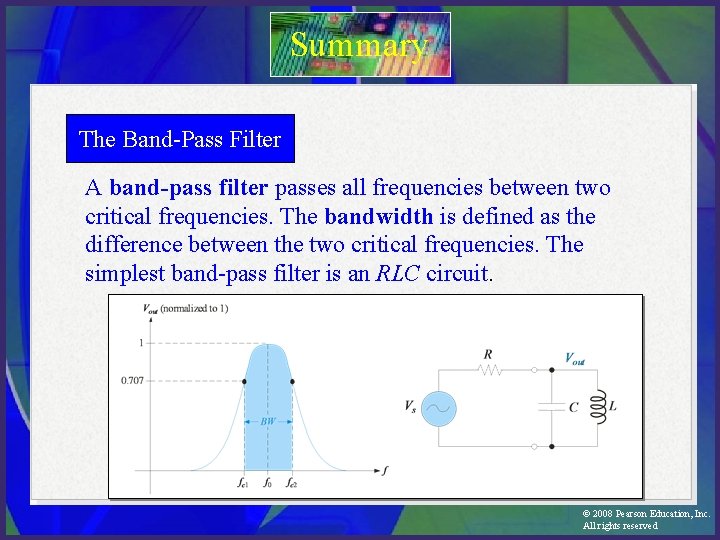
Summary The Band-Pass Filter A band-pass filter passes all frequencies between two critical frequencies. The bandwidth is defined as the difference between the two critical frequencies. The simplest band-pass filter is an RLC circuit. © 2008 Pearson Education, Inc. All rights reserved
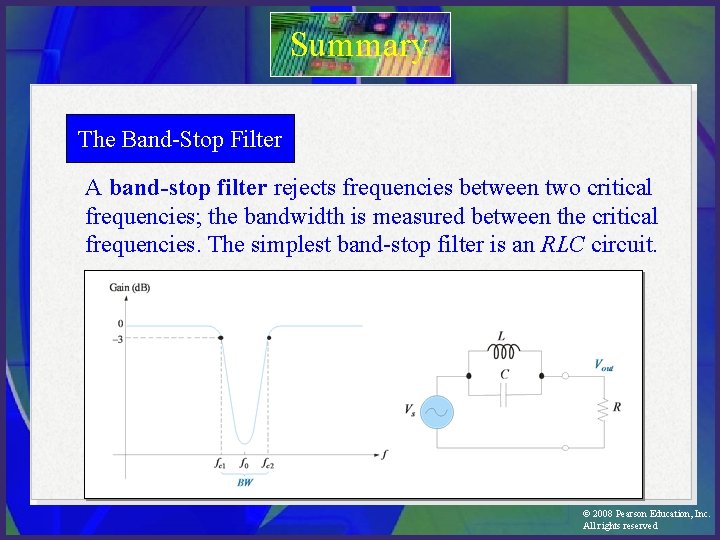
Summary The Band-Stop Filter A band-stop filter rejects frequencies between two critical frequencies; the bandwidth is measured between the critical frequencies. The simplest band-stop filter is an RLC circuit. © 2008 Pearson Education, Inc. All rights reserved
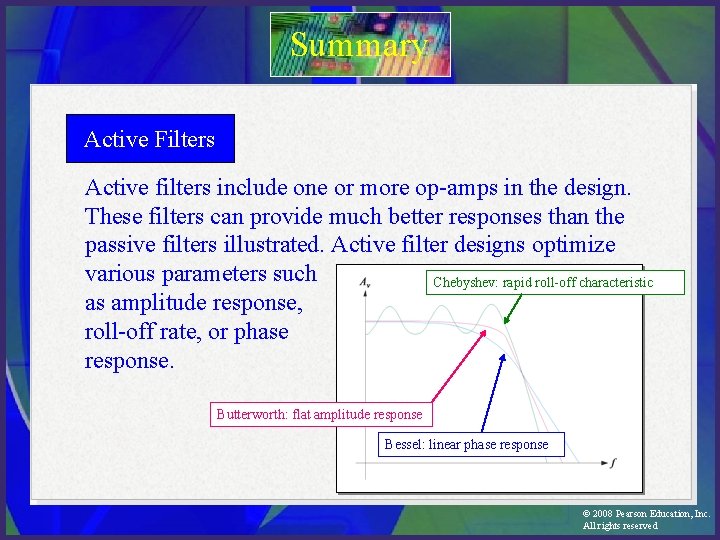
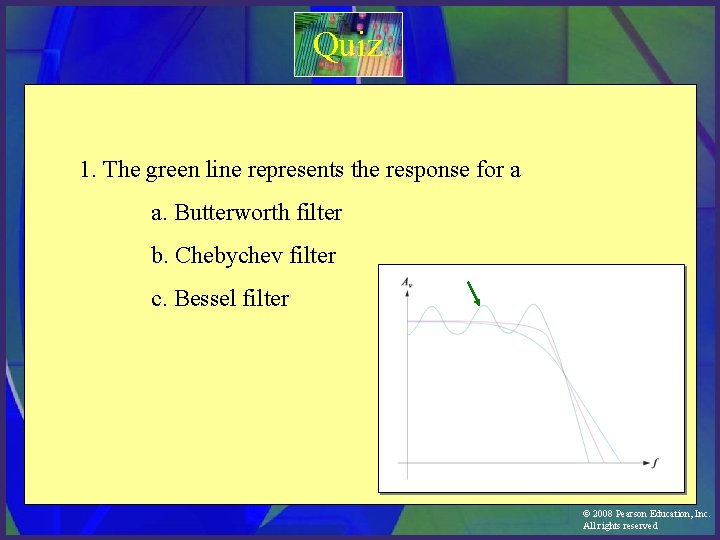
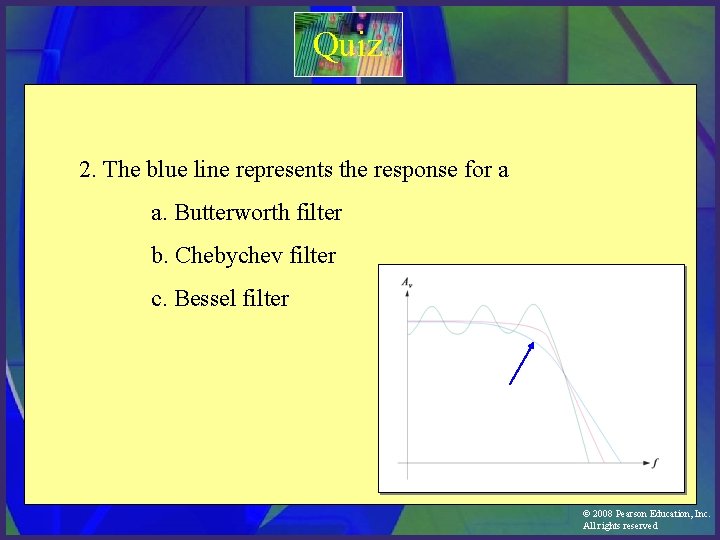
Summary Active Filters Active filters include one or more op-amps in the design. These filters can provide much better responses than the passive filters illustrated. Active filter designs optimize various parameters such Chebyshev: rapid roll-off characteristic as amplitude response, roll-off rate, or phase response. Butterworth: flat amplitude response Bessel: linear phase response © 2008 Pearson Education, Inc. All rights reserved
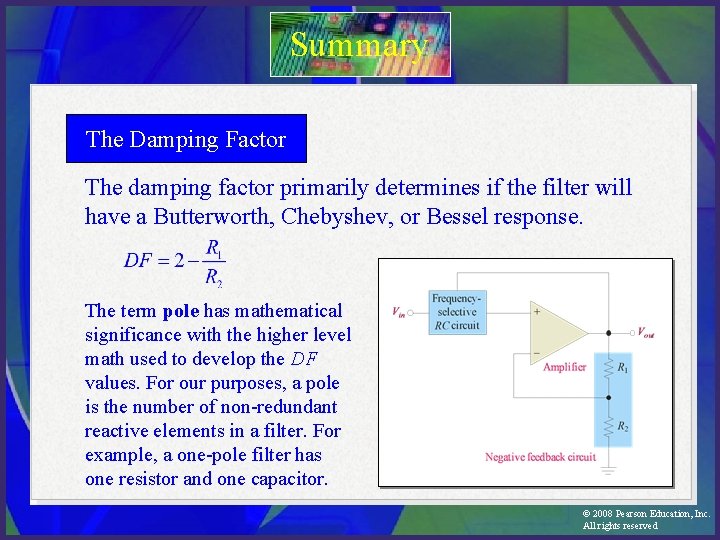
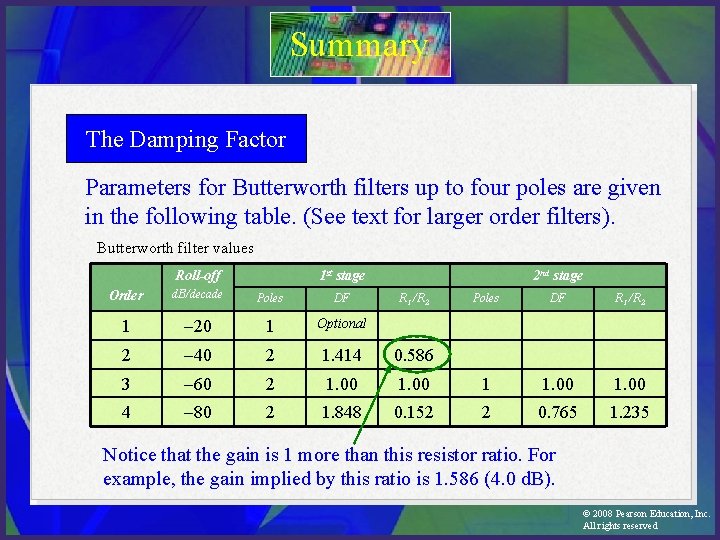
Summary The Damping Factor The damping factor primarily determines if the filter will have a Butterworth, Chebyshev, or Bessel response. The term pole has mathematical significance with the higher level math used to develop the DF values. For our purposes, a pole is the number of non-redundant reactive elements in a filter. For example, a one-pole filter has one resistor and one capacitor. © 2008 Pearson Education, Inc. All rights reserved
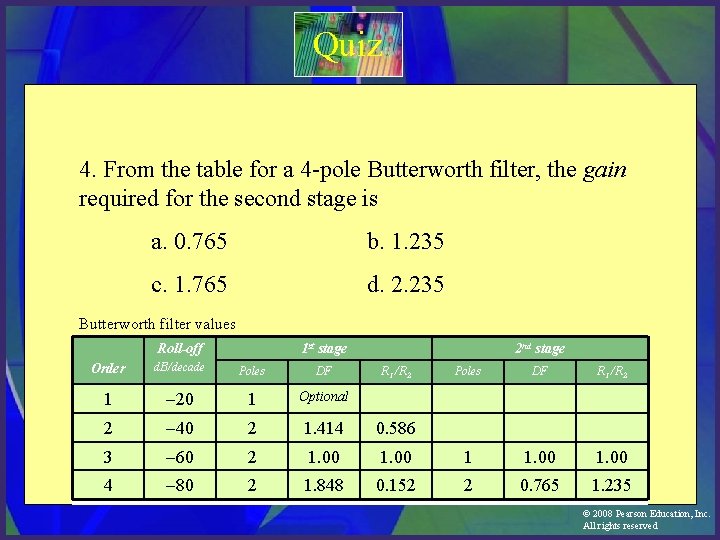
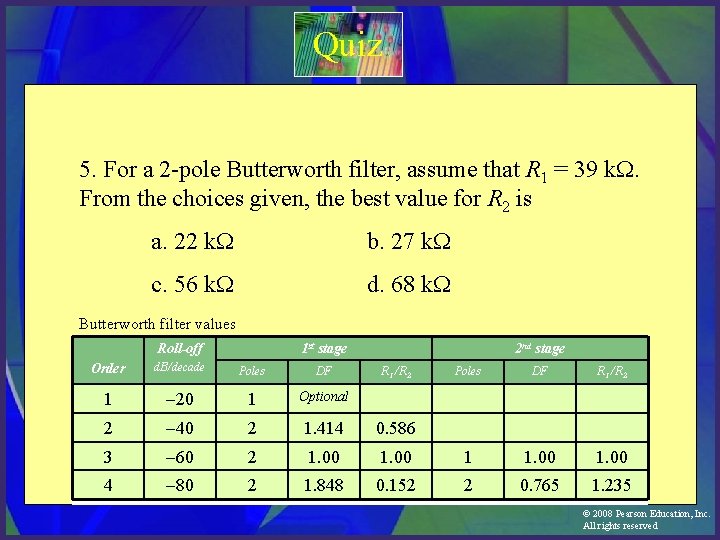
Summary The Damping Factor Parameters for Butterworth filters up to four poles are given in the following table. (See text for larger order filters). Butterworth filter values Roll-off 1 st stage 2 nd stage Order d. B/decade Poles DF 1 -20 1 Optional 2 -40 2 1. 414 0. 586 3 -60 2 1. 00 4 -80 2 1. 848 R 1 /R 2 Poles DF R 1 /R 2 1. 00 0. 152 2 0. 765 1. 235 Notice that the gain is 1 more than this resistor ratio. For example, the gain implied by this ratio is 1. 586 (4. 0 d. B). © 2008 Pearson Education, Inc. All rights reserved
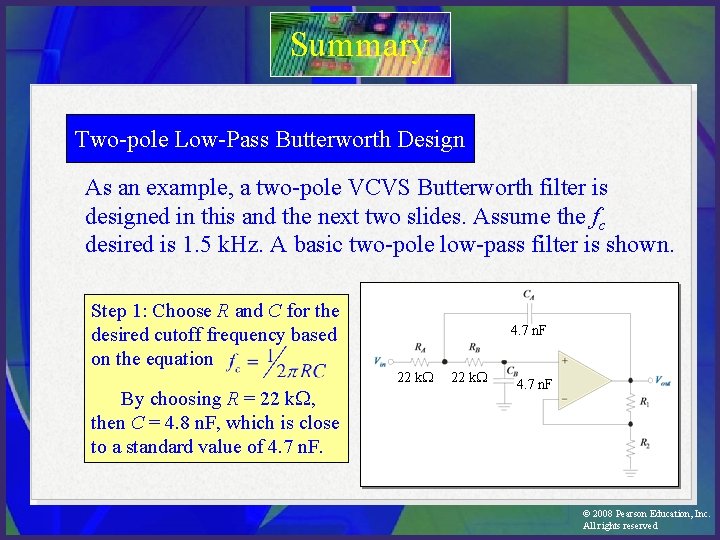
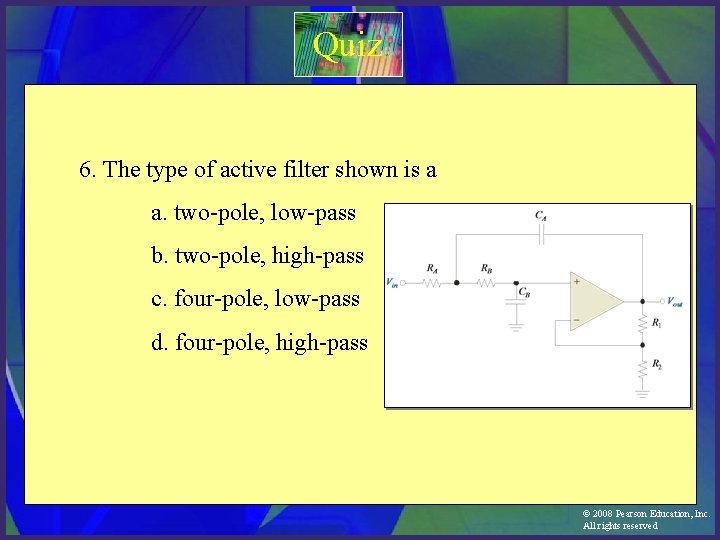
Summary Two-pole Low-Pass Butterworth Design As an example, a two-pole VCVS Butterworth filter is designed in this and the next two slides. Assume the fc desired is 1. 5 k. Hz. A basic two-pole low-pass filter is shown. Step 1: Choose R and C for the desired cutoff frequency based on the equation By choosing R = 22 k. W, then C = 4. 8 n. F, which is close to a standard value of 4. 7 n. F 22 k. W 4. 7 n. F © 2008 Pearson Education, Inc. All rights reserved
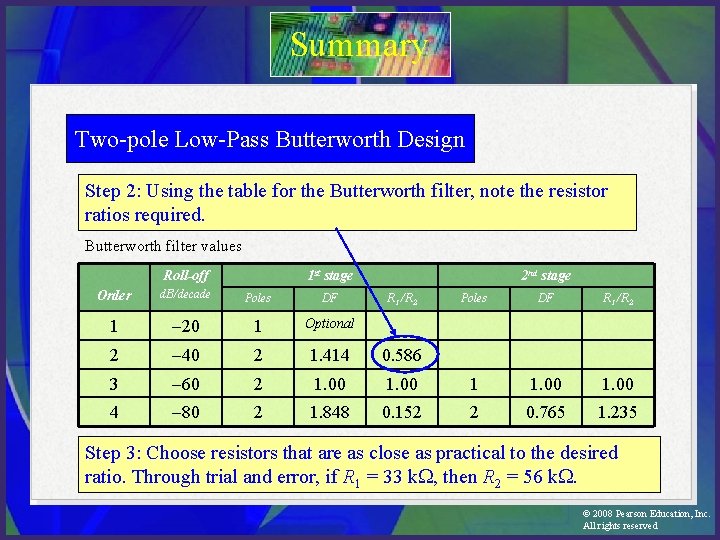
Summary Two-pole Low-Pass Butterworth Design Step 2: Using the table for the Butterworth filter, note the resistor ratios required. Butterworth filter values Roll-off 1 st stage 2 nd stage Order d. B/decade Poles DF 1 -20 1 Optional 2 -40 2 1. 414 0. 586 3 -60 2 1. 00 4 -80 2 1. 848 R 1 /R 2 Poles DF R 1 /R 2 1. 00 0. 152 2 0. 765 1. 235 Step 3: Choose resistors that are as close as practical to the desired ratio. Through trial and error, if R 1 = 33 k. W, then R 2 = 56 k. W. © 2008 Pearson Education, Inc. All rights reserved
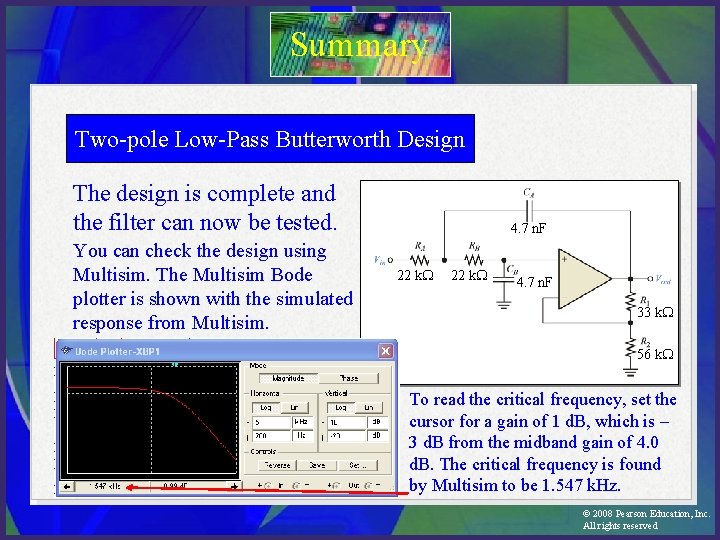
Summary Two-pole Low-Pass Butterworth Design The design is complete and the filter can now be tested. You can check the design using Multisim. The Multisim Bode plotter is shown with the simulated response from Multisim. 4. 7 n. F 22 k. W 4. 7 n. F 33 k. W 56 k. W To read the critical frequency, set the cursor for a gain of 1 d. B, which is 3 d. B from the midband gain of 4. 0 d. B. The critical frequency is found by Multisim to be 1. 547 k. Hz. © 2008 Pearson Education, Inc. All rights reserved
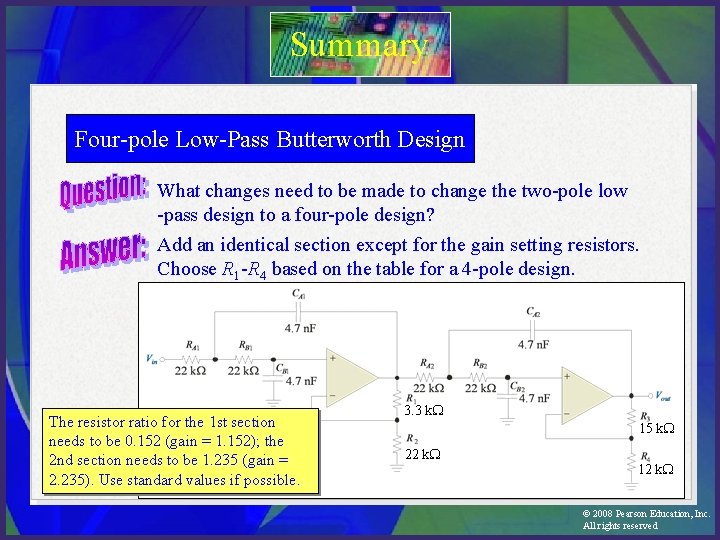
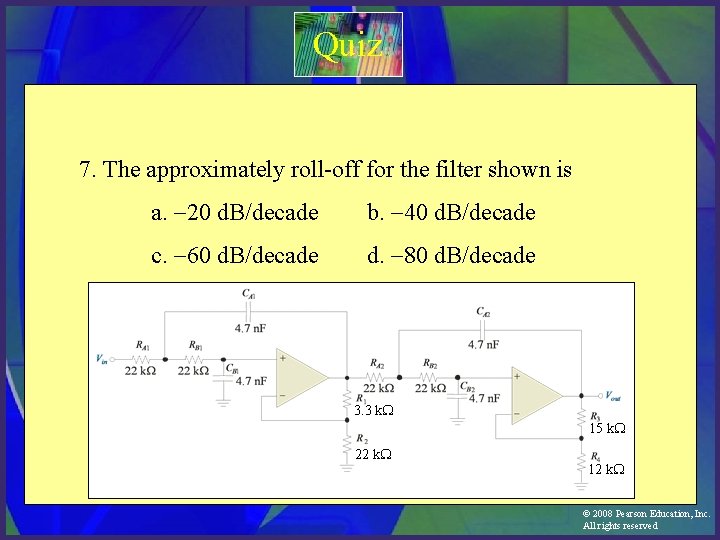
Summary Four-pole Low-Pass Butterworth Design What changes need to be made to change the two-pole low -pass design to a four-pole design? Add an identical section except for the gain setting resistors. Choose R 1 -R 4 based on the table for a 4 -pole design. The resistor ratio for the 1 st section needs to be 0. 152 (gain = 1. 152); the 2 nd section needs to be 1. 235 (gain = 2. 235). Use standard values if possible. 3. 3 k. W 15 k. W 22 k. W 12 k. W © 2008 Pearson Education, Inc. All rights reserved
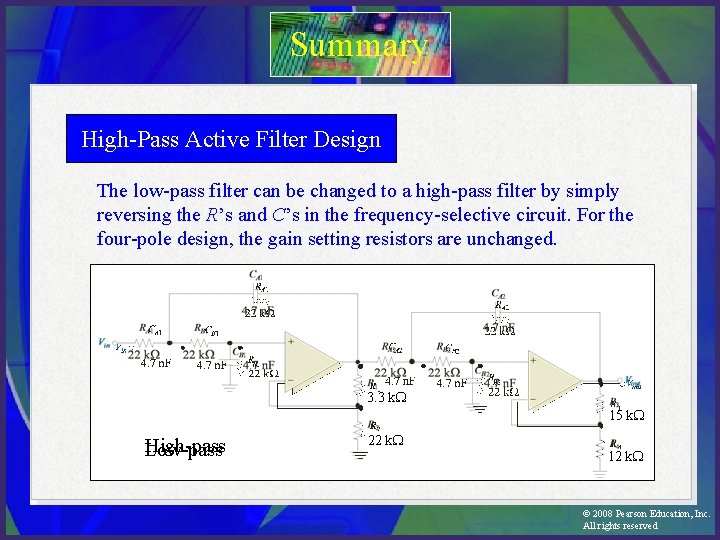
Summary High-Pass Active Filter Design The low-pass filter can be changed to a high-pass filter by simply reversing the R’s and C’s in the frequency-selective circuit. For the four-pole design, the gain setting resistors are unchanged. 3. 3 k. W 15 k. W High-pass Low-pass 22 k. W 12 k. W © 2008 Pearson Education, Inc. All rights reserved
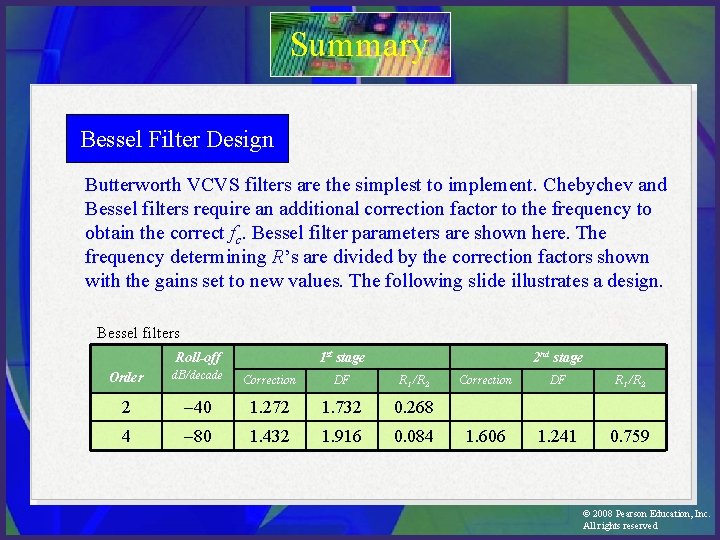
Summary Bessel Filter Design Butterworth VCVS filters are the simplest to implement. Chebychev and Bessel filters require an additional correction factor to the frequency to obtain the correct fc. Bessel filter parameters are shown here. The frequency determining R’s are divided by the correction factors shown with the gains set to new values. The following slide illustrates a design. Bessel filters Roll-off 1 st stage 2 nd stage Order d. B/decade Correction DF R 1 /R 2 2 -40 1. 272 1. 732 0. 268 4 -80 1. 432 1. 916 0. 084 Correction DF R 1 /R 2 1. 606 1. 241 0. 759 © 2008 Pearson Education, Inc. All rights reserved
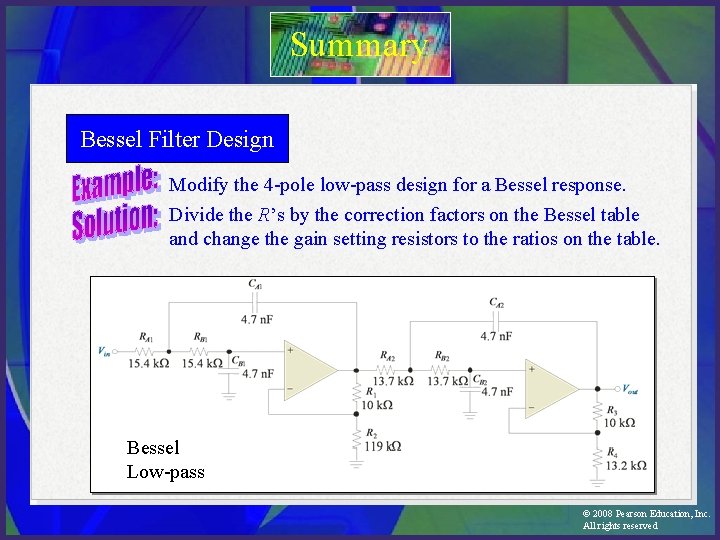
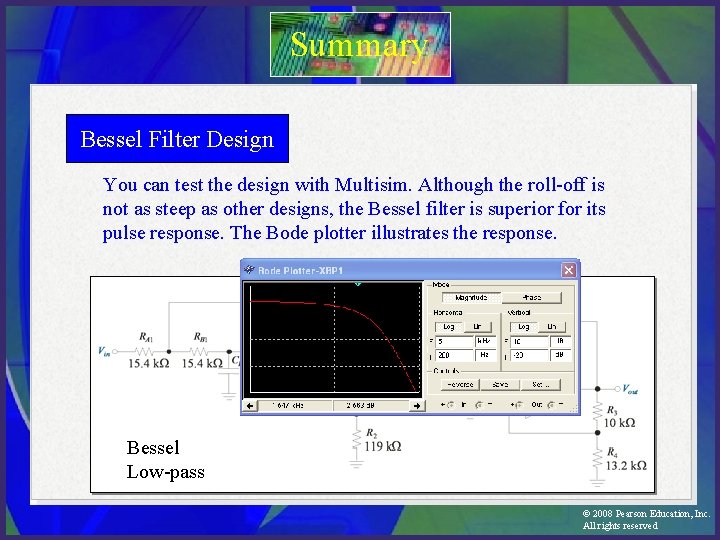
Summary Bessel Filter Design Modify the 4 -pole low-pass design for a Bessel response. Divide the R’s by the correction factors on the Bessel table and change the gain setting resistors to the ratios on the table. 3. 3 k. W 15 k. W Bessel Butterworth Low-pass 22 k. W 12 k. W © 2008 Pearson Education, Inc. All rights reserved
Summary Bessel Filter Design You can test the design with Multisim. Although the roll-off is not as steep as other designs, the Bessel filter is superior for its pulse response. The Bode plotter illustrates the response. Bessel Low-pass © 2008 Pearson Education, Inc. All rights reserved
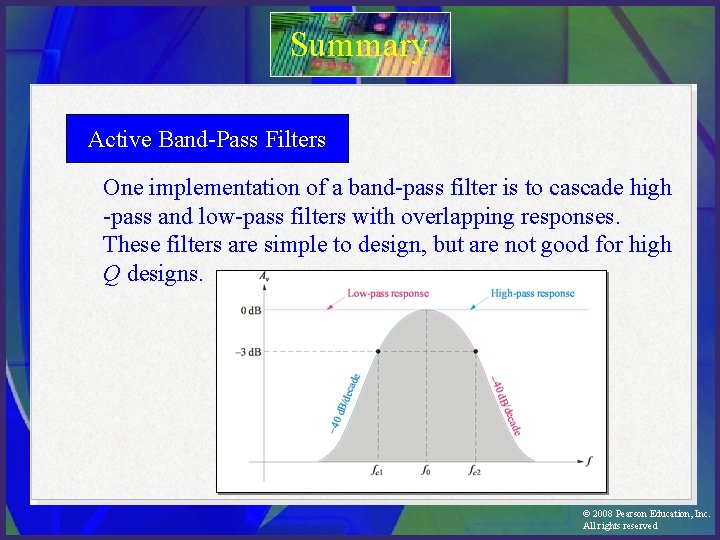
Summary Active Band-Pass Filters One implementation of a band-pass filter is to cascade high -pass and low-pass filters with overlapping responses. These filters are simple to design, but are not good for high Q designs. © 2008 Pearson Education, Inc. All rights reserved
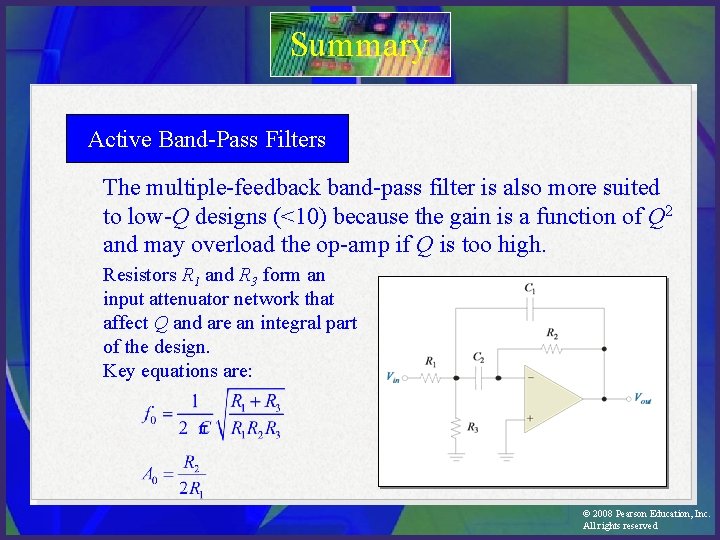
Summary Active Band-Pass Filters The multiple-feedback band-pass filter is also more suited to low-Q designs (<10) because the gain is a function of Q 2 and may overload the op-amp if Q is too high. Resistors R 1 and R 3 form an input attenuator network that affect Q and are an integral part of the design. Key equations are: © 2008 Pearson Education, Inc. All rights reserved
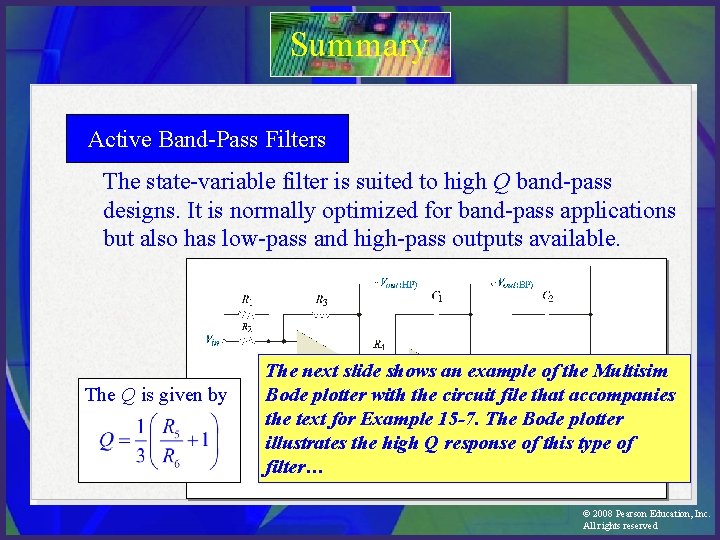
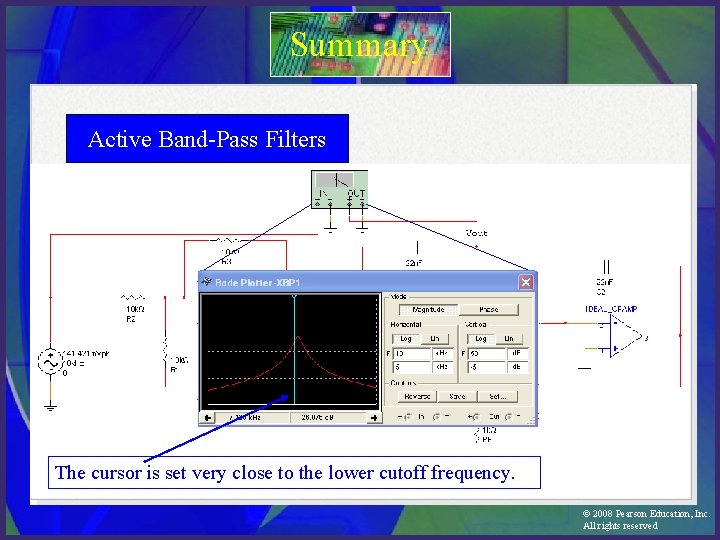
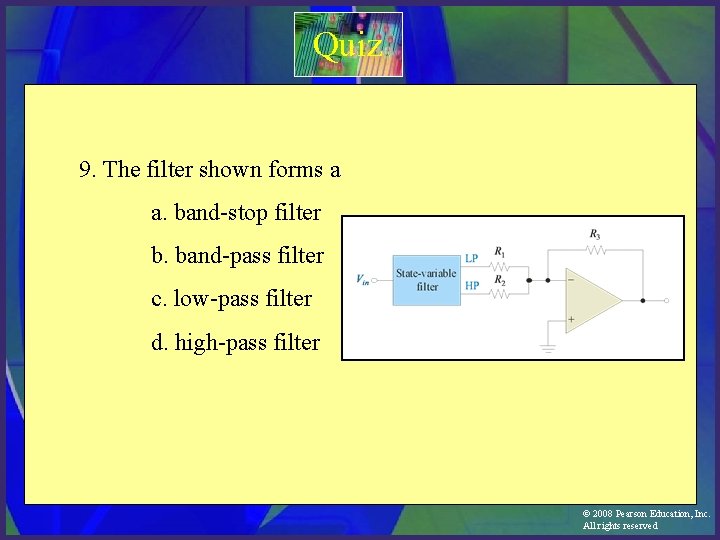
Summary Active Band-Pass Filters The state-variable filter is suited to high Q band-pass designs. It is normally optimized for band-pass applications but also has low-pass and high-pass outputs available. The Q is given by The next slide shows an example of the Multisim Bode plotter with the circuit file that accompanies the text for Example 15 -7. The Bode plotter illustrates the high Q response of this type of filter… © 2008 Pearson Education, Inc. All rights reserved
Summary Active Band-Pass Filters The cursor is set very close to the lower cutoff frequency. © 2008 Pearson Education, Inc. All rights reserved
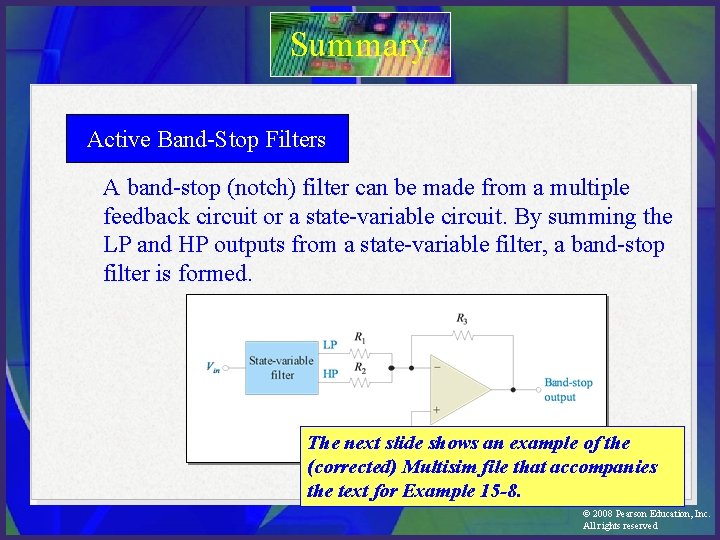
Summary Active Band-Stop Filters A band-stop (notch) filter can be made from a multiple feedback circuit or a state-variable circuit. By summing the LP and HP outputs from a state-variable filter, a band-stop filter is formed. The next slide shows an example of the (corrected) Multisim file that accompanies the text for Example 15 -8. © 2008 Pearson Education, Inc. All rights reserved
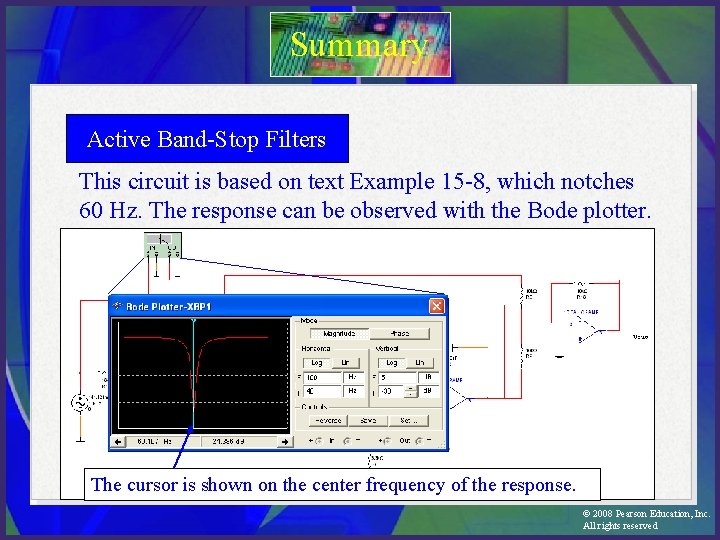
Summary Active Band-Stop Filters This circuit is based on text Example 15 -8, which notches 60 Hz. The response can be observed with the Bode plotter. The cursor is shown on the center frequency of the response. © 2008 Pearson Education, Inc. All rights reserved
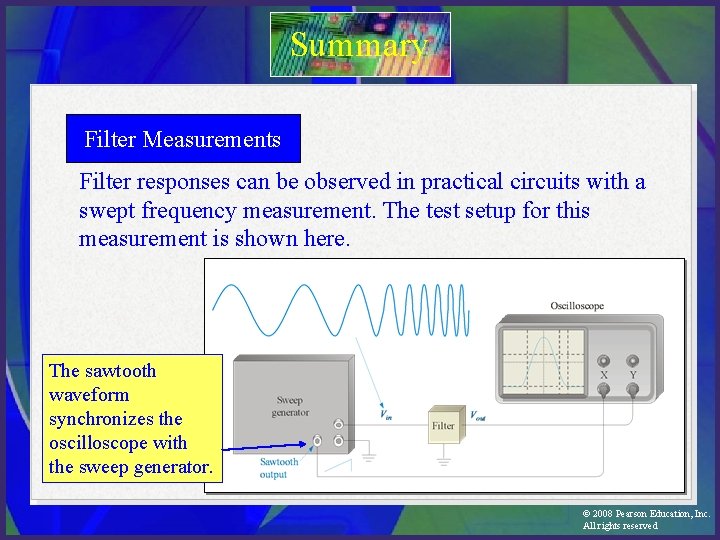
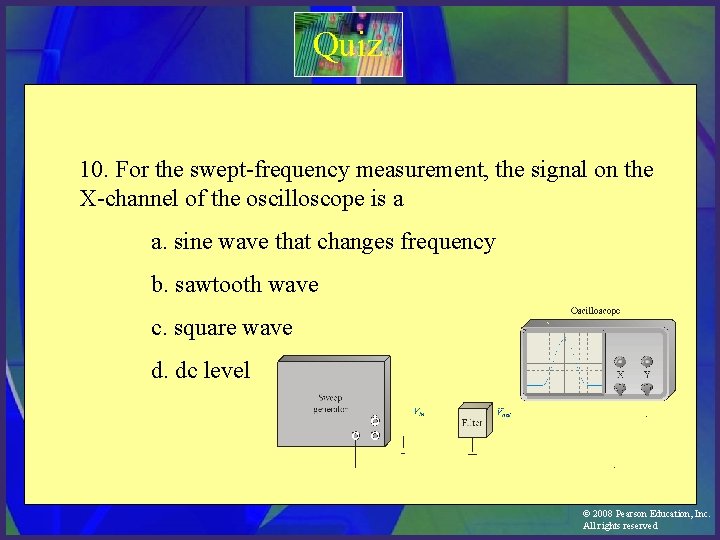
Summary Filter Measurements Filter responses can be observed in practical circuits with a swept frequency measurement. The test setup for this measurement is shown here. The sawtooth waveform synchronizes the oscilloscope with the sweep generator. © 2008 Pearson Education, Inc. All rights reserved
Selected Key Terms Pole A circuit containing one resistor and one capacitor that contributes -20 d. B/decade to a filter’s roll-off. Roll-off The rate of decrease in gain below or above the critical frequencies of a filter. Damping factor A filter characteristic that determines the type of response. © 2008 Pearson Education, Inc. All rights reserved
Quiz 1. The green line represents the response for a a. Butterworth filter b. Chebychev filter c. Bessel filter © 2008 Pearson Education, Inc. All rights reserved
Quiz 2. The blue line represents the response for a a. Butterworth filter b. Chebychev filter c. Bessel filter © 2008 Pearson Education, Inc. All rights reserved
Quiz 3. The filter that is superior for its pulse response is the a. Butterworth filter b. Chebychev filter c. Bessel filter © 2008 Pearson Education, Inc. All rights reserved
Quiz 4. From the table for a 4 -pole Butterworth filter, the gain required for the second stage is a. 0. 765 b. 1. 235 c. 1. 765 d. 2. 235 Butterworth filter values Roll-off 1 st stage 2 nd stage Order d. B/decade Poles DF 1 -20 1 Optional 2 -40 2 1. 414 0. 586 3 -60 2 1. 00 4 -80 2 1. 848 R 1 /R 2 Poles DF R 1 /R 2 1. 00 0. 152 2 0. 765 1. 235 © 2008 Pearson Education, Inc. All rights reserved
Quiz 5. For a 2 -pole Butterworth filter, assume that R 1 = 39 k. W. From the choices given, the best value for R 2 is a. 22 k. W b. 27 k. W c. 56 k. W d. 68 k. W Butterworth filter values Roll-off 1 st stage 2 nd stage Order d. B/decade Poles DF 1 -20 1 Optional 2 -40 2 1. 414 0. 586 3 -60 2 1. 00 4 -80 2 1. 848 R 1 /R 2 Poles DF R 1 /R 2 1. 00 0. 152 2 0. 765 1. 235 © 2008 Pearson Education, Inc. All rights reserved
Quiz 6. The type of active filter shown is a a. two-pole, low-pass b. two-pole, high-pass c. four-pole, low-pass d. four-pole, high-pass © 2008 Pearson Education, Inc. All rights reserved
Quiz 7. The approximately roll-off for the filter shown is a. -20 d. B/decade b. -40 d. B/decade c. -60 d. B/decade d. -80 d. B/decade 3. 3 k. W 15 k. W 22 k. W 12 k. W © 2008 Pearson Education, Inc. All rights reserved
Quiz 8. A good choice for a high-Q active band-pass filter is a. cascaded high-pass and low-pass filters b. a multiple-feedback band-pass filter c. a state-variable band-pass filter d. an inverting amplifier with a resonant filter © 2008 Pearson Education, Inc. All rights reserved
Quiz 9. The filter shown forms a a. band-stop filter b. band-pass filter c. low-pass filter d. high-pass filter © 2008 Pearson Education, Inc. All rights reserved
Quiz 10. For the swept-frequency measurement, the signal on the X-channel of the oscilloscope is a a. sine wave that changes frequency b. sawtooth wave c. square wave d. dc level © 2008 Pearson Education, Inc. All rights reserved
Quiz Answers: 1. b 6. a 2. c 7. d 3. c 8. c 4. d 9. a 5. d 10. b © 2008 Pearson Education, Inc. All rights reserved