
Electronic Configuration Ochran 2014 THE BOHR MODEL OF
Electronic Configuration Ochran 2014
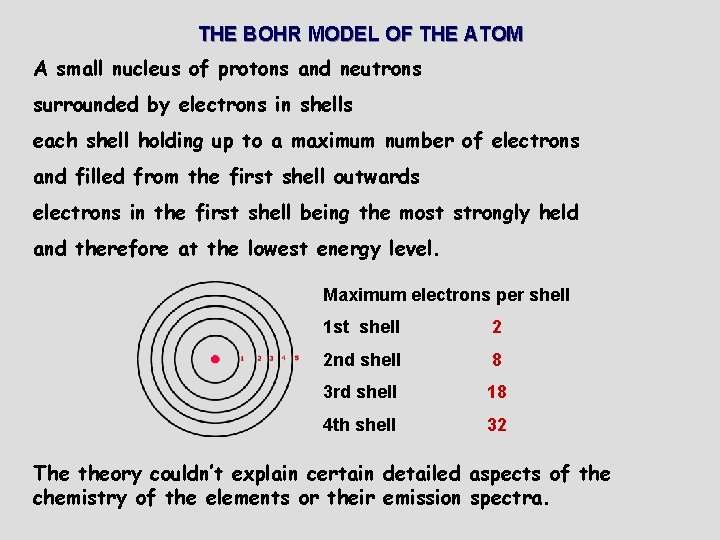
THE BOHR MODEL OF THE ATOM A small nucleus of protons and neutrons surrounded by electrons in shells each shell holding up to a maximum number of electrons and filled from the first shell outwards electrons in the first shell being the most strongly held and therefore at the lowest energy level. Maximum electrons per shell 1 st shell 2 2 nd shell 8 3 rd shell 18 4 th shell 32 The theory couldn’t explain certain detailed aspects of the chemistry of the elements or their emission spectra.
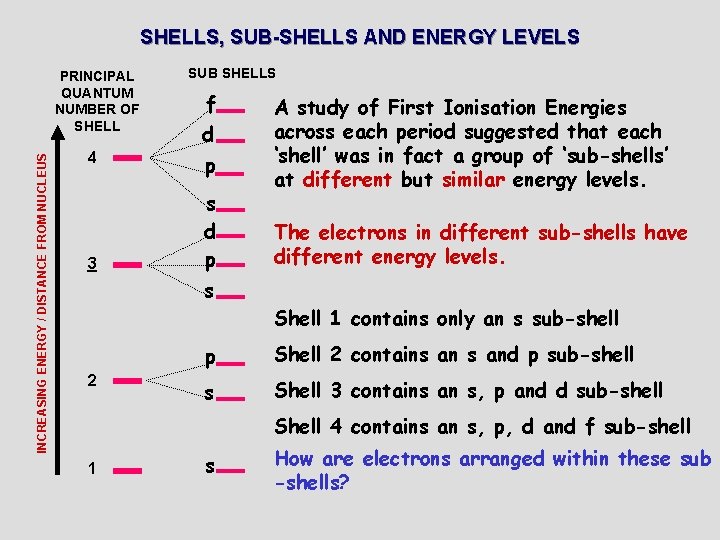
SHELLS, SUB-SHELLS AND ENERGY LEVELS INCREASING ENERGY / DISTANCE FROM NUCLEUS PRINCIPAL QUANTUM NUMBER OF SHELL 4 3 SUB SHELLS f d p s d p A study of First Ionisation Energies across each period suggested that each ‘shell’ was in fact a group of ‘sub-shells’ at different but similar energy levels. The electrons in different sub-shells have different energy levels. s Shell 1 contains only an s sub-shell 2 p Shell 2 contains and p sub-shell s Shell 3 contains an s, p and d sub-shell Shell 4 contains an s, p, d and f sub-shell 1 s How are electrons arranged within these sub -shells?
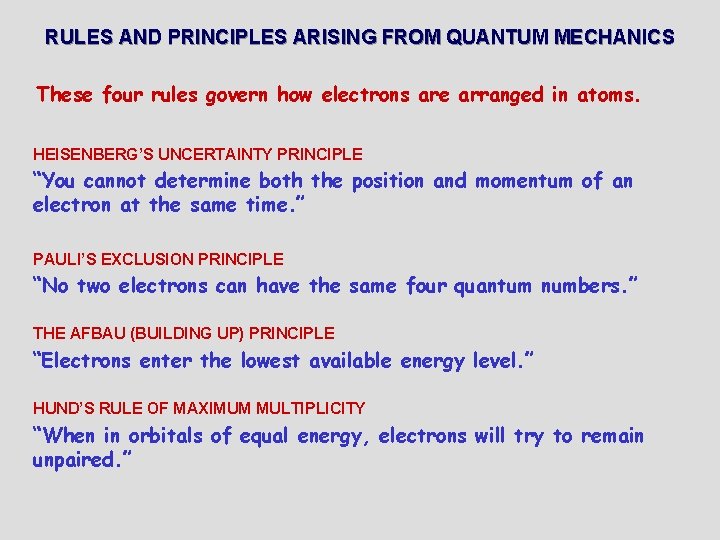
RULES AND PRINCIPLES ARISING FROM QUANTUM MECHANICS These four rules govern how electrons are arranged in atoms. HEISENBERG’S UNCERTAINTY PRINCIPLE “You cannot determine both the position and momentum of an electron at the same time. ” PAULI’S EXCLUSION PRINCIPLE “No two electrons can have the same four quantum numbers. ” THE AFBAU (BUILDING UP) PRINCIPLE “Electrons enter the lowest available energy level. ” HUND’S RULE OF MAXIMUM MULTIPLICITY “When in orbitals of equal energy, electrons will try to remain unpaired. ”
ELECTRONS OCCUPY ORBITALS An orbital is a region in space where there is a 95% probability of finding the electron. (Heisenberg’s Uncertainty Principle) Orbitals can hold one electron or two electrons as long as they have opposite spin. (Pauli Exclusion Principle) Orbitals have different shapes depending on which sub-shell they are in. DO NOT USE THE WORD ORBIT WHEN YOU MEAN AN ORBITAL
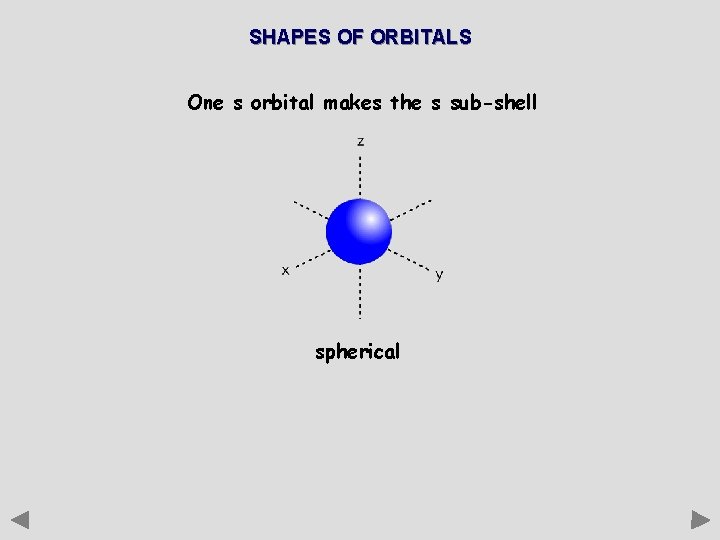
SHAPES OF ORBITALS One s orbital makes the s sub-shell spherical
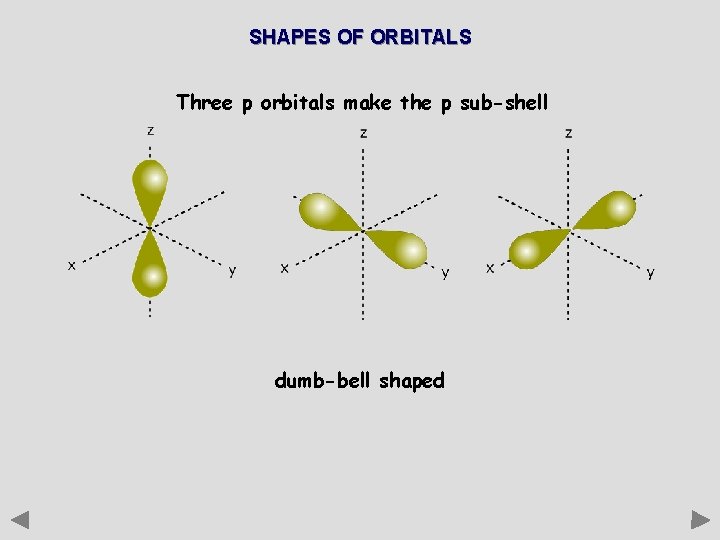
SHAPES OF ORBITALS Three p orbitals make the p sub-shell dumb-bell shaped

SHAPES OF ORBITALS Five d orbitals make the d sub-shell four are double dumb-bell shaped the other a dumb-bell with a collar
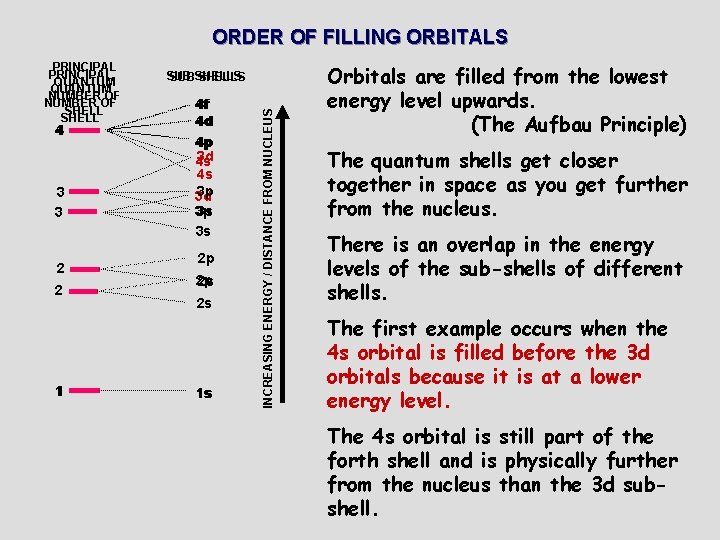
ORDER OF FILLING ORBITALS 44 3 3 2 2 11 SUBSHELLS 4 f 4 f 4 d 4 d 4 p 4 p 3 d 4 s 4 s 3 p 3 d 3 s 3 p 3 s 2 p 2 p 2 s 2 s 1 s 1 s INCREASING ENERGY / DISTANCE FROM NUCLEUS PRINCIPAL QUANTUM NUMBER OF SHELL Orbitals are filled from the lowest energy level upwards. (The Aufbau Principle) The quantum shells get closer together in space as you get further from the nucleus. There is an overlap in the energy levels of the sub-shells of different shells. The first example occurs when the 4 s orbital is filled before the 3 d orbitals because it is at a lower energy level. The 4 s orbital is still part of the forth shell and is physically further from the nucleus than the 3 d subshell.
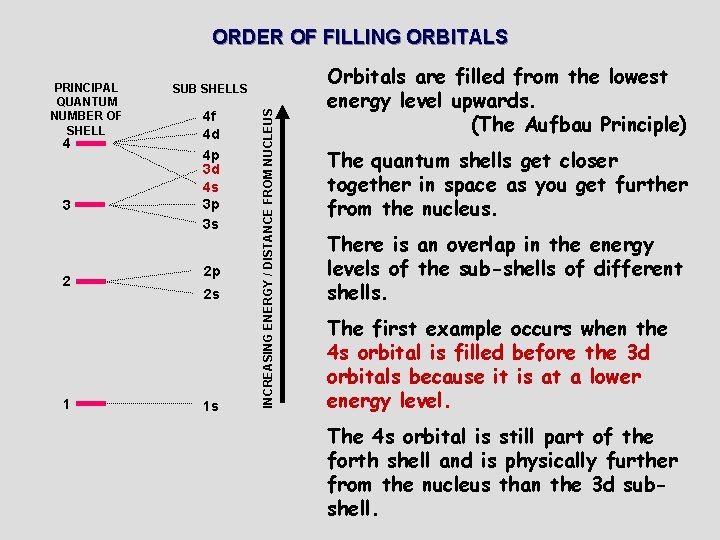
ORDER OF FILLING ORBITALS 4 3 2 1 SUB SHELLS 4 f 4 d 4 p 3 d 4 s 3 p 3 s 2 p 2 s 1 s INCREASING ENERGY / DISTANCE FROM NUCLEUS PRINCIPAL QUANTUM NUMBER OF SHELL Orbitals are filled from the lowest energy level upwards. (The Aufbau Principle) The quantum shells get closer together in space as you get further from the nucleus. There is an overlap in the energy levels of the sub-shells of different shells. The first example occurs when the 4 s orbital is filled before the 3 d orbitals because it is at a lower energy level. The 4 s orbital is still part of the forth shell and is physically further from the nucleus than the 3 d subshell.
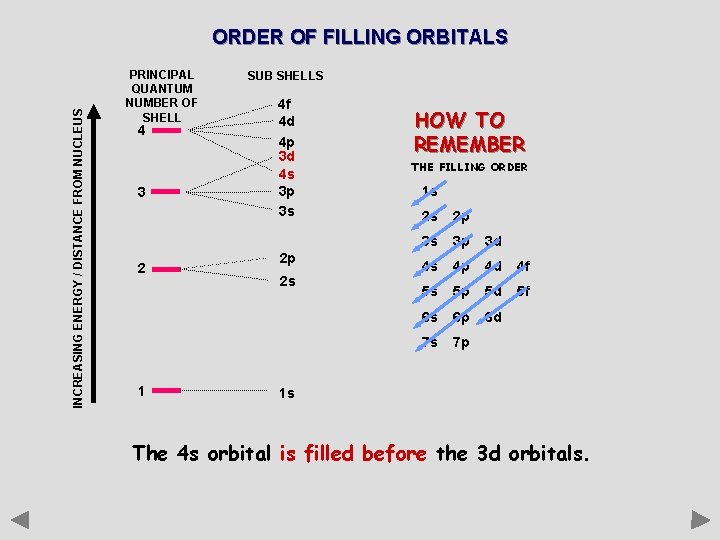
INCREASING ENERGY / DISTANCE FROM NUCLEUS ORDER OF FILLING ORBITALS PRINCIPAL QUANTUM NUMBER OF SHELL 4 3 2 1 SUB SHELLS 4 f 4 d 4 p 3 d 4 s 3 p 3 s 2 p 2 s HOW TO REMEMBER THE FILLING ORDER 1 s 2 s 2 p 3 s 3 p 3 d 4 s 4 p 4 d 4 f 5 s 5 p 5 d 5 f 6 s 6 p 6 d 7 s 7 p 1 s The 4 s orbital is filled before the 3 d orbitals.
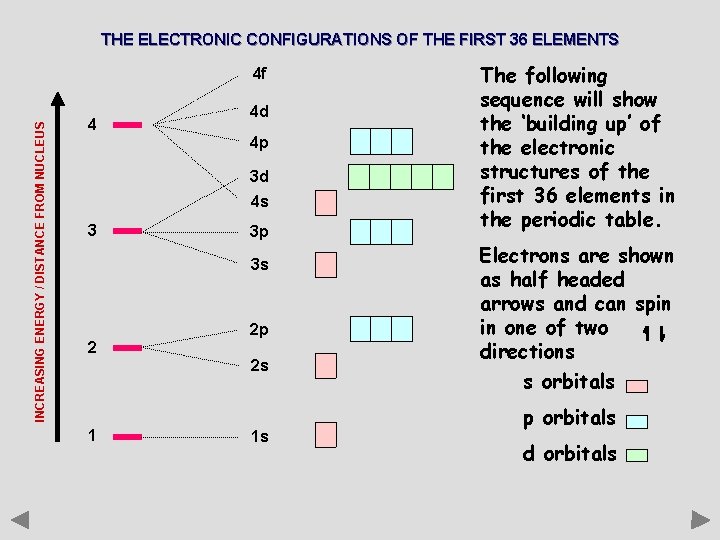
THE ELECTRONIC CONFIGURATIONS OF THE FIRST 36 ELEMENTS INCREASING ENERGY / DISTANCE FROM NUCLEUS 4 f 4 4 d 4 p 3 d 4 s 3 3 p 3 s 2 2 p 2 s 1 1 s The following sequence will show the ‘building up’ of the electronic structures of the first 36 elements in the periodic table. Electrons are shown as half headed arrows and can spin in one of two directions s orbitals p orbitals d orbitals
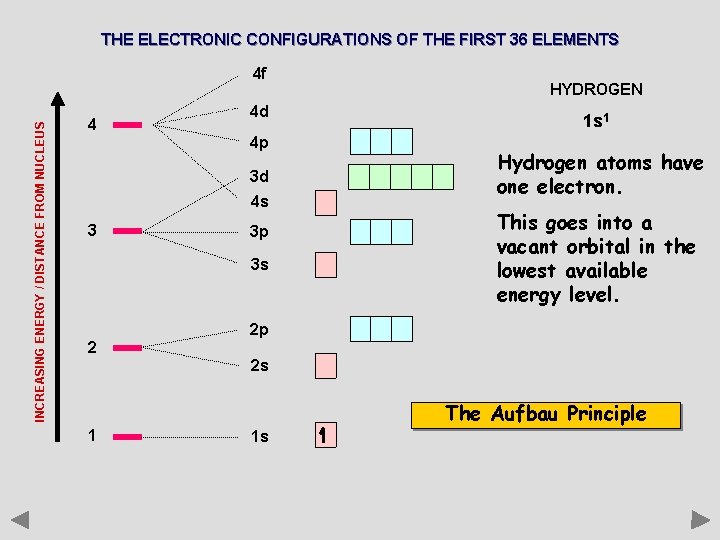
THE ELECTRONIC CONFIGURATIONS OF THE FIRST 36 ELEMENTS INCREASING ENERGY / DISTANCE FROM NUCLEUS 4 f 4 4 d 4 p 3 d 4 s 3 3 p 3 s 2 HYDROGEN 1 s 1 Hydrogen atoms have one electron. This goes into a vacant orbital in the lowest available energy level. 2 p 2 s The Aufbau Principle 1 1 s
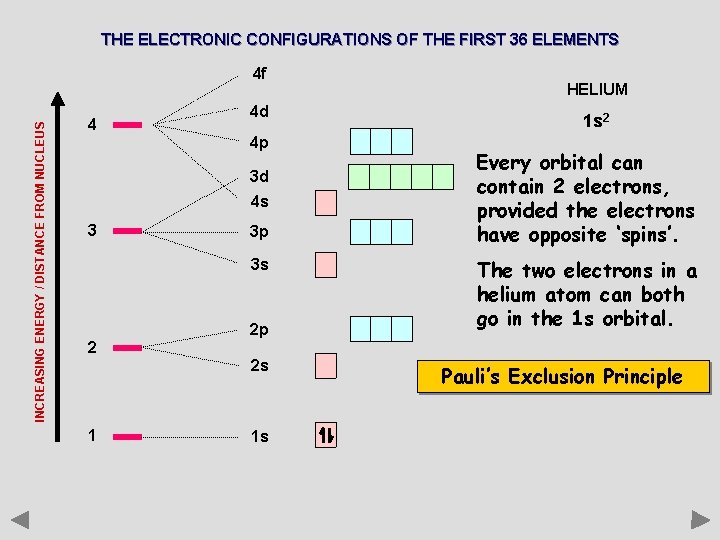
THE ELECTRONIC CONFIGURATIONS OF THE FIRST 36 ELEMENTS INCREASING ENERGY / DISTANCE FROM NUCLEUS 4 f 4 4 d 4 p 3 d 4 s 3 3 p 3 s 2 2 p 2 s 1 1 s HELIUM 1 s 2 Every orbital can contain 2 electrons, provided the electrons have opposite ‘spins’. The two electrons in a helium atom can both go in the 1 s orbital. Pauli’s Exclusion Principle
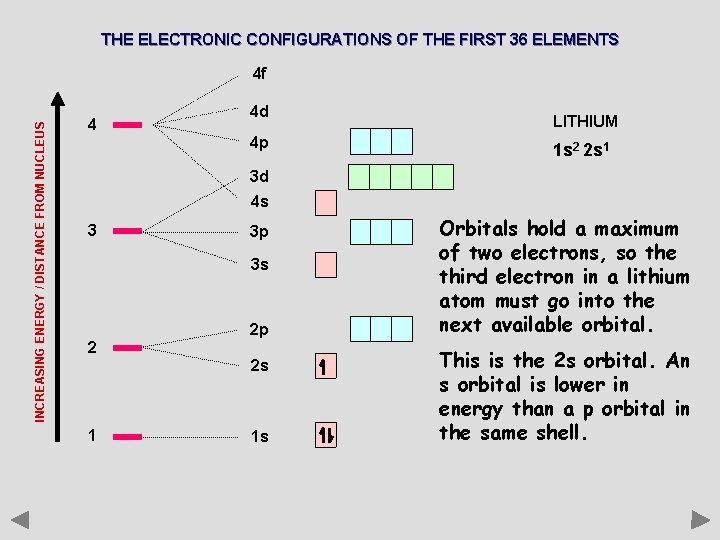
THE ELECTRONIC CONFIGURATIONS OF THE FIRST 36 ELEMENTS INCREASING ENERGY / DISTANCE FROM NUCLEUS 4 f 4 4 d 4 p LITHIUM 1 s 2 2 s 1 3 d 4 s 3 3 p 3 s 2 2 p 2 s 1 1 s Orbitals hold a maximum of two electrons, so the third electron in a lithium atom must go into the next available orbital. This is the 2 s orbital. An s orbital is lower in energy than a p orbital in the same shell.
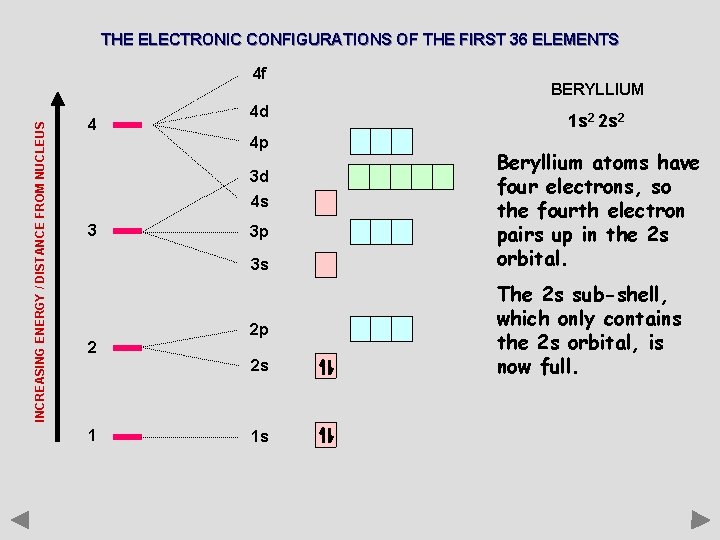
THE ELECTRONIC CONFIGURATIONS OF THE FIRST 36 ELEMENTS INCREASING ENERGY / DISTANCE FROM NUCLEUS 4 f 4 4 d 4 p 3 d 4 s 3 3 p 3 s 2 2 p 2 s 1 1 s BERYLLIUM 1 s 2 2 s 2 Beryllium atoms have four electrons, so the fourth electron pairs up in the 2 s orbital. The 2 s sub-shell, which only contains the 2 s orbital, is now full.
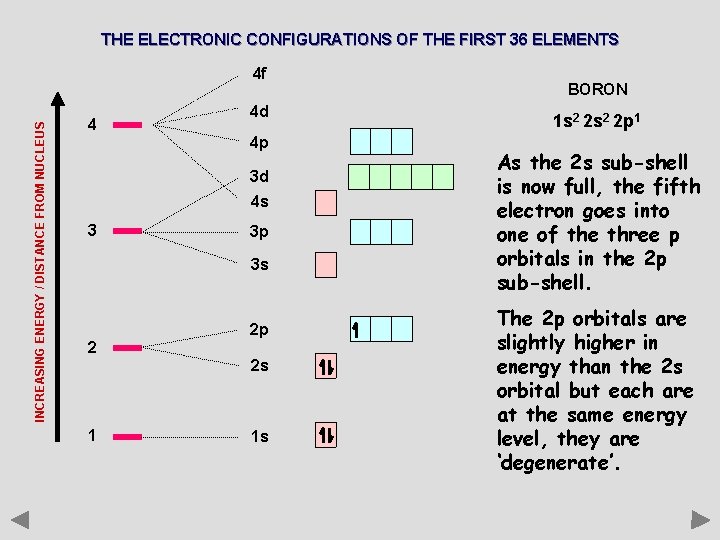
THE ELECTRONIC CONFIGURATIONS OF THE FIRST 36 ELEMENTS INCREASING ENERGY / DISTANCE FROM NUCLEUS 4 f 4 4 d 4 p 3 d 4 s 3 3 p 3 s 2 2 p 2 s 1 1 s BORON 1 s 2 2 p 1 As the 2 s sub-shell is now full, the fifth electron goes into one of the three p orbitals in the 2 p sub-shell. The 2 p orbitals are slightly higher in energy than the 2 s orbital but each are at the same energy level, they are ‘degenerate’.
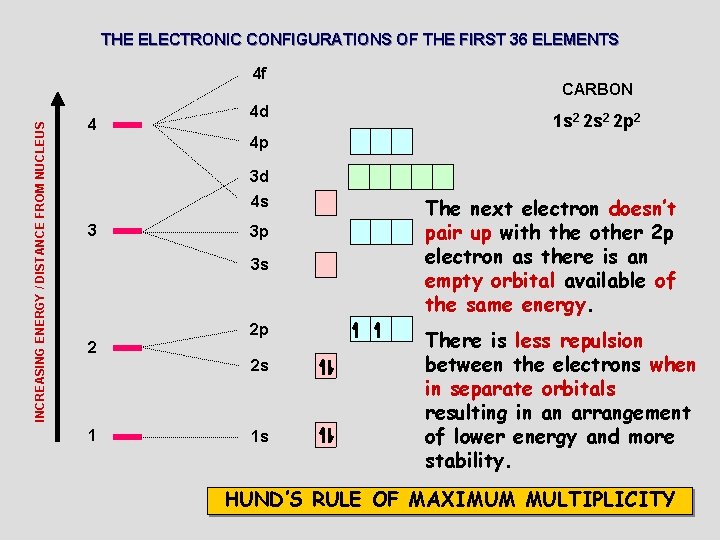
THE ELECTRONIC CONFIGURATIONS OF THE FIRST 36 ELEMENTS INCREASING ENERGY / DISTANCE FROM NUCLEUS 4 f 4 4 d CARBON 1 s 2 2 p 2 4 p 3 d 4 s 3 3 p 3 s 2 2 p 2 s 1 1 s The next electron doesn’t pair up with the other 2 p electron as there is an empty orbital available of the same energy. There is less repulsion between the electrons when in separate orbitals resulting in an arrangement of lower energy and more stability. HUND’S RULE OF MAXIMUM MULTIPLICITY
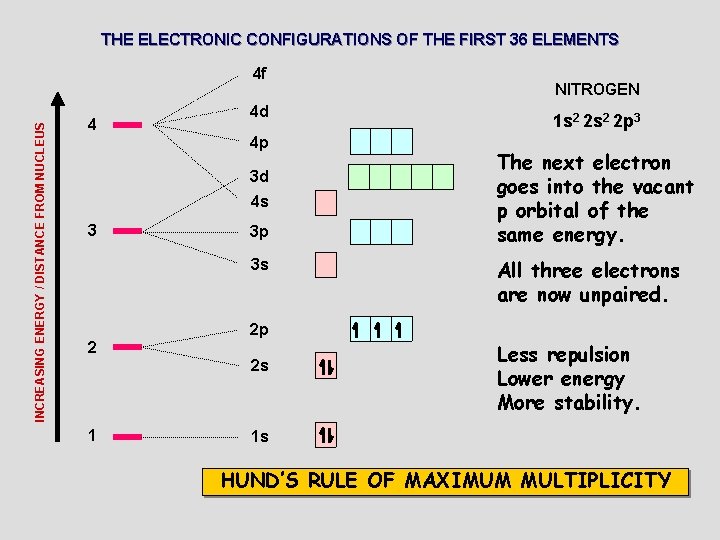
THE ELECTRONIC CONFIGURATIONS OF THE FIRST 36 ELEMENTS INCREASING ENERGY / DISTANCE FROM NUCLEUS 4 f 4 4 d 4 p 3 d 4 s 3 3 p 3 s 2 1 s 2 2 p 3 The next electron goes into the vacant p orbital of the same energy. All three electrons are now unpaired. 2 p 2 s 1 NITROGEN Less repulsion Lower energy More stability. 1 s HUND’S RULE OF MAXIMUM MULTIPLICITY
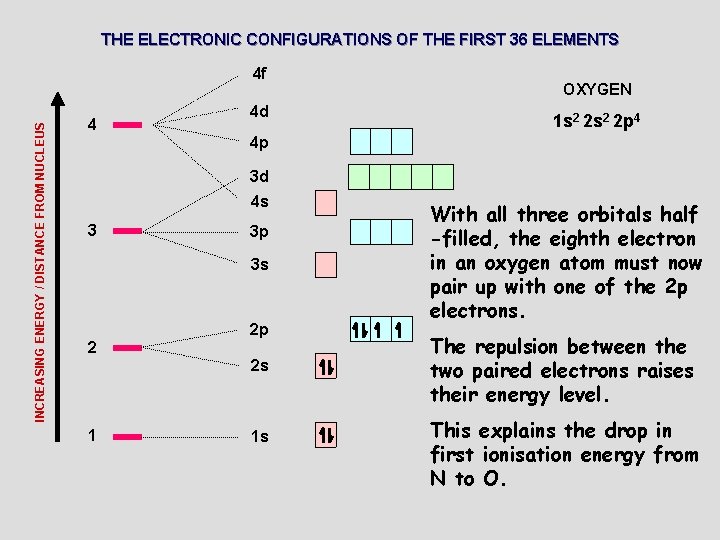
THE ELECTRONIC CONFIGURATIONS OF THE FIRST 36 ELEMENTS INCREASING ENERGY / DISTANCE FROM NUCLEUS 4 f 4 4 d OXYGEN 1 s 2 2 p 4 4 p 3 d 4 s 3 3 p 3 s 2 2 p 2 s 1 1 s With all three orbitals half -filled, the eighth electron in an oxygen atom must now pair up with one of the 2 p electrons. The repulsion between the two paired electrons raises their energy level. This explains the drop in first ionisation energy from N to O.
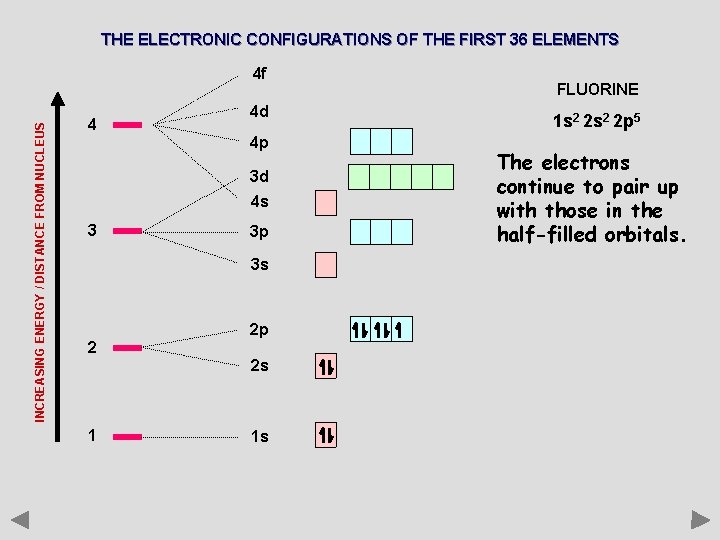
THE ELECTRONIC CONFIGURATIONS OF THE FIRST 36 ELEMENTS INCREASING ENERGY / DISTANCE FROM NUCLEUS 4 f 4 4 d 4 p 3 d 4 s 3 3 p 3 s 2 2 p 2 s 1 1 s FLUORINE 1 s 2 2 p 5 The electrons continue to pair up with those in the half-filled orbitals.
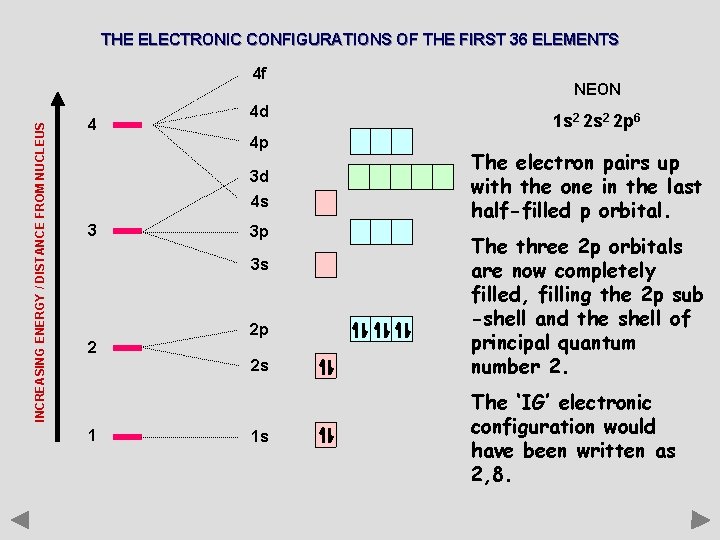
THE ELECTRONIC CONFIGURATIONS OF THE FIRST 36 ELEMENTS INCREASING ENERGY / DISTANCE FROM NUCLEUS 4 f 4 4 d 4 p 3 d 4 s 3 3 p 3 s 2 2 p 2 s 1 1 s NEON 1 s 2 2 p 6 The electron pairs up with the one in the last half-filled p orbital. The three 2 p orbitals are now completely filled, filling the 2 p sub -shell and the shell of principal quantum number 2. The ‘IG’ electronic configuration would have been written as 2, 8.
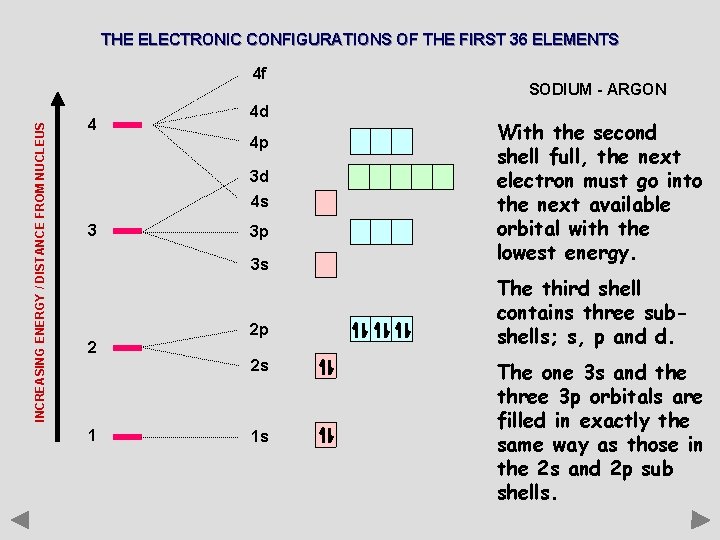
THE ELECTRONIC CONFIGURATIONS OF THE FIRST 36 ELEMENTS INCREASING ENERGY / DISTANCE FROM NUCLEUS 4 f 4 4 d 4 p 3 d 4 s 3 3 p 3 s 2 2 p 2 s 1 1 s SODIUM - ARGON With the second shell full, the next electron must go into the next available orbital with the lowest energy. The third shell contains three subshells; s, p and d. The one 3 s and the three 3 p orbitals are filled in exactly the same way as those in the 2 s and 2 p sub shells.
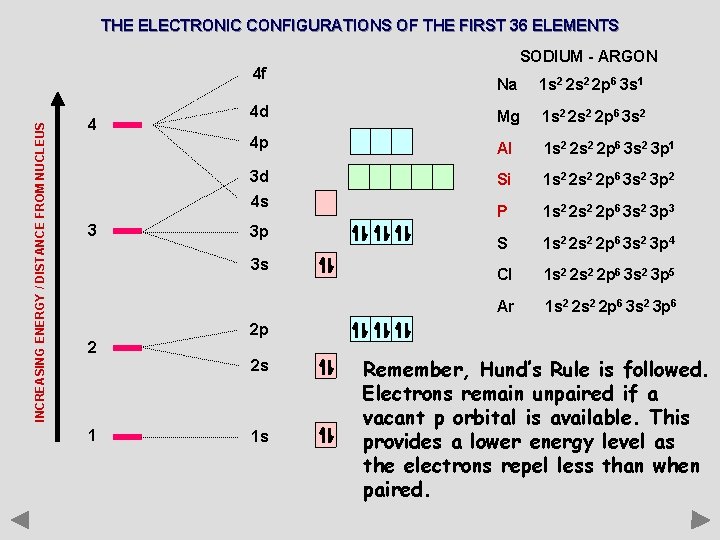
THE ELECTRONIC CONFIGURATIONS OF THE FIRST 36 ELEMENTS INCREASING ENERGY / DISTANCE FROM NUCLEUS 4 f 4 Na 1 s 2 2 p 6 3 s 1 4 d Mg 1 s 2 2 p 6 3 s 2 4 p Al 1 s 2 2 p 6 3 s 2 3 p 1 3 d Si 1 s 2 2 p 6 3 s 2 3 p 2 P 1 s 2 2 p 6 3 s 2 3 p 3 S 1 s 2 2 p 6 3 s 2 3 p 4 Cl 1 s 2 2 p 6 3 s 2 3 p 5 Ar 1 s 2 2 p 6 3 s 2 3 p 6 4 s 3 3 p 3 s 2 2 p 2 s 1 SODIUM - ARGON 1 s Remember, Hund’s Rule is followed. Electrons remain unpaired if a vacant p orbital is available. This provides a lower energy level as the electrons repel less than when paired.
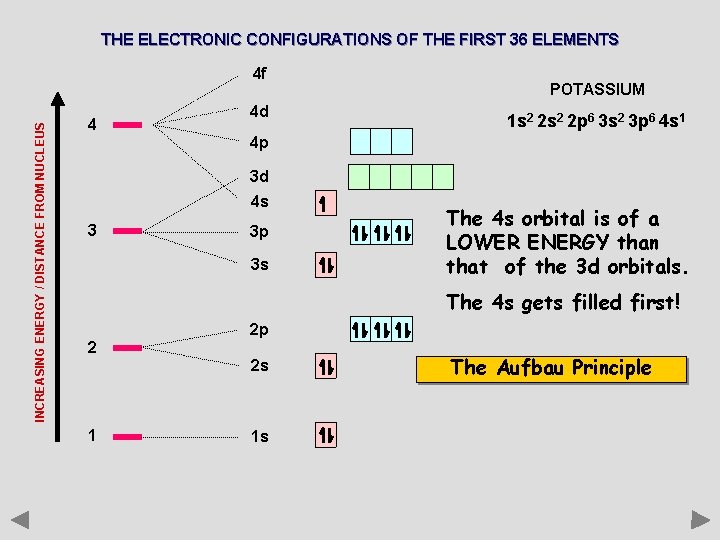
THE ELECTRONIC CONFIGURATIONS OF THE FIRST 36 ELEMENTS INCREASING ENERGY / DISTANCE FROM NUCLEUS 4 f 4 4 d POTASSIUM 1 s 2 2 p 6 3 s 2 3 p 6 4 s 1 4 p 3 d 4 s 3 3 p 3 s The 4 s orbital is of a LOWER ENERGY than that of the 3 d orbitals. The 4 s gets filled first! 2 2 p 2 s 1 1 s The Aufbau Principle
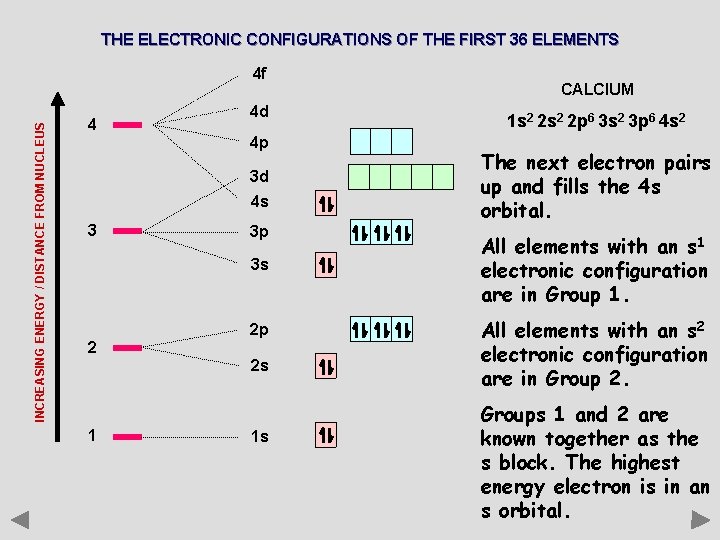
THE ELECTRONIC CONFIGURATIONS OF THE FIRST 36 ELEMENTS INCREASING ENERGY / DISTANCE FROM NUCLEUS 4 f 4 4 d 4 p 3 d 4 s 3 3 p 3 s 2 2 p 2 s 1 1 s CALCIUM 1 s 2 2 p 6 3 s 2 3 p 6 4 s 2 The next electron pairs up and fills the 4 s orbital. All elements with an s 1 electronic configuration are in Group 1. All elements with an s 2 electronic configuration are in Group 2. Groups 1 and 2 are known together as the s block. The highest energy electron is in an s orbital.
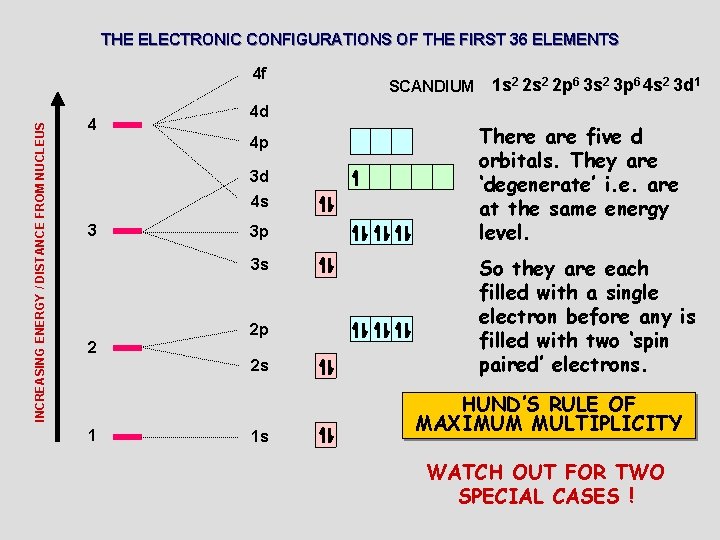
THE ELECTRONIC CONFIGURATIONS OF THE FIRST 36 ELEMENTS INCREASING ENERGY / DISTANCE FROM NUCLEUS 4 f 4 3 d 4 s 3 p 3 s 2 2 p 2 s 1 1 s 2 2 p 6 3 s 2 3 p 6 4 s 2 3 d 1 4 d 4 p 3 SCANDIUM 1 s There are five d orbitals. They are ‘degenerate’ i. e. are at the same energy level. So they are each filled with a single electron before any is filled with two ‘spin paired’ electrons. HUND’S RULE OF MAXIMUM MULTIPLICITY WATCH OUT FOR TWO SPECIAL CASES !
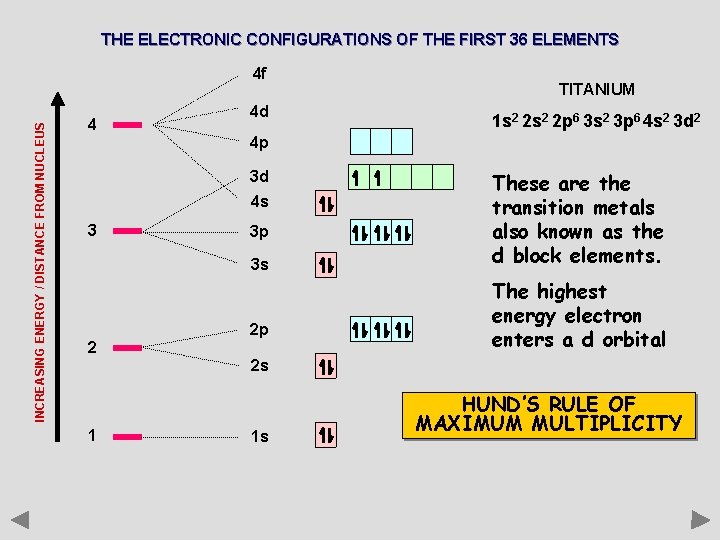
THE ELECTRONIC CONFIGURATIONS OF THE FIRST 36 ELEMENTS INCREASING ENERGY / DISTANCE FROM NUCLEUS 4 f 4 4 d TITANIUM 1 s 2 2 p 6 3 s 2 3 p 6 4 s 2 3 d 2 4 p 3 d 4 s 3 3 p 3 s 2 2 p These are the transition metals also known as the d block elements. The highest energy electron enters a d orbital 2 s 1 1 s HUND’S RULE OF MAXIMUM MULTIPLICITY
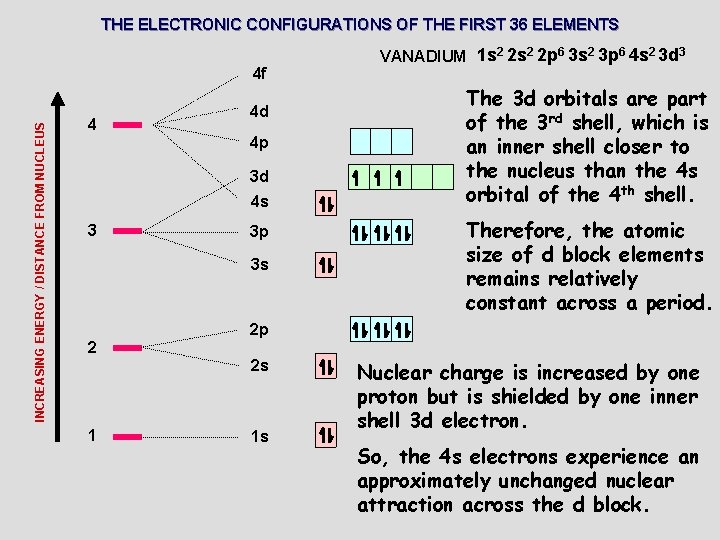
THE ELECTRONIC CONFIGURATIONS OF THE FIRST 36 ELEMENTS INCREASING ENERGY / DISTANCE FROM NUCLEUS 4 f 4 4 d 4 p 3 d 4 s 3 3 p 3 s 2 The 3 d orbitals are part of the 3 rd shell, which is an inner shell closer to the nucleus than the 4 s orbital of the 4 th shell. Therefore, the atomic size of d block elements remains relatively constant across a period. 2 p 2 s 1 VANADIUM 1 s 2 2 p 6 3 s 2 3 p 6 4 s 2 3 d 3 1 s Nuclear charge is increased by one proton but is shielded by one inner shell 3 d electron. So, the 4 s electrons experience an approximately unchanged nuclear attraction across the d block.
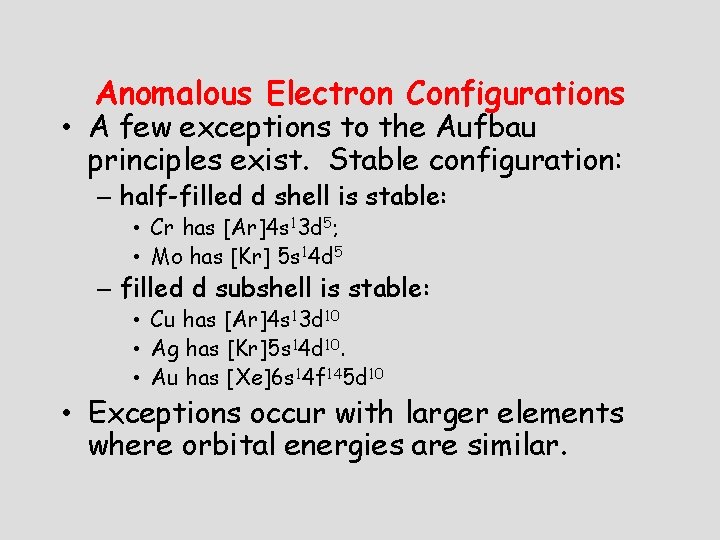
Anomalous Electron Configurations • A few exceptions to the Aufbau principles exist. Stable configuration: – half-filled d shell is stable: • Cr has [Ar]4 s 13 d 5; • Mo has [Kr] 5 s 14 d 5 – filled d subshell is stable: • Cu has [Ar]4 s 13 d 10 • Ag has [Kr]5 s 14 d 10. • Au has [Xe]6 s 14 f 145 d 10 • Exceptions occur with larger elements where orbital energies are similar.
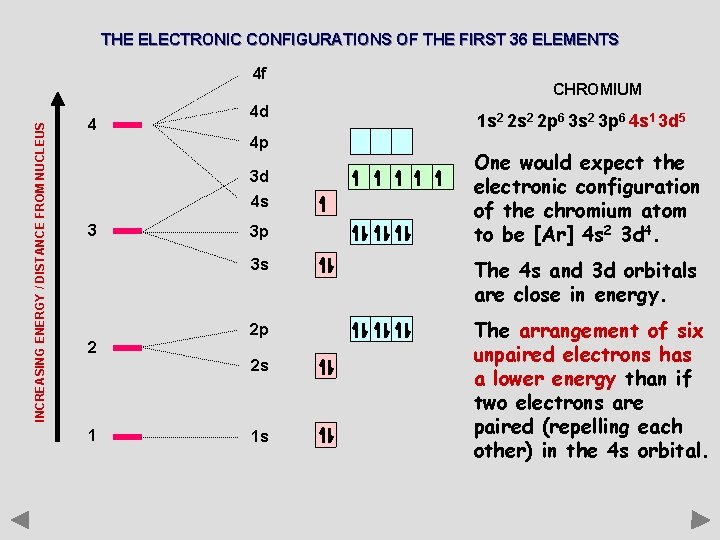
THE ELECTRONIC CONFIGURATIONS OF THE FIRST 36 ELEMENTS INCREASING ENERGY / DISTANCE FROM NUCLEUS 4 f 4 4 d 4 p 3 d 4 s 3 2 3 p 1 s 2 2 p 6 3 s 2 3 p 6 4 s 1 3 d 5 One would expect the electronic configuration of the chromium atom to be [Ar] 4 s 2 3 d 4. 3 s The 4 s and 3 d orbitals are close in energy. 2 p The arrangement of six unpaired electrons has a lower energy than if two electrons are paired (repelling each other) in the 4 s orbital. 2 s 1 CHROMIUM 1 s
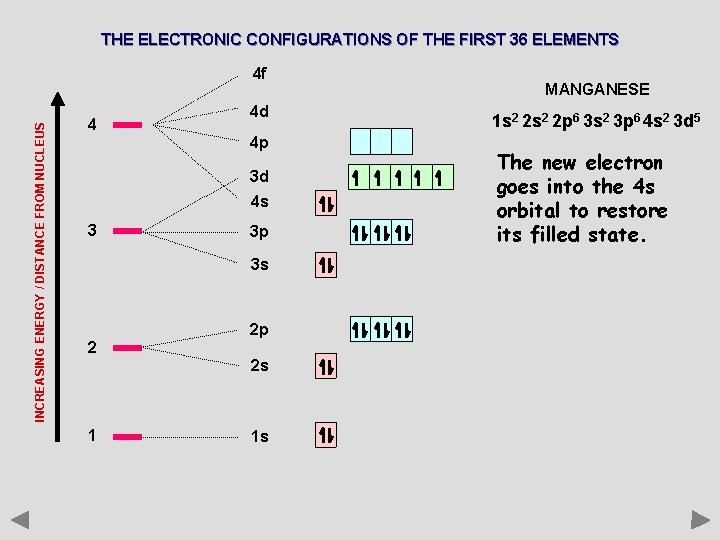
THE ELECTRONIC CONFIGURATIONS OF THE FIRST 36 ELEMENTS INCREASING ENERGY / DISTANCE FROM NUCLEUS 4 f 4 4 d 4 p 3 d 4 s 3 3 p 3 s 2 2 p 2 s 1 1 s MANGANESE 1 s 2 2 p 6 3 s 2 3 p 6 4 s 2 3 d 5 The new electron goes into the 4 s orbital to restore its filled state.
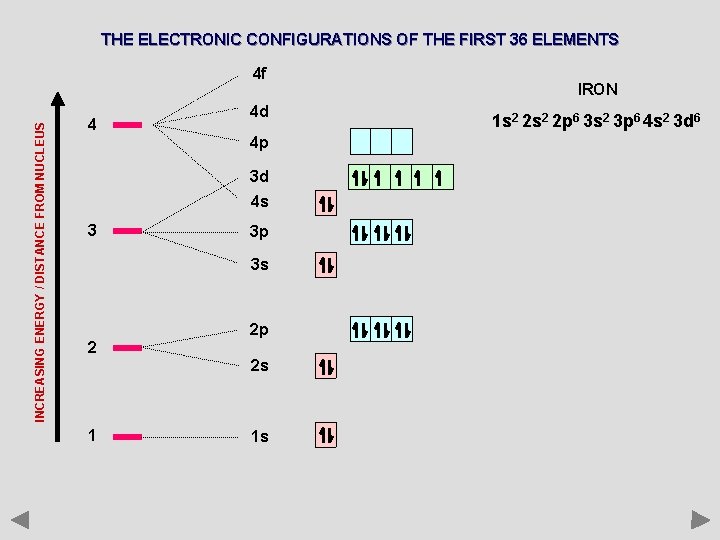
THE ELECTRONIC CONFIGURATIONS OF THE FIRST 36 ELEMENTS INCREASING ENERGY / DISTANCE FROM NUCLEUS 4 f 4 4 d 4 p 3 d 4 s 3 3 p 3 s 2 2 p 2 s 1 1 s IRON 1 s 2 2 p 6 3 s 2 3 p 6 4 s 2 3 d 6
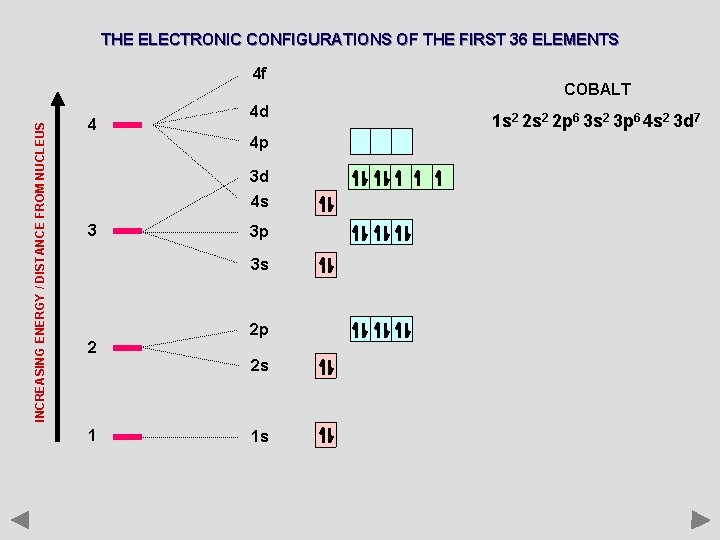
THE ELECTRONIC CONFIGURATIONS OF THE FIRST 36 ELEMENTS INCREASING ENERGY / DISTANCE FROM NUCLEUS 4 f 4 4 d 4 p 3 d 4 s 3 3 p 3 s 2 2 p 2 s 1 1 s COBALT 1 s 2 2 p 6 3 s 2 3 p 6 4 s 2 3 d 7
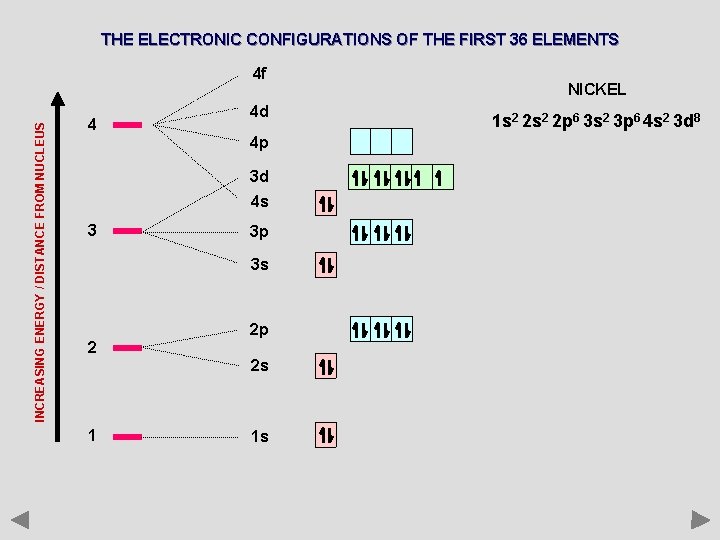
THE ELECTRONIC CONFIGURATIONS OF THE FIRST 36 ELEMENTS INCREASING ENERGY / DISTANCE FROM NUCLEUS 4 f 4 4 d 4 p 3 d 4 s 3 3 p 3 s 2 2 p 2 s 1 1 s NICKEL 1 s 2 2 p 6 3 s 2 3 p 6 4 s 2 3 d 8
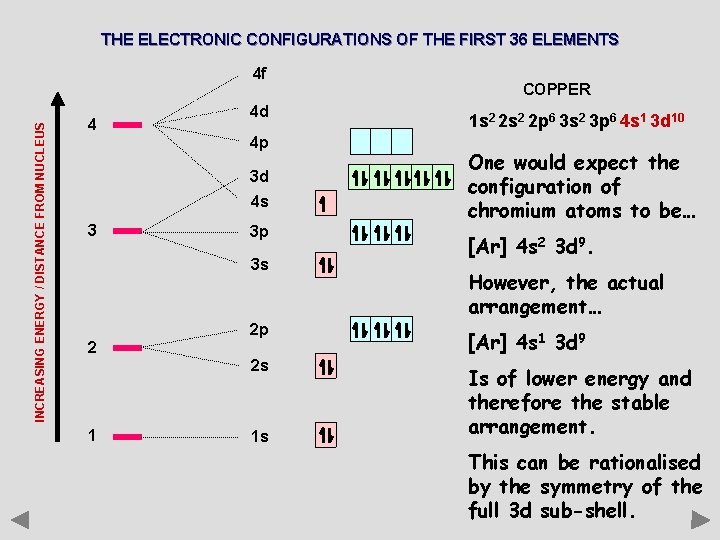
THE ELECTRONIC CONFIGURATIONS OF THE FIRST 36 ELEMENTS INCREASING ENERGY / DISTANCE FROM NUCLEUS 4 f 4 4 d 4 p 3 d 4 s 3 3 p 3 s 2 1 COPPER 1 s 2 2 p 6 3 s 2 3 p 6 4 s 1 3 d 10 One would expect the configuration of chromium atoms to be… [Ar] 4 s 2 3 d 9. However, the actual arrangement… 2 p [Ar] 4 s 1 3 d 9 2 s Is of lower energy and therefore the stable arrangement. 1 s This can be rationalised by the symmetry of the full 3 d sub-shell.
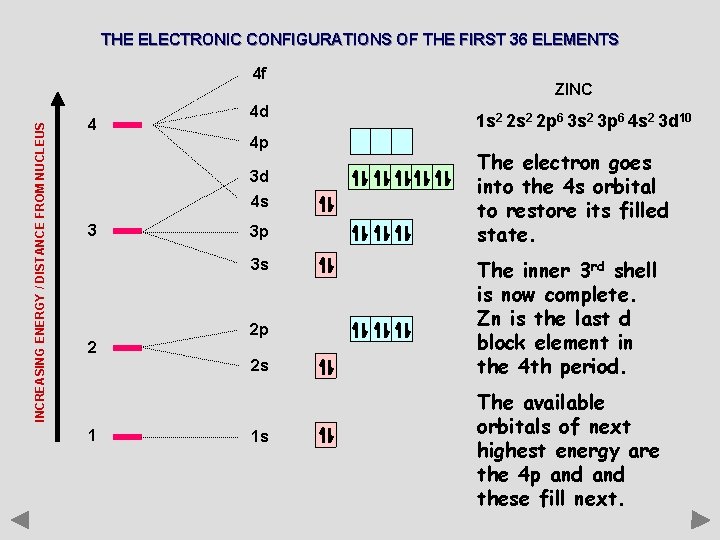
THE ELECTRONIC CONFIGURATIONS OF THE FIRST 36 ELEMENTS INCREASING ENERGY / DISTANCE FROM NUCLEUS 4 f 4 4 d 4 p 3 d 4 s 3 3 p 3 s 2 2 p 2 s 1 1 s ZINC 1 s 2 2 p 6 3 s 2 3 p 6 4 s 2 3 d 10 The electron goes into the 4 s orbital to restore its filled state. The inner 3 rd shell is now complete. Zn is the last d block element in the 4 th period. The available orbitals of next highest energy are the 4 p and these fill next.
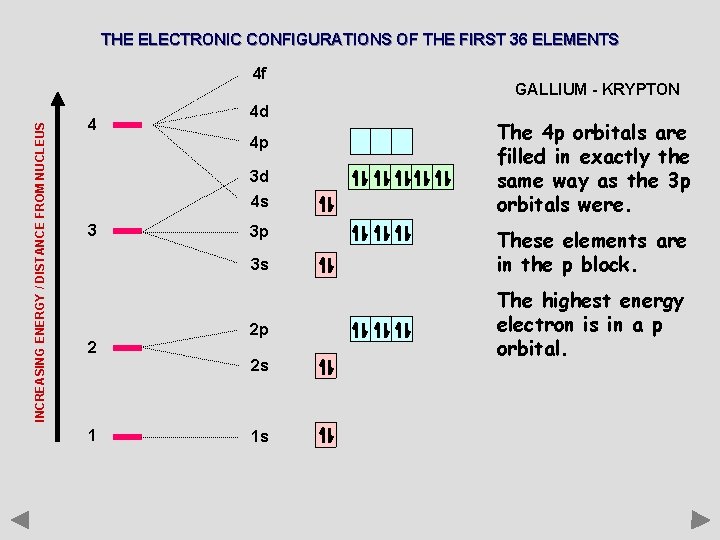
THE ELECTRONIC CONFIGURATIONS OF THE FIRST 36 ELEMENTS INCREASING ENERGY / DISTANCE FROM NUCLEUS 4 f 4 4 d 4 p 3 d 4 s 3 3 p 3 s 2 2 p 2 s 1 1 s GALLIUM - KRYPTON The 4 p orbitals are filled in exactly the same way as the 3 p orbitals were. These elements are in the p block. The highest energy electron is in a p orbital.
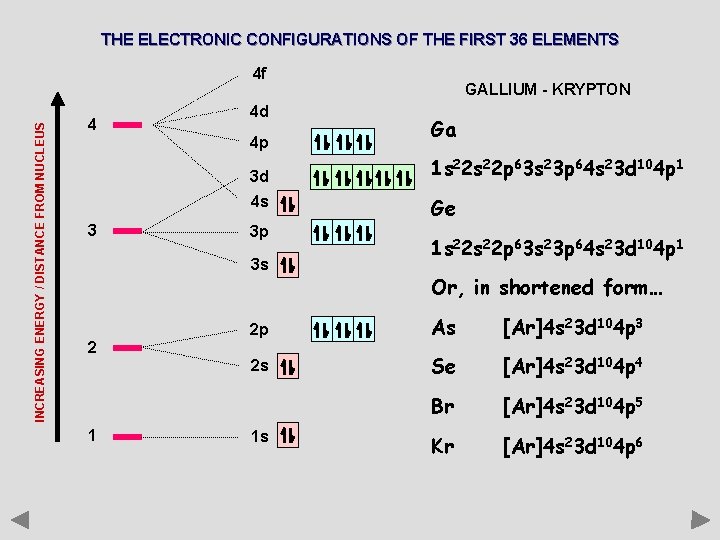
THE ELECTRONIC CONFIGURATIONS OF THE FIRST 36 ELEMENTS INCREASING ENERGY / DISTANCE FROM NUCLEUS 4 f 4 4 d 4 p 3 d 4 s 3 3 p 3 s 2 1 GALLIUM - KRYPTON Ga 1 s 22 p 63 s 23 p 64 s 23 d 104 p 1 Ge 1 s 22 p 63 s 23 p 64 s 23 d 104 p 1 Or, in shortened form… 2 p As [Ar]4 s 23 d 104 p 3 2 s Se [Ar]4 s 23 d 104 p 4 Br [Ar]4 s 23 d 104 p 5 Kr [Ar]4 s 23 d 104 p 6 1 s
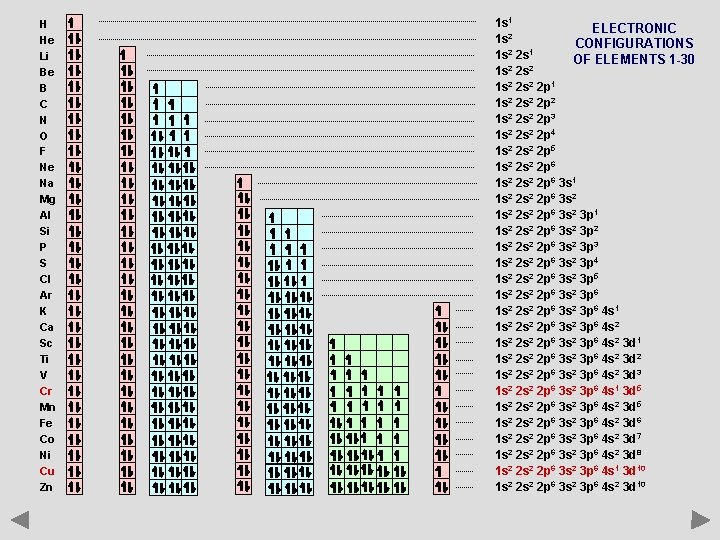
H He Li Be B C N O F Ne Na Mg Al Si P S Cl Ar K Ca Sc Ti V Cr Mn Fe Co Ni Cu Zn 1 s 1 ELECTRONIC 1 s 2 CONFIGURATIONS 1 s 2 2 s 1 OF ELEMENTS 1 -30 1 s 2 2 s 2 2 p 1 1 s 2 2 p 2 1 s 2 2 p 3 1 s 2 2 p 4 1 s 2 2 p 5 1 s 2 2 s 2 2 p 6 3 s 1 1 s 2 2 s 2 2 p 6 3 s 2 3 p 1 1 s 2 2 p 6 3 s 2 3 p 2 1 s 2 2 p 6 3 s 2 3 p 3 1 s 2 2 p 6 3 s 2 3 p 4 1 s 2 2 p 6 3 s 2 3 p 5 1 s 2 2 s 2 2 p 6 3 s 2 3 p 6 4 s 1 1 s 2 2 s 2 2 p 6 3 s 2 3 p 6 4 s 2 3 d 1 1 s 2 2 p 6 3 s 2 3 p 6 4 s 2 3 d 2 1 s 2 2 p 6 3 s 2 3 p 6 4 s 2 3 d 3 1 s 2 2 p 6 3 s 2 3 p 6 4 s 1 3 d 5 1 s 2 2 s 2 2 p 6 3 s 2 3 p 6 4 s 2 3 d 6 1 s 2 2 p 6 3 s 2 3 p 6 4 s 2 3 d 7 1 s 2 2 p 6 3 s 2 3 p 6 4 s 2 3 d 8 1 s 2 2 p 6 3 s 2 3 p 6 4 s 1 3 d 10 1 s 2 2 p 6 3 s 2 3 p 6 4 s 2 3 d 10
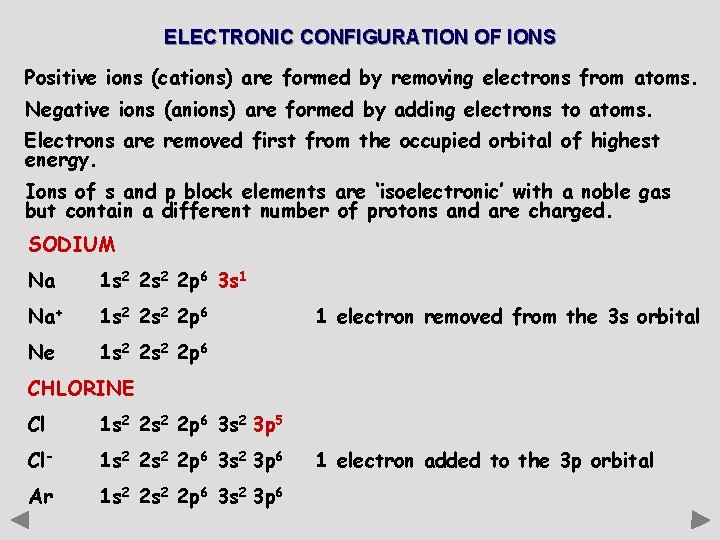
ELECTRONIC CONFIGURATION OF IONS Positive ions (cations) are formed by removing electrons from atoms. Negative ions (anions) are formed by adding electrons to atoms. Electrons are removed first from the occupied orbital of highest energy. Ions of s and p block elements are ‘isoelectronic’ with a noble gas but contain a different number of protons and are charged. SODIUM Na 1 s 2 2 p 6 3 s 1 Na+ 1 s 2 2 p 6 Ne 1 s 2 2 p 6 1 electron removed from the 3 s orbital CHLORINE Cl 1 s 2 2 p 6 3 s 2 3 p 5 Cl- 1 s 2 2 p 6 3 s 2 3 p 6 Ar 1 s 2 2 p 6 3 s 2 3 p 6 1 electron added to the 3 p orbital
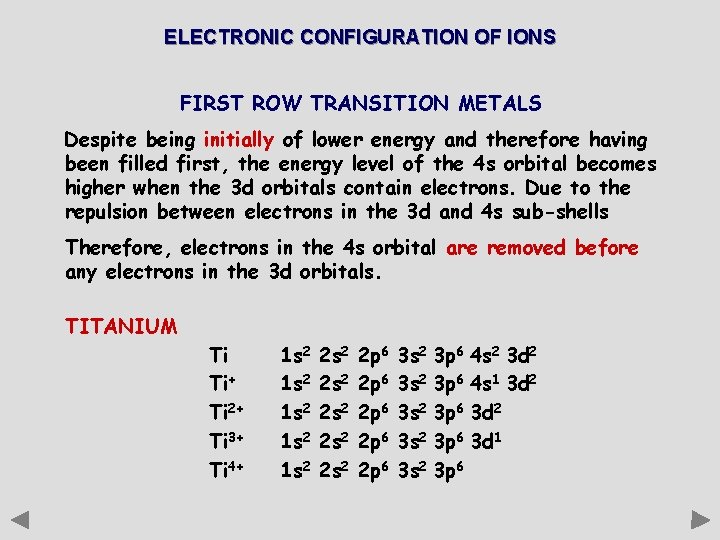
ELECTRONIC CONFIGURATION OF IONS FIRST ROW TRANSITION METALS Despite being initially of lower energy and therefore having been filled first, the energy level of the 4 s orbital becomes higher when the 3 d orbitals contain electrons. Due to the repulsion between electrons in the 3 d and 4 s sub-shells Therefore, electrons in the 4 s orbital are removed before any electrons in the 3 d orbitals. TITANIUM Ti Ti+ Ti 2+ Ti 3+ Ti 4+ 1 s 2 1 s 2 2 s 2 2 p 6 2 p 6 3 s 2 3 p 6 4 s 2 3 d 2 3 s 2 3 p 6 4 s 1 3 d 2 3 s 2 3 p 6 3 d 1 3 s 2 3 p 6
References Nelson 12 Richard Rogers Nomad 1970
- Slides: 43