
ELECTRONIC COMMUNICATIONS A SYSTEMS APPROACH CHAPTER 7 Digital

- Slides: 32
ELECTRONIC COMMUNICATIONS A SYSTEMS APPROACH CHAPTER 7 Digital Communications Techniques Electronic Communications: A Systems Approach Beasley | Hymer | Miller Copyright © 2014 by Pearson Education, Inc. All Rights Reserved
Introduction to Digital Communications • For communications to take place digitally, analog signals converted to discrete samples for transmission as data. • Data coded (prepared) for transmission over communications channel that does not provide direct electrical continuity between transmitter and receiver. Electronic Communications: A Systems Approach Beasley | Hymer | Miller Copyright © 2014 by Pearson Education, Inc. All Rights Reserved
Introduction to Digital Communications • Error detection/correction techniques deployed to enhance performance in presence of noise. Electronic Communications: A Systems Approach Beasley | Hymer | Miller Copyright © 2014 by Pearson Education, Inc. All Rights Reserved
Pulse Modulation and Multiplexing • Pulse Modulation § Transmit only samples and let receiver reconstruct total signal with high degree of accuracy. • Multiplexing § Conveying two or more information signals over single transmission channel. Electronic Communications: A Systems Approach Beasley | Hymer | Miller Copyright © 2014 by Pearson Education, Inc. All Rights Reserved
Pulse Modulation and Multiplexing • Time-division Multiplexing (TDM) § Computer time sharing; several users make use of computer simultaneously. Electronic Communications: A Systems Approach Beasley | Hymer | Miller Copyright © 2014 by Pearson Education, Inc. All Rights Reserved
Pulse Modulation and Multiplexing • Pulse-Amplitude Modulation (PAM) § Pulse amplitude made proportional to amplitude of modulating signal. • Pulse-Width Modulation (PWM) § § Form of PTM. Pulse-duration modulation (PDM). Pulse-length modulation (PLM). Basis for class D power amplification. Electronic Communications: A Systems Approach Beasley | Hymer | Miller Copyright © 2014 by Pearson Education, Inc. All Rights Reserved
Pulse Modulation and Multiplexing • Pulse-Position Modulation (PPM) § Superior noise characteristics. § Major use for PWM is to generate PPM. • Demodulation § Reproducing original analog signal. § PPM signal converted to PWM, then demodulated using technique for demodulating PWM. Electronic Communications: A Systems Approach Beasley | Hymer | Miller Copyright © 2014 by Pearson Education, Inc. All Rights Reserved
Sample Rate and Nyquist Frequency • Act of sampling an analog waveform is form of modulation because of interaction that takes place between sampled pulses and information signal. Electronic Communications: A Systems Approach Beasley | Hymer | Miller Copyright © 2014 by Pearson Education, Inc. All Rights Reserved
Sample Rate and Nyquist Frequency • Sample rate must be at least twice the highest frequency of intelligence or information signal to be sampled. • Nyquist rate § Minimum sample rate. Electronic Communications: A Systems Approach Beasley | Hymer | Miller Copyright © 2014 by Pearson Education, Inc. All Rights Reserved
Pulse-Code Modulation • PCM Encoding Steps § Sampling § Quantizing § Coding • PCM Decoding Steps § Regeneration § Decoding § Reconstruction Electronic Communications: A Systems Approach Beasley | Hymer | Miller Copyright © 2014 by Pearson Education, Inc. All Rights Reserved
Pulse-Code Modulation • The Sample-and-Hold Circuit § Functions as modulator in PCM system; information signal sampled. § Junction field-effect transistor (JFET). § Metaloxide semiconductor field-effect transistor (MOSFET). Electronic Communications: A Systems Approach Beasley | Hymer | Miller Copyright © 2014 by Pearson Education, Inc. All Rights Reserved
Pulse-Code Modulation • The Sample-and-Hold Circuit § Acquisition time • Amount of time it takes for hold circuit to reach its final value. § Aperture time • Time S/H circuit must hold sampled voltage. Electronic Communications: A Systems Approach Beasley | Hymer | Miller Copyright © 2014 by Pearson Education, Inc. All Rights Reserved
Pulse-Code Modulation • Natural and Flat-top Sampling § Natural sampling • Tops of sampled waveform retain their natural shape. § Flat-top sampling • Sample signal voltage held constant between samples. Electronic Communications: A Systems Approach Beasley | Hymer | Miller Copyright © 2014 by Pearson Education, Inc. All Rights Reserved
Pulse-Code Modulation • Quantization § Each level corresponds to different binary number. § Each quantization level step-size • Quantile or quantile interval; determines resolution of digitizing system. Electronic Communications: A Systems Approach Beasley | Hymer | Miller Copyright © 2014 by Pearson Education, Inc. All Rights Reserved
Pulse-Code Modulation • Dynamic Range/Signal-to-Noise Calculations § Dynamic range (DR) • Ratio of maximum input or output voltage level to smallest voltage level quantized and/or reproduced by converters. § Signal-to-noise ratio (S/N). § Signal-to-quantization-noise level (S/N)q. Electronic Communications: A Systems Approach Beasley | Hymer | Miller Copyright © 2014 by Pearson Education, Inc. All Rights Reserved
Pulse-Code Modulation • Companding § Nonlinear or nonuniform coding • Each quantile interval step-size may vary in magnitude. Electronic Communications: A Systems Approach Beasley | Hymer | Miller Copyright © 2014 by Pearson Education, Inc. All Rights Reserved
Pulse-Code Modulation • Idle Channel Noise § Noise source of small amplitude that exists in channel independent of analog input signal and quantized by ADC converter. • Amplitude Companding § Volume compression before transmission and expansion after detection. Electronic Communications: A Systems Approach Beasley | Hymer | Miller Copyright © 2014 by Pearson Education, Inc. All Rights Reserved
Pulse-Code Modulation • Coding and Analog-to-Digital Conversion § Coding • Each quantized value as binary word. § Function of analog-to-digital (ADC) conversion. Electronic Communications: A Systems Approach Beasley | Hymer | Miller Copyright © 2014 by Pearson Education, Inc. All Rights Reserved
Pulse-Code Modulation • Digital-to-Analog Converters § Digital-to-analog (DAC) conversion • Reconstruction of analog signal from PCM representation. § Convert digital (binary) bit stream to analog signal. Electronic Communications: A Systems Approach Beasley | Hymer | Miller Copyright © 2014 by Pearson Education, Inc. All Rights Reserved
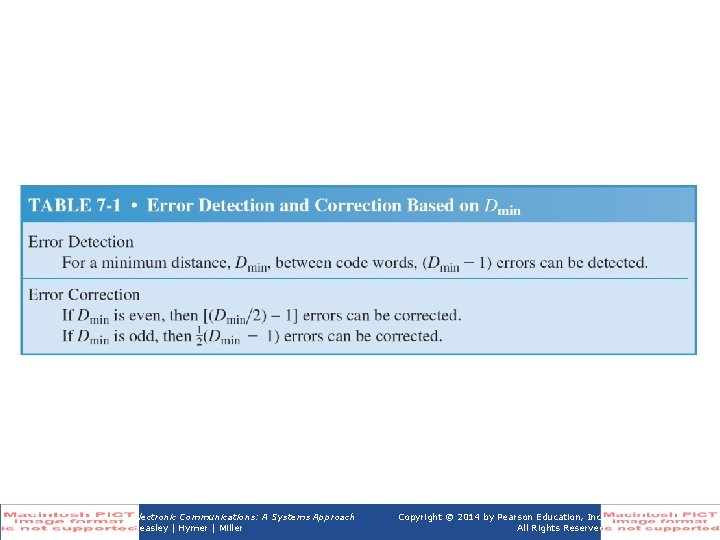
Coding Principles • Decreasing an error depends on transmission system used and digital encoding and modulation techniques employed. • Hamming distance § Distance between each defined state (minimum distance). § See Table 7 -1: Error Detection and Correction Based on Dmin Electronic Communications: A Systems Approach Beasley | Hymer | Miller Copyright © 2014 by Pearson Education, Inc. All Rights Reserved
Table 7 -1 Dmin Error Detection and Correction Based on Electronic Communications: A Systems Approach Beasley | Hymer | Miller Copyright © 2014 by Pearson Education, Inc. All Rights Reserved
Coding Principles • XOR operation that yields smallest result tells which is correct code. Electronic Communications: A Systems Approach Beasley | Hymer | Miller Copyright © 2014 by Pearson Education, Inc. All Rights Reserved
Code Error Detection and Correction • Parity § Most common method of error detection. § Single (parity) bit added to each code representation. § Automatic request for retransmission (ARQ). § Display of unused symbol for character with parity error (symbol substitution). Electronic Communications: A Systems Approach Beasley | Hymer | Miller Copyright © 2014 by Pearson Education, Inc. All Rights Reserved
Code Error Detection and Correction • Block Check Character (BCC) § Block • Group of characters transmitted with no time gap between them. § Followed by end-of-message (EOM) indicator and then BCC. § Longitudinal redundancy check (LRC). Electronic Communications: A Systems Approach Beasley | Hymer | Miller Copyright © 2014 by Pearson Education, Inc. All Rights Reserved
Code Error Detection and Correction • Cyclic Redundancy Check (CRC) § One of the most powerful errordetection schemes; mathematical technique. • CRC Code-Dividing Circuit § At receive side, received code verified by feeding received serial CRC code into CRC dividing circuit. Electronic Communications: A Systems Approach Beasley | Hymer | Miller Copyright © 2014 by Pearson Education, Inc. All Rights Reserved
Code Error Detection and Correction • Hamming Code § Techniques that allow correction at receiver are forward error-correcting (FEC) codes. § Requirement • Sufficient redundancy to allow error correction without further input from transmitter. § Can detect only single error. Electronic Communications: A Systems Approach Beasley | Hymer | Miller Copyright © 2014 by Pearson Education, Inc. All Rights Reserved
Code Error Detection and Correction • Reed–Solomon Codes § Forward error-correcting codes (FEC) like Hamming code. § Can detect multiple errors. § Interleaving • Technique used to rearrange data into nonlinear ordering scheme to improve chance of correcting data errors. Electronic Communications: A Systems Approach Beasley | Hymer | Miller Copyright © 2014 by Pearson Education, Inc. All Rights Reserved
Digital Signal Processing • Digital Signal Processing (DSP) § Mathematical functions to control characteristics of digitized signal. § Extract information from processed signal, usually in presence of noise. § Occurs in real time/nearly real time. Electronic Communications: A Systems Approach Beasley | Hymer | Miller Copyright © 2014 by Pearson Education, Inc. All Rights Reserved
Digital Signal Processing • Digital Signal Processing (DSP) § Easily reprogrammed; more flexible. § Emulates almost all communications system functions. § DSP processing and filtering used in almost every area of electronic communication. Electronic Communications: A Systems Approach Beasley | Hymer | Miller Copyright © 2014 by Pearson Education, Inc. All Rights Reserved
Digital Signal Processing • DSP Filtering § Impulse • Infinitely narrow pulse. § Filters that exhibit properties of sinc function (sin(x)/x filters). Electronic Communications: A Systems Approach Beasley | Hymer | Miller Copyright © 2014 by Pearson Education, Inc. All Rights Reserved
Digital Signal Processing • DSP Filtering § Filter to which impulse applied at its input will output signal whose impulse response is equal to that of filter frequency response. § IIR filter recursive. § FIR filter nonrecursive. Electronic Communications: A Systems Approach Beasley | Hymer | Miller Copyright © 2014 by Pearson Education, Inc. All Rights Reserved
Digital Signal Processing • DSP Filtering § Difference equation • Present digital sample value of input signal with number of previous input values (possibly previous output values) to generate output signal. § Algorithms employing previous output values are recursive or iterative. § DSP techniques increasingly form heart of digital implementations of all types. Electronic Communications: A Systems Approach Beasley | Hymer | Miller Copyright © 2014 by Pearson Education, Inc. All Rights Reserved