
Electronic Communication vs Traditional Print Media Which is
- Slides: 24
Electronic Communication vs. Traditional Print Media: Which is More Effective? Presenters: Christopher Small – GDAIS Jonathan Steele – GDAIS Jim Slavin – College Board
Introductions Who are these guys, and why are they here? ? ? Christopher Small Jonathan Steele Jim Slavin
About GDA Integrated Services is a market research, consulting and services firm specializing in customized, integrated marketing solutions to help colleges and universities compete successfully for students, funding and visibility in the 21 st century. Market Research Services include: Integrated Marketing Plans Integrated Communications Telemarketing Direct Mail Website Design Electronic Communications “Guaranteed Visibility” Printed Communications Public Relations Counsel Video Production Fundraising
So which is better, print or electronic communication? Answer: Both Thanks for coming!
How Do Students Communicate with Colleges? GDAIS conducted an extensive survey of college-bound high school students from the applicant and search pools of six different institutions. We asked them how they approach the college search process. This is some of what we learned…
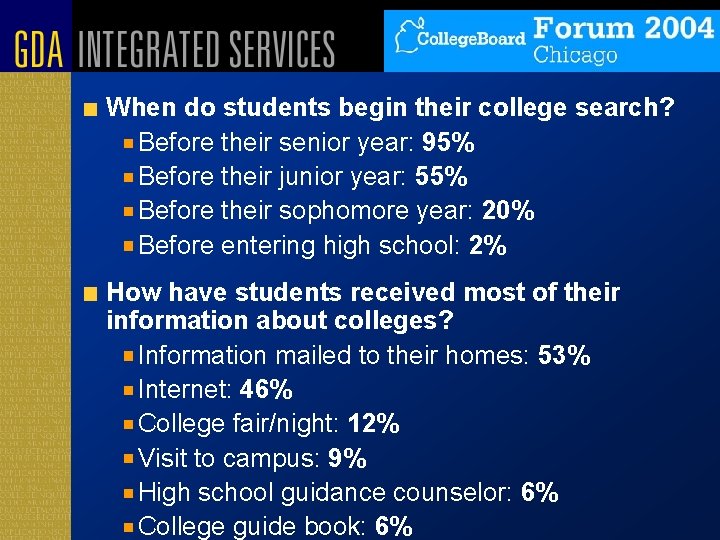
When do students begin their college search? Before their senior year: 95% Before their junior year: 55% Before their sophomore year: 20% Before entering high school: 2% How have students received most of their information about colleges? Information mailed to their homes: 53% Internet: 46% College fair/night: 12% Visit to campus: 9% High school guidance counselor: 6% College guide book: 6%
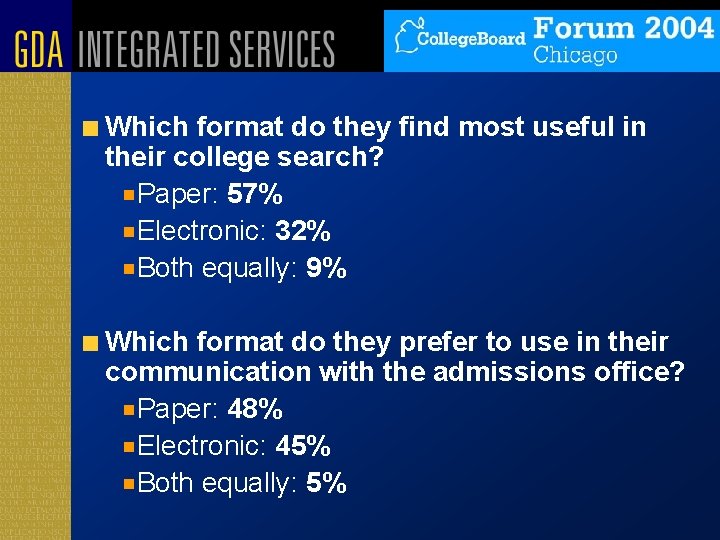
Which format do they find most useful in their college search? Paper: 57% Electronic: 32% Both equally: 9% Which format do they prefer to use in their communication with the admissions office? Paper: 48% Electronic: 45% Both equally: 5%
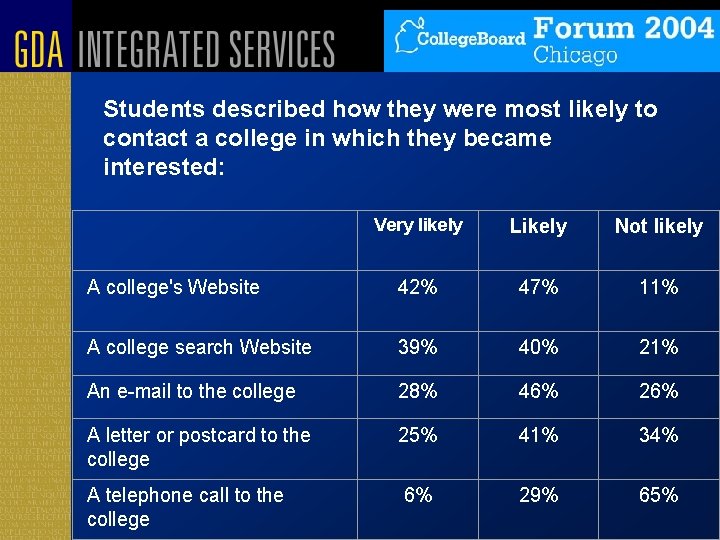
Students described how they were most likely to contact a college in which they became interested: Very likely Likely Not likely A college's Website 42% 47% 11% A college search Website 39% 40% 21% An e-mail to the college 28% 46% 26% A letter or postcard to the college 25% 41% 34% A telephone call to the college 6% 29% 65%
Interpreting the Research • Students are starting the college search earlier • More students are using the Web for research • Students still like to read print publications • Colleges need to develop an integrated print and electronic communications plan
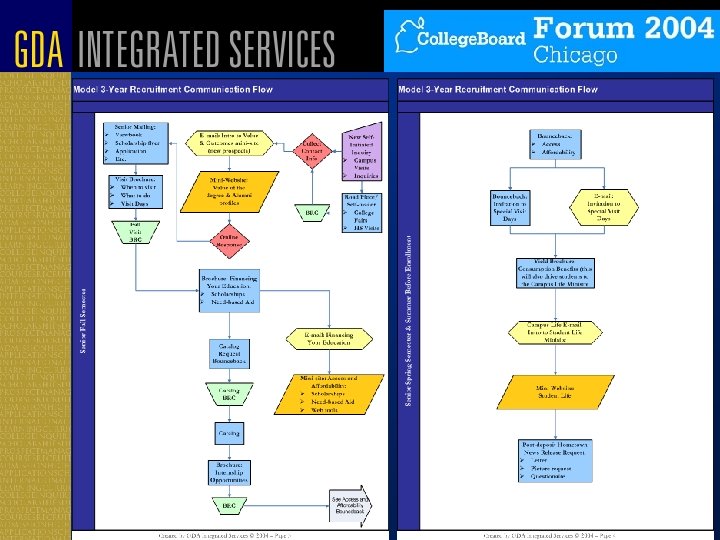
Getting MORE from Your Communication Flow • Most Students are not reading your mail • Don’t be afraid to promote the distinctiveness of your institution • Timing is everything – Investment benefits
Getting EVEN MORE from Your Communication Flow • Keep messages clear and concise • Limit messages to one at a time • Always have a response mechanism to see who is paying attention • Respond quickly to those who respond to you • Develop ways to measure the effectiveness
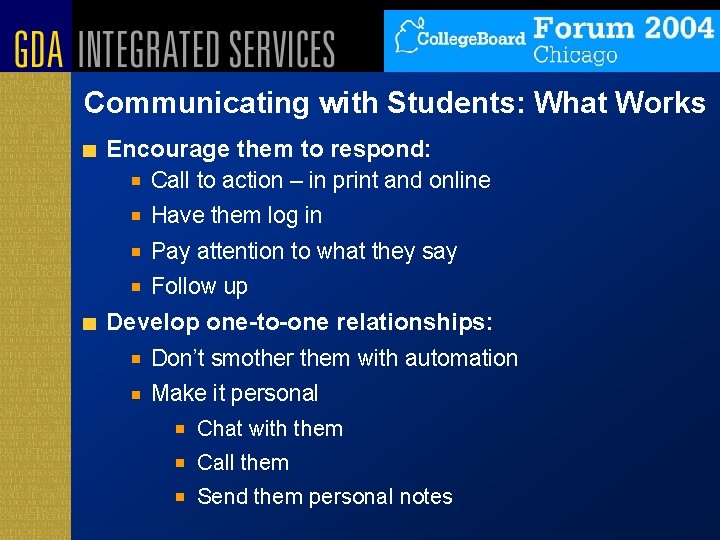
Communicating with Students: What Works Encourage them to respond: Call to action – in print and online Have them log in Pay attention to what they say Follow up Develop one-to-one relationships: Don’t smother them with automation Make it personal Chat with them Call them Send them personal notes
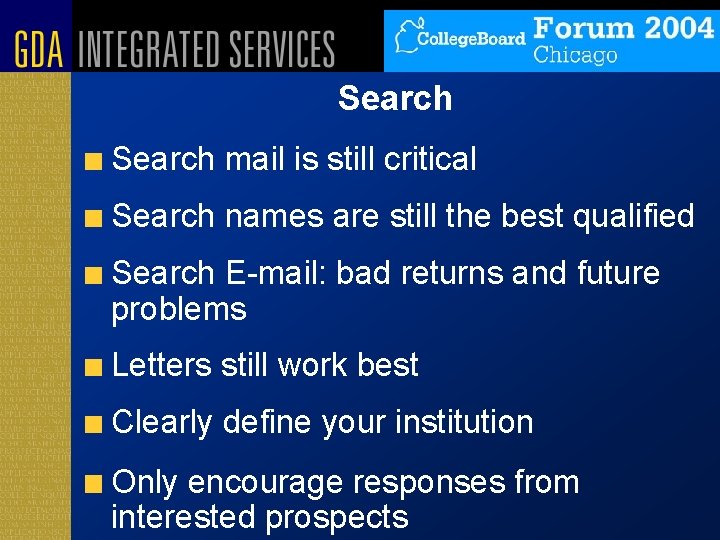
Search mail is still critical Search names are still the best qualified Search E-mail: bad returns and future problems Letters still work best Clearly define your institution Only encourage responses from interested prospects
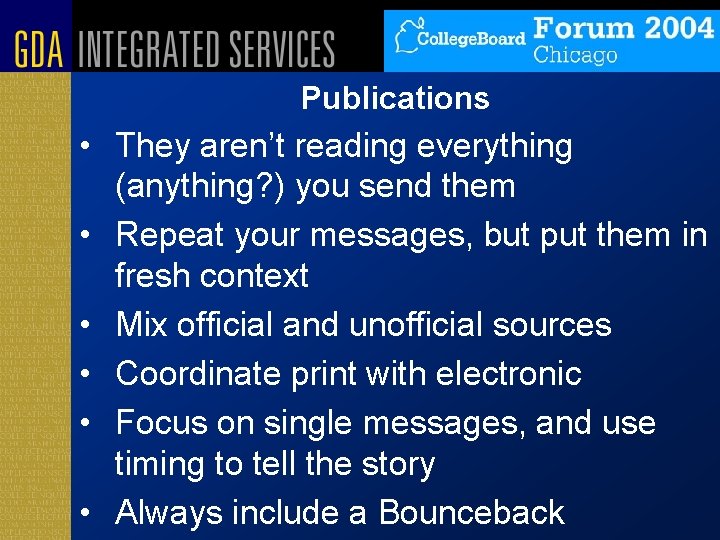
Publications • They aren’t reading everything (anything? ) you send them • Repeat your messages, but put them in fresh context • Mix official and unofficial sources • Coordinate print with electronic • Focus on single messages, and use timing to tell the story • Always include a Bounceback
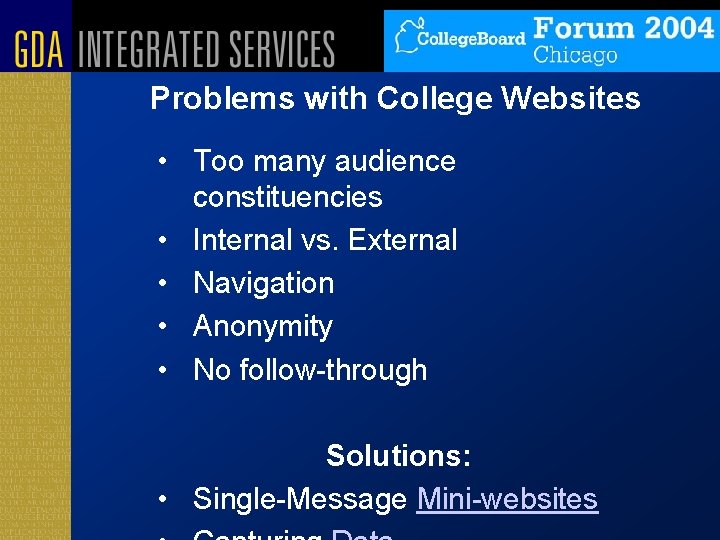
Problems with College Websites • Too many audience constituencies • Internal vs. External • Navigation • Anonymity • No follow-through Solutions: • Single-Message Mini-websites
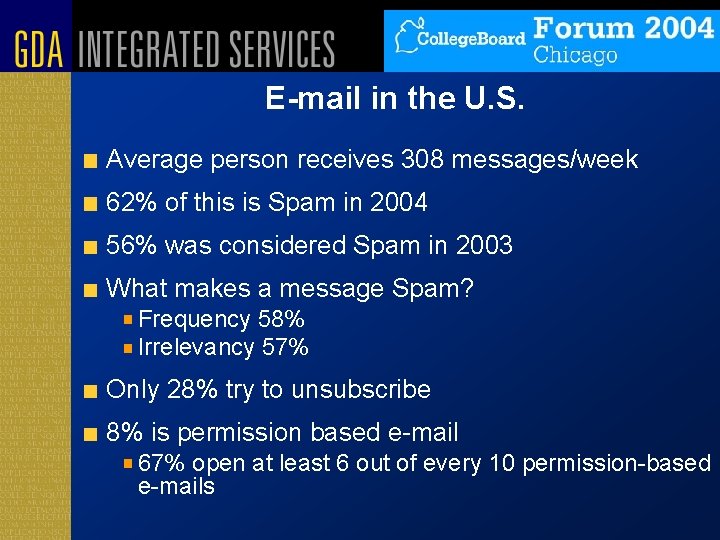
E-mail in the U. S. Average person receives 308 messages/week 62% of this is Spam in 2004 56% was considered Spam in 2003 What makes a message Spam? Frequency 58% Irrelevancy 57% Only 28% try to unsubscribe 8% is permission based e-mail 67% open at least 6 out of every 10 permission-based e-mails
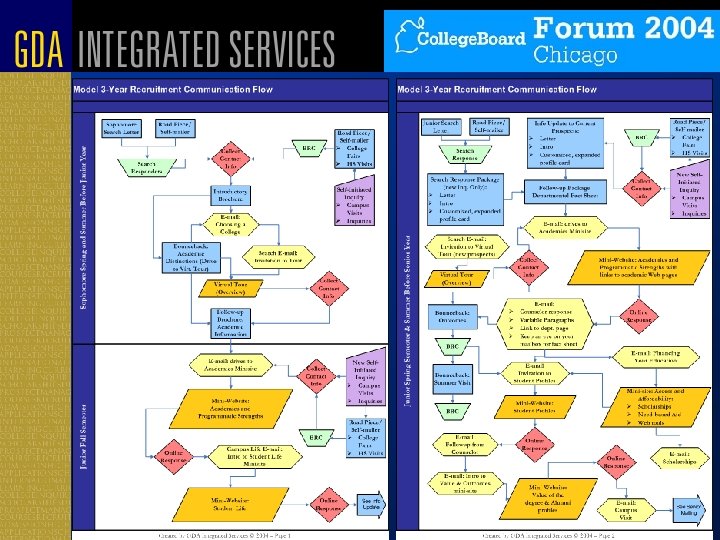
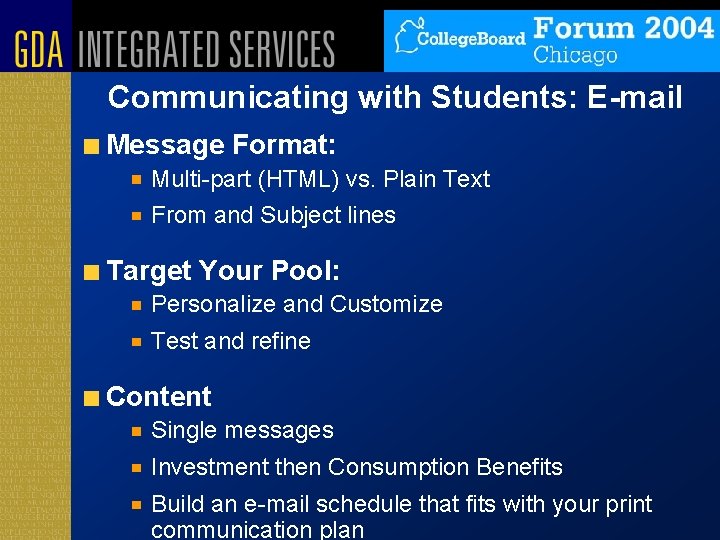
Communicating with Students: E-mail Message Format: Multi-part (HTML) vs. Plain Text From and Subject lines Target Your Pool: Personalize and Customize Test and refine Content Single messages Investment then Consumption Benefits Build an e-mail schedule that fits with your print communication plan
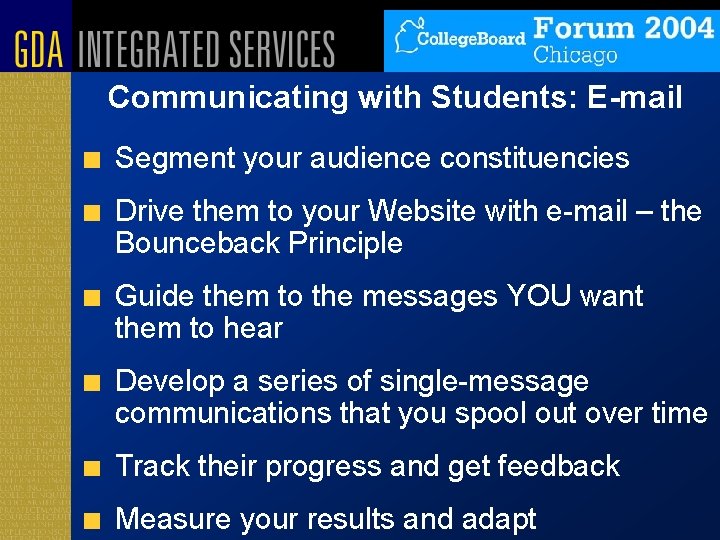
Communicating with Students: E-mail Segment your audience constituencies Drive them to your Website with e-mail – the Bounceback Principle Guide them to the messages YOU want them to hear Develop a series of single-message communications that you spool out over time Track their progress and get feedback Measure your results and adapt
The Pitfalls of E-mail and What’s Next E-mail is cheap – too cheap, and colleges have begun bombarding their Search lists Students will lose patience Colleges will get reported and blacklisted CAN-SPAM – are our Search files still compliant? Sender ID and SPF – Doesn’t that have something to do with sunscreen? G-mail: Google enters the scene- Are you ready? Instant Messaging is growing exponentially as a
Instant Messaging By the end of 2003, 20 million people worldwide were using IM in businesses This will reach 300 million by the end of 2005 42% of online Americans use instant messaging 24% of instant messengers use IM more frequently than email AOL's instant-messenger (includes ICQ) had 59. 2 million users in April MSN had 23. 6 million
Great, now I have a headache… • Keep an eye on these trends – Students will adopt new technology fastest – They expect and demand colleges to keep up • Don’t lose focus: the old rules still apply – – – Build a communication flow Make your case over time Use a mix of print and electronic communication Repeat messages until it hurts! Get feedback from students and tailor your appeal It’s still about people
THANK YOU GDA Integrated Services 33 Main Street, Suite F Old Saybrook CT 06475 860 -388 -3958 fax: 860 -388 -0595 www. gdais. com gdais@dehne. com