
Electronic Commerce The eTrading Business Models B 2
Electronic Commerce The e-Trading Business Models B 2 B & Supply Chain Management
Agenda E-Commerce – A Business Perspective: The Business-to-Business EC models (B 2 B). B 2 B and Supply Chain. 2
e-Trading Implementation Domains 1. Business-to-Business (B 2 B)
B 2 B Electronic Marketing Business-to-business (B 2 B) Requires precise record keeping, trackability, accountability, and formal contracts, usually with high volume of transactions and large amount payments 4
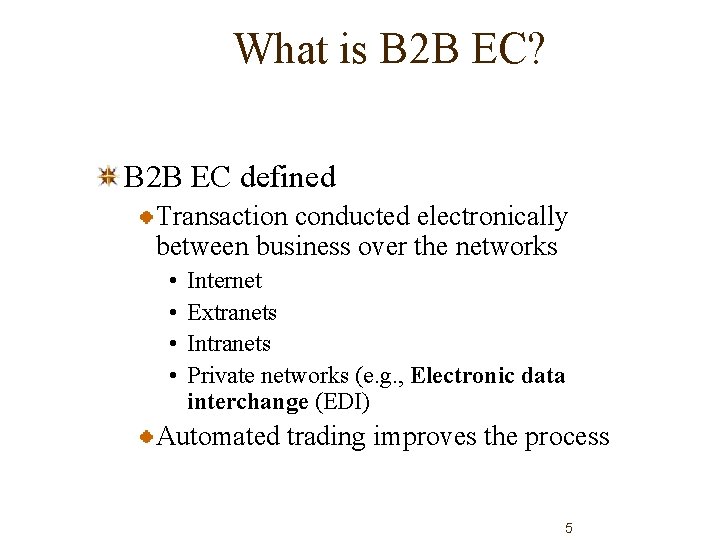
What is B 2 B EC? B 2 B EC defined Transaction conducted electronically between business over the networks • • Internet Extranets Intranets Private networks (e. g. , Electronic data interchange (EDI) Automated trading improves the process 5
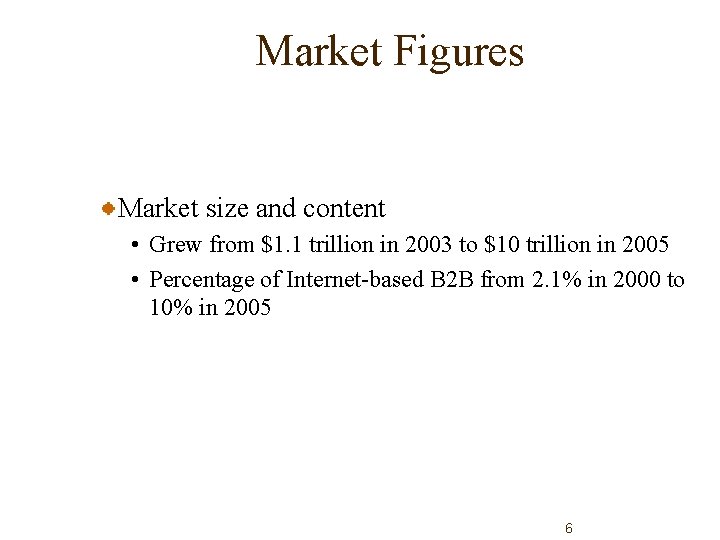
Market Figures Market size and content • Grew from $1. 1 trillion in 2003 to $10 trillion in 2005 • Percentage of Internet-based B 2 B from 2. 1% in 2000 to 10% in 2005 6
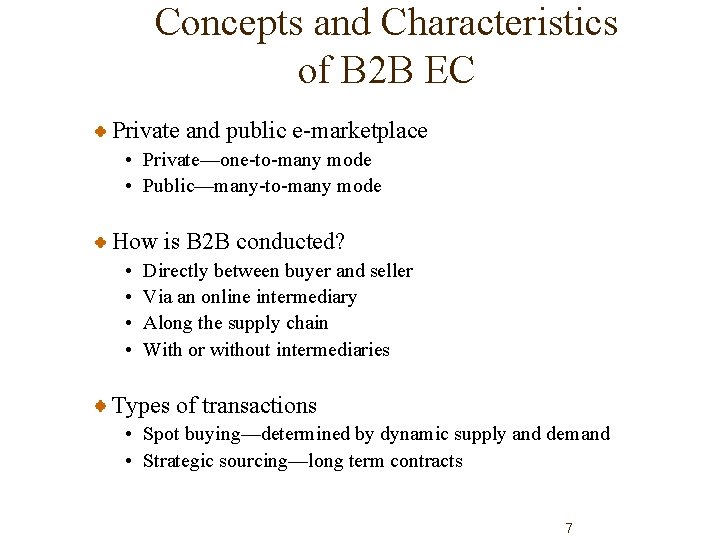
Concepts and Characteristics of B 2 B EC Private and public e-marketplace • Private—one-to-many mode • Public—many-to-many mode How is B 2 B conducted? • • Directly between buyer and seller Via an online intermediary Along the supply chain With or without intermediaries Types of transactions • Spot buying—determined by dynamic supply and demand • Strategic sourcing—long term contracts 7
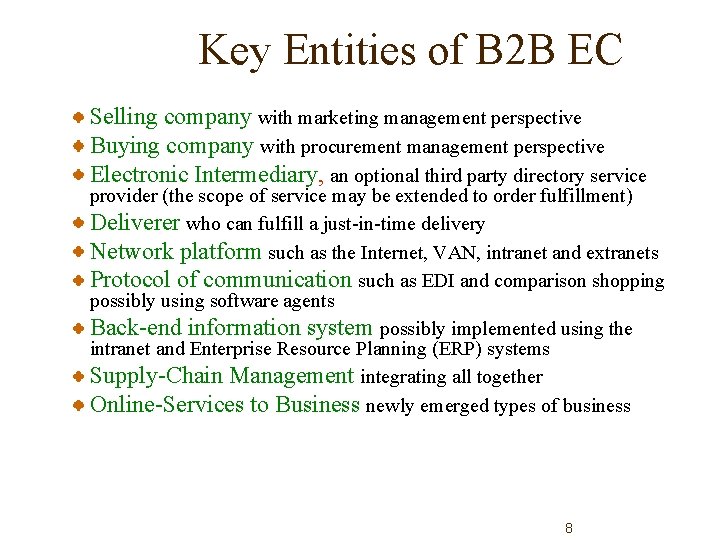
Key Entities of B 2 B EC Selling company with marketing management perspective Buying company with procurement management perspective Electronic Intermediary, an optional third party directory service provider (the scope of service may be extended to order fulfillment) Deliverer who can fulfill a just-in-time delivery Network platform such as the Internet, VAN, intranet and extranets Protocol of communication such as EDI and comparison shopping possibly using software agents Back-end information system possibly implemented using the intranet and Enterprise Resource Planning (ERP) systems Supply-Chain Management integrating all together Online-Services to Business newly emerged types of business 8
Models of B 2 B
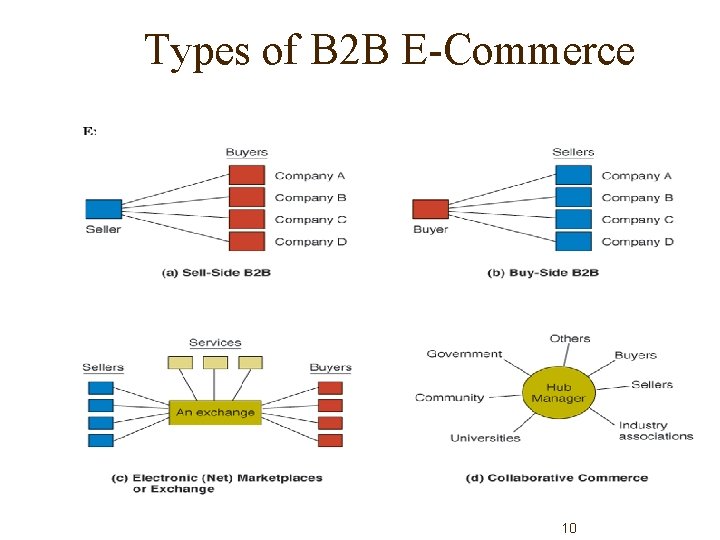
Types of B 2 B E-Commerce 10
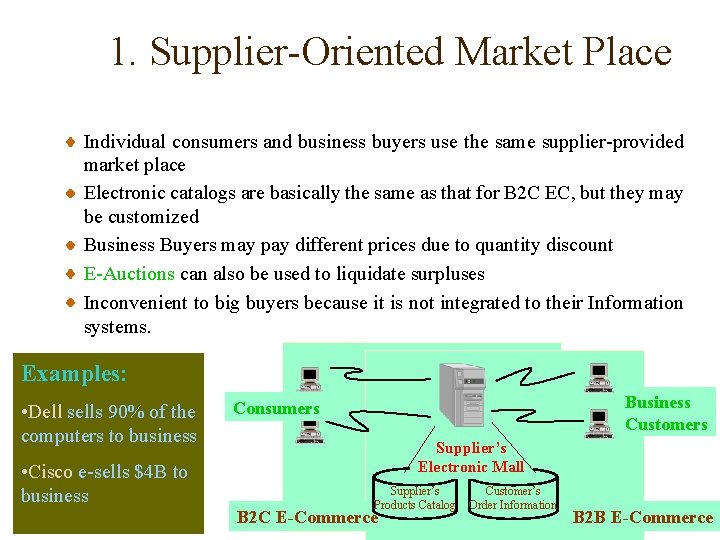
1. Supplier-Oriented Market Place Individual consumers and business buyers use the same supplier-provided market place Electronic catalogs are basically the same as that for B 2 C EC, but they may be customized Business Buyers may pay different prices due to quantity discount E-Auctions can also be used to liquidate surpluses Inconvenient to big buyers because it is not integrated to their Information systems. Examples: • Dell sells 90% of the computers to business • Cisco e-sells $4 B to business Business Customers Consumers Supplier’s Electronic Mall Supplier’s Products Catalog B 2 C E-Commerce Customer’s Order Information B 2 B E-Commerce 11
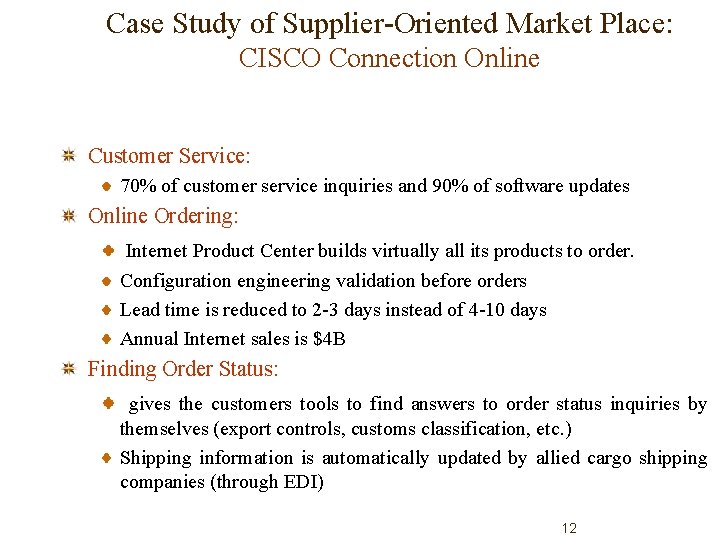
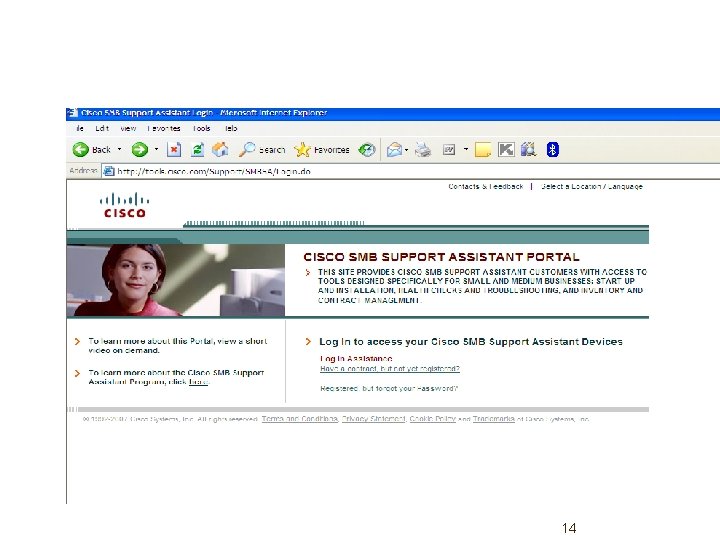
Case Study of Supplier-Oriented Market Place: CISCO Connection Online Customer Service: 70% of customer service inquiries and 90% of software updates Online Ordering: Internet Product Center builds virtually all its products to order. Configuration engineering validation before orders Lead time is reduced to 2 -3 days instead of 4 -10 days Annual Internet sales is $4 B Finding Order Status: gives the customers tools to find answers to order status inquiries by themselves (export controls, customs classification, etc. ) Shipping information is automatically updated by allied cargo shipping companies (through EDI) 12
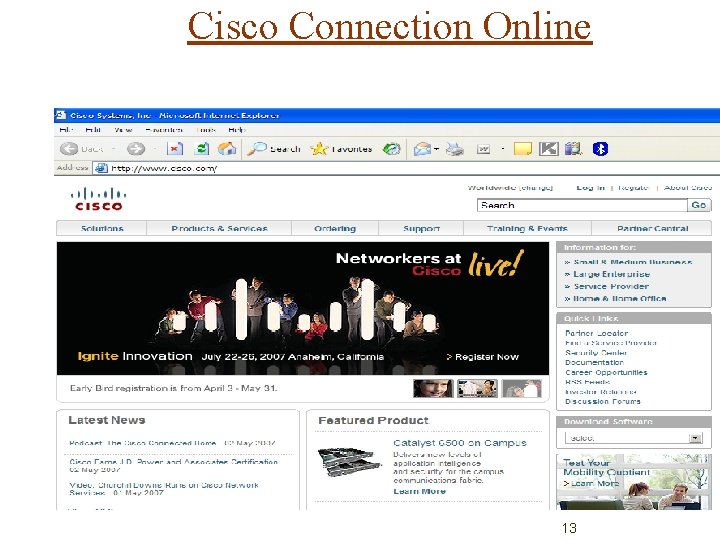
Cisco Connection Online 13
14
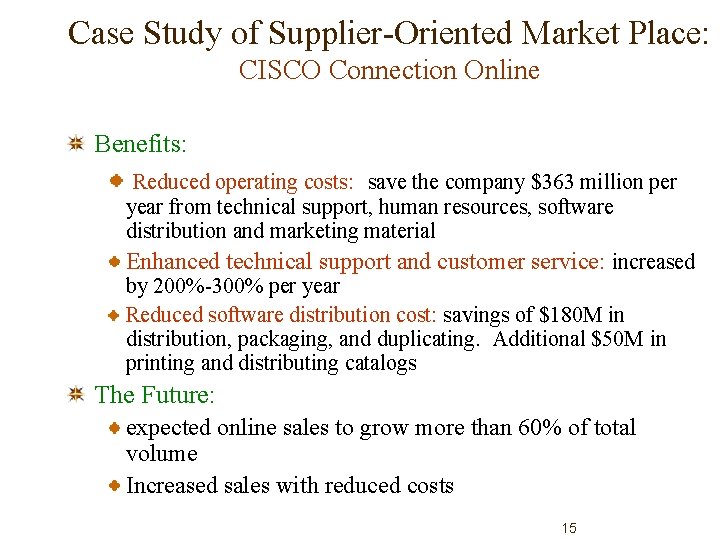
Case Study of Supplier-Oriented Market Place: CISCO Connection Online Benefits: Reduced operating costs: save the company $363 million per year from technical support, human resources, software distribution and marketing material Enhanced technical support and customer service: increased by 200%-300% per year Reduced software distribution cost: savings of $180 M in distribution, packaging, and duplicating. Additional $50 M in printing and distributing catalogs The Future: expected online sales to grow more than 60% of total volume Increased sales with reduced costs 15
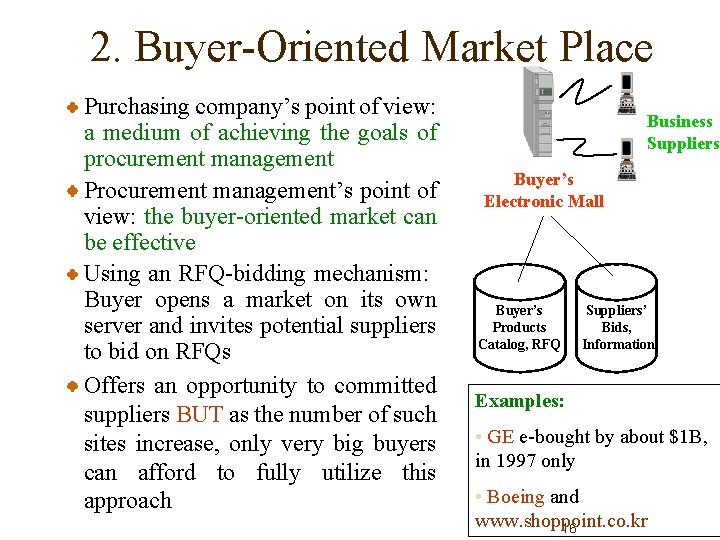
2. Buyer-Oriented Market Place Purchasing company’s point of view: a medium of achieving the goals of procurement management Procurement management’s point of view: the buyer-oriented market can be effective Using an RFQ-bidding mechanism: Buyer opens a market on its own server and invites potential suppliers to bid on RFQs Offers an opportunity to committed suppliers BUT as the number of such sites increase, only very big buyers can afford to fully utilize this approach Business Suppliers Buyer’s Electronic Mall Buyer’s Products Catalog, RFQ Suppliers’ Bids, Information Examples: • GE e-bought by about $1 B, in 1997 only • Boeing and www. shoppoint. co. kr 16
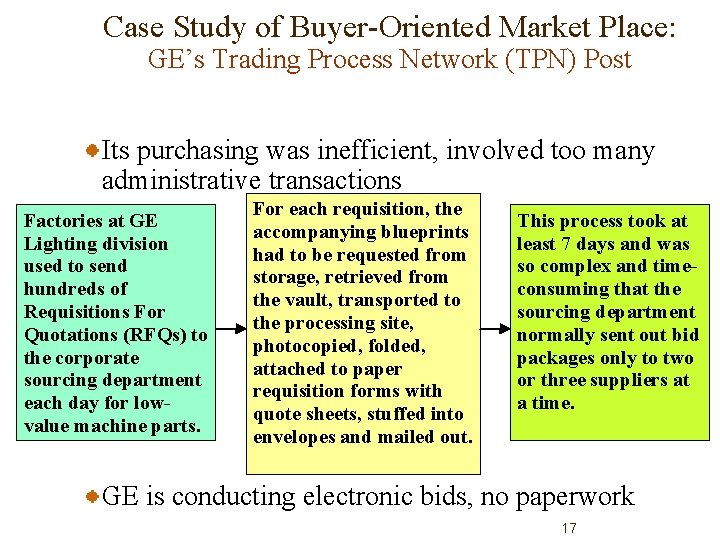
Case Study of Buyer-Oriented Market Place: GE’s Trading Process Network (TPN) Post Its purchasing was inefficient, involved too many administrative transactions Factories at GE Lighting division used to send hundreds of Requisitions For Quotations (RFQs) to the corporate sourcing department each day for lowvalue machine parts. For each requisition, the accompanying blueprints had to be requested from storage, retrieved from the vault, transported to the processing site, photocopied, folded, attached to paper requisition forms with quote sheets, stuffed into envelopes and mailed out. This process took at least 7 days and was so complex and timeconsuming that the sourcing department normally sent out bid packages only to two or three suppliers at a time. GE is conducting electronic bids, no paperwork 17
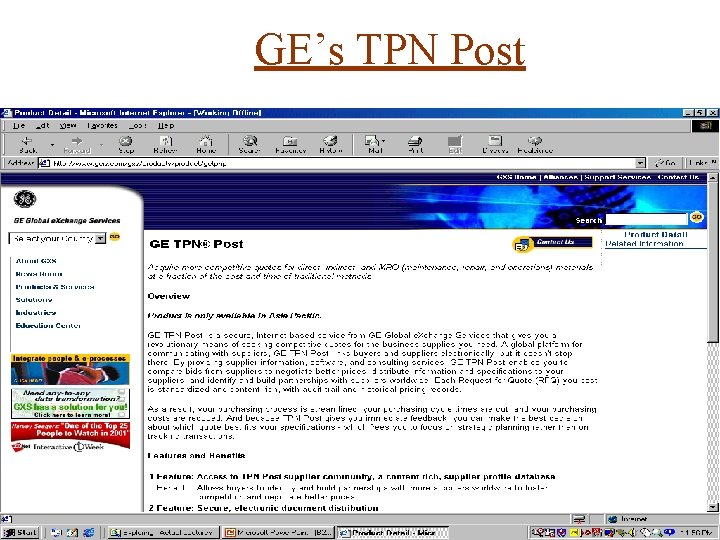
GE’s TPN Post 18
GE’s TPN Post 19
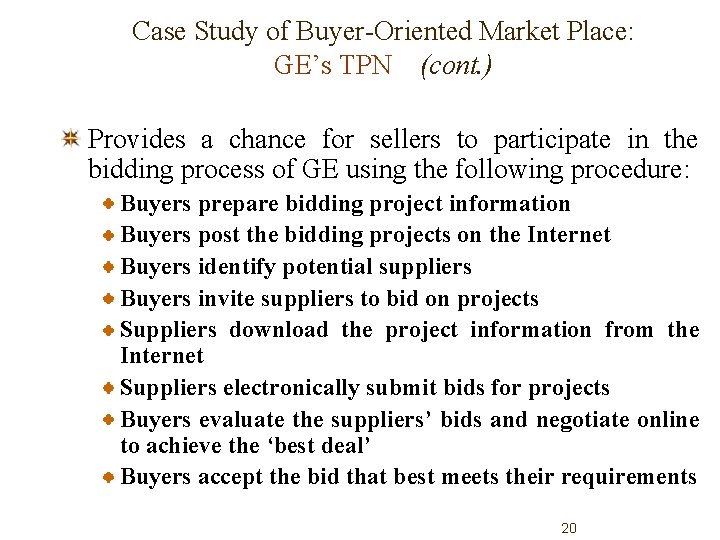
Case Study of Buyer-Oriented Market Place: GE’s TPN (cont. ) Provides a chance for sellers to participate in the bidding process of GE using the following procedure: Buyers prepare bidding project information Buyers post the bidding projects on the Internet Buyers identify potential suppliers Buyers invite suppliers to bid on projects Suppliers download the project information from the Internet Suppliers electronically submit bids for projects Buyers evaluate the suppliers’ bids and negotiate online to achieve the ‘best deal’ Buyers accept the bid that best meets their requirements 20
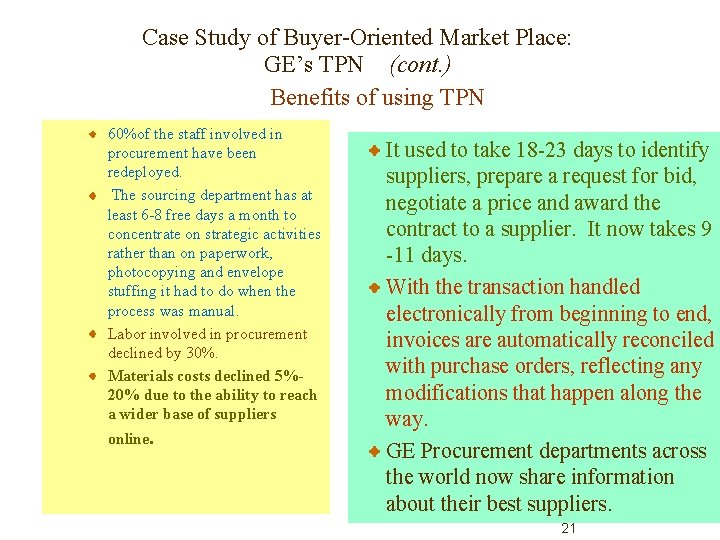
Case Study of Buyer-Oriented Market Place: GE’s TPN (cont. ) Benefits of using TPN 60%of the staff involved in procurement have been redeployed. The sourcing department has at least 6 -8 free days a month to concentrate on strategic activities rather than on paperwork, photocopying and envelope stuffing it had to do when the process was manual. Labor involved in procurement declined by 30%. Materials costs declined 5%20% due to the ability to reach a wider base of suppliers online. It used to take 18 -23 days to identify suppliers, prepare a request for bid, negotiate a price and award the contract to a supplier. It now takes 9 -11 days. With the transaction handled electronically from beginning to end, invoices are automatically reconciled with purchase orders, reflecting any modifications that happen along the way. GE Procurement departments across the world now share information about their best suppliers. 21
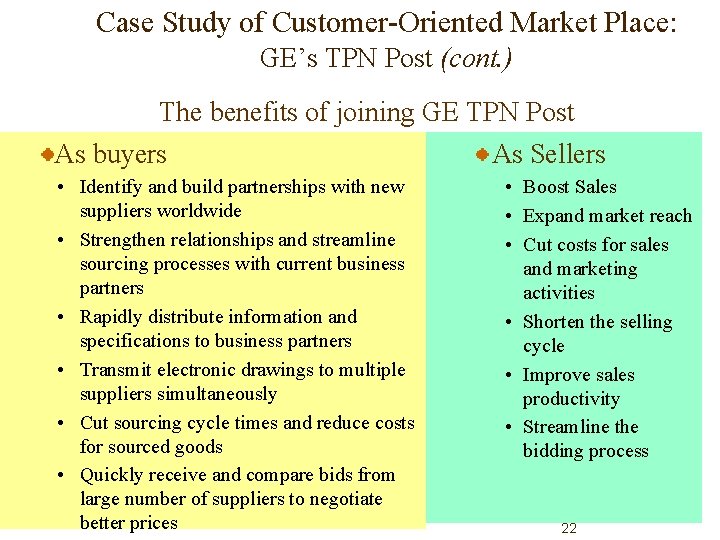
Case Study of Customer-Oriented Market Place: GE’s TPN Post (cont. ) The benefits of joining GE TPN Post As buyers • Identify and build partnerships with new suppliers worldwide • Strengthen relationships and streamline sourcing processes with current business partners • Rapidly distribute information and specifications to business partners • Transmit electronic drawings to multiple suppliers simultaneously • Cut sourcing cycle times and reduce costs for sourced goods • Quickly receive and compare bids from large number of suppliers to negotiate better prices As Sellers • Boost Sales • Expand market reach • Cut costs for sales and marketing activities • Shorten the selling cycle • Improve sales productivity • Streamline the bidding process 22
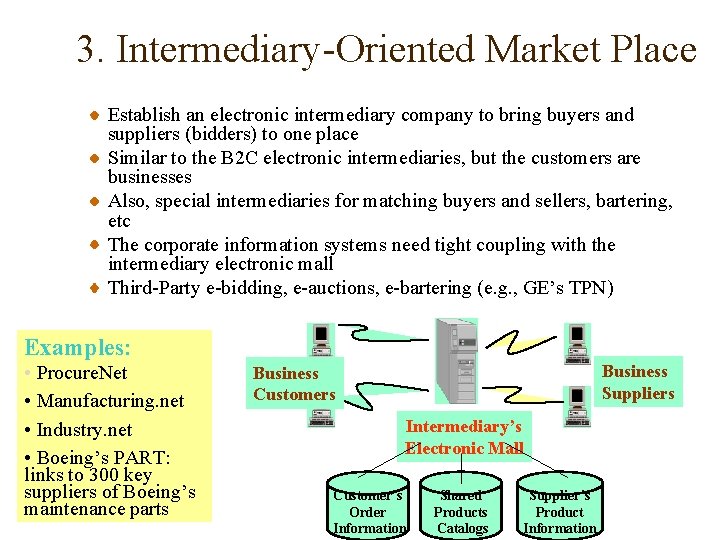
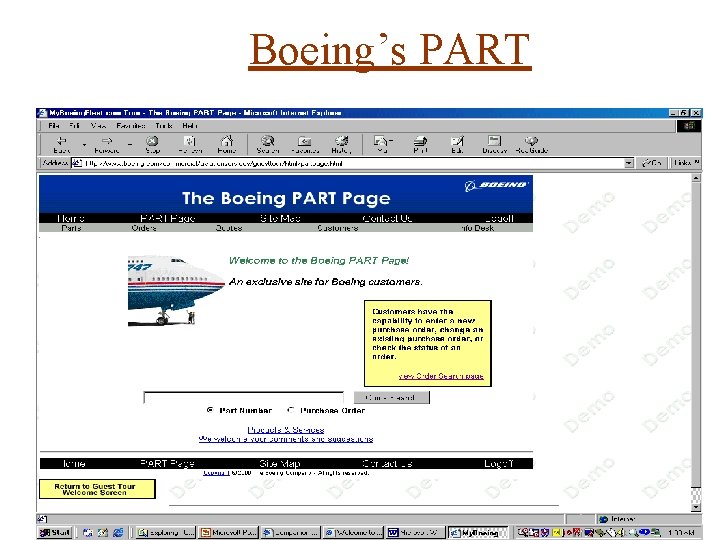
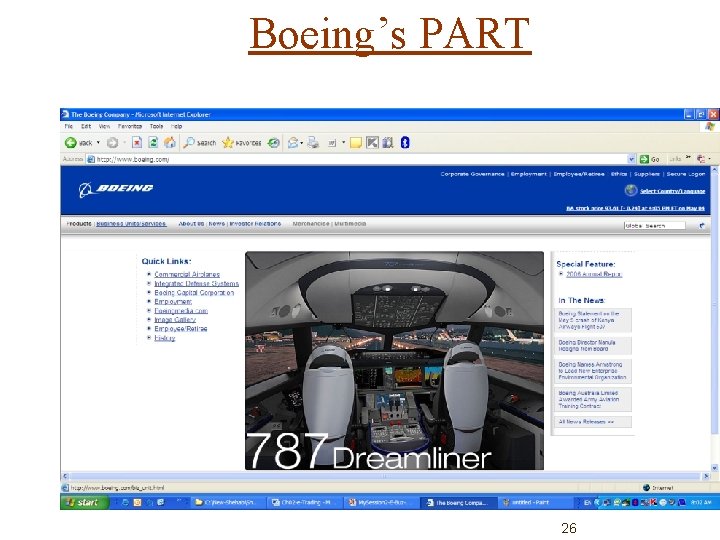
3. Intermediary-Oriented Market Place Establish an electronic intermediary company to bring buyers and suppliers (bidders) to one place Similar to the B 2 C electronic intermediaries, but the customers are businesses Also, special intermediaries for matching buyers and sellers, bartering, etc The corporate information systems need tight coupling with the intermediary electronic mall Third-Party e-bidding, e-auctions, e-bartering (e. g. , GE’s TPN) Examples: • Procure. Net • Manufacturing. net • Industry. net • Boeing’s PART: links to 300 key suppliers of Boeing’s maintenance parts Business Suppliers Business Customers Intermediary’s Electronic Mall Customer’s Order Information Shared Products Catalogs Supplier’s Product 23 Information
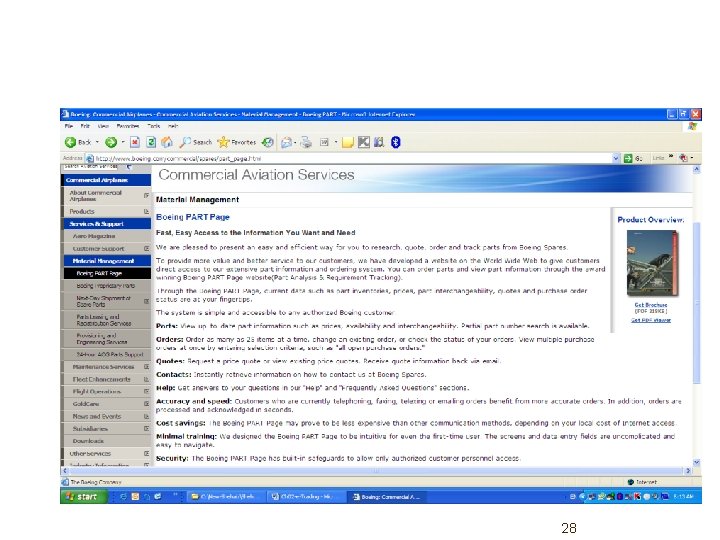
Case Study of Intermediary-Oriented Market Place: Boeing’s PART Acts as an intermediary between the airlines and parts’ suppliers Provides a single point of online access through which airlines and parts providers can access the data needed Goal: provide its customers with onestop shopping with online parts and maintenance information and ordering capability Revenue is a minor concern here This model is extremely useful for assembling companies who provide maintenance parts 24
Boeing’s PART 25
Boeing’s PART 26
Case Study of Intermediary-Oriented Market Place: Boeing’s PART (cont. ) Boeing On Line Data (BOLD) Incorporating not only engineering drawings but manuals, catalogs and other technical information that used to be available only in paper or in microfiche format Portable Maintenance Aid (PMA) Solves maintenance problems 27
28
Case Study of Intermediary-Oriented Market Place: Boeing’s PART (cont. ) Benefits to Boeing’s Customers Increased productivity • spending less time searching for information; frees up engineers and maintenance technicians to focus on more productive activities • one airliner saved $1. 5 M/year due to 4% increased productivity Reduced costs • with information available online at the airports’ gates, through PMA, rather than back in the office, delays at the gate due to missing information are reduced by 5 -10% Increased revenue opportunity • through BOLD and PMA, a European airline estimates it will save 1 -2 days/year of routine maintenance down time for each aircraft (a saving of tens of thousands of dollars for each idle day) Should Boeing keep the inventory of parts in stock, or rely on the manufacturers? 29
Models of B 2 B EC (Guidelines) Question: Are all B 2 B through extranets? Can Internet be used for this type? How? If sales promotion is a major concern and there is enough loyal business customers, adopt the Supplier-Oriented Marketing approach possibly joining popular Intermediary. Oriented Market Places as well If purchase process re-engineering is a major concern, consider establishing Customer-Oriented Market Place (if sales volume is big enough) to attract the attention of major vendors Otherwise, join a third party Intermediary-Oriented Market Place to implement the plan from either or both aspects, because every company needs effective and efficient sales and purchases 30
4. Procurement Management Using B 2 B EC Platform A direct relationship with committed suppliers where items and prices are pre-agreed upon. The end-buyer (not procurement) can have direct access to the information stored in an internal database, to simplify the purchasing decision Effectively applied for low-valued items with highly repetitive purchases from committed suppliers, avoiding inventory 31
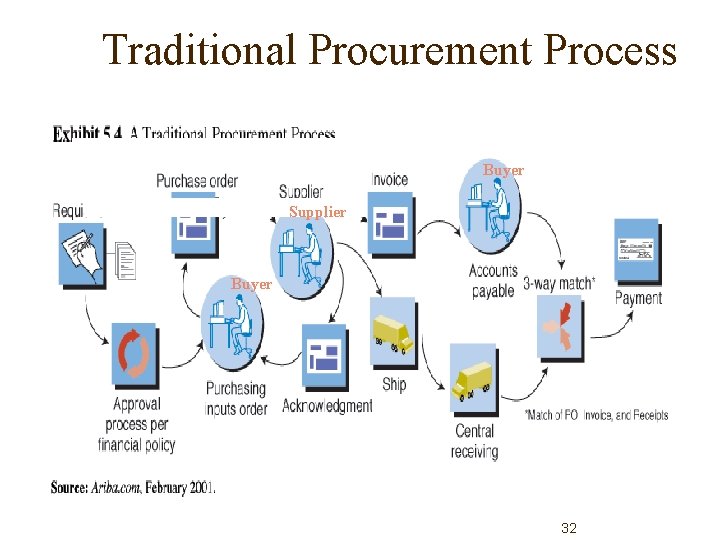
Traditional Procurement Process Buyer Supplier Buyer 32
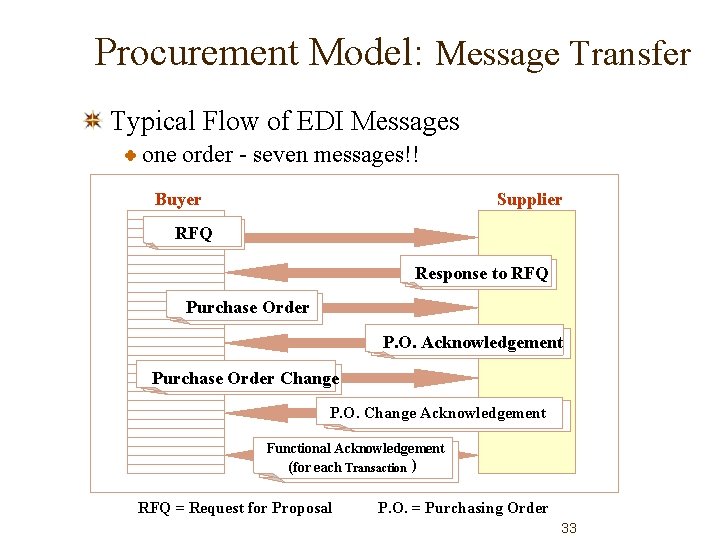
Procurement Model: Message Transfer Typical Flow of EDI Messages one order - seven messages!! Buyer Supplier RFQ Response to RFQ Purchase Order P. O. Acknowledgement Purchase Order Change P. O. Change Acknowledgement Functional Acknowledgement (for each Transaction ) RFQ = Request for Proposal P. O. = Purchasing Order 33
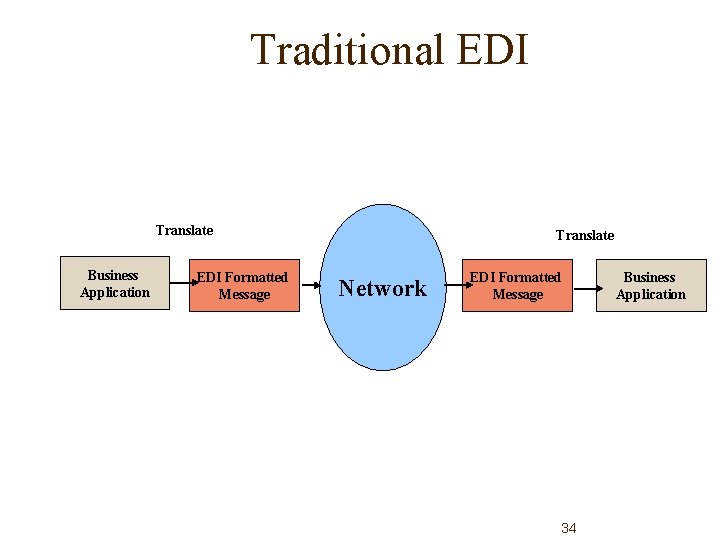
Traditional EDI Translate Business Application EDI Formatted Message Translate Network EDI Formatted Message 34 Business Application
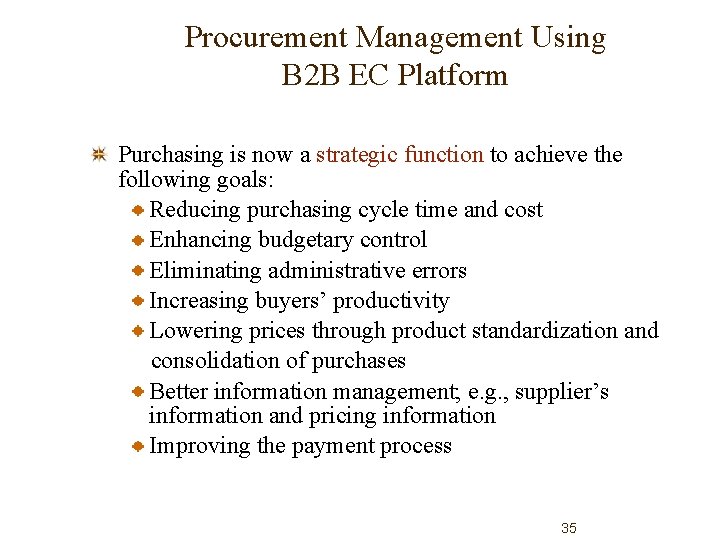
Procurement Management Using B 2 B EC Platform Purchasing is now a strategic function to achieve the following goals: Reducing purchasing cycle time and cost Enhancing budgetary control Eliminating administrative errors Increasing buyers’ productivity Lowering prices through product standardization and consolidation of purchases Better information management; e. g. , supplier’s information and pricing information Improving the payment process 35
5. Aggregation Models Buyers’ aggregation Suppliers’ Aggregation Exchanges (Hubs) 36
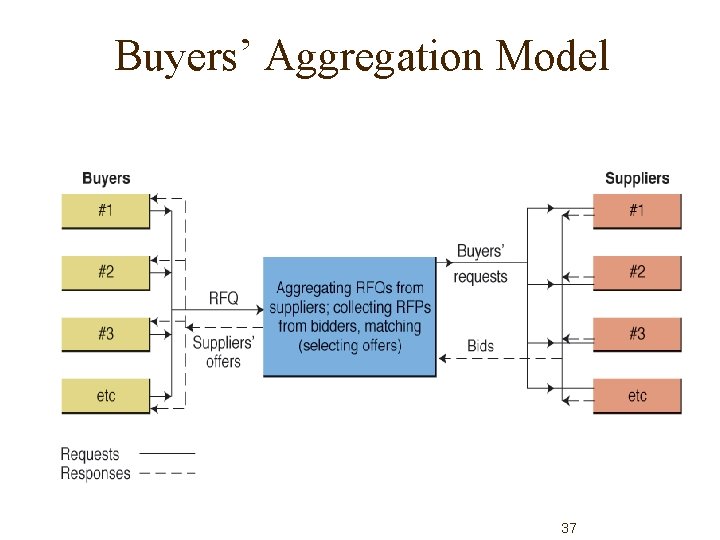
Buyers’ Aggregation Model 37
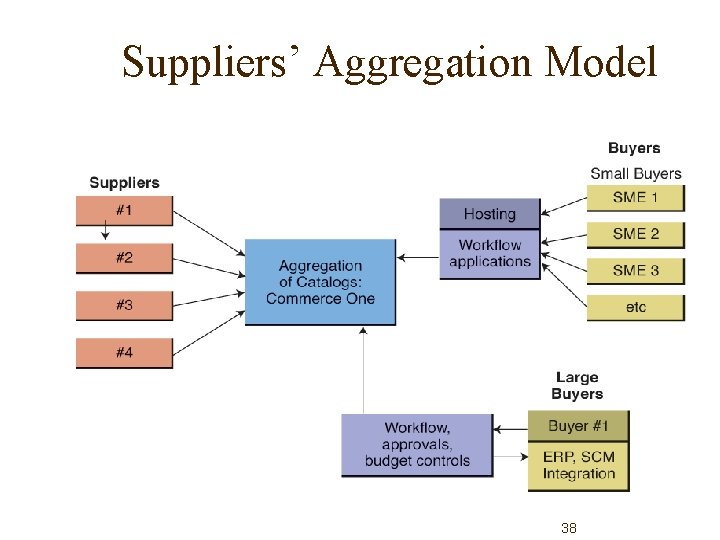
Suppliers’ Aggregation Model 38
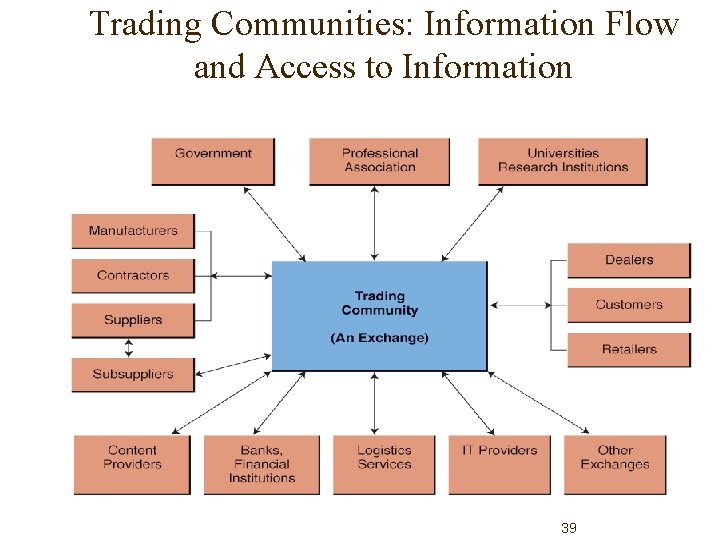
Trading Communities: Information Flow and Access to Information 39
6. Just-In-Time Delivery Delivering materials and parts in time is essential; and EC helps realizing JIT The advanced confirmation of the delivery date at the contract stage is important (different than in B 2 C) Example: Fed Express Inter. Net. Ship Internet and private networks improve efficiency and customer satisfaction Fed. Ex Power. Ship and Fed. Ex Ship were the two software rolled out in the mid-1980 s and 1995 respectively Now moving to the Internet : Inter. Net. Ship 40
Just-In-Time Delivery: Fed Express Inter. Net. Ship Fed. Ex Inter. Net. Ship Extends online capabilities to the Internet Customers can request a parcel pickup or find the nearest drop-off point, print packing labels, compute fees, request invoice adjustments and track the status of their deliveries without leaving the Web site Fed. Ex COSMOS (own proprietary network) handles 54 million transactions a day (1998) Hundreds of thousands of tracking requests per month come from links from over 5, 000 Web sites to fedex. com 41
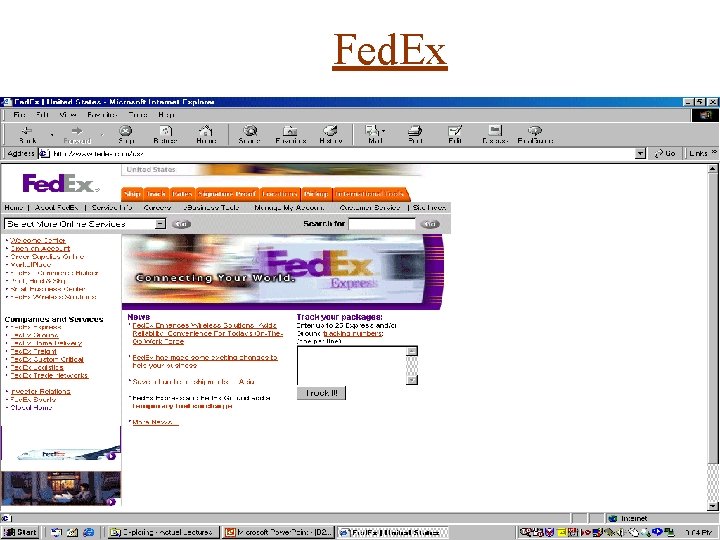
Fed. Ex 42
Just-In-Time Delivery: Fed Express Inter. Net. Ship (cont. ) Benefits to Fed. Ex Avoided Costs • If not for Fed. Ex Power. Ship, Fed. Ex would have had to hire an additional 20, 000 employees to answer phone calls at the call centers and key in air bills Lower Operating Costs • Without the system, approximately half of the calls would have gone to Fed. Ex’s toll-free number resulting in high telephone and labor expenses Better Customer Service • Customers still have a choice for how they interact with the company, whether by e-mail, phone, fax or other means 43
e-Commerce Implementation Domains 2. Supply-Chain Management
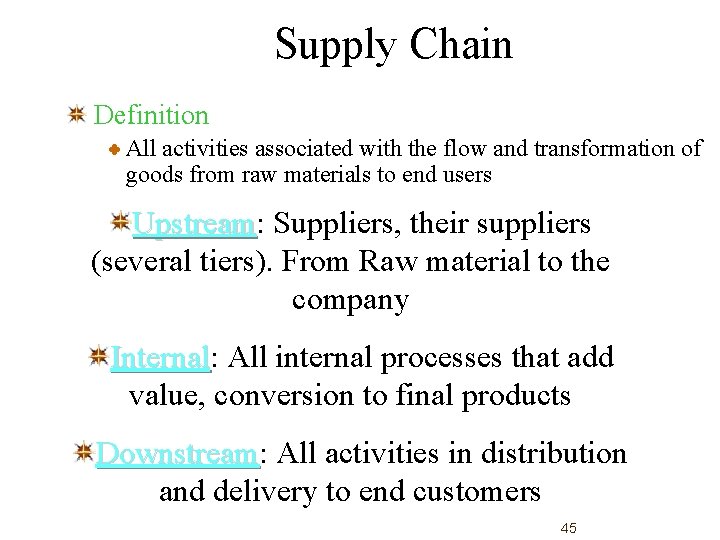
Supply Chain Definition All activities associated with the flow and transformation of goods from raw materials to end users Upstream: Suppliers, their suppliers Upstream (several tiers). From Raw material to the company Internal: All internal processes that add Internal value, conversion to final products Downstream: All activities in distribution Downstream and delivery to end customers 45
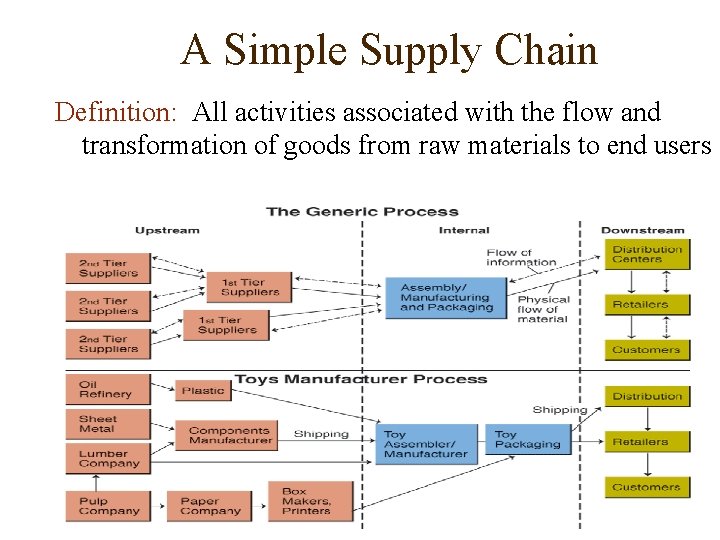
A Simple Supply Chain Definition: All activities associated with the flow and transformation of goods from raw materials to end users 46
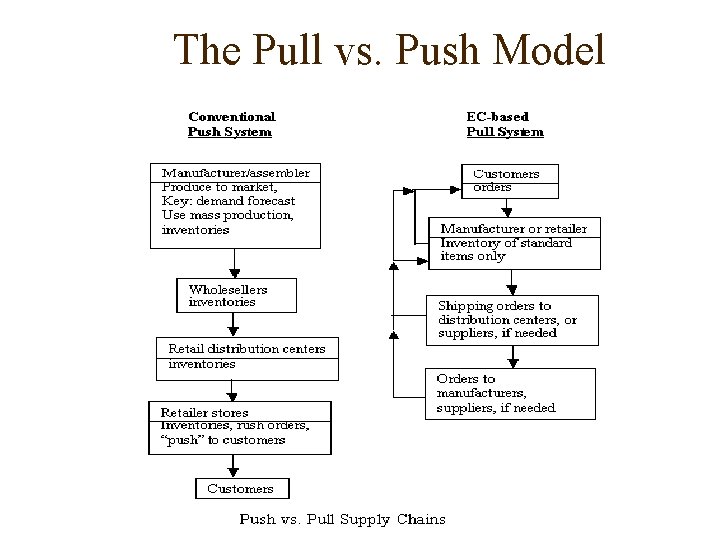
The Pull vs. Push Model 47
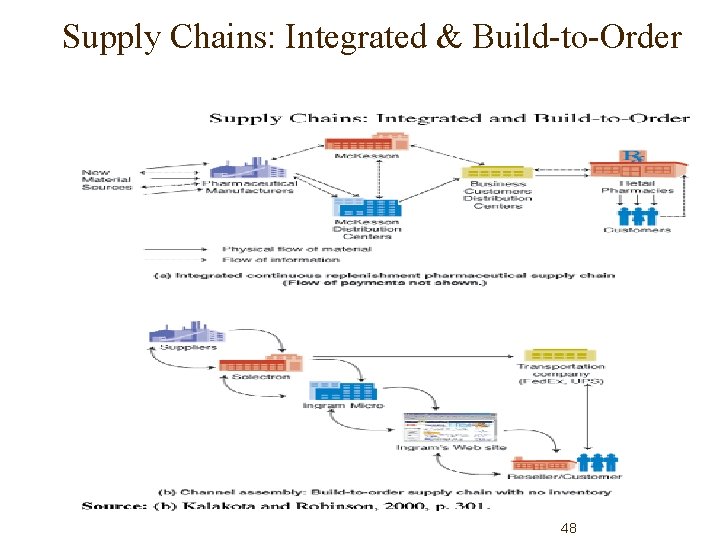
Supply Chains: Integrated & Build-to-Order 48
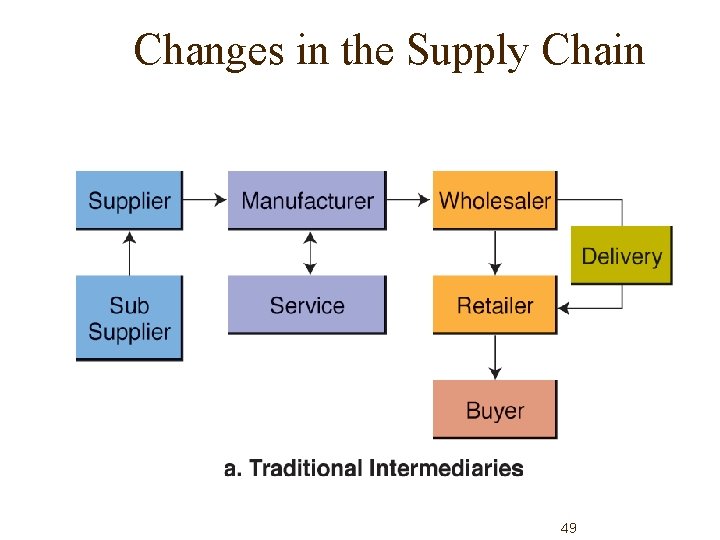
Changes in the Supply Chain 49
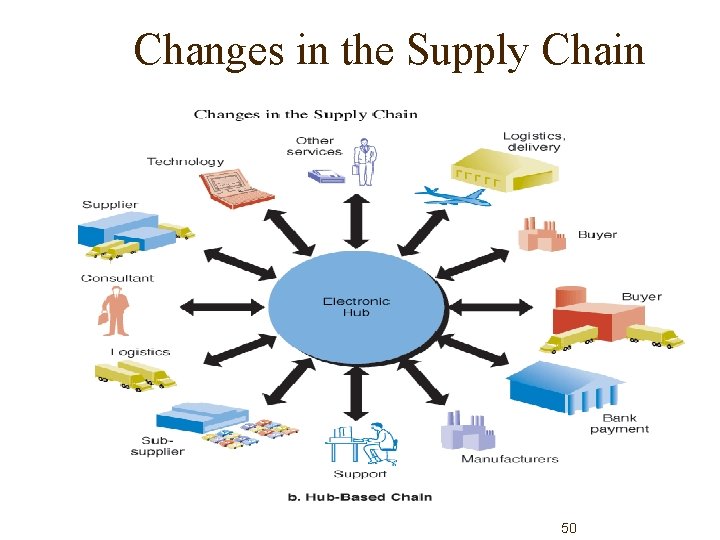
Changes in the Supply Chain 50
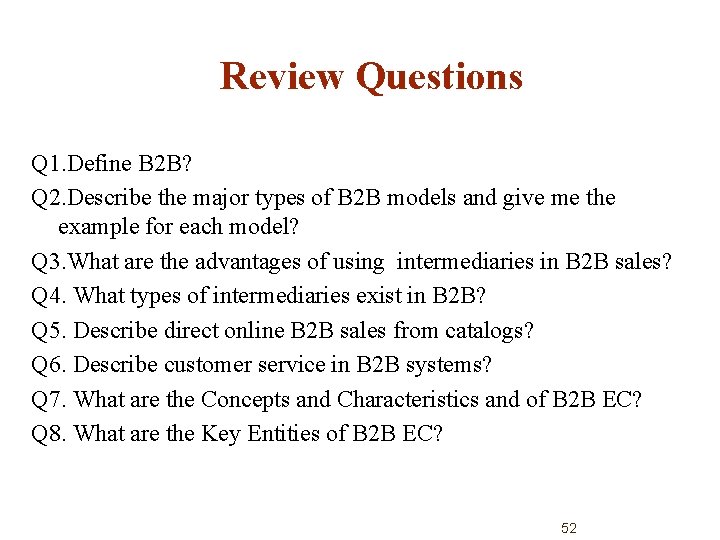
Review Questions Q 1. Define B 2 B? Q 2. Describe the major types of B 2 B models and give me the example for each model? Q 3. What are the advantages of using intermediaries in B 2 B sales? Q 4. What types of intermediaries exist in B 2 B? Q 5. Describe direct online B 2 B sales from catalogs? Q 6. Describe customer service in B 2 B systems? Q 7. What are the Concepts and Characteristics and of B 2 B EC? Q 8. What are the Key Entities of B 2 B EC? 52
- Slides: 51