
Electronic Citations Purpose of Citations The purpose of
- Slides: 21
Electronic Citations
Purpose of Citations The purpose of using citations is to provide readers with away to locate your information for themselves.
Types of Citations Four most popular formats in college are: n MLA = Used by English majors n APA = Used by Social Sciences, Science, and Education majors n Chicago = ? ? ? n Turabian = ? ? ? All Madison City Schools use the MLA format.
“MLA Documentation Style Documentation of sources take two forms in a paper: Acknowledge your sources by keying brief parenthetical citations in your text to an alphabetical list of works that appear at the end of the paper” (Gibaldi 1995). 1995 Gibaldi, Joseph. MLA Handbook for Writers of Research Papers. 4 th Edition. New York: Modern language Association of American, 1995. 120 -121. (Page number optional)
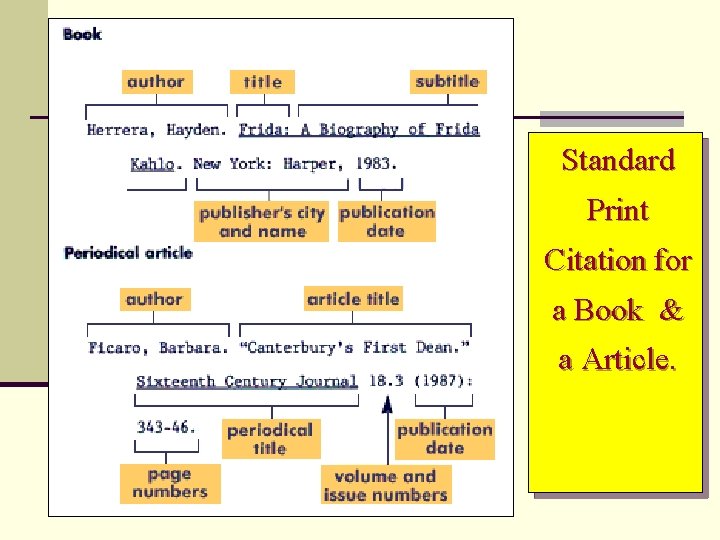
Standard Print Citation for a Book & a Article.
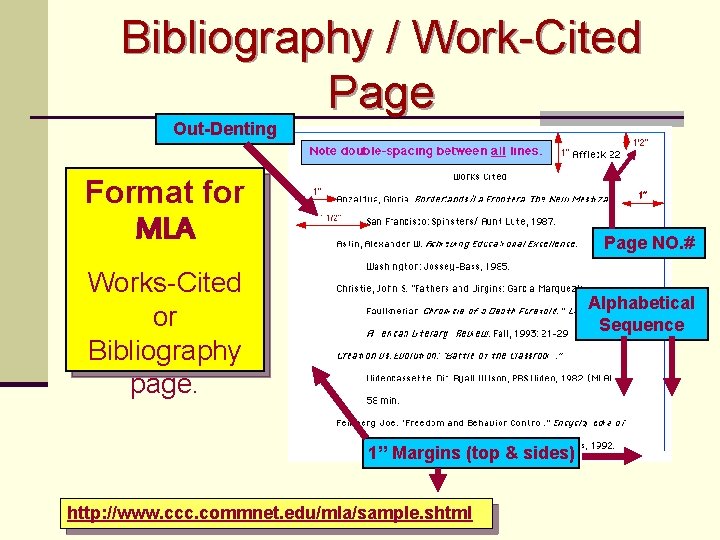
Bibliography / Work-Cited Page Out-Denting Format for MLA Page NO. # Works-Cited or Bibliography page. Alphabetical Sequence 1” Margins (top & sides) http: //www. ccc. commnet. edu/mla/sample. shtml
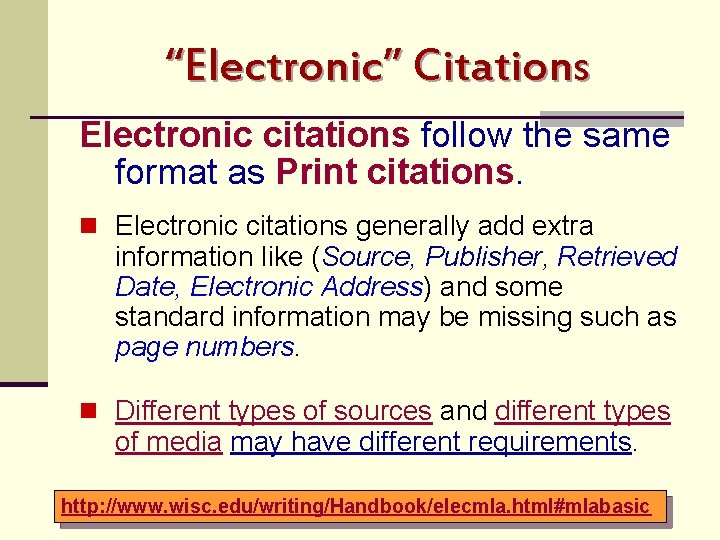
“Electronic” Citations Electronic citations follow the same format as Print citations. n Electronic citations generally add extra information like (Source, Publisher, Retrieved Date, Electronic Address) and some standard information may be missing such as page numbers. n Different types of sources and different types of media may have different requirements. http: //www. wisc. edu/writing/Handbook/elecmla. html#mlabasic
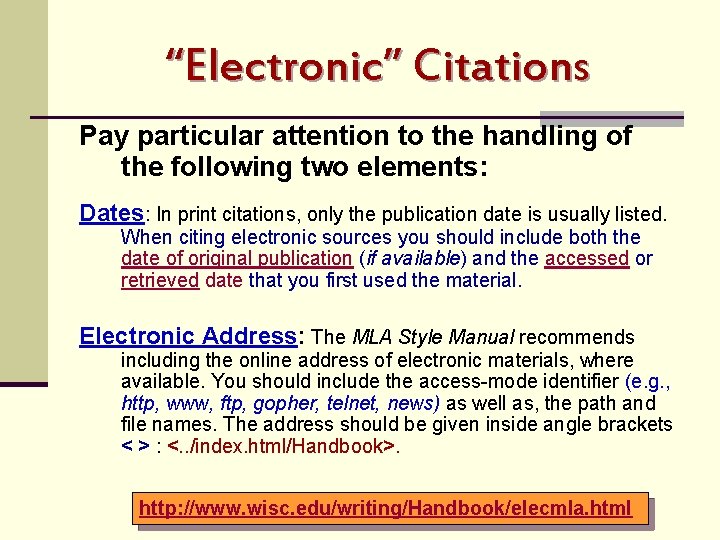
“Electronic” Citations Pay particular attention to the handling of the following two elements: Dates: In print citations, only the publication date is usually listed. When citing electronic sources you should include both the date of original publication (if available) and the accessed or retrieved date that you first used the material. Electronic Address: The MLA Style Manual recommends including the online address of electronic materials, where available. You should include the access-mode identifier (e. g. , http, www, ftp, gopher, telnet, news) as well as, the path and file names. The address should be given inside angle brackets < > : <. . /index. html/Handbook>. http: //www. wisc. edu/writing/Handbook/elecmla. html
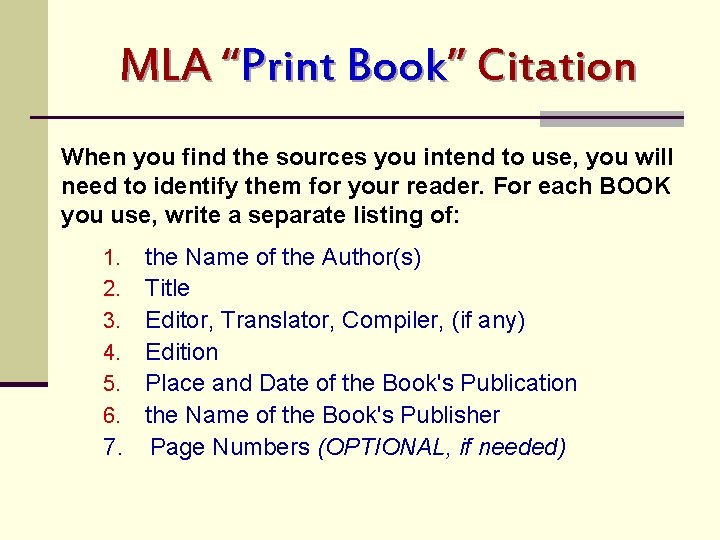
MLA “Print Book” Citation When you find the sources you intend to use, you will need to identify them for your reader. For each BOOK you use, write a separate listing of: the Name of the Author(s) Title Editor, Translator, Compiler, (if any) Edition Place and Date of the Book's Publication the Name of the Book's Publisher 7. Page Numbers (OPTIONAL, if needed) 1. 2. 3. 4. 5. 6.
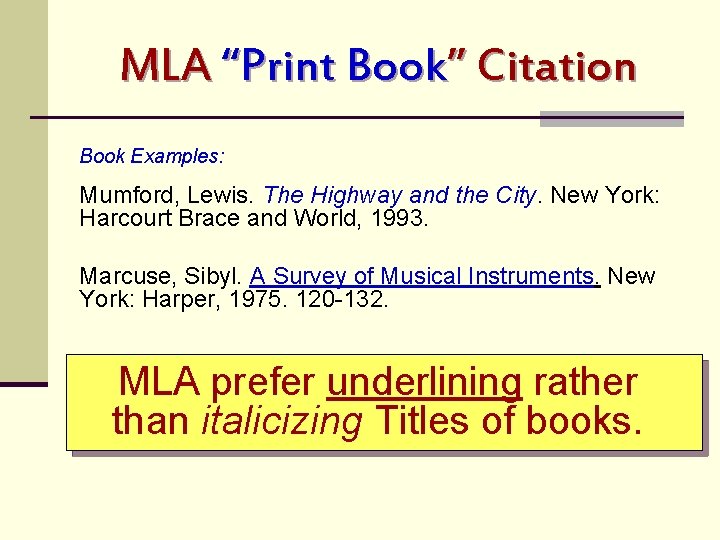
MLA “Print Book” Citation Book Examples: Mumford, Lewis. The Highway and the City. New York: Harcourt Brace and World, 1993. Marcuse, Sibyl. A Survey of Musical Instruments. New York: Harper, 1975. 120 -132. MLA prefer underlining rather than italicizing Titles of books.
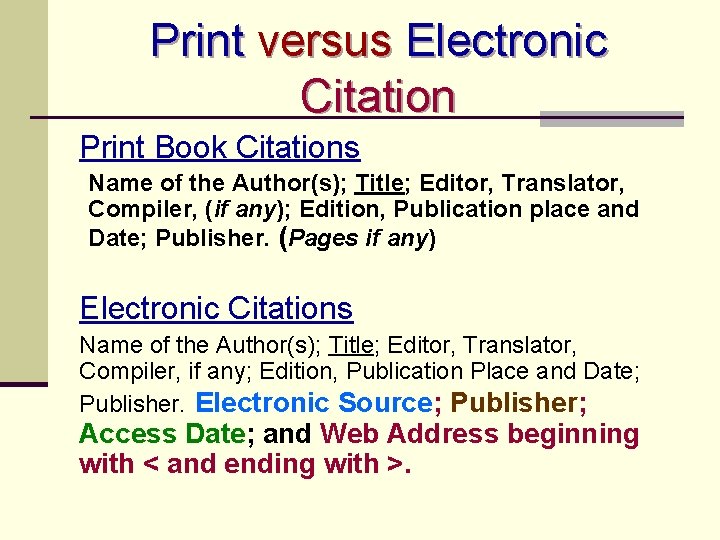
Print versus Electronic Citation Print Book Citations Name of the Author(s); Title; Editor, Translator, Compiler, (if any); Edition, Publication place and Date; Publisher. (Pages if any) Electronic Citations Name of the Author(s); Title; Editor, Translator, Compiler, if any; Edition, Publication Place and Date; Publisher. Electronic Source; Publisher; Access Date; and Web Address beginning with < and ending with >.
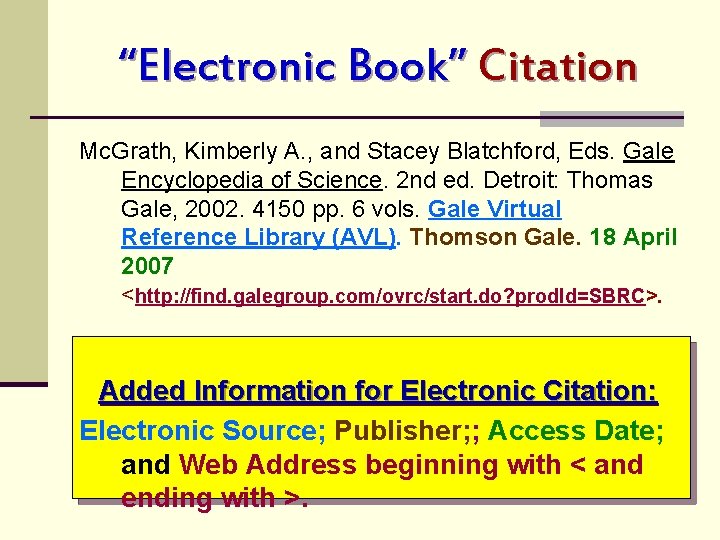
“Electronic Book” Citation Mc. Grath, Kimberly A. , and Stacey Blatchford, Eds. Gale Encyclopedia of Science. 2 nd ed. Detroit: Thomas Gale, 2002. 4150 pp. 6 vols. Gale Virtual Reference Library (AVL). Thomson Gale. 18 April 2007 <http: //find. galegroup. com/ovrc/start. do? prod. Id=SBRC>. Added Information for Electronic Citation: Electronic Source; Publisher; ; Access Date; and Web Address beginning with < and ending with >.
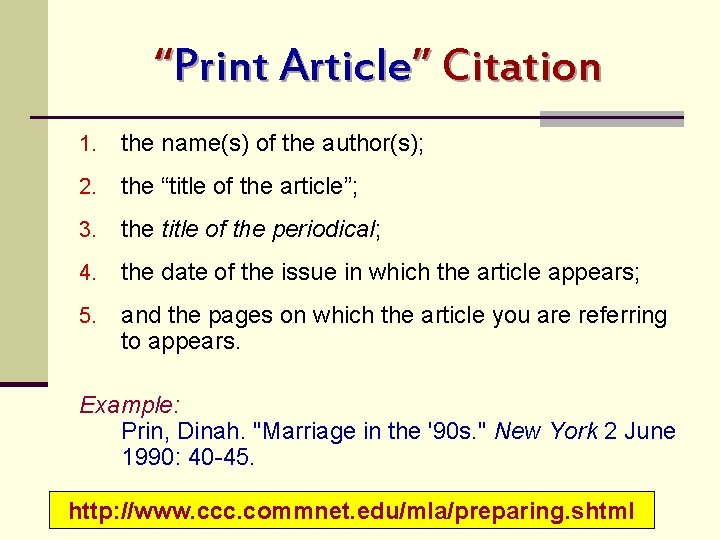
“Print Article” Citation 1. the name(s) of the author(s); 2. the “title of the article”; 3. the title of the periodical; 4. the date of the issue in which the article appears; 5. and the pages on which the article you are referring to appears. Example: Prin, Dinah. "Marriage in the '90 s. " New York 2 June 1990: 40 -45. http: //www. ccc. commnet. edu/mla/preparing. shtml
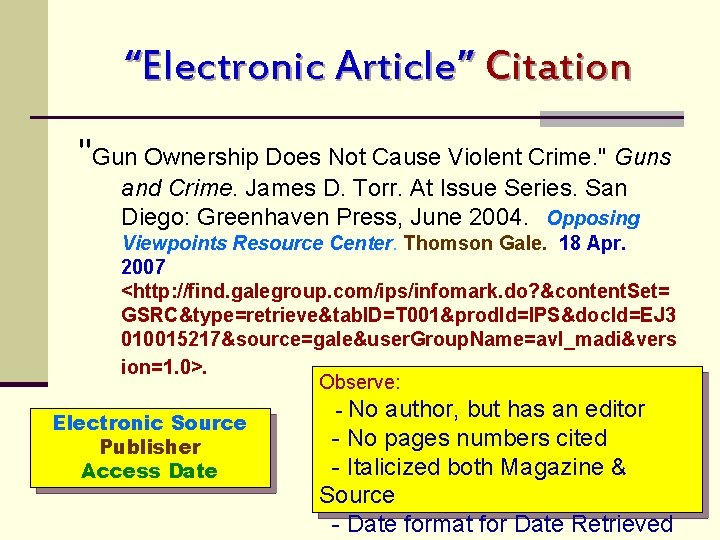
“Electronic Article” Citation "Gun Ownership Does Not Cause Violent Crime. " Guns and Crime. James D. Torr. At Issue Series. San Diego: Greenhaven Press, June 2004. Opposing Viewpoints Resource Center. Thomson Gale. 18 Apr. 2007 <http: //find. galegroup. com/ips/infomark. do? &content. Set= GSRC&type=retrieve&tab. ID=T 001&prod. Id=IPS&doc. Id=EJ 3 010015217&source=gale&user. Group. Name=avl_madi&vers ion=1. 0>. Observe: - No author, but has an editor Electronic Source - No pages numbers cited Publisher - Italicized both Magazine & Access Date Source - Date format for Date Retrieved
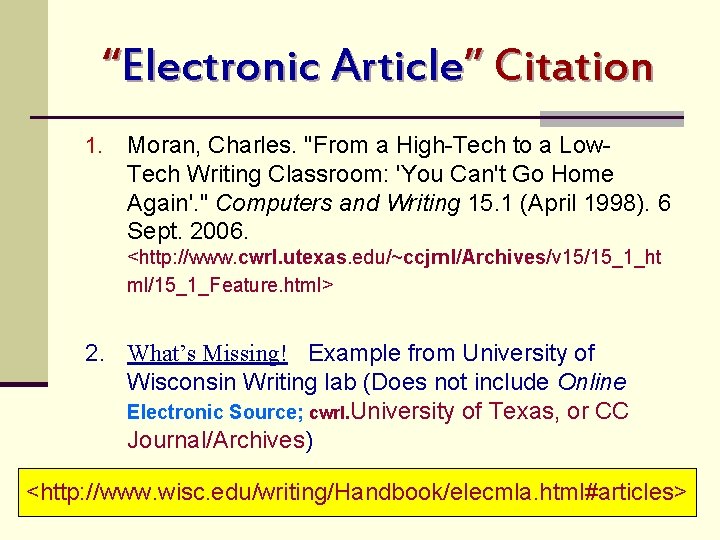
“Electronic Article” Citation 1. Moran, Charles. "From a High-Tech to a Low. Tech Writing Classroom: 'You Can't Go Home Again'. " Computers and Writing 15. 1 (April 1998). 6 Sept. 2006. <http: //www. cwrl. utexas. edu/~ccjrnl/Archives/v 15/15_1_ht ml/15_1_Feature. html> 2. What’s Missing! Example from University of Wisconsin Writing lab (Does not include Online Electronic Source; cwrl. University of Texas, or CC Journal/Archives) <http: //www. wisc. edu/writing/Handbook/elecmla. html#articles>
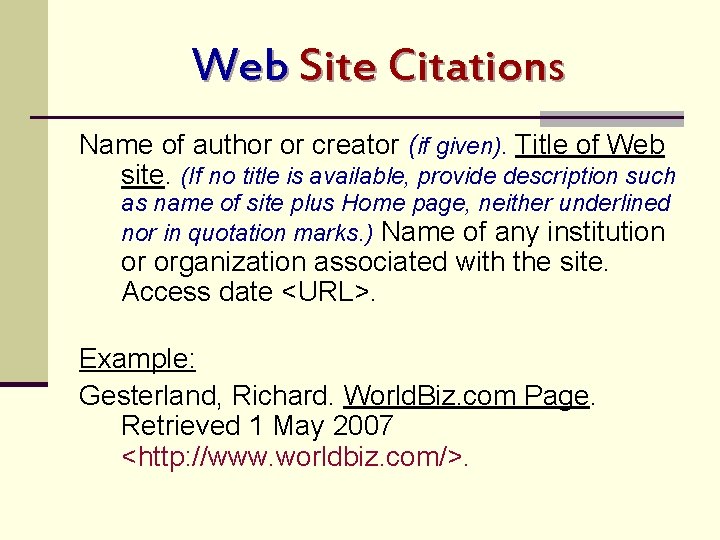
Web Site Citations Name of author or creator (if given). Title of Web site. (If no title is available, provide description such as name of site plus Home page, neither underlined nor in quotation marks. ) Name of any institution or organization associated with the site. Access date <URL>. Example: Gesterland, Richard. World. Biz. com Page. Retrieved 1 May 2007 <http: //www. worldbiz. com/>.
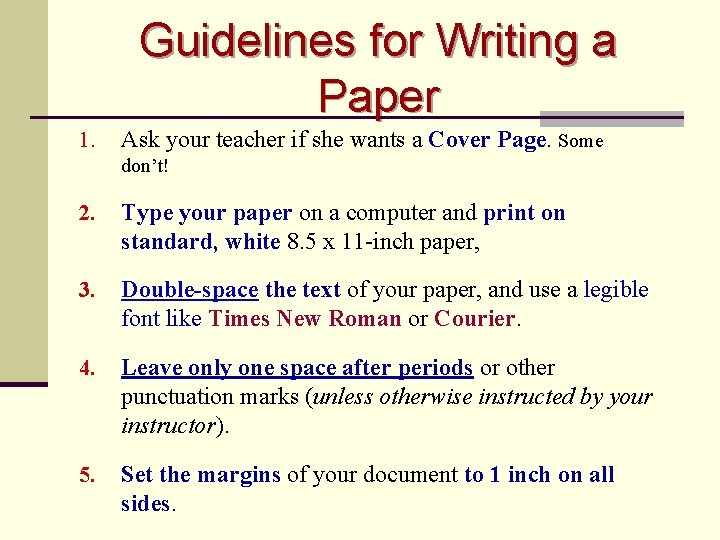
Guidelines for Writing a Paper 1. Ask your teacher if she wants a Cover Page. Some don’t! 2. Type your paper on a computer and print on standard, white 8. 5 x 11 -inch paper, 3. Double-space the text of your paper, and use a legible font like Times New Roman or Courier. 4. Leave only one space after periods or other punctuation marks (unless otherwise instructed by your instructor). 5. Set the margins of your document to 1 inch on all sides.
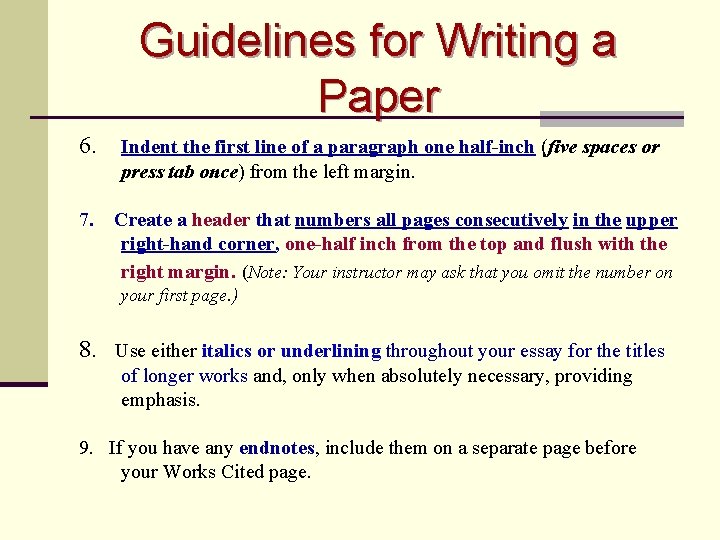
Guidelines for Writing a Paper 6. Indent the first line of a paragraph one half-inch (five spaces or press tab once) from the left margin. 7. Create a header that numbers all pages consecutively in the upper right-hand corner, one-half inch from the top and flush with the right margin. (Note: Your instructor may ask that you omit the number on your first page. ) 8. Use either italics or underlining throughout your essay for the titles of longer works and, only when absolutely necessary, providing emphasis. 9. If you have any endnotes, include them on a separate page before your Works Cited page.
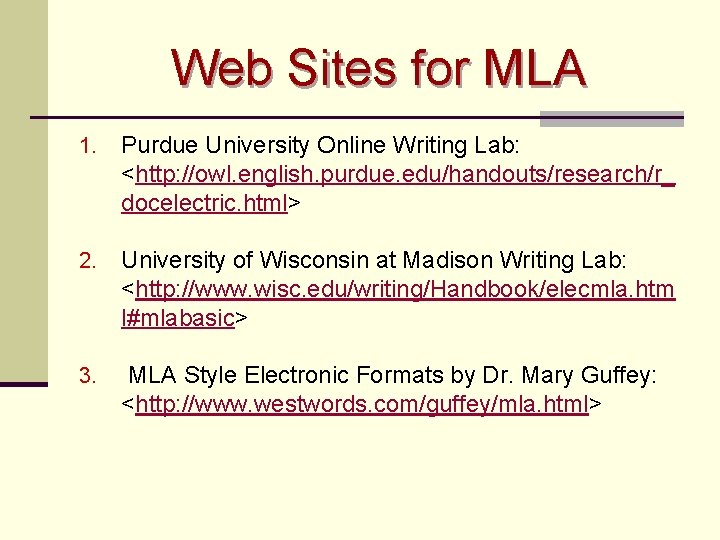
Web Sites for MLA 1. Purdue University Online Writing Lab: <http: //owl. english. purdue. edu/handouts/research/r_ docelectric. html> 2. University of Wisconsin at Madison Writing Lab: <http: //www. wisc. edu/writing/Handbook/elecmla. htm l#mlabasic> 3. MLA Style Electronic Formats by Dr. Mary Guffey: <http: //www. westwords. com/guffey/mla. html>
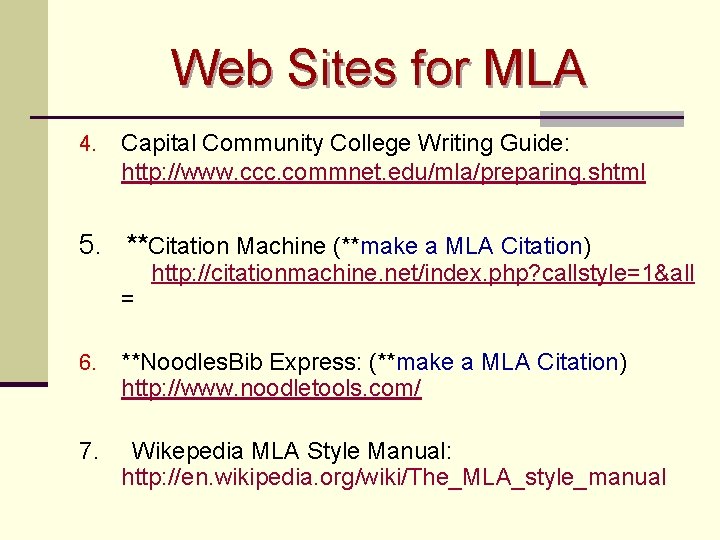
Web Sites for MLA 4. Capital Community College Writing Guide: http: //www. ccc. commnet. edu/mla/preparing. shtml 5. **Citation Machine (**make a MLA Citation) = http: //citationmachine. net/index. php? callstyle=1&all 6. **Noodles. Bib Express: (**make a MLA Citation) http: //www. noodletools. com/ 7. Wikepedia MLA Style Manual: http: //en. wikipedia. org/wiki/The_MLA_style_manual
For More Information See: MLA Handbook for Writer of Research Papers By Joseph Gibaldi See it in your School or Local “Reference” Library.