
Electronic Circuits in an Automotive Environment Herman Casier









- Slides: 123
Electronic Circuits in an Automotive Environment Herman Casier AMI Semiconductor Belgium herman_casier@amis. com
Outline 1 t Introduction Automotive Market and trends o Characteristics of Electronics in a car o Automotive Electronics Challenges o t Cost and Time To Market t Quality and Safety Quality requirements o Safety requirements o DFMEA o 2004 11 29 AID-EMC / HC / Electronic Circuits in an Automotive Environment 2
Outline 2 t High Voltage : the car battery o o o History of the car battery Why switching over to 42 V Power. Net Specifications of car-batteries Example: lamp-failure detector Example: high-side driver t High Temperature requirements o o o Temperature range specification Functionality and reliability limits Diode leakage currents Example: bandgap circuit Example: SC-circuit 2004 11 29 AID-EMC / HC / Electronic Circuits in an Automotive Environment 3
Outline 3 t EMC general Definition of EMC o Compliance and pre-compliance tests o EMC standards in IC-design o t EME – Electro Magnetic Emission o o o 1 W/150 W test method EME what happens? EME how to cope with? Example: digital circuit current peaks Example: CANH differential output 2004 11 29 AID-EMC / HC / Electronic Circuits in an Automotive Environment 4
Outline 4 t EMS – Electro Magnetic Susceptibility o o o o o DPI – Direct Power Injection method EMS compliance levels EMS what happens? EMS how to cope with? Example: rectification of single ended signal Example: rectification of differential signal Example: substrate currents in ESD diodes Types of substrate currents Example: jumper detection 2004 11 29 AID-EMC / HC / Electronic Circuits in an Automotive Environment 5
Outline 5 t Automotive transients (ISO-7637) (sometimes called Schaffner pulses) o Transient pulse definitions o Transient pulses what happens? o Example: supply & low-side driver o Example: bandgap circuit t Acknowledgments t References 2004 11 29 AID-EMC / HC / Electronic Circuits in an Automotive Environment 6
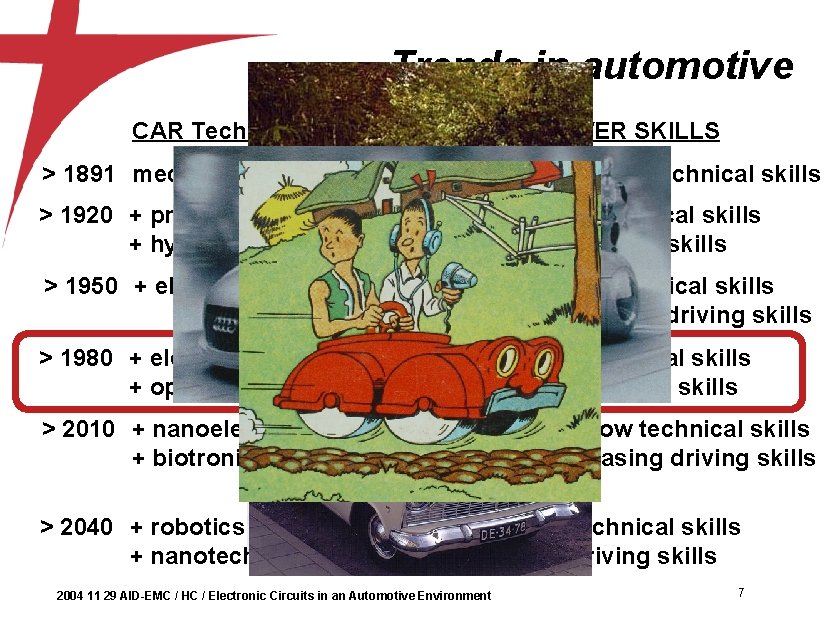
Trends in automotive CAR Technology > 1891 mechanical system > 1920 + pneumatic systems + hydraulic systems > 1950 + electric systems TRAFFIC DRIVER SKILLS very low very high technical skills low increasing high technical skills low driving skills good technical skills increasing driving skills > 1980 + electronic systems congestion + optronic systems starts low technical skills high driving skills > 2010 + nanoelectronics congested + biotronic systems optimization starts very low technical skills decreasing driving skills > 2040 + robotics + nanotechnology no technical skills no driving skills maximal and optimized 2004 11 29 AID-EMC / HC / Electronic Circuits in an Automotive Environment 7
Automotive Electronics Phase 1: Introduction of Electronics in non-critical applications o Driver information and entertainment e. g. radio, o Comfort and convenience e. g. electric windows, wiper/washer, seat heating, central locking, interior light control … Low intelligence electronic systems Minor communication between systems (pushbutton control) No impact on engine performance No impact on driving & driver skills 2004 11 29 AID-EMC / HC / Electronic Circuits in an Automotive Environment 8
Automotive Electronics Phase 2: Electronics support critical applications o Engine optimization: e. g. efficiency improvement & pollution control o Active and Passive Safety e. g. ABS, ESP, airbags, tire pressure, Xenon lamps … o Driver information and entertainment e. g. radio-CD-GPS, parking radar, service warnings … o Comfort, convenience and security: e. g. airco, cruise control, keyless entry, transponders … Increasingly complex and intelligent electronic systems Communication between electronic systems within the car Full control of engine performance No control of driving & driver skills But reactive correction of driver errors. Electronics impact remains within the car 2004 11 29 AID-EMC / HC / Electronic Circuits in an Automotive Environment 9
Automotive Electronics Phase 3: Electronics control critical applications o Full Engine control e. g. start/stop cycles, hybrid vehicles … o Active and Passive Safety e. g. X by wire, anti-collision radar, dead-angle radar … o Driver information and entertainment e. g. traffic congestion warning, weather and road conditions … o Comfort and convenience Very intelligent and robust electronics Communication between internal and external systems Information exchange with traffic network Full control of engine performance Control of driving and (decreasing) driving skills Proactive prevention of dangerous situations inside and around the car Full control of car and immediate surroundings 2004 11 29 AID-EMC / HC / Electronic Circuits in an Automotive Environment 10
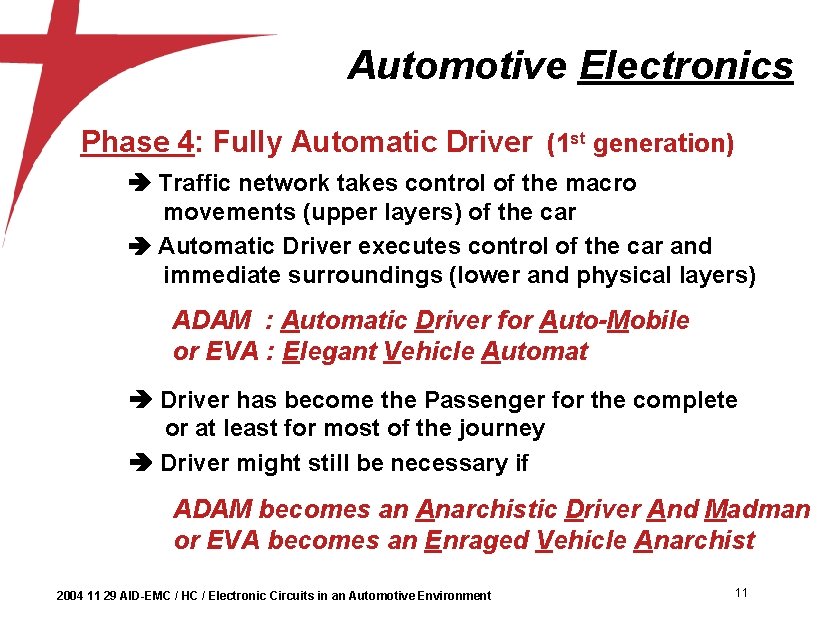
Automotive Electronics Phase 4: Fully Automatic Driver (1 st generation) Traffic network takes control of the macro movements (upper layers) of the car Automatic Driver executes control of the car and immediate surroundings (lower and physical layers) ADAM : Automatic Driver for Auto-Mobile or EVA : Elegant Vehicle Automat Driver has become the Passenger for the complete or at least for most of the journey Driver might still be necessary if ADAM becomes an Anarchistic Driver And Madman or EVA becomes an Enraged Vehicle Anarchist 2004 11 29 AID-EMC / HC / Electronic Circuits in an Automotive Environment 11
Automotive Drivers t Safety (FMEA) level 1: remains “in-spec” in Harsh environment t Increasing Complexity more functions and more intelligence : makes the car system more transparant for the driver t Increasing Accuracy More, higher performance sensors : cheapest sensors require most performance t Low cost and Time-To-Market (of course) t Legislation 2004 11 29 AID-EMC / HC / Electronic Circuits in an Automotive Environment 12
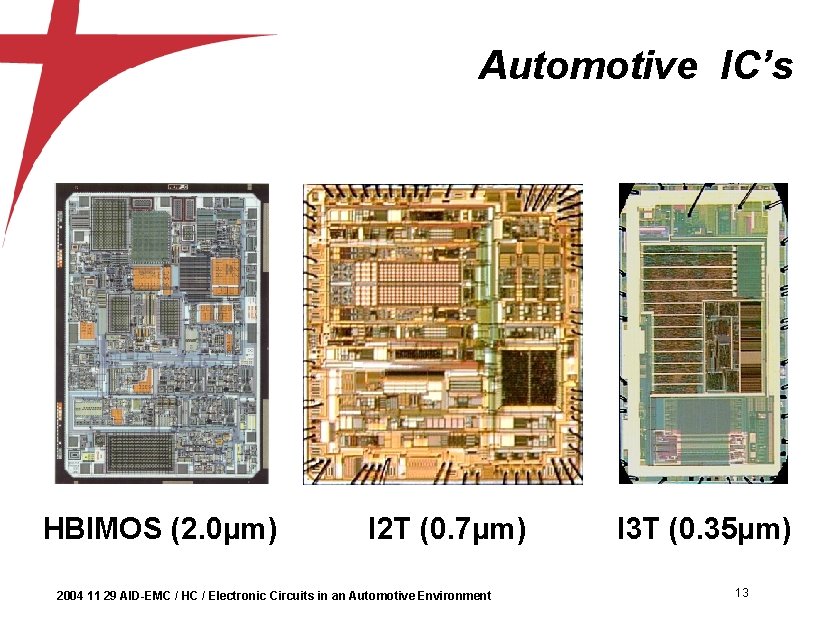
Automotive IC’s HBIMOS (2. 0µm) I 2 T (0. 7µm) 2004 11 29 AID-EMC / HC / Electronic Circuits in an Automotive Environment I 3 T (0. 35µm) 13
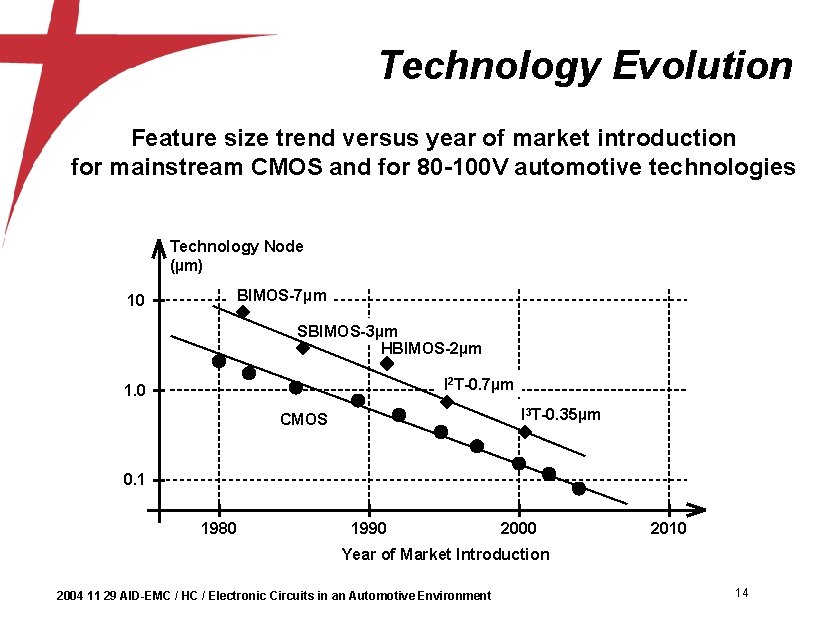
Technology Evolution Feature size trend versus year of market introduction for mainstream CMOS and for 80 -100 V automotive technologies Technology Node (µm) 10 BIMOS-7µm SBIMOS-3µm HBIMOS-2µm I 2 T-0. 7µm 1. 0 I 3 T-0. 35µm CMOS 0. 1 1980 1990 2000 2010 Year of Market Introduction 2004 11 29 AID-EMC / HC / Electronic Circuits in an Automotive Environment 14
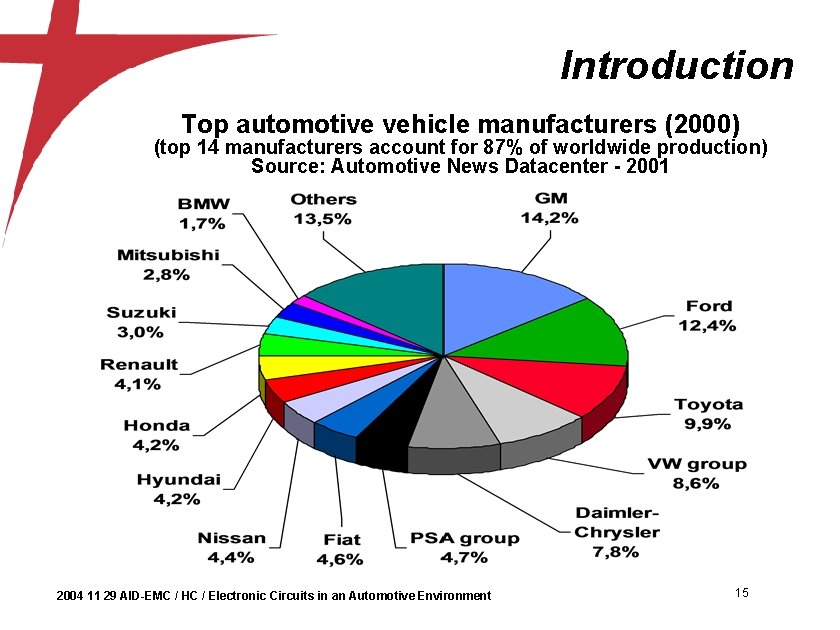
Introduction Top automotive vehicle manufacturers (2000) (top 14 manufacturers account for 87% of worldwide production) Source: Automotive News Datacenter - 2001 2004 11 29 AID-EMC / HC / Electronic Circuits in an Automotive Environment 15
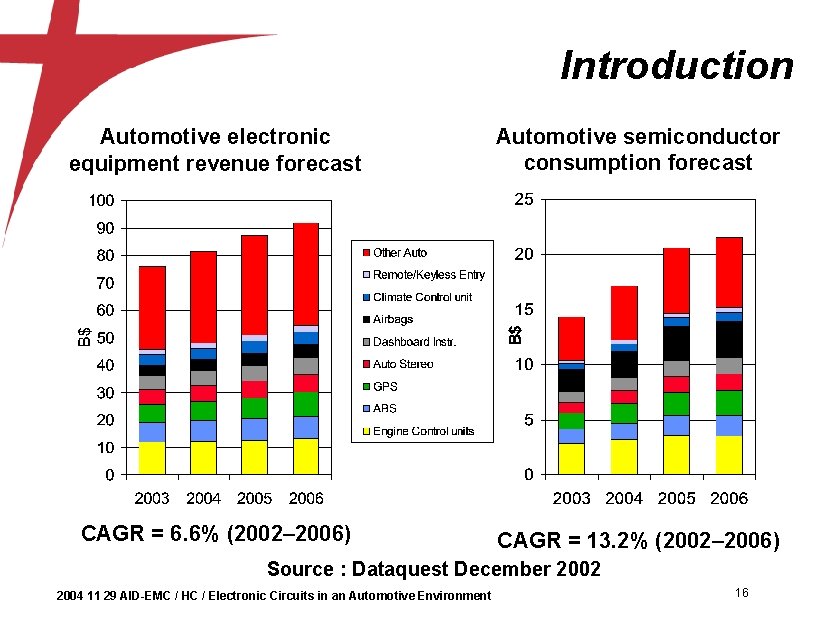
Introduction Automotive electronic equipment revenue forecast Automotive semiconductor consumption forecast CAGR = 6. 6% (2002– 2006) CAGR = 13. 2% (2002– 2006) Source : Dataquest December 2002 2004 11 29 AID-EMC / HC / Electronic Circuits in an Automotive Environment 16
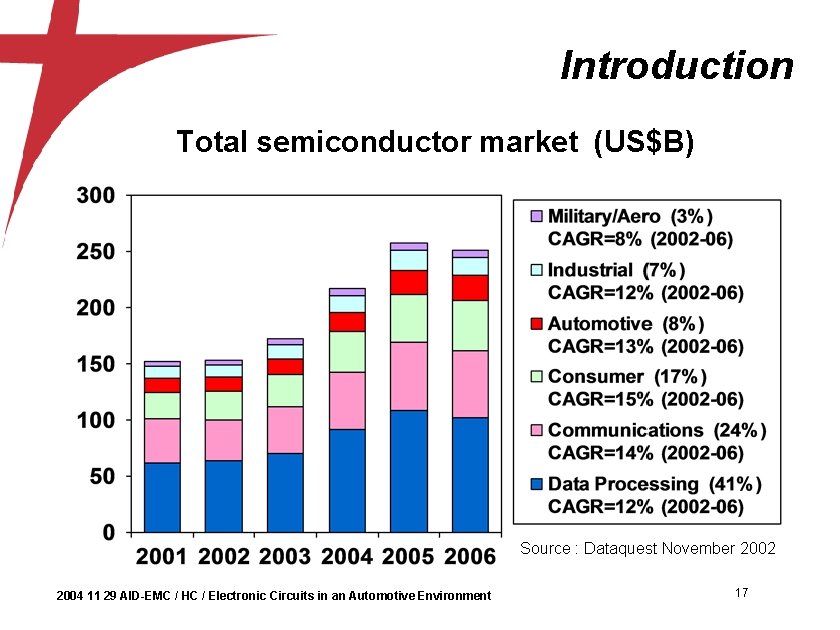
Introduction Total semiconductor market (US$B) Source : Dataquest November 2002 2004 11 29 AID-EMC / HC / Electronic Circuits in an Automotive Environment 17
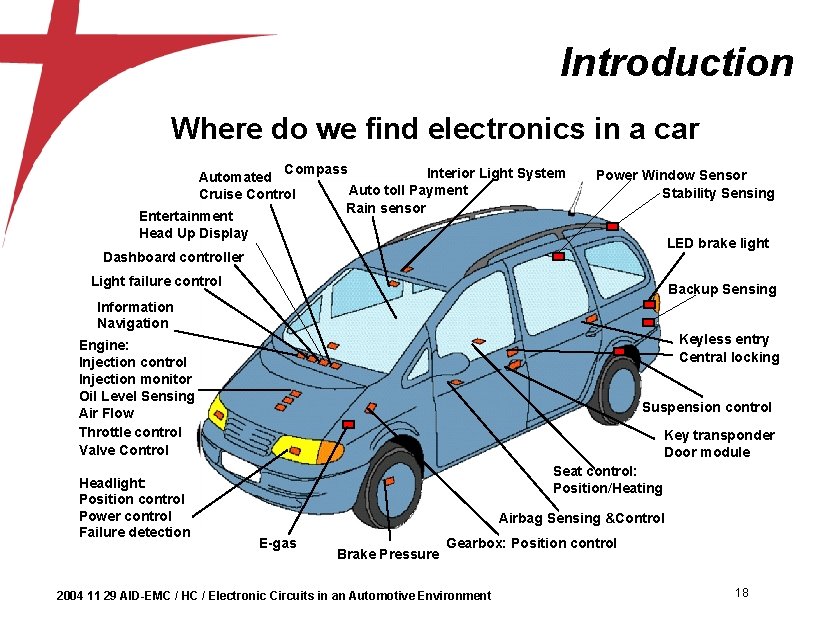
Introduction Where do we find electronics in a car Compass Interior Light System Automated Auto toll Payment Cruise Control Rain sensor Entertainment Head Up Display Power Window Sensor Stability Sensing LED brake light Dashboard controller Light failure control Backup Sensing Information Navigation Keyless entry Central locking Engine: Injection control Injection monitor Oil Level Sensing Air Flow Throttle control Valve Control Headlight: Position control Power control Failure detection Suspension control Key transponder Door module Seat control: Position/Heating E-gas Brake Pressure Airbag Sensing &Control Gearbox: Position control 2004 11 29 AID-EMC / HC / Electronic Circuits in an Automotive Environment 18
Introduction Electronics are distributed all over the car-body t Distributed supply used for both power drivers and low power control systems è direct battery supply for the modules: highvoltage with large variation Trend: Battery voltage from 12 V 42 V è large supply transients due to interferences of high-power users switching or error condition (load-dump) Trend: comparable supply transients, lower loaddump transient 2004 11 29 AID-EMC / HC / Electronic Circuits in an Automotive Environment 19
Introduction t Modules, distributed over the car-body have to comply with stringent EMC and ESD è low EME to other modules and external world è low EMS (high EMI) for externally and internally generated fields è High ESD and system-ESD requirements Trend: increasing EMC frequency and EMC field strength for the module. Trend: increasing ESD voltages and power Trend: more integration brings the module border closer to the chip border : the chip has to comply with higher EMC field strengths and ESD power. 2004 11 29 AID-EMC / HC / Electronic Circuits in an Automotive Environment 20
Introduction t Modules on all locations in the car, close to controlled sensors and actuators è large temperature range: - 40 … +150°C ambient Trend: increasing ambient temperature t Critical car-functions controlled by electronics è Safety & reliability very important Trend: increasing safety and reliability requirements è Communication speed and reliability Trend: higher speed, lower/fixed latency, higher reliability and accident proof communications 2004 11 29 AID-EMC / HC / Electronic Circuits in an Automotive Environment 21
Introduction t Many modules interface with cheap (large offset, low linearity) and low-power sensors è High accuracy and programmability of sensor interface: sensitivity, linearization, calibration … Trend: increasing sensor interface accuracy, speed and programmability with higher interference rejection and more intelligence t SOC-type semiconductors in module è Lower cost mandates single chip Trend: increasing intelligence requires state-ofthe-art technology with high-voltage (80 V), higher temperature (175°C ambient) and higher interference rejection (EMC, ESD) capabilities 2004 11 29 AID-EMC / HC / Electronic Circuits in an Automotive Environment 22
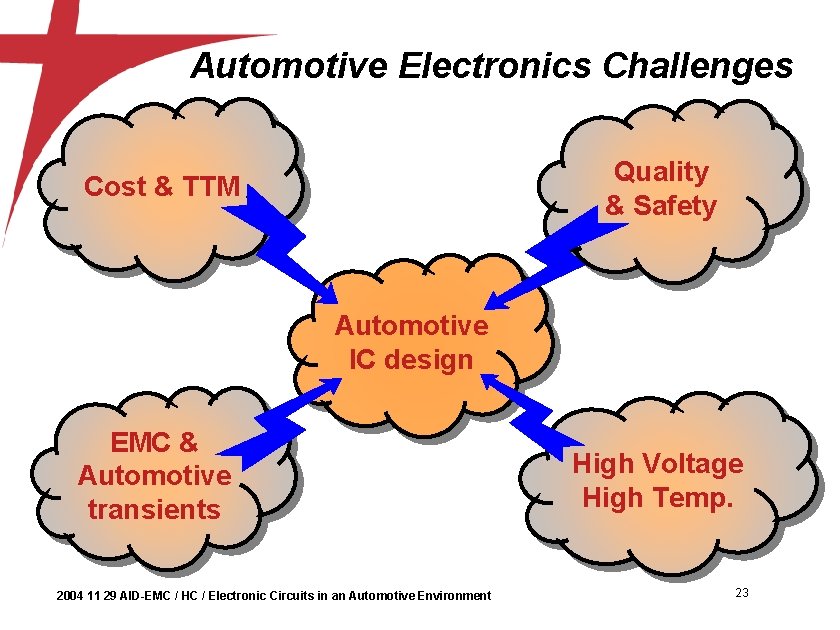
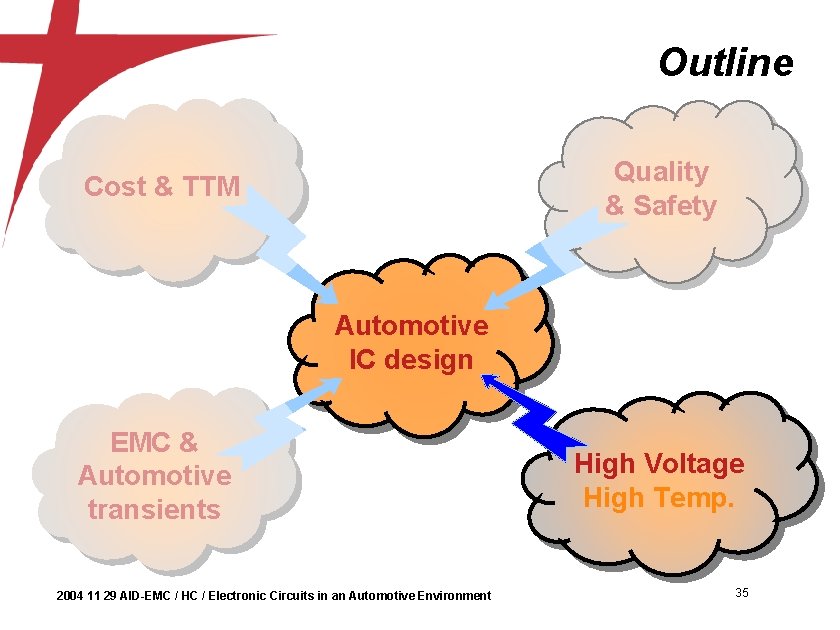
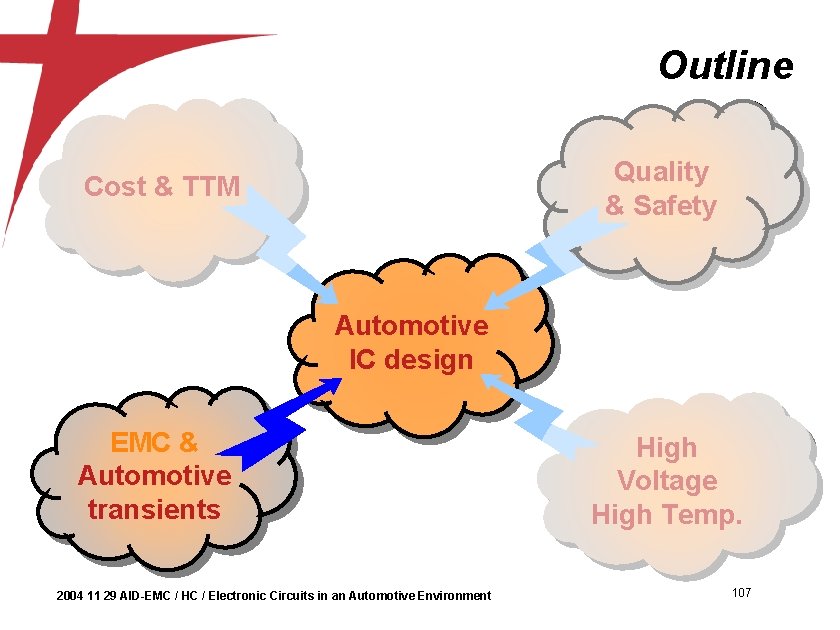
Automotive Electronics Challenges Quality & Safety Cost & TTM Automotive IC design EMC & Automotive transients 2004 11 29 AID-EMC / HC / Electronic Circuits in an Automotive Environment High Voltage High Temp. 23
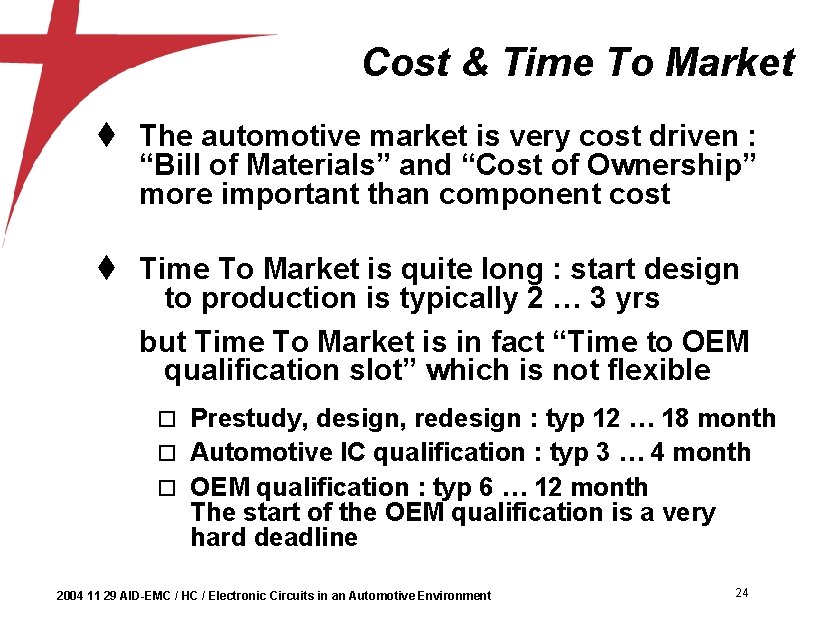
Cost & Time To Market t The automotive market is very cost driven : “Bill of Materials” and “Cost of Ownership” more important than component cost t Time To Market is quite long : start design to production is typically 2 … 3 yrs but Time To Market is in fact “Time to OEM qualification slot” which is not flexible Prestudy, design, redesign : typ 12 … 18 month o Automotive IC qualification : typ 3 … 4 month o OEM qualification : typ 6 … 12 month The start of the OEM qualification is a very hard deadline o 2004 11 29 AID-EMC / HC / Electronic Circuits in an Automotive Environment 24
Outline Quality & Safety Cost & TTM Automotive IC design EMC & Automotive transients 2004 11 29 AID-EMC / HC / Electronic Circuits in an Automotive Environment High Voltage High Temp. 25
Quality and Safety t Required reliability ? Most cars actually drive less than 10. 000 hrs over the cars lifespan of 10 … 15 years o Most electronics also only functioning during 10. 000 hrs but some are powered for > 10 years o t High reliability requirements : 1 ppm for production reasons (low infant mortality) o for safety reasons and long lifetime (failure rate). o t Implications Design : 6 sigma approach o Test: high test coverage (digital and analog), test at different temperatures IDDQ, Vstress for early life-time failures o Packaging : high reliability o 2004 11 29 AID-EMC / HC / Electronic Circuits in an Automotive Environment 26
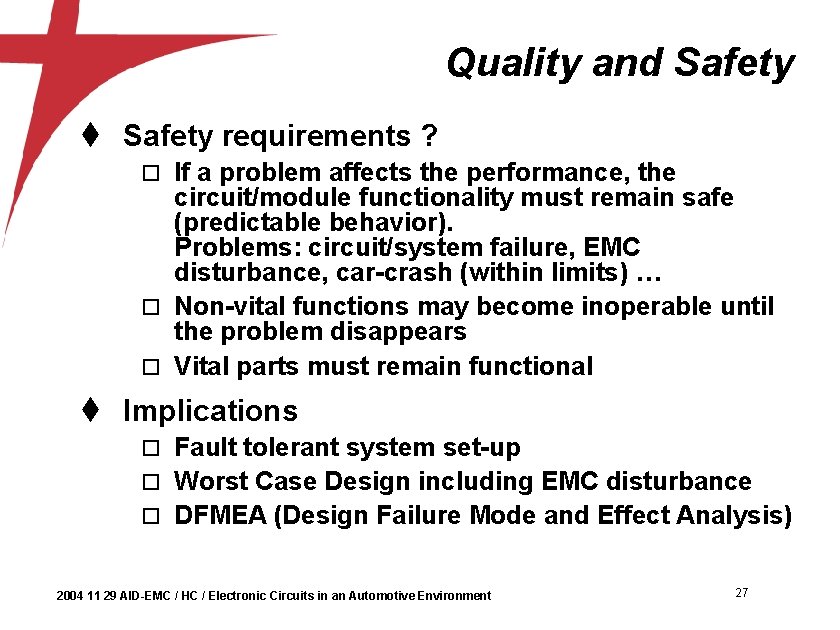
Quality and Safety t Safety requirements ? If a problem affects the performance, the circuit/module functionality must remain safe (predictable behavior). Problems: circuit/system failure, EMC disturbance, car-crash (within limits) … o Non-vital functions may become inoperable until the problem disappears o Vital parts must remain functional o t Implications Fault tolerant system set-up o Worst Case Design including EMC disturbance o DFMEA (Design Failure Mode and Effect Analysis) o 2004 11 29 AID-EMC / HC / Electronic Circuits in an Automotive Environment 27
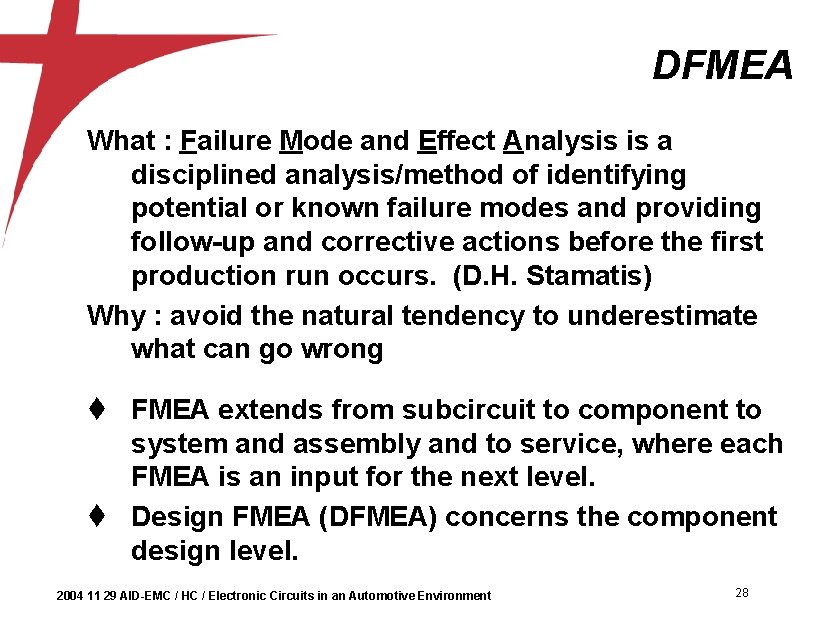
DFMEA What : Failure Mode and Effect Analysis is a disciplined analysis/method of identifying potential or known failure modes and providing follow-up and corrective actions before the first production run occurs. (D. H. Stamatis) Why : avoid the natural tendency to underestimate what can go wrong t FMEA extends from subcircuit to component to system and assembly and to service, where each FMEA is an input for the next level. t Design FMEA (DFMEA) concerns the component design level. 2004 11 29 AID-EMC / HC / Electronic Circuits in an Automotive Environment 28
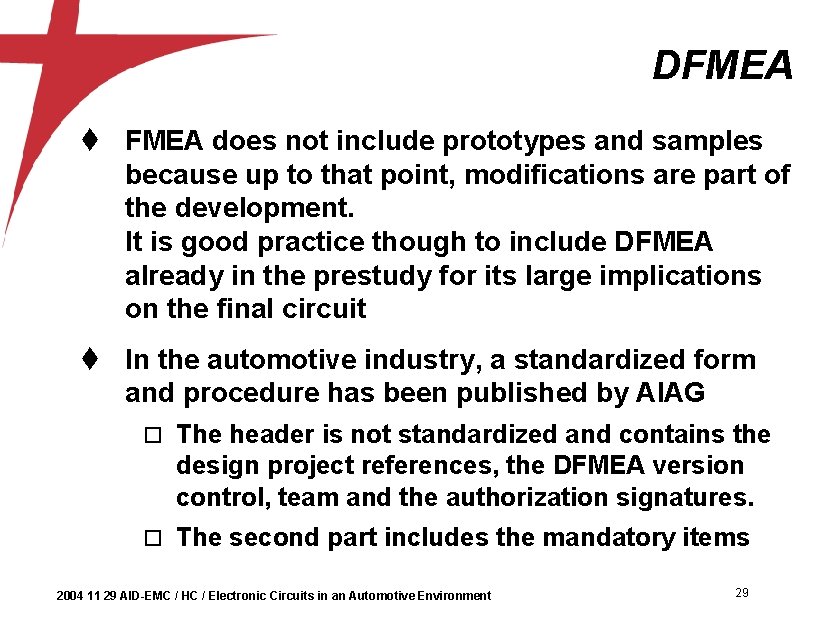
DFMEA t FMEA does not include prototypes and samples because up to that point, modifications are part of the development. It is good practice though to include DFMEA already in the prestudy for its large implications on the final circuit t In the automotive industry, a standardized form and procedure has been published by AIAG o The header is not standardized and contains the design project references, the DFMEA version control, team and the authorization signatures. o The second part includes the mandatory items 2004 11 29 AID-EMC / HC / Electronic Circuits in an Automotive Environment 29
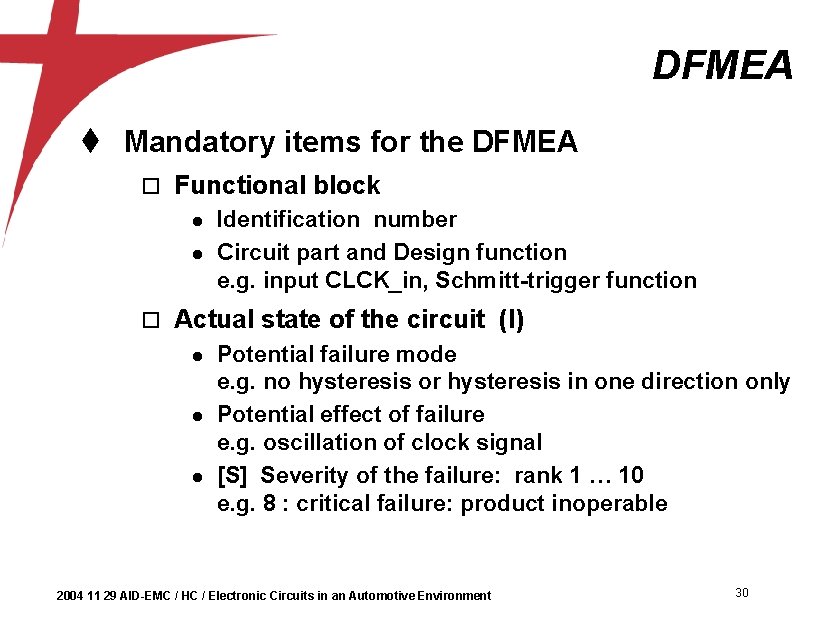
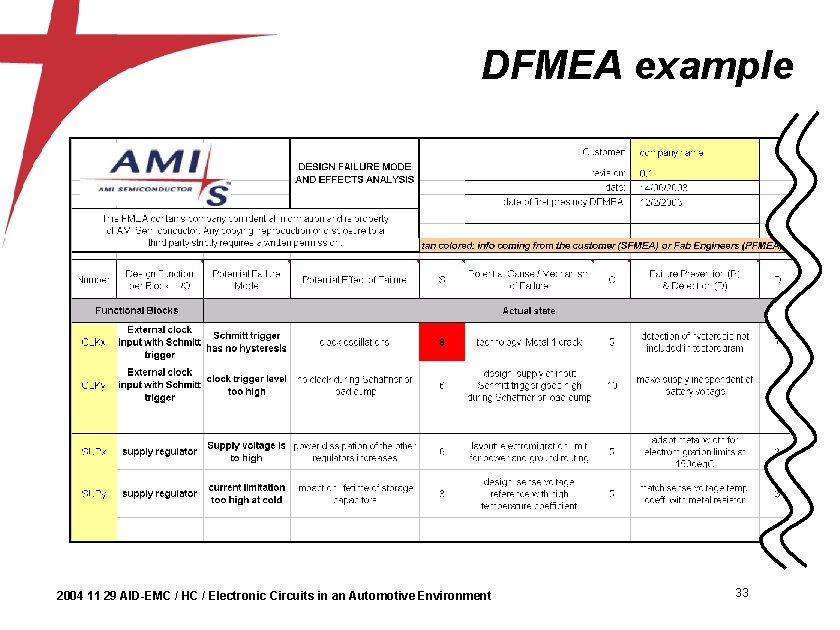
DFMEA t Mandatory items for the DFMEA o Functional block l l o Identification number Circuit part and Design function e. g. input CLCK_in, Schmitt-trigger function Actual state of the circuit (I) l l l Potential failure mode e. g. no hysteresis or hysteresis in one direction only Potential effect of failure e. g. oscillation of clock signal [S] Severity of the failure: rank 1 … 10 e. g. 8 : critical failure: product inoperable 2004 11 29 AID-EMC / HC / Electronic Circuits in an Automotive Environment 30
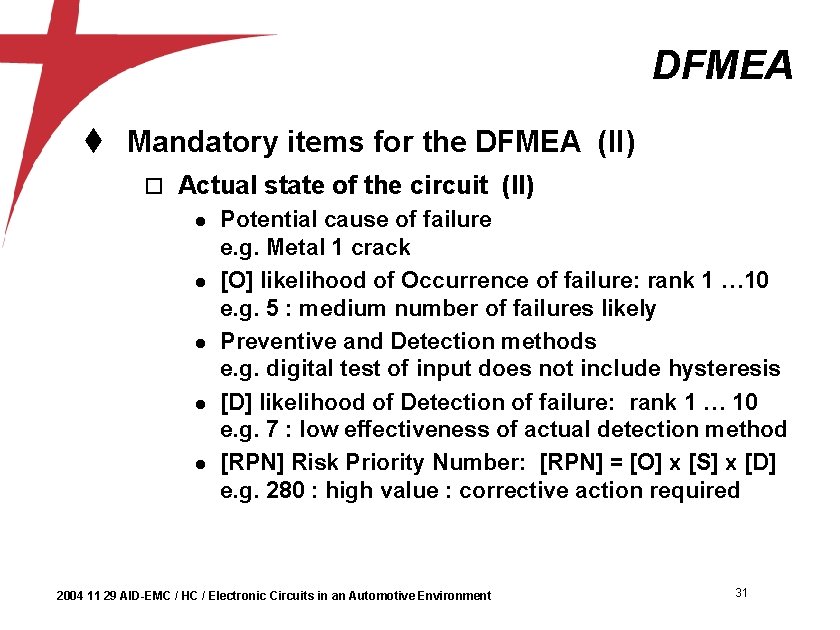
DFMEA t Mandatory items for the DFMEA (II) o Actual state of the circuit (II) l l l Potential cause of failure e. g. Metal 1 crack [O] likelihood of Occurrence of failure: rank 1 … 10 e. g. 5 : medium number of failures likely Preventive and Detection methods e. g. digital test of input does not include hysteresis [D] likelihood of Detection of failure: rank 1 … 10 e. g. 7 : low effectiveness of actual detection method [RPN] Risk Priority Number: [RPN] = [O] x [S] x [D] e. g. 280 : high value : corrective action required 2004 11 29 AID-EMC / HC / Electronic Circuits in an Automotive Environment 31
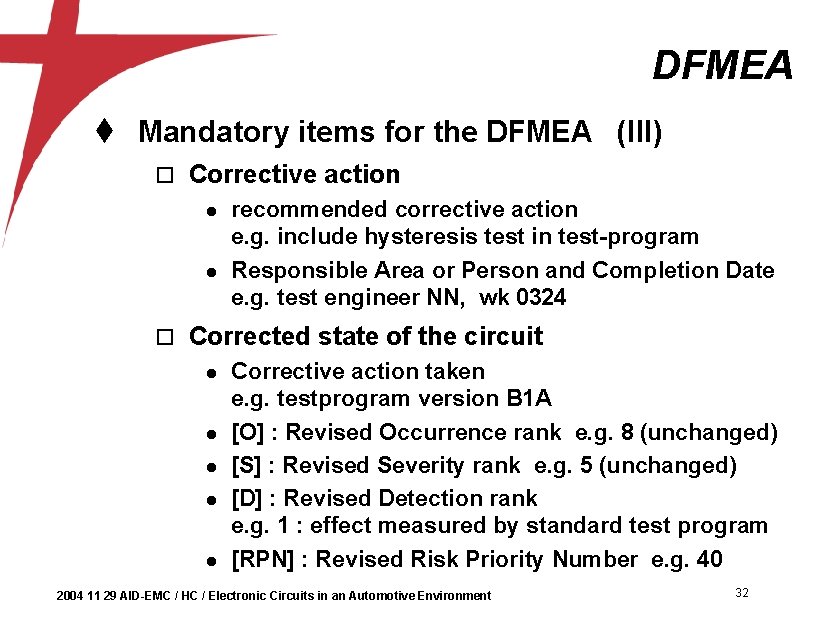
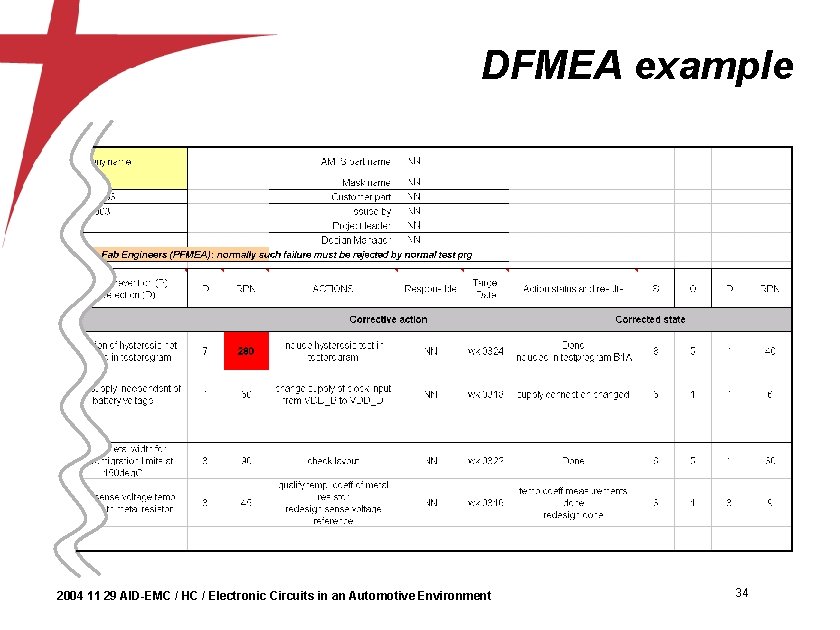
DFMEA t Mandatory items for the DFMEA (III) o Corrective action l l o recommended corrective action e. g. include hysteresis test in test-program Responsible Area or Person and Completion Date e. g. test engineer NN, wk 0324 Corrected state of the circuit l l l Corrective action taken e. g. testprogram version B 1 A [O] : Revised Occurrence rank e. g. 8 (unchanged) [S] : Revised Severity rank e. g. 5 (unchanged) [D] : Revised Detection rank e. g. 1 : effect measured by standard test program [RPN] : Revised Risk Priority Number e. g. 40 2004 11 29 AID-EMC / HC / Electronic Circuits in an Automotive Environment 32
DFMEA example 2004 11 29 AID-EMC / HC / Electronic Circuits in an Automotive Environment 33
DFMEA example 2004 11 29 AID-EMC / HC / Electronic Circuits in an Automotive Environment 34
Outline Quality & Safety Cost & TTM Automotive IC design EMC & Automotive transients 2004 11 29 AID-EMC / HC / Electronic Circuits in an Automotive Environment High Voltage High Temp. 35
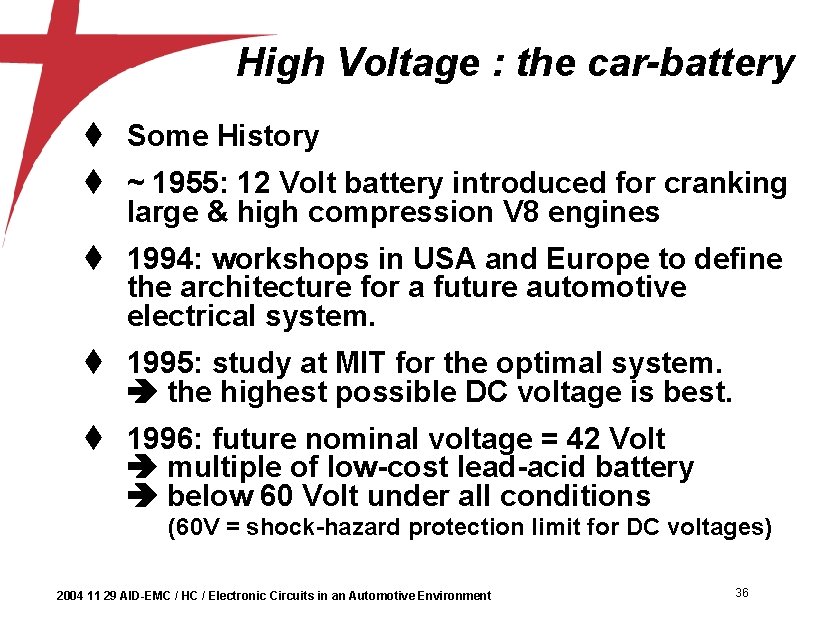
High Voltage : the car-battery t Some History t ~ 1955: 12 Volt battery introduced for cranking large & high compression V 8 engines t 1994: workshops in USA and Europe to define the architecture for a future automotive electrical system. t 1995: study at MIT for the optimal system. the highest possible DC voltage is best. t 1996: future nominal voltage = 42 Volt multiple of low-cost lead-acid battery below 60 Volt under all conditions (60 V = shock-hazard protection limit for DC voltages) 2004 11 29 AID-EMC / HC / Electronic Circuits in an Automotive Environment 36
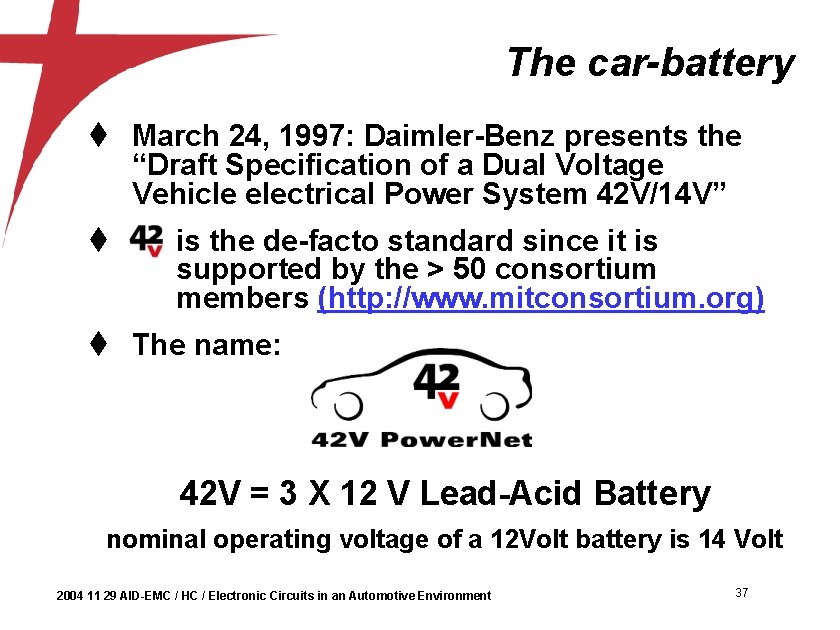
The car-battery t March 24, 1997: Daimler-Benz presents the “Draft Specification of a Dual Voltage Vehicle electrical Power System 42 V/14 V” t is the de-facto standard since it is supported by the > 50 consortium members (http: //www. mitconsortium. org) t The name: 42 V = 3 X 12 V Lead-Acid Battery nominal operating voltage of a 12 Volt battery is 14 Volt 2004 11 29 AID-EMC / HC / Electronic Circuits in an Automotive Environment 37
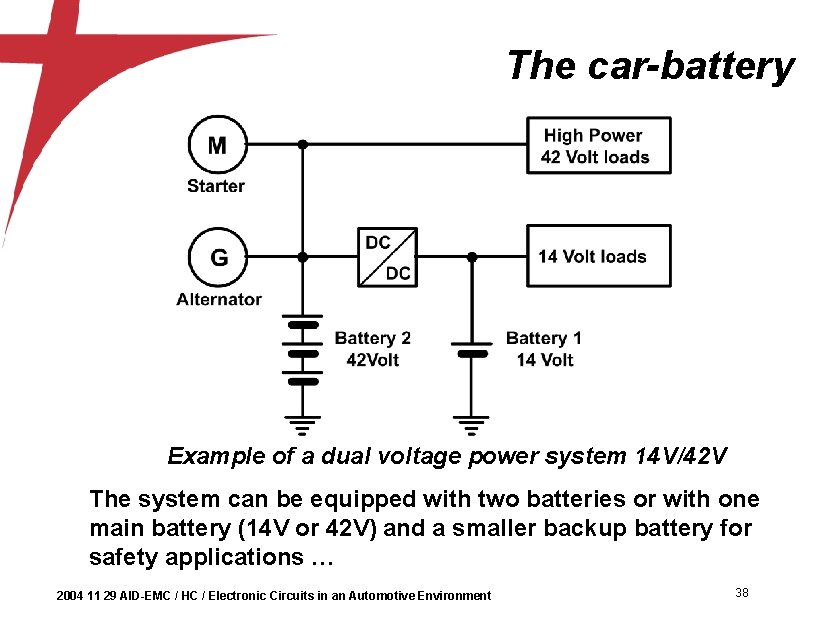
The car-battery Example of a dual voltage power system 14 V/42 V The system can be equipped with two batteries or with one main battery (14 V or 42 V) and a smaller backup battery for safety applications … 2004 11 29 AID-EMC / HC / Electronic Circuits in an Automotive Environment 38
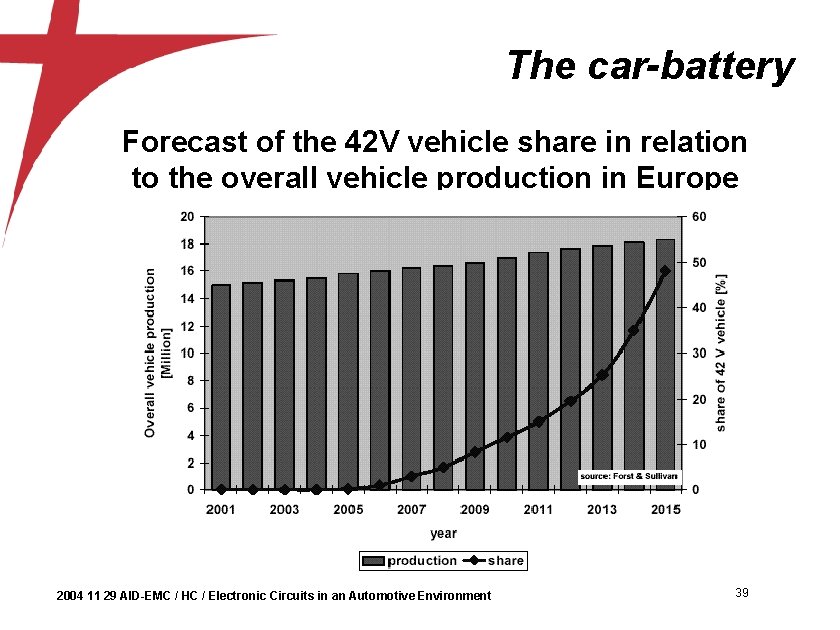
The car-battery Forecast of the 42 V vehicle share in relation to the overall vehicle production in Europe 2004 11 29 AID-EMC / HC / Electronic Circuits in an Automotive Environment 39
The car-battery Why switching over to 42 Volt battery ? t Electrical power consumption in a car rises beyond the capabilities of a 12 Volt battery. o Limit for 14 V generator power ~ 3 k. W o Mean power consumption of a luxury car ~ 1. 1 k. W (corresponds to ~ 1, 5 l/100 km fuel in urban traffic) o The required power for all installed applications in luxury cars already exceeds the generator capability. o New applications e. g. ISG (Integrated-Starter. Generator), X-by-wire, require much higher power 2004 11 29 AID-EMC / HC / Electronic Circuits in an Automotive Environment 40
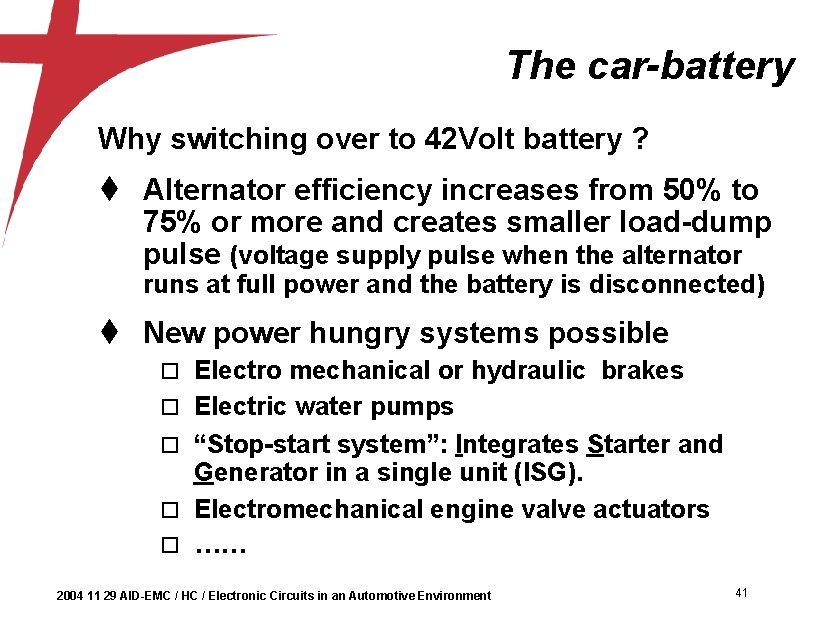
The car-battery Why switching over to 42 Volt battery ? t Alternator efficiency increases from 50% to 75% or more and creates smaller load-dump pulse (voltage supply pulse when the alternator runs at full power and the battery is disconnected) t New power hungry systems possible o o o Electro mechanical or hydraulic brakes Electric water pumps “Stop-start system”: Integrates Starter and Generator in a single unit (ISG). Electromechanical engine valve actuators …… 2004 11 29 AID-EMC / HC / Electronic Circuits in an Automotive Environment 41
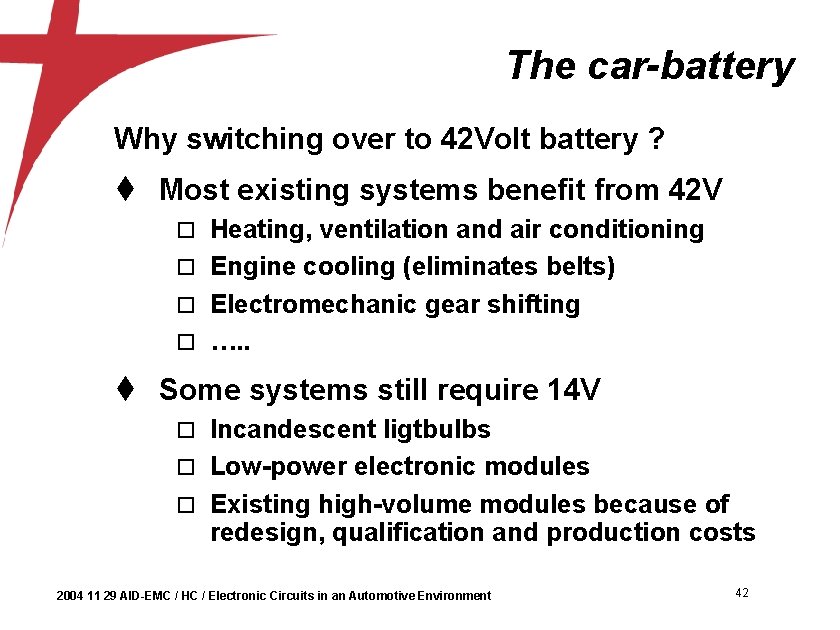
The car-battery Why switching over to 42 Volt battery ? t Most existing systems benefit from 42 V Heating, ventilation and air conditioning o Engine cooling (eliminates belts) o Electromechanic gear shifting o …. . o t Some systems still require 14 V Incandescent ligtbulbs o Low-power electronic modules o Existing high-volume modules because of redesign, qualification and production costs o 2004 11 29 AID-EMC / HC / Electronic Circuits in an Automotive Environment 42
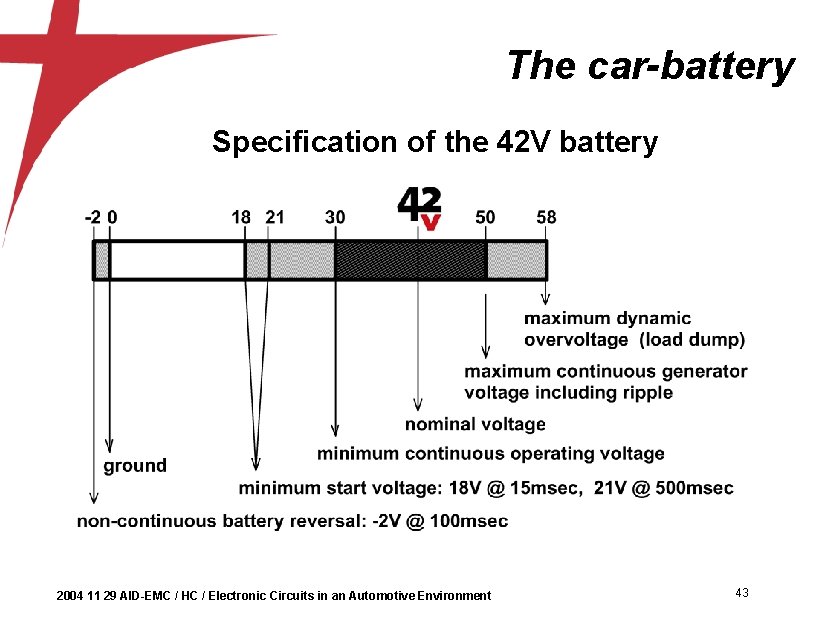
The car-battery Specification of the 42 V battery 2004 11 29 AID-EMC / HC / Electronic Circuits in an Automotive Environment 43
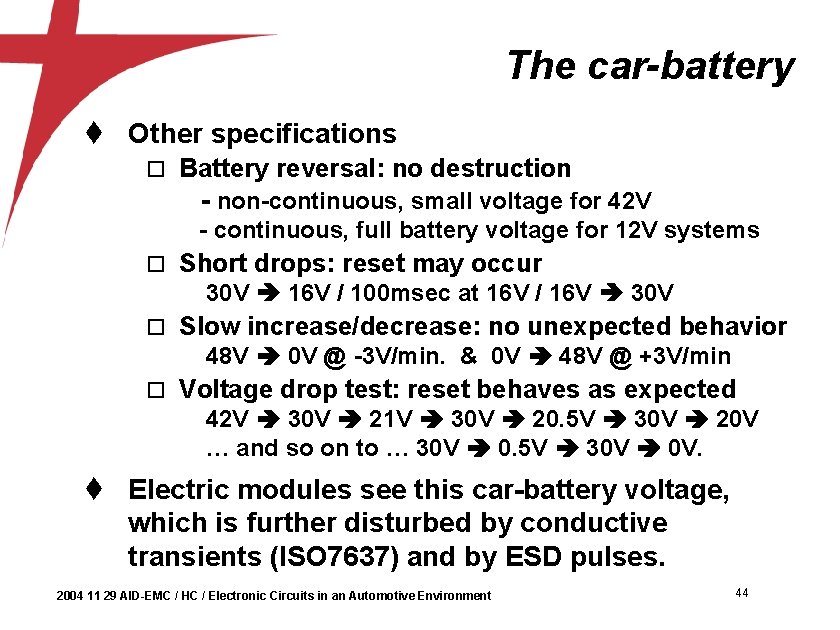
The car-battery t Other specifications o Battery reversal: no destruction - non-continuous, small voltage for 42 V - continuous, full battery voltage for 12 V systems o Short drops: reset may occur 30 V 16 V / 100 msec at 16 V / 16 V 30 V o Slow increase/decrease: no unexpected behavior 48 V 0 V @ -3 V/min. & 0 V 48 V @ +3 V/min o Voltage drop test: reset behaves as expected 42 V 30 V 21 V 30 V 20. 5 V 30 V 20 V … and so on to … 30 V 0. 5 V 30 V 0 V. t Electric modules see this car-battery voltage, which is further disturbed by conductive transients (ISO 7637) and by ESD pulses. 2004 11 29 AID-EMC / HC / Electronic Circuits in an Automotive Environment 44
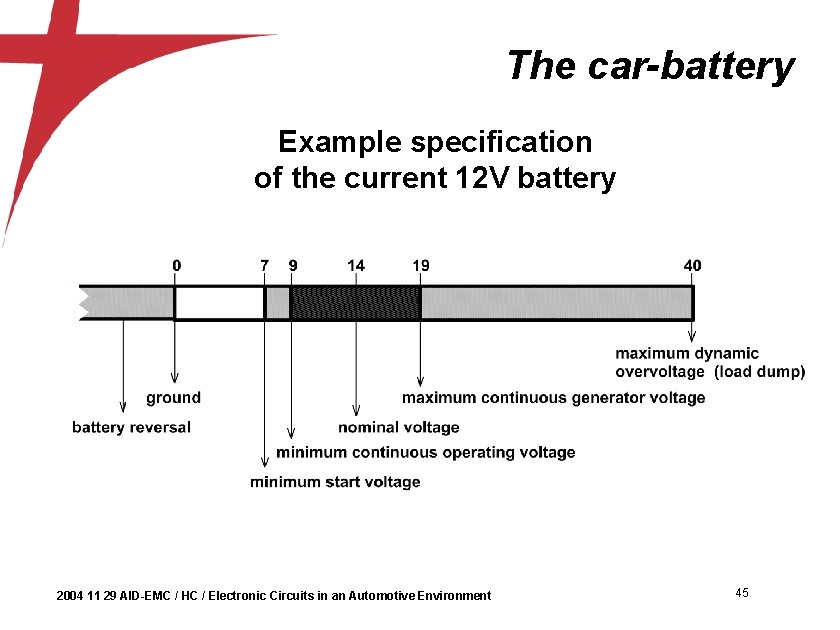
The car-battery Example specification of the current 12 V battery 2004 11 29 AID-EMC / HC / Electronic Circuits in an Automotive Environment 45
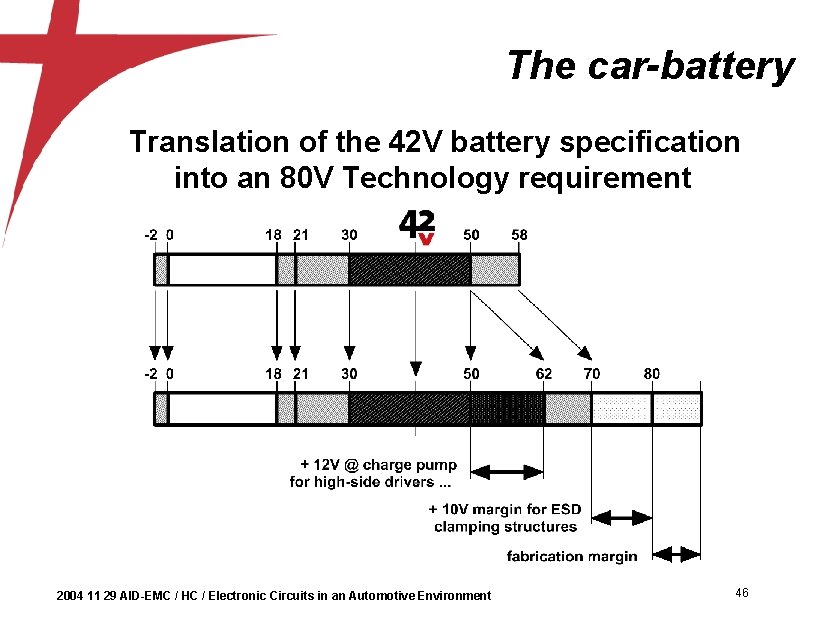
The car-battery Translation of the 42 V battery specification into an 80 V Technology requirement 2004 11 29 AID-EMC / HC / Electronic Circuits in an Automotive Environment 46
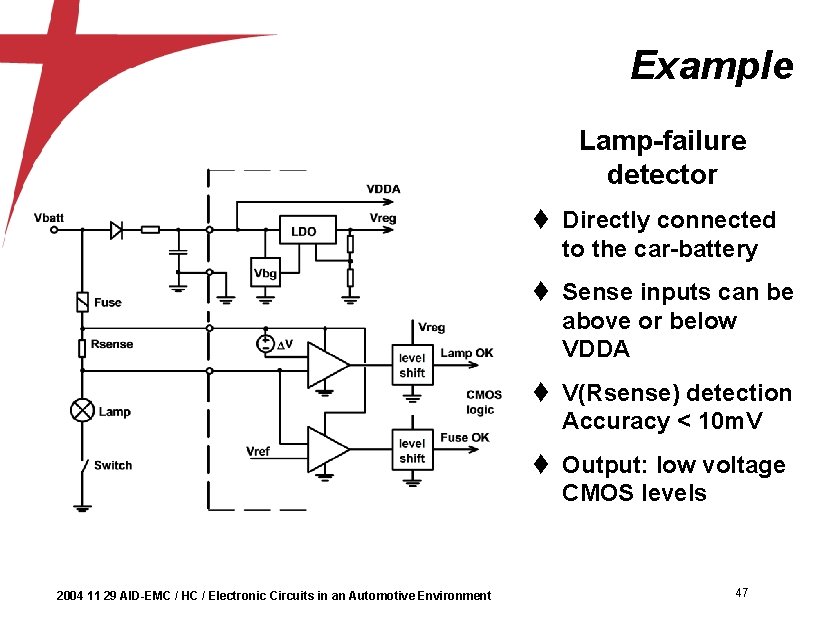
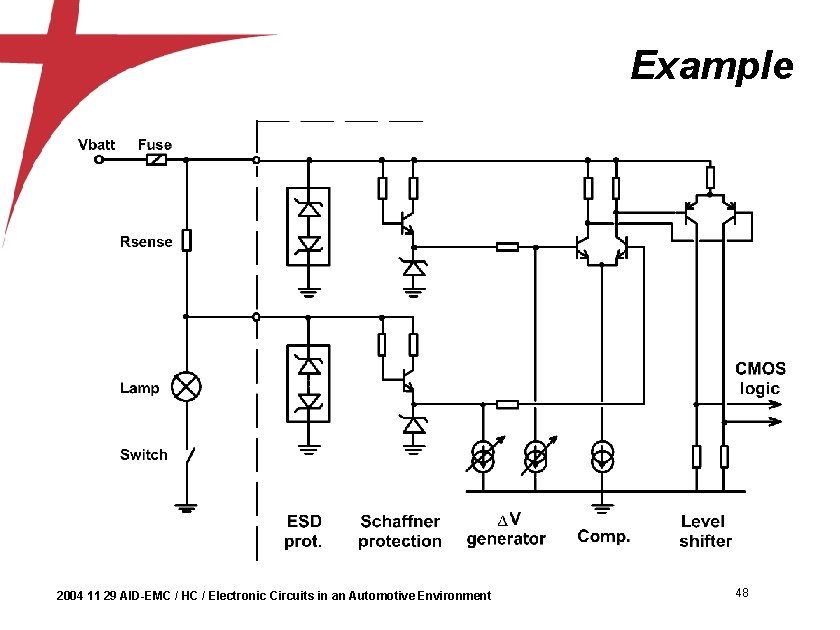
Example Lamp-failure detector t Directly connected to the car-battery t Sense inputs can be above or below VDDA t V(Rsense) detection Accuracy < 10 m. V t Output: low voltage CMOS levels 2004 11 29 AID-EMC / HC / Electronic Circuits in an Automotive Environment 47
Example 2004 11 29 AID-EMC / HC / Electronic Circuits in an Automotive Environment 48
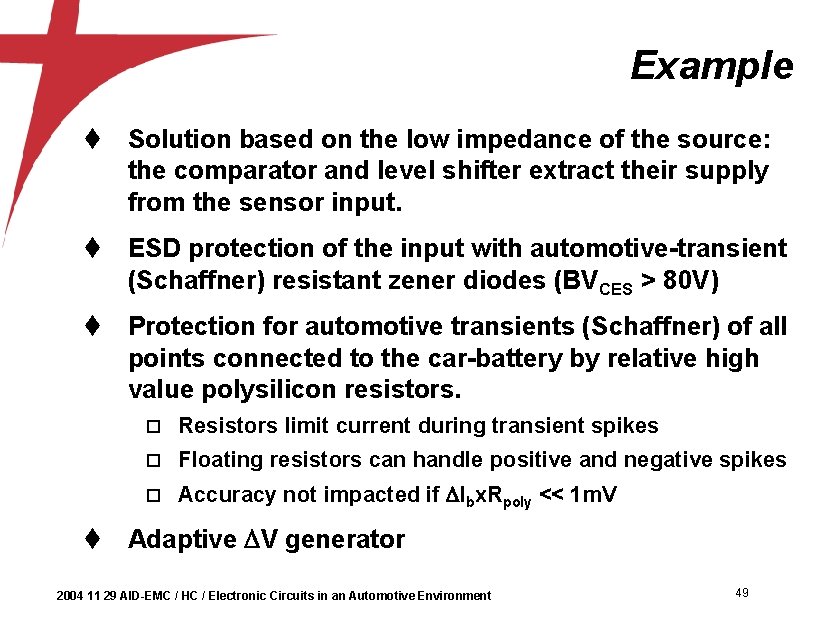
Example t Solution based on the low impedance of the source: the comparator and level shifter extract their supply from the sensor input. t ESD protection of the input with automotive-transient (Schaffner) resistant zener diodes (BVCES > 80 V) t Protection for automotive transients (Schaffner) of all points connected to the car-battery by relative high value polysilicon resistors. o Resistors limit current during transient spikes o Floating resistors can handle positive and negative spikes o Accuracy not impacted if DIbx. Rpoly << 1 m. V t Adaptive DV generator 2004 11 29 AID-EMC / HC / Electronic Circuits in an Automotive Environment 49
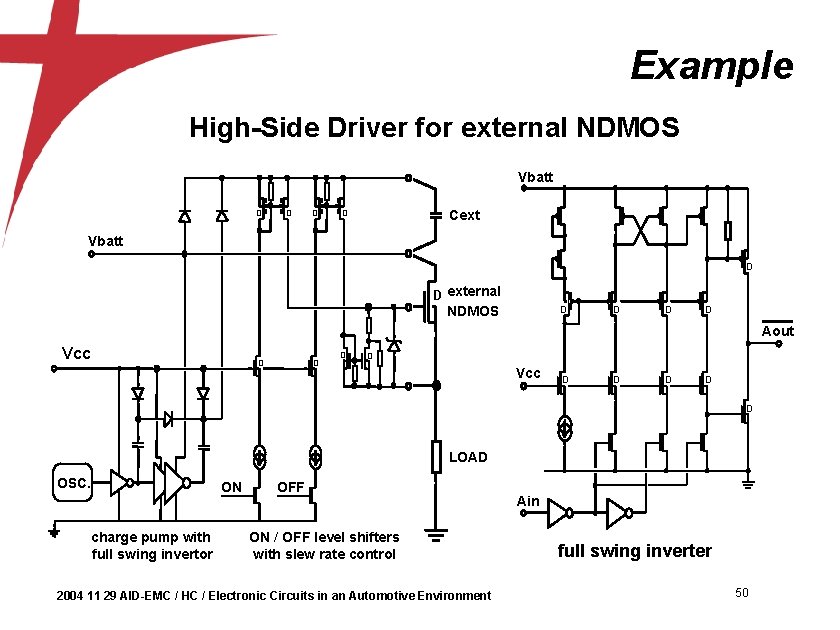
Example High-Side Driver for external NDMOS Vbatt D D D Cext D Vbatt D D external NDMOS D D Aout Vcc D D D D D LOAD OSC. charge pump with full swing invertor ON OFF ON / OFF level shifters with slew rate control 2004 11 29 AID-EMC / HC / Electronic Circuits in an Automotive Environment Ain full swing inverter 50
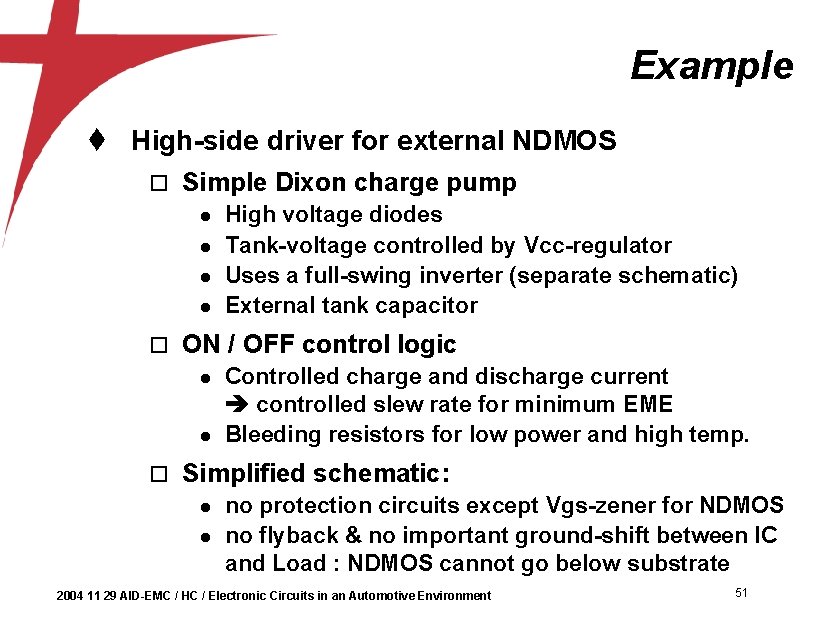
Example t High-side driver for external NDMOS o Simple Dixon charge pump l l o ON / OFF control logic l l o High voltage diodes Tank-voltage controlled by Vcc-regulator Uses a full-swing inverter (separate schematic) External tank capacitor Controlled charge and discharge current controlled slew rate for minimum EME Bleeding resistors for low power and high temp. Simplified schematic: l l no protection circuits except Vgs-zener for NDMOS no flyback & no important ground-shift between IC and Load : NDMOS cannot go below substrate 2004 11 29 AID-EMC / HC / Electronic Circuits in an Automotive Environment 51
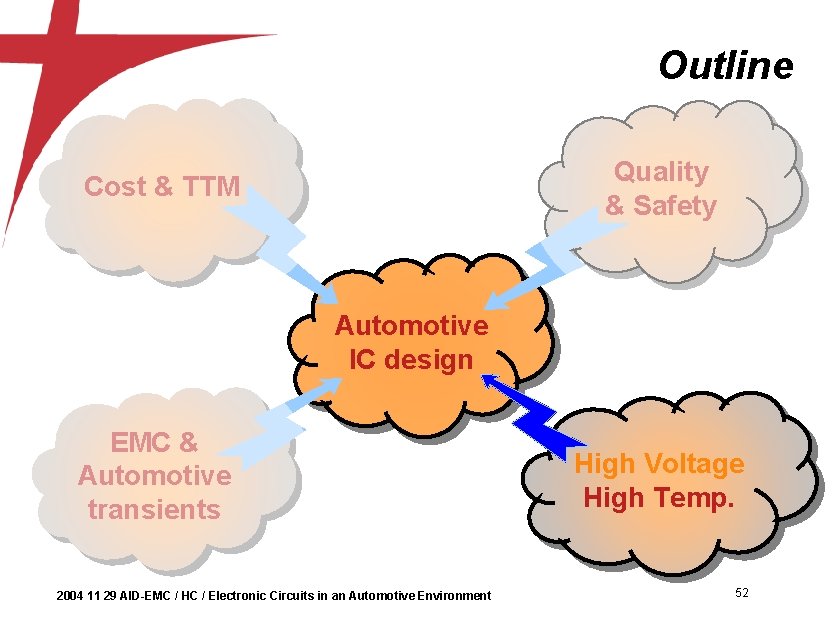
Outline Quality & Safety Cost & TTM Automotive IC design EMC & Automotive transients 2004 11 29 AID-EMC / HC / Electronic Circuits in an Automotive Environment High Voltage High Temp. 52
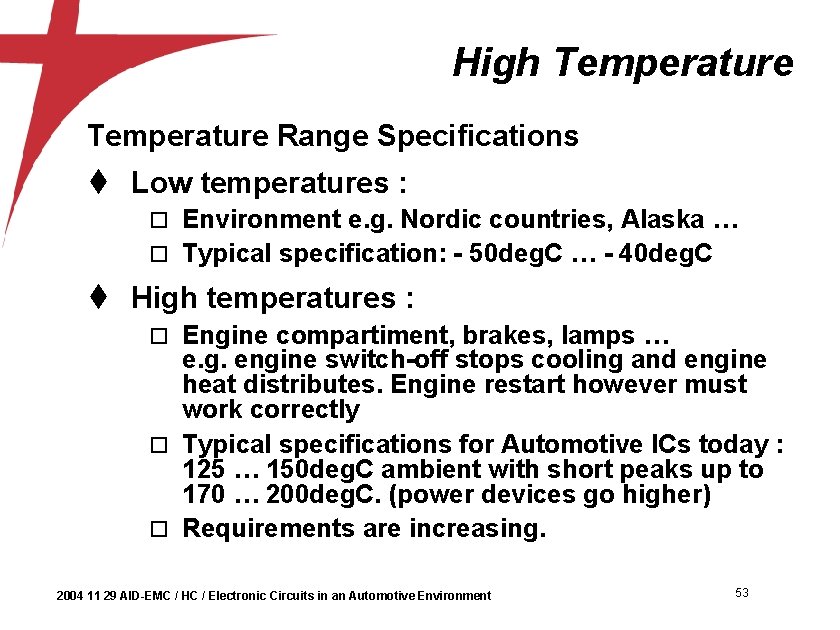
High Temperature Range Specifications t Low temperatures : Environment e. g. Nordic countries, Alaska … o Typical specification: - 50 deg. C … - 40 deg. C o t High temperatures : Engine compartiment, brakes, lamps … e. g. engine switch-off stops cooling and engine heat distributes. Engine restart however must work correctly o Typical specifications for Automotive ICs today : 125 … 150 deg. C ambient with short peaks up to 170 … 200 deg. C. (power devices go higher) o Requirements are increasing. o 2004 11 29 AID-EMC / HC / Electronic Circuits in an Automotive Environment 53
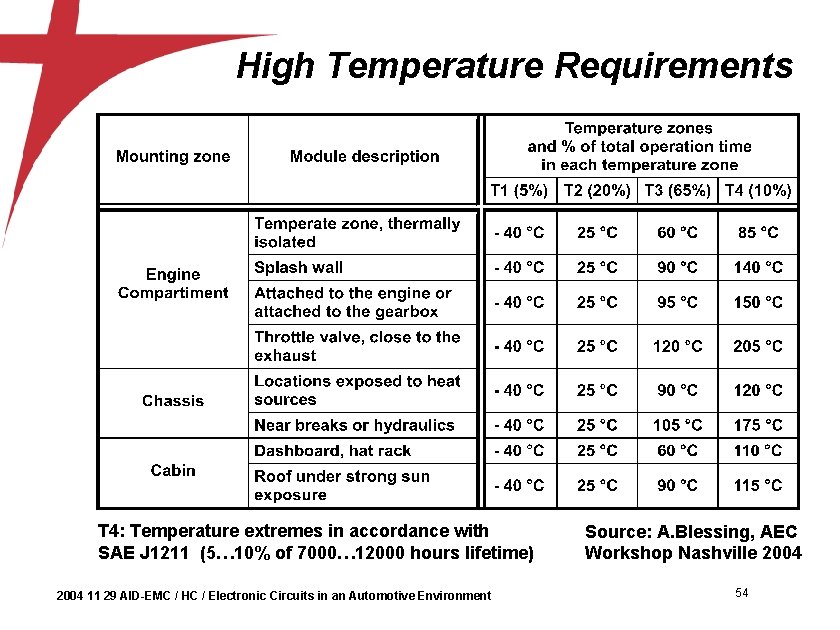
High Temperature Requirements T 4: Temperature extremes in accordance with SAE J 1211 (5… 10% of 7000… 12000 hours lifetime) 2004 11 29 AID-EMC / HC / Electronic Circuits in an Automotive Environment Source: A. Blessing, AEC Workshop Nashville 2004 54
High temperature limitations Functionality of on-chip components ? t Bulk silicon can be used up to ~ 200 … 250 deg. C. (with appropriate design techniques) o o o Below the intrinsic temperature of the lowest doped regions (~200 deg. C for 100 V, ~250 deg. C for 5 V techno). The MOS transistor remains a transistor, but with decreasing Vt and decreasing mobility increasing sub-threshold leakage increasing area Diffusion and poly-resistors remain resistors Thin oxide capacitors remain capacitors Junction diodes remain diodes but the leakage current goes up drastically. t SOI can be used up to ~ 250 … 300 deg. C t Ga. As can be used up to ~ 500 deg. C 2004 11 29 AID-EMC / HC / Electronic Circuits in an Automotive Environment 55
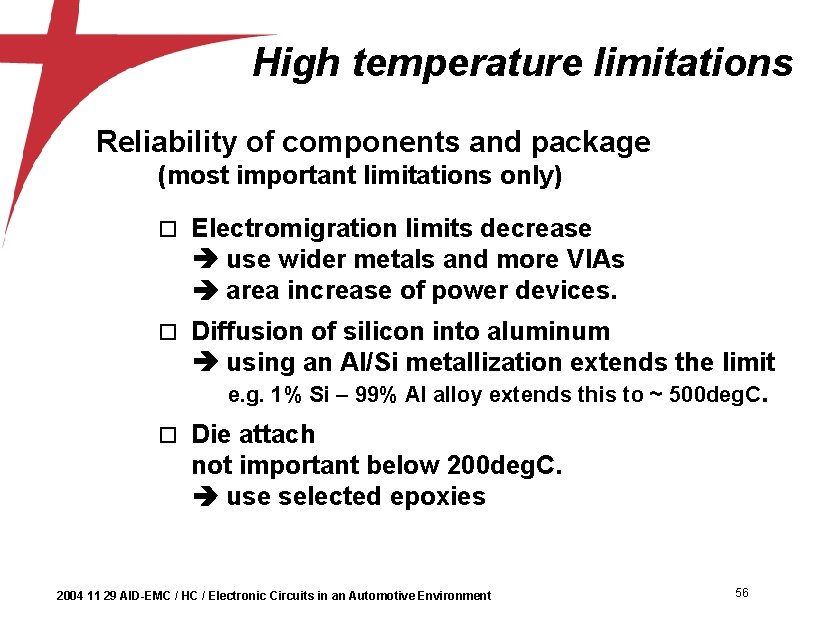
High temperature limitations Reliability of components and package (most important limitations only) o Electromigration limits decrease use wider metals and more VIAs area increase of power devices. o Diffusion of silicon into aluminum using an Al/Si metallization extends the limit e. g. 1% Si – 99% Al alloy extends this to ~ 500 deg. C. o Die attach not important below 200 deg. C. use selected epoxies 2004 11 29 AID-EMC / HC / Electronic Circuits in an Automotive Environment 56
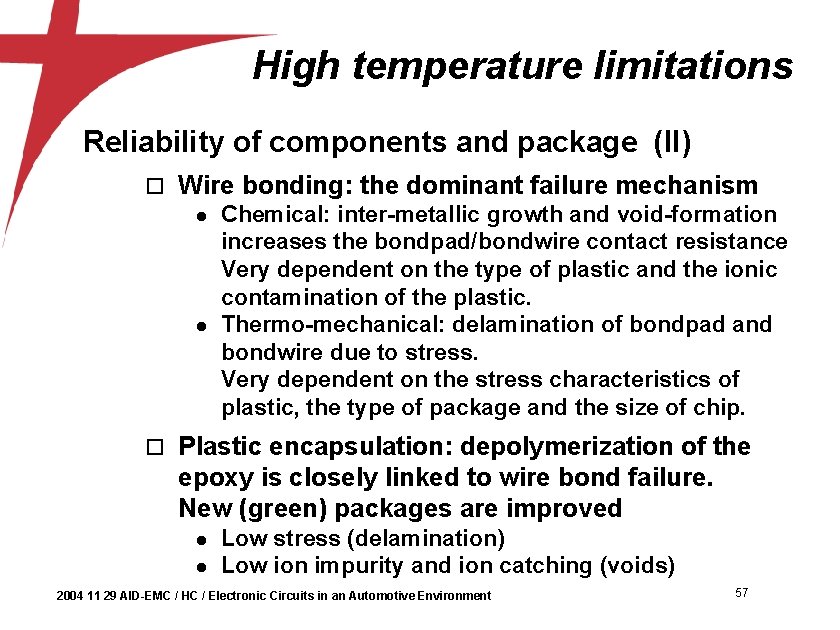
High temperature limitations Reliability of components and package (II) o Wire bonding: the dominant failure mechanism l l o Chemical: inter-metallic growth and void-formation increases the bondpad/bondwire contact resistance Very dependent on the type of plastic and the ionic contamination of the plastic. Thermo-mechanical: delamination of bondpad and bondwire due to stress. Very dependent on the stress characteristics of plastic, the type of package and the size of chip. Plastic encapsulation: depolymerization of the epoxy is closely linked to wire bond failure. New (green) packages are improved l l Low stress (delamination) Low ion impurity and ion catching (voids) 2004 11 29 AID-EMC / HC / Electronic Circuits in an Automotive Environment 57
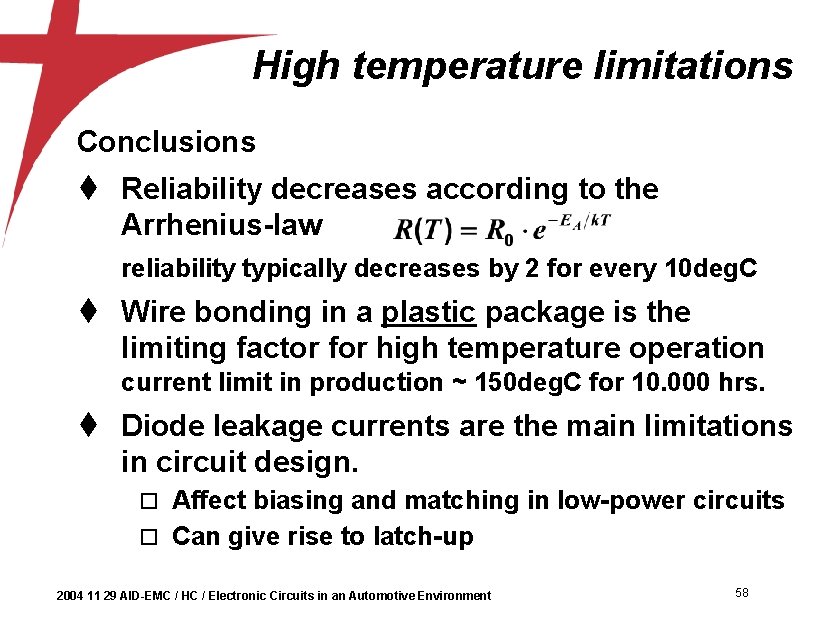
High temperature limitations Conclusions t Reliability decreases according to the Arrhenius-law reliability typically decreases by 2 for every 10 deg. C t Wire bonding in a plastic package is the limiting factor for high temperature operation current limit in production ~ 150 deg. C for 10. 000 hrs. t Diode leakage currents are the main limitations in circuit design. Affect biasing and matching in low-power circuits o Can give rise to latch-up o 2004 11 29 AID-EMC / HC / Electronic Circuits in an Automotive Environment 58
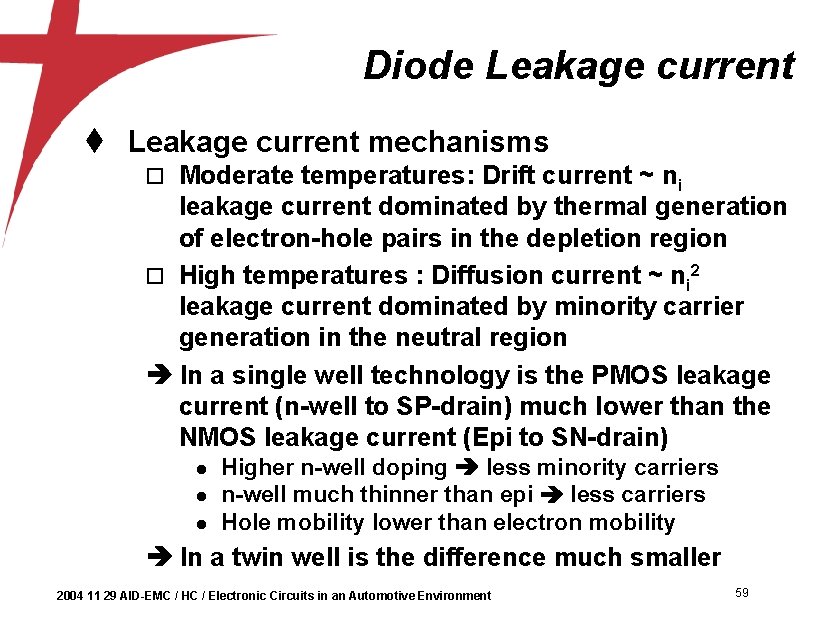
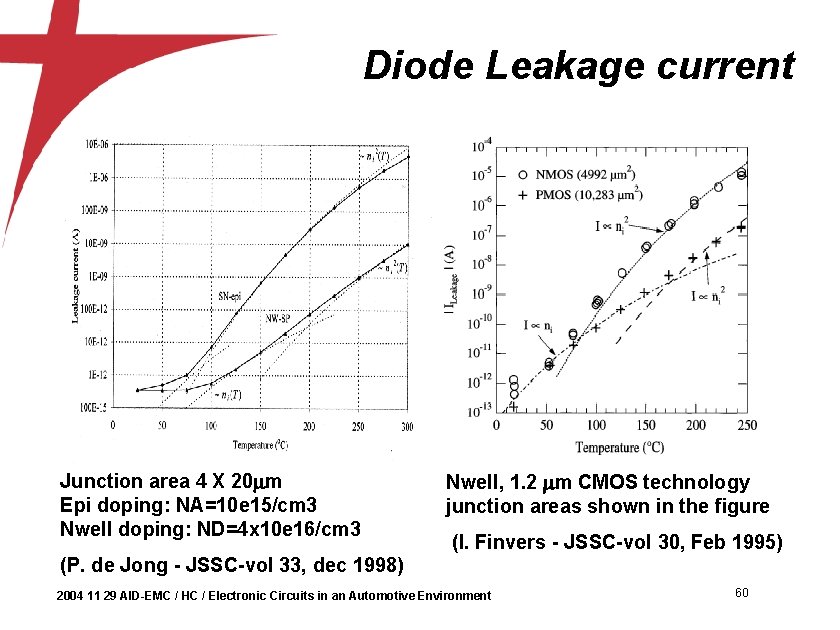
Diode Leakage current t Leakage current mechanisms Moderate temperatures: Drift current ~ ni leakage current dominated by thermal generation of electron-hole pairs in the depletion region o High temperatures : Diffusion current ~ ni 2 leakage current dominated by minority carrier generation in the neutral region In a single well technology is the PMOS leakage current (n-well to SP-drain) much lower than the NMOS leakage current (Epi to SN-drain) o l l l Higher n-well doping less minority carriers n-well much thinner than epi less carriers Hole mobility lower than electron mobility In a twin well is the difference much smaller 2004 11 29 AID-EMC / HC / Electronic Circuits in an Automotive Environment 59
Diode Leakage current Junction area 4 X 20 mm Epi doping: NA=10 e 15/cm 3 Nwell doping: ND=4 x 10 e 16/cm 3 Nwell, 1. 2 mm CMOS technology junction areas shown in the figure (I. Finvers - JSSC-vol 30, Feb 1995) (P. de Jong - JSSC-vol 33, dec 1998) 2004 11 29 AID-EMC / HC / Electronic Circuits in an Automotive Environment 60
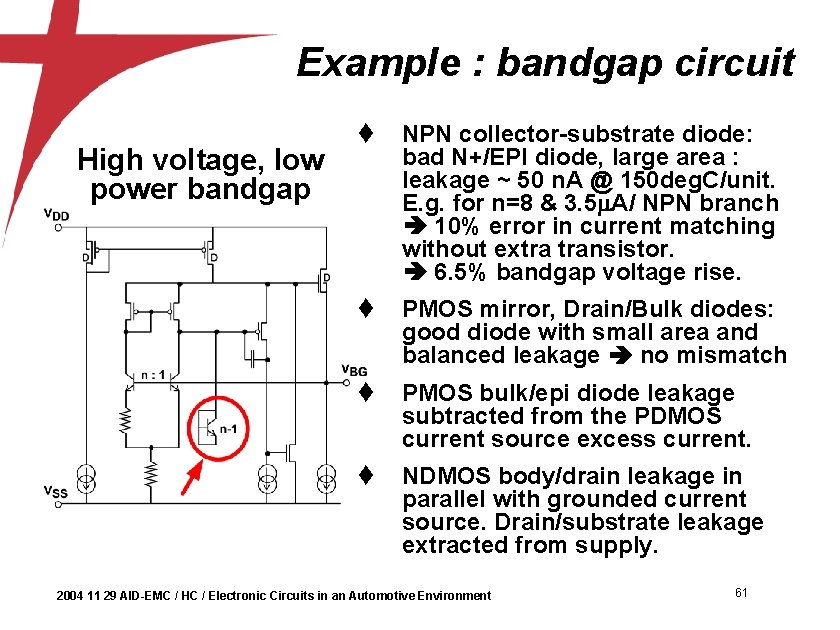
Example : bandgap circuit High voltage, low power bandgap t NPN collector-substrate diode: bad N+/EPI diode, large area : leakage ~ 50 n. A @ 150 deg. C/unit. E. g. for n=8 & 3. 5 m. A/ NPN branch 10% error in current matching without extra transistor. 6. 5% bandgap voltage rise. t PMOS mirror, Drain/Bulk diodes: good diode with small area and balanced leakage no mismatch t PMOS bulk/epi diode leakage subtracted from the PDMOS current source excess current. t NDMOS body/drain leakage in parallel with grounded current source. Drain/substrate leakage extracted from supply. 2004 11 29 AID-EMC / HC / Electronic Circuits in an Automotive Environment 61
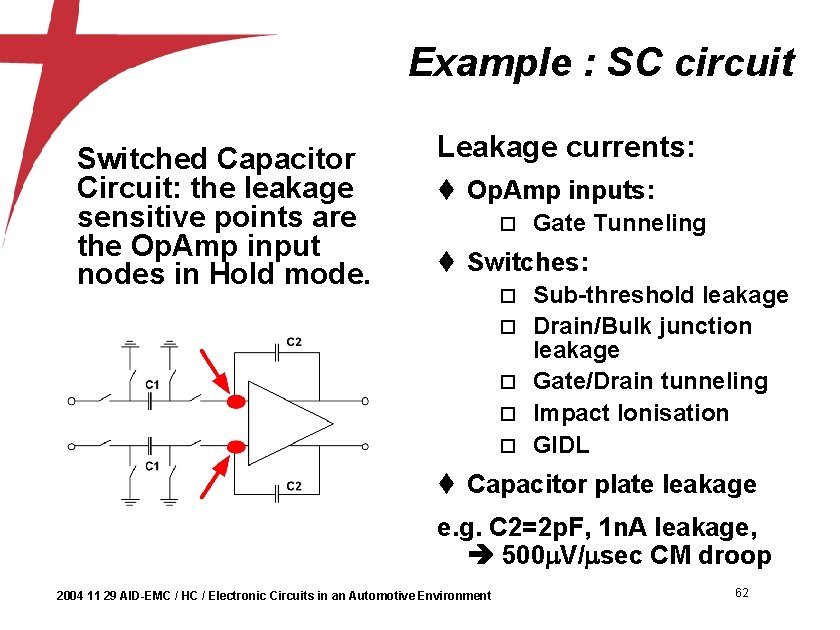
Example : SC circuit Switched Capacitor Circuit: the leakage sensitive points are the Op. Amp input nodes in Hold mode. Leakage currents: t Op. Amp inputs: o Gate Tunneling t Switches: o o o Sub-threshold leakage Drain/Bulk junction leakage Gate/Drain tunneling Impact Ionisation GIDL t Capacitor plate leakage e. g. C 2=2 p. F, 1 n. A leakage, 500 m. V/msec CM droop 2004 11 29 AID-EMC / HC / Electronic Circuits in an Automotive Environment 62
Outline Quality & Safety Cost & TTM Automotive IC design EMC & Automotive transients 2004 11 29 AID-EMC / HC / Electronic Circuits in an Automotive Environment High Voltage High Temp. 63
EMC : Definition (UK Defense Standard 59 -41) “Electro Magnetic Compatibility is the ability of electrical and electronic equipments, subsystems and systems to share the electromagnetic spectrum and perform their desired functions without unacceptable degradation from or to the specified electromagnetic environment. ” In other words: The Electro Magnetic Emission (EME) must be low enough, not to disturb the environment The Electro Magnetic Susceptibility (EMS) must be low enough, not to be disturbed by the environment 2004 11 29 AID-EMC / HC / Electronic Circuits in an Automotive Environment 64
EMC : Examples t EMS examples o Unwanted but not safety critical l o Car-radio, GPS … Safety-critical systems require full in-spec functionality during EMC l ABS system, airbag system, Motor control … t EME examples o Unwanted EME sources l l o switching of heavy or inductive loads: lamps, startmotor, ignition … fast switching circuits: digital circuits … Wanted EME sources l mobile phones, CB transmitters, radio stations … : 2004 11 29 AID-EMC / HC / Electronic Circuits in an Automotive Environment 65
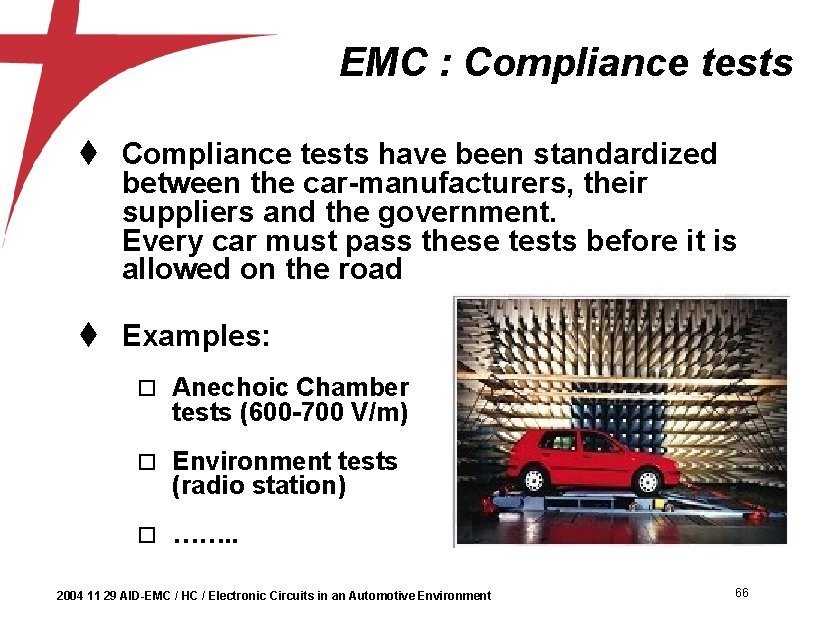
EMC : Compliance tests t Compliance tests have been standardized between the car-manufacturers, their suppliers and the government. Every car must pass these tests before it is allowed on the road t Examples: o Anechoic Chamber tests (600 -700 V/m) o Environment tests (radio station) o ……. . 2004 11 29 AID-EMC / HC / Electronic Circuits in an Automotive Environment 66
EMC : Pre-Compliance tests t The later EMC problems are detected, the more difficult the identification of the root-cause and the more limited and expensive the solution. At final car qualification level, many modules could cause the EMC problem and there is no time for a redesign. The only solution is adding extra shielding and anti-interference components like chokes, coils, capacitors, which is very expensive. o At module qualification level, the PCB layout can be changed and extra components (chokes, coils, cap’s) can be added. This has less impact on the bill of materials but can impact the time to qualification slot. It is mandatory to include EMC in all phases of the development : IC’s, PCB’s, modules and car-layout. o Pre-compliance tests have been standardized to enable this at module and at IC level. 2004 11 29 AID-EMC / HC / Electronic Circuits in an Automotive Environment 67
EMC : Pre-Compliance tests t Pre-compliance tests agreed between carmanufacturer and module-supplier or between module-manufacturer and IC supplier. PRO: module and IC manufacturers make portable designs CON: tendency to end up with a chain of over-specification t Of the many EMC standards, 3 standards are particularly important for IC’s. IEC 61967 for EME measurements (150 k. Hz – 1 GHz, narrow-band EME) o IEC 62132 for EMS measurements (150 k. Hz – 1 GHz, narrow-band EMS) o ISO 7637 for Automotive transients (EMS for power supply line disturbances) o 2004 11 29 AID-EMC / HC / Electronic Circuits in an Automotive Environment 68
EME standard: IEC 61967 t IEC 61967 : Integrated circuits – Measurement of electromagnetic emissions 150 k. Hz to 1 GHz. o Part 1: General conditions and definitions t Radiated emission measurements Part 2: TEM-cell (Transversal Electromagnetic cell) o Part 3: Surface scan method o t Conducted emission measurements Part 4: 1 Ohm/150 Ohm method o Part 5: Workbench Faraday Cage method (WBFC) o Part 6: Magnetic probe method o 2004 11 29 AID-EMC / HC / Electronic Circuits in an Automotive Environment 69
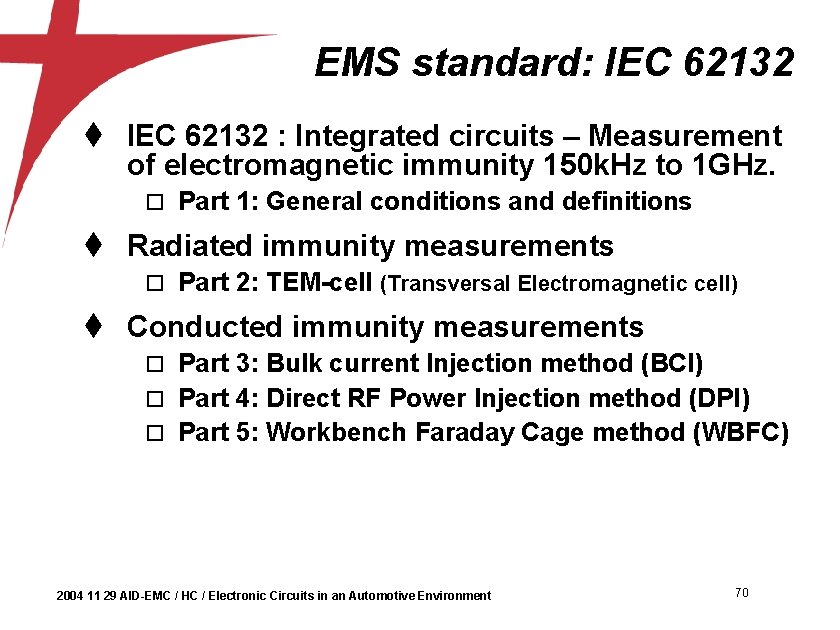
EMS standard: IEC 62132 t IEC 62132 : Integrated circuits – Measurement of electromagnetic immunity 150 k. Hz to 1 GHz. o Part 1: General conditions and definitions t Radiated immunity measurements o Part 2: TEM-cell (Transversal Electromagnetic cell) t Conducted immunity measurements Part 3: Bulk current Injection method (BCI) o Part 4: Direct RF Power Injection method (DPI) o Part 5: Workbench Faraday Cage method (WBFC) o 2004 11 29 AID-EMC / HC / Electronic Circuits in an Automotive Environment 70
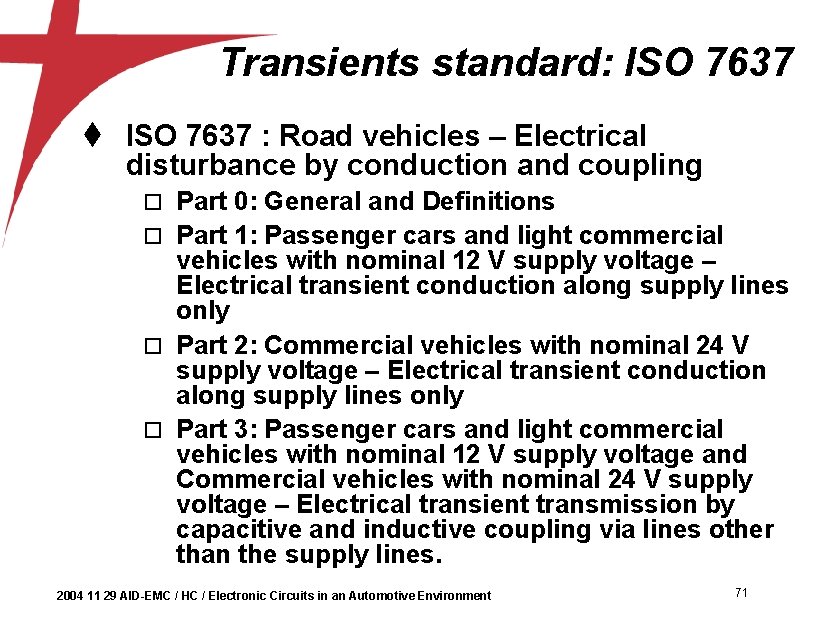
Transients standard: ISO 7637 t ISO 7637 : Road vehicles – Electrical disturbance by conduction and coupling Part 0: General and Definitions o Part 1: Passenger cars and light commercial vehicles with nominal 12 V supply voltage – Electrical transient conduction along supply lines only o Part 2: Commercial vehicles with nominal 24 V supply voltage – Electrical transient conduction along supply lines only o Part 3: Passenger cars and light commercial vehicles with nominal 12 V supply voltage and Commercial vehicles with nominal 24 V supply voltage – Electrical transient transmission by capacitive and inductive coupling via lines other than the supply lines. o 2004 11 29 AID-EMC / HC / Electronic Circuits in an Automotive Environment 71
EMC standards in design t How to include EMC in the IC development flow EMC deals with electromagnetic fields. o EM noise generator emits EM-energy, wanted or unwanted. o EM noise receiver susceptible to this EM-energy o The coupling channel conducts EM-energy from the noise-generator to the noise-receiver via radiation or conduction. o radiation EM-noise receiver EM-noise generator conduction 2004 11 29 AID-EMC / HC / Electronic Circuits in an Automotive Environment 72
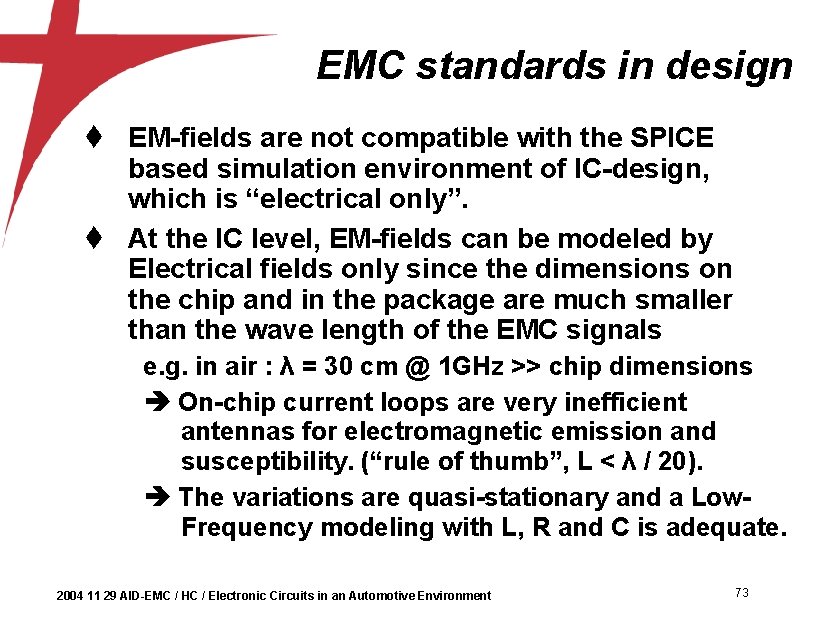
EMC standards in design t EM-fields are not compatible with the SPICE based simulation environment of IC-design, which is “electrical only”. t At the IC level, EM-fields can be modeled by Electrical fields only since the dimensions on the chip and in the package are much smaller than the wave length of the EMC signals e. g. in air : λ = 30 cm @ 1 GHz >> chip dimensions On-chip current loops are very inefficient antennas for electromagnetic emission and susceptibility. (“rule of thumb”, L < λ / 20). The variations are quasi-stationary and a Low. Frequency modeling with L, R and C is adequate. 2004 11 29 AID-EMC / HC / Electronic Circuits in an Automotive Environment 73
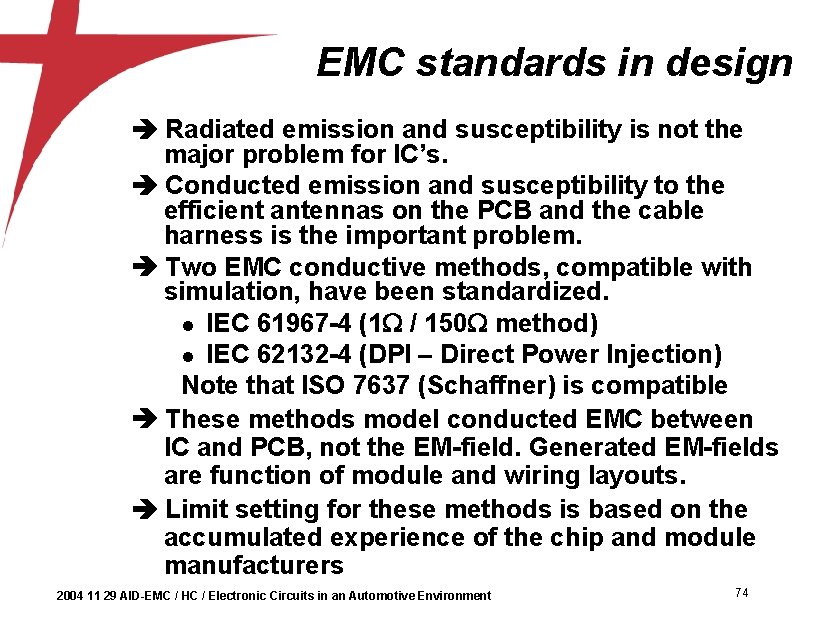
EMC standards in design Radiated emission and susceptibility is not the major problem for IC’s. Conducted emission and susceptibility to the efficient antennas on the PCB and the cable harness is the important problem. Two EMC conductive methods, compatible with simulation, have been standardized. l IEC 61967 -4 (1 W / 150 W method) l IEC 62132 -4 (DPI – Direct Power Injection) Note that ISO 7637 (Schaffner) is compatible These methods model conducted EMC between IC and PCB, not the EM-field. Generated EM-fields are function of module and wiring layouts. Limit setting for these methods is based on the accumulated experience of the chip and module manufacturers 2004 11 29 AID-EMC / HC / Electronic Circuits in an Automotive Environment 74
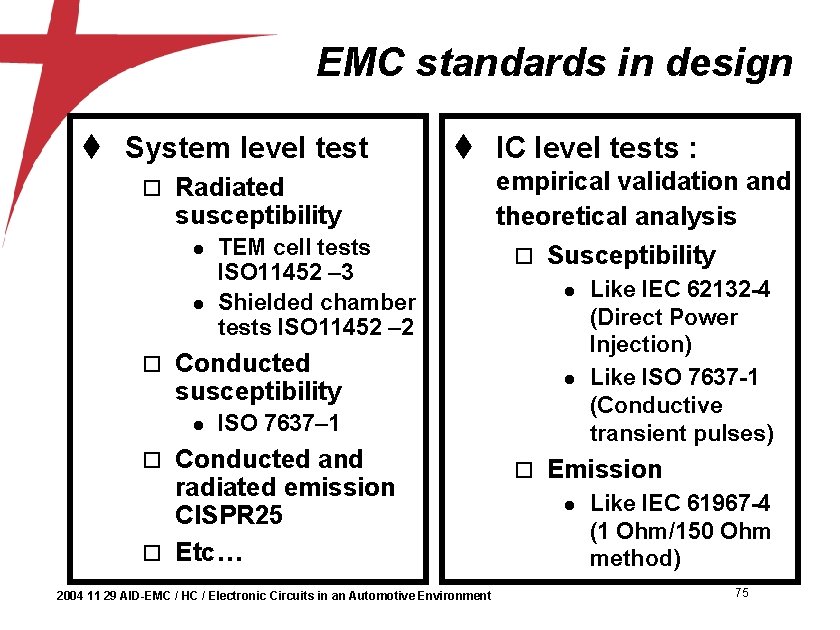
EMC standards in design t System level test o Radiated susceptibility l l o t IC level tests : TEM cell tests ISO 11452 – 3 Shielded chamber tests ISO 11452 – 2 empirical validation and theoretical analysis o Susceptibility l Conducted susceptibility l l ISO 7637– 1 Conducted and radiated emission CISPR 25 o Etc… o 2004 11 29 AID-EMC / HC / Electronic Circuits in an Automotive Environment o Like IEC 62132 -4 (Direct Power Injection) Like ISO 7637 -1 (Conductive transient pulses) Emission l Like IEC 61967 -4 (1 Ohm/150 Ohm method) 75
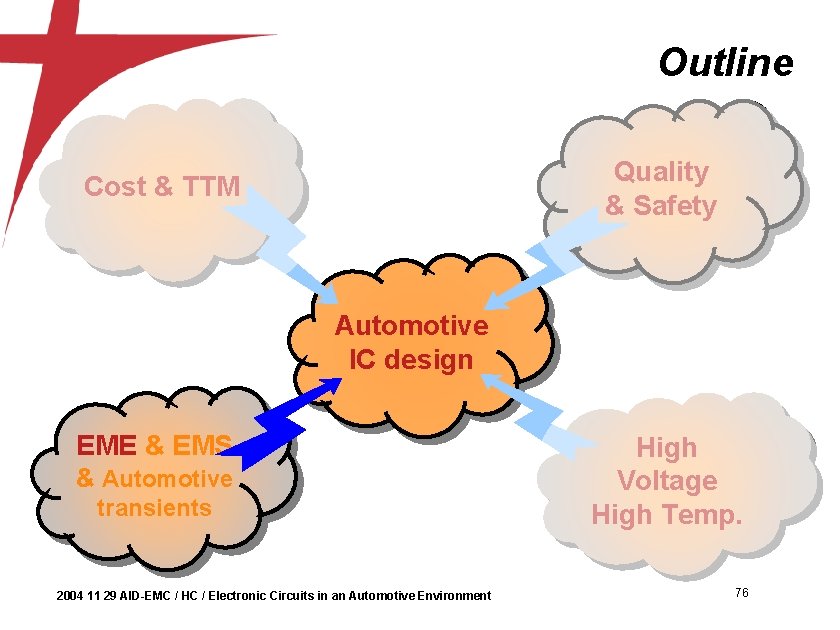
Outline Quality & Safety Cost & TTM Automotive IC design EME & EMS & Automotive transients 2004 11 29 AID-EMC / HC / Electronic Circuits in an Automotive Environment High Voltage High Temp. 76
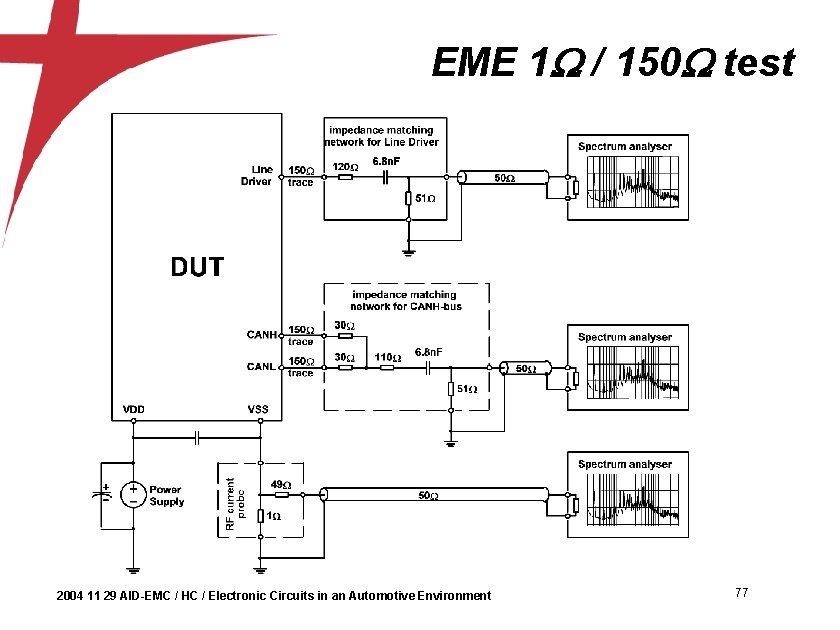
EME 1 W / 150 W test 2004 11 29 AID-EMC / HC / Electronic Circuits in an Automotive Environment 77
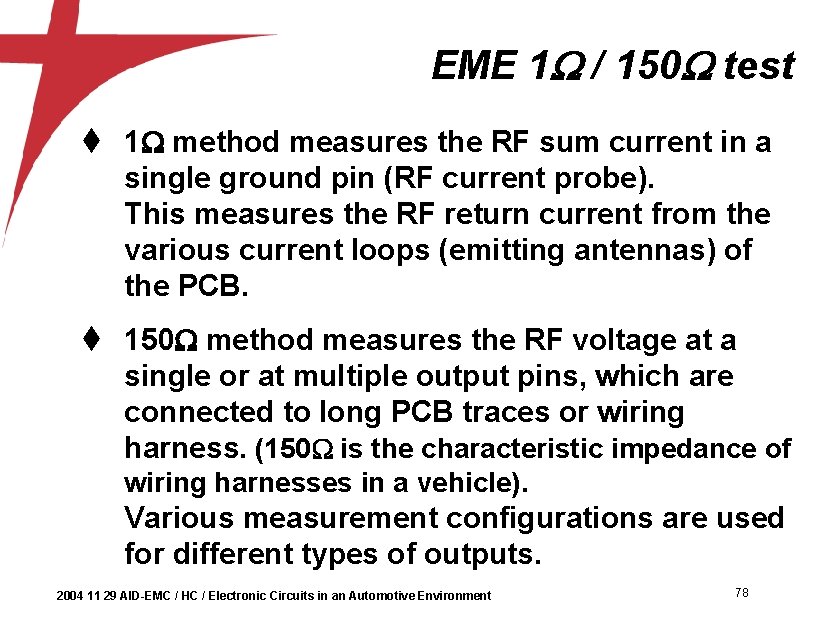
EME 1 W / 150 W test t 1 W method measures the RF sum current in a single ground pin (RF current probe). This measures the RF return current from the various current loops (emitting antennas) of the PCB. t 150 W method measures the RF voltage at a single or at multiple output pins, which are connected to long PCB traces or wiring harness. (150 W is the characteristic impedance of wiring harnesses in a vehicle). Various measurement configurations are used for different types of outputs. 2004 11 29 AID-EMC / HC / Electronic Circuits in an Automotive Environment 78
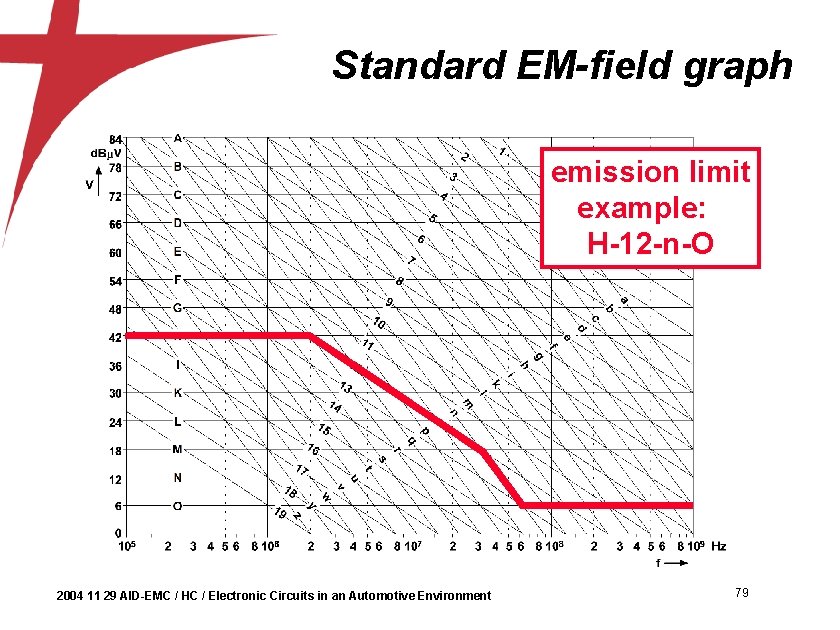
Standard EM-field graph emission limit example: H-12 -n-O 2004 11 29 AID-EMC / HC / Electronic Circuits in an Automotive Environment 79
EME what happens t EME is generated by HF currents in external loops, which act as antennas. t Sources of the HF currents Switching of core digital logic: glue logic, mcore, DSP, memory, clock drivers … synchronous logic generates large and sharp current peaks with large HF content o Activity of the analog core circuit does not generate large current peaks o Switching of the digital I/O pins fast and large current peaks directly to the PCB o High power output drivers large current peaks to the PCB and wiring harness. o 2004 11 29 AID-EMC / HC / Electronic Circuits in an Automotive Environment 80
EME how to cope with Internal measures t Limit the switching power to the external Use low power circuits & circuit techniques - low power flip-flop, memory … - architecture with different clock domains - lower or adaptive supply voltage - …. Note: gated clocks are not efficient for EME if modes exist where all gates are open. o Use a more advanced technology o Use on-chip capacitors o EME (HF) looks at switching power spectrum, low-power digital looks at mean dissipated power. 2004 11 29 AID-EMC / HC / Electronic Circuits in an Automotive Environment 81
EME how to cope with t Shape the current peaks to the external o Slow down the switching edges - MS-FF and 2 phase clock - asynchronous logic - controlled edges for I/O or power driver - …. External and Chip-layout measures Differential output signals e. g. CAN, LVDS … twisted-pair like lines generate less EME and are less susceptible to EME o VDD and VSS close to each other - differential signals (see above) - external decoupling easier and more efficient o 2004 11 29 AID-EMC / HC / Electronic Circuits in an Automotive Environment 82
EME how to cope with t EME of the module is the result of the current peaks generated by the IC times the efficiency of the emitting antennas of the PCB and wiring harness. t The current peaks simulated or measured with the 1 W / 150 W method do not predict the correct value of the emission but give a good relative indication. A correlation with the actual measured EME of the module is required. t Each manufacturer specifies his own limits for the emission as simulated or measured by the IEC 61967 -4 1 W / 150 W method. 2004 11 29 AID-EMC / HC / Electronic Circuits in an Automotive Environment 83
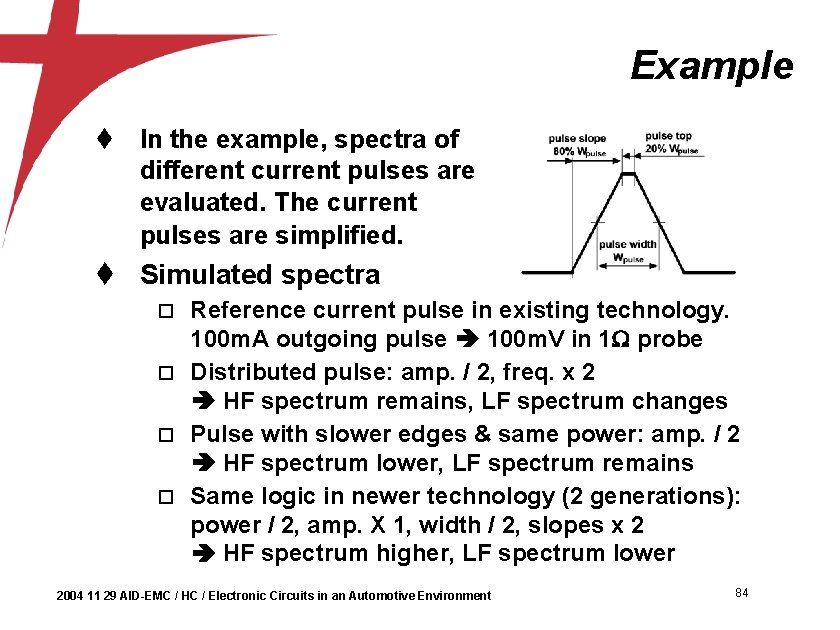
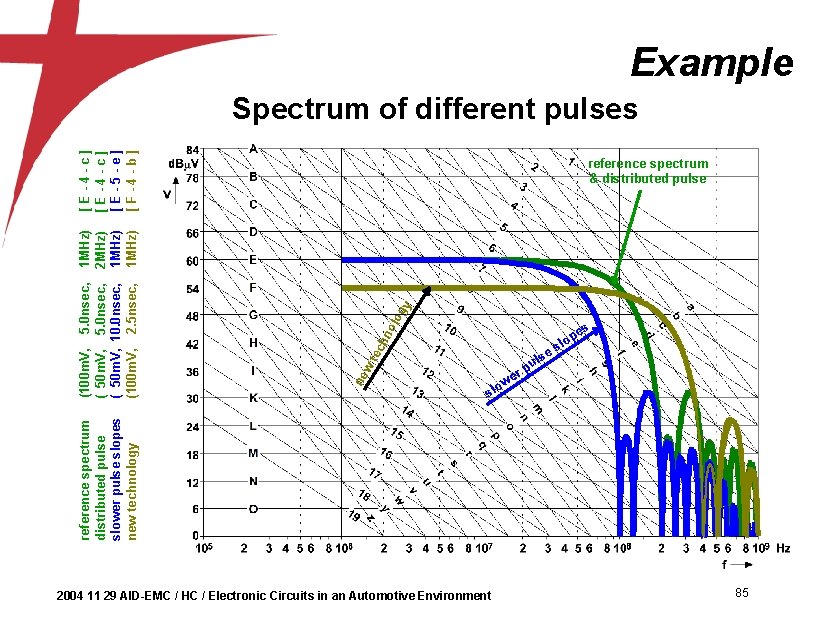
Example t In the example, spectra of different current pulses are evaluated. The current pulses are simplified. t Simulated spectra Reference current pulse in existing technology. 100 m. A outgoing pulse 100 m. V in 1 W probe o Distributed pulse: amp. / 2, freq. x 2 HF spectrum remains, LF spectrum changes o Pulse with slower edges & same power: amp. / 2 HF spectrum lower, LF spectrum remains o Same logic in newer technology (2 generations): power / 2, amp. X 1, width / 2, slopes x 2 HF spectrum higher, LF spectrum lower o 2004 11 29 AID-EMC / HC / Electronic Circuits in an Automotive Environment 84
reference spectrum distributed pulse slower pulse slopes new technology w ne tec y log hn o (100 m. V, 5. 0 nsec, ( 50 m. V, 10. 0 nsec, (100 m. V, 2. 5 nsec, 1 MHz) 2 MHz) 1 MHz) [E-4 -c] [E-5 -e] [F-4 -b] Example Spectrum of different pulses reference spectrum & distributed pulse es e w slo 2004 11 29 AID-EMC / HC / Electronic Circuits in an Automotive Environment er ls pu p slo 85
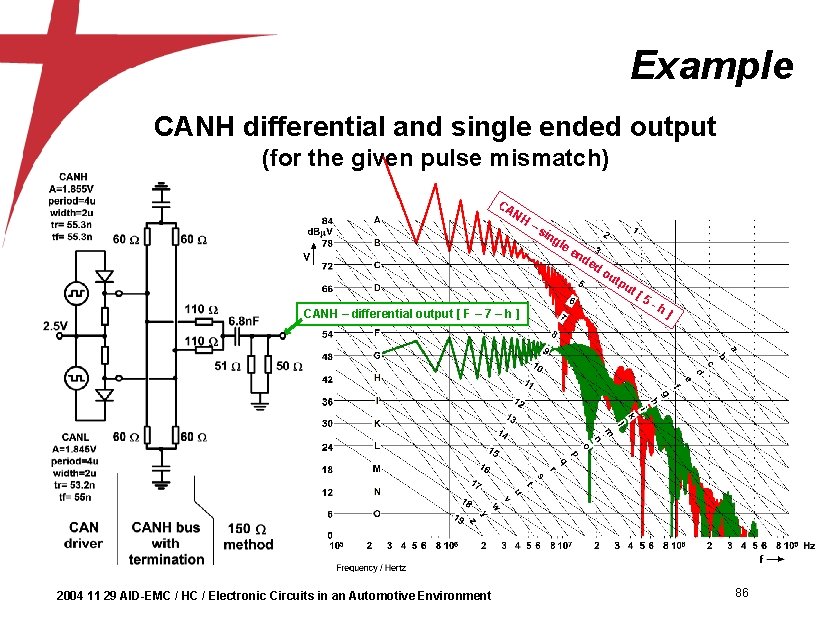
Example CANH differential and single ended output (for the given pulse mismatch) CA NH –s ing le en de do ut CANH – differential output [ F – 7 – h ] 2004 11 29 AID-EMC / HC / Electronic Circuits in an Automotive Environment pu t[ 5 - h] 86
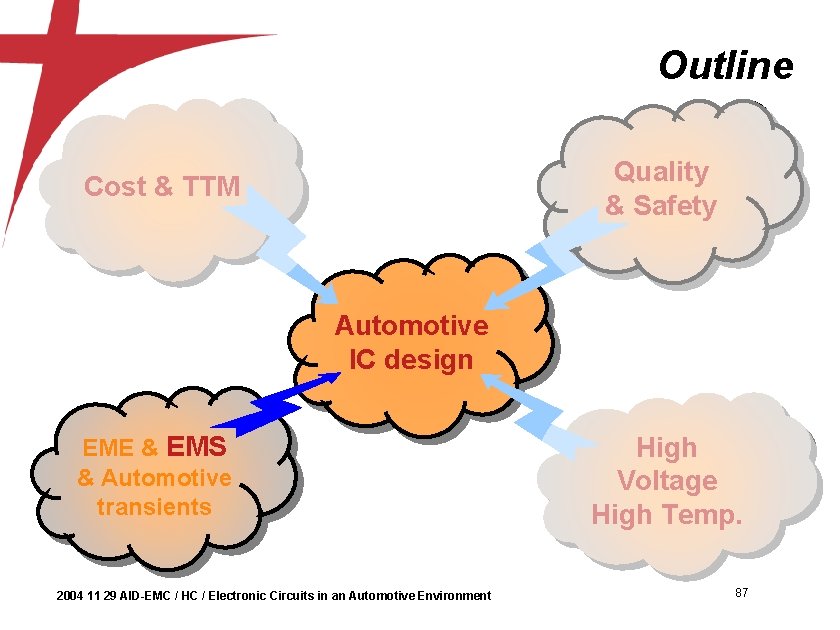
Outline Quality & Safety Cost & TTM Automotive IC design EME & EMS & Automotive transients 2004 11 29 AID-EMC / HC / Electronic Circuits in an Automotive Environment High Voltage High Temp. 87
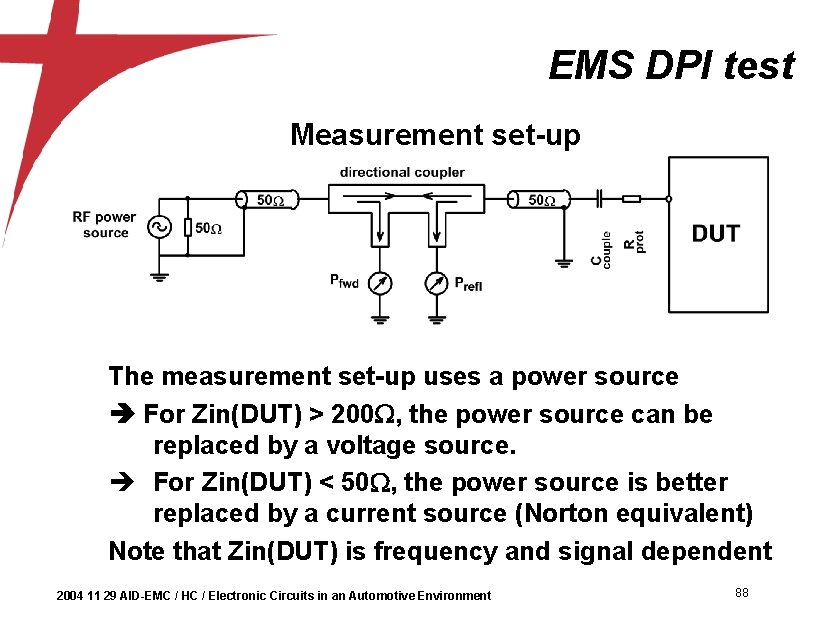
EMS DPI test Measurement set-up The measurement set-up uses a power source For Zin(DUT) > 200 W, the power source can be replaced by a voltage source. è For Zin(DUT) < 50 W, the power source is better replaced by a current source (Norton equivalent) Note that Zin(DUT) is frequency and signal dependent 2004 11 29 AID-EMC / HC / Electronic Circuits in an Automotive Environment 88
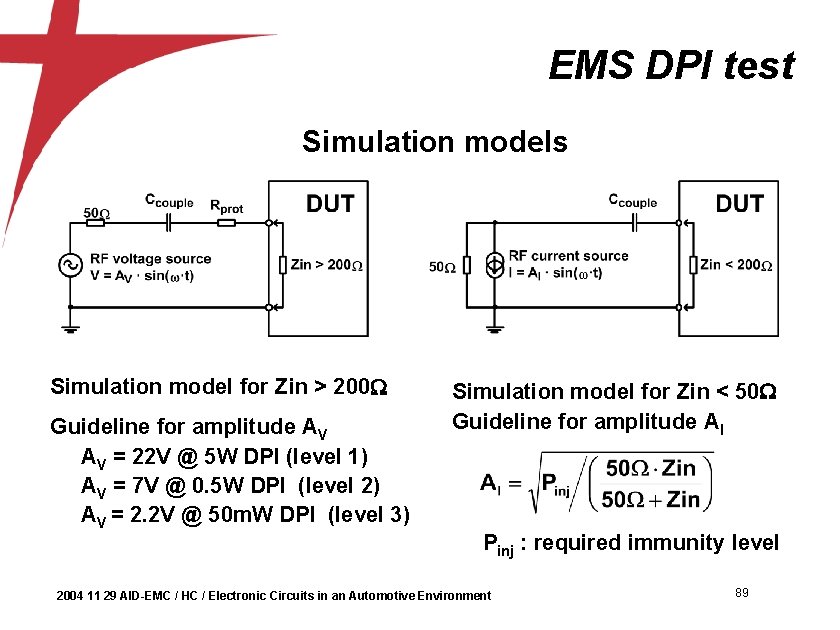
EMS DPI test Simulation models Simulation model for Zin > 200 W Guideline for amplitude AV AV = 22 V @ 5 W DPI (level 1) AV = 7 V @ 0. 5 W DPI (level 2) AV = 2. 2 V @ 50 m. W DPI (level 3) Simulation model for Zin < 50 W Guideline for amplitude AI Pinj : required immunity level 2004 11 29 AID-EMC / HC / Electronic Circuits in an Automotive Environment 89
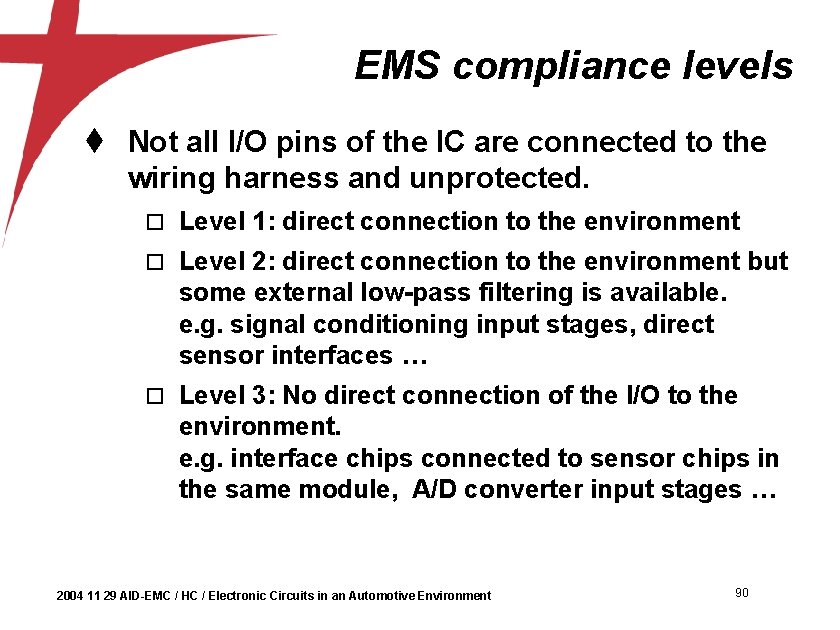
EMS compliance levels t Not all I/O pins of the IC are connected to the wiring harness and unprotected. o Level 1: direct connection to the environment o Level 2: direct connection to the environment but some external low-pass filtering is available. e. g. signal conditioning input stages, direct sensor interfaces … o Level 3: No direct connection of the I/O to the environment. e. g. interface chips connected to sensor chips in the same module, A/D converter input stages … 2004 11 29 AID-EMC / HC / Electronic Circuits in an Automotive Environment 90
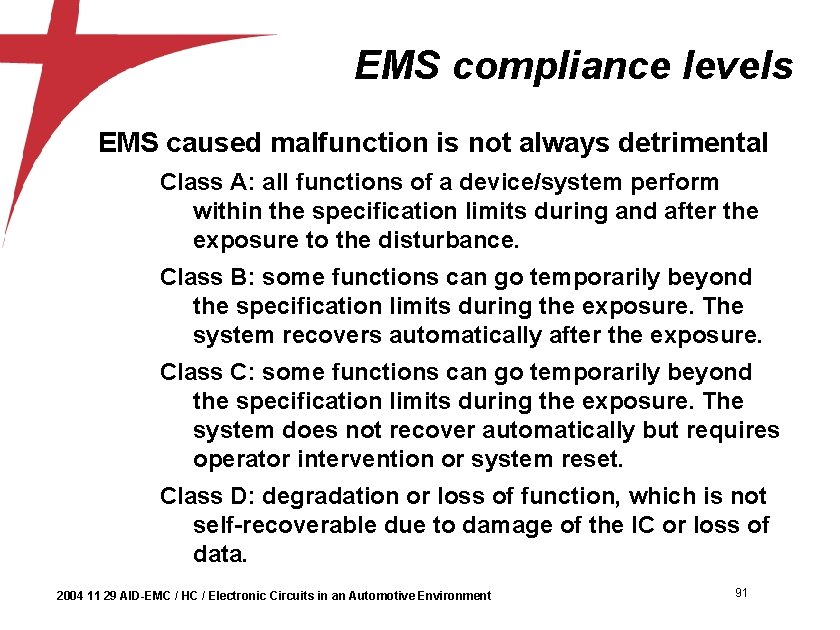
EMS compliance levels EMS caused malfunction is not always detrimental Class A: all functions of a device/system perform within the specification limits during and after the exposure to the disturbance. Class B: some functions can go temporarily beyond the specification limits during the exposure. The system recovers automatically after the exposure. Class C: some functions can go temporarily beyond the specification limits during the exposure. The system does not recover automatically but requires operator intervention or system reset. Class D: degradation or loss of function, which is not self-recoverable due to damage of the IC or loss of data. 2004 11 29 AID-EMC / HC / Electronic Circuits in an Automotive Environment 91
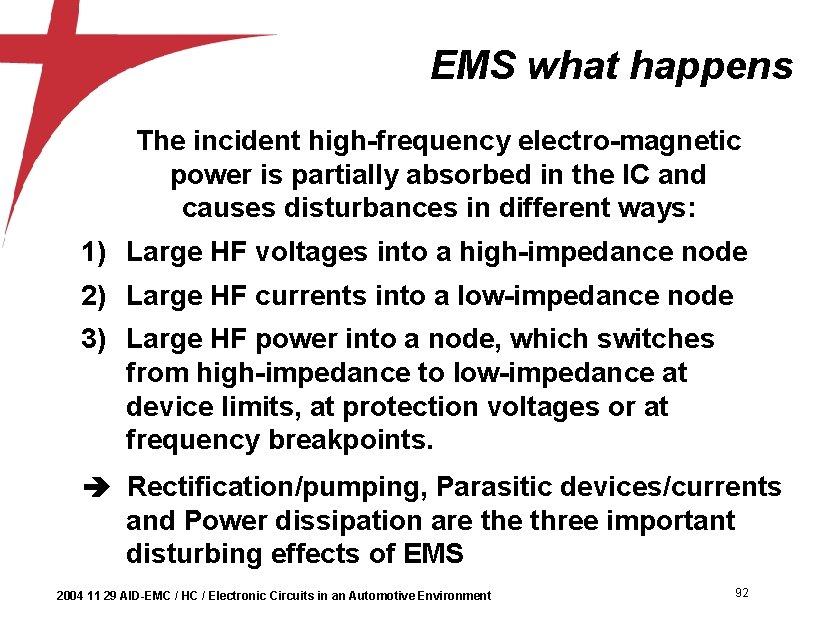
EMS what happens The incident high-frequency electro-magnetic power is partially absorbed in the IC and causes disturbances in different ways: 1) Large HF voltages into a high-impedance node 2) Large HF currents into a low-impedance node 3) Large HF power into a node, which switches from high-impedance to low-impedance at device limits, at protection voltages or at frequency breakpoints. Rectification/pumping, Parasitic devices/currents and Power dissipation are three important disturbing effects of EMS 2004 11 29 AID-EMC / HC / Electronic Circuits in an Automotive Environment 92
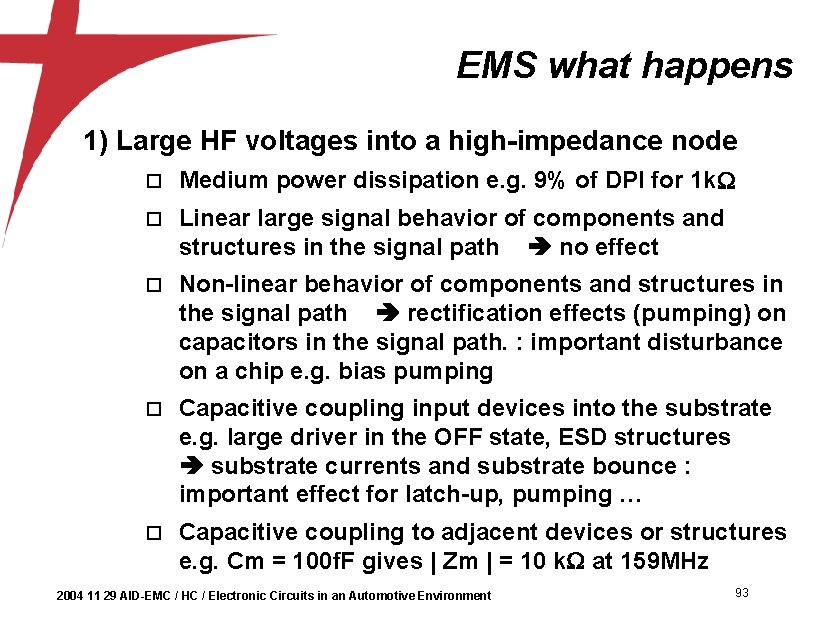
EMS what happens 1) Large HF voltages into a high-impedance node o Medium power dissipation e. g. 9% of DPI for 1 k. W o Linear large signal behavior of components and structures in the signal path no effect o Non-linear behavior of components and structures in the signal path rectification effects (pumping) on capacitors in the signal path. : important disturbance on a chip e. g. bias pumping o Capacitive coupling input devices into the substrate e. g. large driver in the OFF state, ESD structures substrate currents and substrate bounce : important effect for latch-up, pumping … o Capacitive coupling to adjacent devices or structures e. g. Cm = 100 f. F gives | Zm | = 10 k. W at 159 MHz 2004 11 29 AID-EMC / HC / Electronic Circuits in an Automotive Environment 93
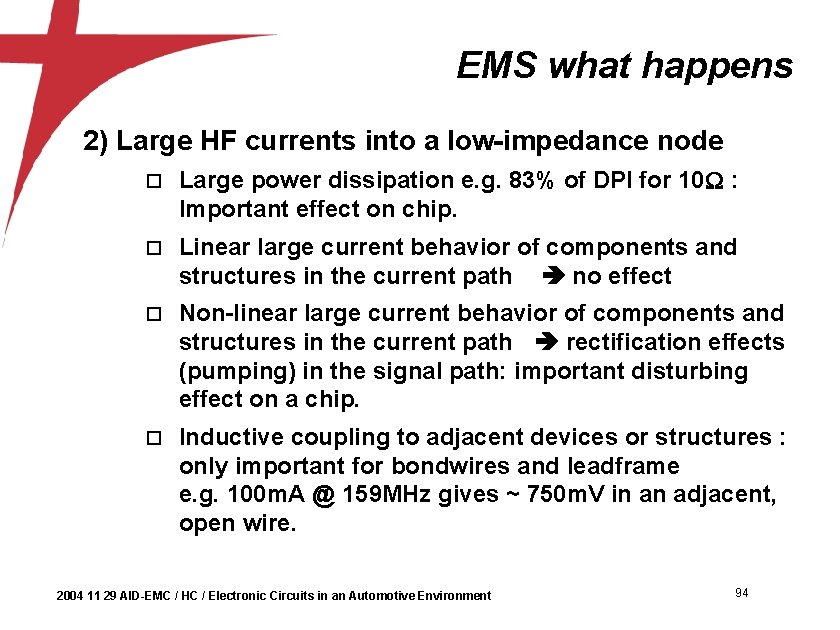
EMS what happens 2) Large HF currents into a low-impedance node o Large power dissipation e. g. 83% of DPI for 10 W : Important effect on chip. o Linear large current behavior of components and structures in the current path no effect o Non-linear large current behavior of components and structures in the current path rectification effects (pumping) in the signal path: important disturbing effect on a chip. o Inductive coupling to adjacent devices or structures : only important for bondwires and leadframe e. g. 100 m. A @ 159 MHz gives ~ 750 m. V in an adjacent, open wire. 2004 11 29 AID-EMC / HC / Electronic Circuits in an Automotive Environment 94
EMS what happens 3) Large HF power into a node, which switches from high-impedance to low-impedance e. g. at device limits or at protection voltages or at frequency breakpoints o Combines high voltage and large currents o Large power dissipation in clipping devices or protection structures Important effect o clipping activates parasitic devices & current paths large current peaks in the supply lines or other pins generates EME in other loops on the PCB. large current peaks in the substrate through parasitic devices important effect e. g. latch-up, substrate coupling … o Nature of the signal path can change with frequency important effect, difficult to cope with. 2004 11 29 AID-EMC / HC / Electronic Circuits in an Automotive Environment 95
EMS how to cope with t Guidelines Use good large signal and HF models o Include all parasitic components of the devices (internal and external) o Design, simulate and layout with all parasitics o t Avoid rectification : make circuits symmetrical Differential circuit topologies and layout o Limit voltage input range of sensitive devices such that they do not go in non-linear behavior or in degradation conditions. o Limit frequency input range of sensitive devices : band-limited signals o 2004 11 29 AID-EMC / HC / Electronic Circuits in an Automotive Environment 96
EMS how to cope with t Make circuits robust for rectification o Design for high CMRR & PSRR o Keep internal node impedances low o Keep sensitive nodes on-chip t Avoid / control parasitic devices and currents o Use protection devices that clip beyond the required EMS injection levels o Make protection levels symmetrical with respect to the signal o Minimize substrate currents o Collect substrate currents in controlled points 2004 11 29 AID-EMC / HC / Electronic Circuits in an Automotive Environment 97
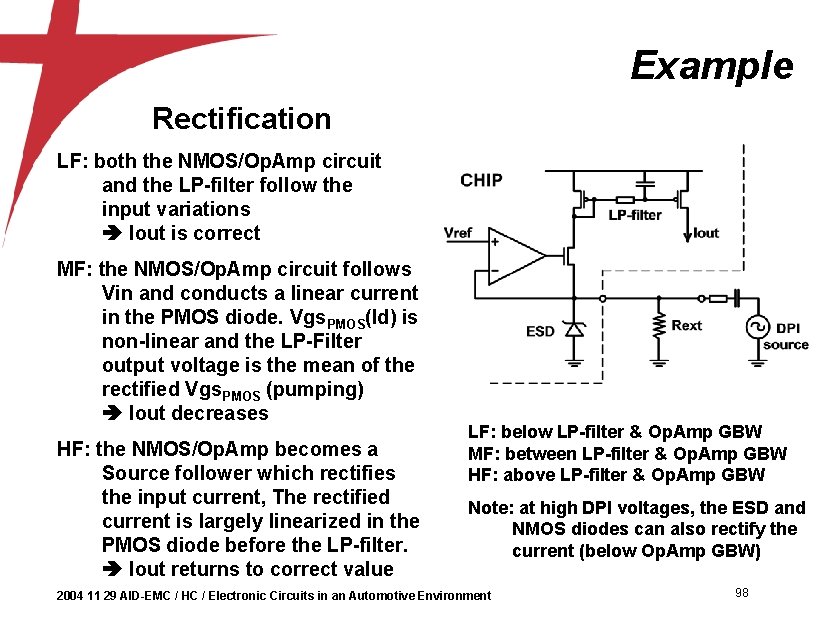
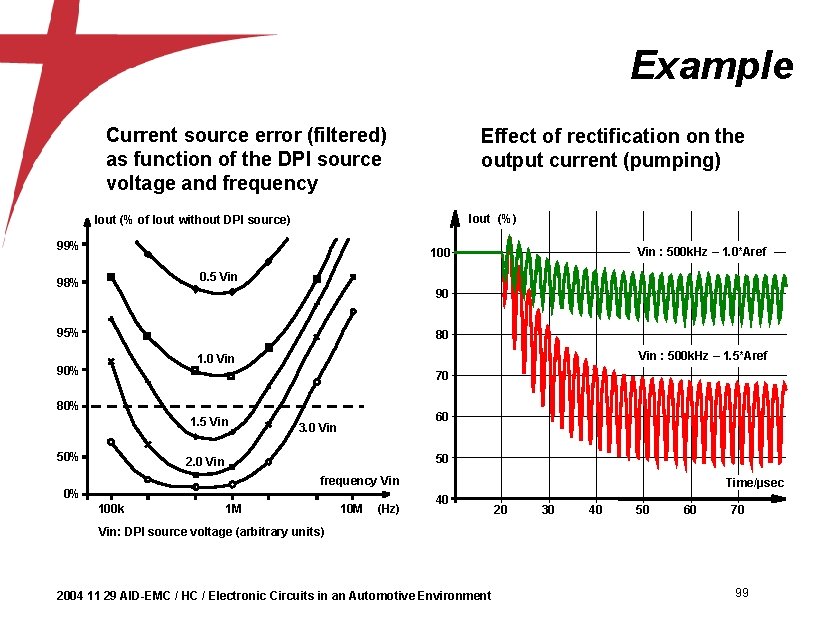
Example Rectification LF: both the NMOS/Op. Amp circuit and the LP-filter follow the input variations Iout is correct MF: the NMOS/Op. Amp circuit follows Vin and conducts a linear current in the PMOS diode. Vgs. PMOS(Id) is non-linear and the LP-Filter output voltage is the mean of the rectified Vgs. PMOS (pumping) Iout decreases HF: the NMOS/Op. Amp becomes a Source follower which rectifies the input current, The rectified current is largely linearized in the PMOS diode before the LP-filter. Iout returns to correct value LF: below LP-filter & Op. Amp GBW MF: between LP-filter & Op. Amp GBW HF: above LP-filter & Op. Amp GBW Note: at high DPI voltages, the ESD and NMOS diodes can also rectify the current (below Op. Amp GBW) 2004 11 29 AID-EMC / HC / Electronic Circuits in an Automotive Environment 98
Example Current source error (filtered) as function of the DPI source voltage and frequency Effect of rectification on the output current (pumping) Iout (% of Iout without DPI source) 99% Vin : 500 k. Hz – 1. 0*Aref 100 0. 5 Vin 98% 90 95% 80 Vin : 500 k. Hz – 1. 5*Aref 1. 0 Vin 90% 70 80% 1. 5 Vin 50% 60 3. 0 Vin 50 2. 0 Vin frequency Vin 0% 100 k 1 M 10 M (Hz) Time/µsec 40 20 30 40 50 60 70 Vin: DPI source voltage (arbitrary units) 2004 11 29 AID-EMC / HC / Electronic Circuits in an Automotive Environment 99
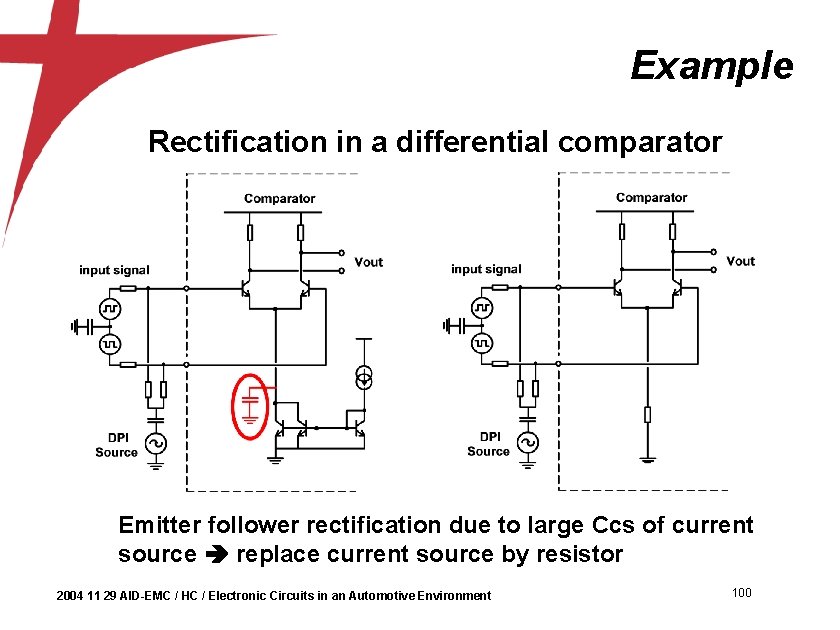
Example Rectification in a differential comparator Emitter follower rectification due to large Ccs of current source replace current source by resistor 2004 11 29 AID-EMC / HC / Electronic Circuits in an Automotive Environment 100
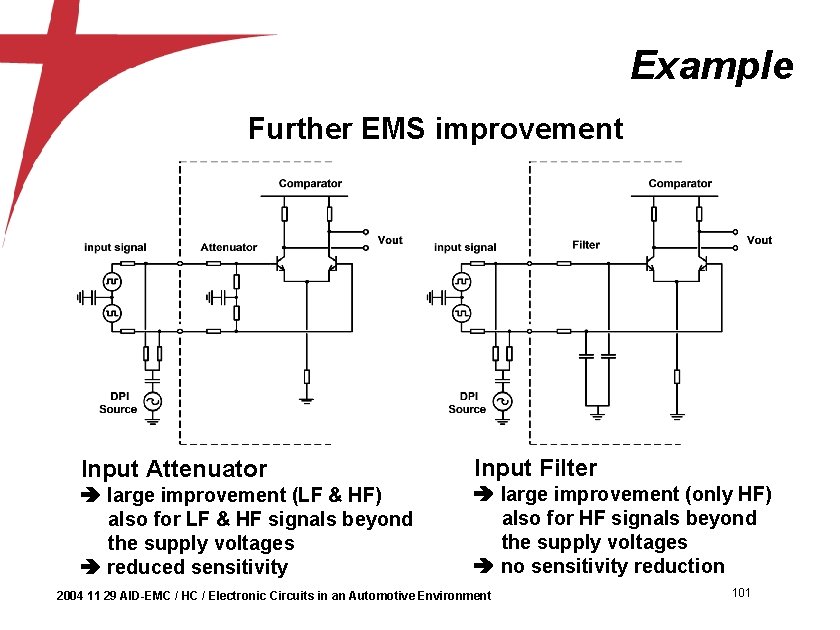
Example Further EMS improvement Input Attenuator Input Filter large improvement (LF & HF) also for LF & HF signals beyond the supply voltages reduced sensitivity large improvement (only HF) also for HF signals beyond the supply voltages no sensitivity reduction 2004 11 29 AID-EMC / HC / Electronic Circuits in an Automotive Environment 101
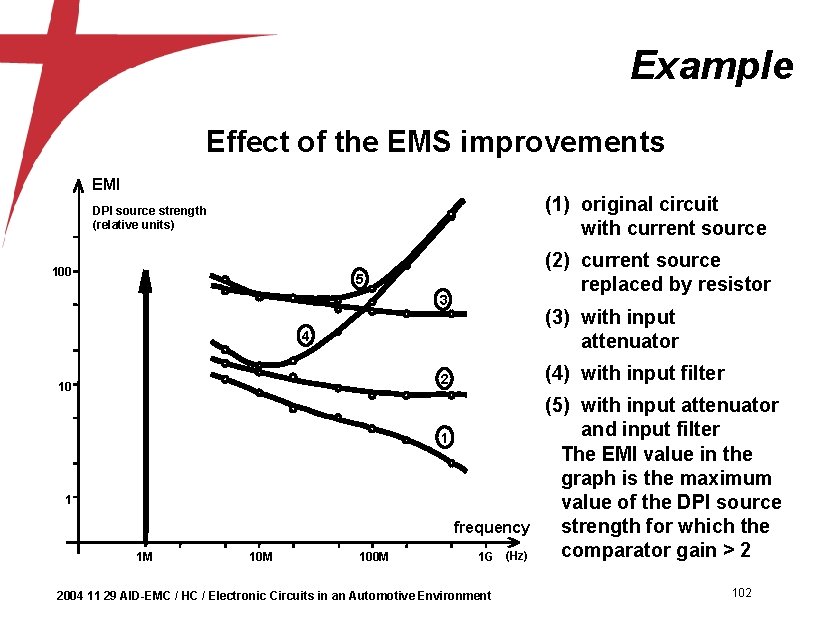
Example Effect of the EMS improvements EMI (1) original circuit with current source DPI source strength (relative units) 100 (2) current source replaced by resistor 5 3 (3) with input attenuator 4 (4) with input filter 2 10 1 1 frequency 1 M 100 M 1 G (Hz) 2004 11 29 AID-EMC / HC / Electronic Circuits in an Automotive Environment (5) with input attenuator and input filter The EMI value in the graph is the maximum value of the DPI source strength for which the comparator gain > 2 102
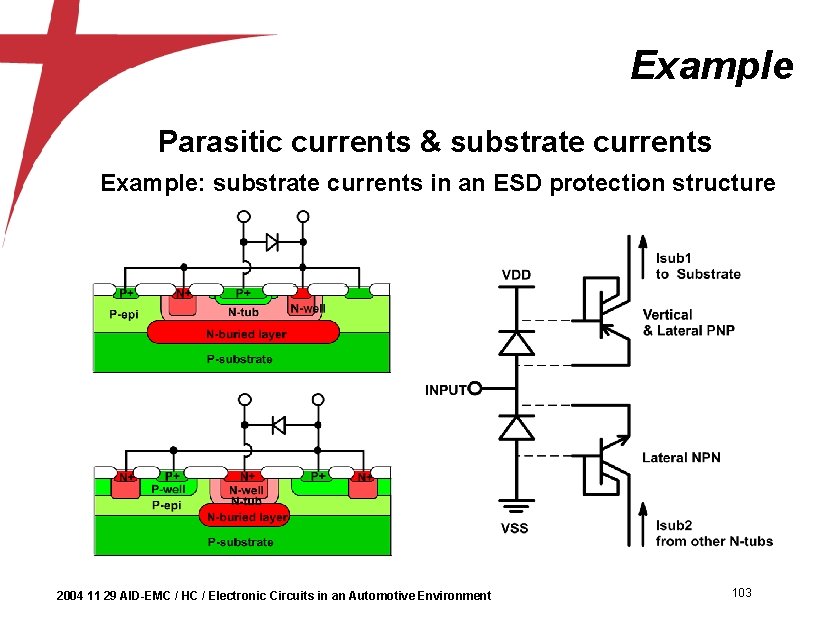
Example Parasitic currents & substrate currents Example: substrate currents in an ESD protection structure 2004 11 29 AID-EMC / HC / Electronic Circuits in an Automotive Environment 103
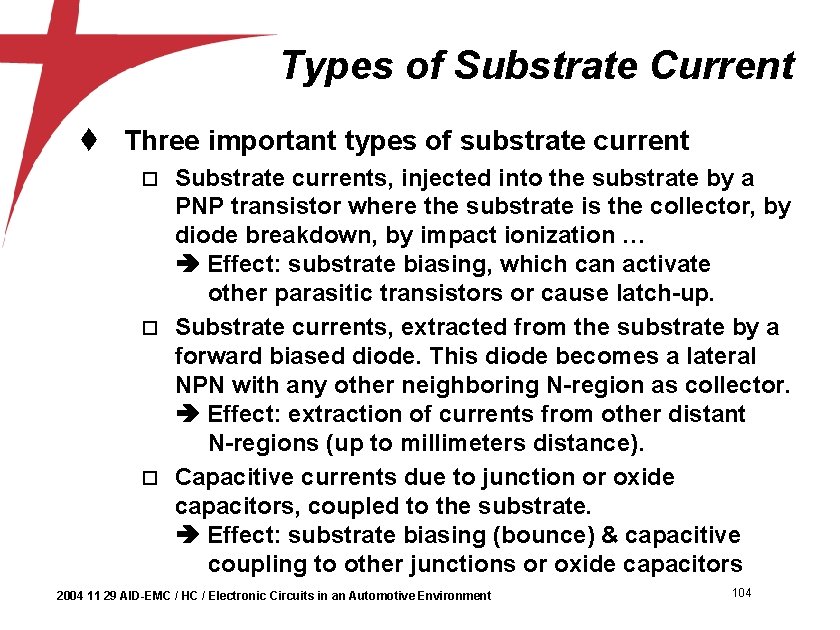
Types of Substrate Current t Three important types of substrate current Substrate currents, injected into the substrate by a PNP transistor where the substrate is the collector, by diode breakdown, by impact ionization … Effect: substrate biasing, which can activate other parasitic transistors or cause latch-up. o Substrate currents, extracted from the substrate by a forward biased diode. This diode becomes a lateral NPN with any other neighboring N-region as collector. Effect: extraction of currents from other distant N-regions (up to millimeters distance). o Capacitive currents due to junction or oxide capacitors, coupled to the substrate. Effect: substrate biasing (bounce) & capacitive coupling to other junctions or oxide capacitors o 2004 11 29 AID-EMC / HC / Electronic Circuits in an Automotive Environment 104
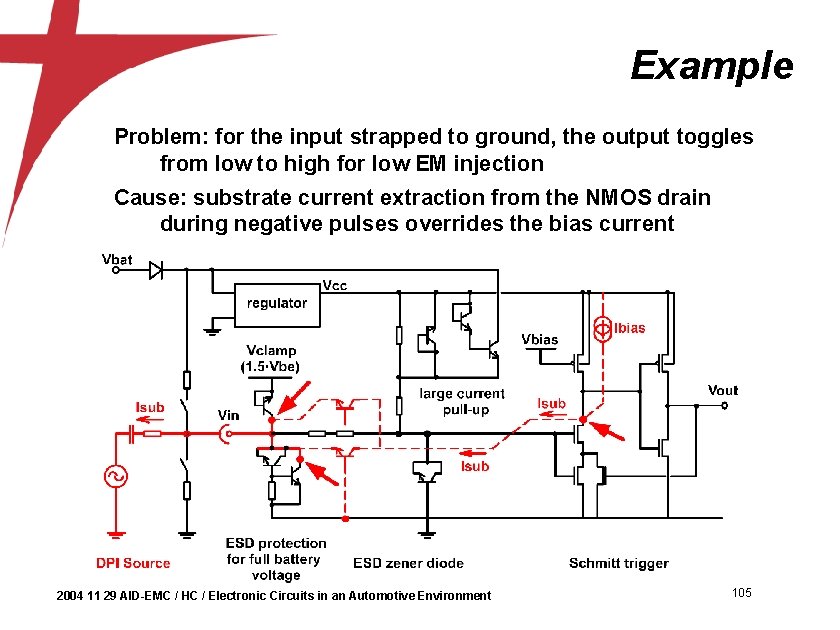
Example Problem: for the input strapped to ground, the output toggles from low to high for low EM injection Cause: substrate current extraction from the NMOS drain during negative pulses overrides the bias current 2004 11 29 AID-EMC / HC / Electronic Circuits in an Automotive Environment 105
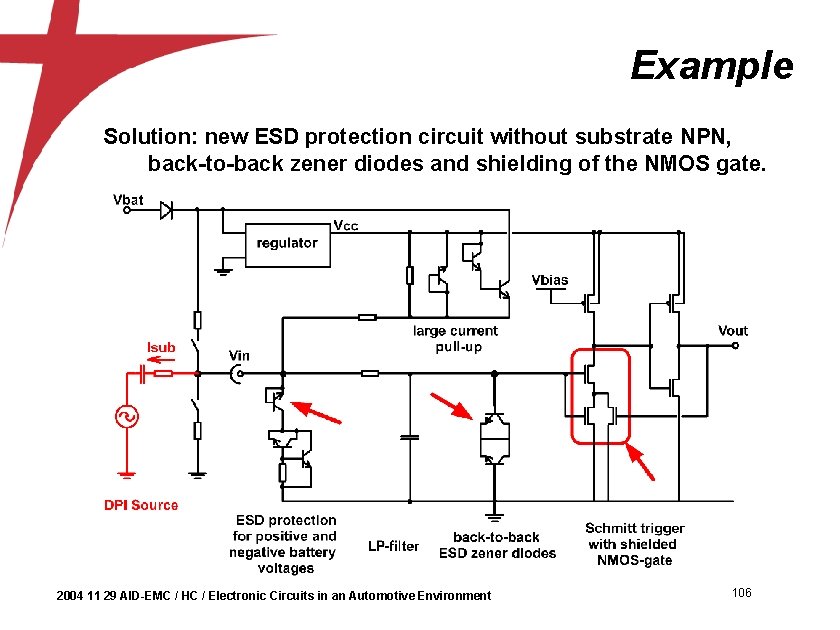
Example Solution: new ESD protection circuit without substrate NPN, back-to-back zener diodes and shielding of the NMOS gate. 2004 11 29 AID-EMC / HC / Electronic Circuits in an Automotive Environment 106
Outline Quality & Safety Cost & TTM Automotive IC design EMC & Automotive transients 2004 11 29 AID-EMC / HC / Electronic Circuits in an Automotive Environment High Voltage High Temp. 107
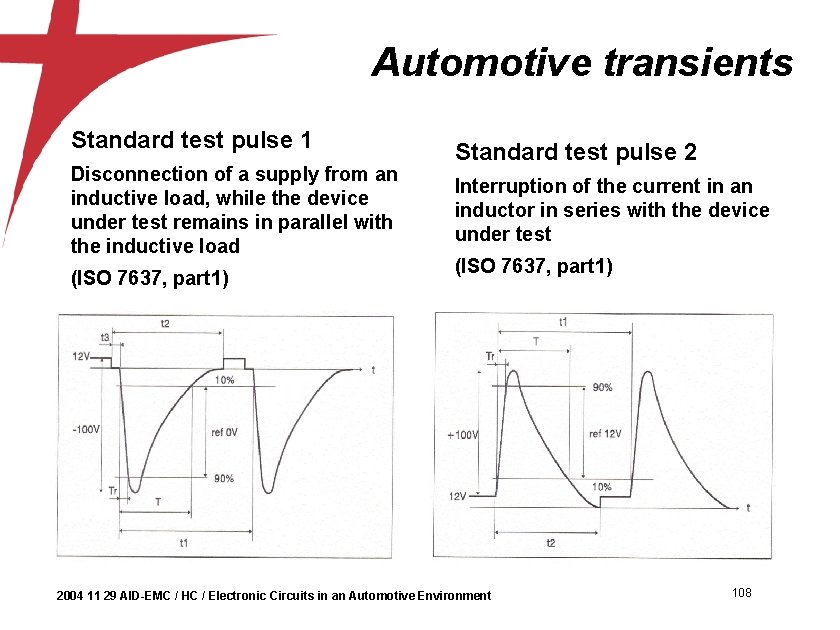
Automotive transients Standard test pulse 1 Disconnection of a supply from an inductive load, while the device under test remains in parallel with the inductive load (ISO 7637, part 1) Standard test pulse 2 Interruption of the current in an inductor in series with the device under test (ISO 7637, part 1) 2004 11 29 AID-EMC / HC / Electronic Circuits in an Automotive Environment 108
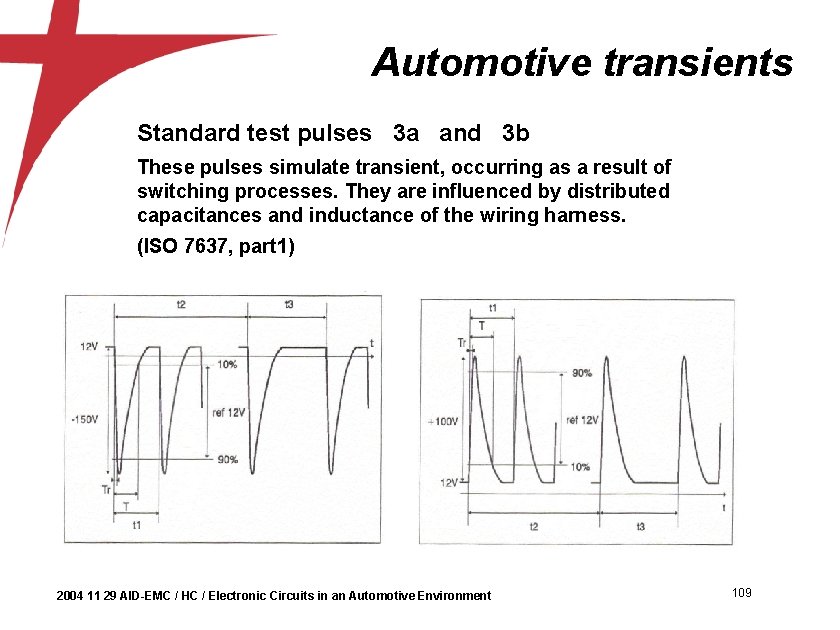
Automotive transients Standard test pulses 3 a and 3 b These pulses simulate transient, occurring as a result of switching processes. They are influenced by distributed capacitances and inductance of the wiring harness. (ISO 7637, part 1) 2004 11 29 AID-EMC / HC / Electronic Circuits in an Automotive Environment 109
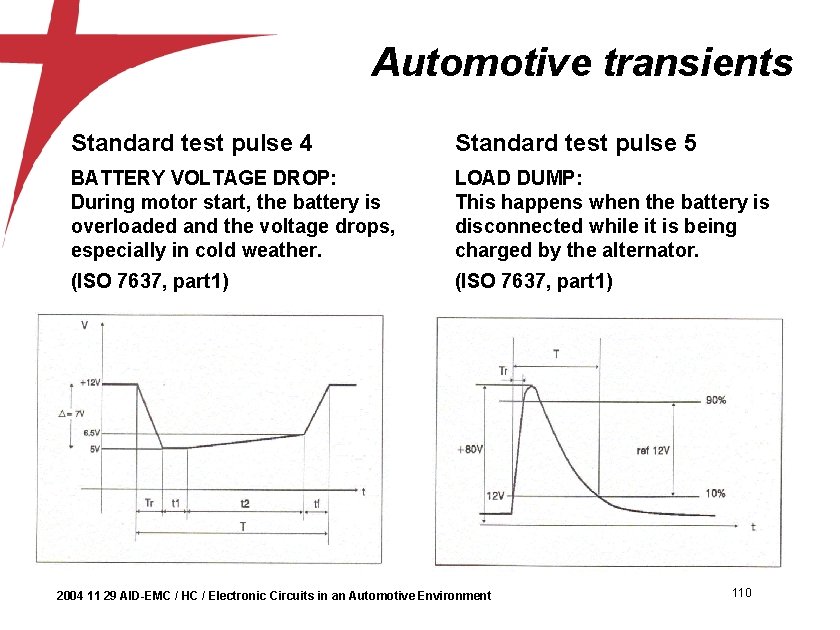
Automotive transients Standard test pulse 4 Standard test pulse 5 BATTERY VOLTAGE DROP: During motor start, the battery is overloaded and the voltage drops, especially in cold weather. LOAD DUMP: This happens when the battery is disconnected while it is being charged by the alternator. (ISO 7637, part 1) 2004 11 29 AID-EMC / HC / Electronic Circuits in an Automotive Environment 110
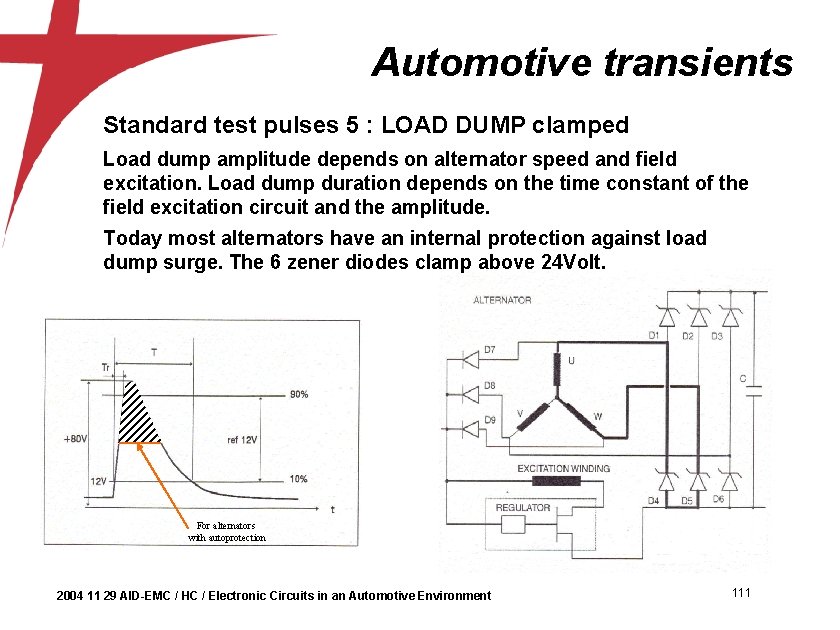
Automotive transients Standard test pulses 5 : LOAD DUMP clamped Load dump amplitude depends on alternator speed and field excitation. Load dump duration depends on the time constant of the field excitation circuit and the amplitude. Today most alternators have an internal protection against load dump surge. The 6 zener diodes clamp above 24 Volt. For alternators with autoprotection 2004 11 29 AID-EMC / HC / Electronic Circuits in an Automotive Environment 111
Automotive transients Standard test pulse 6 This disturbance occurs when the ignition. current is interrupted. (ISO 7637, part 1) Standard test pulse 7 Simulates the decrease of the magnetic field of the alternator when the engine stops. (ISO 7637, part 1) 2004 11 29 AID-EMC / HC / Electronic Circuits in an Automotive Environment 112
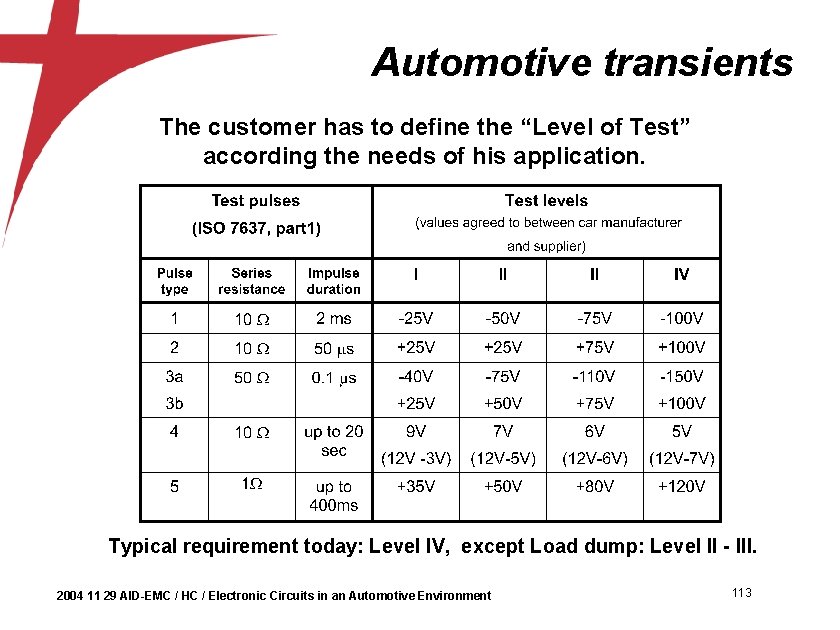
Automotive transients The customer has to define the “Level of Test” according the needs of his application. Typical requirement today: Level IV, except Load dump: Level II - III. 2004 11 29 AID-EMC / HC / Electronic Circuits in an Automotive Environment 113
Transients – What happens t Automotive transients (ISO-7637 -1): electrical transient conduction along the supply lines only. other IC pins indirectly connected to supply via load devices (outputs) or sensors (inputs) t ISO-7637 -1 describes two types of pulses o Pulse 4 defines the minimum battery voltage. Note: battery voltage = module supply voltage. Internal IC supply voltage = module supply – reverse battery diode – module supply regulator – internal supply regulator of the chip. o Pulses 1, 2, 3 a, 3 b, 5, 6 and 7 describe high voltage, high power transient disturbances on the supply line. 2004 11 29 AID-EMC / HC / Electronic Circuits in an Automotive Environment 114
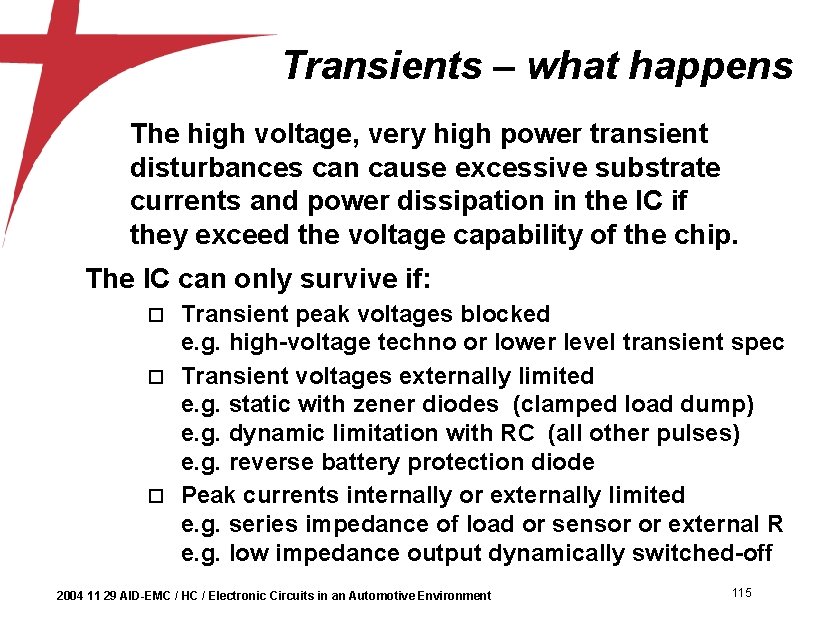
Transients – what happens The high voltage, very high power transient disturbances can cause excessive substrate currents and power dissipation in the IC if they exceed the voltage capability of the chip. The IC can only survive if: Transient peak voltages blocked e. g. high-voltage techno or lower level transient spec o Transient voltages externally limited e. g. static with zener diodes (clamped load dump) e. g. dynamic limitation with RC (all other pulses) e. g. reverse battery protection diode o Peak currents internally or externally limited e. g. series impedance of load or sensor or external R e. g. low impedance output dynamically switched-off o 2004 11 29 AID-EMC / HC / Electronic Circuits in an Automotive Environment 115
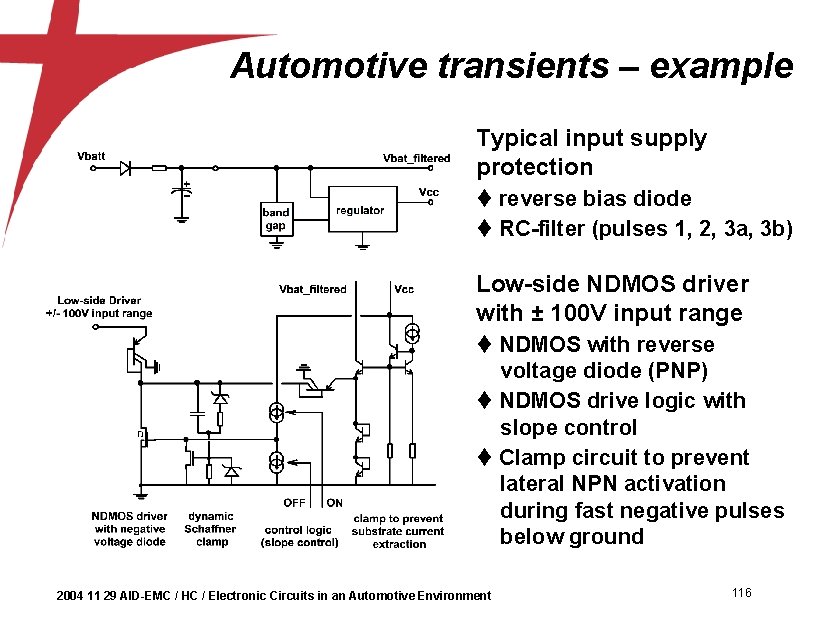
Automotive transients – example Typical input supply protection t reverse bias diode t RC-filter (pulses 1, 2, 3 a, 3 b) Low-side NDMOS driver with ± 100 V input range t NDMOS with reverse voltage diode (PNP) t NDMOS drive logic with slope control t Clamp circuit to prevent lateral NPN activation during fast negative pulses below ground 2004 11 29 AID-EMC / HC / Electronic Circuits in an Automotive Environment 116
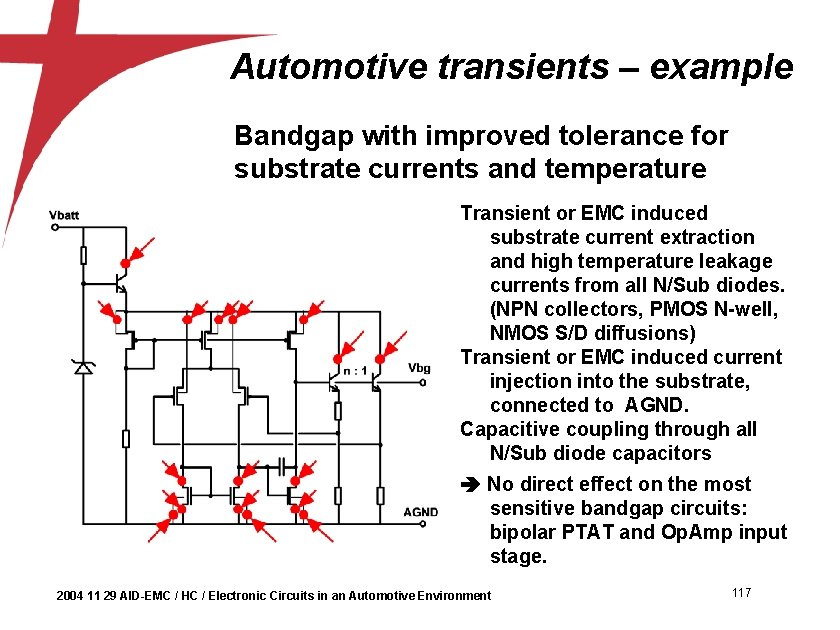
Automotive transients – example Bandgap with improved tolerance for substrate currents and temperature Transient or EMC induced substrate current extraction and high temperature leakage currents from all N/Sub diodes. (NPN collectors, PMOS N-well, NMOS S/D diffusions) Transient or EMC induced current injection into the substrate, connected to AGND. Capacitive coupling through all N/Sub diode capacitors No direct effect on the most sensitive bandgap circuits: bipolar PTAT and Op. Amp input stage. 2004 11 29 AID-EMC / HC / Electronic Circuits in an Automotive Environment 117
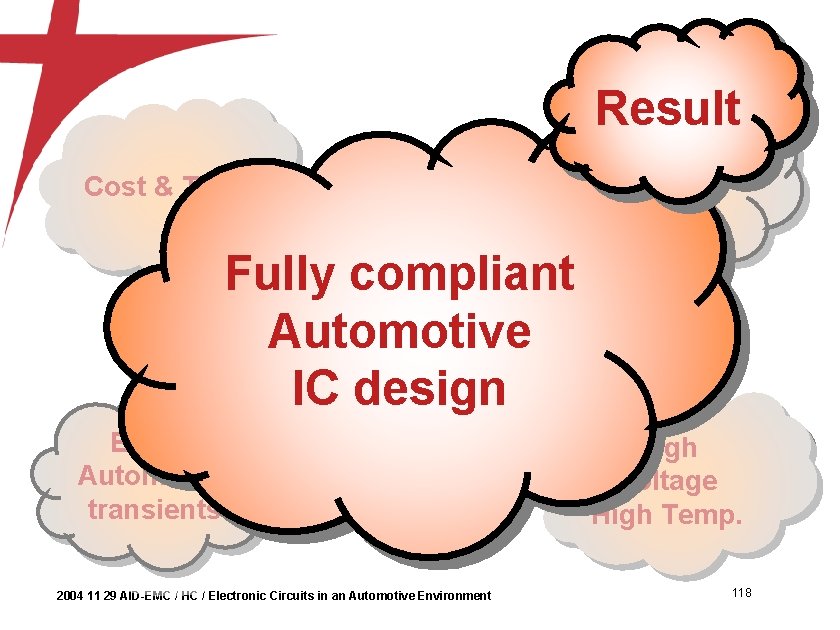
Result Cost & TTM Quality & Safety Fully compliant Automotive IC design EMC & Automotive transients 2004 11 29 AID-EMC / HC / Electronic Circuits in an Automotive Environment High Voltage High Temp. 118
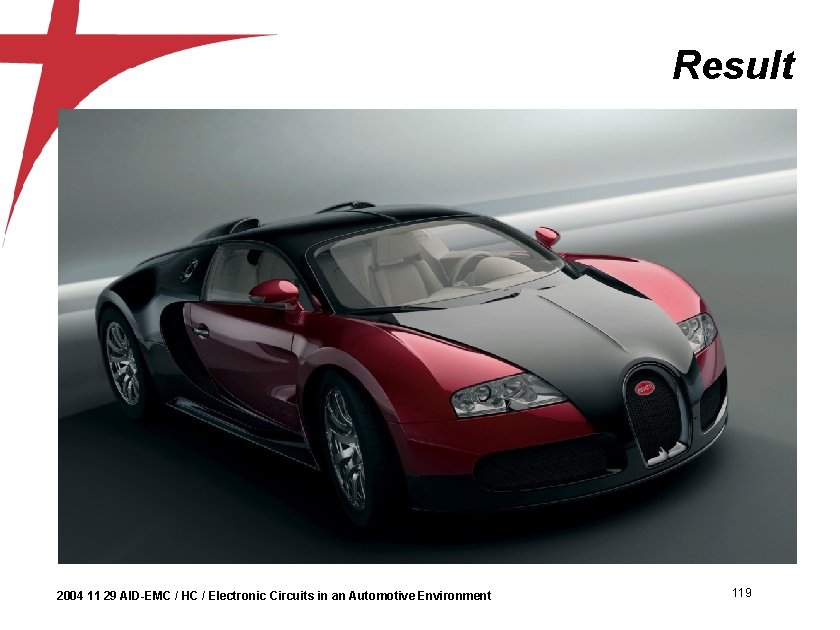
Result Combination of Silicon and Design Technology for Automotive Applications 2004 11 29 AID-EMC / HC / Electronic Circuits in an Automotive Environment 119
Ackowledgments This work would not have been possible without the cooperation and dedication of many colleagues at AMI Semiconductor. I would like to thank in particular: Michel De Mey, Aarnout Wieers, Geert Vandensande, Hans Gugg. Schweiger, Eddy Blansaer, Luc Dhaeze, Koen Geirnaert, Herve Branquart and many others. 2004 11 29 AID-EMC / HC / Electronic Circuits in an Automotive Environment 120
References – 1 t P. Thoma, “Risks for the automotive industry with regard to the market shift in worldwide semiconductor demand (in German)”, VDI Berichte nr. 1287, pp 1 -12, 12 September 1996. t “Potential Failure Mode and Effect analysis (FMEA)”, 3 th edition, April 2001, Chrysler Corporation, ford Motor Company, General Motors Corporation. t IEC 61967 -4, “Integrated Circuits – Measurement of Electromagnetic Emissions – 150 k. Hz to 1 GHz, Part 4: Measurement of Conducted Emission, 1 Ohm/150 Ohm Method”. t IEC 62132 -4, “Integrated Circuits – Measurement of Electromagnetic Immunity – 150 k. Hz to 1 GHz, Part 4: Direct RF Power Injection Method”. t ISO 7637 -1 , ISO 7637 -2, Road Vehicles – Electrical Disturbance by Conduction and Coupling, vehicles with nominal 12 V (part 1) and 24 V (part 2) supply voltages – Electrical transient conduction along supply lines only. t J. Kassakian, “Challenges of the New 42 Volt Architecture and Progress on its International Acceptance”, VDI Berichte nr. 1415, pp. 21 -35, 08 October 1998 t Hans-Dieter Hartmann, “Standardisation of the 42 V Power. Net - History, Current Status, Future Action”, HDT conference "42 V-Power. Net: The first Solutions", Villach, Austria, September 28 -29, 1999 2004 11 29 AID-EMC / HC / Electronic Circuits in an Automotive Environment 121
References - 2 t K. Ehlers, “The effect of the 3 -litre car on the architecture of the automotive electrical system“, 5. 98, http: //www. sci-worx. com → Partner → Forum Bordnetzarchitektur t Ivars G. Finvers, J. W. Haslett, F. N. Trofimenkoff, “A High Temperature Precision Amplifier”, IEEE Journal of Solid-state Circuits, vol. 30, pp 120 -128, February 1995. t Paul C. de Jong, “Smart Sensor systems for High-Temperature Applications”, Ph. D dissertation, T. U. Delft, the Netherlands, November 1998. t Paul C. de Jong, Gerard C. M. Meijer, Arthur H. M. van Roermond, “A 300°C Dynamic-Feedback Instrumentation Amplifier”, IEEE Journal of Solid-State Circuits, vol. 33, pp. 1999 -2009, December 1998. t “High Temperature Electronics”, edited by F. Patrick Mc. Cluskey, Richard Grzybowski, Thomas Podlesak, CRC Press, Boca Raton, Florida, 1997, ISBN 08493 -9623 -9 t W. Wondrak, A. Dehbi, G. Umbach, A. Blessing, R. Getto, F. P. Pesl and W. Unger, “Passive Components for High Temperatures: Application Potential and Technological Challenges” AEC Reliability Workshop, Nashville 2004 t Ron Schmitt, “Understanding Electromagnetic Fields and Antenna Radiation takes (almost) no Math”, EDN magazine, March 2, 2000, pp 77 -88. 2004 11 29 AID-EMC / HC / Electronic Circuits in an Automotive Environment 122
References - 3 t Wolfgang Horn, Heinz Zitta, “A Robust Smart Power Bandgap Reference Circuit for Use in an Automotive Environment”, IEEE Journal of Solid-state Circuits, vol. 37, pp 949 -952, July 2002. t M. De Mey, “Robustness in Analog Design”, Proceedings of the 12 th Workshop on the Advances in Analogue Circuit Design, AACD 2003, 15 -17 April 2003, Graz Austria t B. Deutschmann, “Improvement of System Robustness through EMC Optimization”, Proceedings of the 12 th Workshop on the Advances in Analogue Circuit Design, AACD 2003, 15 -17 April 2003, Graz Austria t D. Temmen, “Noise rejection of clocked interference sources (in German)”, VDI Berichte nr. 1646, pp. 599 -618, 27 September 2001 t Robert J. Widlar, “Controlling Substrate Currents in Junction-Isolated IC’s”, IEEE Journal of Solid-state Circuits, vol. 26, pp 1090 -1097, August 1991. t Bruno Murari, “Power Integrated Circuits, Problems, Tradeoffs and Solutions”, IEEE Journal of solid-state Circuits, vol 13, pp 307 -319, June 1978 2004 11 29 AID-EMC / HC / Electronic Circuits in an Automotive Environment 123