
Electronic Bill Payment Transformation in Saudi Arabia Presentation

Electronic Bill Payment Transformation in Saudi Arabia Presentation to the ECB – MNB Conference Budapest, 15 -16 November 2012

www. sadad. com SADAD Payment System was incepted by SAMA to increase epayment adoption in KSA Executive Summary • SADAD Payment System is an initiative launched by the Saudi Arabian Monetary Agency (SAMA), with the mandate of developing e-Payment products & services for individuals, businesses and government. In 2007, SADAD EBPP was officially launched to consolidate and centralize bill payments in KSA SADAD EBPP has generated several benefits for the Saudi macro-economy, including banks, billers, • and consumers by increasing efficiency, reducing costs, and stimulating e-Payments adoption SADAD has captured 90% market share processing more than 120 m transactions with a value • exceeding SAR 100 bn in 2011, thereby encouraging e-Payments adoption in KSA. Going forward, SADAD is pursuing its ‘Next Horizon’ strategy, focusing on e-Commerce and SME e • -Payment enablement through the launch of three new services: Online Payments e-Commerce (OLP), Biller Base Expansion (BBE), and e-Invoicing 2 SADAD Payment System

www. sadad. com Stakeholders Benefits Today, Electronic Bill Payment Benefits All Stakeholders in Saudi Arabia The Impact of SADAD Consumers Billers • One location for all payments • Access to all customers through any bank • Increased convenience through ‘one-click’ payment • Freedom to pay through any bank via all bank channels • Reduced late fees and charges paid 3 • Rapid collection cycle (1 day settlement time) • Reduced cash management risk (fraud / errors) • Lower bill payment processing costs • Enhanced financial management Banks Government • Significant reduction in cost of bill payment processing • 90% of government bills collected electronically • No bill payment queues in branches • Increased transparency of collection • More equitable value proposition (previously no revenues for bill payments) • Automated & centralized payment collection • Maintain relationships with customers • Elimination of physical cash management Macro-Economy • 100% of utility bills collected through SADAD • Decreased dependency on cash in the economy • Increased capital efficiency for the national economy • Positive environmental impact due to reduced paper bill printing & delivery SADAD Payment System
www. sadad. com SADAD Background SADAD EBPP SADAD Next Horizon Appendix 4 SADAD Payment System

www. sadad. com In the 1980 s, SAMA mandated banks to facilitate consumer bill payments which lead to several challenges Background • In the early 1980 s, SAMA mandated that all Saudi banks must accept bill payments on behalf of utilities (electricity, telecom, and water) at no charge and regardless of the customer’s banking relationship. • Over the years, the process became operationally inefficient for several reasons. It placed an unduly large burden on banks resulting in: o High operational costs for banks o Late / missed payment processing o Risky cash management o Escalating complaints • As the market tried to self-correct, the distributed point-to-point model emerged between banks and billers. This fragmented approach further divided the market, thus lacking centralization and common standards • There was a clear need for a solution that satisfied and served consumers better, streamlined government collections, and increased cooperation between the government and the private sector 5 SADAD Payment System
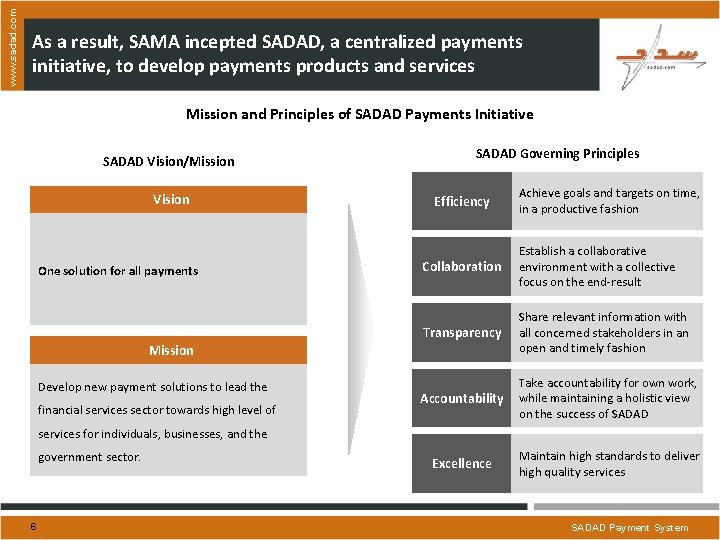
www. sadad. com As a result, SAMA incepted SADAD, a centralized payments initiative, to develop payments products and services Mission and Principles of SADAD Payments Initiative SADAD Vision/Mission Vision One solution for all payments SADAD Governing Principles Efficiency Collaboration Establish a collaborative environment with a collective focus on the end-result Transparency Share relevant information with all concerned stakeholders in an open and timely fashion Accountability Take accountability for own work, while maintaining a holistic view on the success of SADAD Excellence Maintain high standards to deliver high quality services Mission Develop new payment solutions to lead the financial services sector towards high level of Achieve goals and targets on time, in a productive fashion services for individuals, businesses, and the government sector. 6 SADAD Payment System

www. sadad. com SADAD Background SADAD EBPP SADAD Next Horizon Appendix 7 SADAD Payment System

www. sadad. com Traditionally, consumer bill processing and payment in KSA was inefficient and complex Perceived Problems and Issues • Long queues for bill payment at banks • Potential disconnection of service due to long delays in bill processing • Need to handle cash Initial Bill Payment Network Consumer Electricity Comments Bank A Telecom Bank B Water Bank C Government Bank D Others (. . ? ? ) • Long collection cycles • Inefficient processes • High level of customer complaints and dissatisfaction • Multiple separate linkages with different banks 8 ILLUSTRATIVE • Higher costs at branches for handling bill payments (often from non-bank customers) • Need to integrate separately with multiple billers • No revenue streams from handling bill payments • Majority of bills were paid by consumers with cash across bank counters • Some billers (e. g. SEC and STC) were developing individual arrangements with banks for streamlining bill payment processes • Bill presentment and payment volumes were anticipated to increase significantly in KSA over next few years • Usage of electronic channels for making payments is low but expected to pick up in future SADAD Payment System
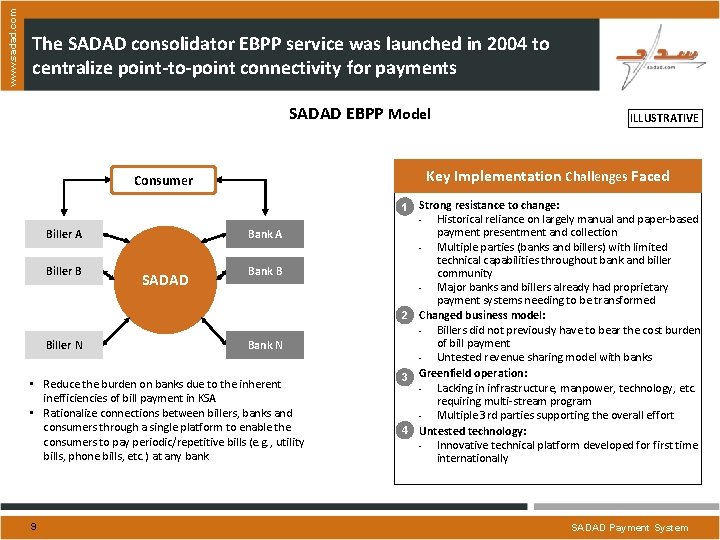
www. sadad. com The SADAD consolidator EBPP service was launched in 2004 to centralize point-to-point connectivity for payments SADAD EBPP Model ILLUSTRATIVE SADAD EBPP Key Implementation Challenges Faced Consumer 1 Strong resistance to change: Historical reliance on largely manual and paper-based payment presentment and collection - Multiple parties (banks and billers) with limited technical capabilities throughout bank and biller community - Major banks and billers already had proprietary payment systems needing to be transformed 2 Changed business model: - Billers did not previously have to bear the cost burden of bill payment - Untested revenue sharing model with banks 3 Greenfield operation: - Lacking in infrastructure, manpower, technology, etc. requiring multi-stream program - Multiple 3 rd parties supporting the overall effort 4 Untested technology: - Innovative technical platform developed for first time internationally - Biller A Biller B Biller N Bank A SADAD Bank B Bank N • Reduce the burden on banks due to the inherent inefficiencies of bill payment in KSA • Rationalize connections between billers, banks and consumers through a single platform to enable the consumers to pay periodic/repetitive bills (e. g. , utility bills, phone bills, etc. ) at any bank 9 SADAD Payment System

www. sadad. com As such, typical transactions accessed bill information held in SADAD through existing bank and biller channels SADAD Operational Model Overview Customer authenticated by the bank prior to querying SADAD Banks would communicate with SADAD through existing infrastructure Branch POS ILLUSTRATIVE Billers would communicate with SADAD to upload new bills, exchange bill status and reconciliation reports SADAD Biller Customer ATM Internet Banking Major Bank Channels 1) Banks SADAD would provide information, update bill status accordingly and initiate the settlement process Walk-in Customer(1) Collection Center Website Biller Channel Customers will still be able to settle their bills through Biller Channels 10 SADAD Payment System
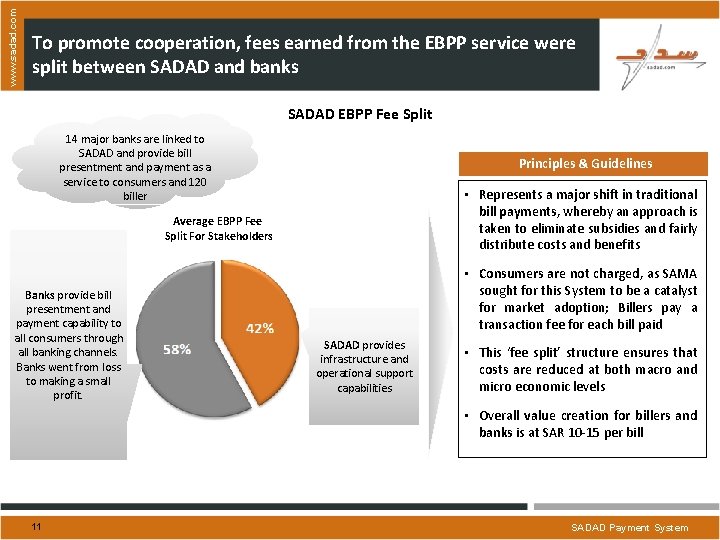
www. sadad. com To promote cooperation, fees earned from the EBPP service were split between SADAD and banks SADAD EBPP Fee Split 14 major banks are linked to SADAD and provide bill presentment and payment as a service to consumers and 120 biller Principles & Guidelines • Represents a major shift in traditional bill payments, whereby an approach is taken to eliminate subsidies and fairly distribute costs and benefits Average EBPP Fee Split For Stakeholders Banks provide bill presentment and payment capability to all consumers through all banking channels. Banks went from loss to making a small profit. • Consumers are not charged, as SAMA sought for this System to be a catalyst for market adoption; Billers pay a transaction fee for each bill paid SADAD provides infrastructure and operational support capabilities • This ‘fee split’ structure ensures that costs are reduced at both macro and micro economic levels • Overall value creation for billers and banks is at SAR 10 -15 per bill 11 SADAD Payment System

www. sadad. com SADAD EBPP service has resulted in numerous macro-economic, biller, consumer and bank benefits SADAD EBPP Benefits 1 • Lower dependency on cash in the economy due to increased penetration of e-Payments in KSA • Increased capital efficiency for the national economy • Increased transparency in government collection process Significant reduction in the cost of bill payment processing 4 Macro-Economic / Society 2 Banks • Reduced cost of bill payment processing • Retention of relationship with billers and consumers • Single point of linkage with multiple billers • Increased revenues from bill payment revenue split 3 SADAD EBPP Biller settlement time reduced from 14 -30 days to 1 day Billers • Faster settlement time for bill payments • Access for all customers through any bank • Lower costs for paper, IT systems and staff as a result of service delivery through online channel • Reduced working capital requirements due to faster collection of bill payments Consumers • Increased convenience due to ability to make e-commerce purchases possible through websites • Increased access to greater variety of products and services online • Availability of a number of different payment options 12 SADAD Payment System

www. sadad. com Demand for SADAD’s EBPP has come from billers across several sectors with government entities serving as a major customer Biller Sectors Total Payments Value Processed (2012) Biller Sectors Using SADAD EBPP Services Government Entities Airlines Financial Services Chamber of Commerce Customs Department of Zakat (Tax) Government Funds Insurance ISPs Ministries Municipalities Postal Services Press & Media Telecom Universities Utility Services Non-Government Entities Government intervened with a full fledged program to automate its billing processes and established a PMO to integrate its agencies with SADAD 13 The majority of SADAD payment volumes are derived from payments to government entities Government Entity Non-Government Entity SADAD Payment System
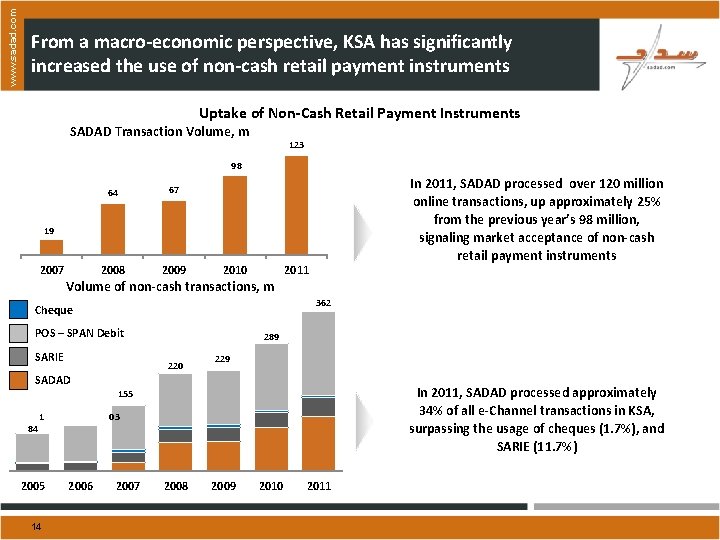
www. sadad. com From a macro-economic perspective, KSA has significantly increased the use of non-cash retail payment instruments Uptake of Non-Cash Retail Payment Instruments SADAD Transaction Volume, m 123 98 64 67 2008 2009 In 2011, SADAD processed over 120 million online transactions, up approximately 25% from the previous year’s 98 million, signaling market acceptance of non-cash retail payment instruments 19 2007 2010 2011 Volume of non-cash transactions, m 362 Cheque POS – SPAN Debit SARIE 289 220 229 SADAD In 2011, SADAD processed approximately 34% of all e-Channel transactions in KSA, surpassing the usage of cheques (1. 7%), and SARIE (11. 7%) 155 84 1 2005 14 03 2006 2007 2008 2009 2010 2011
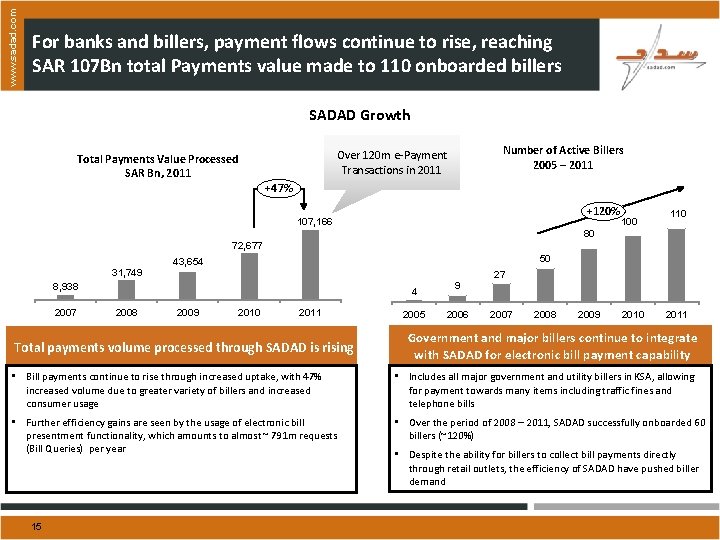
www. sadad. com For banks and billers, payment flows continue to rise, reaching SAR 107 Bn total Payments value made to 110 onboarded billers SADAD Growth Number of Active Billers 2005 – 2011 Over 120 m e-Payment Transactions in 2011 Total Payments Value Processed SAR Bn, 2011 +47% +120% 107, 166 100 110 80 72, 677 31, 749 50 43, 654 8, 938 2007 4 2008 2009 2010 2011 Total payments volume processed through SADAD is rising 2005 9 2006 27 2008 2009 2010 2011 Government and major billers continue to integrate with SADAD for electronic bill payment capability • Bill payments continue to rise through increased uptake, with 47% increased volume due to greater variety of billers and increased consumer usage • Includes all major government and utility billers in KSA, allowing for payment towards many items including traffic fines and telephone bills • Further efficiency gains are seen by the usage of electronic bill presentment functionality, which amounts to almost ~ 791 m requests (Bill Queries) per year • Over the period of 2008 – 2011, SADAD successfully onboarded 60 billers (~120%) 15 • Despite the ability for billers to collect bill payments directly through retail outlets, the efficiency of SADAD have pushed biller demand
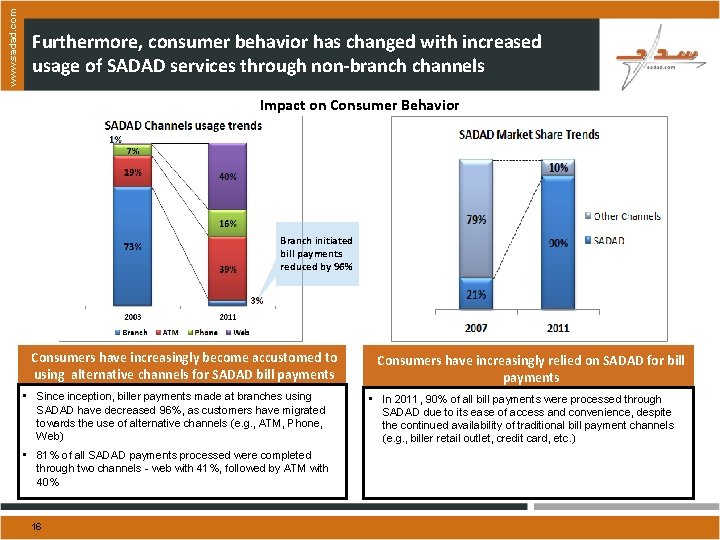
www. sadad. com Furthermore, consumer behavior has changed with increased usage of SADAD services through non-branch channels Impact on Consumer Behavior Branch initiated bill payments reduced by 96% Consumers have increasingly become accustomed to using alternative channels for SADAD bill payments • Sinception, biller payments made at branches using SADAD have decreased 96%, as customers have migrated towards the use of alternative channels (e. g. , ATM, Phone, Web) • 81% of all SADAD payments processed were completed through two channels - web with 41%, followed by ATM with 40% 16 Consumers have increasingly relied on SADAD for bill payments • In 2011, 90% of all bill payments were processed through SADAD due to its ease of access and convenience, despite the continued availability of traditional bill payment channels (e. g. , biller retail outlet, credit card, etc. )

www. sadad. com 17 SADAD received a number of awards and still continues to receive international recognition as a ‘market change catalyst’ UN Public Service Award ISO Quality Mgmt GCC e-Government Award Injaz e-Government Achievement Award ISO Information Security Mgmt.

www. sadad. com SADAD Introduction SADAD EBPP SADAD Next Horizon Appendix 18
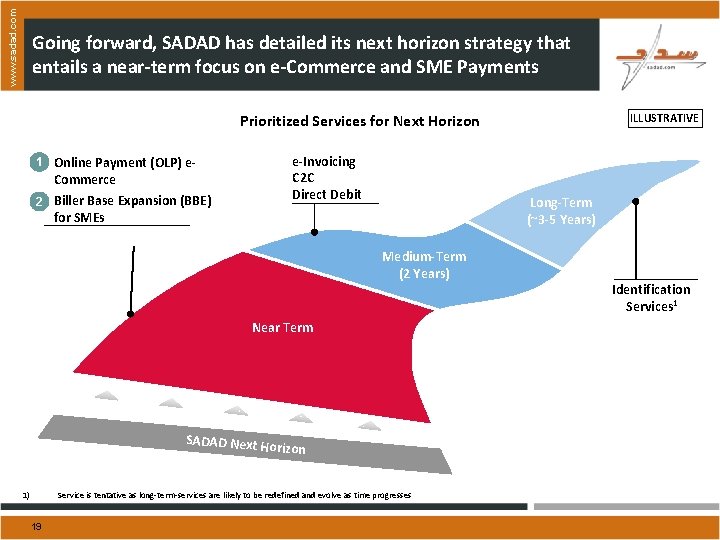
www. sadad. com Going forward, SADAD has detailed its next horizon strategy that entails a near-term focus on e-Commerce and SME Payments Prioritized Services for Next Horizon e-Invoicing C 2 C Direct Debit 1 Online Payment (OLP) e- Commerce 2 Biller Base Expansion (BBE) for SMEs Long-Term (~3 -5 Years) Medium-Term (2 Years) Near Term SADAD Next H orizon 1) Service is tentative as long-term-services are likely to be redefined and evolve as time progresses 19 ILLUSTRATIVE Identification Services 1
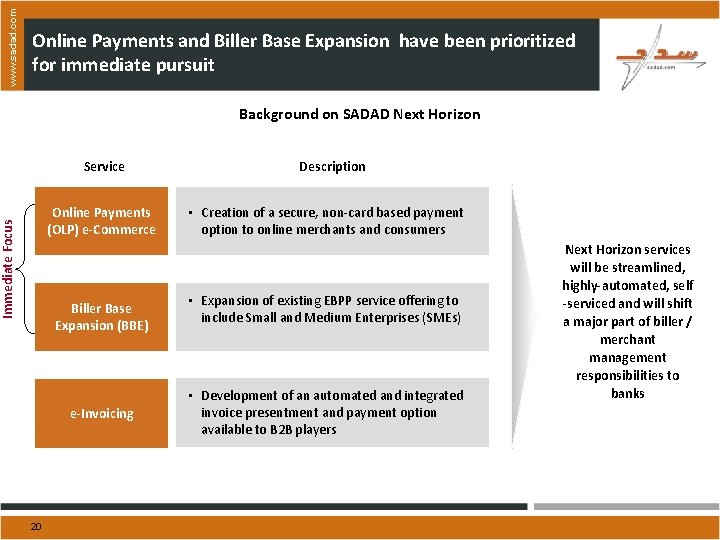
Background on SADAD Next Horizon Service Online Payments (OLP) e-Commerce Immediate Focus www. sadad. com Online Payments and Biller Base Expansion have been prioritized for immediate pursuit Biller Base Expansion (BBE) e-Invoicing 20 Description • Creation of a secure, non-card based payment option to online merchants and consumers • Expansion of existing EBPP service offering to include Small and Medium Enterprises (SMEs) • Development of an automated and integrated invoice presentment and payment option available to B 2 B players Next Horizon services will be streamlined, highly-automated, self -serviced and will shift a major part of biller / merchant management responsibilities to banks

Thank you. Questions & Comments
- Slides: 21