
Electronic and Mechanical Materials Properties from DFT Calculations
- Slides: 1
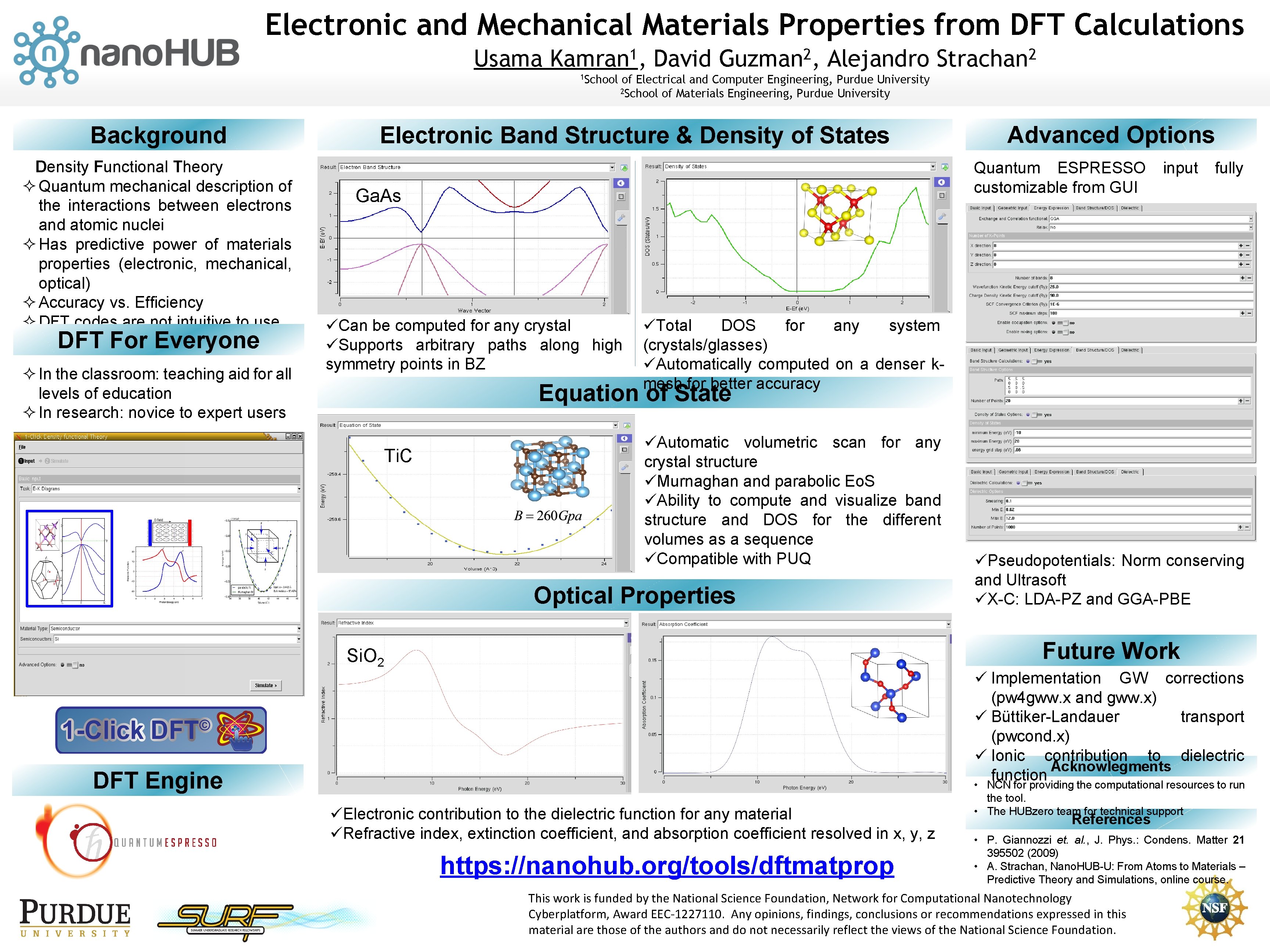
Electronic and Mechanical Materials Properties from DFT Calculations Usama 1 Kamran , 1 School Background Density Functional Theory ² Quantum mechanical description of the interactions between electrons and atomic nuclei ² Has predictive power of materials properties (electronic, mechanical, optical) ² Accuracy vs. Efficiency ² DFT codes are not intuitive to use DFT For Everyone ² In the classroom: teaching aid for all levels of education ² In research: novice to expert users David 2 Guzman , Alejandro 2 Strachan of Electrical and Computer Engineering, Purdue University 2 School of Materials Engineering, Purdue University Electronic Band Structure & Density of States Advanced Options Quantum ESPRESSO customizable from GUI Ga. As üCan be computed for any crystal üSupports arbitrary paths along high symmetry points in BZ input fully üTotal DOS for any system (crystals/glasses) üAutomatically computed on a denser kmesh for better accuracy Equation of State Ti. C üAutomatic volumetric scan for any crystal structure üMurnaghan and parabolic Eo. S üAbility to compute and visualize band structure and DOS for the different volumes as a sequence üCompatible with PUQ Optical Properties üPseudopotentials: Norm conserving and Ultrasoft üX-C: LDA-PZ and GGA-PBE Future Work Si. O 2 ü Implementation GW corrections (pw 4 gww. x and gww. x) ü Büttiker-Landauer transport (pwcond. x) ü Ionic contribution to dielectric Acknowlegments function DFT Engine üElectronic contribution to the dielectric function for any material üRefractive index, extinction coefficient, and absorption coefficient resolved in x, y, z https: //nanohub. org/tools/dftmatprop • NCN for providing the computational resources to run the tool. • The HUBzero team for technical support References • P. Giannozzi et. al. , J. Phys. : Condens. Matter 21 395502 (2009) • A. Strachan, Nano. HUB-U: From Atoms to Materials – Predictive Theory and Simulations, online course. This work is funded by the National Science Foundation, Network for Computational Nanotechnology Cyberplatform, Award EEC-1227110. Any opinions, findings, conclusions or recommendations expressed in this material are those of the authors and do not necessarily reflect the views of the National Science Foundation.