
Electronegativity and Polarity Section 4 Objectives Describe how
Electronegativity and Polarity Section 4
Objectives • Describe how electronegativity is used to determine bond type • Compare and contrast polar and nonpolar covalent bonds • Describe the characteristics of compounds that are covalently bonded
Electron affinity • Attraction of an atom to an electron in a bond • Electronegativity

Linus Pauling • Scale of electronegativity • F has the highest: 3. 98 • Fr has the lowest: 0. 7 • Noble gases are 0
Electron Affinity tells us… • Character and type of bond – Never completely ionic or covalent – Sharing is not always completely equal
Ionic Bond • Large differences in electronegativity indicate that electrons are transferred
Nonpolar covalent bonds • Difference in electron affinity of atoms is very small • Electrons shared fairly equally
Identical Atoms • Difference in electronegativity is 0 • Electrons are shared equally.
Polar Covalent Bonds • Unequal sharing • Stronger affinity = greater strength
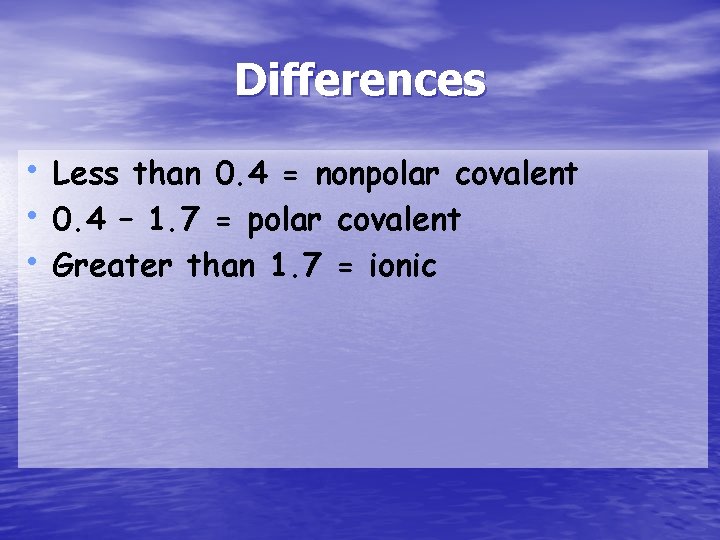
Differences • Less than 0. 4 = nonpolar covalent • 0. 4 – 1. 7 = polar covalent • Greater than 1. 7 = ionic
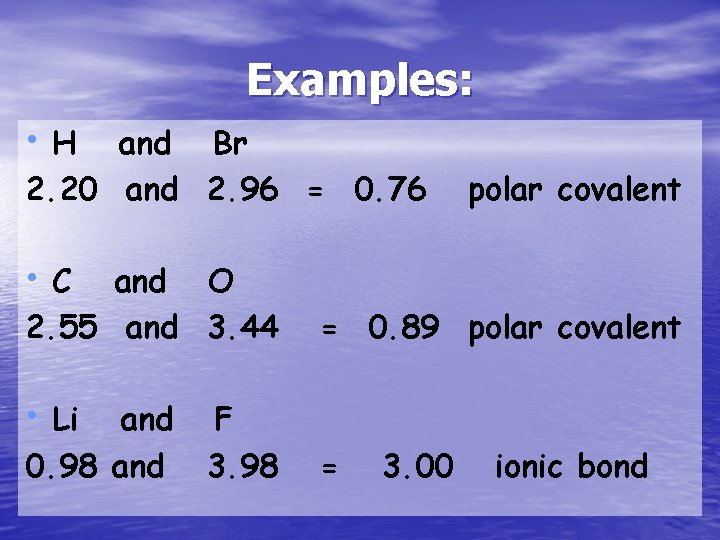
Examples: • H and Br 2. 20 and 2. 96 = 0. 76 • C and O 2. 55 and 3. 44 • Li and 0. 98 and F 3. 98 polar covalent = 0. 89 polar covalent = 3. 00 ionic bond
Solubility of Polar Molecules • Like dissolves like – Polar (and ionic) compounds are soluble in polar substances – Nonpolar only soluble in non-polar
Van der Waals Forces • Forces of attraction between individual molecules
Types of Van der Waals • Nonpolar – Weak attraction – Dispersion or induced dipole • Polar – Strong attraction – Dipole-dipole force • Hydrogen bond – Very strong – Between H and another dipole
Physical properties • Low melting/boiling points • Many are gases at room temp • Covalent solids are soft • Non-conductors *Due to Van der Waals!!
- Slides: 16