
Electron Spin Resonance Spectroscopy of a Single Carbon
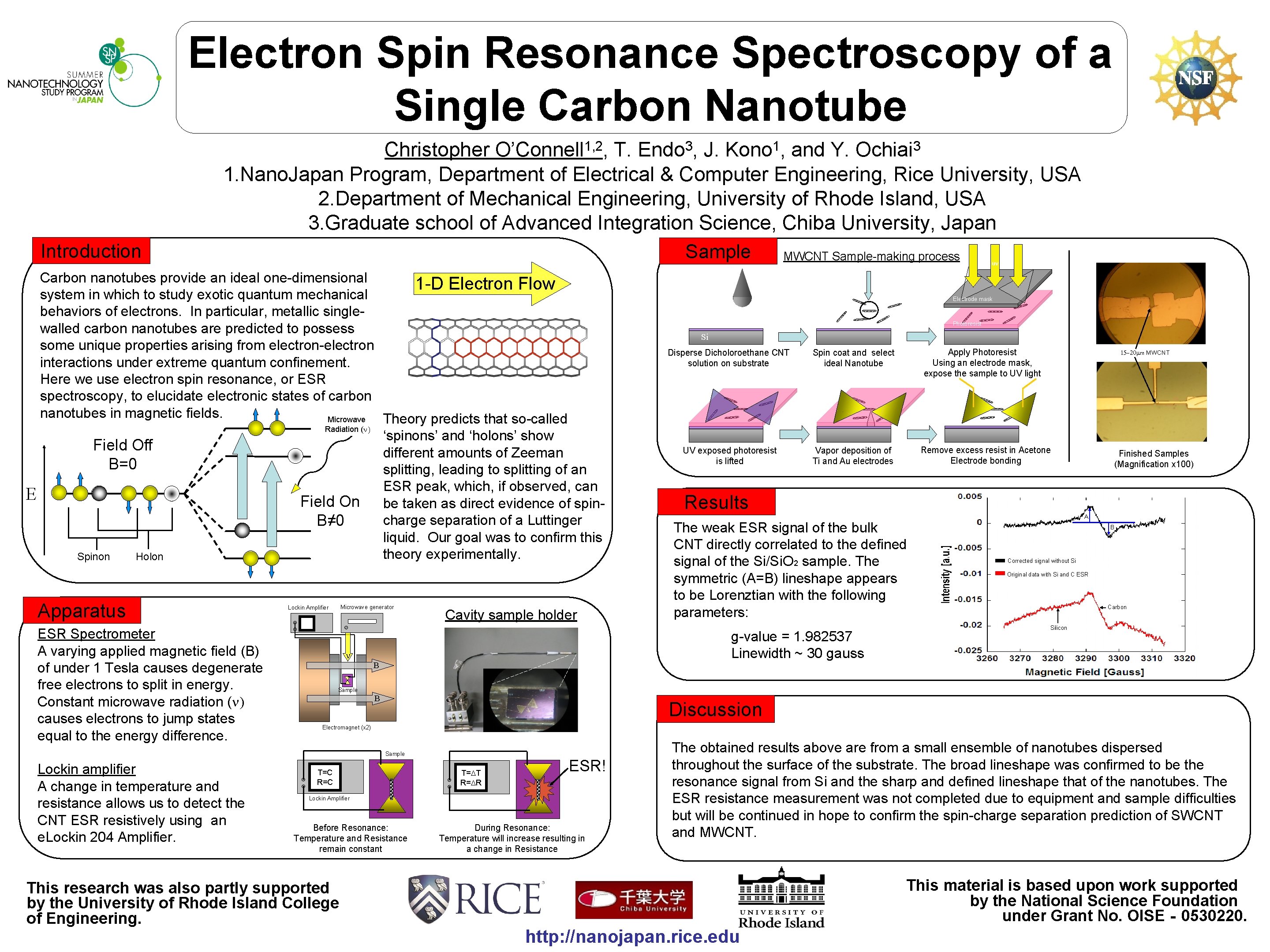
Electron Spin Resonance Spectroscopy of a Single Carbon Nanotube Introduction Christopher O’Connell 1, 2, T. Endo 3, J. Kono 1, and Y. Ochiai 3 1. Nano. Japan Program, Department of Electrical & Computer Engineering, Rice University, USA 2. Department of Mechanical Engineering, University of Rhode Island, USA 3. Graduate school of Advanced Integration Science, Chiba University, Japan Sample MWCNT Sample-making process uv Carbon nanotubes provide an ideal one-dimensional 1 -D Electron Flow system in which to study exotic quantum mechanical behaviors of electrons. In particular, metallic singlewalled carbon nanotubes are predicted to possess some unique properties arising from electron-electron interactions under extreme quantum confinement. Here we use electron spin resonance, or ESR spectroscopy, to elucidate electronic states of carbon nanotubes in magnetic fields. Microwave Theory predicts that so-called Radiation (n) ‘spinons’ and ‘holons’ show Field Off different amounts of Zeeman B=0 splitting, leading to splitting of an ESR peak, which, if observed, can E Field On be taken as direct evidence of spincharge separation of a Luttinger B≠ 0 liquid. Our goal was to confirm this theory experimentally. Holon Spinon Apparatus ESR Spectrometer A varying applied magnetic field (B) of under 1 Tesla causes degenerate free electrons to split in energy. Constant microwave radiation (n) causes electrons to jump states equal to the energy difference. Microwave generator Lockin Amplifier Cavity sample holder Si. O 2 Photoresist Si Disperse Dicholoroethane CNT solution on substrate Spin coat and select ideal Nanotube UV exposed photoresist is lifted Vapor deposition of Ti and Au electrodes n B Apply Photoresist Using an electrode mask, expose the sample to UV light 15 -20 mm MWCNT Remove excess resist in Acetone Electrode bonding Finished Samples (Magnification x 100) Results The weak ESR signal of the bulk CNT directly correlated to the defined signal of the Si/Si. O 2 sample. The symmetric (A=B) lineshape appears to be Lorenztian with the following parameters: g-value = 1. 982537 Linewidth ~ 30 gauss A B Corrected signal without Si Original data with Si and C ESR Carbon Silicon Sample B Discussion Electromagnet (x 2) Sample Lockin amplifier A change in temperature and resistance allows us to detect the CNT ESR resistively using an e. Lockin 204 Amplifier. Electrode mask T=C R=C T=DT R=DR ESR! Lockin Amplifier Before Resonance: Temperature and Resistance remain constant This research was also partly supported by the University of Rhode Island College of Engineering. During Resonance: Temperature will increase resulting in a change in Resistance The obtained results above are from a small ensemble of nanotubes dispersed throughout the surface of the substrate. The broad lineshape was confirmed to be the resonance signal from Si and the sharp and defined lineshape that of the nanotubes. The ESR resistance measurement was not completed due to equipment and sample difficulties but will be continued in hope to confirm the spin-charge separation prediction of SWCNT and MWCNT. This material is based upon work supported by the National Science Foundation under Grant No. OISE‐ 0530220. http: //nanojapan. rice. edu
- Slides: 1