
Electron detectors and spectrometers Necessity of detection in
- Slides: 12
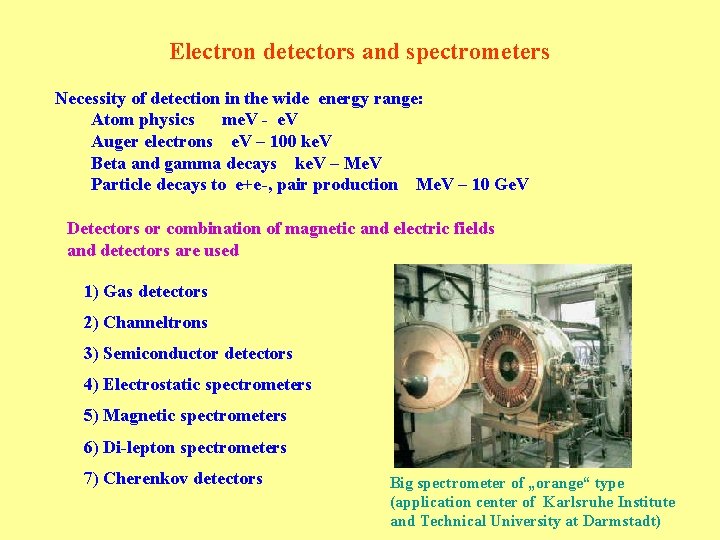
Electron detectors and spectrometers Necessity of detection in the wide energy range: Atom physics me. V - e. V Auger electrons e. V – 100 ke. V Beta and gamma decays ke. V – Me. V Particle decays to e+e-, pair production Me. V – 10 Ge. V Detectors or combination of magnetic and electric fields and detectors are used 1) Gas detectors 2) Channeltrons 3) Semiconductor detectors 4) Electrostatic spectrometers 5) Magnetic spectrometers 6) Di-lepton spectrometers 7) Cherenkov detectors Big spectrometer of „orange“ type (application center of Karlsruhe Institute and Technical University at Darmstadt)
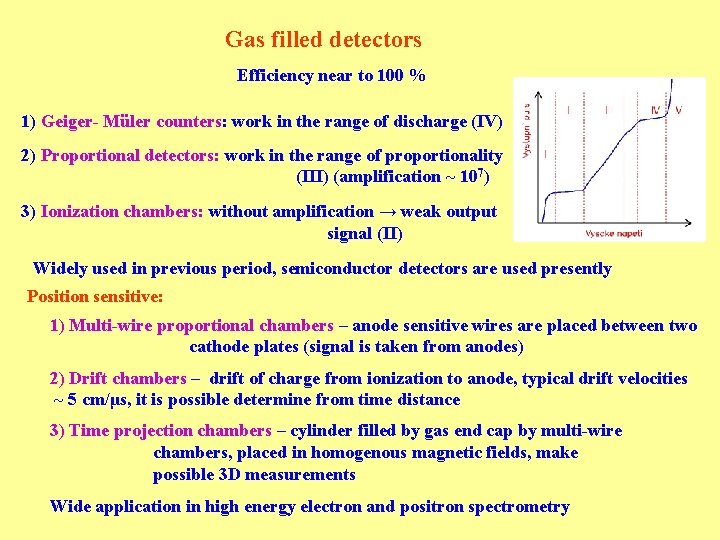
Gas filled detectors Efficiency near to 100 % 1) Geiger- Müler counters: work in the range of discharge (IV) 2) Proportional detectors: work in the range of proportionality (III) (amplification ~ 107) 3) Ionization chambers: without amplification → weak output signal (II) Widely used in previous period, semiconductor detectors are used presently Position sensitive: 1) Multi-wire proportional chambers – anode sensitive wires are placed between two cathode plates (signal is taken from anodes) 2) Drift chambers – drift of charge from ionization to anode, typical drift velocities ~ 5 cm/μs, it is possible determine from time distance 3) Time projection chambers – cylinder filled by gas end cap by multi-wire chambers, placed in homogenous magnetic fields, make possible 3 D measurements Wide application in high energy electron and positron spectrometry
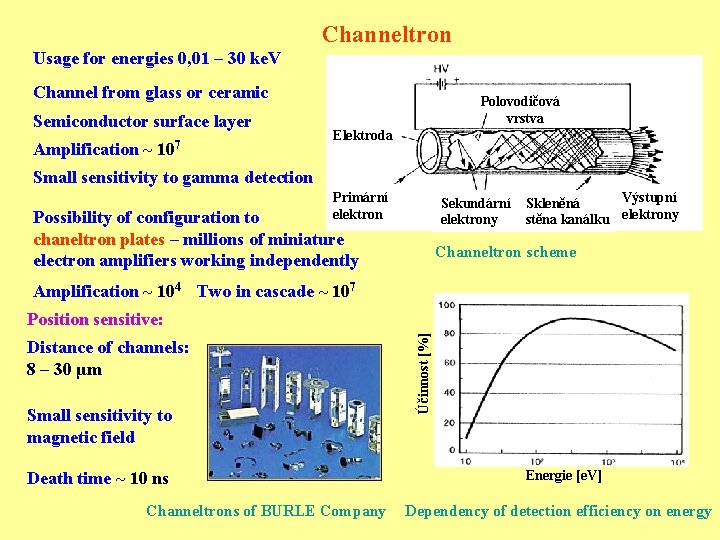
Channeltron Usage for energies 0, 01 – 30 ke. V Channel from glass or ceramic Semiconductor surface layer Amplification ~ 107 Polovodičová vrstva Elektroda Small sensitivity to gamma detection Primární elektron Sekundární elektrony Possibility of configuration to chaneltron plates – millions of miniature electron amplifiers working independently Výstupní Skleněná stěna kanálku elektrony Channeltron scheme Amplification ~ 104 Two in cascade ~ 107 Distance of channels: 8 – 30 μm Small sensitivity to magnetic field Death time ~ 10 ns Channeltrons of BURLE Company Účinnost [%] Position sensitive: Energie [e. V] Dependency of detection efficiency on energy
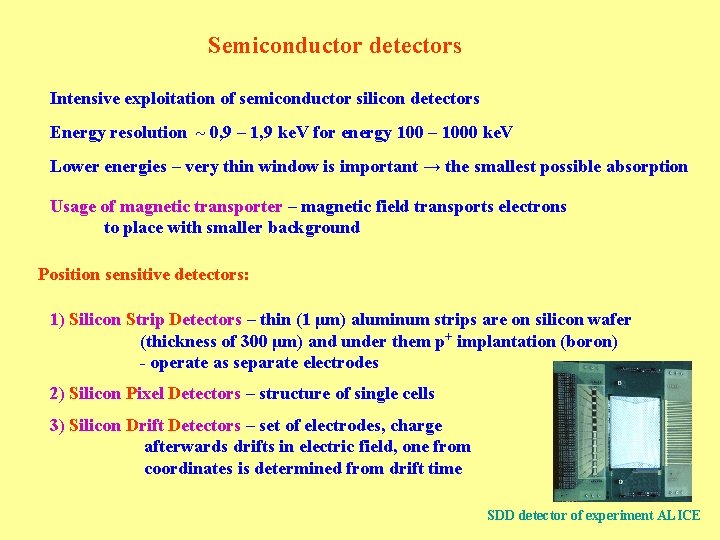
Semiconductor detectors Intensive exploitation of semiconductor silicon detectors Energy resolution ~ 0, 9 – 1, 9 ke. V for energy 100 – 1000 ke. V Lower energies – very thin window is important → the smallest possible absorption Usage of magnetic transporter – magnetic field transports electrons to place with smaller background Position sensitive detectors: 1) Silicon Strip Detectors – thin (1 μm) aluminum strips are on silicon wafer (thickness of 300 μm) and under them p+ implantation (boron) - operate as separate electrodes 2) Silicon Pixel Detectors – structure of single cells 3) Silicon Drift Detectors – set of electrodes, charge afterwards drifts in electric field, one from coordinates is determined from drift time SDD detector of experiment ALICE
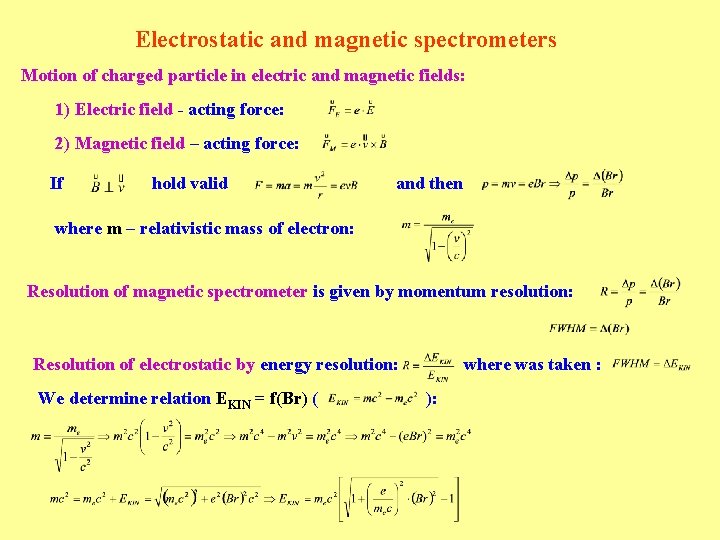
Electrostatic and magnetic spectrometers Motion of charged particle in electric and magnetic fields: 1) Electric field - acting force: 2) Magnetic field – acting force: If hold valid and then where m – relativistic mass of electron: Resolution of magnetic spectrometer is given by momentum resolution: Resolution of electrostatic by energy resolution: We determine relation EKIN = f(Br) ( where was taken : ):
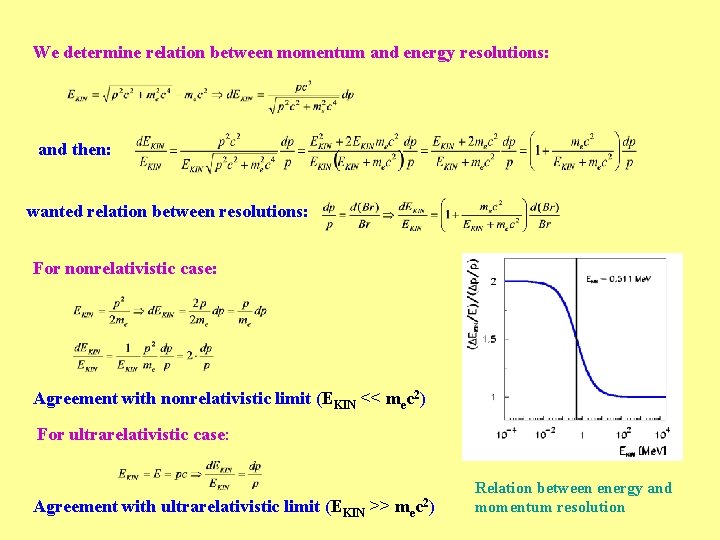
We determine relation between momentum and energy resolutions: and then: wanted relation between resolutions: For nonrelativistic case: Agreement with nonrelativistic limit (EKIN << mec 2) For ultrarelativistic case: Agreement with ultrarelativistic limit (EKIN >> mec 2) Relation between energy and momentum resolution
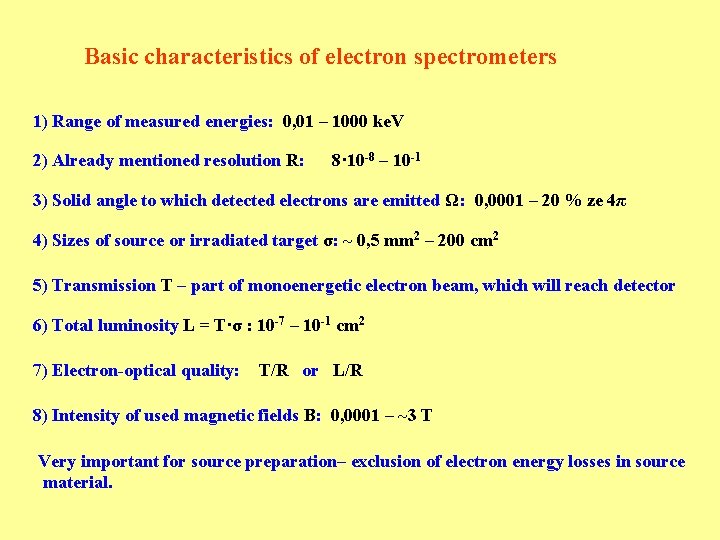
Basic characteristics of electron spectrometers 1) Range of measured energies: 0, 01 – 1000 ke. V 2) Already mentioned resolution R: 8·10 -8 – 10 -1 3) Solid angle to which detected electrons are emitted Ω: 0, 0001 – 20 % ze 4π 4) Sizes of source or irradiated target σ: ~ 0, 5 mm 2 – 200 cm 2 5) Transmission T – part of monoenergetic electron beam, which will reach detector 6) Total luminosity L = T·σ : 10 -7 – 10 -1 cm 2 7) Electron-optical quality: T/R or L/R 8) Intensity of used magnetic fields B: 0, 0001 – ~3 T Very important for source preparation– exclusion of electron energy losses in source material.
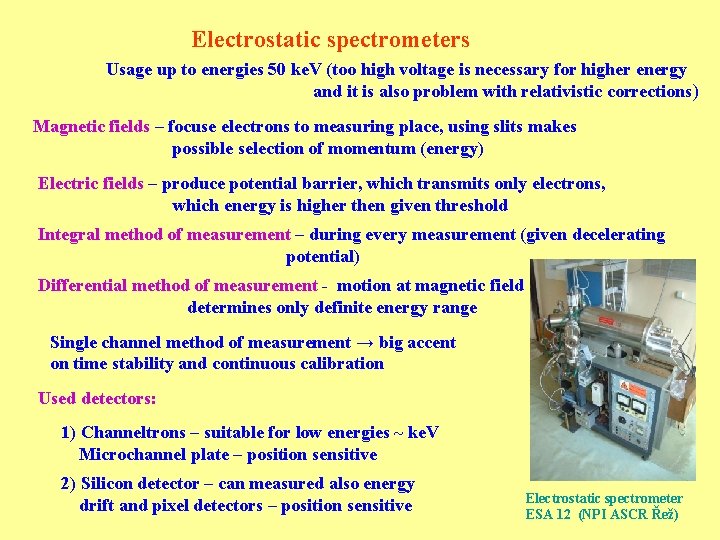
Electrostatic spectrometers Usage up to energies 50 ke. V (too high voltage is necessary for higher energy and it is also problem with relativistic corrections) Magnetic fields – focuse electrons to measuring place, using slits makes possible selection of momentum (energy) Electric fields – produce potential barrier, which transmits only electrons, which energy is higher then given threshold Integral method of measurement – during every measurement (given decelerating potential) Differential method of measurement - motion at magnetic field determines only definite energy range Single channel method of measurement → big accent on time stability and continuous calibration Used detectors: 1) Channeltrons – suitable for low energies ~ ke. V Microchannel plate – position sensitive 2) Silicon detector – can measured also energy drift and pixel detectors – position sensitive Electrostatic spectrometer ESA 12 (NPI ASCR Řež)
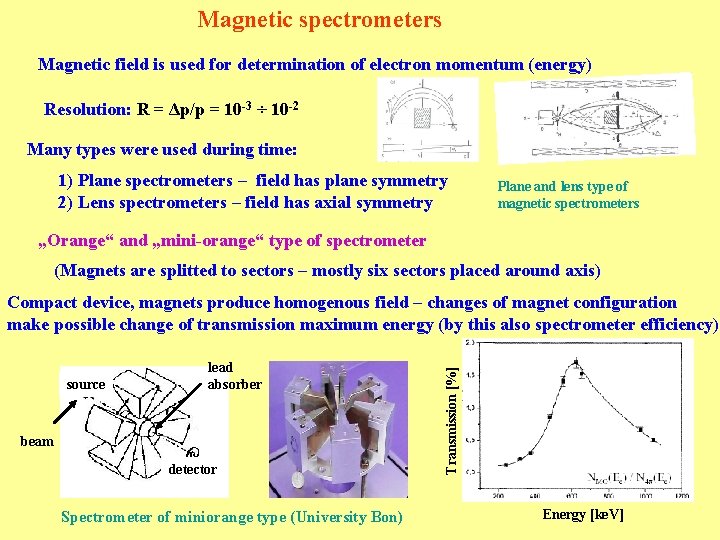
Magnetic spectrometers Magnetic field is used for determination of electron momentum (energy) Resolution: R = Δp/p = 10 -3 ÷ 10 -2 Many types were used during time: 1) Plane spectrometers – field has plane symmetry 2) Lens spectrometers – field has axial symmetry Plane and lens type of magnetic spectrometers „Orange“ and „mini-orange“ type of spectrometer (Magnets are splitted to sectors – mostly six sectors placed around axis) source lead absorber beam detector Spectrometer of miniorange type (University Bon) Transmission [%] Compact device, magnets produce homogenous field – changes of magnet configuration make possible change of transmission maximum energy (by this also spectrometer efficiency) Energy [ke. V]
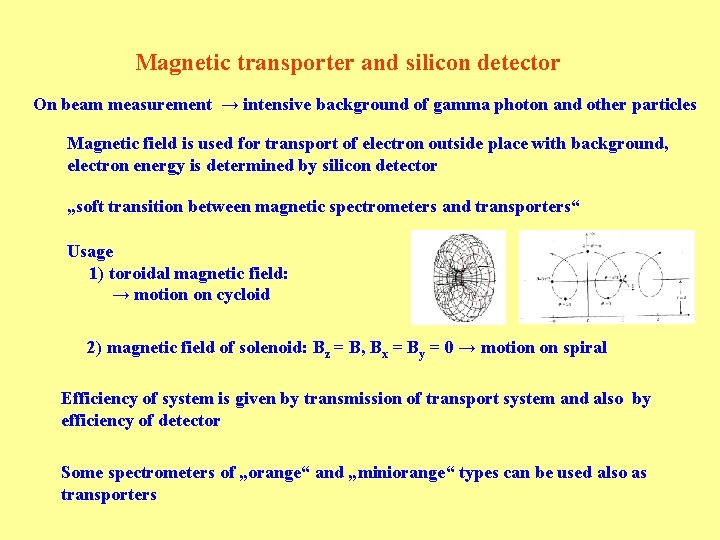
Magnetic transporter and silicon detector On beam measurement → intensive background of gamma photon and other particles Magnetic field is used for transport of electron outside place with background, electron energy is determined by silicon detector „soft transition between magnetic spectrometers and transporters“ Usage 1) toroidal magnetic field: → motion on cycloid 2) magnetic field of solenoid: Bz = B, Bx = By = 0 → motion on spiral Efficiency of system is given by transmission of transport system and also by efficiency of detector Some spectrometers of „orange“ and „miniorange“ types can be used also as transporters
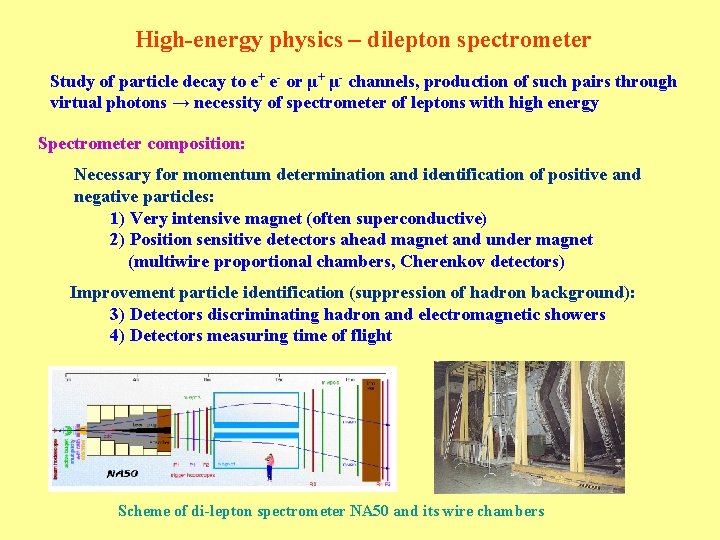
High-energy physics – dilepton spectrometer Study of particle decay to e+ e- or μ+ μ- channels, production of such pairs through virtual photons → necessity of spectrometer of leptons with high energy Spectrometer composition: Necessary for momentum determination and identification of positive and negative particles: 1) Very intensive magnet (often superconductive) 2) Position sensitive detectors ahead magnet and under magnet (multiwire proportional chambers, Cherenkov detectors) Improvement particle identification (suppression of hadron background): 3) Detectors discriminating hadron and electromagnetic showers 4) Detectors measuring time of flight Scheme of di-lepton spectrometer NA 50 and its wire chambers
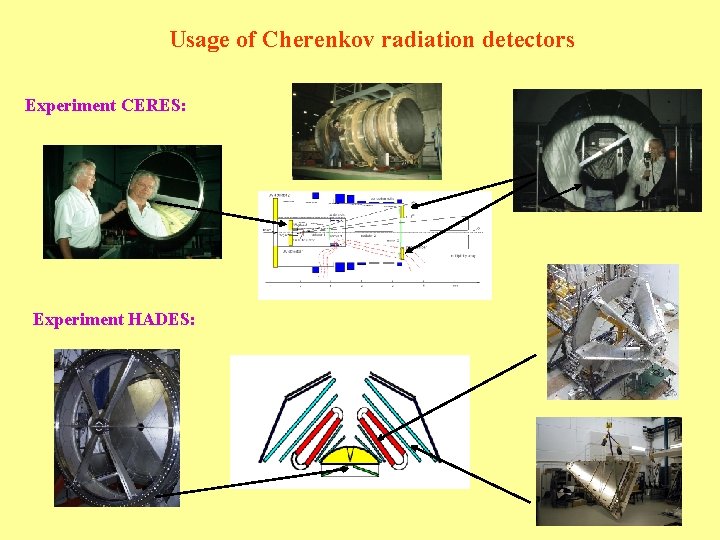
Usage of Cherenkov radiation detectors Experiment CERES: Experiment HADES: