
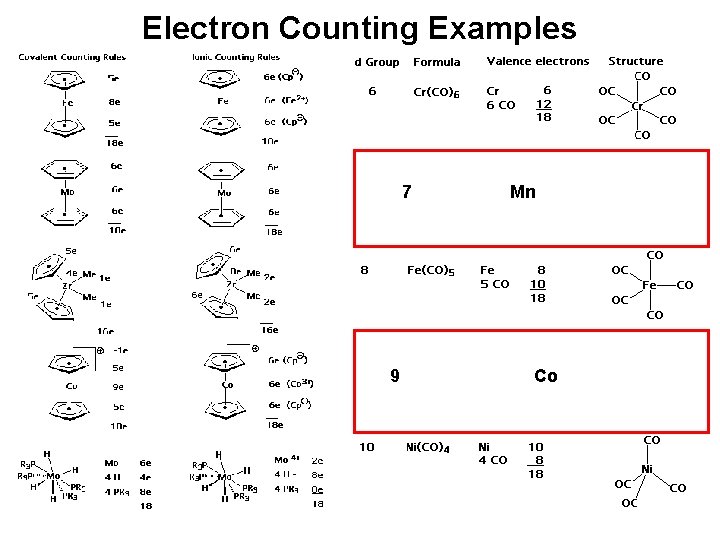
Electron Counting Examples 7 9 Mn Co Look
- Slides: 8
Electron Counting Examples 7 9 Mn Co
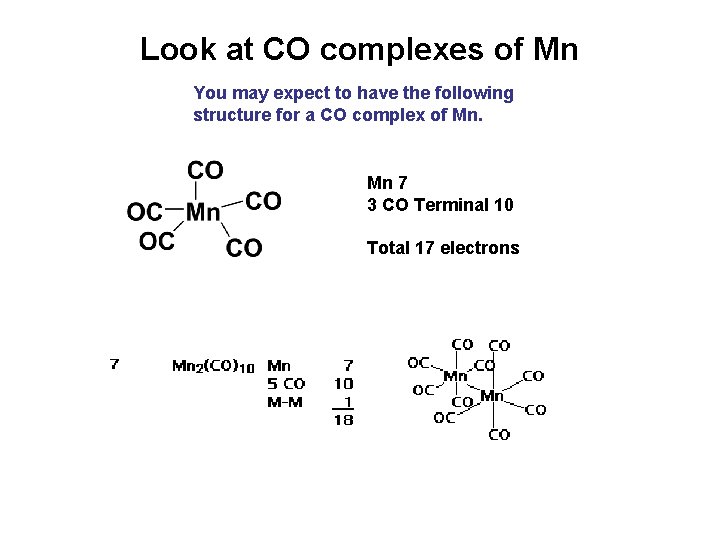
Look at CO complexes of Mn You may expect to have the following structure for a CO complex of Mn. Mn 7 3 CO Terminal 10 Total 17 electrons
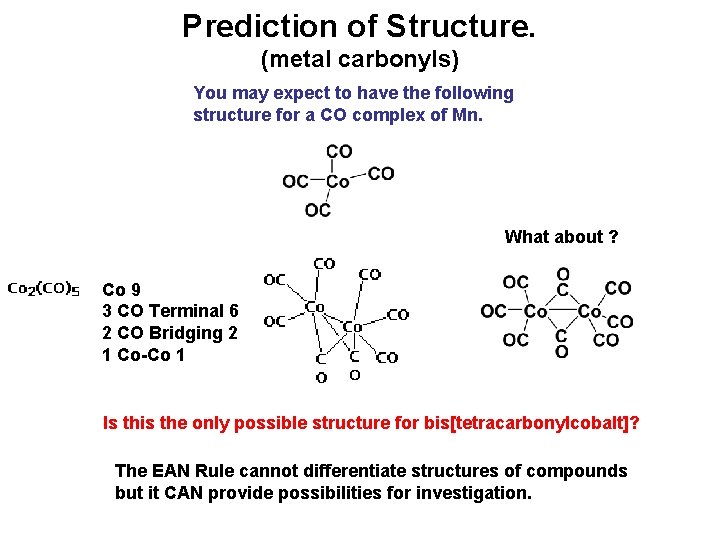
Prediction of Structure. (metal carbonyls) You may expect to have the following structure for a CO complex of Mn. What about ? Co 9 3 CO Terminal 6 2 CO Bridging 2 1 Co-Co 1 Is this the only possible structure for bis[tetracarbonylcobalt]? The EAN Rule cannot differentiate structures of compounds but it CAN provide possibilities for investigation.
Compounds and the EAN Rule We can divide compounds into three groups. 1. Electronic configurations are completely unrelated to the EAN rule. The central metal may have >, <, = 18 electrons. 2. Electron configurations follow the EAN rule and never have >18 electrons, but may have less. 3. A group that follows EAN rule rigorously. 4. (This is what I have shown you so far) 5. How can we understand this?
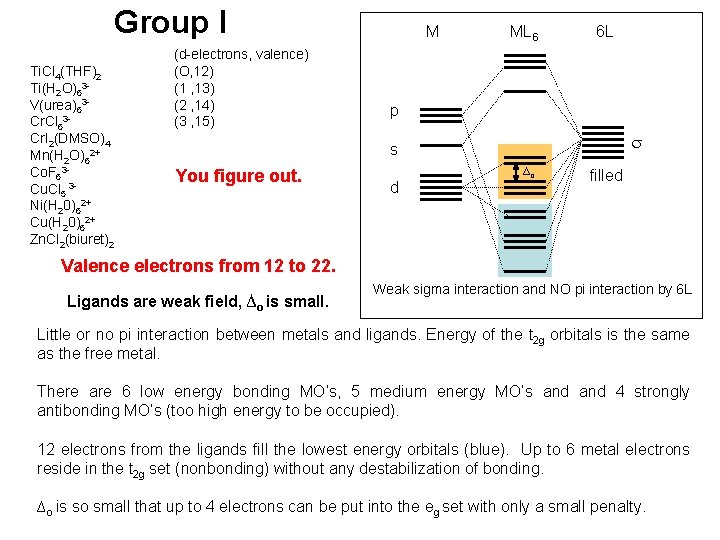
Group I Ti. Cl 4(THF)2 Ti(H 2 O)63 V(urea)63 Cr. Cl 63 Cr. I 2(DMSO)4 Mn(H 2 O)62+ Co. F 63 Cu. Cl 5 3 Ni(H 20)62+ Cu(H 20)62+ Zn. Cl 2(biuret)2 (d-electrons, valence) (O, 12) (1 , 13) (2 , 14) (3 , 15) M ML 6 6 L p s You figure out. d ∆o filled Valence electrons from 12 to 22. Ligands are weak field, ∆o is small. Weak sigma interaction and NO pi interaction by 6 L Little or no pi interaction between metals and ligands. Energy of the t 2 g orbitals is the same as the free metal. There are 6 low energy bonding MO’s, 5 medium energy MO’s and 4 strongly antibonding MO’s (too high energy to be occupied). 12 electrons from the ligands fill the lowest energy orbitals (blue). Up to 6 metal electrons reside in the t 2 g set (nonbonding) without any destabilization of bonding. ∆o is so small that up to 4 electrons can be put into the eg set with only a small penalty.
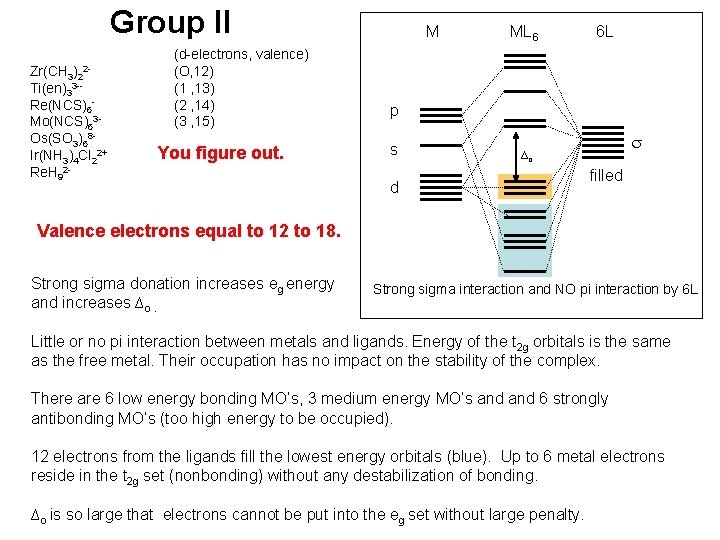
Group II Zr(CH 3)22 Ti(en)33 -- Re(NCS)6 Mo(NCS)63 Os(SO 3)68 Ir(NH 3)4 Cl 22+ Re. H 92 - (d-electrons, valence) (O, 12) (1 , 13) (2 , 14) (3 , 15) You figure out. M ML 6 6 L p s ∆o d filled Valence electrons equal to 12 to 18. Strong sigma donation increases eg energy and increases ∆o. Strong sigma interaction and NO pi interaction by 6 L Little or no pi interaction between metals and ligands. Energy of the t 2 g orbitals is the same as the free metal. Their occupation has no impact on the stability of the complex. There are 6 low energy bonding MO’s, 3 medium energy MO’s and 6 strongly antibonding MO’s (too high energy to be occupied). 12 electrons from the ligands fill the lowest energy orbitals (blue). Up to 6 metal electrons reside in the t 2 g set (nonbonding) without any destabilization of bonding. ∆o is so large that electrons cannot be put into the eg set without large penalty.
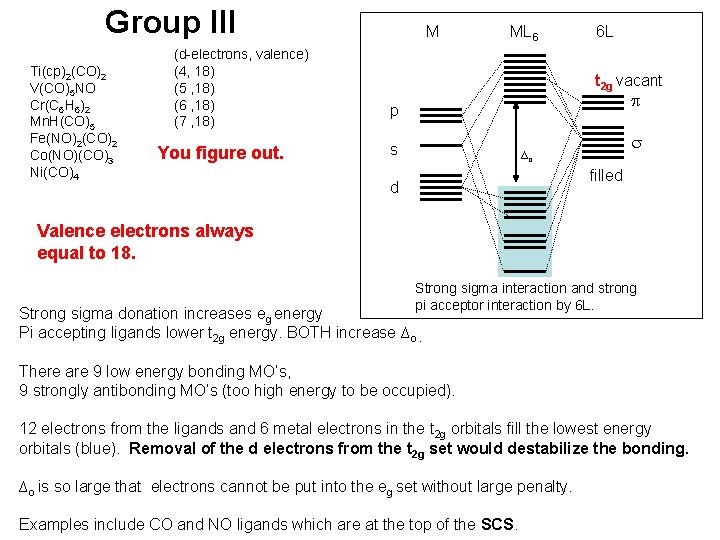
Group III Ti(cp)2(CO)2 V(CO)5 NO Cr(C 6 H 6)2 Mn. H(CO)5 Fe(NO)2(CO)2 Co(NO)(CO)3 Ni(CO)4 (d-electrons, valence) (4, 18) (5 , 18) (6 , 18) (7 , 18) You figure out. M ML 6 6 L t 2 g vacant p p s ∆o filled d Valence electrons always equal to 18. Strong sigma interaction and strong pi acceptor interaction by 6 L. Strong sigma donation increases eg energy Pi accepting ligands lower t 2 g energy. BOTH increase ∆o. There are 9 low energy bonding MO’s, 9 strongly antibonding MO’s (too high energy to be occupied). 12 electrons from the ligands and 6 metal electrons in the t 2 g orbitals fill the lowest energy orbitals (blue). Removal of the d electrons from the t 2 g set would destabilize the bonding. ∆o is so large that electrons cannot be put into the eg set without large penalty. Examples include CO and NO ligands which are at the top of the SCS.
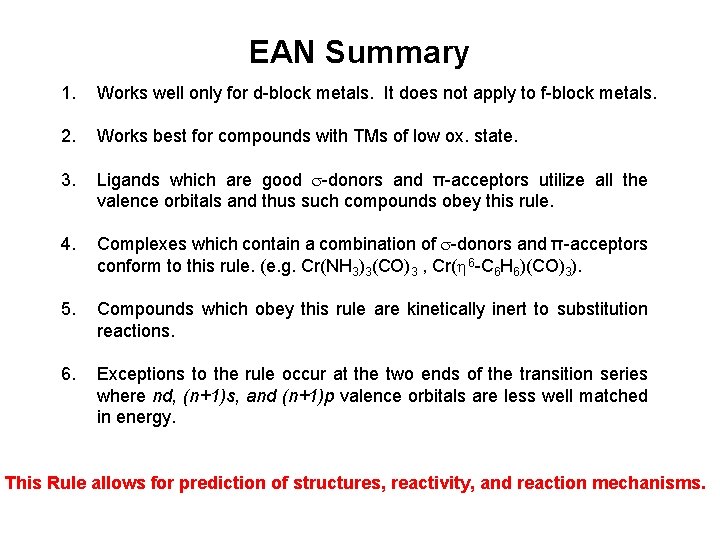
EAN Summary 1. Works well only for d-block metals. It does not apply to f-block metals. 2. Works best for compounds with TMs of low ox. state. 3. Ligands which are good -donors and π-acceptors utilize all the valence orbitals and thus such compounds obey this rule. 4. Complexes which contain a combination of -donors and π-acceptors conform to this rule. (e. g. Cr(NH 3)3(CO)3 , Cr( 6 -C 6 H 6)(CO)3). 5. Compounds which obey this rule are kinetically inert to substitution reactions. 6. Exceptions to the rule occur at the two ends of the transition series where nd, (n+1)s, and (n+1)p valence orbitals are less well matched in energy. This Rule allows for prediction of structures, reactivity, and reaction mechanisms.