
Electron Configurations the Periodic Table Chapter 7 Electromagnetic
Electron Configurations & the Periodic Table Chapter 7
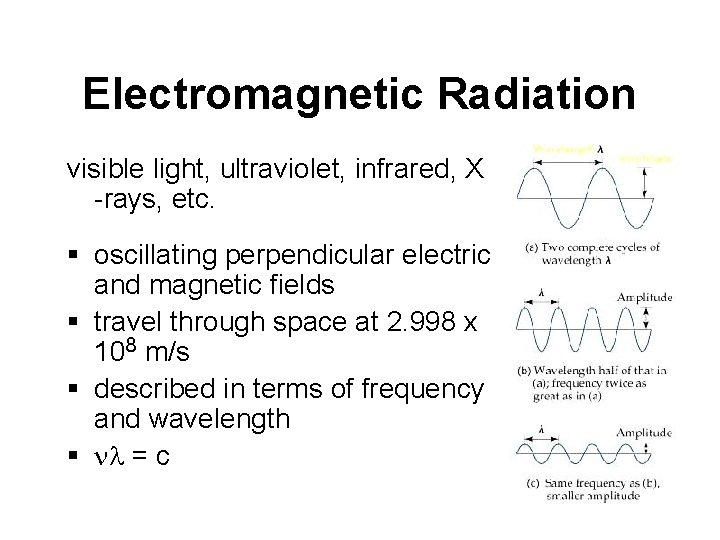
Electromagnetic Radiation visible light, ultraviolet, infrared, X -rays, etc. § oscillating perpendicular electric and magnetic fields § travel through space at 2. 998 x 108 m/s § described in terms of frequency and wavelength § nl = c
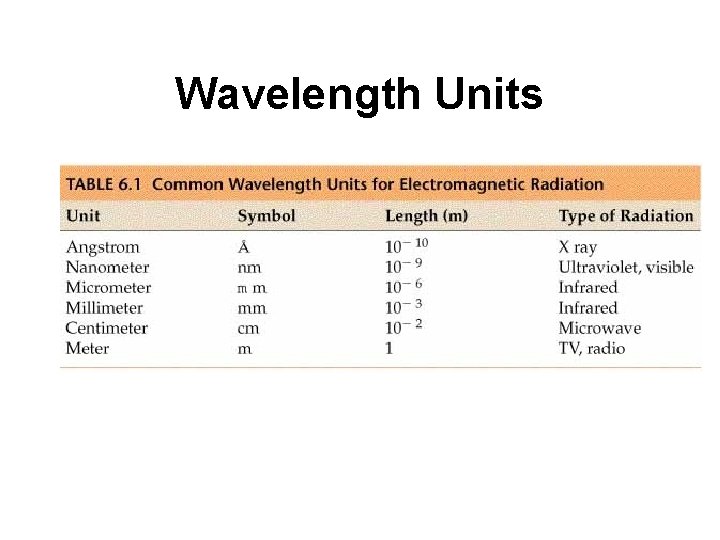
Wavelength Units
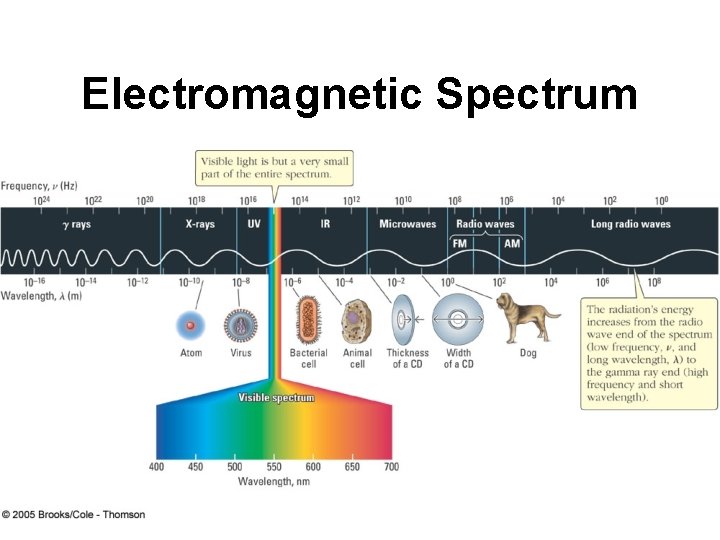
Electromagnetic Spectrum
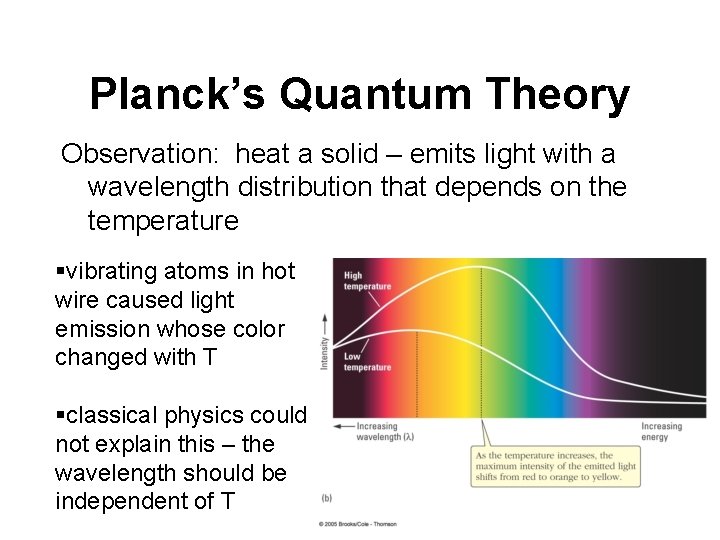
Planck’s Quantum Theory Observation: heat a solid – emits light with a wavelength distribution that depends on the temperature §vibrating atoms in hot wire caused light emission whose color changed with T §classical physics could not explain this – the wavelength should be independent of T
Planck’s Quantum Theory § Max Planck (1900) § assume energy can be released or absorbed by atoms in packets only § these packets have a minimum size § packet of energy = quantum § energy of a quantum is proportional to the frequency of radiation § (E = hn) § h = Planck’s constant = 6. 626 x 10 -34 Js § energy is emitted or absorbed in whole # multiples (1 hn, 2 hn, etc. )
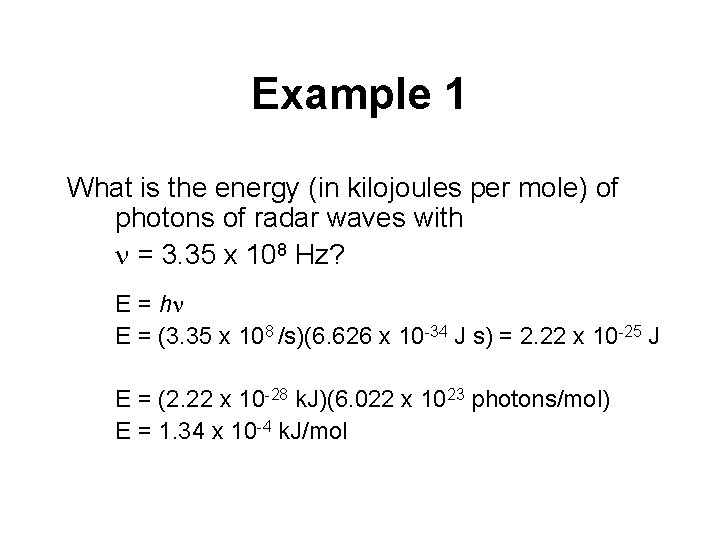
Example 1 What is the energy (in kilojoules per mole) of photons of radar waves with n = 3. 35 x 108 Hz? E = hn E = (3. 35 x 108 /s)(6. 626 x 10 -34 J s) = 2. 22 x 10 -25 J E = (2. 22 x 10 -28 k. J)(6. 022 x 1023 photons/mol) E = 1. 34 x 10 -4 k. J/mol
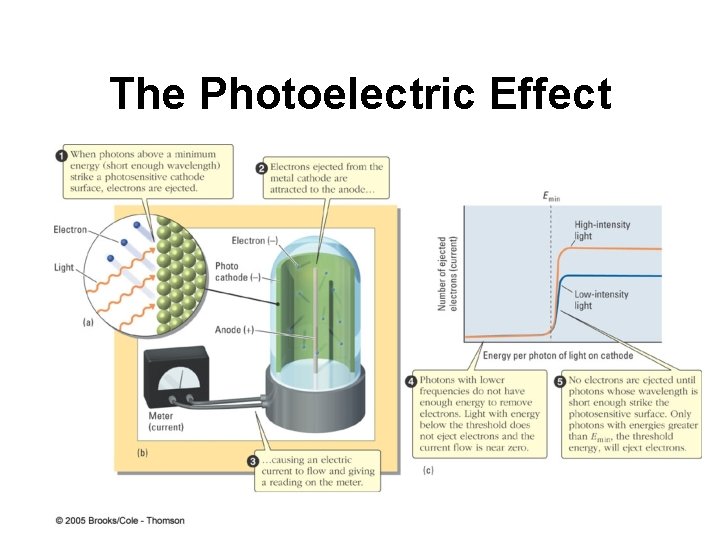
The Photoelectric Effect
The Photoelectric Effect § Einstein assumed light striking metal was stream of tiny energy packets § Each energy packet behaves like tiny particle of light (photon) § E = hn radiant energy is quantized § Dilemma – is light a wave or a particle? ? ?
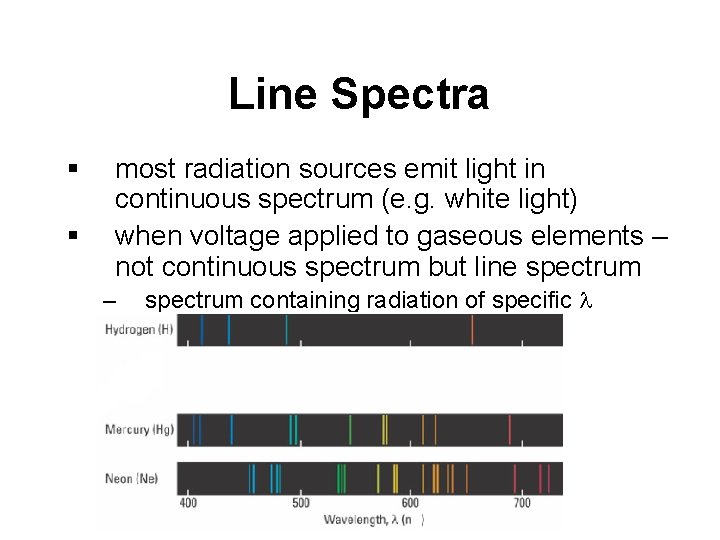
Line Spectra § § most radiation sources emit light in continuous spectrum (e. g. white light) when voltage applied to gaseous elements – not continuous spectrum but line spectrum – spectrum containing radiation of specific l
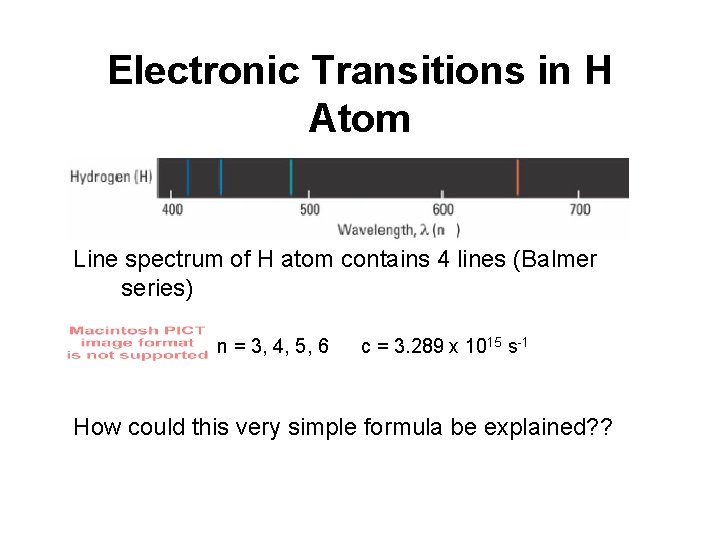
Electronic Transitions in H Atom Line spectrum of H atom contains 4 lines (Balmer series) n = 3, 4, 5, 6 c = 3. 289 x 1015 s-1 How could this very simple formula be explained? ?
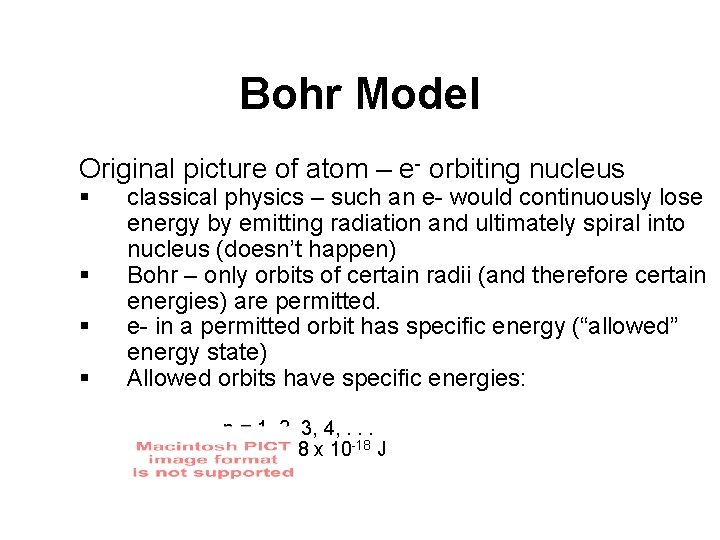
Bohr Model Original picture of atom – e- orbiting nucleus § § classical physics – such an e- would continuously lose energy by emitting radiation and ultimately spiral into nucleus (doesn’t happen) Bohr – only orbits of certain radii (and therefore certain energies) are permitted. e- in a permitted orbit has specific energy (“allowed” energy state) Allowed orbits have specific energies: n = 1, 2, 3, 4, . . . RH = 2. 18 x 10 -18 J

Bohr Model (cont’d) § each orbit – different n value § radius increases as n increases (r n 2) § 1 st allowed orbit – n = 1, radius = 0. 529 Å § Energies of electrons negative for all values of n. n :
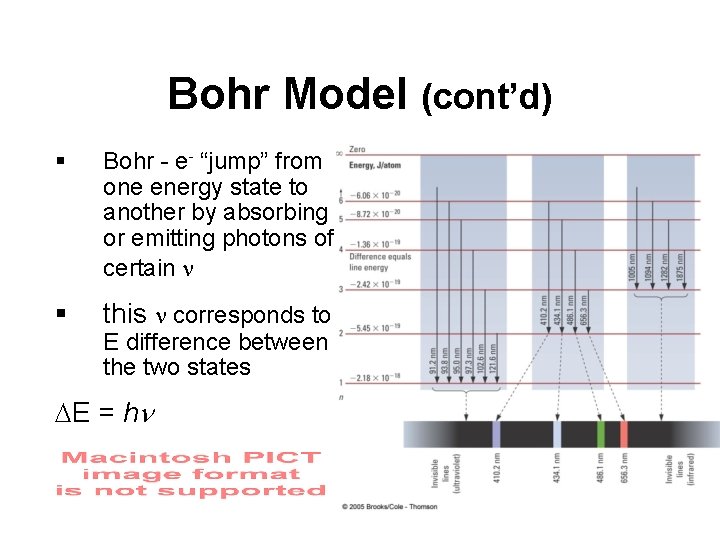
Bohr Model (cont’d) § Bohr - e- “jump” from one energy state to another by absorbing or emitting photons of certain n § this n corresponds to E difference between the two states E = hn
- Slides: 14