
Electron Configurations of Transition Metal Atoms Ions PROBLEM
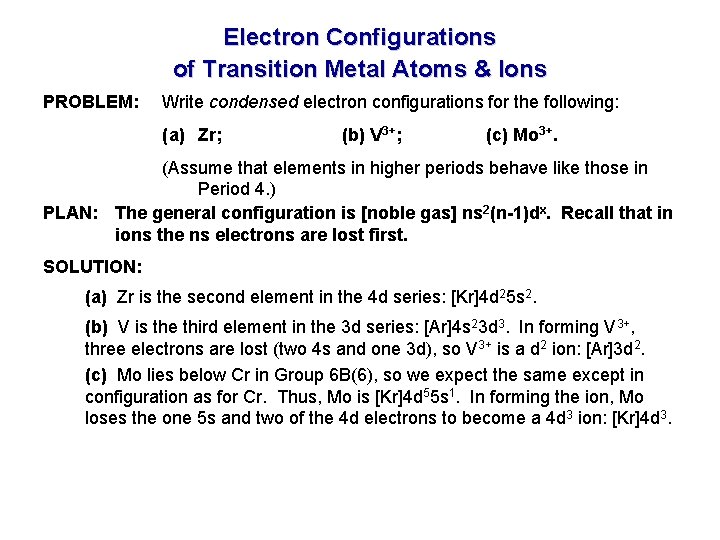
Electron Configurations of Transition Metal Atoms & Ions PROBLEM: Write condensed electron configurations for the following: (a) Zr; (b) V 3+; (c) Mo 3+. (Assume that elements in higher periods behave like those in Period 4. ) PLAN: The general configuration is [noble gas] ns 2(n-1)dx. Recall that in ions the ns electrons are lost first. SOLUTION: (a) Zr is the second element in the 4 d series: [Kr]4 d 25 s 2. (b) V is the third element in the 3 d series: [Ar]4 s 23 d 3. In forming V 3+, three electrons are lost (two 4 s and one 3 d), so V 3+ is a d 2 ion: [Ar]3 d 2. (c) Mo lies below Cr in Group 6 B(6), so we expect the same except in configuration as for Cr. Thus, Mo is [Kr]4 d 55 s 1. In forming the ion, Mo loses the one 5 s and two of the 4 d electrons to become a 4 d 3 ion: [Kr]4 d 3.
Transition Metal Chemistry One striking characteristic of the representative elements was that their chemistry changes markedly across a given period as the number of valence electrons changes. The chemical similarities occur mainly within the vertical groups. In contrast, the transition metals show great similarities within a given period as well as within a given vertical group. Why?
Transistion Metals Chemistry & Electron Configuration This difference occurs because the last electrons added to the transition metal elements are inner electrons: d electrons for the d-block transition metals and f electrons for the lanthanides and actinides. These inner d and f electrons cannot participate in bonding as readily as the valence s and p electrons. Thus, the chemistry of transition elements is not as greatly affected by the gradual change in the number of electrons as is the chemistry of the representative elements. Also note that the transition metals do not extend all the way across the d-block because the Group 12 elements (zinc, cadmium, and mercury) are not normally considered to be transition elements. Because their d-orbitals are full, the Group 12 elements have properties that are more like those of maingroup metals than transition metals.
Transition Metal Chemistry So what charateristics can we expect with transition elements? (1) Variable oxidation states except for the first & last column. The central group having the most variety. (2) All the d-block elements are metals. Most of these “dmetals” are good electrical conductors, malleable, ductile, and lustrous. Generally, their melting and boiling points are higher than those of the main-group elements. They are “hard” metals except for Zn. (3) The low oxidation state ions are generally good reducing agents (they undergo oxidation) and all 3 d elements reduce H+ except Cu. Recall the activity series. M → Mn+ + ne-
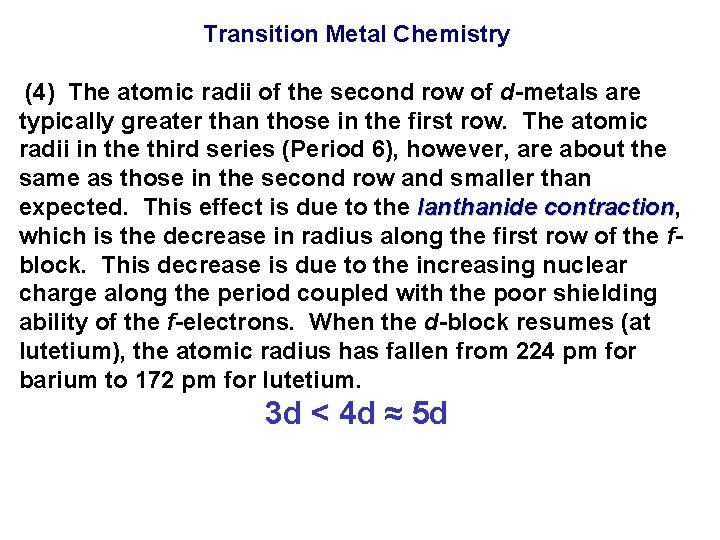
Transition Metal Chemistry (4) The atomic radii of the second row of d-metals are typically greater than those in the first row. The atomic radii in the third series (Period 6), however, are about the same as those in the second row and smaller than expected. This effect is due to the lanthanide contraction, contraction which is the decrease in radius along the first row of the fblock. This decrease is due to the increasing nuclear charge along the period coupled with the poor shielding ability of the f-electrons. When the d-block resumes (at lutetium), the atomic radius has fallen from 224 pm for barium to 172 pm for lutetium. 3 d < 4 d ≈ 5 d
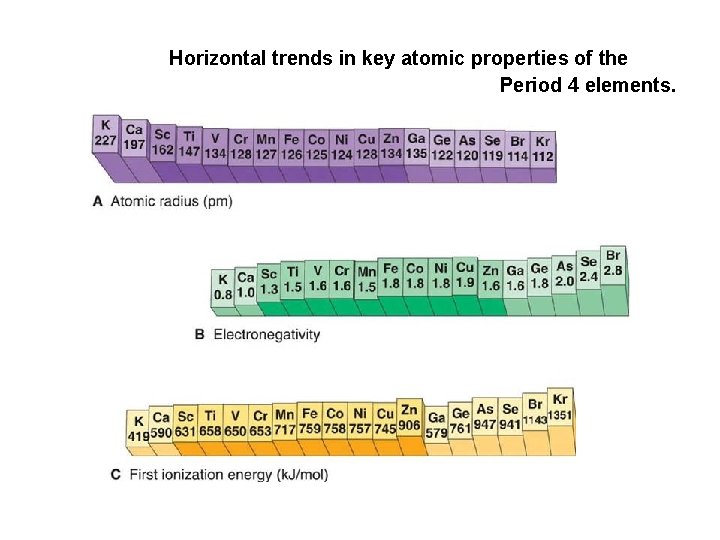
Horizontal trends in key atomic properties of the Period 4 elements.

Transition Metal Chemistry (5) Periodicity The atomic radius decreases across a period reaching a constant size due to shielding by the other electrons. Electronegativity generally increases across a period slightly. Ionization energy gradually increases across a period. Atomic size and oxidation state has a major effect on the nature of bonding. Ionic bonding is more prevalent for lower oxidation state ions and covalent bonding is preferred for the higher states.
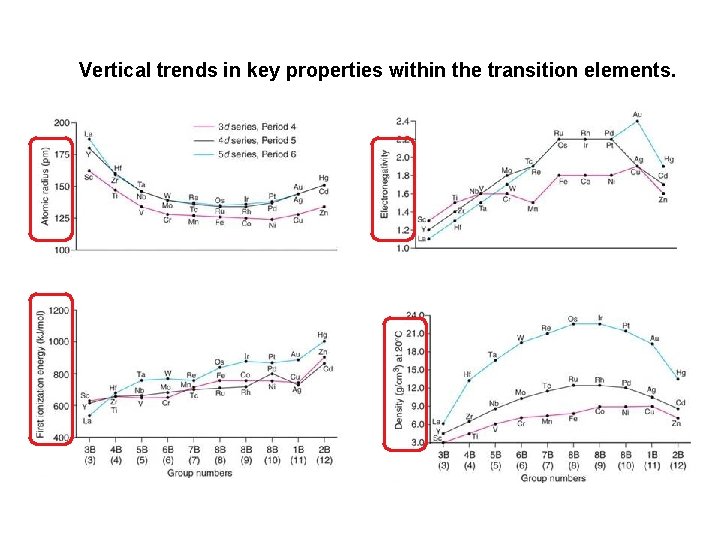
Vertical trends in key properties within the transition elements.
Transition Metal Chemistry (in depth) In forming ionic compounds with nonmetals, the transition metals exhibit several typical characteristics: 1. Various oxidation states can be found depending on the placement of the transition metals. Elements at the ends of each row occur in only one oxidation state other than zero (exception: mercury). Most other elements have at least two oxidation states other than zero, and elements closer to the center of each row have the widest range of oxidation states. Furthermore, elements in the second and third rows are most likely to reach higher oxidation states than those in the first row.

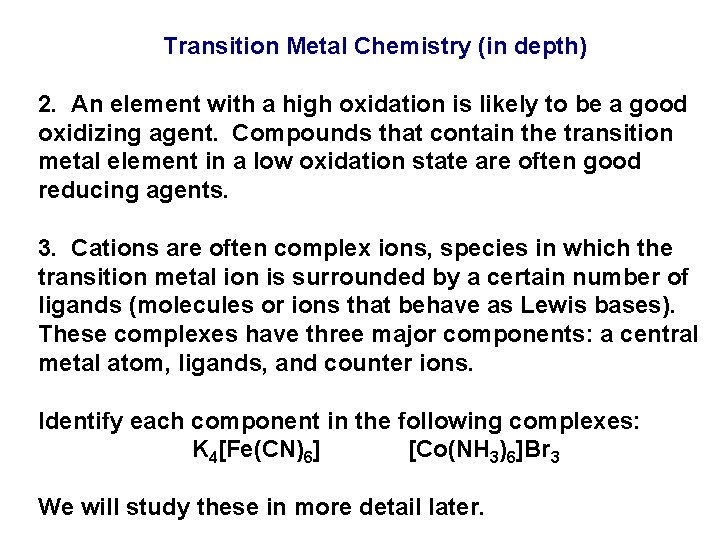
Transition Metal Chemistry (in depth) 2. An element with a high oxidation is likely to be a good oxidizing agent. Compounds that contain the transition metal element in a low oxidation state are often good reducing agents. 3. Cations are often complex ions, species in which the transition metal ion is surrounded by a certain number of ligands (molecules or ions that behave as Lewis bases). These complexes have three major components: a central metal atom, ligands, and counter ions. Identify each component in the following complexes: K 4[Fe(CN)6] [Co(NH 3)6]Br 3 We will study these in more detail later.
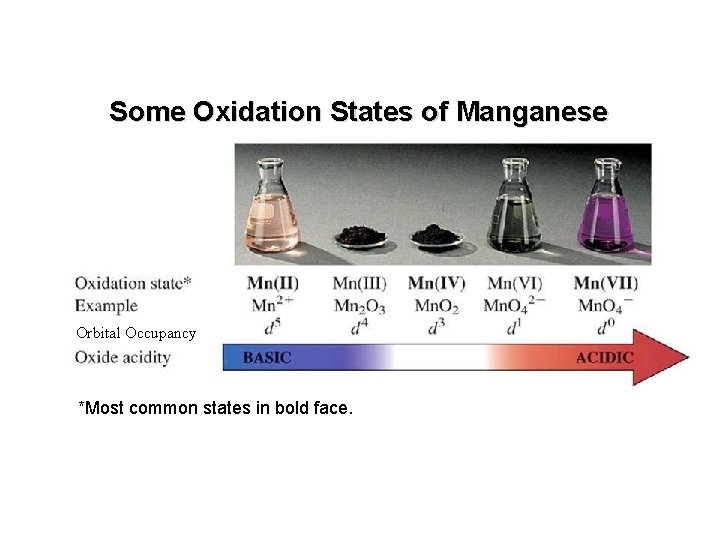
Some Oxidation States of Manganese Orbital Occupancy *Most common states in bold face.
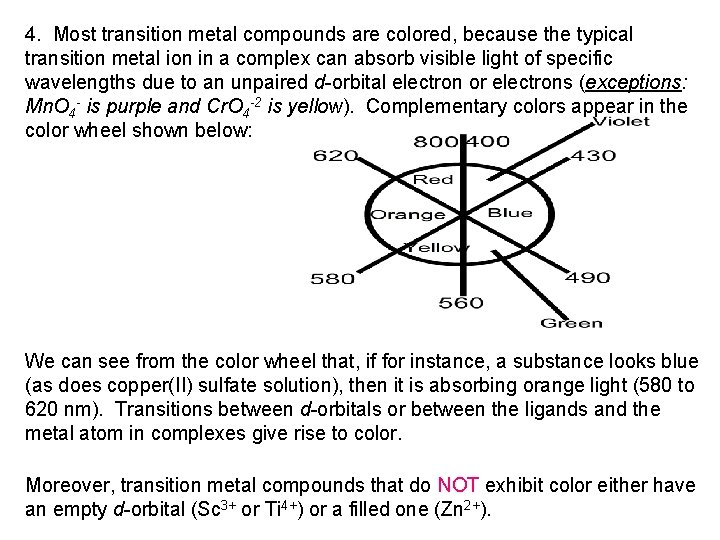
4. Most transition metal compounds are colored, because the typical transition metal ion in a complex can absorb visible light of specific wavelengths due to an unpaired d-orbital electron or electrons (exceptions: Mn. O 4 - is purple and Cr. O 4 -2 is yellow). Complementary colors appear in the color wheel shown below: We can see from the color wheel that, if for instance, a substance looks blue (as does copper(II) sulfate solution), then it is absorbing orange light (580 to 620 nm). Transitions between d-orbitals or between the ligands and the metal atom in complexes give rise to color. Moreover, transition metal compounds that do NOT exhibit color either have an empty d-orbital (Sc 3+ or Ti 4+) or a filled one (Zn 2+).
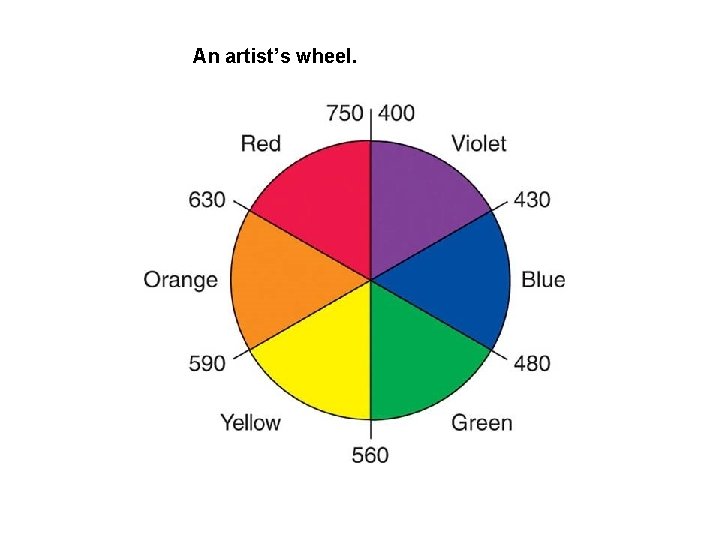
An artist’s wheel.
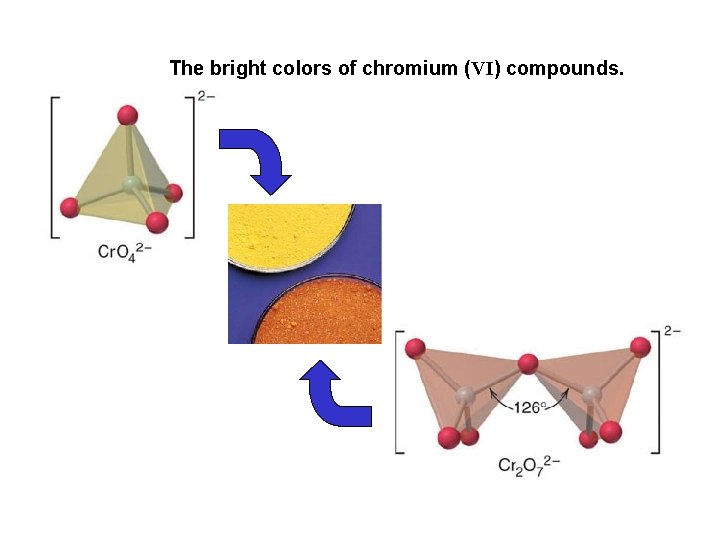
The bright colors of chromium (VI) compounds.
![Metal Complexes and Coordination Compounds Species such as [Co(NH 3)5 Cl]+2 that are assemblies](http://slidetodoc.com/presentation_image/af69d10871ebca0b6dbf0471f05bea0c/image-16.jpg "Metal Complexes and Coordination Compounds Species such as [Co(NH 3)5 Cl]+2 that are assemblies")
Metal Complexes and Coordination Compounds Species such as [Co(NH 3)5 Cl]+2 that are assemblies of a central metal ion bonded to a group of surrounding molecules or ions are called metal complexes or merely complexes. If the complex carries a net charge, it is generally called a complex ion. Compounds that contain complexes are known as coordination compounds The molecules or ions that surround the metal ion in a complex are known as ligands Ligands coordinate (or bond) to a metal atom or ion to form a coordinate covalent bond. Notice that this bond is different than an ordinary covalent bond (where electrons are shared between two joining species). In the coordinate covalent bond, both electrons used to generate the bond are property of the ligand NOT the metal! A saturated complex fullfills the 18 e- rule.
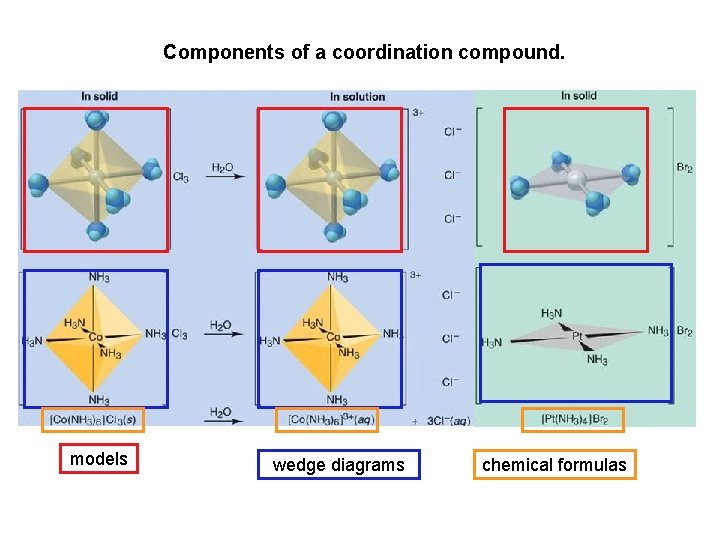
Components of a coordination compound. models wedge diagrams chemical formulas

Ligands are normally either anions or neutral polar molecules. Every ligand has at least one unshared pair of valence electrons to donate. Furthermore, they can broken down into the following categories: Monodentate ligand examples: Bidentate ligand examples:
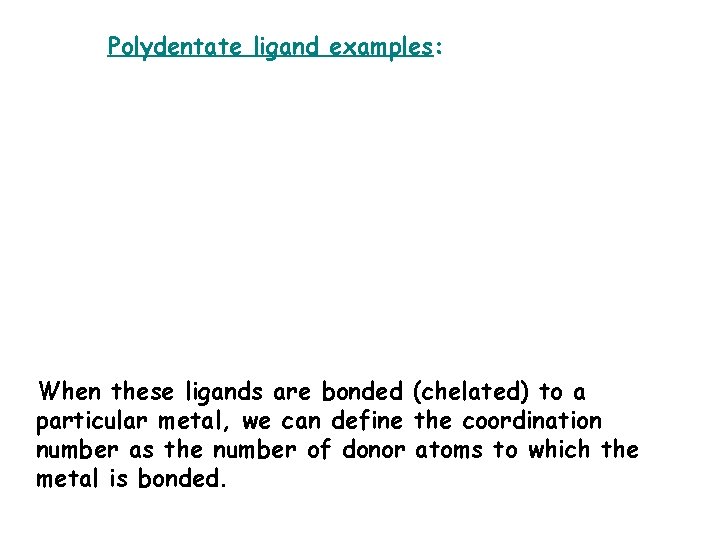
Polydentate ligand examples: When these ligands are bonded (chelated) to a particular metal, we can define the coordination number as the number of donor atoms to which the metal is bonded.

Names of monodentate: Aqua, ammine, fluoro, chloro, cyano, thiocyano, hydroxo, nitro Some more Bidentate ligands: CO 32 - carbanato NO 3 - nitrato SO 42 - sulfato
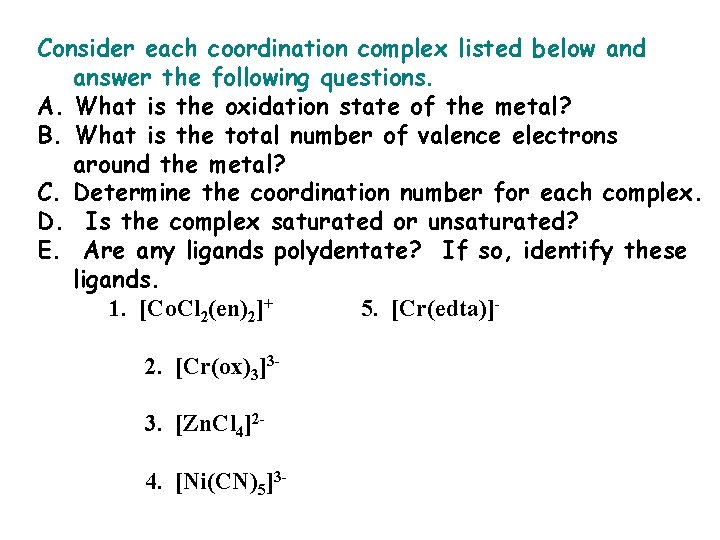
Consider each coordination complex listed below and answer the following questions. A. What is the oxidation state of the metal? B. What is the total number of valence electrons around the metal? C. Determine the coordination number for each complex. D. Is the complex saturated or unsaturated? E. Are any ligands polydentate? If so, identify these ligands. 1. [Co. Cl 2(en)2]+ 5. [Cr(edta)]2. [Cr(ox)3]33. [Zn. Cl 4]24. [Ni(CN)5]3 -

Naming Coordination Compounds 1. In naming salts, the name of the cation is given before the name of the anion. For example, in [Co(NH 3)5 Cl]Cl 2, we name [Co(NH 3)5 Cl]2+ before Cl-. 2. Within a complex ion or molecule, the ligands are named before the metal. Ligands are listed in alphabetical order, regardless of charge on the ligand. Prefixes (see Rule #4 below) that give the number of ligands are NOT considered part of the ligand name in determining alphabetical order. Consider once again the [Co(NH 3)5 Cl]2+ ion. Name the ammonia ligand first, then the chloride, followed by the metal: pentaamminechlorocobalt(III).
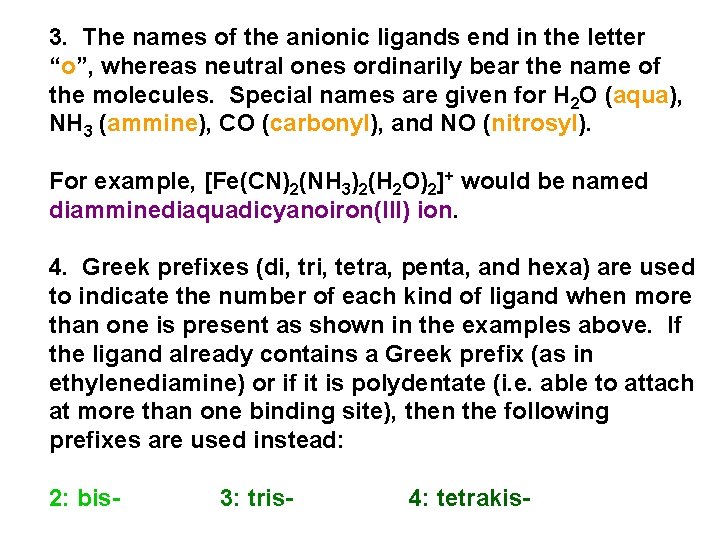
3. The names of the anionic ligands end in the letter “o”, whereas neutral ones ordinarily bear the name of the molecules. Special names are given for H 2 O (aqua), NH 3 (ammine), CO (carbonyl), and NO (nitrosyl). For example, [Fe(CN)2(NH 3)2(H 2 O)2]+ would be named diamminediaquadicyanoiron(III) ion. 4. Greek prefixes (di, tri, tetra, penta, and hexa) are used to indicate the number of each kind of ligand when more than one is present as shown in the examples above. If the ligand already contains a Greek prefix (as in ethylenediamine) or if it is polydentate (i. e. able to attach at more than one binding site), then the following prefixes are used instead: 2: bis- 3: tris- 4: tetrakis-
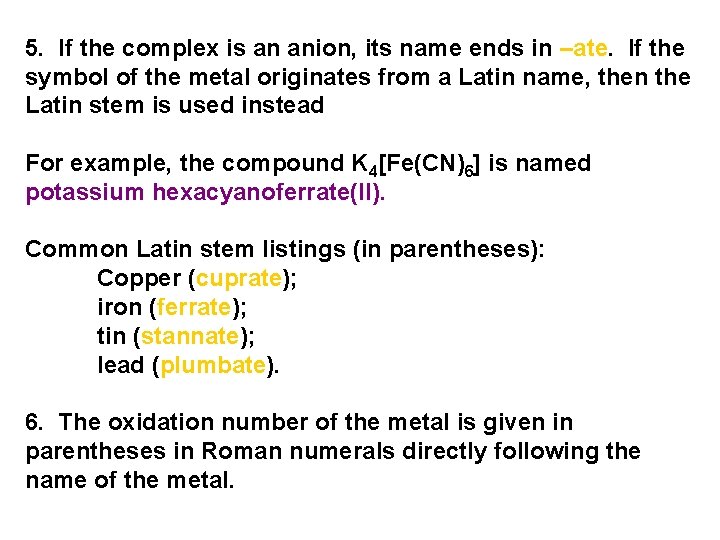
5. If the complex is an anion, its name ends in –ate. If the symbol of the metal originates from a Latin name, then the Latin stem is used instead For example, the compound K 4[Fe(CN)6] is named potassium hexacyanoferrate(II). Common Latin stem listings (in parentheses): Copper (cuprate); iron (ferrate); tin (stannate); lead (plumbate). 6. The oxidation number of the metal is given in parentheses in Roman numerals directly following the name of the metal.
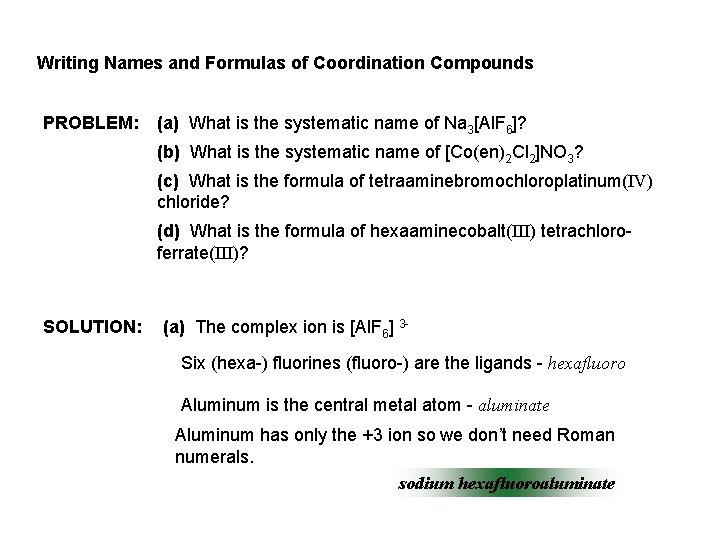
Writing Names and Formulas of Coordination Compounds PROBLEM: (a) What is the systematic name of Na 3[Al. F 6]? (b) What is the systematic name of [Co(en)2 Cl 2]NO 3? (c) What is the formula of tetraaminebromochloroplatinum(IV) chloride? (d) What is the formula of hexaaminecobalt(III) tetrachloroferrate(III)? SOLUTION: (a) The complex ion is [Al. F 6] 3 Six (hexa-) fluorines (fluoro-) are the ligands - hexafluoro Aluminum is the central metal atom - aluminate Aluminum has only the +3 ion so we don’t need Roman numerals. sodium hexafluoroaluminate
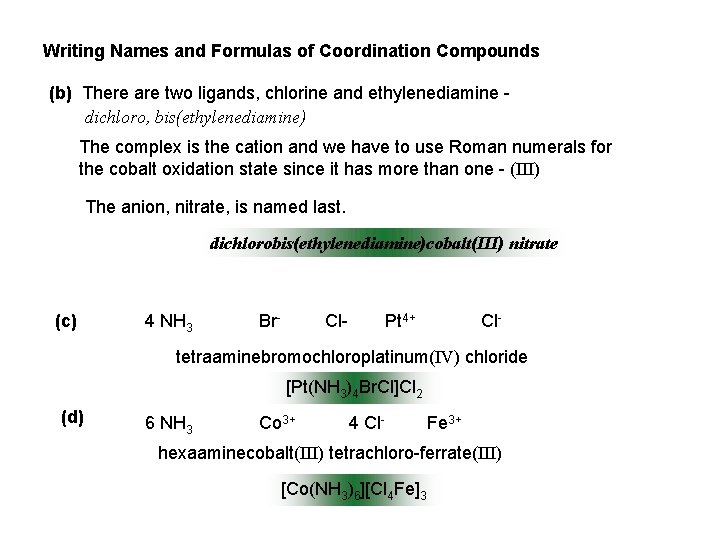
Writing Names and Formulas of Coordination Compounds (b) There are two ligands, chlorine and ethylenediamine dichloro, bis(ethylenediamine) The complex is the cation and we have to use Roman numerals for the cobalt oxidation state since it has more than one - (III) The anion, nitrate, is named last. dichlorobis(ethylenediamine)cobalt(III) nitrate (c) 4 NH 3 Br- Cl- Pt 4+ Cl- tetraaminebromochloroplatinum(IV) chloride [Pt(NH 3)4 Br. Cl]Cl 2 (d) 6 NH 3 Co 3+ 4 Cl- Fe 3+ hexaaminecobalt(III) tetrachloro-ferrate(III) [Co(NH 3)6][Cl 4 Fe]3
![Name/draw each of the following compounds listed below: A. NH 4[Pt. Cl 3(NH 3)]](http://slidetodoc.com/presentation_image/af69d10871ebca0b6dbf0471f05bea0c/image-27.jpg "Name/draw each of the following compounds listed below: A. NH 4[Pt. Cl 3(NH 3)]")
Name/draw each of the following compounds listed below: A. NH 4[Pt. Cl 3(NH 3)] B. [Co(NH 3)6][Au. Cl 4]2 C. [Cr(OH)2(NH 3)4]Br D. [Co(en)3]3+ E. Na 2[Pt. Cl 2(ox)2] F. [Fe. OH(H 2 O)5]Cl 2 G. Sodium tetrahydroxoaluminate H. potassium hexacyanoferrate(II) I. Dicarbonatodifluorocobalt(III) perchlorate J. hexapyridinenickel(II) bromide
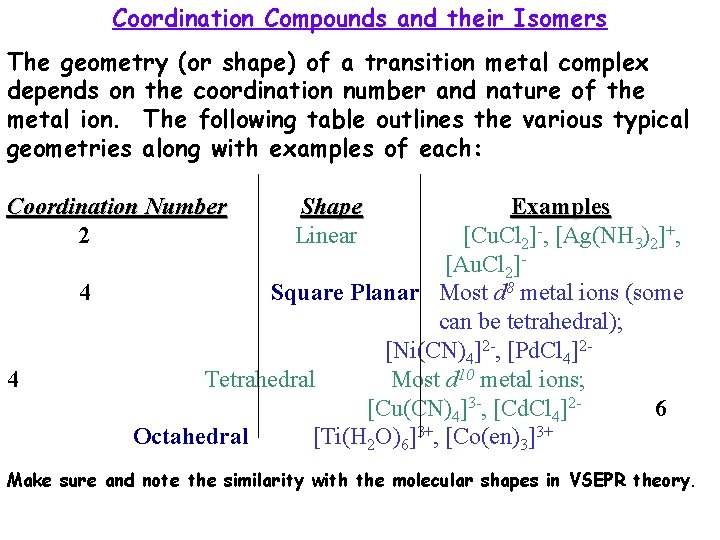
Coordination Compounds and their Isomers The geometry (or shape) of a transition metal complex depends on the coordination number and nature of the metal ion. The following table outlines the various typical geometries along with examples of each: Coordination Number 2 4 4 Shape Linear Examples [Cu. Cl 2]-, [Ag(NH 3)2]+, [Au. Cl 2]Square Planar Most d 8 metal ions (some can be tetrahedral); [Ni(CN)4]2 -, [Pd. Cl 4]2 Tetrahedral Most d 10 metal ions; [Cu(CN)4]3 -, [Cd. Cl 4]26 Octahedral [Ti(H 2 O)6]3+, [Co(en)3]3+ Make sure and note the similarity with the molecular shapes in VSEPR theory.
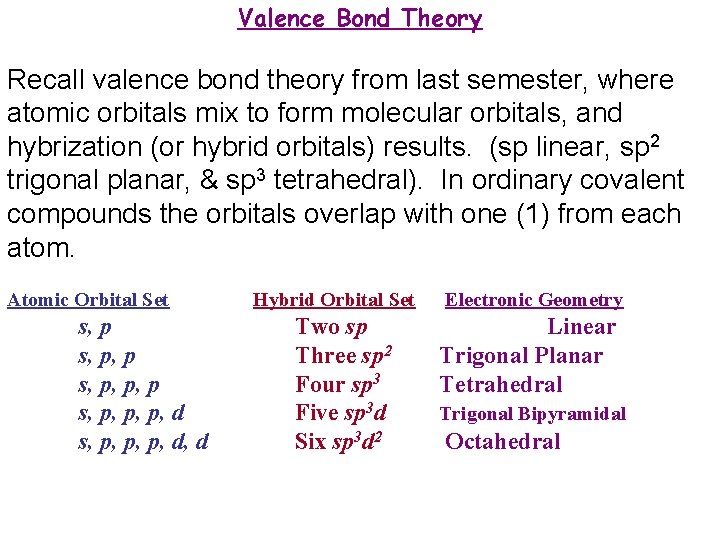
Valence Bond Theory Recall valence bond theory from last semester, where atomic orbitals mix to form molecular orbitals, and hybrization (or hybrid orbitals) results. (sp linear, sp 2 trigonal planar, & sp 3 tetrahedral). In ordinary covalent compounds the orbitals overlap with one (1) from each atom. Atomic Orbital Set s, p, p, p, d s, p, p, p, d, d Hybrid Orbital Set Two sp Three sp 2 Four sp 3 Five sp 3 d Six sp 3 d 2 Electronic Geometry Linear Trigonal Planar Tetrahedral Trigonal Bipyramidal Octahedral
Valence Bond Theory for Coordination Complexes The ligands (Lewis Bases) donate electrons to the metal (Lewis Acids) to form the covalent bond in the complex resulting in a mixing of the s, p, & d orbitals of the metal. In coordinate covalent bonds the ligand orbital (containing 2 e-’s) overlaps with the UNOCCUPIED orbital of the metal. The number & type of metal ion hybrid orbital occupied by the ligand’s lone pair of electrons determines the geometry of the complex.
![Valence Bond Theory [Cr(NH 3)6]3+ Hexaamminechromium(III) ion a yellow complex is paramagnetic, use valence](http://slidetodoc.com/presentation_image/af69d10871ebca0b6dbf0471f05bea0c/image-31.jpg "Valence Bond Theory [Cr(NH 3)6]3+ Hexaamminechromium(III) ion a yellow complex is paramagnetic, use valence")
Valence Bond Theory [Cr(NH 3)6]3+ Hexaamminechromium(III) ion a yellow complex is paramagnetic, use valence bond theory to explain the bonding and magnetic properties of the complex. d 3 Cr 3+ _ _ _ (p) _ (s) _____ (d) and consider 6 : NH 3 therefore need 6 equivalent bonds! hybridization : _ _ _ : : : dddddsppp The 3 d metal electrons are unhybridized thus paramagnetic and the ligand electrons fit into the leftover hybridized d 2 sp 3 orbitals of the metal. CN=6 thus octahedral
![Valence Bond Theory [Ni(CN)4]2 - Use valence bond theory to explain the bonding and](http://slidetodoc.com/presentation_image/af69d10871ebca0b6dbf0471f05bea0c/image-32.jpg "Valence Bond Theory [Ni(CN)4]2 - Use valence bond theory to explain the bonding and")
Valence Bond Theory [Ni(CN)4]2 - Use valence bond theory to explain the bonding and magnetic properties of the above complex. d 8 Ni 2+ _ _ _ (p) _ (s) _____ (d) and consider 4 : CN therefore need 4 equivalent bonds! hybridization : _ _ : : _ dddddsppp The 3 d metal electrons are unhybridized thus diamagnetic and the ligand electrons fit into the leftover hybridized dsp 2 orbitals of the metal. CN=4 and square planar. Describe [Zn(OH)4]2 -
![Hybrid orbitals and bonding in the tetrahedral [Zn(OH)4]2 - ion.](http://slidetodoc.com/presentation_image/af69d10871ebca0b6dbf0471f05bea0c/image-33.jpg "Hybrid orbitals and bonding in the tetrahedral [Zn(OH)4]2 - ion.")
Hybrid orbitals and bonding in the tetrahedral [Zn(OH)4]2 - ion.

Important types of isomerism in coordination compounds. ISOMERS Same chemical formula, but different properties Constitutional (structural) isomers Stereoisomers Atoms connected differently Different spatial arrangement Coordination isomers Linkage isomers Ligand counter-ion exchange Different donor atom Geometric (cistrans) isomers (diastereomers) Different arrangement around metal ion Optical isomers (enantiomers) Nonsuperimposable mirror images Coordination isomers: [Pt(NH 3)4 Cl 2](NO 2)2 & [Pt(NH 3)4(NO 2)2]Cl 2
![Linkage isomers Co(NH 3)5(NO 2)]Cl 2 is an orange solid called pentaamminenitrocobalt(III) chloride [Co(NH](http://slidetodoc.com/presentation_image/af69d10871ebca0b6dbf0471f05bea0c/image-35.jpg "Linkage isomers Co(NH 3)5(NO 2)]Cl 2 is an orange solid called pentaamminenitrocobalt(III) chloride [Co(NH")
Linkage isomers Co(NH 3)5(NO 2)]Cl 2 is an orange solid called pentaamminenitrocobalt(III) chloride [Co(NH 3)5(ONO)]Cl 2 is a red compound known as pentaamminenitritocobalt(III) chloride. NCO: cyanato OCN: isocyanato S=C=N: thiocyanato
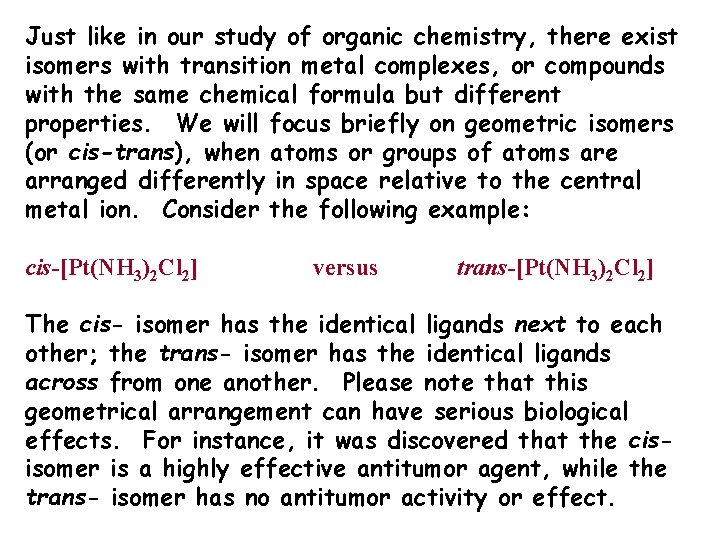
Just like in our study of organic chemistry, there exist isomers with transition metal complexes, or compounds with the same chemical formula but different properties. We will focus briefly on geometric isomers (or cis-trans), when atoms or groups of atoms are arranged differently in space relative to the central metal ion. Consider the following example: cis-[Pt(NH 3)2 Cl 2] versus trans-[Pt(NH 3)2 Cl 2] The cis- isomer has the identical ligands next to each other; the trans- isomer has the identical ligands across from one another. Please note that this geometrical arrangement can have serious biological effects. For instance, it was discovered that the cisisomer is a highly effective antitumor agent, while the trans- isomer has no antitumor activity or effect.
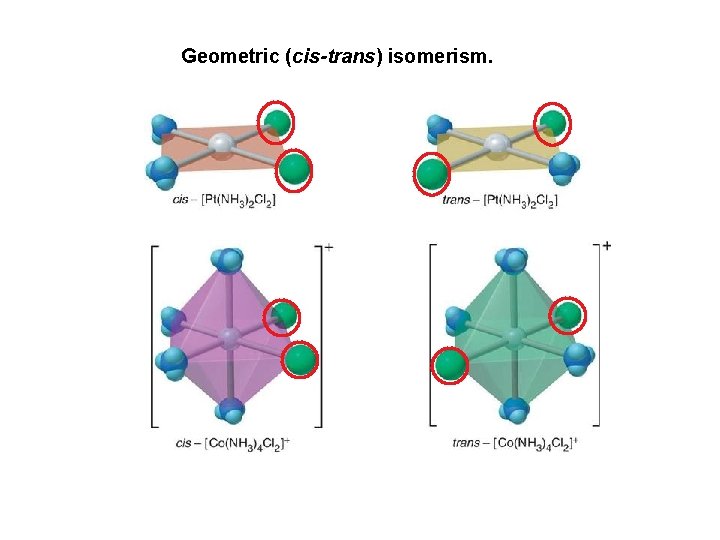
Geometric (cis-trans) isomerism.
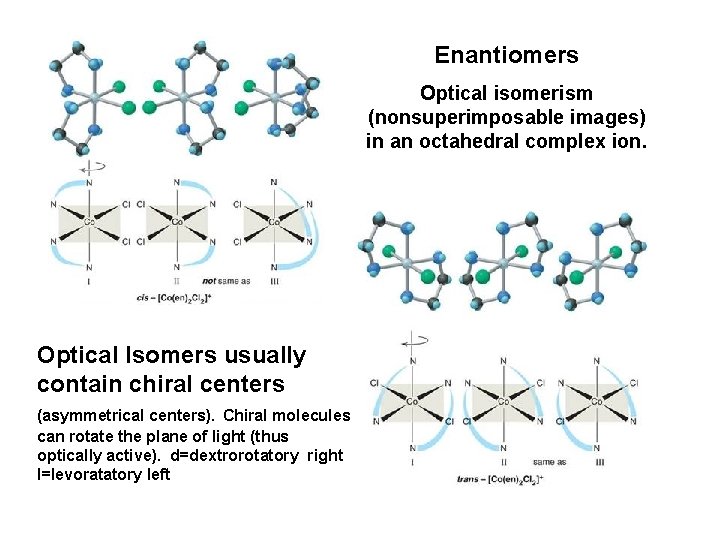
Enantiomers Optical isomerism (nonsuperimposable images) in an octahedral complex ion. Optical Isomers usually contain chiral centers (asymmetrical centers). Chiral molecules can rotate the plane of light (thus optically active). d=dextrorotatory right l=levoratatory left
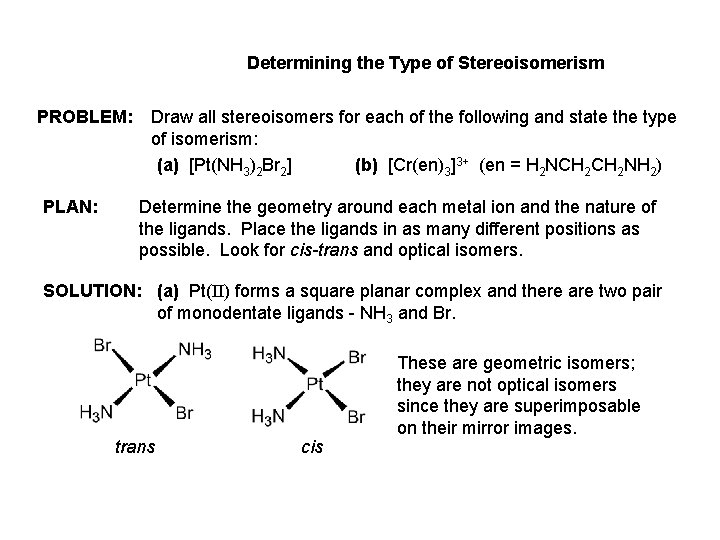
Determining the Type of Stereoisomerism PROBLEM: PLAN: Draw all stereoisomers for each of the following and state the type of isomerism: (a) [Pt(NH 3)2 Br 2] (b) [Cr(en)3]3+ (en = H 2 NCH 2 NH 2) Determine the geometry around each metal ion and the nature of the ligands. Place the ligands in as many different positions as possible. Look for cis-trans and optical isomers. SOLUTION: (a) Pt(II) forms a square planar complex and there are two pair of monodentate ligands - NH 3 and Br. trans cis These are geometric isomers; they are not optical isomers since they are superimposable on their mirror images.
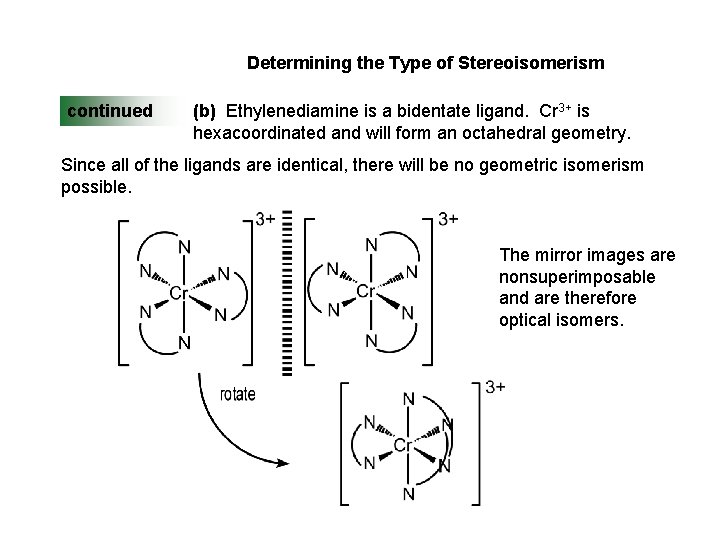
Determining the Type of Stereoisomerism continued (b) Ethylenediamine is a bidentate ligand. Cr 3+ is hexacoordinated and will form an octahedral geometry. Since all of the ligands are identical, there will be no geometric isomerism possible. The mirror images are nonsuperimposable and are therefore optical isomers.

Crystal Field Theory Recall valence bond theory, where atomic orbitals mix to form molecular orbitals, and hybrization (or hybrid orbitals) results. While important, this theory fails to give insight into the colors of coordination compounds and their magnetic properties. Instead, we turn to crystal field theory, which highlights the effects on the d-orbital energies of the metal ion as a ligand approaches to form a coordinate covalent bond. The model assumes that a complex ion forms as a result of electrostatic attractions between the transition metal cation and the negative charge of the ligands. In the isolated metal ion, the d orbitals have equal energies despite their different orientations.
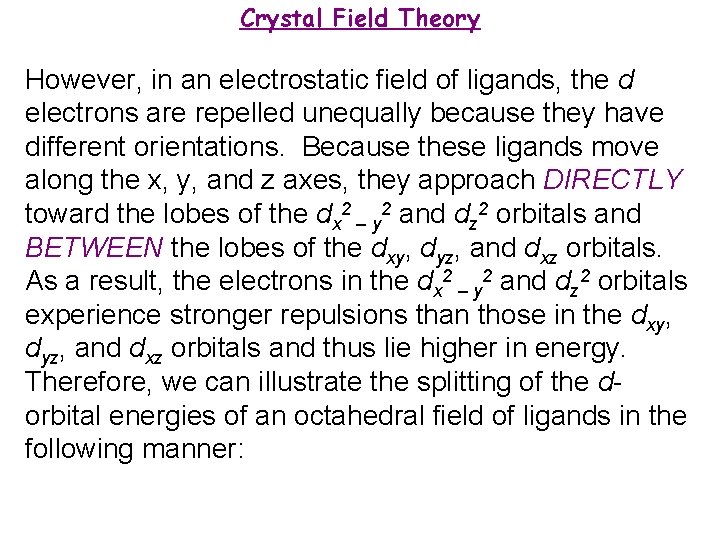
Crystal Field Theory However, in an electrostatic field of ligands, the d electrons are repelled unequally because they have different orientations. Because these ligands move along the x, y, and z axes, they approach DIRECTLY toward the lobes of the dx 2 – y 2 and dz 2 orbitals and BETWEEN the lobes of the dxy, dyz, and dxz orbitals. As a result, the electrons in the dx 2 – y 2 and dz 2 orbitals experience stronger repulsions than those in the dxy, dyz, and dxz orbitals and thus lie higher in energy. Therefore, we can illustrate the splitting of the dorbital energies of an octahedral field of ligands in the following manner:
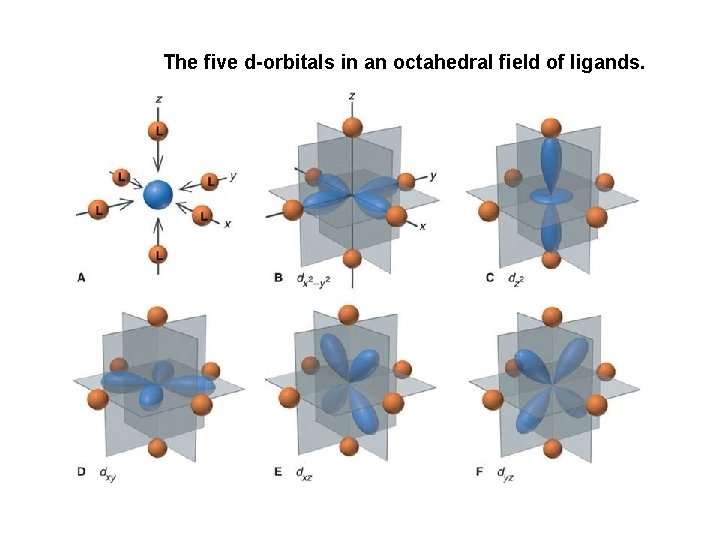
The five d-orbitals in an octahedral field of ligands.
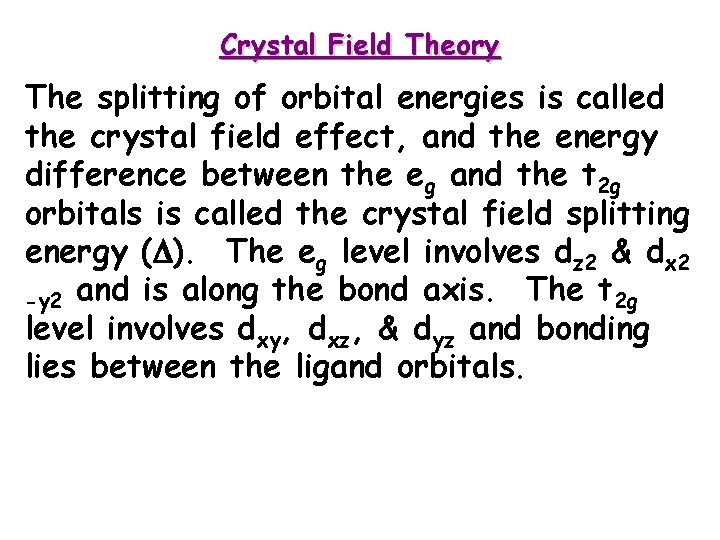
Crystal Field Theory The splitting of orbital energies is called the crystal field effect, and the energy difference between the eg and the t 2 g orbitals is called the crystal field splitting energy ( ). The eg level involves dz 2 & dx 2 -y 2 and is along the bond axis. The t 2 g level involves dxy, dxz, & dyz and bonding lies between the ligand orbitals.
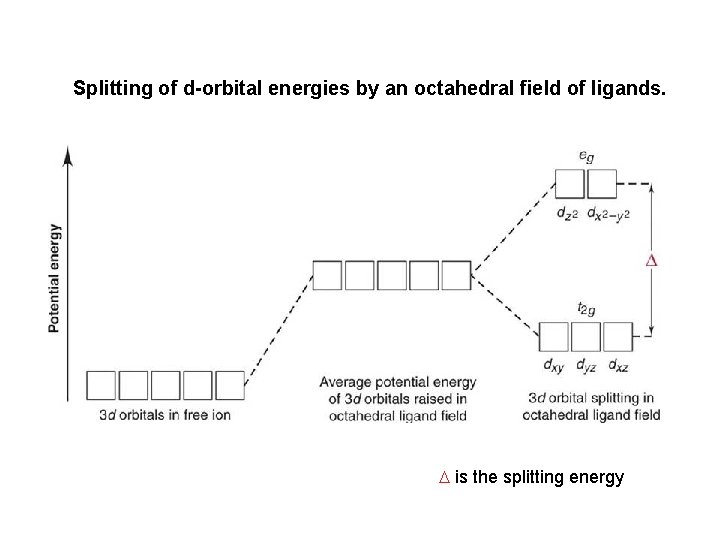
Splitting of d-orbital energies by an octahedral field of ligands. is the splitting energy
Crystal Field Theory Different ligands create crystal fields of different strength, thereby causing the d -orbital energies to split differently. A strong-field ligand leads to a larger splitting; a weak-field ligand leads to a smaller splitting. Color in a transition metal complex arises due to two main factors: oxidation state of the metal ion AND type of ligand.

The effect of ligand on splitting energy.
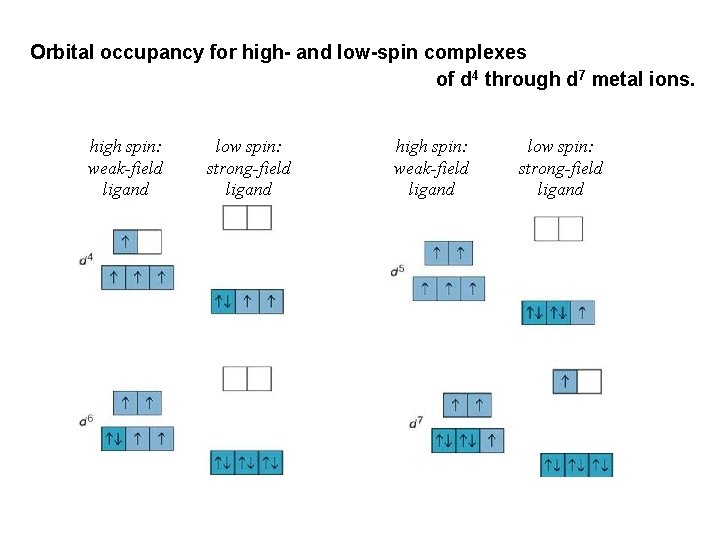
Orbital occupancy for high- and low-spin complexes of d 4 through d 7 metal ions. high spin: weak-field ligand low spin: strong-field ligand

High-spin and low-spin complex ions of Mn 2+.
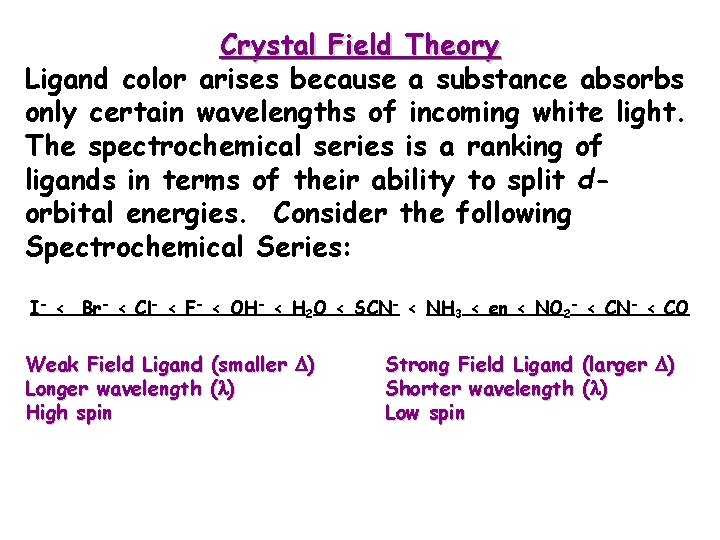
Crystal Field Theory Ligand color arises because a substance absorbs only certain wavelengths of incoming white light. The spectrochemical series is a ranking of ligands in terms of their ability to split dorbital energies. Consider the following Spectrochemical Series: I- < Br- < Cl- < F- < OH- < H 2 O < SCN- < NH 3 < en < NO 2 - < CN- < CO Weak Field Ligand (smaller ) Longer wavelength ( ) High spin Strong Field Ligand (larger ) Shorter wavelength ( ) Low spin
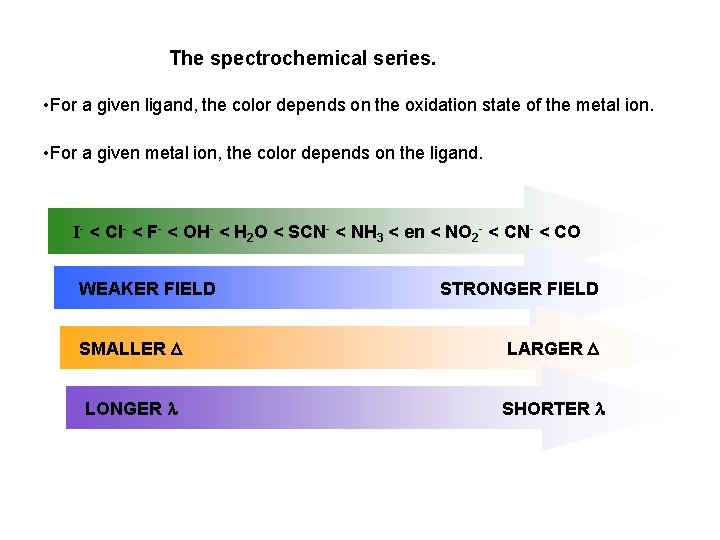
The spectrochemical series. • For a given ligand, the color depends on the oxidation state of the metal ion. • For a given metal ion, the color depends on the ligand. I- < Cl- < F- < OH- < H 2 O < SCN- < NH 3 < en < NO 2 - < CN- < CO WEAKER FIELD STRONGER FIELD SMALLER LARGER LONGER SHORTER

Identifying Complex Ions as High Spin or Low Spin PROBLEM: PLAN: Iron (II) forms an essential complex in hemoglobin. For each of the two octahedral complex ions [Fe(H 2 O)6]2+ and [Fe(CN)6]4 -, draw an orbital splitting diagram, predict the number of unpaired electrons, and identify the ion as low or high spin. The electron configuration of Fe 2+ gives us information that the iron has 6 d electrons. The two ligands have field strengths shown in. potential energy Draw the orbital box diagrams, splitting the d orbitals into eg and t 2 g. Add the electrons noting that a weak-field ligand gives the maximum number of unpaired electrons and a high-spin complex and vice-versa. [Fe(CN)6]42+ [Fe(H 2 O)6] SOLUTION: 4 unpaired e-eg (high spin) eg no unpaired e-(low spin) t 2 g

The splitting of energy levels influences magnetic properties by affecting the number of unpaired electrons in the metal ion's d orbitals. That is, the relative size of determines the occupancy of the d orbitals, which in turn determines the number of unpaired electrons (if any) present. Questions: 1. Predict whether the complex is high or low spin: a) Mn(OH)64 b) Mn(CN)642. Fe(CN)63 - ion has one unpaired electron, does CNligand produce a strong or weak field? Explain. 3. Predict the number of unpaired electrons in [Cu(CN)6]4 -
![The color of [Ti(H 2 O)6]3+. Although it is difficult to predict the actual](http://slidetodoc.com/presentation_image/af69d10871ebca0b6dbf0471f05bea0c/image-54.jpg "The color of [Ti(H 2 O)6]3+. Although it is difficult to predict the actual")
The color of [Ti(H 2 O)6]3+. Although it is difficult to predict the actual color of a given complex, we can predict whether a complex will absorb longer or shorter wavelengths of light when compared to other complexes. hc If the splitting is large (strong field) then is large making small (ie. low absorbed like blue light) therefore the complementary red is reflected or transmitted.
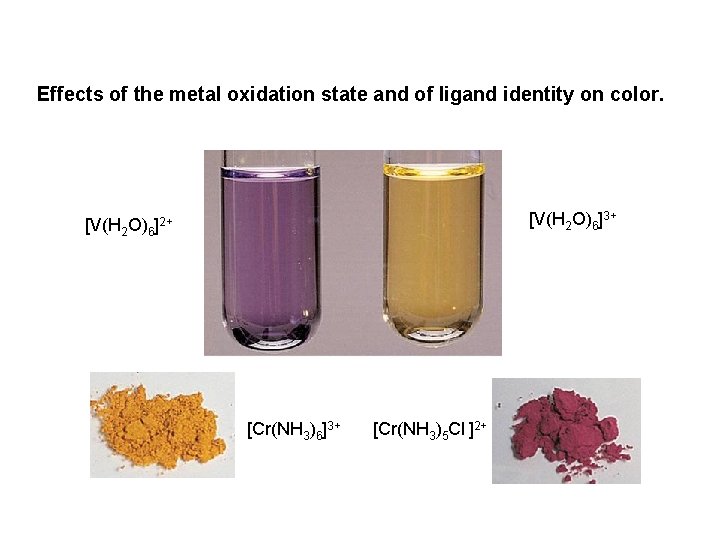
Effects of the metal oxidation state and of ligand identity on color. [V(H 2 O)6]3+ [V(H 2 O)6]2+ [Cr(NH 3)6]3+ [Cr(NH 3)5 Cl ]2+

Crystal Field Theory for CN = 4 Finally, four ligands around a metal ion can also cause d -orbital splitting, but the magnitude and pattern of the splitting depends on whether the ligands are in a tetrahedral or a square planar arrangement. Consider the following two orbital splitting diagrams on the next slide. Question: Qualitative analysis of nickel was based on the reaction of the nickel ion with dimethylglyoxime to form the bidentate chelate: bis(dimethylglyoximato)nickel(II), a reddish-pink colored insoluble compound. If the lone pairs of electrons on nitrogen bond to nickel to form a diamagnetic species, describe the geometry of the complex. CH 3 -C=N-OH l CH 3 -C=N-OH dimethylglyoxime
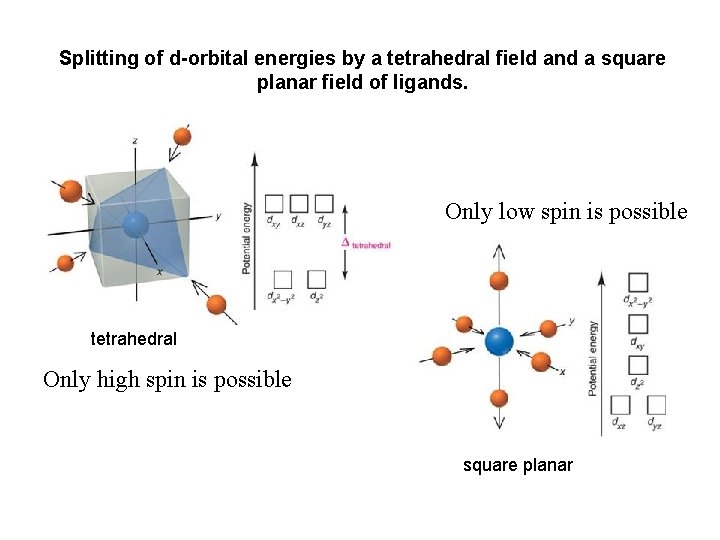
Splitting of d-orbital energies by a tetrahedral field and a square planar field of ligands. Only low spin is possible tetrahedral Only high spin is possible square planar
![Extra Questions on Crystal field Theory 1. Consider the two complexes [Mn(H 2 O)6]2+](http://slidetodoc.com/presentation_image/af69d10871ebca0b6dbf0471f05bea0c/image-58.jpg "Extra Questions on Crystal field Theory 1. Consider the two complexes [Mn(H 2 O)6]2+")
Extra Questions on Crystal field Theory 1. Consider the two complexes [Mn(H 2 O)6]2+ versus [Mn(CN)6]4 -. Diagram the expected orbital splitting diagram for each complex, predict the number of unpaired electrons (if any), and identify the ion as low or high spin. 2. Predict the electron configuration of an octahedral d 4 complex with (a) strong field ligands and (b) weak field ligands, and state the number of unpaired electrons in each case. 3. Predict which of the following complexes absorbs light of the shorter wavelength and explain your reasoning: [Co(H 2 O)6]3+ or [Co(en)3]3+. 4. Compare the magnetic properties of [Fe(H 2 O)6]2+ and [Fe(CN)6]4 -. 5. What change in magnetic properties (if any) can be expected when NO 2 - ligands in an octahedral complex are replaced by Cl- ligands in a d 6 complex? 6. Draw the orbital splitting diagram for the following complex and give its electron configuration: tetrahedral Co. Cl 42 -. 7. The complex ion Pd. Cl 42 - is diamagnetic. Propose a structure for Pd. Cl 42 -.
![8. Explain the following differences in color: A. [Cr(H 2 O)6]Cl 3 is violet,](http://slidetodoc.com/presentation_image/af69d10871ebca0b6dbf0471f05bea0c/image-59.jpg "8. Explain the following differences in color: A. [Cr(H 2 O)6]Cl 3 is violet,")
8. Explain the following differences in color: A. [Cr(H 2 O)6]Cl 3 is violet, whereas [Cr(NH 3)6]Cl 3 is yellow. B. [Co(H 2 O)6]2+ is pink, whereas tetrahedral [Co. Cl 4]2 - is blue. C. One of the following solids is yellow, and the other is green: Fe(NO 3)2· 6 H 2 O versus K 4[Fe(CN)6· 3 H 2 O]. Indicate which is which and explain your reasoning.
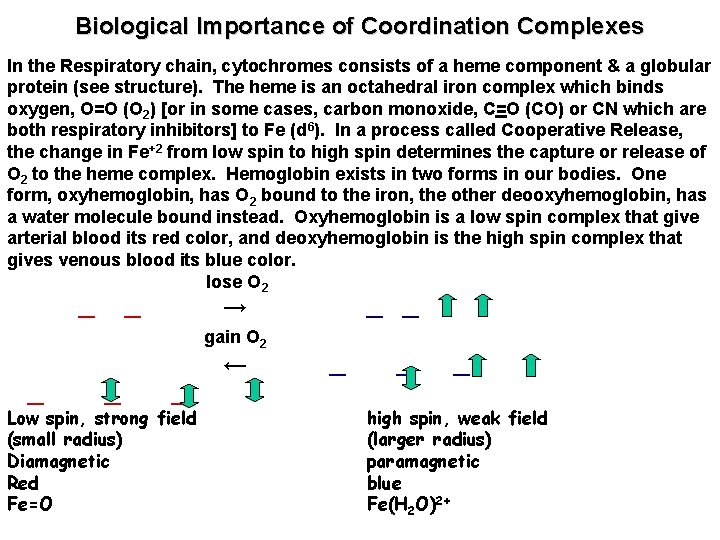
Biological Importance of Coordination Complexes In the Respiratory chain, cytochromes consists of a heme component & a globular protein (see structure). The heme is an octahedral iron complex which binds oxygen, O=O (O 2) [or in some cases, carbon monoxide, C=O (CO) or CN which are both respiratory inhibitors] to Fe (d 6). In a process called Cooperative Release, the change in Fe+2 from low spin to high spin determines the capture or release of O 2 to the heme complex. Hemoglobin exists in two forms in our bodies. One form, oxyhemoglobin, has O 2 bound to the iron, the other deooxyhemoglobin, has a water molecule bound instead. Oxyhemoglobin is a low spin complex that give arterial blood its red color, and deoxyhemoglobin is the high spin complex that gives venous blood its blue color. lose O 2 _ _ gain O 2 _ _ → _ Low spin, strong field (small radius) Diamagnetic Red Fe=O ← _ _ _ high spin, weak field (larger radius) paramagnetic blue Fe(H 2 O)2+

Hemoglobin and the octahedral complex in heme.
Putting it all together! Consider Vitamin B 12 shown to the right. This molecule is useful in the treatment of pernicious anemia and other diseases; enzymes derived from vitamin B 12 accelerate a large range of important reactions including those involved in producing red blood cells.
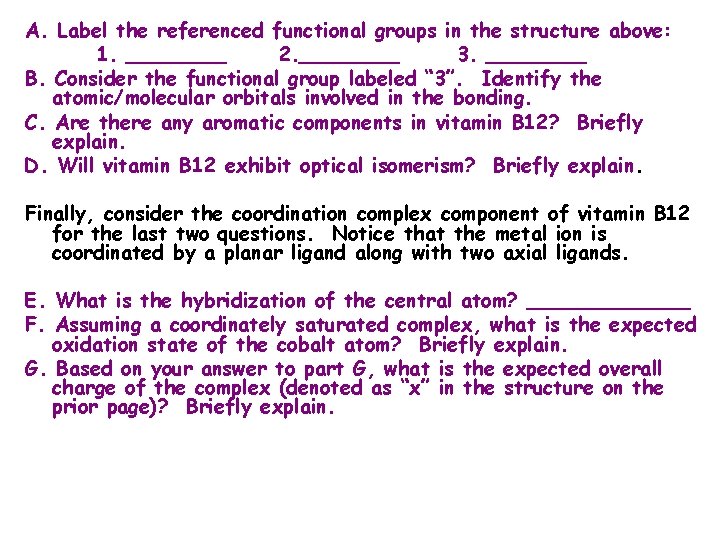
A. Label the referenced functional groups in the structure above: 1. ____ 2. ____ 3. ____ B. Consider the functional group labeled “ 3”. Identify the atomic/molecular orbitals involved in the bonding. C. Are there any aromatic components in vitamin B 12? Briefly explain. D. Will vitamin B 12 exhibit optical isomerism? Briefly explain. Finally, consider the coordination complex component of vitamin B 12 for the last two questions. Notice that the metal ion is coordinated by a planar ligand along with two axial ligands. E. What is the hybridization of the central atom? _______ F. Assuming a coordinately saturated complex, what is the expected oxidation state of the cobalt atom? Briefly explain. G. Based on your answer to part G, what is the expected overall charge of the complex (denoted as “x” in the structure on the prior page)? Briefly explain.
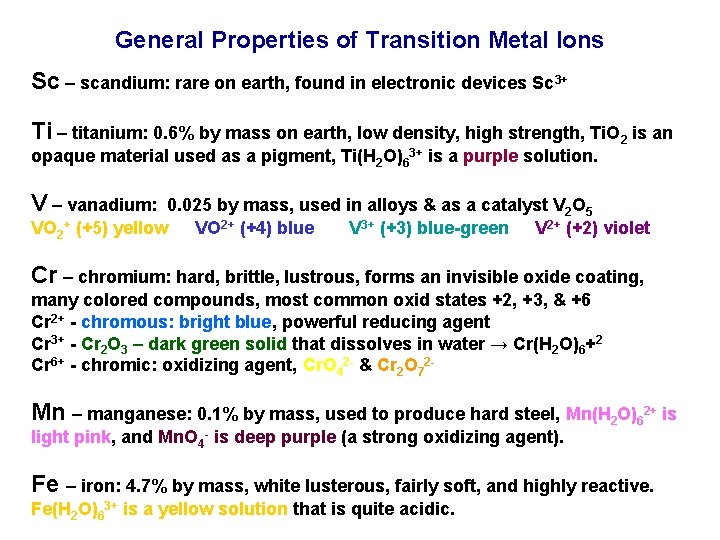
General Properties of Transition Metal Ions Sc – scandium: rare on earth, found in electronic devices Sc 3+ Ti – titanium: 0. 6% by mass on earth, low density, high strength, Ti. O 2 is an opaque material used as a pigment, Ti(H 2 O)63+ is a purple solution. V – vanadium: 0. 025 by mass, used in alloys & as a catalyst V 2 O 5 VO 2+ (+5) yellow VO 2+ (+4) blue V 3+ (+3) blue-green V 2+ (+2) violet Cr – chromium: hard, brittle, lustrous, forms an invisible oxide coating, many colored compounds, most common oxid states +2, +3, & +6 Cr 2+ - chromous: bright blue, powerful reducing agent Cr 3+ - Cr 2 O 3 – dark green solid that dissolves in water → Cr(H 2 O)6+2 Cr 6+ - chromic: oxidizing agent, Cr. O 42 - & Cr 2 O 72 - Mn – manganese: 0. 1% by mass, used to produce hard steel, Mn(H 2 O)62+ is light pink, and Mn. O 4 - is deep purple (a strong oxidizing agent). Fe – iron: 4. 7% by mass, white lusterous, fairly soft, and highly reactive. Fe(H 2 O)63+ is a yellow solution that is quite acidic.

General Properties of Transition Metal Ions Co – cobalt: relatively rare, hard, bluish-white metal used to make alloys. Co(H 2 O)62+ is rose colored. Ni – nickel: abundant, silver-white metal with high electrical & thermal conductivity. It is resistant to corrosion and is used for plating other metals. Ni(H 2 O)62+ is green colored Cu – copper: found free in nature, (only Au & Ag), has a stable 0 oxid state. Produces alloys: brass=Cu, Zn, Sn, Pb, Mn; bronze=Cu, Sn Zn Pb P; sterling silver= Ag Cu; 18 carat gold=Au Ag Cu Cu(H 2 O)62+ is blue; Cu(H 2 O)6+ is green Zn – zinc: colorless solutions, white lustrous, active metal, main ore is sphalerite (Zn. Fe)S, reducing agent, tarnishes rapidly, 90% is used to galvanize steel, Zn 2+
- Slides: 65