
Electron Configurations CHEMISTRY 1 Warm Up Watch crash

![3. Cd = [Kr] 5 s 24 d 10 36 4. Cl =](https://slidetodoc.com/presentation_image_h2/a7832bec482d7566126ef1bcbf125367/image-31.jpg "3. Cd = [Kr] 5 s 24 d 10 36 4. Cl =")

- Slides: 43
Electron Configurations CHEMISTRY 1
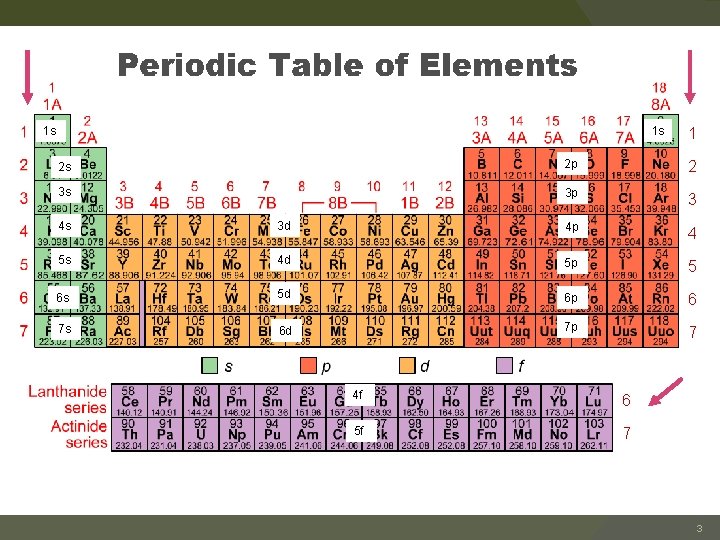
Warm Up � Watch crash course �Crash Course Clip clip: � Answer the following questions: � 1. Newlands compared the periodic table to what? � 2. Energy given off by electrons is called what? � 3. Electrons are better described as what? � 4. Electrons exist in what? � 5. How many different orbitals exist? What are they? � 6. What is an electron configuration? � 7. On your periodic table, label the orbitals. 2
1 s 1 s 1 2 s 2 p 2 p 2 3 s 3 p 3 4 s 3 d 4 p 4 5 s 4 d 5 p 5 6 s 5 d 6 p 6 7 s 6 d 7 p 7 4 f 6 5 f 7 3
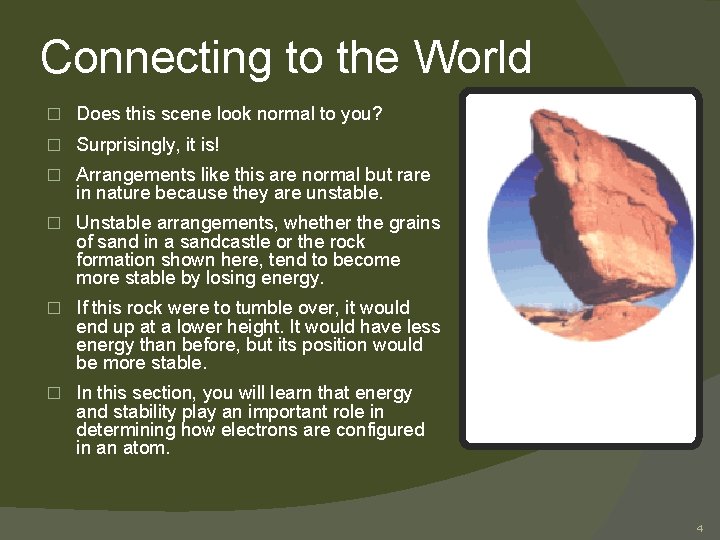
Connecting to the World � Does this scene look normal to you? � Surprisingly, it is! � Arrangements like this are normal but rare in nature because they are unstable. � Unstable arrangements, whether the grains of sand in a sandcastle or the rock formation shown here, tend to become more stable by losing energy. � If this rock were to tumble over, it would end up at a lower height. It would have less energy than before, but its position would be more stable. � In this section, you will learn that energy and stability play an important role in determining how electrons are configured in an atom. 4
Electron Configurations Learning Targets: I will be able to: 1. describe and use three rules for writing the electron configurations of elements. 2. explain why actual electron configurations for some elements differ from those assigned using the aufbau principle. 5
Atomic Orbitals Electrons are found in specific energy levels around the nucleus. � The rows of the Periodic Table arranged to match these energy levels. � A certain amount of energy is needed to keep an electron in each level. � The level closest to the nucleus has the lowest energy. � The energy needed increases as the distance from the nucleus increases. � 6
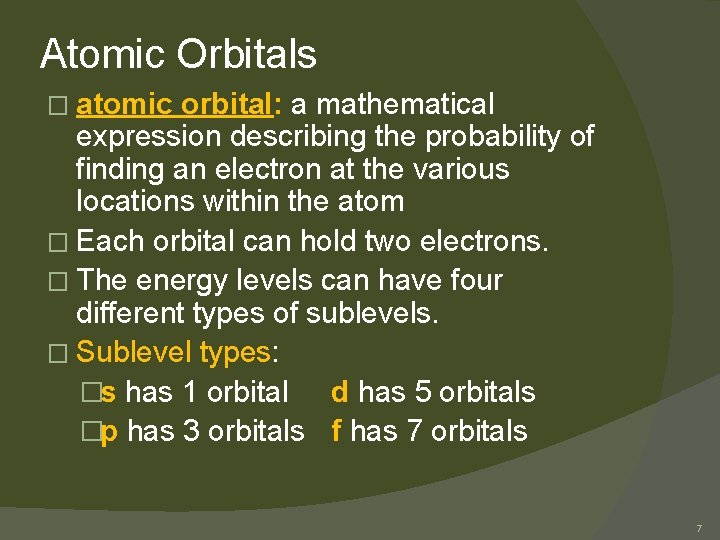
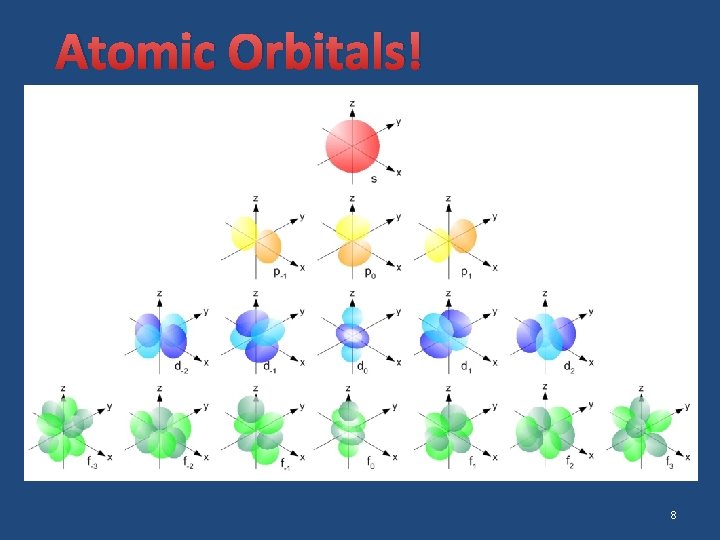
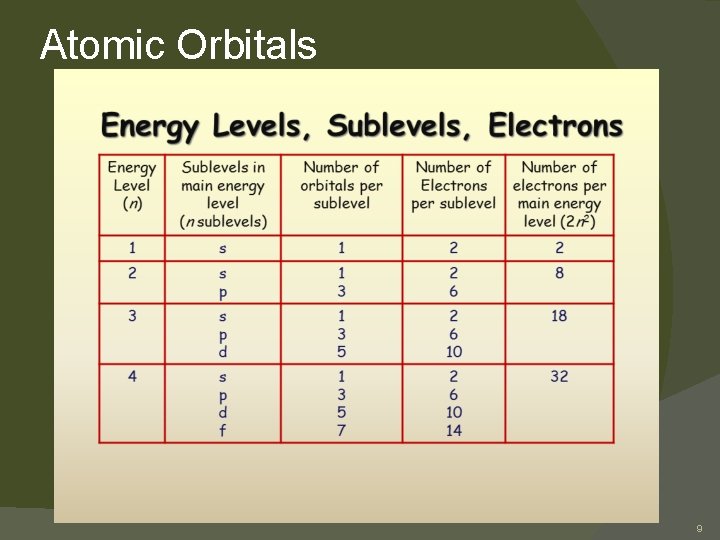
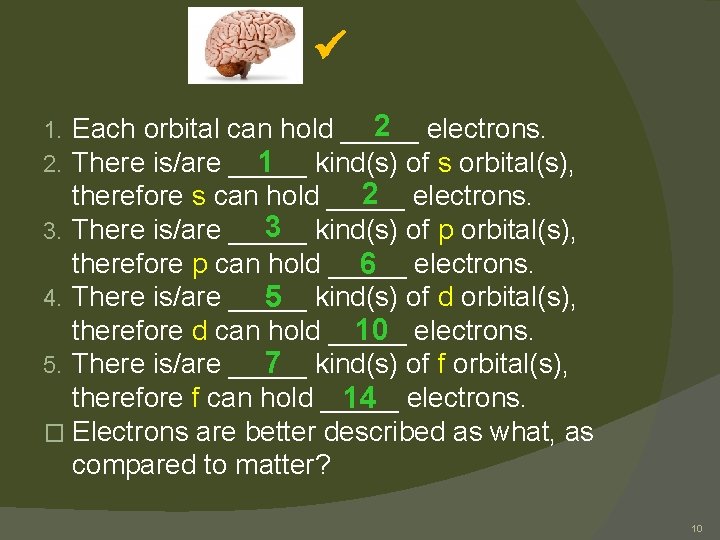
Atomic Orbitals � atomic orbital: a mathematical expression describing the probability of finding an electron at the various locations within the atom � Each orbital can hold two electrons. � The energy levels can have four different types of sublevels. � Sublevel types: �s has 1 orbital d has 5 orbitals �p has 3 orbitals f has 7 orbitals 7
Atomic Orbitals! 8
Atomic Orbitals 9
2 electrons. Each orbital can hold _____ There is/are _____ 1 kind(s) of s orbital(s), 2 electrons. therefore s can hold _____ 3 kind(s) of p orbital(s), 3. There is/are _____ therefore p can hold _____ 6 electrons. 4. There is/are _____ 5 kind(s) of d orbital(s), therefore d can hold _____ 10 electrons. 7 kind(s) of f orbital(s), 5. There is/are _____ therefore f can hold _____ 14 electrons. � Electrons are better described as what, as compared to matter? 1. 2. 10
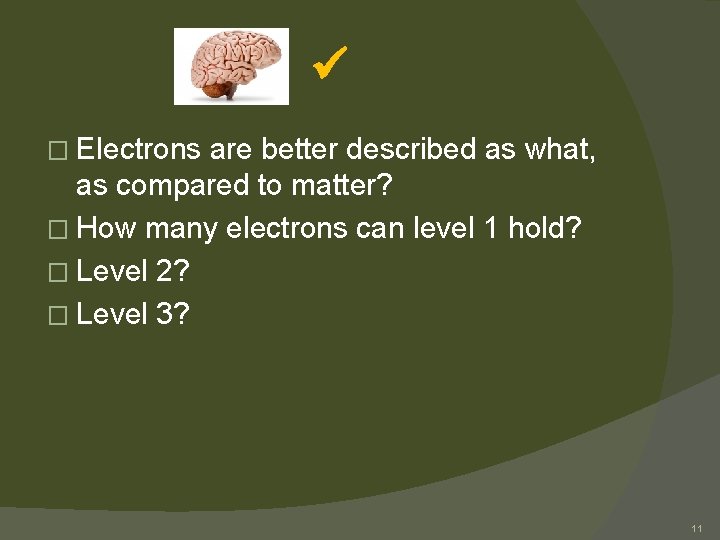
� Electrons are better described as what, as compared to matter? � How many electrons can level 1 hold? � Level 2? � Level 3? 11
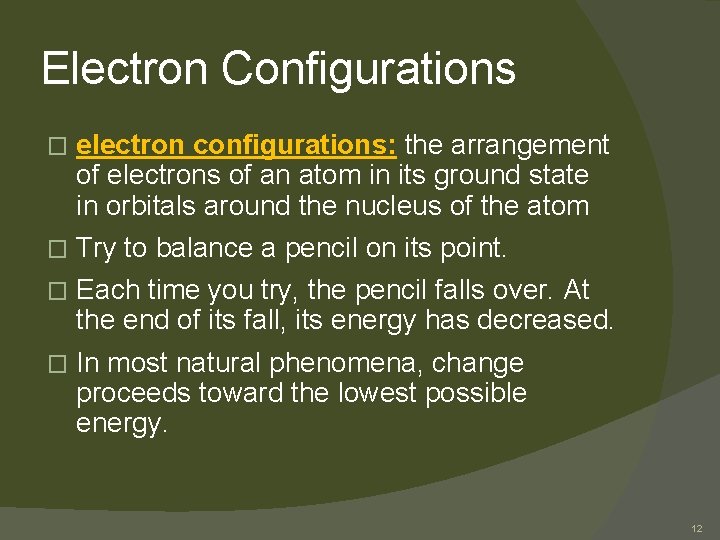
Electron Configurations � electron configurations: the arrangement of electrons of an atom in its ground state in orbitals around the nucleus of the atom � Try to balance a pencil on its point. � Each time you try, the pencil falls over. At the end of its fall, its energy has decreased. � In most natural phenomena, change proceeds toward the lowest possible energy. 12
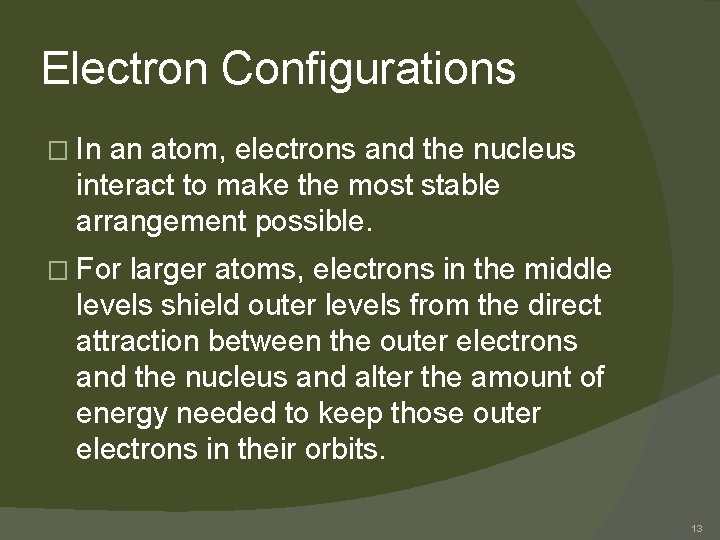
Electron Configurations � In an atom, electrons and the nucleus interact to make the most stable arrangement possible. � For larger atoms, electrons in the middle levels shield outer levels from the direct attraction between the outer electrons and the nucleus and alter the amount of energy needed to keep those outer electrons in their orbits. 13
Electron Configurations � As the atoms become larger on the Periodic Table, the number of electrons increases. (H = 1, He = 2, Li = 3, etc. ) � There are specific rules as to how each electron is added to an orbital. � Electron configuration rules: 1. The aufbau principle 2. The Pauli exclusion principle 3. Hund’s rule 14
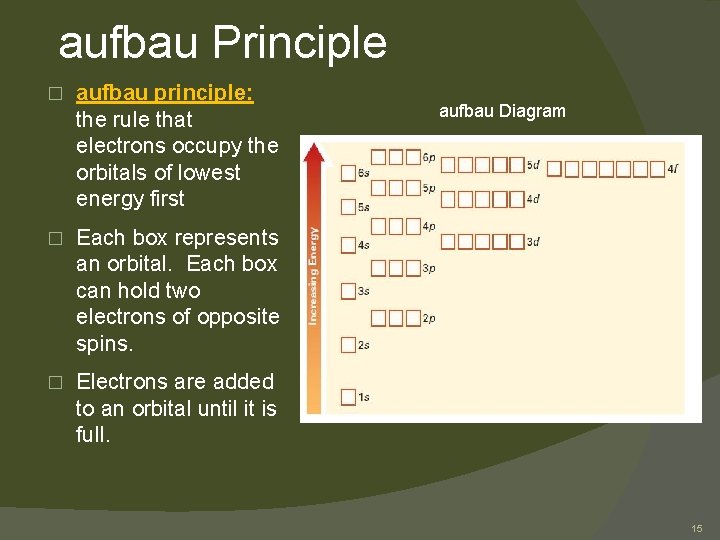
aufbau Principle � aufbau principle: the rule that electrons occupy the orbitals of lowest energy first � Each box represents an orbital. Each box can hold two electrons of opposite spins. � Electrons are added to an orbital until it is full. aufbau Diagram 15
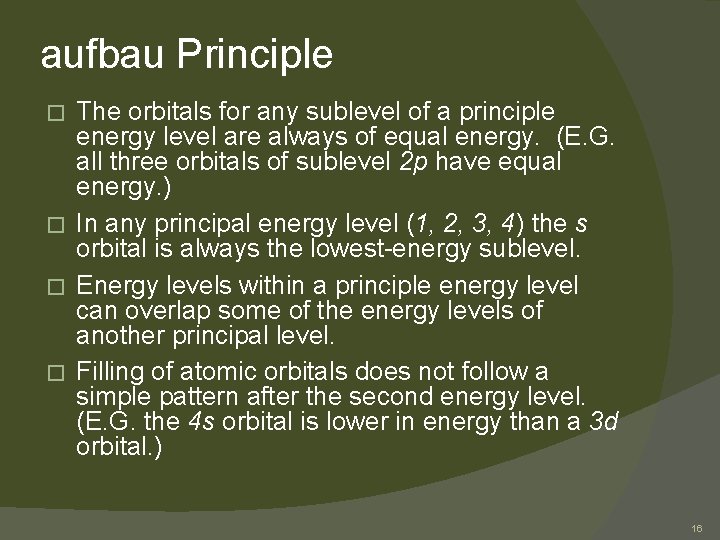
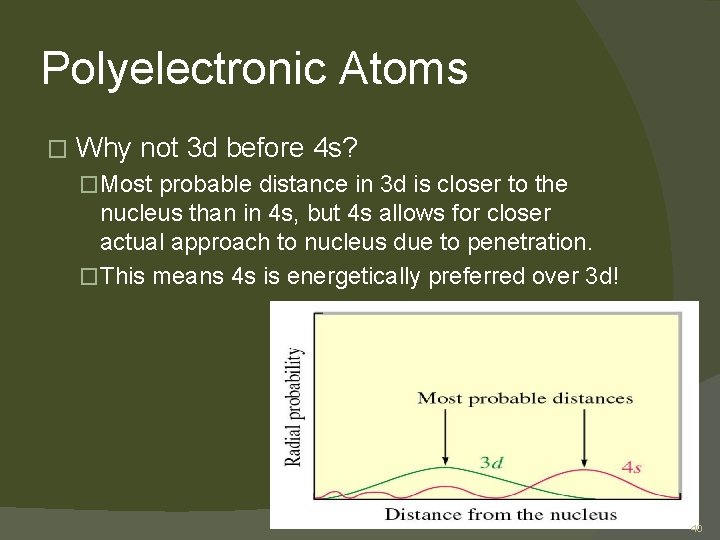
aufbau Principle The orbitals for any sublevel of a principle energy level are always of equal energy. (E. G. all three orbitals of sublevel 2 p have equal energy. ) � In any principal energy level (1, 2, 3, 4) the s orbital is always the lowest-energy sublevel. � Energy levels within a principle energy level can overlap some of the energy levels of another principal level. � Filling of atomic orbitals does not follow a simple pattern after the second energy level. (E. G. the 4 s orbital is lower in energy than a 3 d orbital. ) � 16
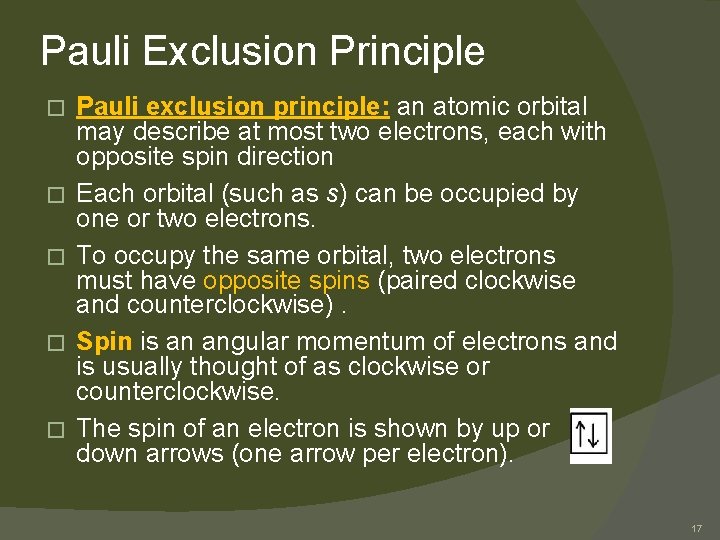
Pauli Exclusion Principle � � � Pauli exclusion principle: an atomic orbital may describe at most two electrons, each with opposite spin direction Each orbital (such as s) can be occupied by one or two electrons. To occupy the same orbital, two electrons must have opposite spins (paired clockwise and counterclockwise). Spin is an angular momentum of electrons and is usually thought of as clockwise or counterclockwise. The spin of an electron is shown by up or down arrows (one arrow per electron). 17
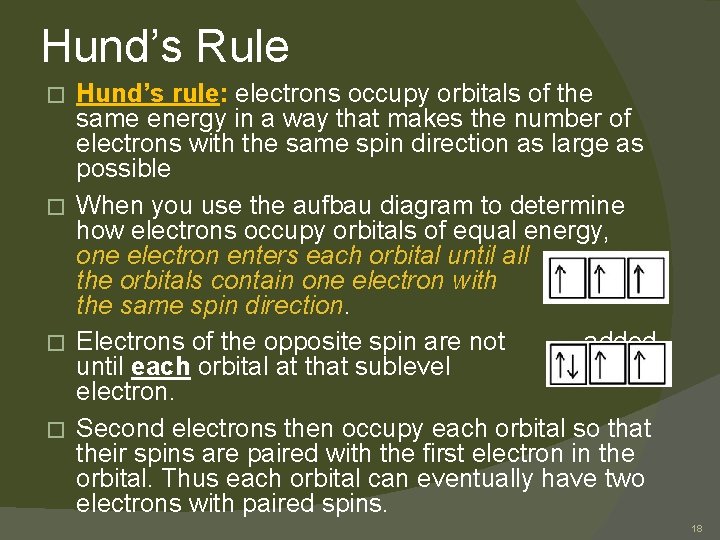
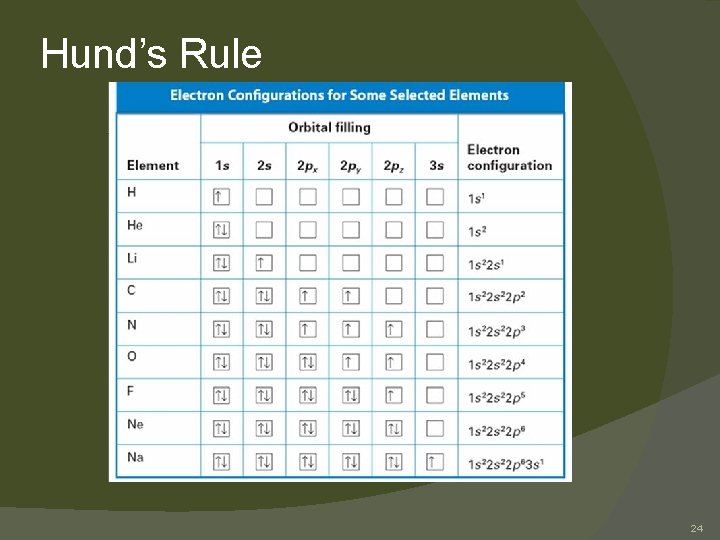
Hund’s Rule Hund’s rule: electrons occupy orbitals of the same energy in a way that makes the number of electrons with the same spin direction as large as possible � When you use the aufbau diagram to determine how electrons occupy orbitals of equal energy, one electron enters each orbital until all the orbitals contain one electron with the same spin direction. � Electrons of the opposite spin are not added until each orbital at that sublevel has one electron. � Second electrons then occupy each orbital so that their spins are paired with the first electron in the orbital. Thus each orbital can eventually have two electrons with paired spins. � 18
� What is an electron configuration? � What does the aufbau principle tell us about electron configurations? � According to Hund’s rule, how are electrons added to orbitals? 19
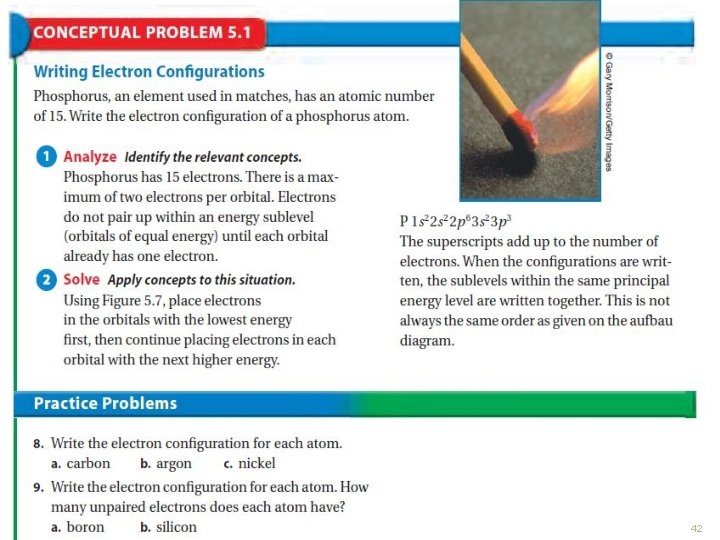
Electron Configurations � To write out electron configurations we use shorthand method. 1. Start with the primary energy level (1, 2, 3, 4, etc. ) 2. Add the sublevel (s, p, d, f) 3. Lastly, add the number of electrons in that sublevel as a superscript number after the sublevel. 20
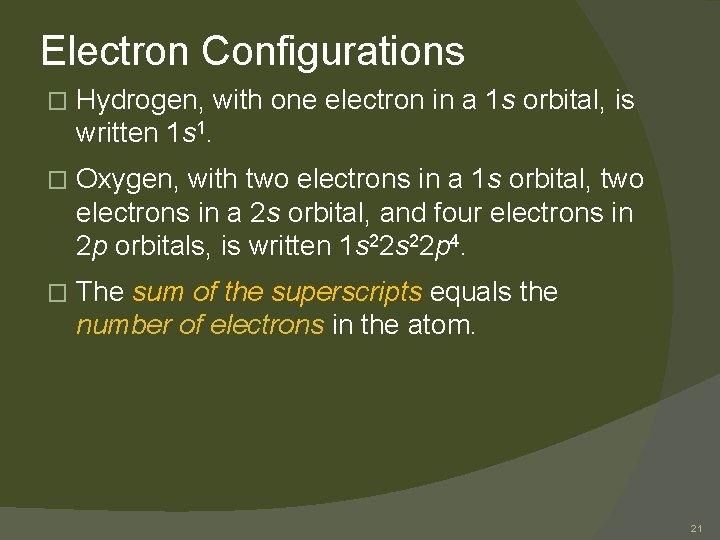
Electron Configurations � Hydrogen, with one electron in a 1 s orbital, is written 1 s 1. � Oxygen, with two electrons in a 1 s orbital, two electrons in a 2 s orbital, and four electrons in 2 p orbitals, is written 1 s 22 p 4. � The sum of the superscripts equals the number of electrons in the atom. 21
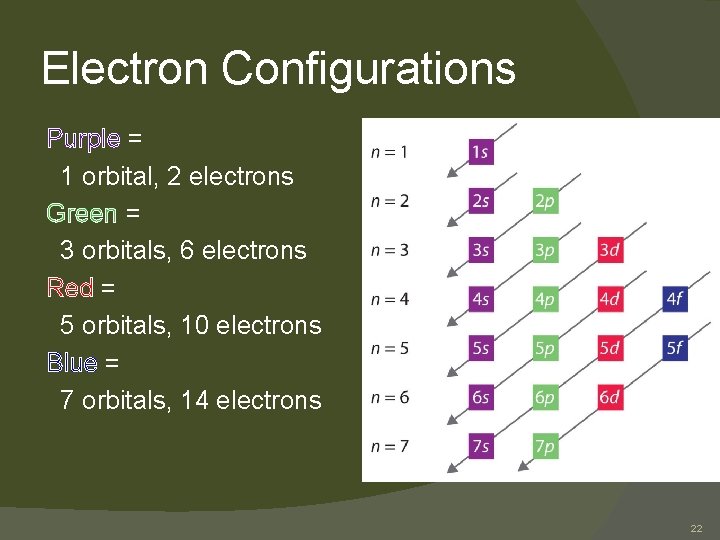
Electron Configurations Purple = 1 orbital, 2 electrons Green = 3 orbitals, 6 electrons Red = 5 orbitals, 10 electrons Blue = 7 orbitals, 14 electrons 22
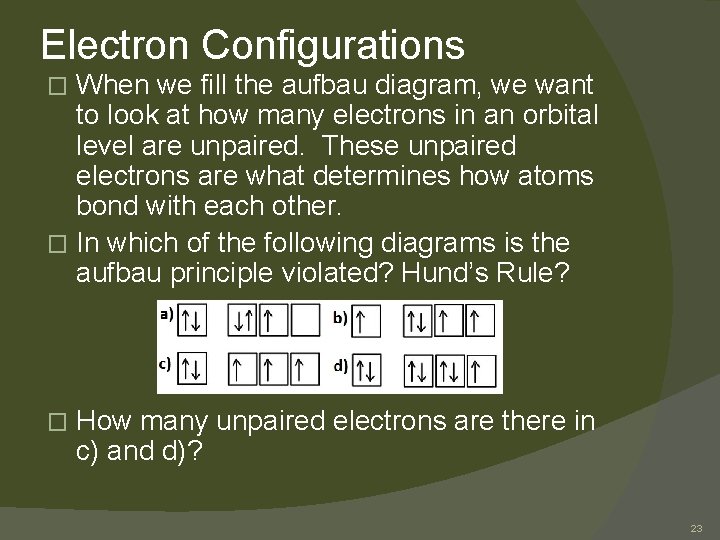
Electron Configurations When we fill the aufbau diagram, we want to look at how many electrons in an orbital level are unpaired. These unpaired electrons are what determines how atoms bond with each other. � In which of the following diagrams is the aufbau principle violated? Hund’s Rule? � � How many unpaired electrons are there in c) and d)? 23
Hund’s Rule 24
25
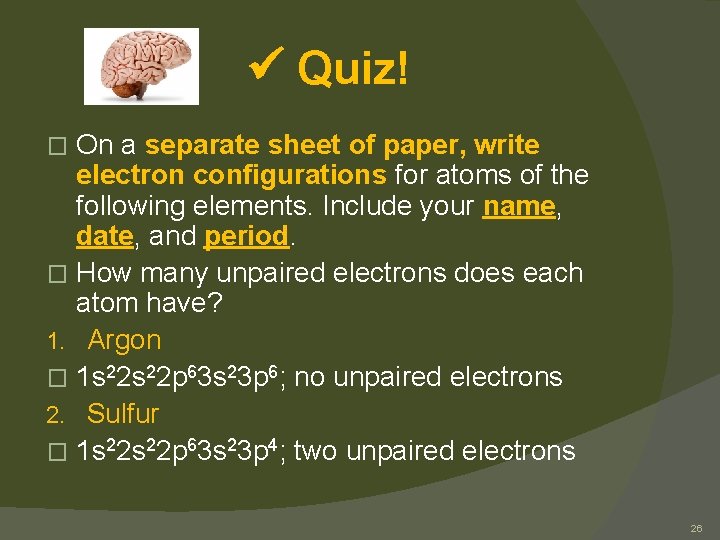
Quiz! On a separate sheet of paper, write electron configurations for atoms of the following elements. Include your name, date, and period. � How many unpaired electrons does each atom have? 1. Argon � 1 s 22 p 63 s 23 p 6; no unpaired electrons 2. Sulfur � 1 s 22 p 63 s 23 p 4; two unpaired electrons � 26
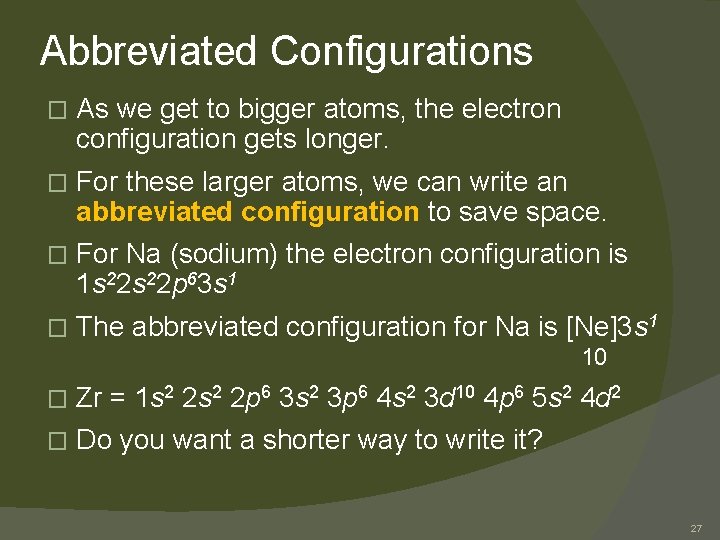
Abbreviated Configurations � As we get to bigger atoms, the electron configuration gets longer. � For these larger atoms, we can write an abbreviated configuration to save space. � For Na (sodium) the electron configuration is 1 s 22 p 63 s 1 � The abbreviated configuration for Na is [Ne]3 s 1 10 � Zr = 1 s 2 2 p 6 3 s 2 3 p 6 4 s 2 3 d 10 4 p 6 5 s 2 4 d 2 � Do you want a shorter way to write it? 27
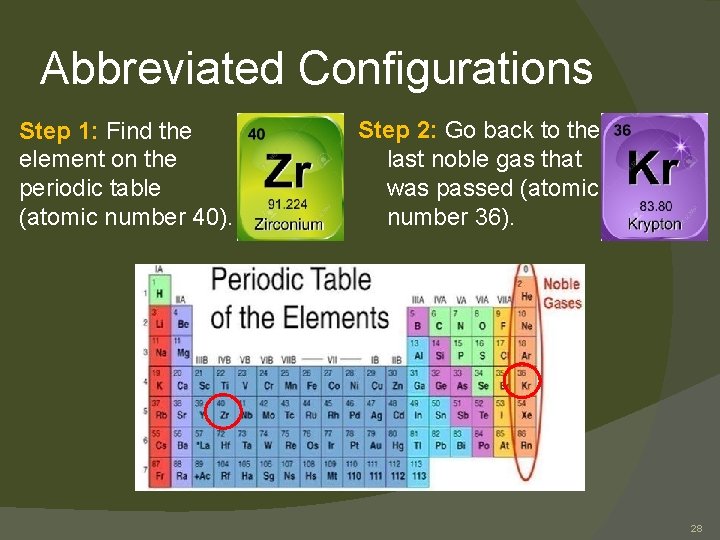
Abbreviated Configurations Step 1: Find the element on the periodic table (atomic number 40). Step 2: Go back to the last noble gas that was passed (atomic number 36). 28
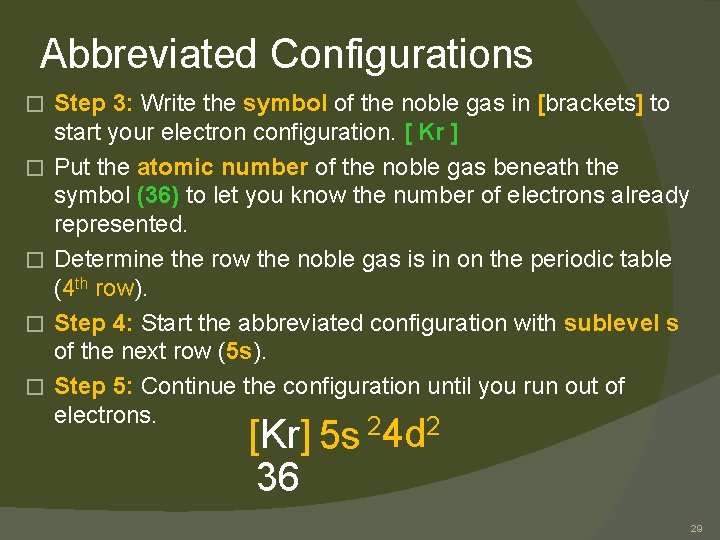
Abbreviated Configurations � � � Step 3: Write the symbol of the noble gas in [brackets] to start your electron configuration. [ Kr ] Put the atomic number of the noble gas beneath the symbol (36) to let you know the number of electrons already represented. Determine the row the noble gas is in on the periodic table (4 th row). Step 4: Start the abbreviated configuration with sublevel s of the next row (5 s). Step 5: Continue the configuration until you run out of electrons. [Kr] 5 s 36 24 d 2 29
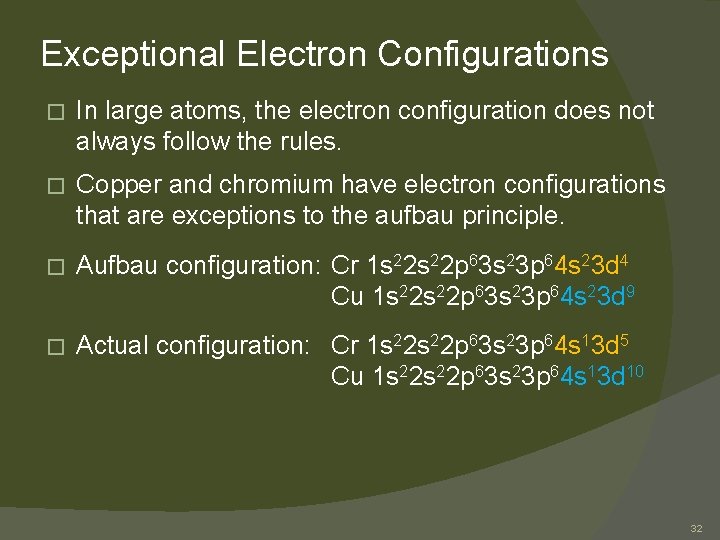
Quiz! � On your Quiz paper, write abbreviated configurations for atoms of the following elements. Cd 4. Cl 5. Ba 6. Pb 7. Fe 3. 30
3. Cd = [Kr] 5 s 24 d 10 36 4. Cl = [Ne] 3 s 23 p 5 10 5. Ba = [Xe] 6 s 2 54 6. Pb = [Xe] 6 s 24 f 145 d 106 p 2 54 7. Fe = [Ar] 4 s 23 d 6 18 31
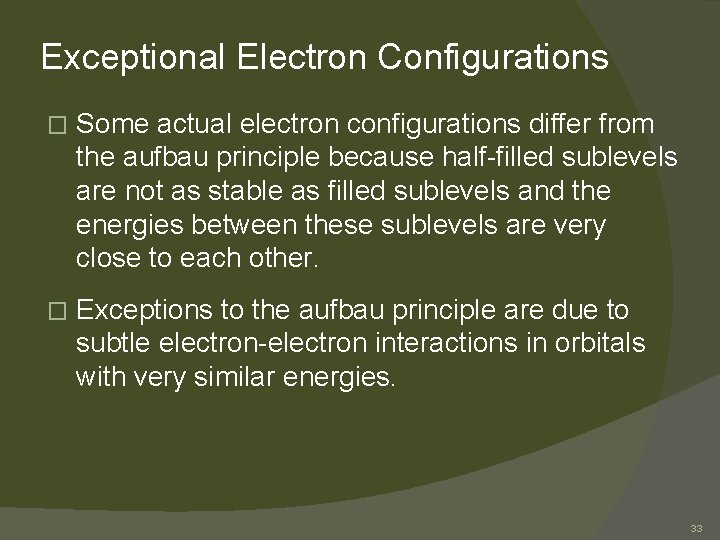
Exceptional Electron Configurations � In large atoms, the electron configuration does not always follow the rules. � Copper and chromium have electron configurations that are exceptions to the aufbau principle. � Aufbau configuration: Cr 1 s 22 p 63 s 23 p 64 s 23 d 4 Cu 1 s 22 p 63 s 23 p 64 s 23 d 9 � Actual configuration: Cr 1 s 22 p 63 s 23 p 64 s 13 d 5 Cu 1 s 22 p 63 s 23 p 64 s 13 d 10 32
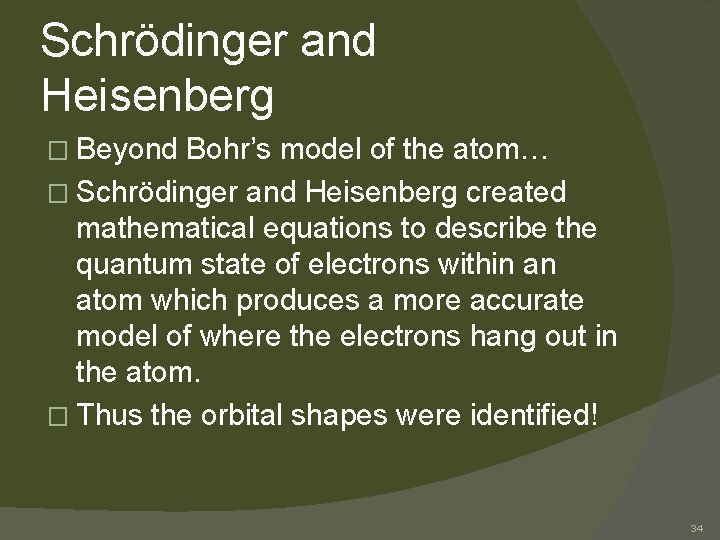
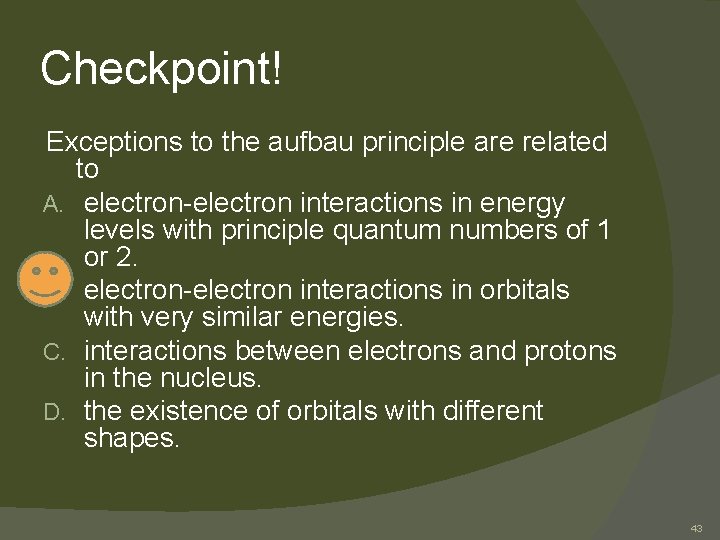
Exceptional Electron Configurations � Some actual electron configurations differ from the aufbau principle because half-filled sublevels are not as stable as filled sublevels and the energies between these sublevels are very close to each other. � Exceptions to the aufbau principle are due to subtle electron-electron interactions in orbitals with very similar energies. 33
Schrödinger and Heisenberg � Beyond Bohr’s model of the atom… � Schrödinger and Heisenberg created mathematical equations to describe the quantum state of electrons within an atom which produces a more accurate model of where the electrons hang out in the atom. � Thus the orbital shapes were identified! 34
Websites � Paired and Unpaired Electrons � https: //www. sophia. org/tutorials/pairedand-unpaired-electrons � PERIODIC TABLE & PERIODIC LAW � http: //mr. powner. org/c/lessons/periodic_t able_and_law. html 35
Questions? 36
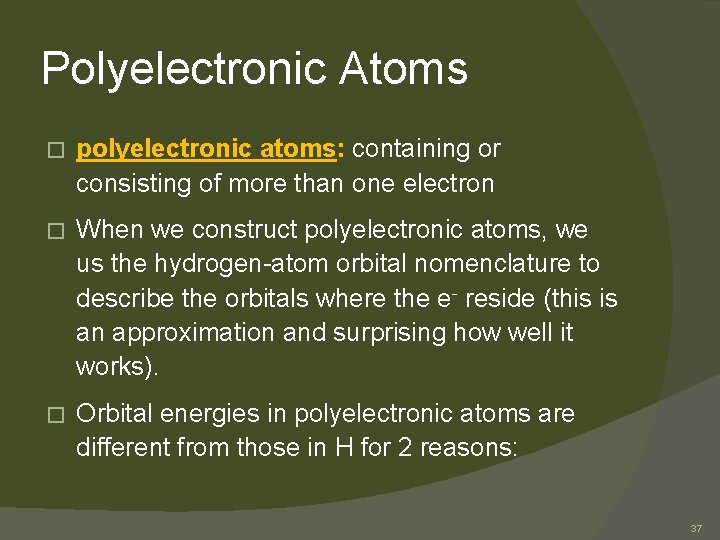
Polyelectronic Atoms � polyelectronic atoms: containing or consisting of more than one electron � When we construct polyelectronic atoms, we us the hydrogen-atom orbital nomenclature to describe the orbitals where the e- reside (this is an approximation and surprising how well it works). � Orbital energies in polyelectronic atoms are different from those in H for 2 reasons: 37
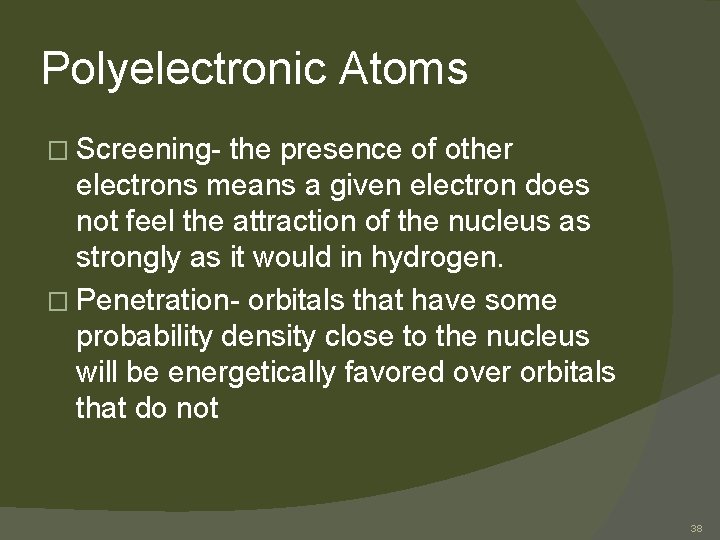
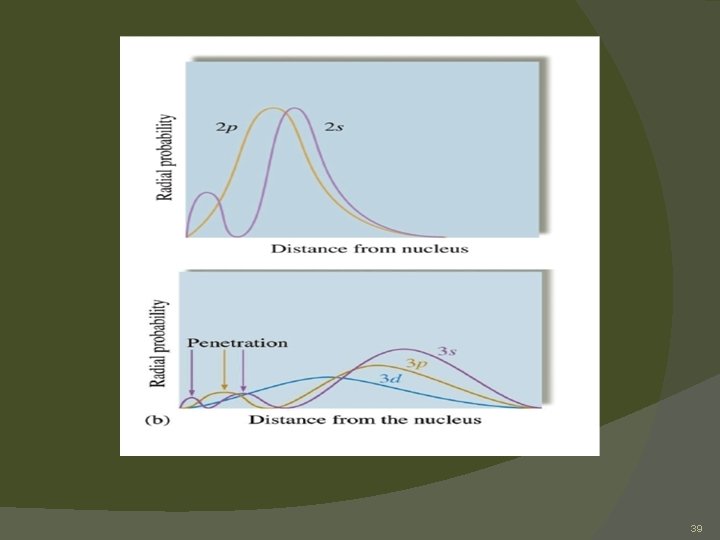
Polyelectronic Atoms � Screening- the presence of other electrons means a given electron does not feel the attraction of the nucleus as strongly as it would in hydrogen. � Penetration- orbitals that have some probability density close to the nucleus will be energetically favored over orbitals that do not 38
39
Polyelectronic Atoms � Why not 3 d before 4 s? �Most probable distance in 3 d is closer to the nucleus than in 4 s, but 4 s allows for closer actual approach to nucleus due to penetration. �This means 4 s is energetically preferred over 3 d! 40
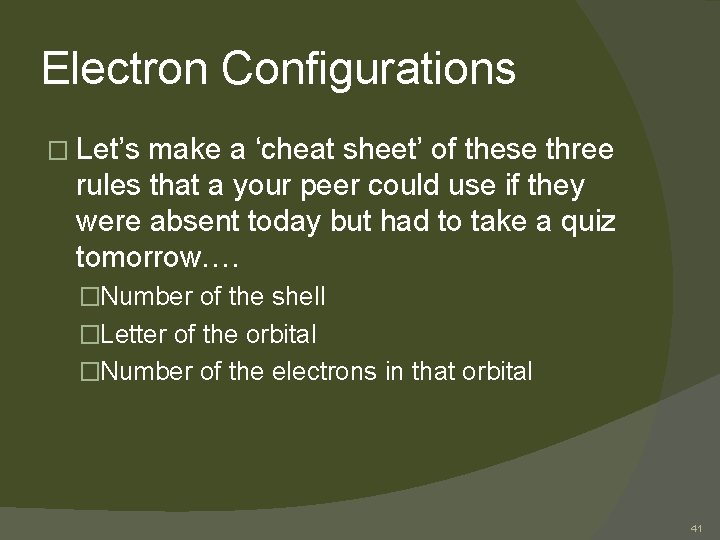
Electron Configurations � Let’s make a ‘cheat sheet’ of these three rules that a your peer could use if they were absent today but had to take a quiz tomorrow…. �Number of the shell �Letter of the orbital �Number of the electrons in that orbital 41
42
Checkpoint! Exceptions to the aufbau principle are related to A. electron-electron interactions in energy levels with principle quantum numbers of 1 or 2. B. electron-electron interactions in orbitals with very similar energies. C. interactions between electrons and protons in the nucleus. D. the existence of orbitals with different shapes. 43