
Electron Configurations Atoms and Energy Radiant Energy knowledge
- Slides: 24
Electron Configurations
Atoms and Energy Radiant Energy: knowledge led to refinements of atomic model A. Wave particle: light behaves as both a wave and a particle-strange! B. Electromagnetic Radiation (EMR): form of energy that exhibits behavior (light) as it travels through space (X-rays, visible light, radio waves) All EMR has a wavelength, frequency, and amplitude that determines its energy
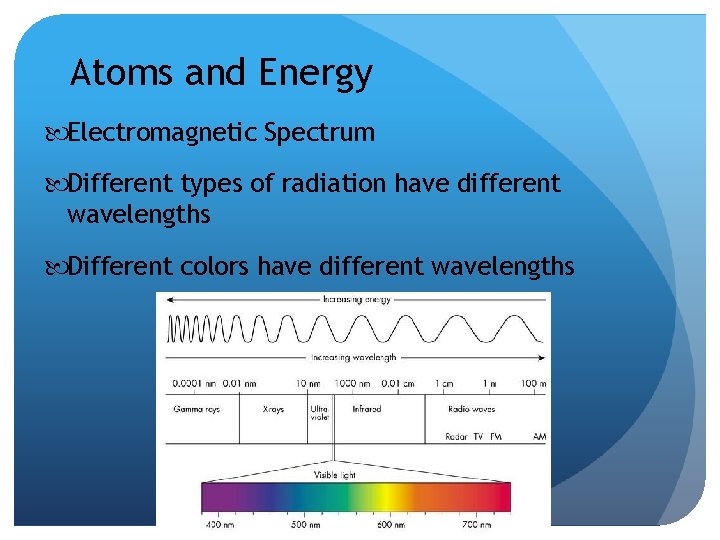
Atoms and Energy Electromagnetic Spectrum Different types of radiation have different wavelengths Different colors have different wavelengths
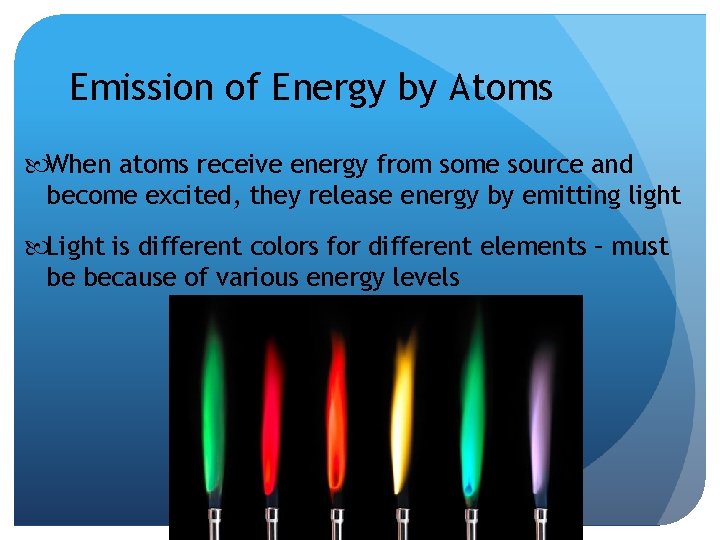
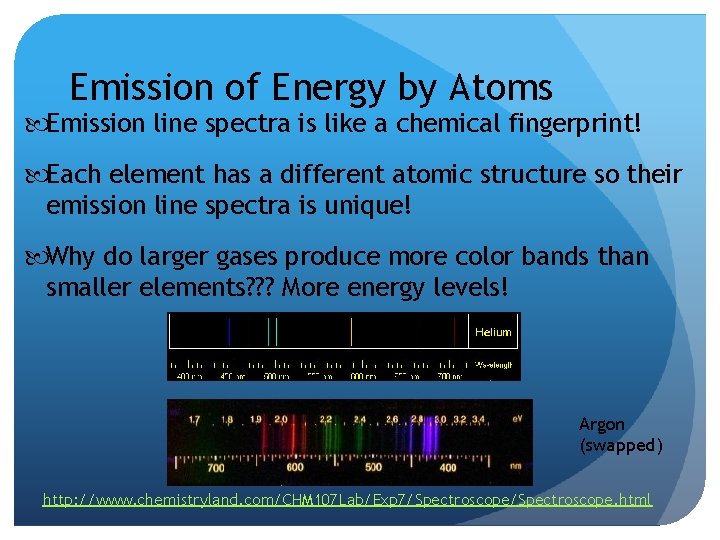
Emission of Energy by Atoms When atoms receive energy from some source and become excited, they release energy by emitting light Light is different colors for different elements – must be because of various energy levels
Emission of Energy by Atoms Emission line spectra is like a chemical fingerprint! Each element has a different atomic structure so their emission line spectra is unique! Why do larger gases produce more color bands than smaller elements? ? ? More energy levels! Argon (swapped) http: //www. chemistryland. com/CHM 107 Lab/Exp 7/Spectroscope. html
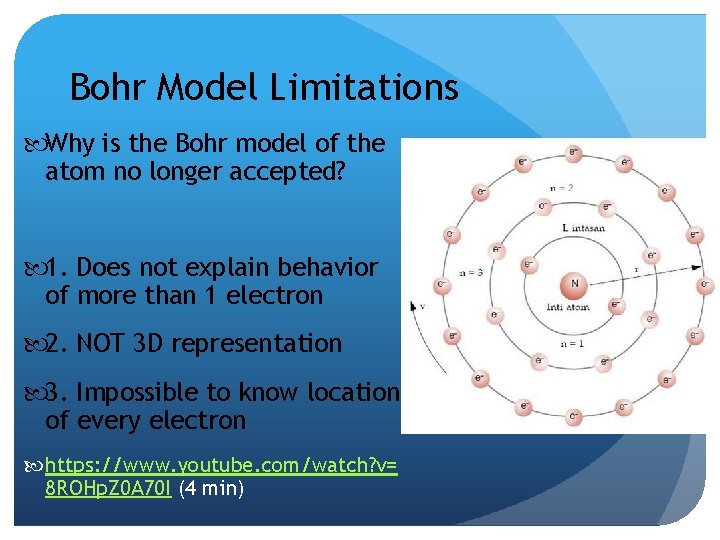
Bohr Model Limitations Why is the Bohr model of the atom no longer accepted? 1. Does not explain behavior of more than 1 electron 2. NOT 3 D representation 3. Impossible to know location of every electron https: //www. youtube. com/watch? v= 8 ROHp. Z 0 A 70 I (4 min)
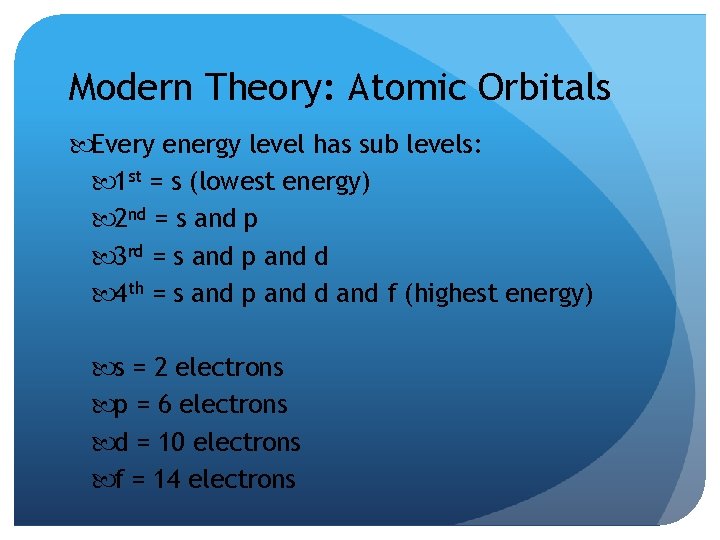
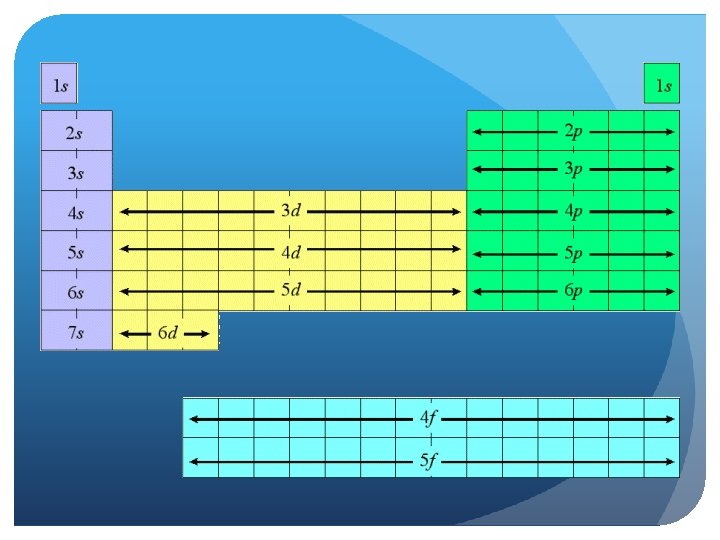
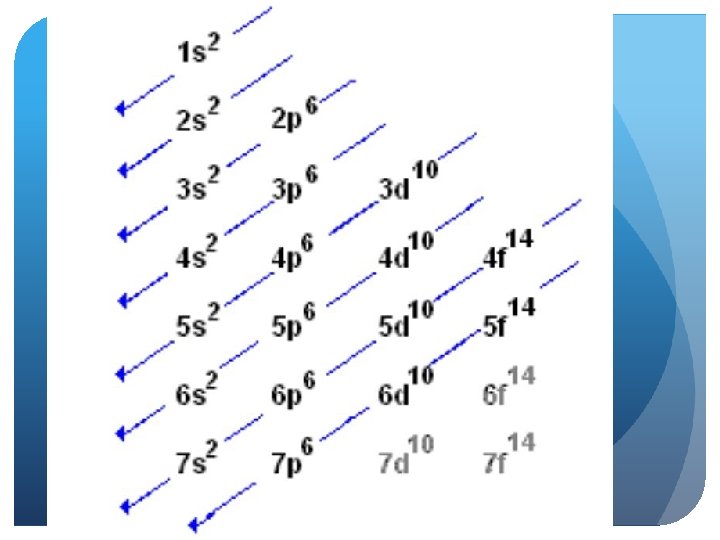
Modern Theory: Atomic Orbitals Every energy level has sub levels: 1 st = s (lowest energy) 2 nd = s and p 3 rd = s and p and d 4 th = s and p and d and f (highest energy) s = 2 electrons p = 6 electrons d = 10 electrons f = 14 electrons
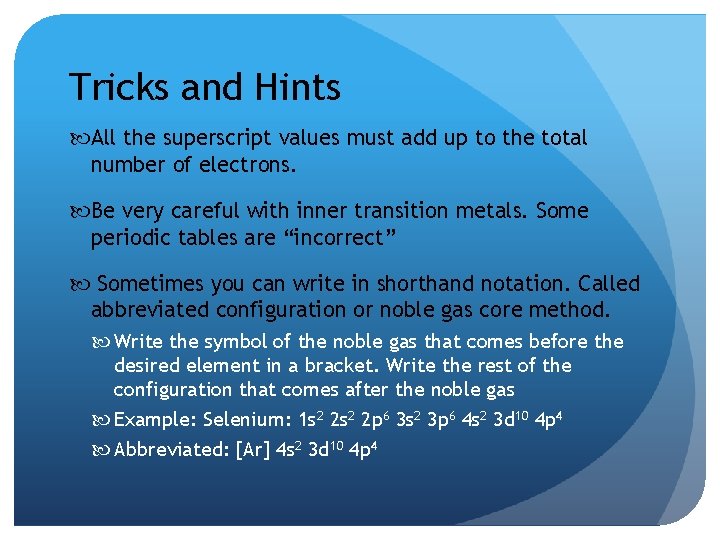
Tricks and Hints All the superscript values must add up to the total number of electrons. Be very careful with inner transition metals. Some periodic tables are “incorrect” Sometimes you can write in shorthand notation. Called abbreviated configuration or noble gas core method. Write the symbol of the noble gas that comes before the desired element in a bracket. Write the rest of the configuration that comes after the noble gas Example: Selenium: 1 s 2 2 p 6 3 s 2 3 p 6 4 s 2 3 d 10 4 p 4 Abbreviated: [Ar] 4 s 2 3 d 10 4 p 4
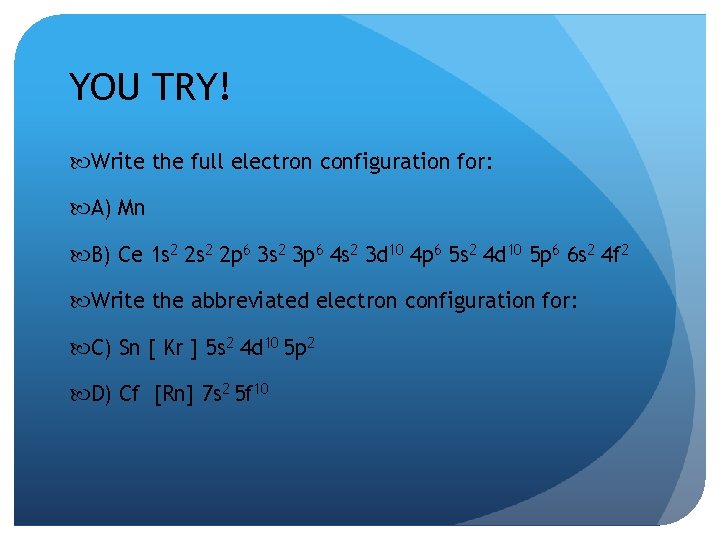
YOU TRY! Write the full electron configuration for: A) Mn B) Ce 1 s 2 2 p 6 3 s 2 3 p 6 4 s 2 3 d 10 4 p 6 5 s 2 4 d 10 5 p 6 6 s 2 4 f 2 Write the abbreviated electron configuration for: C) Sn [ Kr ] 5 s 2 4 d 10 5 p 2 D) Cf [Rn] 7 s 2 5 f 10
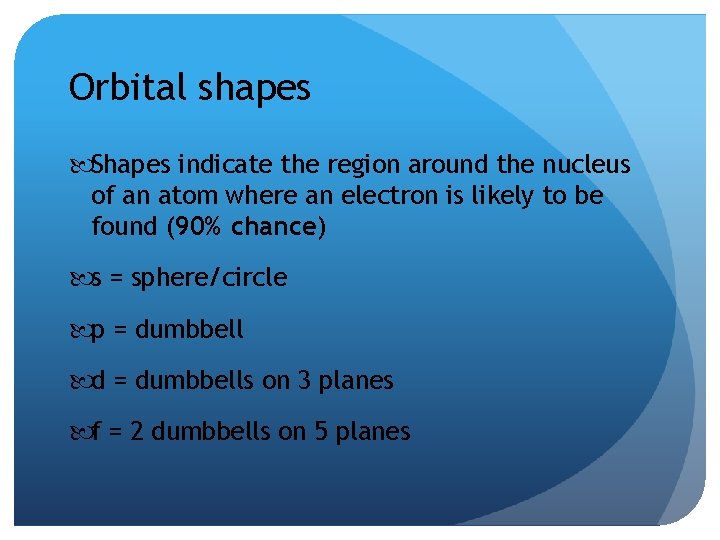
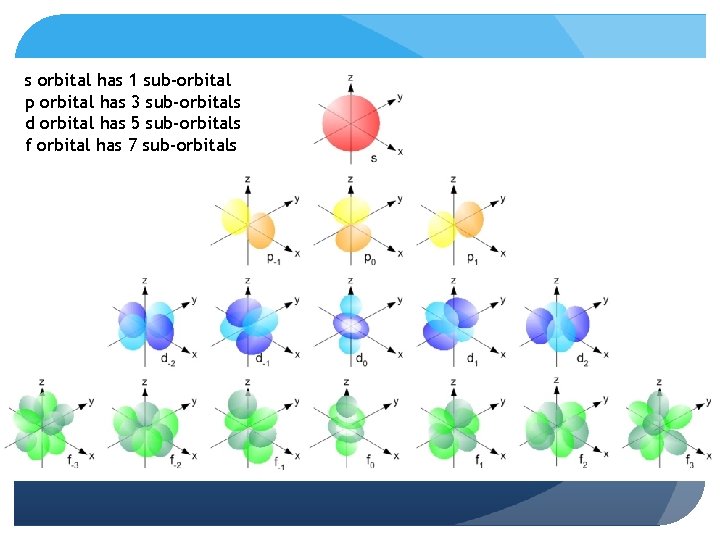
Orbital shapes Shapes indicate the region around the nucleus of an atom where an electron is likely to be found (90% chance) s = sphere/circle p = dumbbell d = dumbbells on 3 planes f = 2 dumbbells on 5 planes
s orbital has 1 sub-orbital p orbital has 3 sub-orbitals d orbital has 5 sub-orbitals f orbital has 7 sub-orbitals
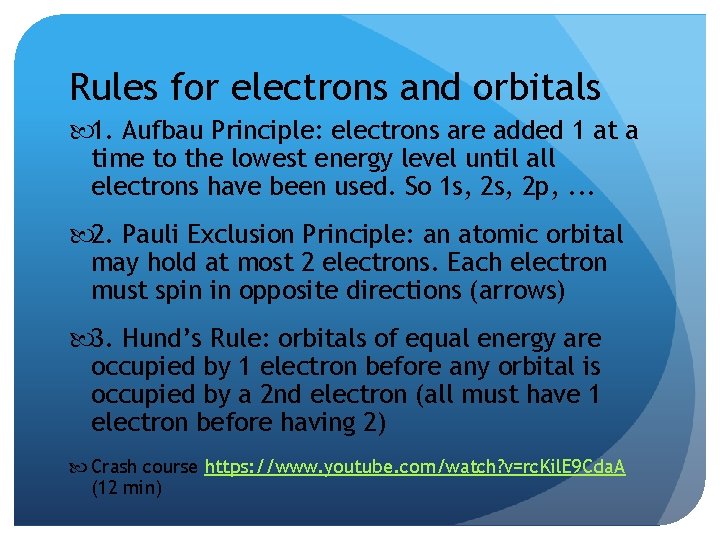
Rules for electrons and orbitals 1. Aufbau Principle: electrons are added 1 at a time to the lowest energy level until all electrons have been used. So 1 s, 2 p, . . . 2. Pauli Exclusion Principle: an atomic orbital may hold at most 2 electrons. Each electron must spin in opposite directions (arrows) 3. Hund’s Rule: orbitals of equal energy are occupied by 1 electron before any orbital is occupied by a 2 nd electron (all must have 1 electron before having 2) Crash course https: //www. youtube. com/watch? v=rc. Kil. E 9 Cda. A (12 min)
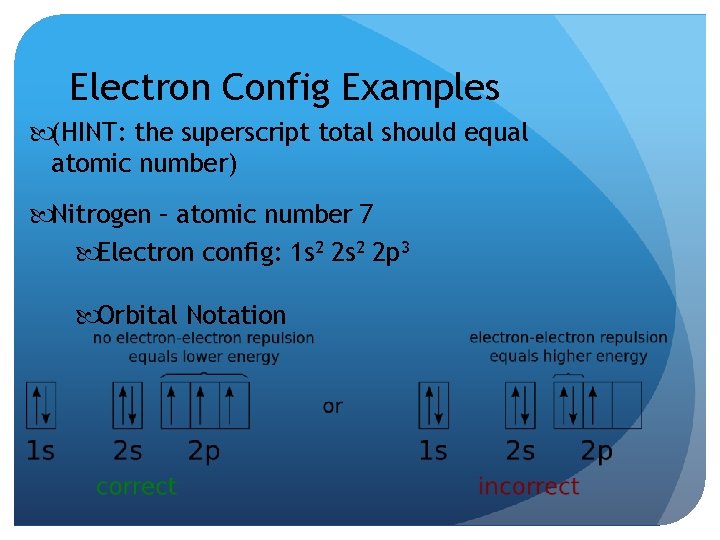
Electron Config Examples (HINT: the superscript total should equal atomic number) Nitrogen – atomic number 7 Electron config: 1 s 2 2 p 3 Orbital Notation
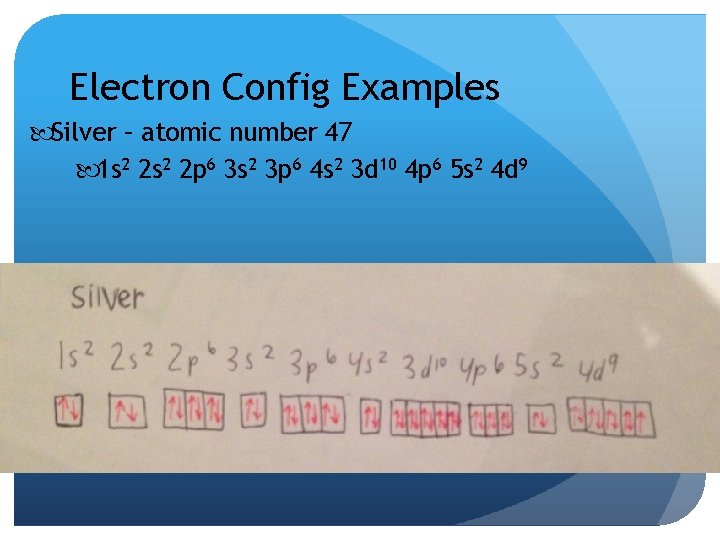
Electron Config Examples Silver – atomic number 47 1 s 2 2 p 6 3 s 2 3 p 6 4 s 2 3 d 10 4 p 6 5 s 2 4 d 9
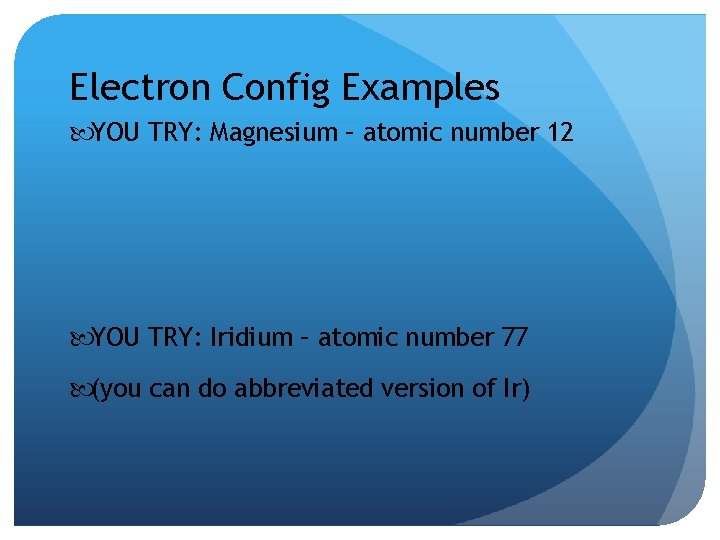
Electron Config Examples YOU TRY: Magnesium – atomic number 12 YOU TRY: Iridium – atomic number 77 (you can do abbreviated version of Ir)
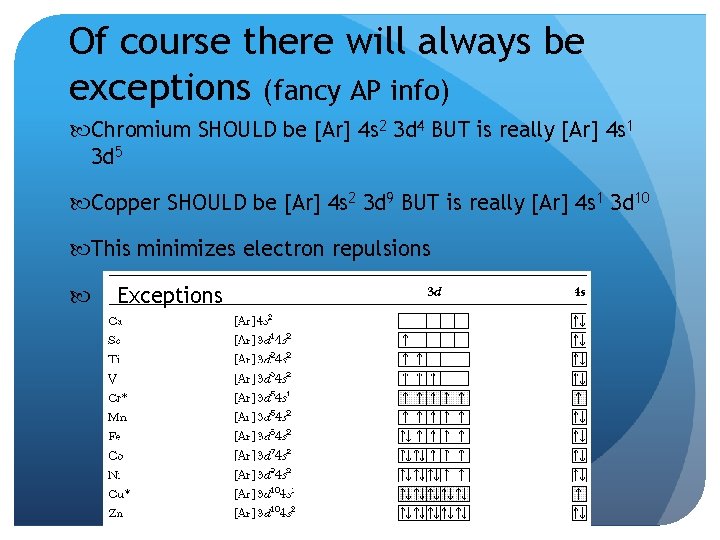
Of course there will always be exceptions (fancy AP info) Chromium SHOULD be [Ar] 4 s 2 3 d 4 BUT is really [Ar] 4 s 1 3 d 5 Copper SHOULD be [Ar] 4 s 2 3 d 9 BUT is really [Ar] 4 s 1 3 d 10 This minimizes electron repulsions Exceptions
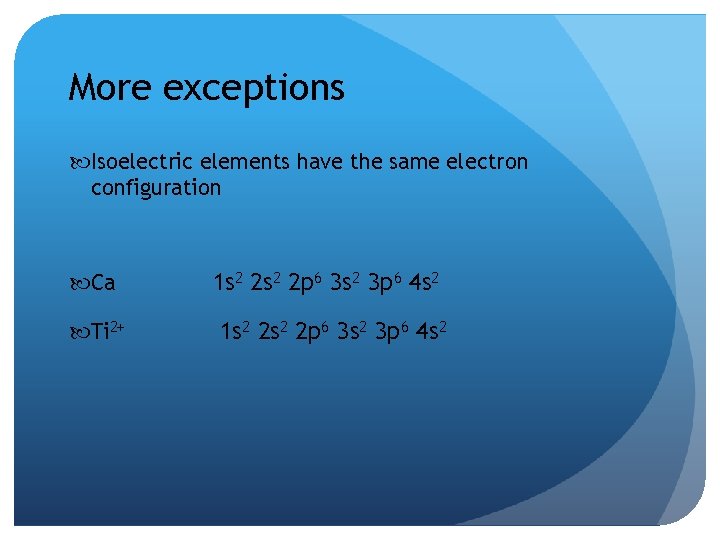
More exceptions Isoelectric elements have the same electron configuration Ca Ti 2+ 1 s 2 2 s 2 2 p 6 3 s 2 3 p 6 4 s 2
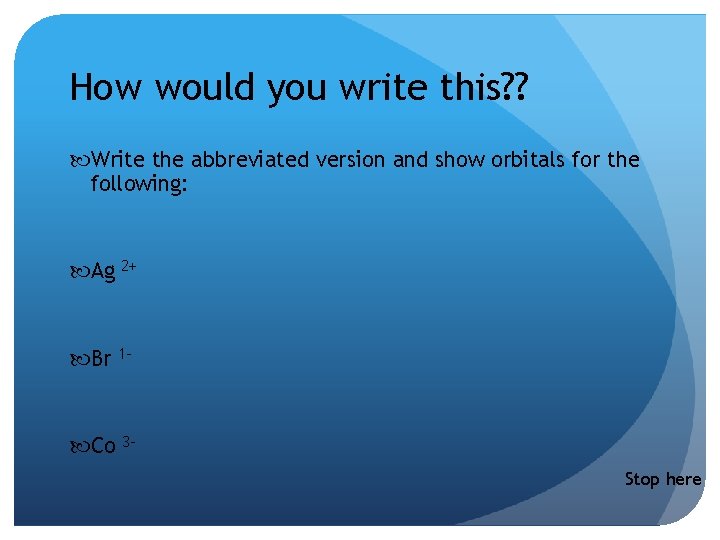
How would you write this? ? Write the abbreviated version and show orbitals for the following: Ag 2+ Br 1 - Co 3 Stop here
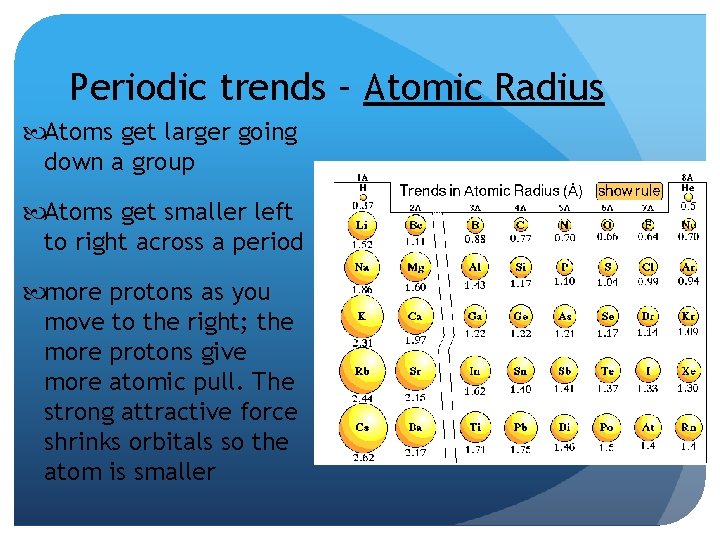
Periodic trends – Atomic Radius Atoms get larger going down a group Atoms get smaller left to right across a period more protons as you move to the right; the more protons give more atomic pull. The strong attractive force shrinks orbitals so the atom is smaller
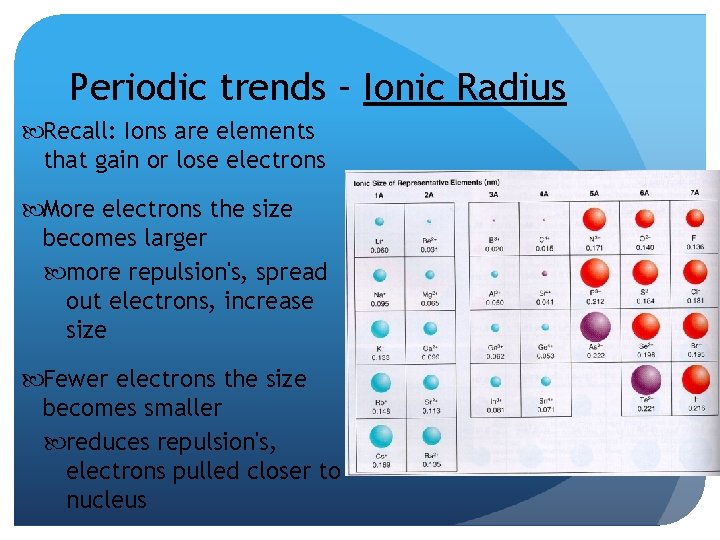
Periodic trends – Ionic Radius Recall: Ions are elements that gain or lose electrons More electrons the size becomes larger more repulsion's, spread out electrons, increase size Fewer electrons the size becomes smaller reduces repulsion's, electrons pulled closer to nucleus
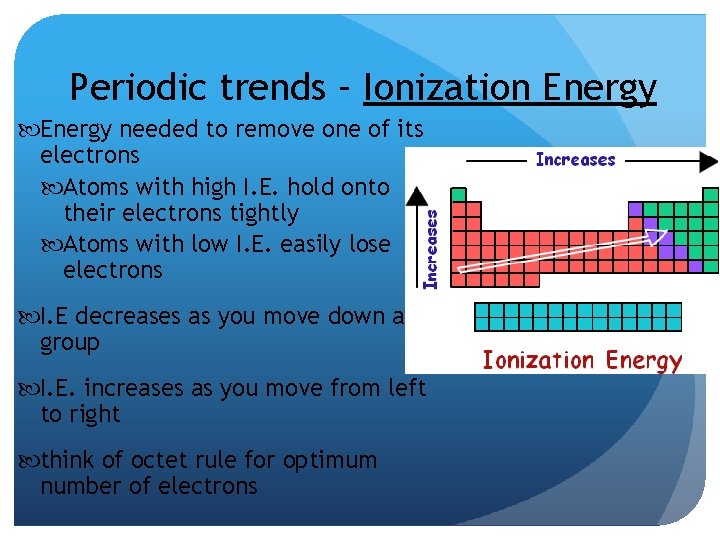
Periodic trends – Ionization Energy needed to remove one of its electrons Atoms with high I. E. hold onto their electrons tightly Atoms with low I. E. easily lose electrons I. E decreases as you move down a group I. E. increases as you move from left to right think of octet rule for optimum number of electrons
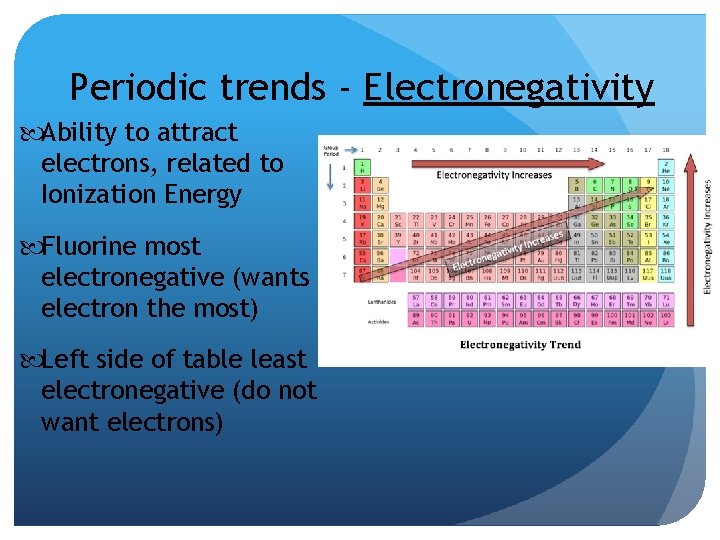
Periodic trends - Electronegativity Ability to attract electrons, related to Ionization Energy Fluorine most electronegative (wants electron the most) Left side of table least electronegative (do not want electrons)