
Electron Configurations 11 DP Chemistry AHL Orbital Energy
Electron Configurations 11 DP Chemistry AHL
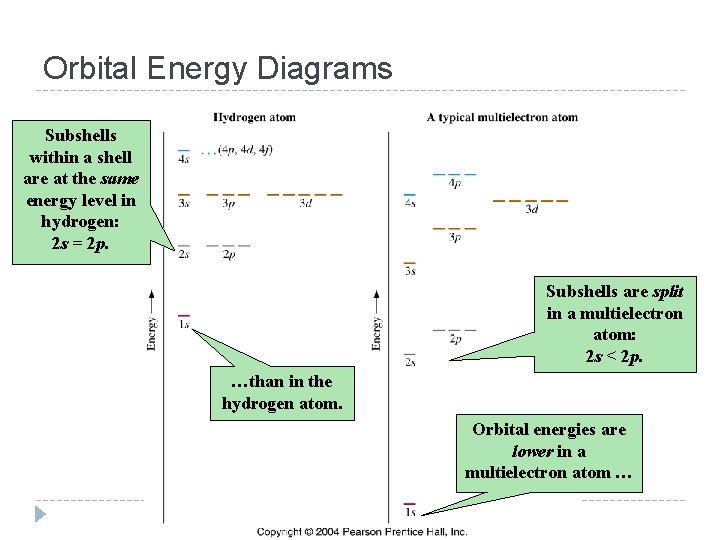
Orbital Energy Diagrams Subshells within a shell are at the same energy level in hydrogen: 2 s = 2 p. Subshells are split in a multielectron atom: 2 s < 2 p. …than in the hydrogen atom. Orbital energies are lower in a multielectron atom …
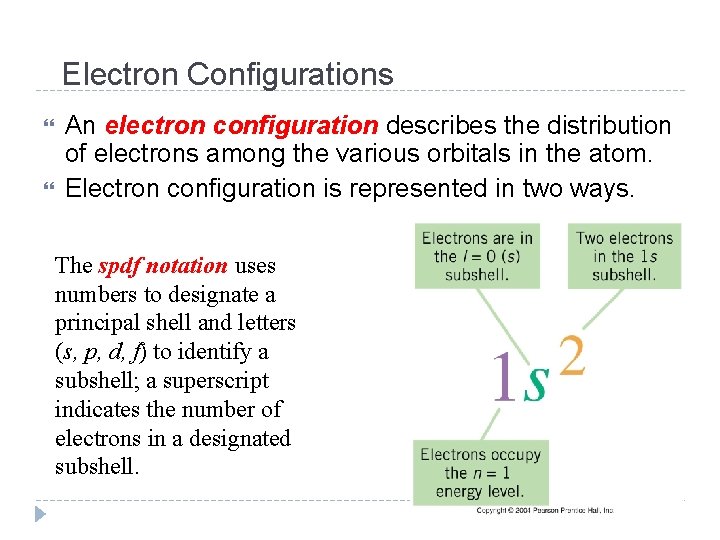
Electron Configurations An electron configuration describes the distribution of electrons among the various orbitals in the atom. Electron configuration is represented in two ways. The spdf notation uses numbers to designate a principal shell and letters (s, p, d, f) to identify a subshell; a superscript indicates the number of electrons in a designated subshell.
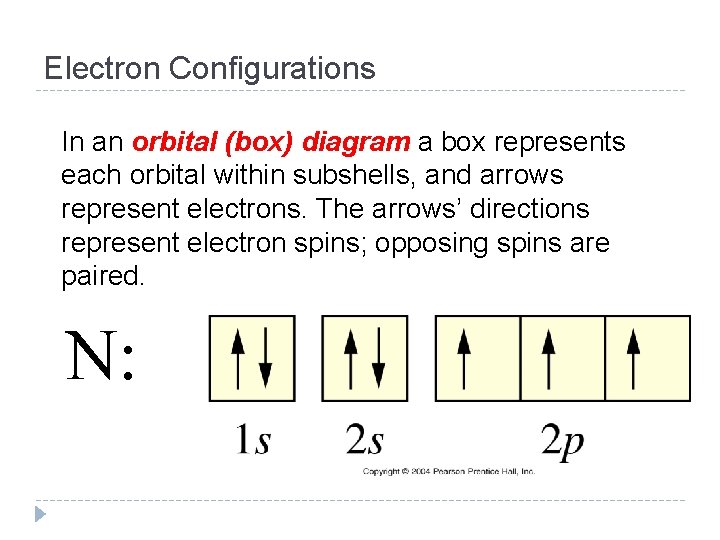
Electron Configurations In an orbital (box) diagram a box represents each orbital within subshells, and arrows represent electrons. The arrows’ directions represent electron spins; opposing spins are paired. N:
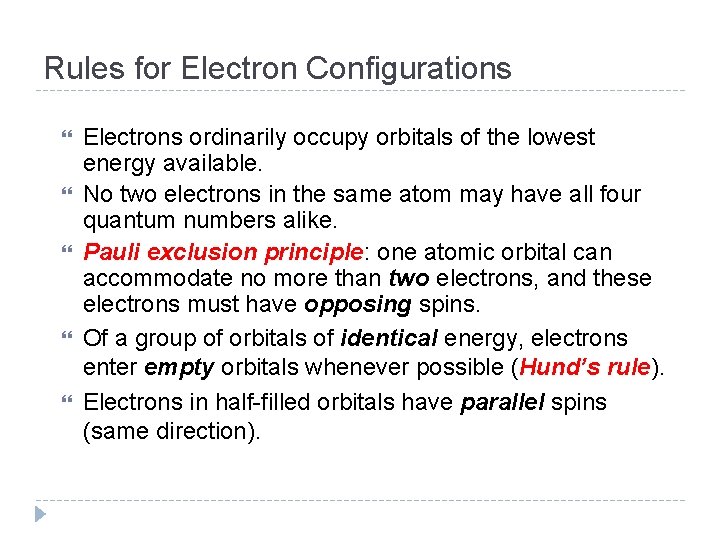
Rules for Electron Configurations Electrons ordinarily occupy orbitals of the lowest energy available. No two electrons in the same atom may have all four quantum numbers alike. Pauli exclusion principle: one atomic orbital can accommodate no more than two electrons, and these electrons must have opposing spins. Of a group of orbitals of identical energy, electrons enter empty orbitals whenever possible (Hund’s rule). Electrons in half-filled orbitals have parallel spins (same direction).
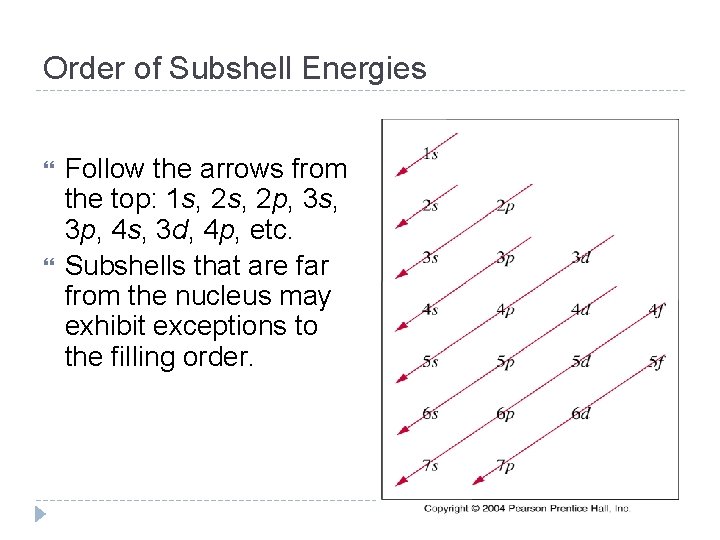
Order of Subshell Energies Follow the arrows from the top: 1 s, 2 p, 3 s, 3 p, 4 s, 3 d, 4 p, etc. Subshells that are far from the nucleus may exhibit exceptions to the filling order.
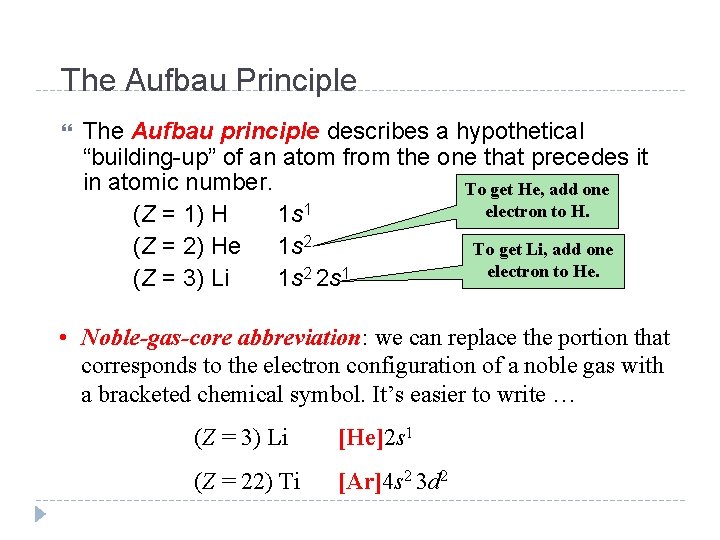
The Aufbau Principle The Aufbau principle describes a hypothetical “building-up” of an atom from the one that precedes it in atomic number. To get He, add one electron to H. (Z = 1) H 1 s 1 (Z = 2) He 1 s 2 To get Li, add one electron to He. (Z = 3) Li 1 s 2 2 s 1 • Noble-gas-core abbreviation: we can replace the portion that corresponds to the electron configuration of a noble gas with a bracketed chemical symbol. It’s easier to write … (Z = 3) Li [He]2 s 1 (Z = 22) Ti [Ar]4 s 2 3 d 2
Exercise 1 Write electron configurations for sulfur, using both the spdf notation and an orbital diagram.
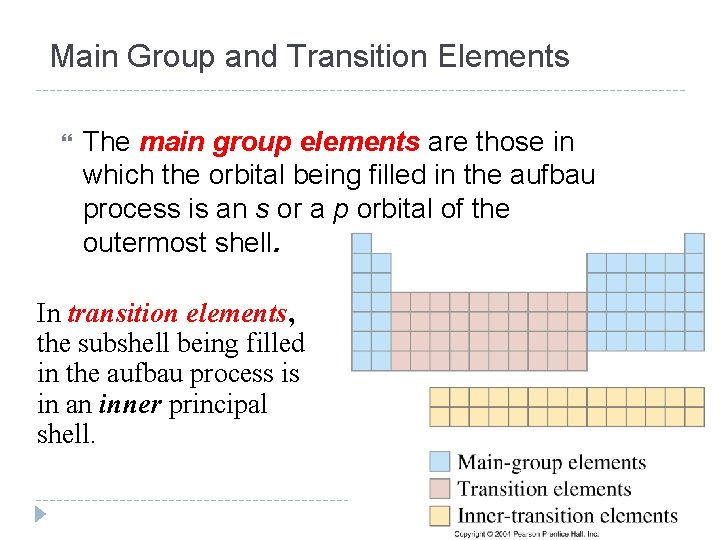
Main Group and Transition Elements The main group elements are those in which the orbital being filled in the aufbau process is an s or a p orbital of the outermost shell. In transition elements, the subshell being filled in the aufbau process is in an inner principal shell.
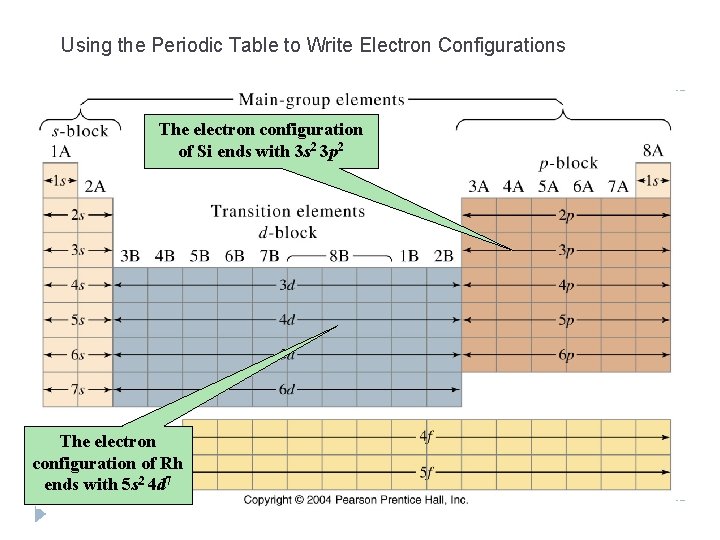
Using the Periodic Table to Write Electron Configurations The electron configuration of Si ends with 3 s 2 3 p 2 The electron configuration of Rh ends with 5 s 2 4 d 7
Exercise 2 Give the complete ground-state electron configuration of a strontium atom (a) in the spdf notation and (b) in the noble -gas-core abbreviated notation.
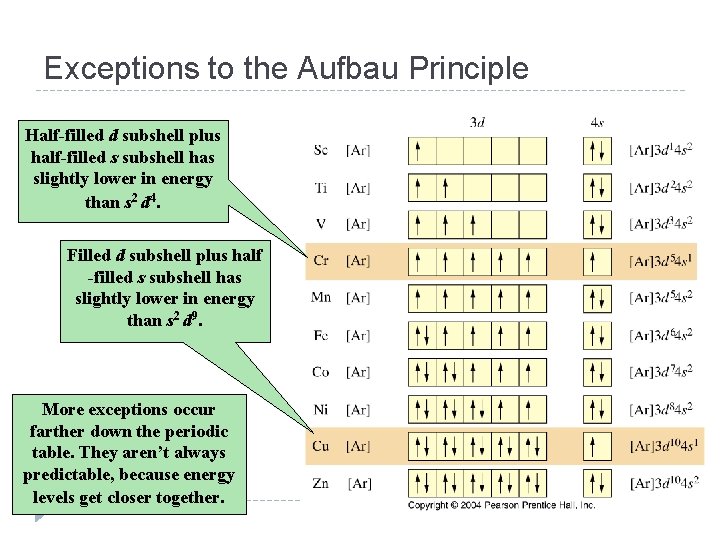
Exceptions to the Aufbau Principle Half-filled d subshell plus half-filled s subshell has slightly lower in energy than s 2 d 4. Filled d subshell plus half -filled s subshell has slightly lower in energy than s 2 d 9. More exceptions occur farther down the periodic table. They aren’t always predictable, because energy levels get closer together.
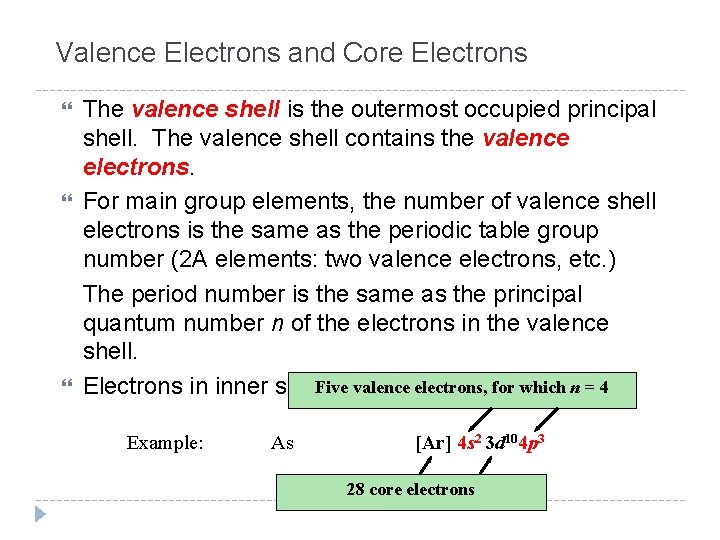
Valence Electrons and Core Electrons The valence shell is the outermost occupied principal shell. The valence shell contains the valence electrons. For main group elements, the number of valence shell electrons is the same as the periodic table group number (2 A elements: two valence electrons, etc. ) The period number is the same as the principal quantum number n of the electrons in the valence shell. Fiveare valence electrons, forelectrons. which n = 4 Electrons in inner shells called core Example: As [Ar] 4 s 2 3 d 104 p 3 28 core electrons
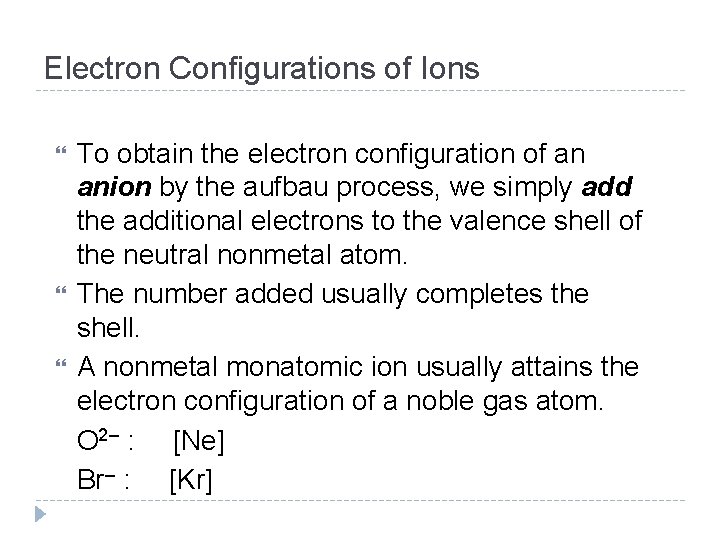
Electron Configurations of Ions To obtain the electron configuration of an anion by the aufbau process, we simply add the additional electrons to the valence shell of the neutral nonmetal atom. The number added usually completes the shell. A nonmetal monatomic ion usually attains the electron configuration of a noble gas atom. O 2– : [Ne] Br– : [Kr]
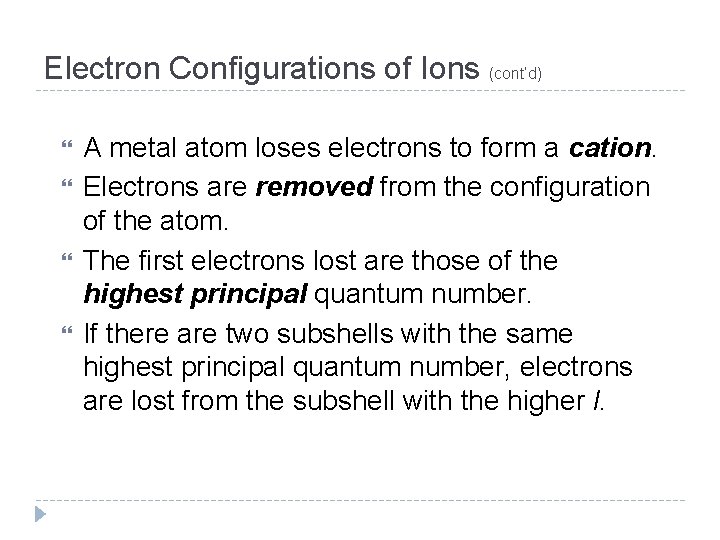
Electron Configurations of Ions (cont’d) A metal atom loses electrons to form a cation. Electrons are removed from the configuration of the atom. The first electrons lost are those of the highest principal quantum number. If there are two subshells with the same highest principal quantum number, electrons are lost from the subshell with the higher l.
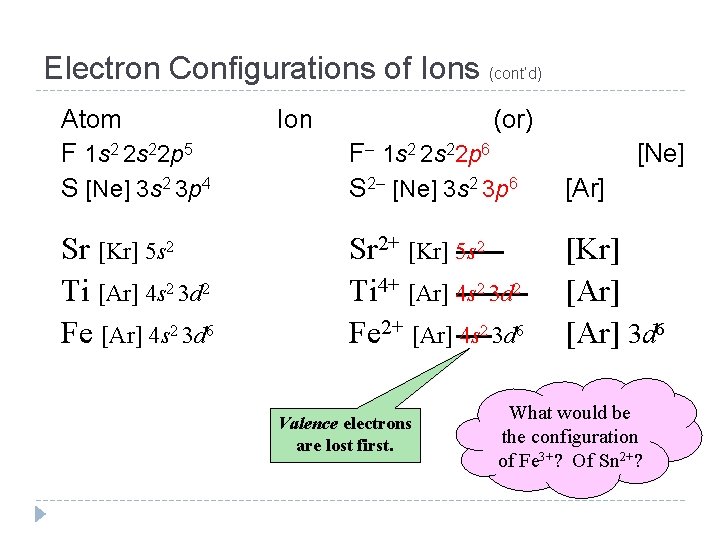
Electron Configurations of Ions (cont’d) Atom F 1 s 2 2 s 22 p 5 S [Ne] 3 s 2 3 p 4 Sr [Kr] 5 s 2 Ti [Ar] 4 s 2 3 d 2 Fe [Ar] 4 s 2 3 d 6 Ion (or) F– 1 s 2 2 s 22 p 6 S 2– [Ne] 3 s 2 3 p 6 [Ar] Sr 2+ [Kr] 5 s 2 Ti 4+ [Ar] 4 s 2 3 d 2 Fe 2+ [Ar] 4 s 2 3 d 6 [Kr] [Ar] 3 d 6 Valence electrons are lost first. [Ne] What would be the configuration of Fe 3+? Of Sn 2+?
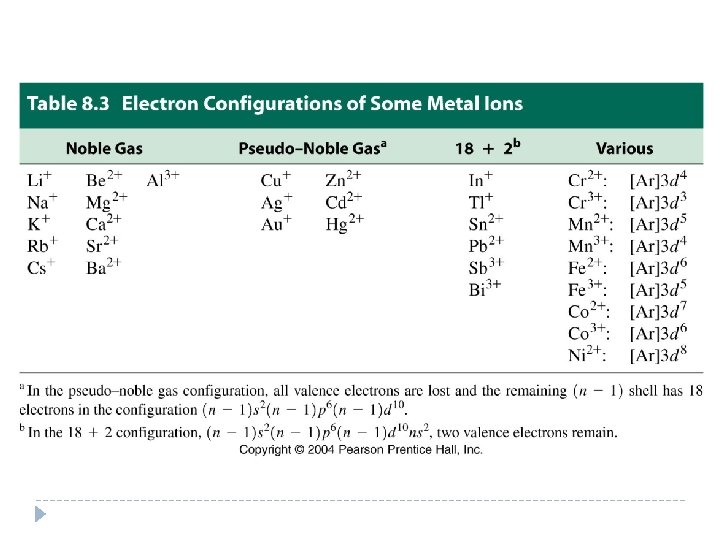
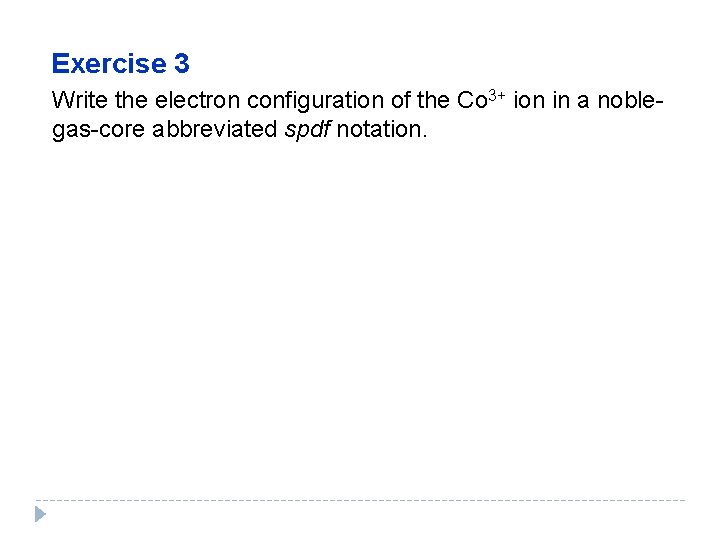
Exercise 3 Write the electron configuration of the Co 3+ ion in a noblegas-core abbreviated spdf notation.
- Slides: 18