
Electron Configuration s p d and f The

- Slides: 22
Electron Configuration
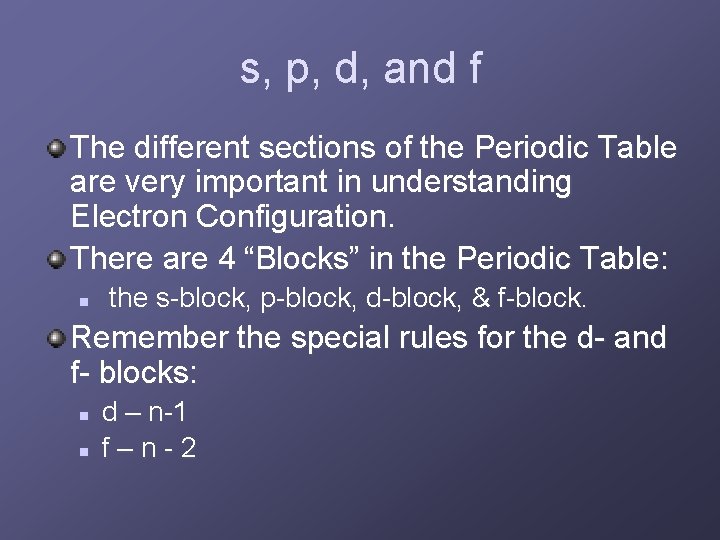
s, p, d, and f The different sections of the Periodic Table are very important in understanding Electron Configuration. There are 4 “Blocks” in the Periodic Table: n the s-block, p-block, d-block, & f-block. Remember the special rules for the d- and f- blocks: n n d – n-1 f–n-2
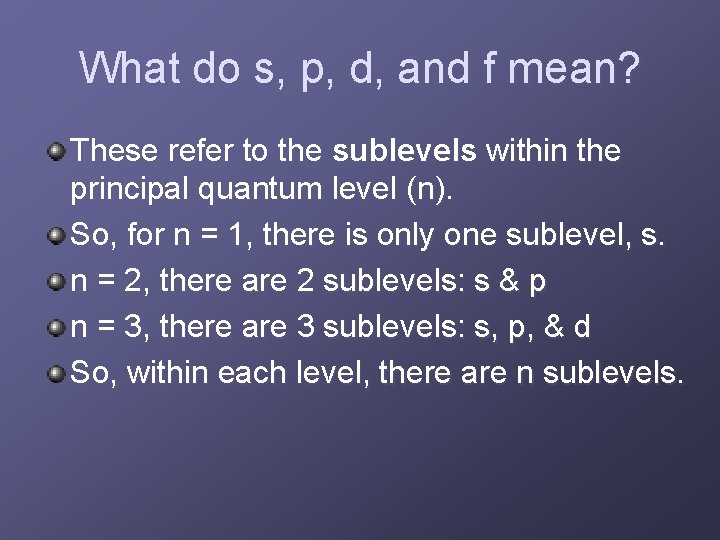
What do s, p, d, and f mean? These refer to the sublevels within the principal quantum level (n). So, for n = 1, there is only one sublevel, s. n = 2, there are 2 sublevels: s & p n = 3, there are 3 sublevels: s, p, & d So, within each level, there are n sublevels.
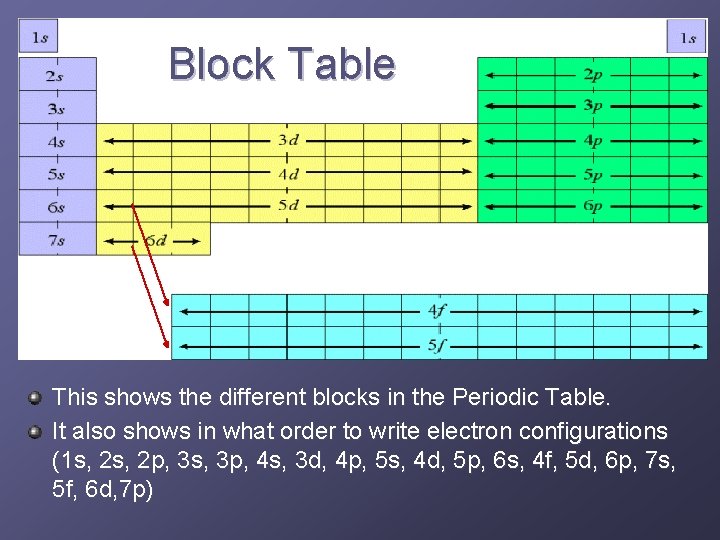
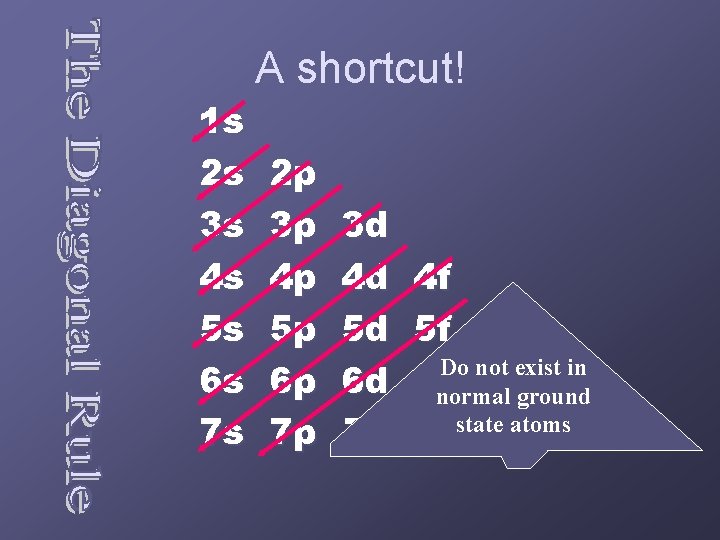
Block Table This shows the different blocks in the Periodic Table. It also shows in what order to write electron configurations (1 s, 2 p, 3 s, 3 p, 4 s, 3 d, 4 p, 5 s, 4 d, 5 p, 6 s, 4 f, 5 d, 6 p, 7 s, 5 f, 6 d, 7 p)
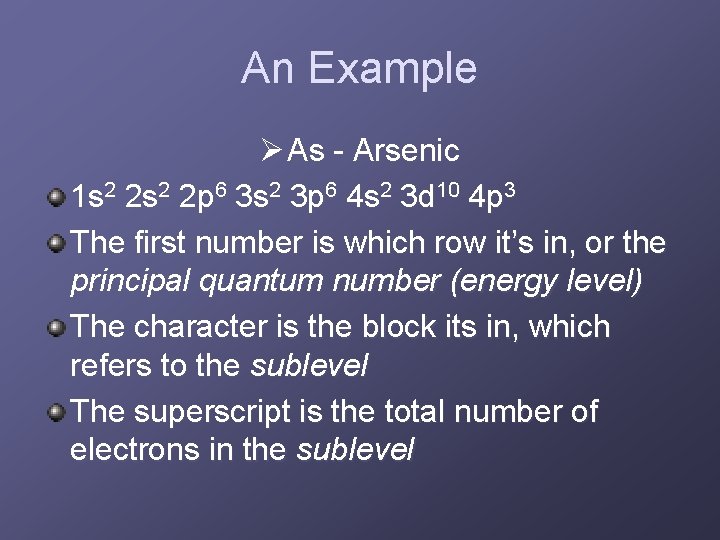
An Example Ø As - Arsenic 1 s 2 2 p 6 3 s 2 3 p 6 4 s 2 3 d 10 4 p 3 The first number is which row it’s in, or the principal quantum number (energy level) The character is the block its in, which refers to the sublevel The superscript is the total number of electrons in the sublevel
1 s 2 s 3 s 4 s 5 s 6 s 7 s A shortcut! 2 p 3 p 4 p 5 p 6 p 7 p 3 d 4 d 5 d 6 d 7 d 4 f 5 f 5 g Do not exist in 6 fnormal 6 g 6 h ground atoms 7 f state 7 g 7 h 7 i
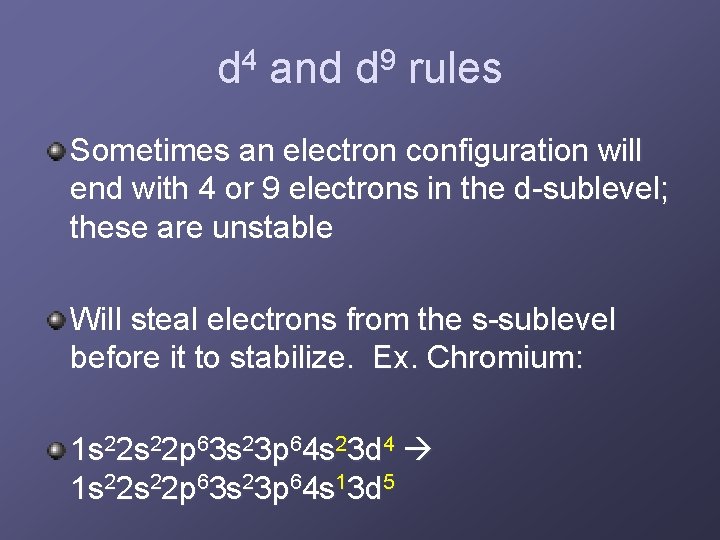
d 4 and d 9 rules Sometimes an electron configuration will end with 4 or 9 electrons in the d-sublevel; these are unstable Will steal electrons from the s-sublevel before it to stabilize. Ex. Chromium: 1 s 22 p 63 s 23 p 64 s 23 d 4 1 s 22 p 63 s 23 p 64 s 13 d 5
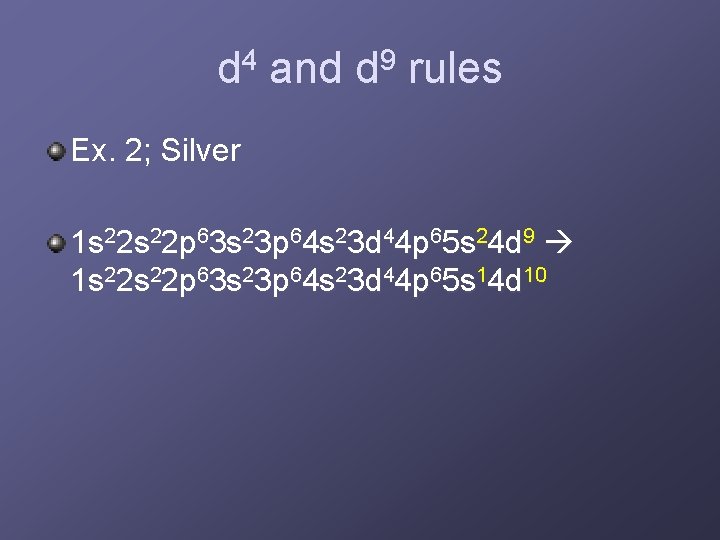
d 4 and d 9 rules Ex. 2; Silver 1 s 22 p 63 s 23 p 64 s 23 d 44 p 65 s 24 d 9 1 s 22 p 63 s 23 p 64 s 23 d 44 p 65 s 14 d 10
The Noble Gas Configuration An obvious solution and convenient short cut!
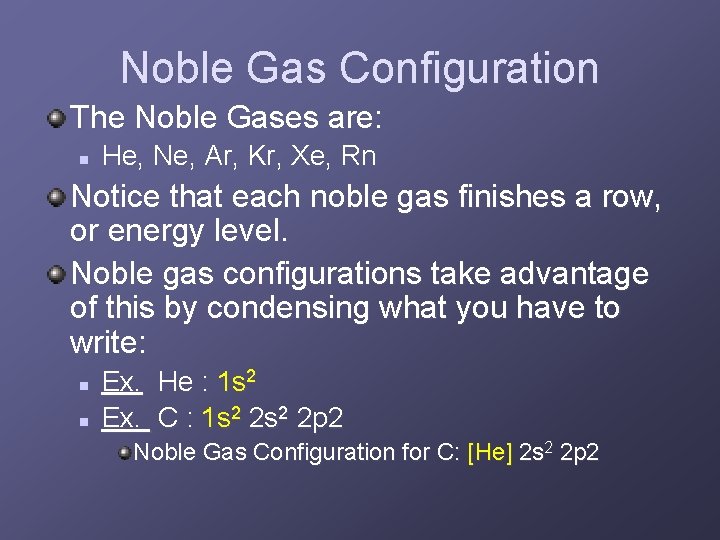
Noble Gas Configuration The Noble Gases are: n He, Ne, Ar, Kr, Xe, Rn Notice that each noble gas finishes a row, or energy level. Noble gas configurations take advantage of this by condensing what you have to write: n n Ex. He : 1 s 2 Ex. C : 1 s 2 2 p 2 Noble Gas Configuration for C: [He] 2 s 2 2 p 2
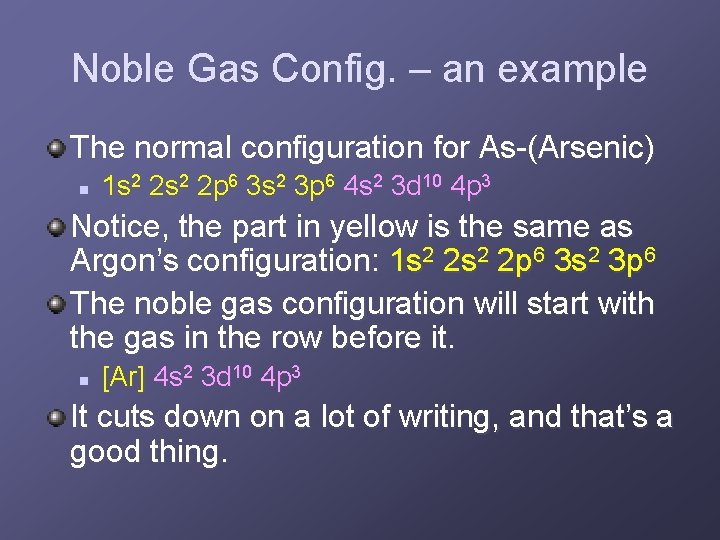
Noble Gas Config. – an example The normal configuration for As-(Arsenic) n 1 s 2 2 p 6 3 s 2 3 p 6 4 s 2 3 d 10 4 p 3 Notice, the part in yellow is the same as Argon’s configuration: 1 s 2 2 p 6 3 s 2 3 p 6 The noble gas configuration will start with the gas in the row before it. n [Ar] 4 s 2 3 d 10 4 p 3 It cuts down on a lot of writing, and that’s a good thing.
Orbital Diagrams They’re Useful!
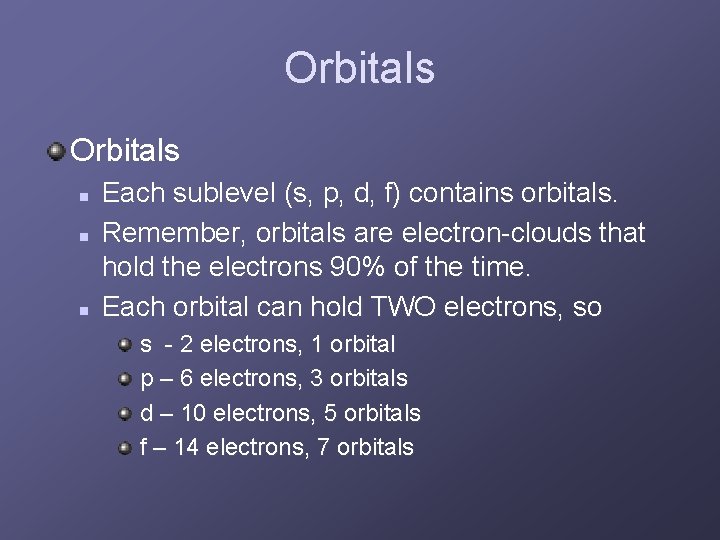
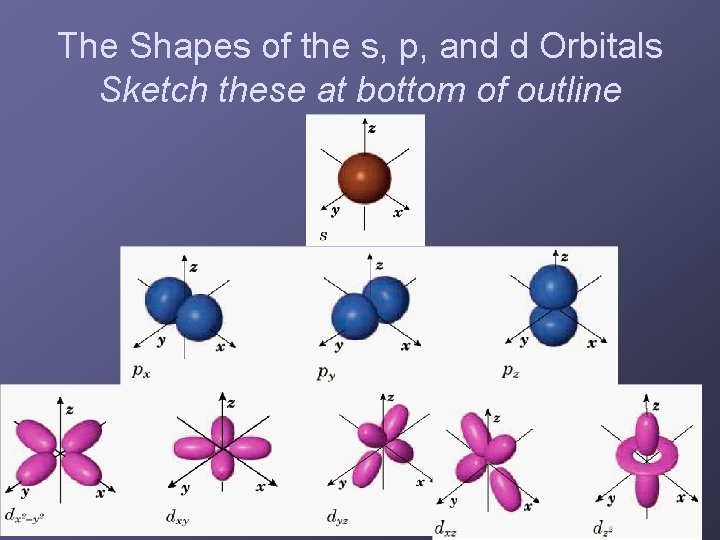
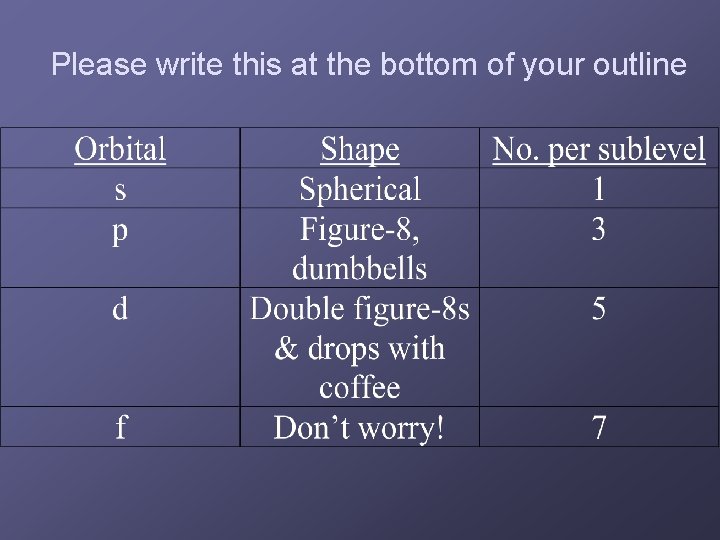
Orbitals n n n Each sublevel (s, p, d, f) contains orbitals. Remember, orbitals are electron-clouds that hold the electrons 90% of the time. Each orbital can hold TWO electrons, so s - 2 electrons, 1 orbital p – 6 electrons, 3 orbitals d – 10 electrons, 5 orbitals f – 14 electrons, 7 orbitals
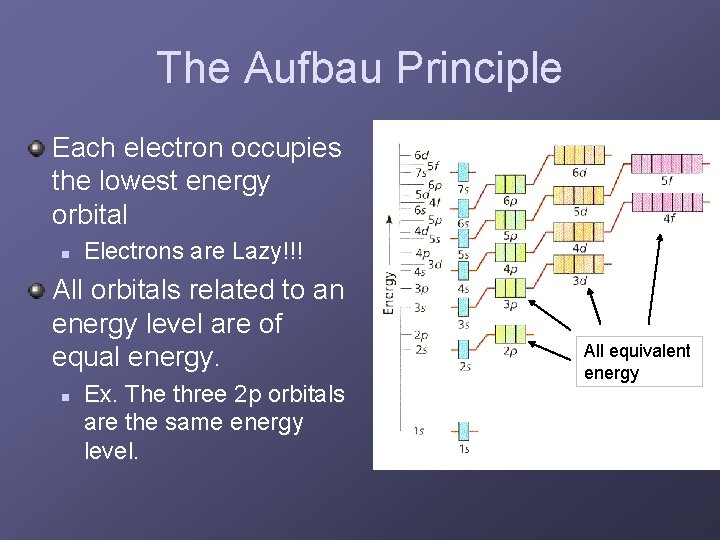
The Aufbau Principle Each electron occupies the lowest energy orbital n Electrons are Lazy!!! All orbitals related to an energy level are of equal energy. n Ex. The three 2 p orbitals are the same energy level. All equivalent energy
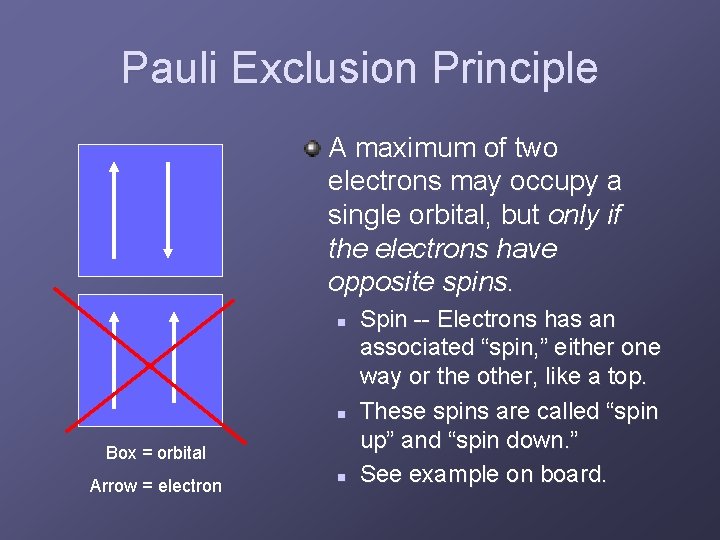
Pauli Exclusion Principle A maximum of two electrons may occupy a single orbital, but only if the electrons have opposite spins. n n Box = orbital Arrow = electron n Spin -- Electrons has an associated “spin, ” either one way or the other, like a top. These spins are called “spin up” and “spin down. ” See example on board.
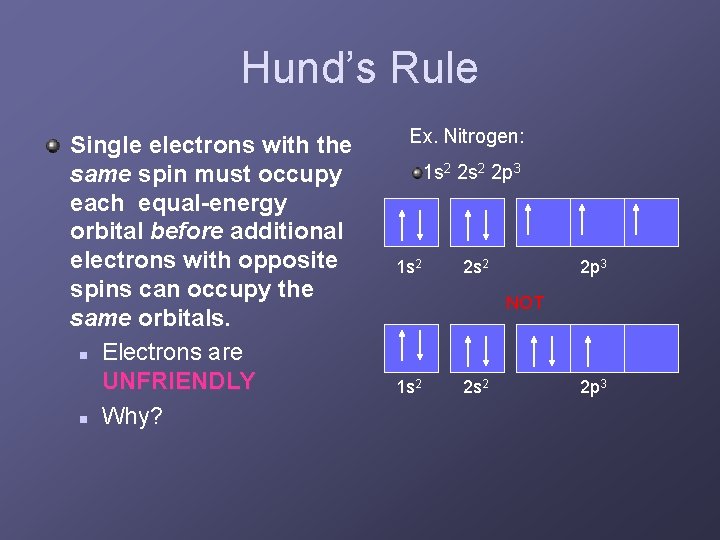
Hund’s Rule Single electrons with the same spin must occupy each equal-energy orbital before additional electrons with opposite spins can occupy the same orbitals. n Electrons are UNFRIENDLY n Why? Ex. Nitrogen: 1 s 2 2 s 2 2 p 3 NOT 1 s 2 2 p 3
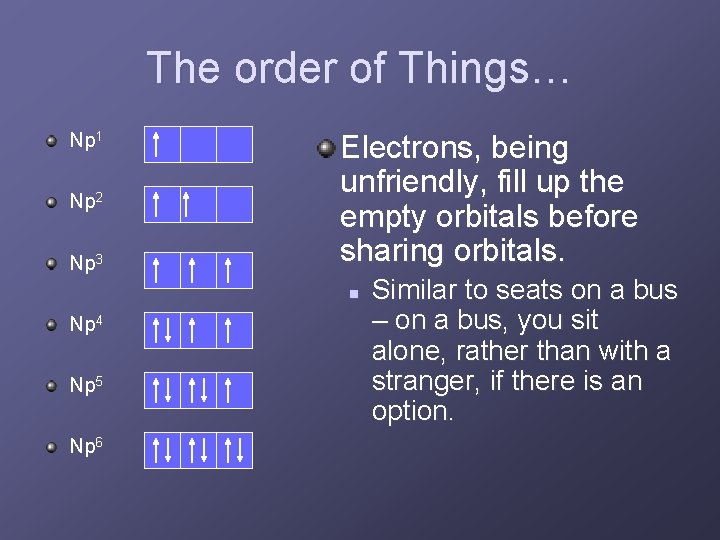
The order of Things… Np 1 Np 2 Np 3 Electrons, being unfriendly, fill up the empty orbitals before sharing orbitals. n Np 4 Np 5 Np 6 Similar to seats on a bus – on a bus, you sit alone, rather than with a stranger, if there is an option.
The Shapes of the s, p, and d Orbitals Sketch these at bottom of outline
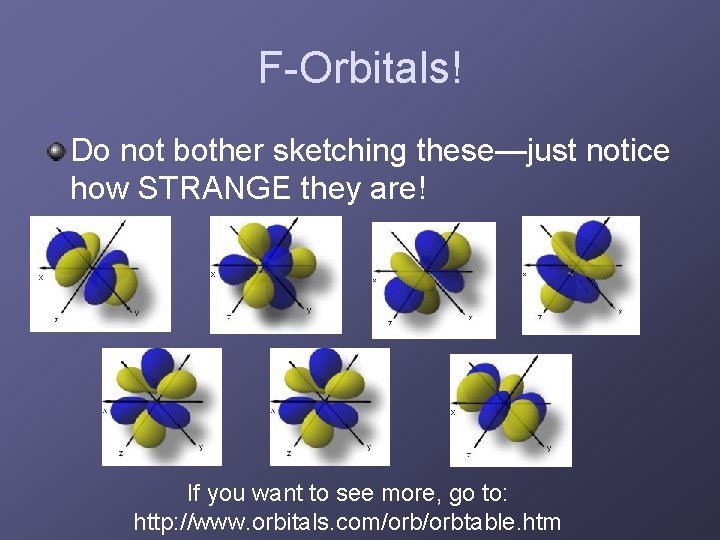
F-Orbitals! Do not bother sketching these—just notice how STRANGE they are! If you want to see more, go to: http: //www. orbitals. com/orbtable. htm
Please write this at the bottom of your outline
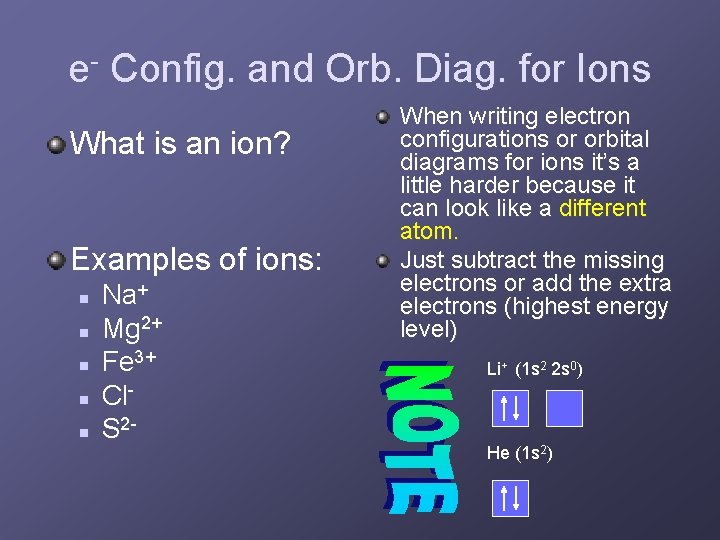
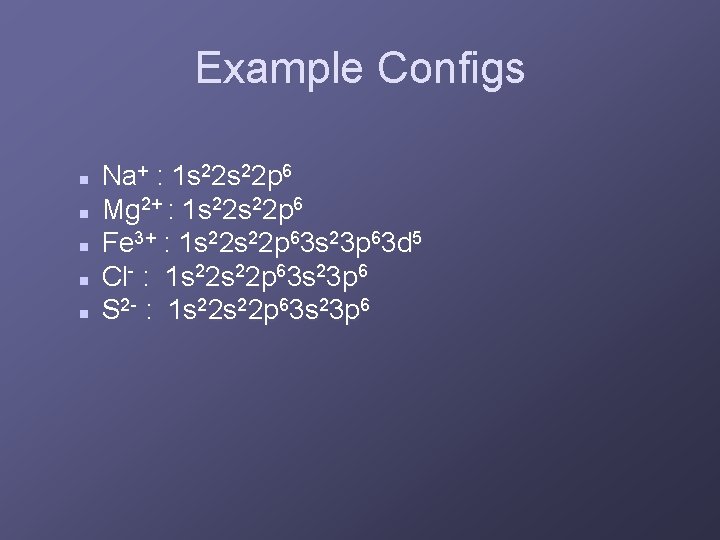
e- Config. and Orb. Diag. for Ions What is an ion? Examples of ions: n n n Na+ Mg 2+ Fe 3+ Cl. S 2 - When writing electron configurations or orbital diagrams for ions it’s a little harder because it can look like a different atom. Just subtract the missing electrons or add the extra electrons (highest energy level) Li+ (1 s 2 2 s 0) He (1 s 2)
Example Configs n n n Na+ : 1 s 22 p 6 Mg 2+ : 1 s 22 p 6 Fe 3+ : 1 s 22 p 63 s 23 p 63 d 5 Cl- : 1 s 22 p 63 s 23 p 6 S 2 - : 1 s 22 p 63 s 23 p 6