
Electron Configuration Periodic Table n Noble gas core
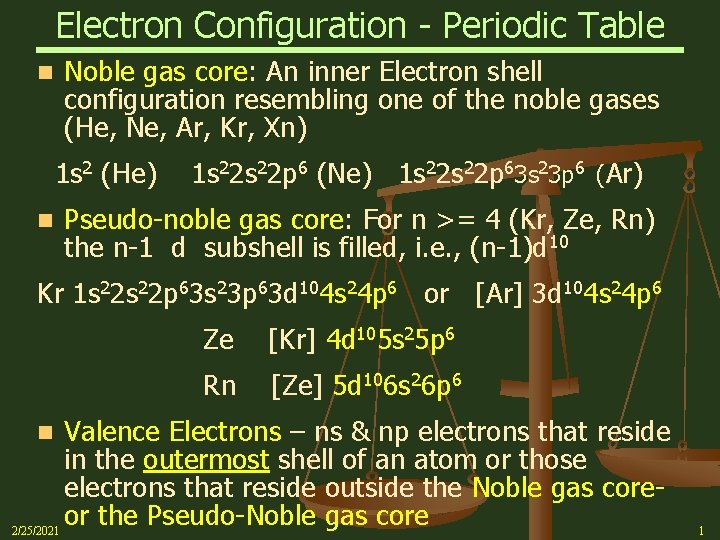
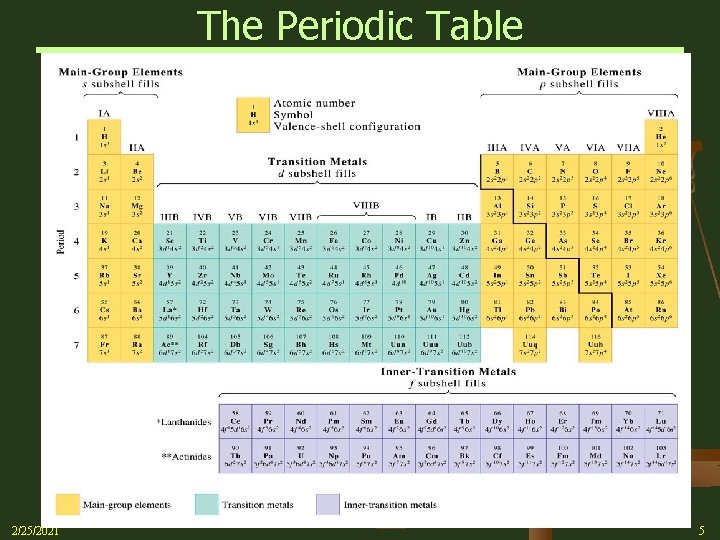
Electron Configuration - Periodic Table n Noble gas core: An inner Electron shell configuration resembling one of the noble gases (He, Ne, Ar, Kr, Xn) 1 s 2 (He) n 1 s 22 p 6 (Ne) 1 s 22 p 63 s 23 p 6 (Ar) Pseudo-noble gas core: For n >= 4 (Kr, Ze, Rn) the n-1 d subshell is filled, i. e. , (n-1)d 10 Kr 1 s 22 p 63 s 23 p 63 d 104 s 24 p 6 or [Ar] 3 d 104 s 24 p 6 Ze [Kr] 4 d 105 s 25 p 6 Rn [Ze] 5 d 106 s 26 p 6 Valence Electrons – ns & np electrons that reside in the outermost shell of an atom or those electrons that reside outside the Noble gas coreor the Pseudo-Noble gas core 2/25/2021 n 1
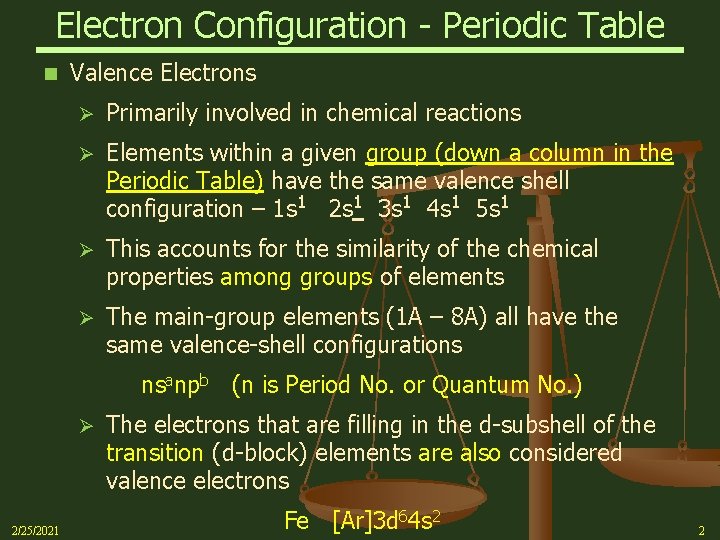
Electron Configuration - Periodic Table n Valence Electrons Ø Primarily involved in chemical reactions Ø Elements within a given group (down a column in the Periodic Table) have the same valence shell configuration – 1 s 1 2 s 1 3 s 1 4 s 1 5 s 1 Ø This accounts for the similarity of the chemical properties among groups of elements Ø The main-group elements (1 A – 8 A) all have the same valence-shell configurations nsanpb (n is Period No. or Quantum No. ) Ø 2/25/2021 The electrons that are filling in the d-subshell of the transition (d-block) elements are also considered valence electrons Fe [Ar]3 d 64 s 2 2
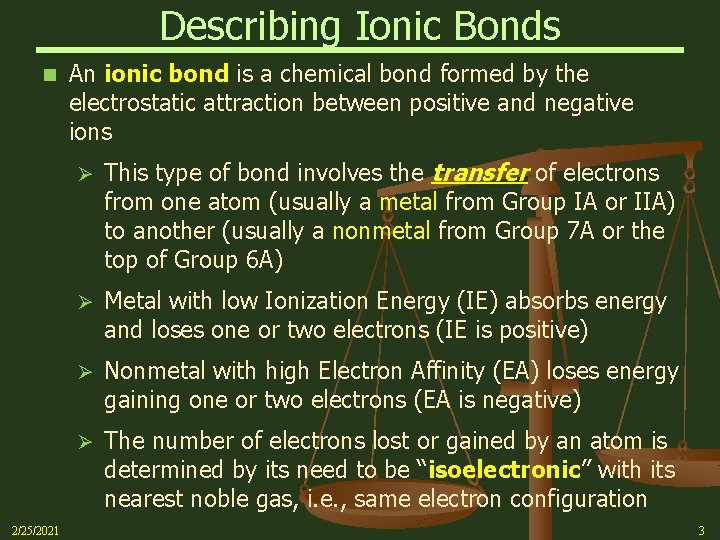
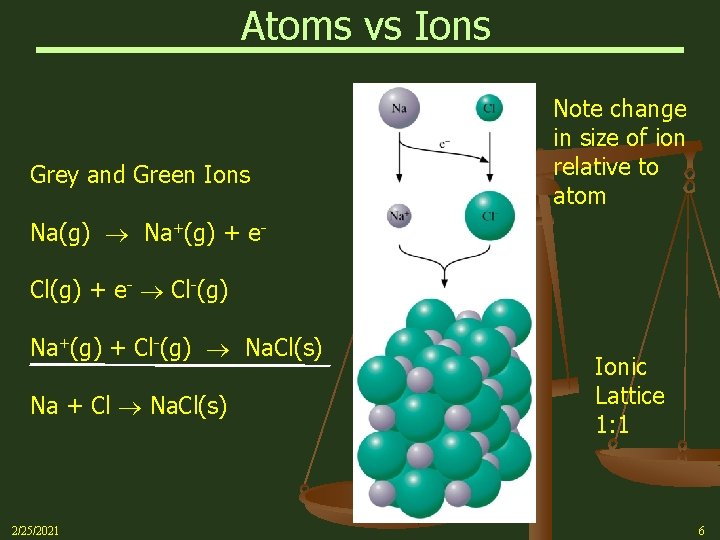
Describing Ionic Bonds n 2/25/2021 An ionic bond is a chemical bond formed by the electrostatic attraction between positive and negative ions Ø This type of bond involves the transfer of electrons from one atom (usually a metal from Group IA or IIA) to another (usually a nonmetal from Group 7 A or the top of Group 6 A) Ø Metal with low Ionization Energy (IE) absorbs energy and loses one or two electrons (IE is positive) Ø Nonmetal with high Electron Affinity (EA) loses energy gaining one or two electrons (EA is negative) Ø The number of electrons lost or gained by an atom is determined by its need to be “isoelectronic” with its nearest noble gas, i. e. , same electron configuration 3
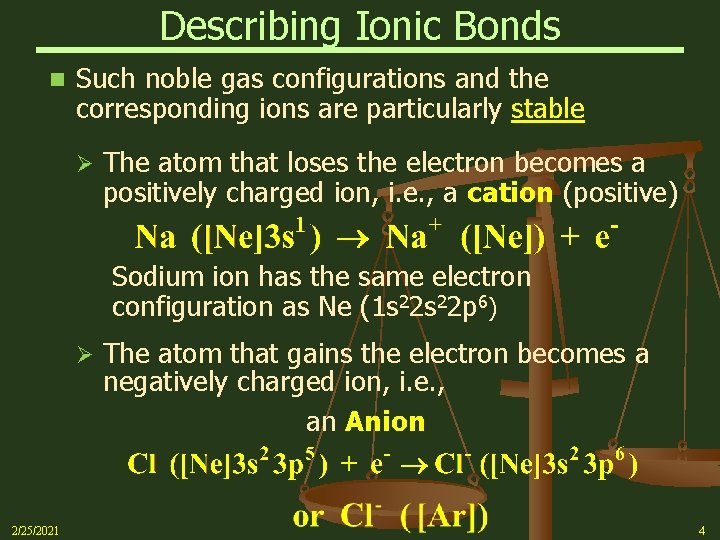
Describing Ionic Bonds n Such noble gas configurations and the corresponding ions are particularly stable Ø The atom that loses the electron becomes a positively charged ion, i. e. , a cation (positive) Sodium ion has the same electron configuration as Ne (1 s 22 p 6) Ø 2/25/2021 The atom that gains the electron becomes a negatively charged ion, i. e. , an Anion 4
The Periodic Table 2/25/2021 5
Atoms vs Ions Grey and Green Ions Note change in size of ion relative to atom Na(g) Na+(g) + e. Cl(g) + e- Cl-(g) Na+(g) + Cl-(g) Na. Cl(s) Na + Cl Na. Cl(s) 2/25/2021 Ionic Lattice 1: 1 6
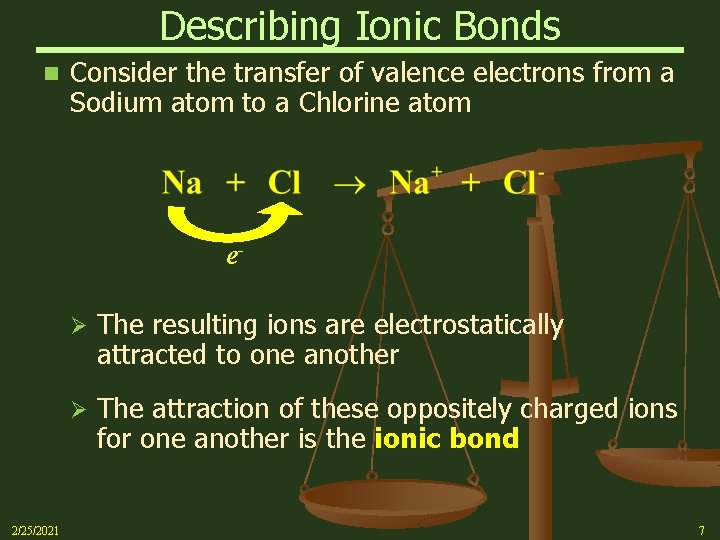
Describing Ionic Bonds n Consider the transfer of valence electrons from a Sodium atom to a Chlorine atom e- 2/25/2021 Ø The resulting ions are electrostatically attracted to one another Ø The attraction of these oppositely charged ions for one another is the ionic bond 7
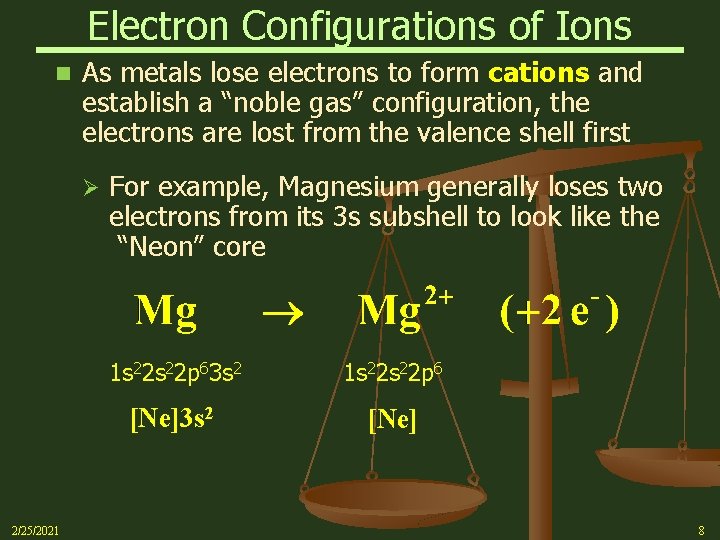
Electron Configurations of Ions n As metals lose electrons to form cations and establish a “noble gas” configuration, the electrons are lost from the valence shell first Ø 2/25/2021 For example, Magnesium generally loses two electrons from its 3 s subshell to look like the “Neon” core 1 s 22 p 63 s 2 1 s 22 p 6 [Ne]3 s 2 [Ne] 8
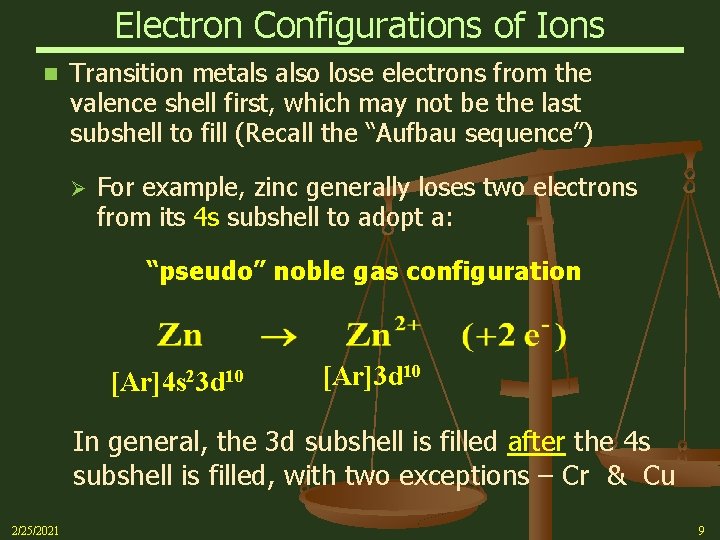
Electron Configurations of Ions n Transition metals also lose electrons from the valence shell first, which may not be the last subshell to fill (Recall the “Aufbau sequence”) Ø For example, zinc generally loses two electrons from its 4 s subshell to adopt a: “pseudo” noble gas configuration [Ar]4 s 23 d 10 [Ar]3 d 10 In general, the 3 d subshell is filled after the 4 s subshell is filled, with two exceptions – Cr & Cu 2/25/2021 9
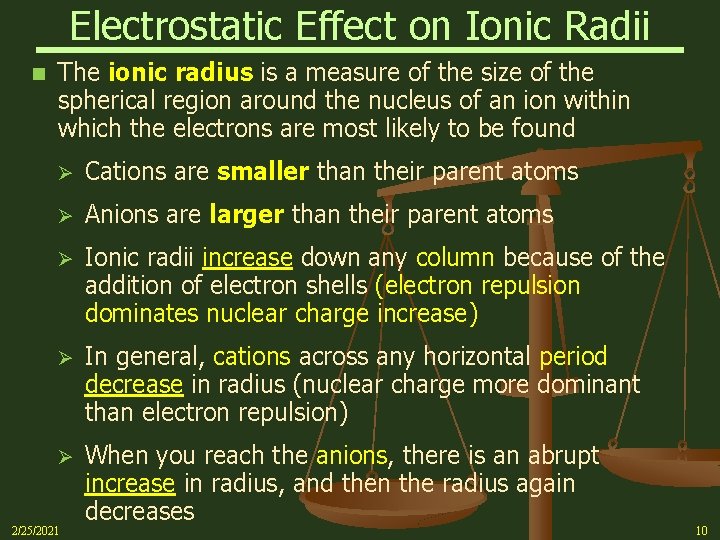
Electrostatic Effect on Ionic Radii n The ionic radius is a measure of the size of the spherical region around the nucleus of an ion within which the electrons are most likely to be found Ø Cations are smaller than their parent atoms Ø Anions are larger than their parent atoms Ø Ionic radii increase down any column because of the addition of electron shells (electron repulsion dominates nuclear charge increase) Ø In general, cations across any horizontal period decrease in radius (nuclear charge more dominant than electron repulsion) Ø When you reach the anions, there is an abrupt increase in radius, and then the radius again decreases 2/25/2021 10
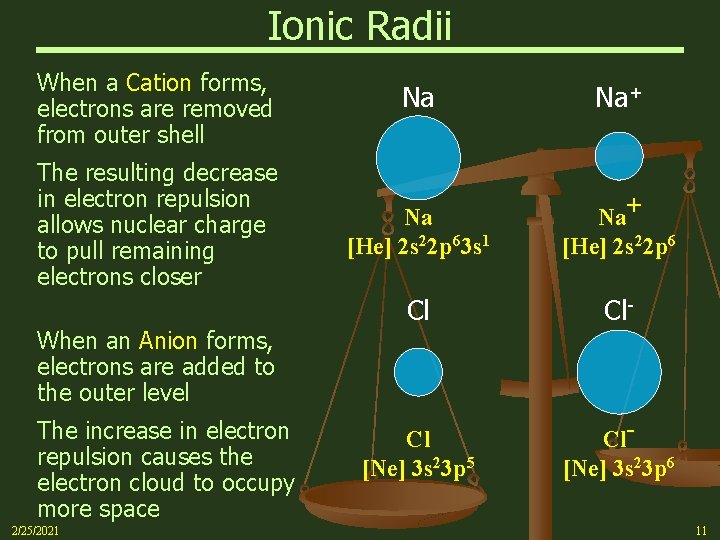
Ionic Radii When a Cation forms, electrons are removed from outer shell The resulting decrease in electron repulsion allows nuclear charge to pull remaining electrons closer When an Anion forms, electrons are added to the outer level The increase in electron repulsion causes the electron cloud to occupy more space 2/25/2021 Na Na+ Na [He] 2 s 22 p 63 s 1 Na+ [He] 2 s 22 p 6 Cl Cl- Cl [Ne] 3 s 23 p 5 Cl[Ne] 3 s 23 p 6 11
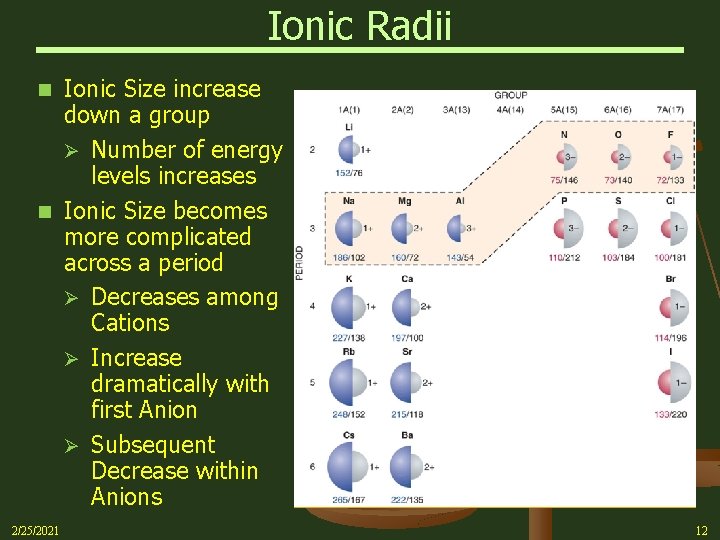
Ionic Radii Ionic Size increase down a group Ø Number of energy levels increases n Ionic Size becomes more complicated across a period Ø Decreases among Cations Ø Increase dramatically with first Anion Ø Subsequent Decrease within Anions n 2/25/2021 12
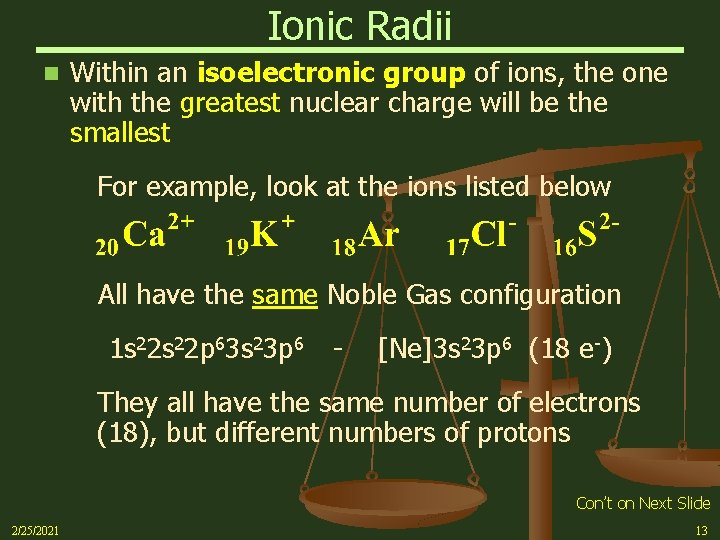
Ionic Radii n Within an isoelectronic group of ions, the one with the greatest nuclear charge will be the smallest For example, look at the ions listed below All have the same Noble Gas configuration 1 s 22 p 63 s 23 p 6 - [Ne]3 s 23 p 6 (18 e-) They all have the same number of electrons (18), but different numbers of protons Con’t on Next Slide 2/25/2021 13
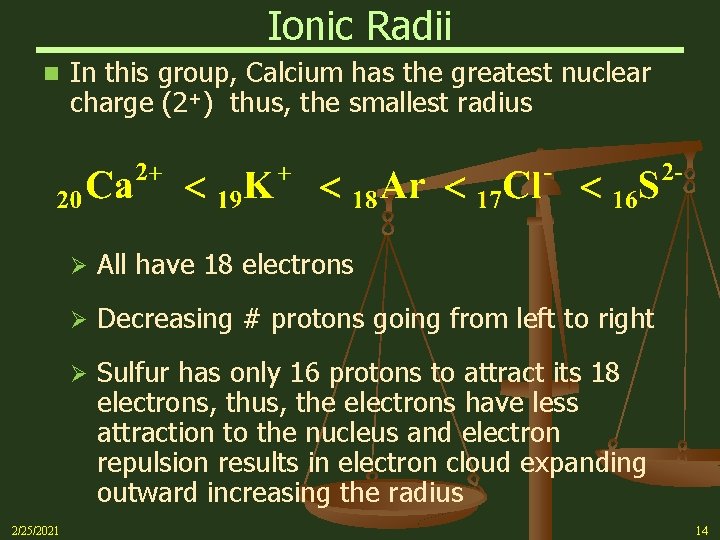
Ionic Radii n 2/25/2021 In this group, Calcium has the greatest nuclear charge (2+) thus, the smallest radius Ø All have 18 electrons Ø Decreasing # protons going from left to right Ø Sulfur has only 16 protons to attract its 18 electrons, thus, the electrons have less attraction to the nucleus and electron repulsion results in electron cloud expanding outward increasing the radius 14
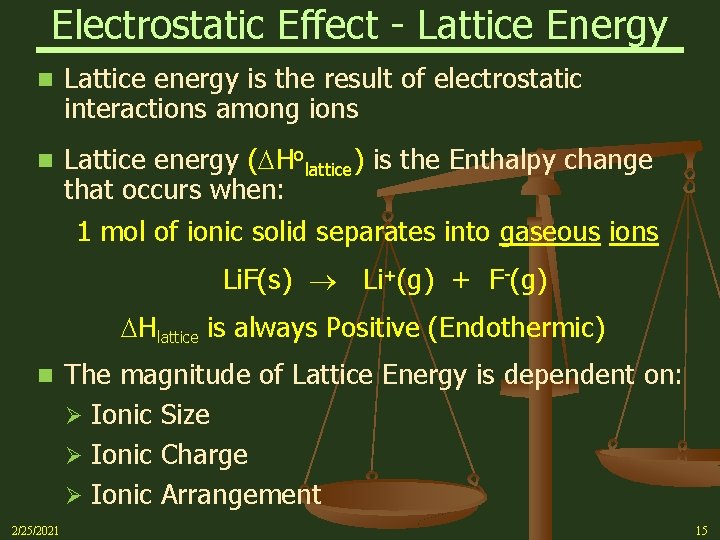
Electrostatic Effect - Lattice Energy n Lattice energy is the result of electrostatic interactions among ions n Lattice energy ( Holattice) is the Enthalpy change that occurs when: 1 mol of ionic solid separates into gaseous ions Li. F(s) Li+(g) + F-(g) Hlattice is always Positive (Endothermic) n 2/25/2021 The magnitude of Lattice Energy is dependent on: Ø Ionic Size Ø Ionic Charge Ø Ionic Arrangement 15
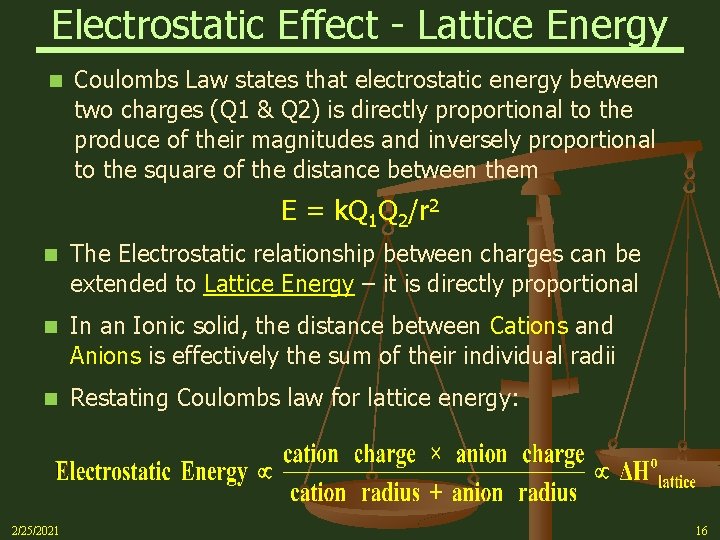
Electrostatic Effect - Lattice Energy n Coulombs Law states that electrostatic energy between two charges (Q 1 & Q 2) is directly proportional to the produce of their magnitudes and inversely proportional to the square of the distance between them E = k. Q 1 Q 2/r 2 n The Electrostatic relationship between charges can be extended to Lattice Energy – it is directly proportional n In an Ionic solid, the distance between Cations and Anions is effectively the sum of their individual radii n Restating Coulombs law for lattice energy: 2/25/2021 16
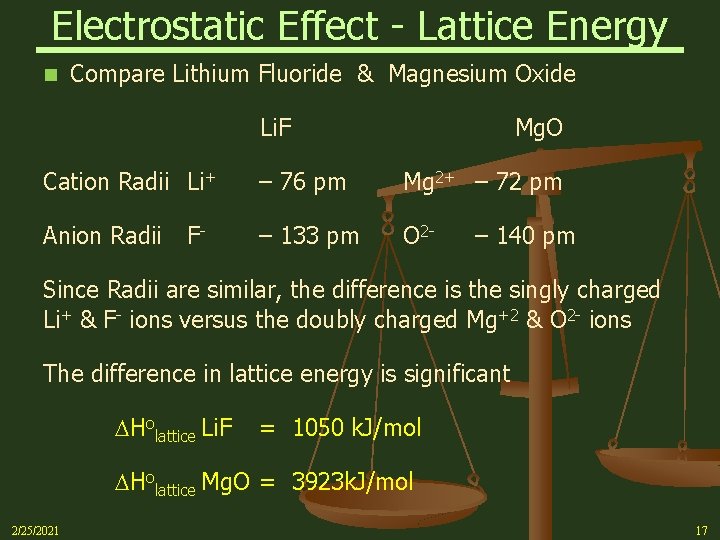
Electrostatic Effect - Lattice Energy n Compare Lithium Fluoride & Magnesium Oxide Li. F Mg. O Cation Radii Li+ – 76 pm Mg 2+ – 72 pm Anion Radii – 133 pm O 2 - F- – 140 pm Since Radii are similar, the difference is the singly charged Li+ & F- ions versus the doubly charged Mg+2 & O 2 - ions The difference in lattice energy is significant Holattice Li. F = 1050 k. J/mol Holattice Mg. O = 3923 k. J/mol 2/25/2021 17
Electrostatic Effect - Lattice Energy n The transfer of an electron from a metal to a nonmetal is not, in itself, energetically favorable; it requires an input of energy ( H positive) n However, when these oppositely charged ions come together, energy is released ( H negative) n Additional energy is released when the ion pairs get close enough to actually solidify into the ionic solid n This net release of energy (- H) for the formation of an ionic solid from the separate gaseous ions is the negative of the lattice energy ( Hlattice), which is always positive 2/25/2021 18
Electrostatic Effect - Lattice Energy n n Lattice energy can not be measured directly It is determined from Hess’s Law, which states: The total Enthalpy change ( Hof) is the sum of the Enthalpy changes of all individual reactions Hof = Ho 1 + Ho 2 + Ho 3 + …… + (- Holattice) Ø 2/25/2021 The law follows from the fact that H for a process depends only on the difference between the final and initial states l An overall reaction occurs through a series of individual reactions steps l Each step has its own Enthalpy change - H l Adding the steps gives the overall process 19
Born-Haber Process Use the Born-Haber cycle to compute lattice energy (unknown) from known Enthalpies n The Born–Haber cycle is an approach to analyzing reaction energies n The cycle is concerned with the formation of an ionic compound from the reaction of a metal (often a Group I or Group II element) with a non -metal n Born–Haber cycles are used primarily as a means of calculating Lattice Energies (or more precisely Enthalpies) which cannot otherwise be measured directly n 2/25/2021 20
Born-Haber Process n Recall the Lattice energy is the Enthalpy change involved in the formation of an ionic compound from gaseous ions n Some chemists define it as the energy to break the ionic compound into gaseous ions n The former definition is invariably Exothermic and the latter is Endothermic n A Born–Haber cycle applies Hess’s Law to calculate the Lattice Enthalpy by comparing the standard Enthalpy change of formation of the ionic compound (from the elements) to the Enthalpy required to make gaseous ions from the elements 2/25/2021 21
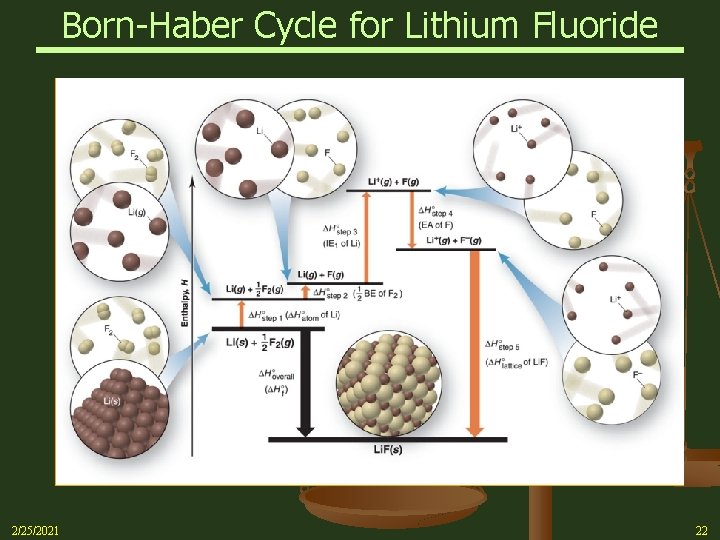
Born-Haber Cycle for Lithium Fluoride 2/25/2021 22
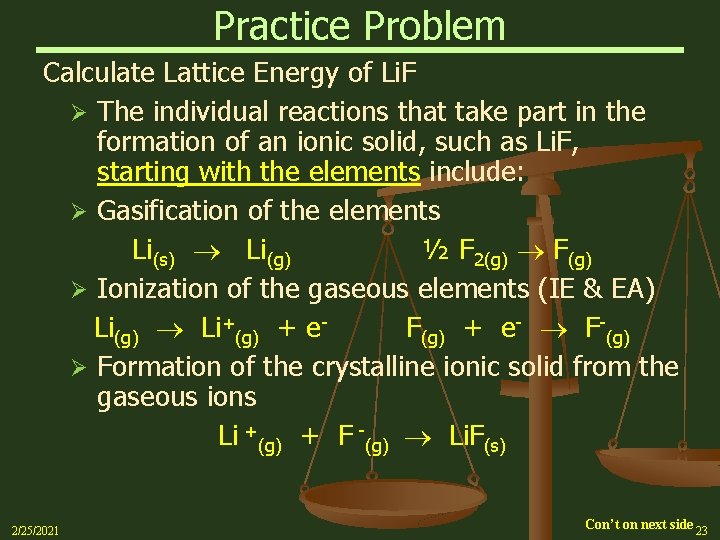
Practice Problem Calculate Lattice Energy of Li. F Ø The individual reactions that take part in the formation of an ionic solid, such as Li. F, starting with the elements include: Ø Gasification of the elements Li(s) Li(g) ½ F 2(g) F(g) Ø Ionization of the gaseous elements (IE & EA) Li(g) Li+(g) + e. F(g) + e- F-(g) Ø Formation of the crystalline ionic solid from the gaseous ions Li +(g) + F -(g) Li. F(s) 2/25/2021 Con’t on next side 23
Practice Problem n Lattice Energies are calculated by means of the Born-Haber Cycle, a series of chosen steps from elements to ionic solid n Example Problem - Calculate Lattice Energy in the formation of Lithium Fluoride (Li. F) Hof of Li. F(s) = sum of Ho values for multistep path Step 1 – Convert 1 mole solid Li to gaseous atoms Li(s) Li(g) Hostep 1 = 161 k. J Con’t on next side 2/25/2021 24
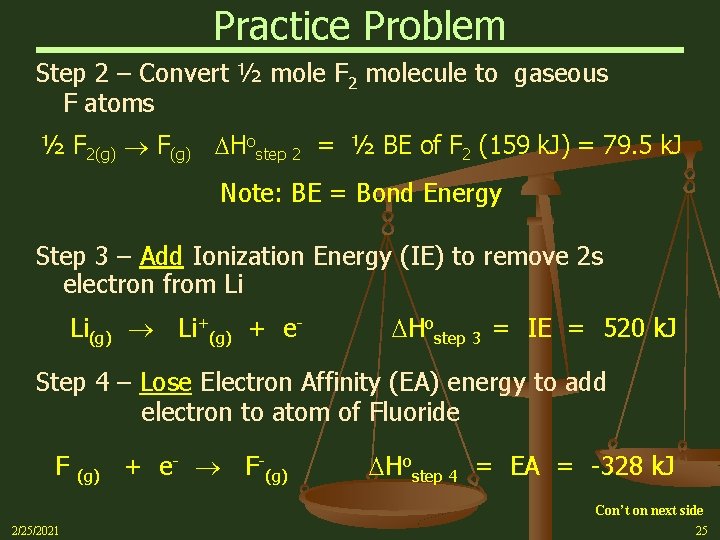
Practice Problem Step 2 – Convert ½ mole F 2 molecule to gaseous F atoms ½ F 2(g) F(g) Hostep 2 = ½ BE of F 2 (159 k. J) = 79. 5 k. J Note: BE = Bond Energy Step 3 – Add Ionization Energy (IE) to remove 2 s electron from Li Li(g) Li+(g) + e- Hostep 3 = IE = 520 k. J Step 4 – Lose Electron Affinity (EA) energy to add electron to atom of Fluoride F (g) + e- F-(g) Hostep 4 = EA = -328 k. J Con’t on next side 2/25/2021 25
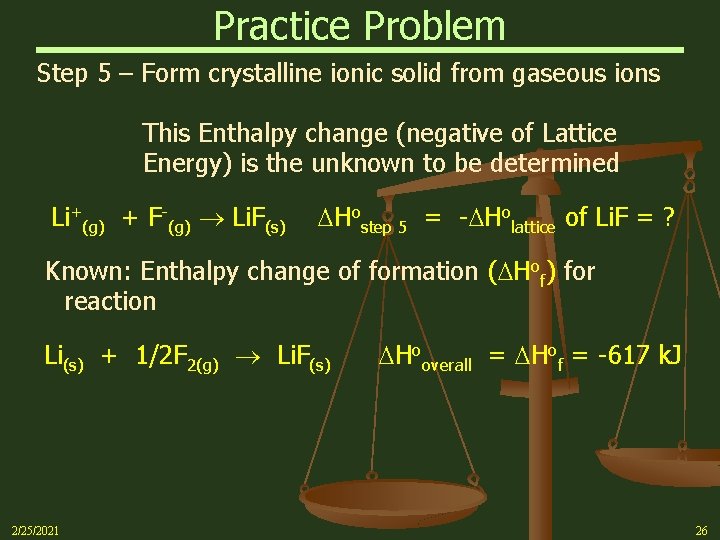
Practice Problem Step 5 – Form crystalline ionic solid from gaseous ions This Enthalpy change (negative of Lattice Energy) is the unknown to be determined Li+(g) + F-(g) Li. F(s) Hostep 5 = - Holattice of Li. F = ? Known: Enthalpy change of formation ( Hof) for reaction Li(s) + 1/2 F 2(g) Li. F(s) 2/25/2021 Hooverall = Hof = -617 k. J 26
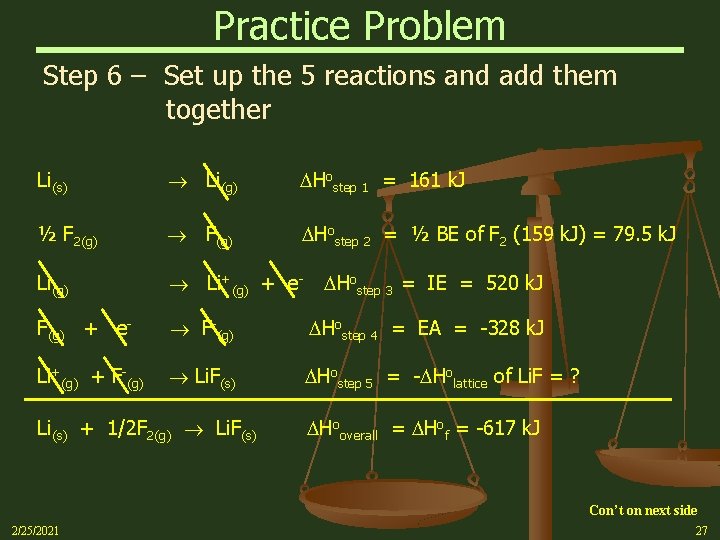
Practice Problem Step 6 – Set up the 5 reactions and add them together Li(s) Li(g) Hostep 1 = 161 k. J ½ F 2(g) F(g) Hostep 2 = ½ BE of F 2 (159 k. J) = 79. 5 k. J Li(g) Li+(g) + e- F(g) + e- F-(g) Hostep 4 = EA = -328 k. J Li+(g) + F-(g) Li. F(s) Hostep 5 = - Holattice of Li. F = ? Li(s) + 1/2 F 2(g) Li. F(s) Hostep 3 = IE = 520 k. J Hooverall = Hof = -617 k. J Con’t on next side 2/25/2021 27
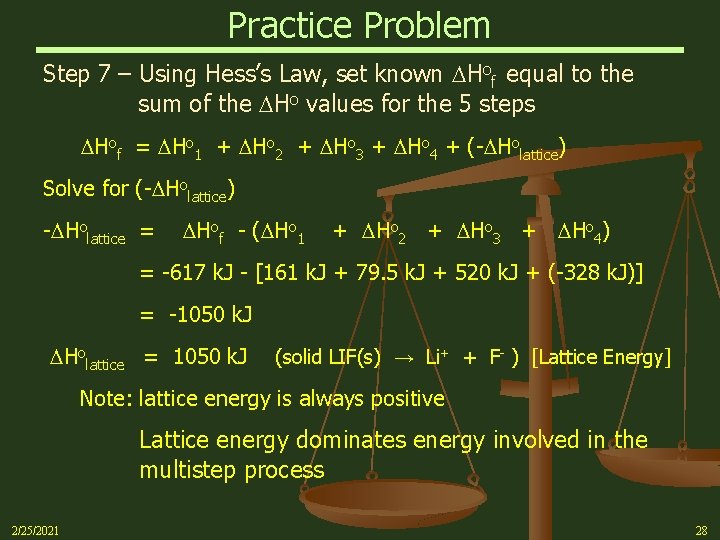
Practice Problem Step 7 – Using Hess’s Law, set known Hof equal to the sum of the Ho values for the 5 steps Hof = Ho 1 + Ho 2 + Ho 3 + Ho 4 + (- Holattice) Solve for (- Holattice) - Holattice = Hof - ( Ho 1 + Ho 2 + Ho 3 + Ho 4) = -617 k. J - [161 k. J + 79. 5 k. J + 520 k. J + (-328 k. J)] = -1050 k. J Holattice = 1050 k. J (solid LIF(s) → Li+ + F- ) [Lattice Energy] Note: lattice energy is always positive Lattice energy dominates energy involved in the multistep process 2/25/2021 28
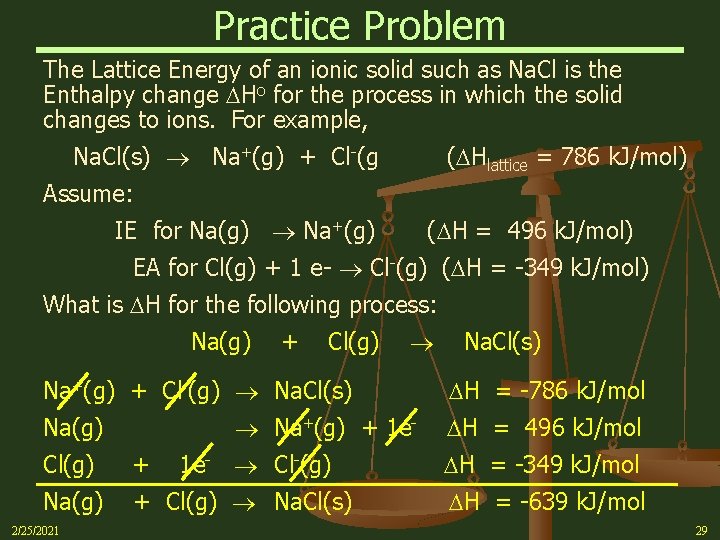
Practice Problem The Lattice Energy of an ionic solid such as Na. Cl is the Enthalpy change Ho for the process in which the solid changes to ions. For example, Na. Cl(s) Na+(g) + Cl-(g ( Hlattice = 786 k. J/mol) Assume: IE for Na(g) Na+(g) ( H = 496 k. J/mol) EA for Cl(g) + 1 e- Cl-(g) ( H = -349 k. J/mol) What is H for the following process: Na(g) + Cl(g) Na+(g) + Cl-(g) Na. Cl(s) Na+(g) + 1 e- Na(g) 1 e- Cl-(g) Cl(g) + Na(g) + Cl(g) Na. Cl(s) 2/25/2021 Na. Cl(s) H = -786 k. J/mol H = 496 k. J/mol H = -349 k. J/mol H = -639 k. J/mol 29
Properties of Ionic Compounds n Ionic Solids Ø Hard – Do not dent Ø Rigid – Do not bend Ø Brittle – Crack without deforming n Properties due to powerful attractive forces holding ions together n Moving ions out of position requires significant energy to overcome these forces 2/25/2021 30
Covalent Bonds n When two nonmetals bond, they often share electrons since they have similar attractions for them. This sharing of valence electrons is called the covalent bond Ø 2/25/2021 These atoms will share sufficient numbers of electrons in order to achieve a noble gas electron configuration (that is, eight valence electrons – ns 2 np 6) 31
Covalent Bonding n A Covalent Bond is formed through the sharing of two electrons n Covalent Bonding is an idealized bonding between two atoms, generally two nonmetals, with little difference in their tendencies to lose or gain electrons n Each nonmetal holds onto its own electrons tightly (high IE) and tends to attract other electrons (EA) n Shared electron pair is said to be localized, spending most of their time between two atoms n Covalent Bonding usually results in the formation of Molecules as opposed to individual ions in a bonded solid 2/25/2021 32
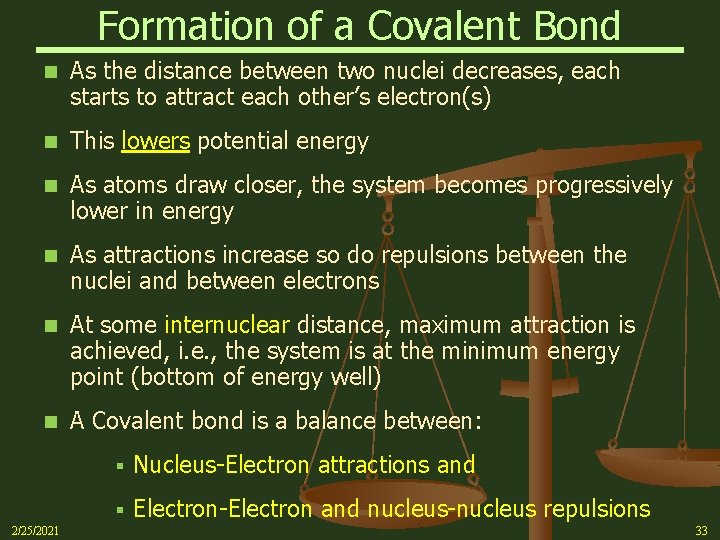
Formation of a Covalent Bond n As the distance between two nuclei decreases, each starts to attract each other’s electron(s) n This lowers potential energy n As atoms draw closer, the system becomes progressively lower in energy n As attractions increase so do repulsions between the nuclei and between electrons n At some internuclear distance, maximum attraction is achieved, i. e. , the system is at the minimum energy point (bottom of energy well) n A Covalent bond is a balance between: 2/25/2021 § Nucleus-Electron attractions and § Electron-Electron and nucleus-nucleus repulsions 33
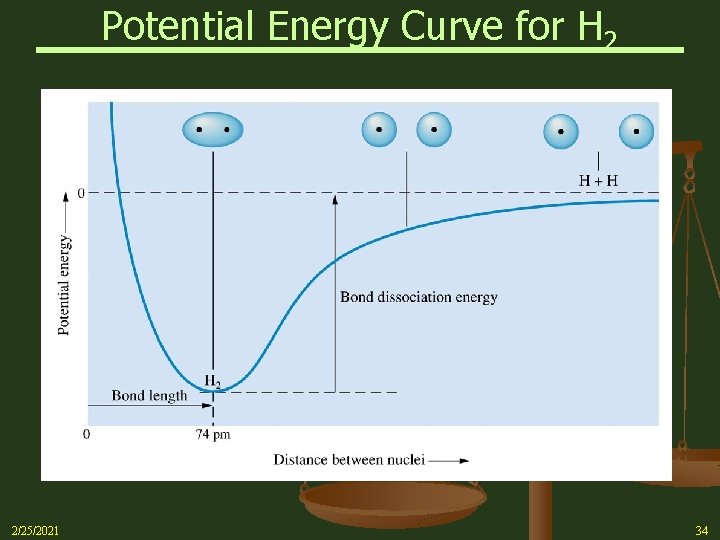
Potential Energy Curve for H 2 2/25/2021 34
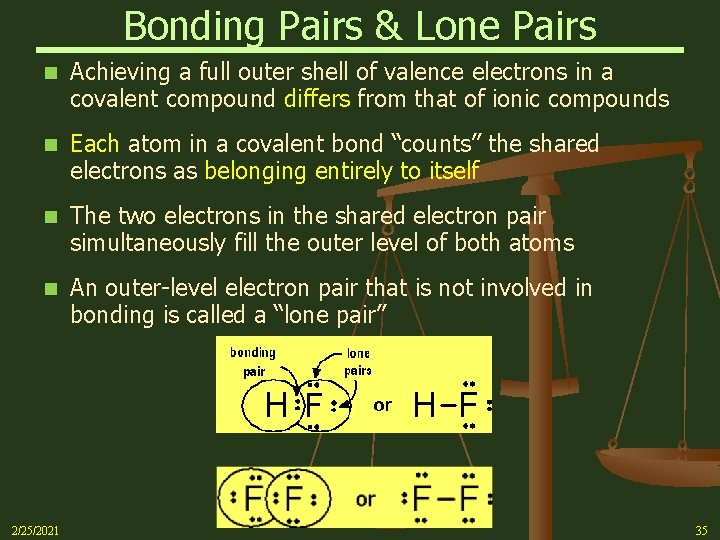
Bonding Pairs & Lone Pairs n Achieving a full outer shell of valence electrons in a covalent compound differs from that of ionic compounds n Each atom in a covalent bond “counts” the shared electrons as belonging entirely to itself n The two electrons in the shared electron pair simultaneously fill the outer level of both atoms n An outer-level electron pair that is not involved in bonding is called a “lone pair” 2/25/2021 35
Properties of Covalent Compounds n The Covalent Bond model proposes that electron sharing between pairs of atoms leads to strong, localized bonds, usually within individual molecules n Covalent substances are poor conductors of electricity because the electrons are localized as either shared or unshared pairs, i. e. they do not move like ions do in ionic compounds or metal/metal compounds) n This model appears inconsistent with observed physical properties of covalent substances 2/25/2021 Ø Most covalent substances are gases, liquids, or lowmelting solids Ø If covalent bonds are so strong, why do these substances melt and boil at such low temperatures? 36
Properties of Covalent Compounds n n 2/25/2021 There are two sets of forces at play with covalent compounds Ø Strong covalent bonding forces hold the atoms together within the molecule Ø Weak intermolecular forces hold separate molecules near each other in the macroscopic sample Ø It is the weak forces between the molecules, not the strong covalent bonds within each molecule, that are responsible for the observed physical properties There are some covalent substances called “network covalent solids” that do not consist of separate molecules, but are held together by covalent bonds that extend in three-dimensions throughout the sample, such as in diamonds and quartz 37
Metal with Metal Bonding n Metals are generally large and have few outer electrons which are well shielded by filled inner electron levels n The have low Ionization Energies (IE) – lose electrons easily, but do not gain them readily (slightly negative or positive Electron Affinity (EA) n Valence electrons are pooled and evenly distributed around metal-ion cores (nucleus plus inner electrons). n Such electrons are delocalized moving freely throughout the metal 2/25/2021 38
Practice Problem Which member of each pair is more metallic? a. Na or Cs b. Mg or Rb c. As or N Ans: Metallic behavior increases to the left and down on the periodic table a) Cs is more metallic since it is further down the alkali metal group than Na b) Rb is more metallic since it is both to the left and down from Mg c) As is more metallic since it is further down Group 5 A than N 2/25/2021 39
Practice Problem Which member of each pair is less metallic? a. I or O b. Be or Ba c. Se or Ge Ans: Metallic behavior increases to the left and down on the periodic table a. Oxygen (O) - slightly left, but much higher group–wise than Iodine (I) b. Beryllium (Be) - higher in the Group 2 A column than Barium (Ba) c. Selenium (Se) - further to the right than Germanium (Ge) on the Period 4 row 2/25/2021 40
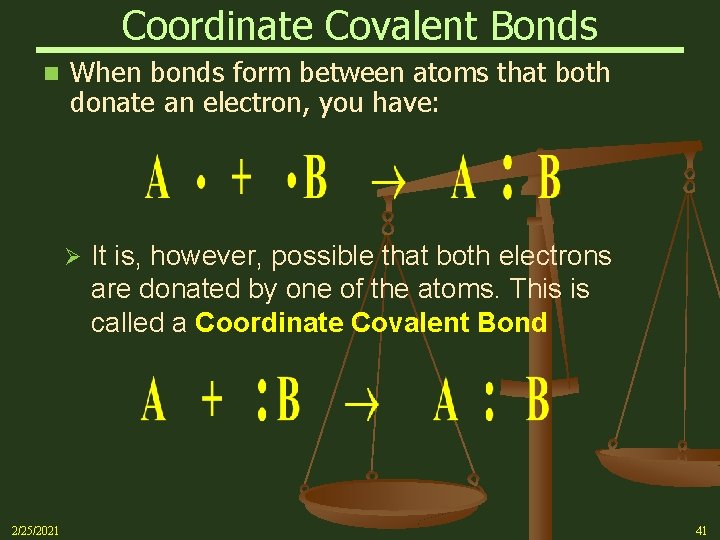
Coordinate Covalent Bonds n When bonds form between atoms that both donate an electron, you have: Ø 2/25/2021 It is, however, possible that both electrons are donated by one of the atoms. This is called a Coordinate Covalent Bond 41
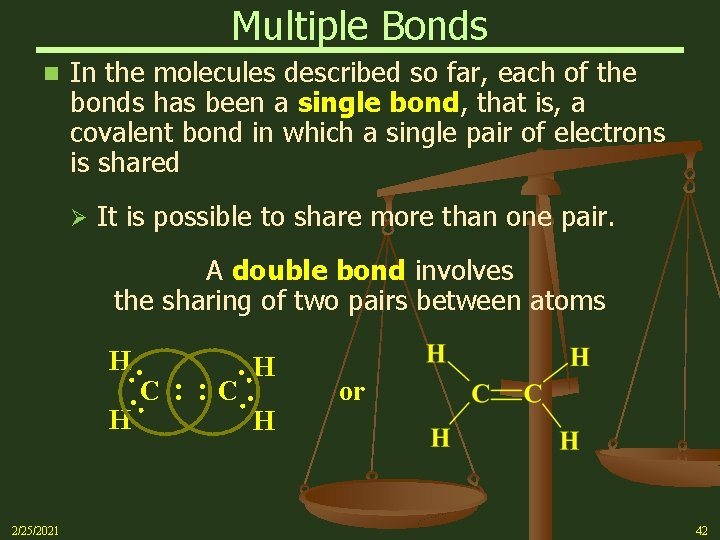
Multiple Bonds n In the molecules described so far, each of the bonds has been a single bond, that is, a covalent bond in which a single pair of electrons is shared Ø It is possible to share more than one pair. A double bond involves the sharing of two pairs between atoms : : H 2/25/2021 : : C : C H : H H or 42
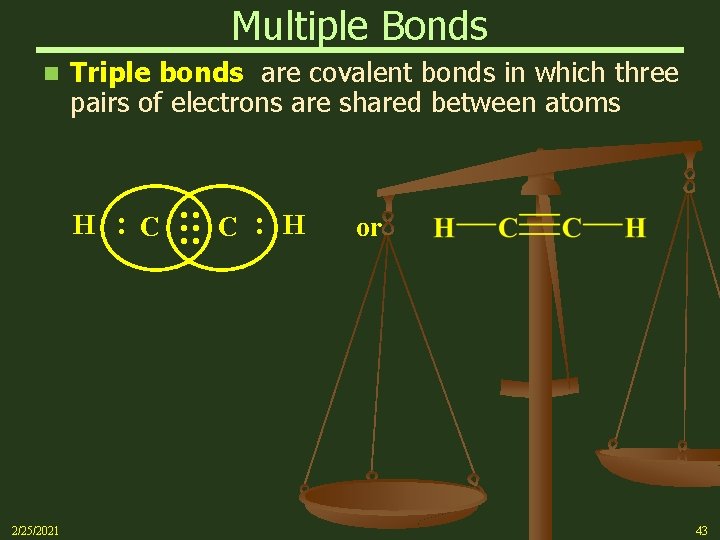
Multiple Bonds Triple bonds are covalent bonds in which three pairs of electrons are shared between atoms : 2/25/2021 C : : : H C : n H or 43
Polar Covalent Bonds n A polar covalent bond is one in which the bonding electrons spend more time near one of the two atoms involved Ø When the atoms are alike, as in the H-H bond of H 2, the bonding electrons are shared equally forming a: “nonpolar” covalent bond Ø When the two atoms are of different elements, thus, different electronegativities, the bonding electrons are not shared equally, resulting in a: “polar” covalent bond 2/25/2021 44
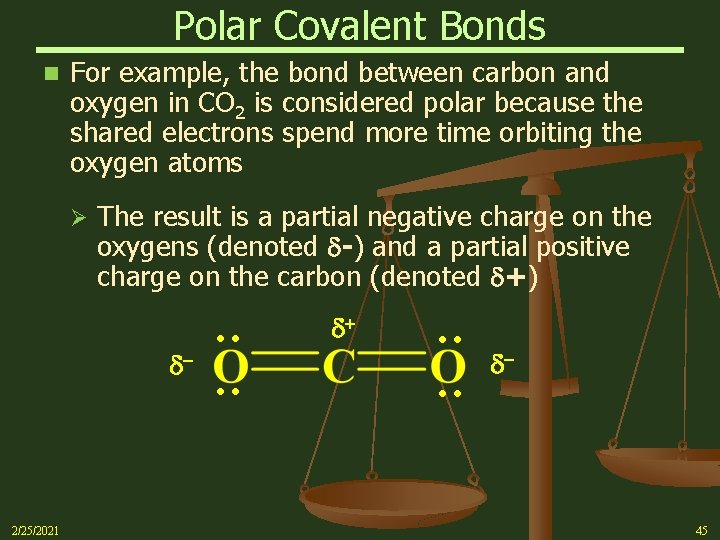
Polar Covalent Bonds n For example, the bond between carbon and oxygen in CO 2 is considered polar because the shared electrons spend more time orbiting the oxygen atoms Ø The result is a partial negative charge on the oxygens (denoted d-) and a partial positive charge on the carbon (denoted d+) : : 2/25/2021 : : d- d+ d- 45
Polar Covalent Bonds Ø Electronegativity is a measure of the ability of an atom in a molecule to draw bonding electrons to itself Ø Ø In general, electronegativity increases from the lower-left corner to the upper-right corner of the periodic table The current electronegativity scale, developed by Linus Pauling, assigns a value of 4. 0 to Fluorine and a value of 0. 7 to Cesium 2/25/2021 46
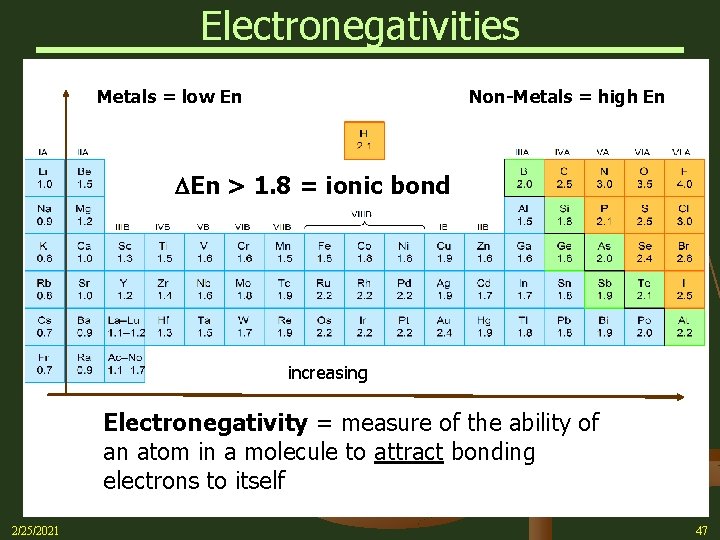
Electronegativities Metals = low En Non-Metals = high En > 1. 8 = ionic bond increasing Electronegativity = measure of the ability of an atom in a molecule to attract bonding electrons to itself 2/25/2021 47
Ionic vs Covalent Ø How to predict “Ionic” vs “Covalent” Ø The absolute value of the difference in electronegativity of two bonded atoms gives a rough measure of the polarity of the bond Ø 2/25/2021 When this difference is small (less than 0. 5), the bond is nonpolar Ø When this difference is large (greater than or equal to 0. 5), the bond is considered polar Ø If the difference exceeds approximately 1. 8, sharing of electrons is no longer possible and the bond becomes ionic 48
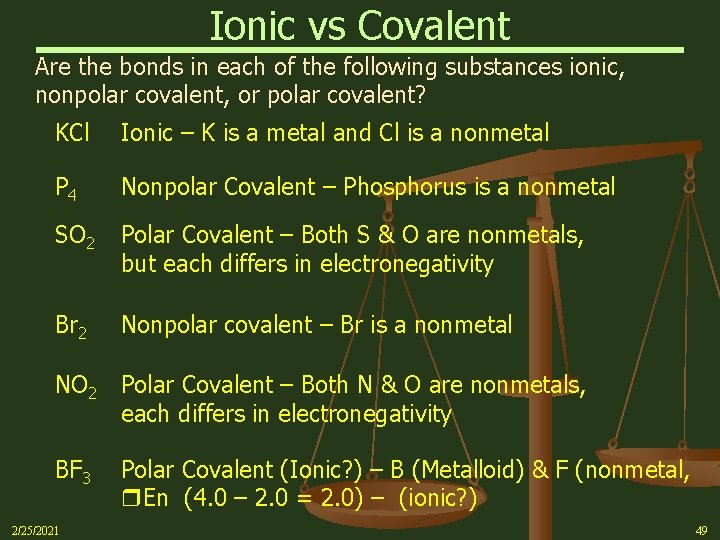
Ionic vs Covalent Are the bonds in each of the following substances ionic, nonpolar covalent, or polar covalent? KCl Ionic – K is a metal and Cl is a nonmetal P 4 Nonpolar Covalent – Phosphorus is a nonmetal SO 2 Polar Covalent – Both S & O are nonmetals, but each differs in electronegativity Br 2 Nonpolar covalent – Br is a nonmetal NO 2 Polar Covalent – Both N & O are nonmetals, each differs in electronegativity BF 3 Polar Covalent (Ionic? ) – B (Metalloid) & F (nonmetal, En (4. 0 – 2. 0 = 2. 0) – (ionic? ) 2/25/2021 49
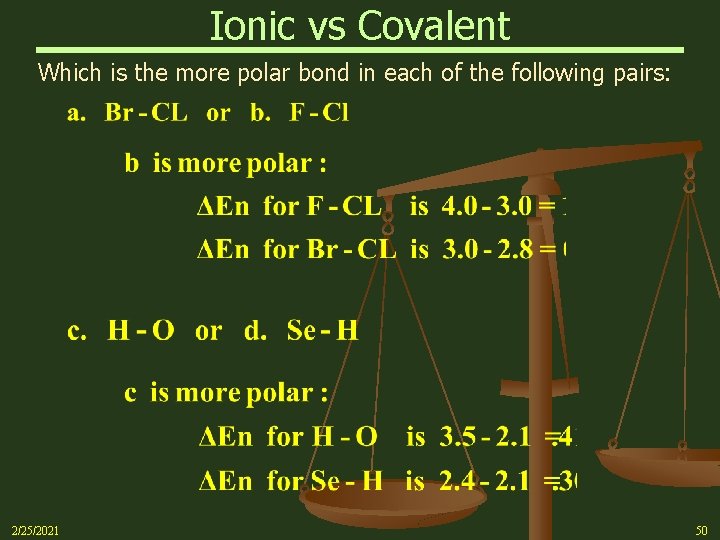
Ionic vs Covalent Which is the more polar bond in each of the following pairs: 2/25/2021 50
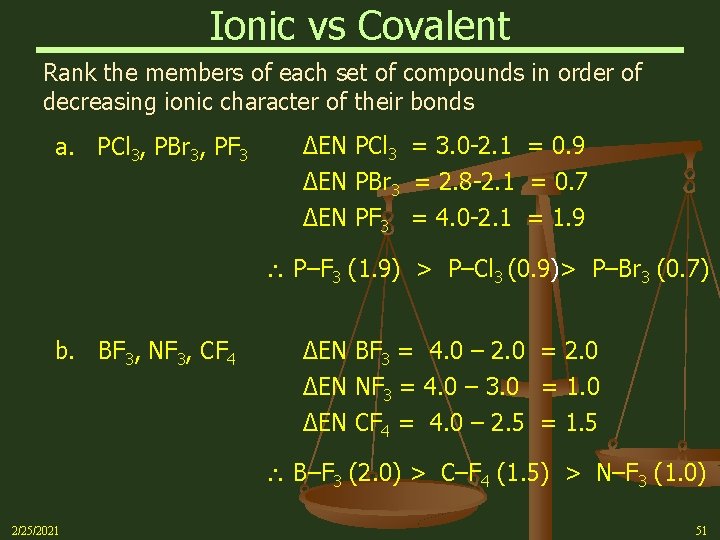
Ionic vs Covalent Rank the members of each set of compounds in order of decreasing ionic character of their bonds a. PCl 3, PBr 3, PF 3 ΔEN PCl 3 = 3. 0 -2. 1 = 0. 9 ΔEN PBr 3 = 2. 8 -2. 1 = 0. 7 ΔEN PF 3 = 4. 0 -2. 1 = 1. 9 P–F 3 (1. 9) > P–Cl 3 (0. 9)> P–Br 3 (0. 7) b. BF 3, NF 3, CF 4 ΔEN BF 3 = 4. 0 – 2. 0 = 2. 0 ΔEN NF 3 = 4. 0 – 3. 0 = 1. 0 ΔEN CF 4 = 4. 0 – 2. 5 = 1. 5 B–F 3 (2. 0) > C–F 4 (1. 5) > N–F 3 (1. 0) 2/25/2021 51
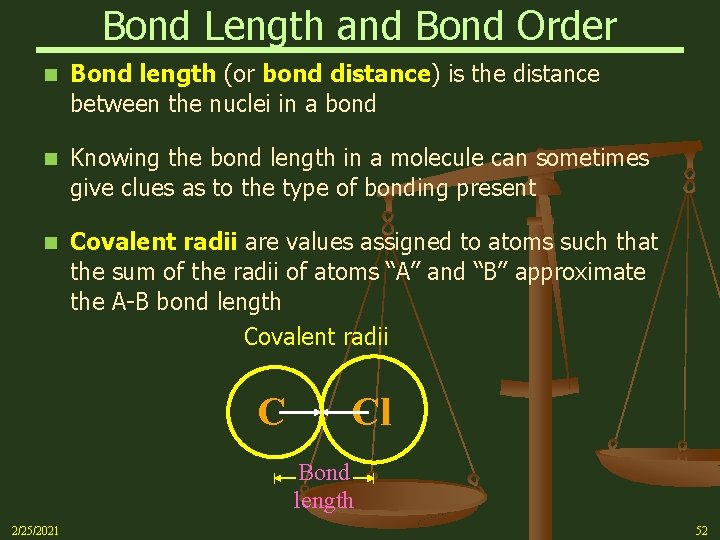
Bond Length and Bond Order n Bond length (or bond distance) is the distance between the nuclei in a bond n Knowing the bond length in a molecule can sometimes give clues as to the type of bonding present n Covalent radii are values assigned to atoms such that the sum of the radii of atoms “A” and “B” approximate the A-B bond length Covalent radii C Cl Bond length 2/25/2021 52
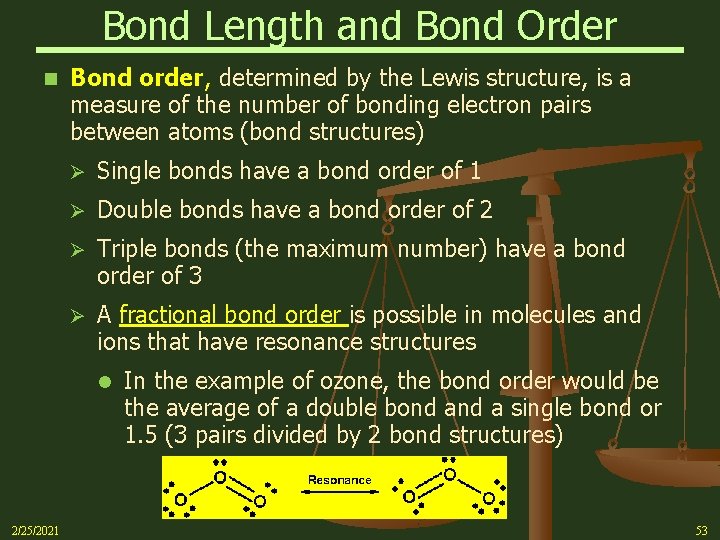
Bond Length and Bond Order n Bond order, determined by the Lewis structure, is a measure of the number of bonding electron pairs between atoms (bond structures) Ø Single bonds have a bond order of 1 Ø Double bonds have a bond order of 2 Ø Triple bonds (the maximum number) have a bond order of 3 Ø A fractional bond order is possible in molecules and ions that have resonance structures l 2/25/2021 In the example of ozone, the bond order would be the average of a double bond a single bond or 1. 5 (3 pairs divided by 2 bond structures) 53
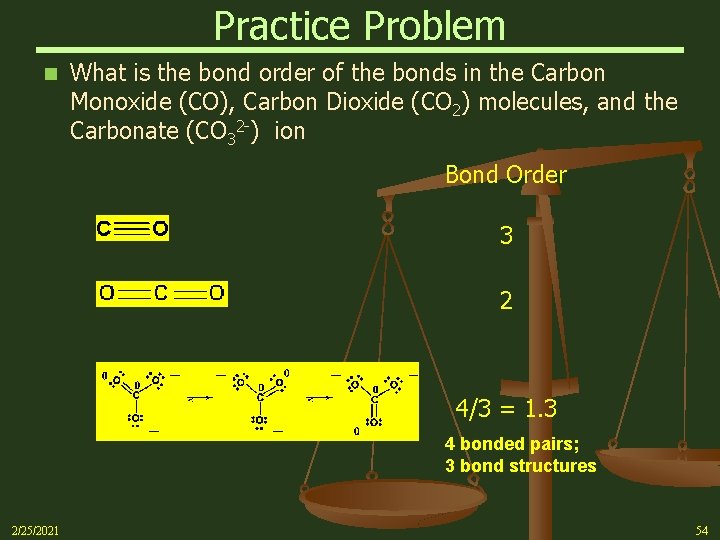
Practice Problem n What is the bond order of the bonds in the Carbon Monoxide (CO), Carbon Dioxide (CO 2) molecules, and the Carbonate (CO 32 -) ion Bond Order 3 2 4/3 = 1. 3 4 bonded pairs; 3 bond structures 2/25/2021 54
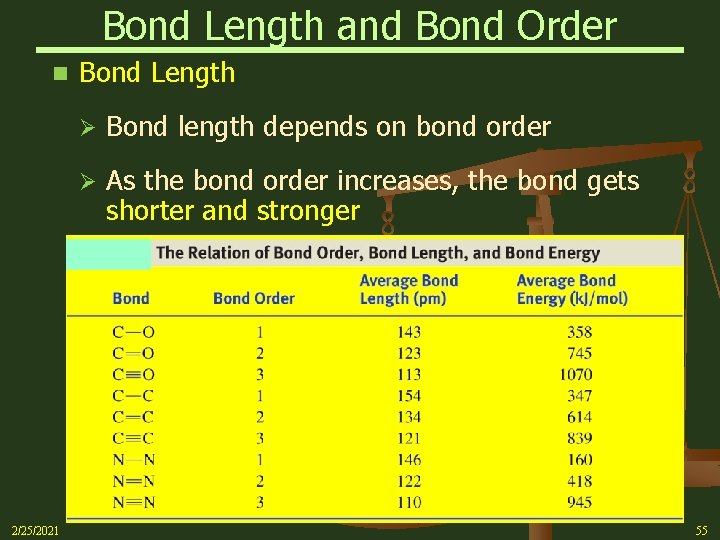
Bond Length and Bond Order n 2/25/2021 Bond Length Ø Bond length depends on bond order Ø As the bond order increases, the bond gets shorter and stronger 55
Bond Energy n Bond Energy (denoted BE) is defined as the average Enthalpy change ( H) for the breaking of an A-B bond in a molecule in its gas phase n In any reaction, the quantity of heat absorbed to break reactant bonds would be: ( Ho n positive value) The quantity of heat released when the atoms rearrange to form product bonds would be: ( Ho 2/25/2021 reactants products negative value) 56
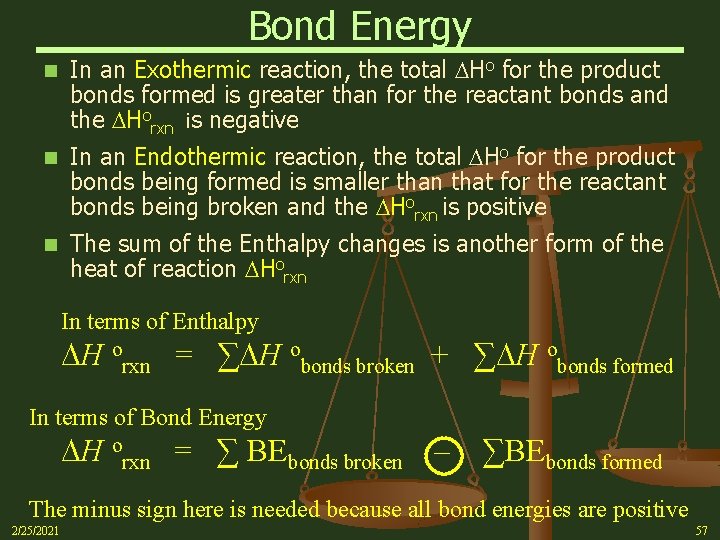
Bond Energy n In an Exothermic reaction, the total Ho for the product bonds formed is greater than for the reactant bonds and the Horxn is negative n In an Endothermic reaction, the total Ho for the product bonds being formed is smaller than that for the reactant bonds being broken and the Horxn is positive n The sum of the Enthalpy changes is another form of the heat of reaction Horxn In terms of Enthalpy H orxn = ∑ H obonds broken + ∑ H obonds formed In terms of Bond Energy H orxn = ∑ BEbonds broken – ∑BEbonds formed The minus sign here is needed because all bond energies are positive 2/25/2021 57

Bond Energy n To illustrate, let’s estimate the H for the following reaction. Ø In this reaction, one C-H bond and one Cl-Cl bond must be broken Ø In turn, one C-Cl bond and one H-Cl bond are formed Con’t on next slide 2/25/2021 58
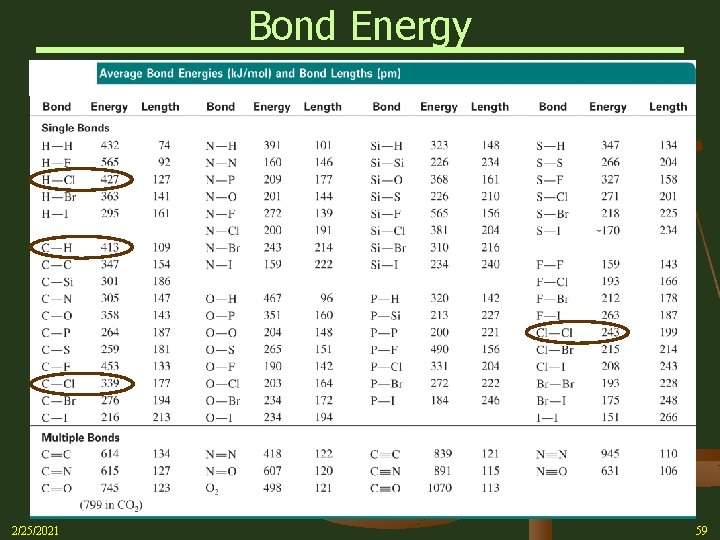
Bond Energy Con’t on next slide 2/25/2021 59
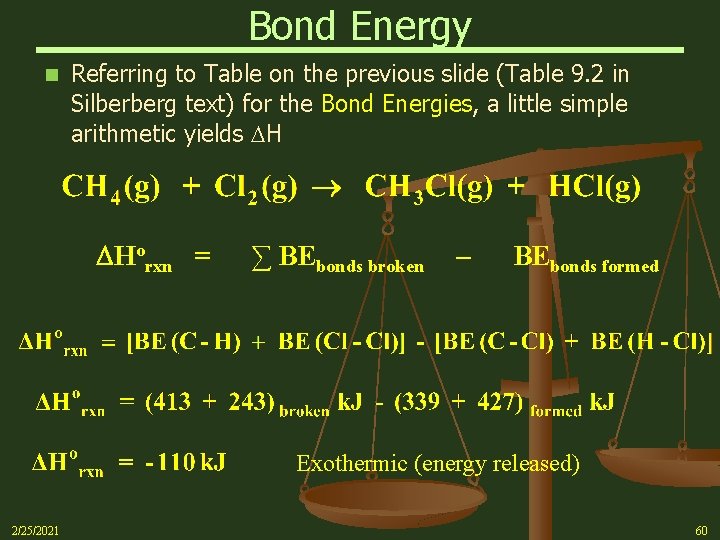
Bond Energy n Referring to Table on the previous slide (Table 9. 2 in Silberberg text) for the Bond Energies, a little simple arithmetic yields H Horxn = ∑ BEbonds broken – BEbonds formed Exothermic (energy released) 2/25/2021 60
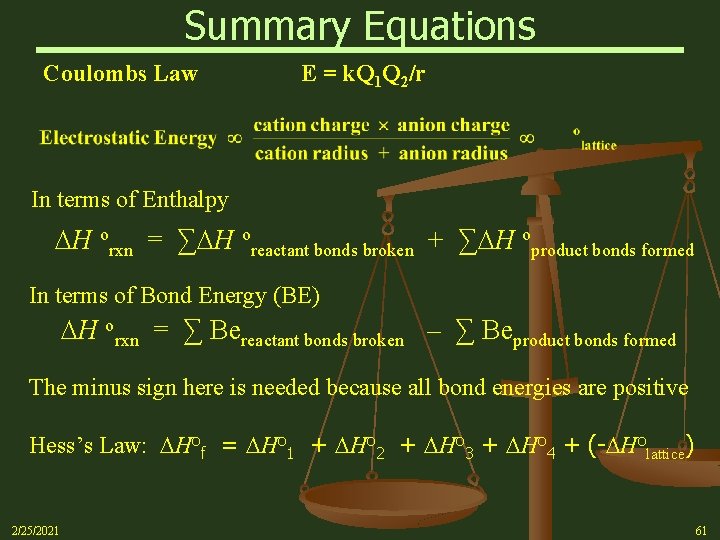
Summary Equations Coulombs Law E = k. Q 1 Q 2/r In terms of Enthalpy H orxn = ∑ H oreactant bonds broken + ∑ H oproduct bonds formed In terms of Bond Energy (BE) H orxn = ∑ Bereactant bonds broken – ∑ Beproduct bonds formed The minus sign here is needed because all bond energies are positive Hess’s Law: Hof = Ho 1 + Ho 2 + Ho 3 + Ho 4 + (- Holattice) 2/25/2021 61
- Slides: 61