
Electron Configuration and Ion Formation Vocabulary 1 valence
Electron Configuration and Ion Formation Vocabulary: 1. valence shell 2. valence electrons 3. anion 4. cation 5. isoelectric 6. Lewis structure (Lewis dot diagram) Banksy, British, 2002
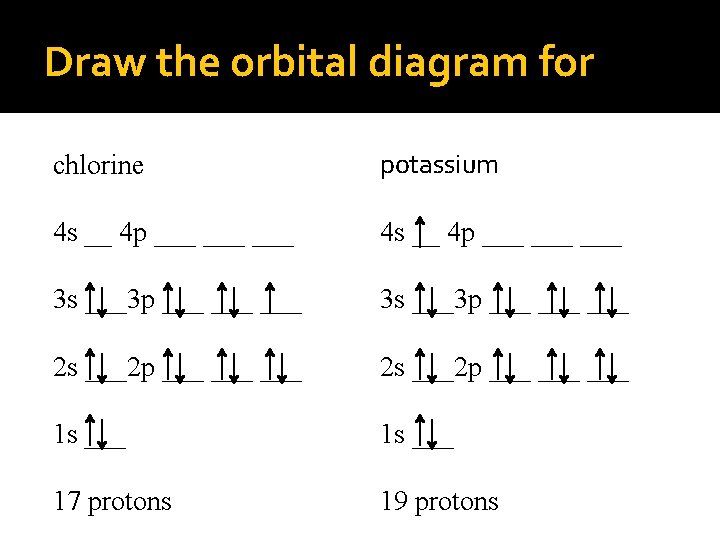
Draw the orbital diagram for chlorine potassium 4 s __ 4 p ___ ___ ___ 3 s ___3 p ___ ___ ___ 2 s ___2 p ___ ___ ___ 1 s ___ 17 protons 19 protons
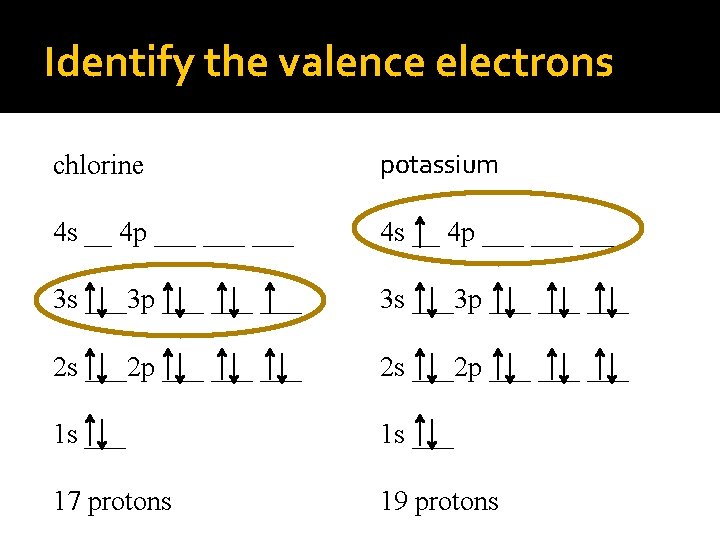
Identify the valence electrons chlorine potassium 4 s __ 4 p ___ ___ ___ 3 s ___3 p ___ ___ ___ 2 s ___2 p ___ ___ ___ 1 s ___ 17 protons 19 protons
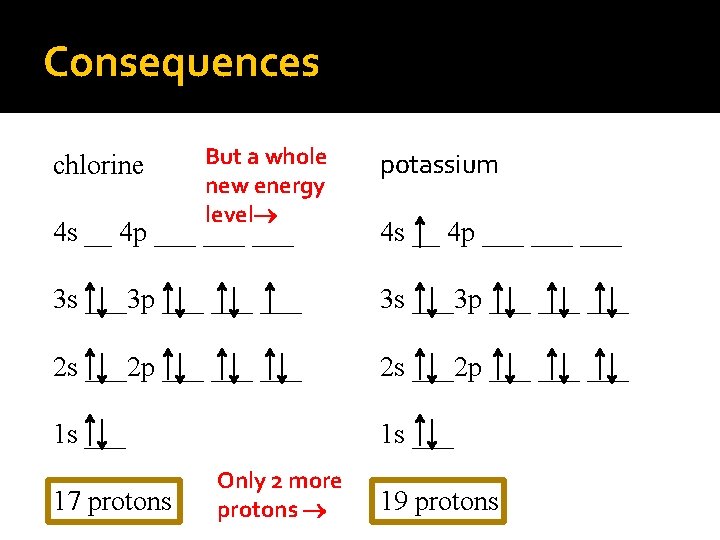
Consequences chlorine But a whole new energy level potassium 4 s __ 4 p ___ ___ ___ 3 s ___3 p ___ ___ ___ 2 s ___2 p ___ ___ ___ 1 s ___ 17 protons Only 2 more protons 19 protons
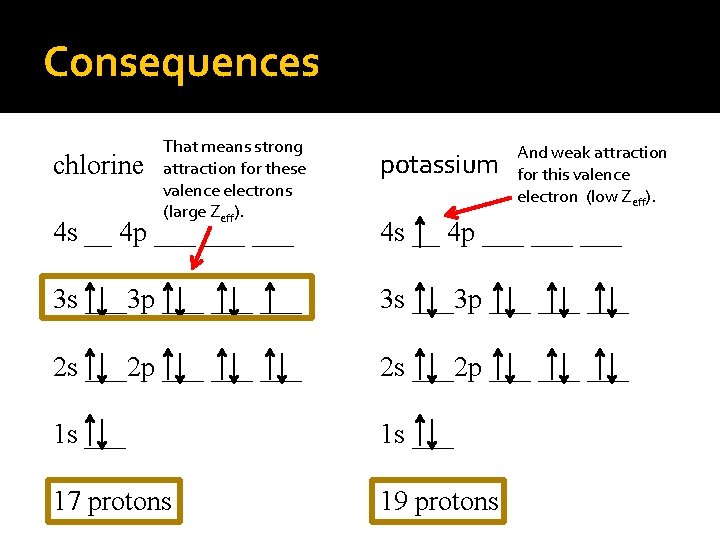
Consequences chlorine That means strong attraction for these valence electrons (large Zeff). potassium And weak attraction for this valence electron (low Zeff). 4 s __ 4 p ___ ___ ___ 3 s ___3 p ___ ___ ___ 2 s ___2 p ___ ___ ___ 1 s ___ 17 protons 19 protons
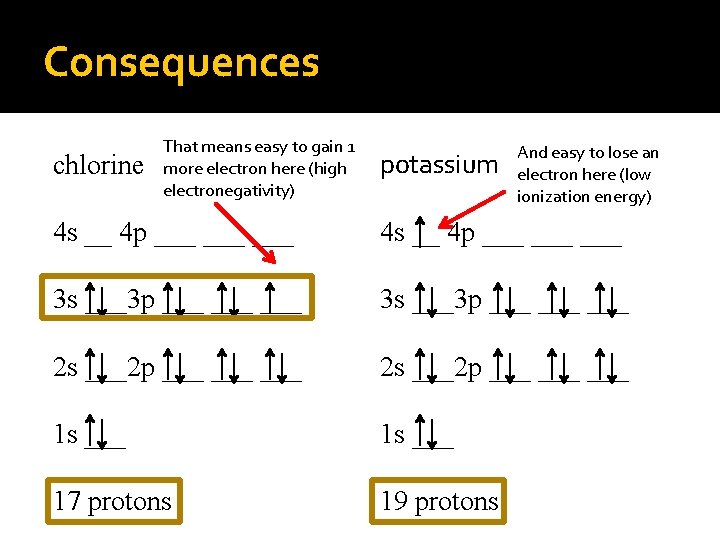
Consequences chlorine That means easy to gain 1 more electron here (high electronegativity) potassium And easy to lose an electron here (low ionization energy) 4 s __ 4 p ___ ___ ___ 3 s ___3 p ___ ___ ___ 2 s ___2 p ___ ___ ___ 1 s ___ 17 protons 19 protons
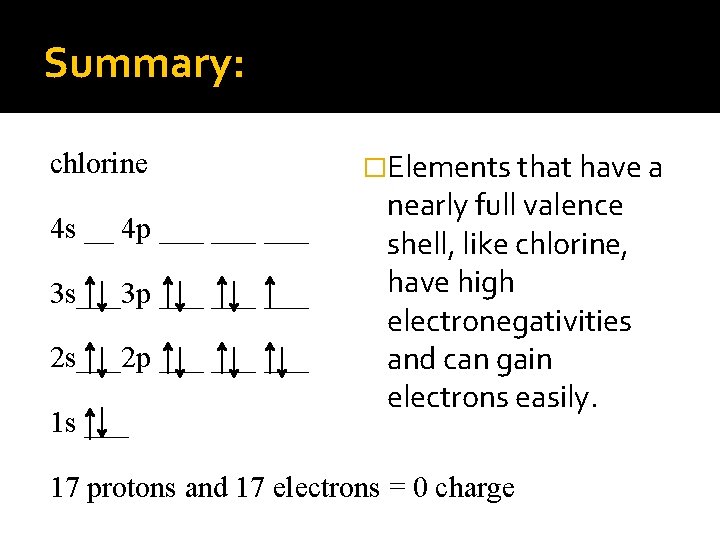
Summary: chlorine 4 s __ 4 p ___ ___ 3 s___3 p ___ ___ 2 s___2 p ___ ___ 1 s ___ �Elements that have a nearly full valence shell, like chlorine, have high electronegativities and can gain electrons easily. 17 protons and 17 electrons = 0 charge
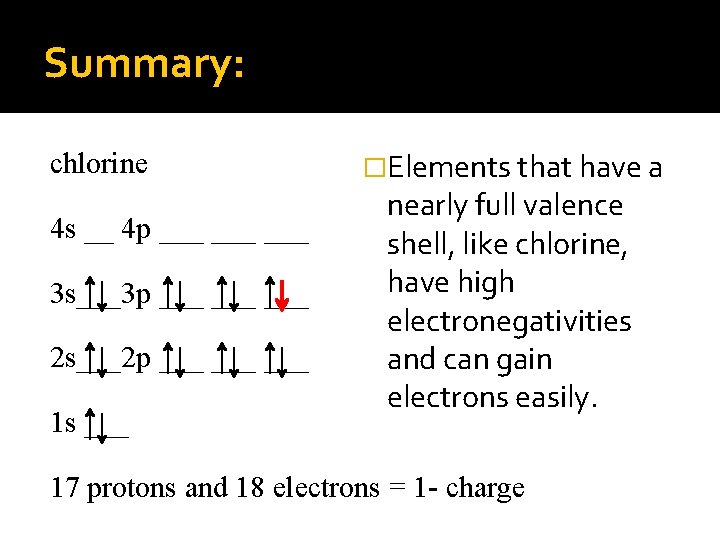
Summary: chlorine 4 s __ 4 p ___ ___ 3 s___3 p ___ ___ 2 s___2 p ___ ___ 1 s ___ �Elements that have a nearly full valence shell, like chlorine, have high electronegativities and can gain electrons easily. 17 protons and 18 electrons = 1 - charge
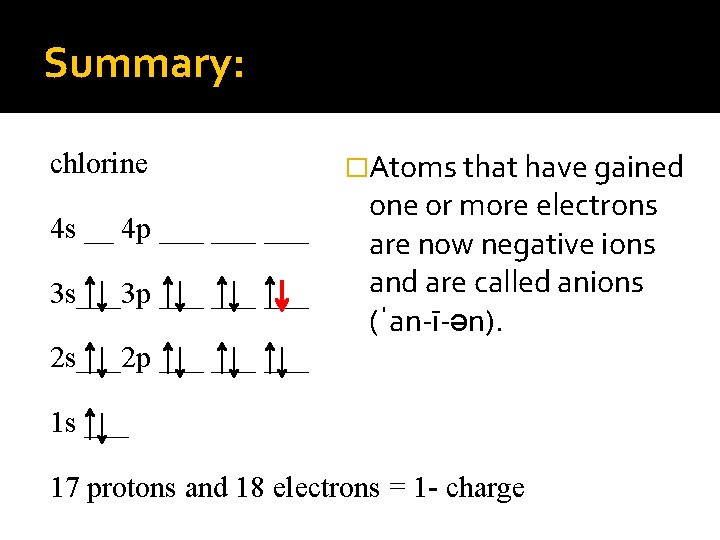
Summary: chlorine 4 s __ 4 p ___ ___ 3 s___3 p ___ ___ �Atoms that have gained one or more electrons are now negative ions and are called anions (ˈan-ī-ən). 2 s___2 p ___ ___ 1 s ___ 17 protons and 18 electrons = 1 - charge
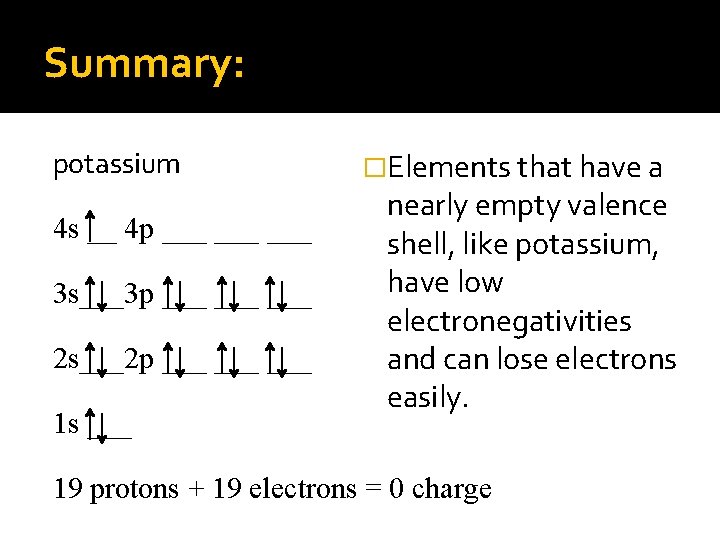
Summary: potassium 4 s __ 4 p ___ ___ 3 s___3 p ___ ___ 2 s___2 p ___ ___ 1 s ___ �Elements that have a nearly empty valence shell, like potassium, have low electronegativities and can lose electrons easily. 19 protons + 19 electrons = 0 charge
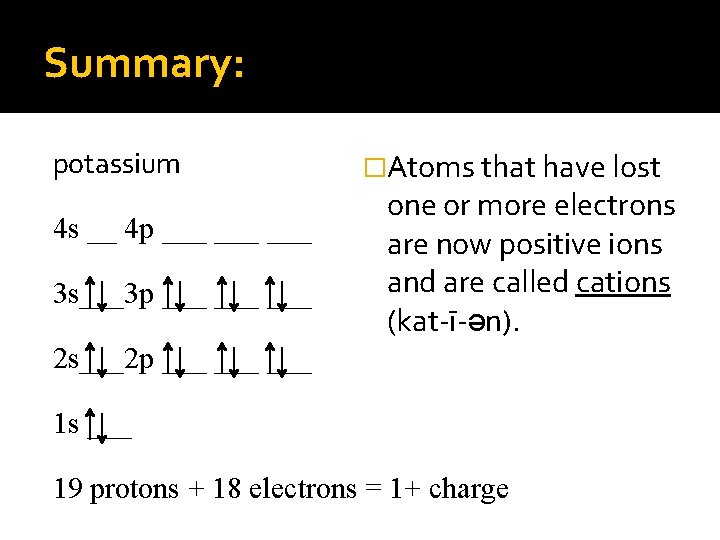
Summary: potassium 4 s __ 4 p ___ ___ 3 s___3 p ___ ___ �Atoms that have lost one or more electrons are now positive ions and are called cations (kat-ī-ən). 2 s___2 p ___ ___ 1 s ___ 19 protons + 18 electrons = 1+ charge
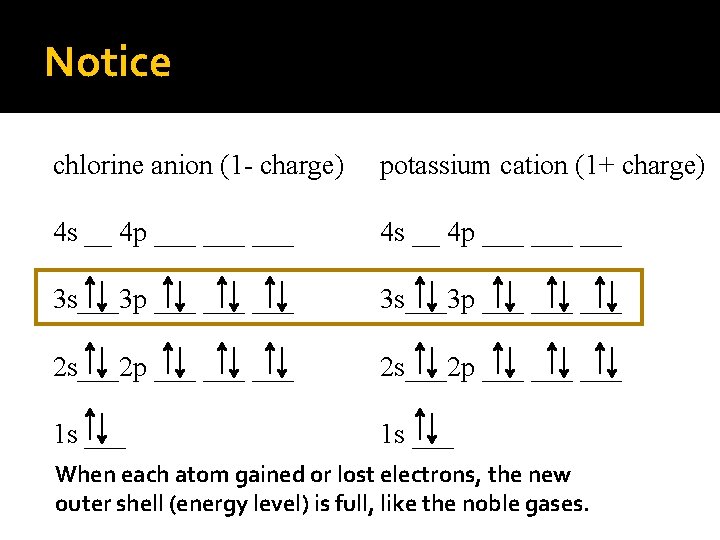
Notice chlorine anion (1 - charge) potassium cation (1+ charge) 4 s __ 4 p ___ ___ ___ 3 s___3 p ___ ___ ___ 2 s___2 p ___ ___ ___ 1 s ___ When each atom gained or lost electrons, the new outer shell (energy level) is full, like the noble gases.
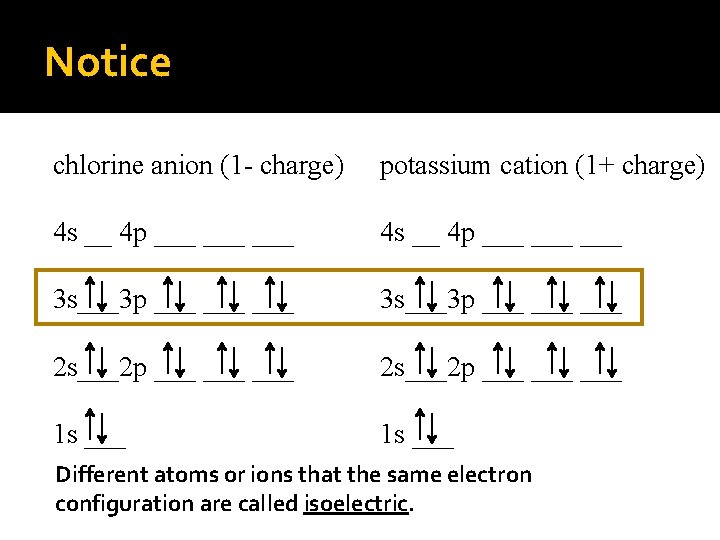
Notice chlorine anion (1 - charge) potassium cation (1+ charge) 4 s __ 4 p ___ ___ ___ 3 s___3 p ___ ___ ___ 2 s___2 p ___ ___ ___ 1 s ___ Different atoms or ions that the same electron configuration are called isoelectric.
The Octet Rule Atoms lose or gain electrons in order to have a full valence shell (a noble gas configuration). This will typically result in 8 valence electrons.
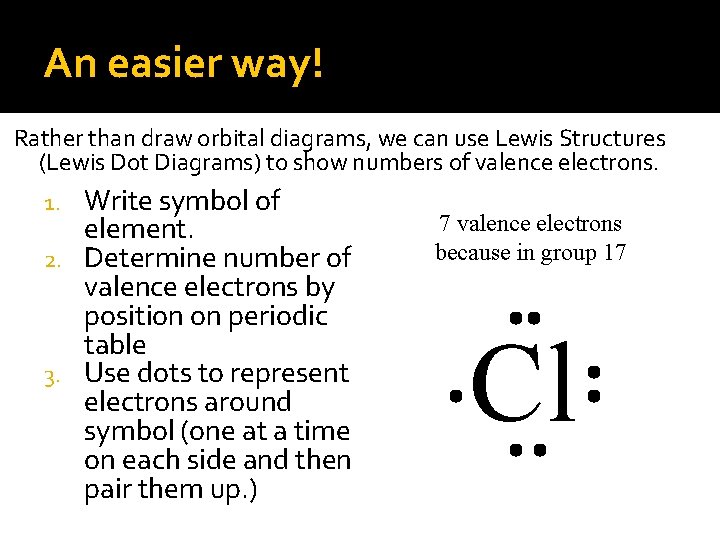
An easier way! Rather than draw orbital diagrams, we can use Lewis Structures (Lewis Dot Diagrams) to show numbers of valence electrons. Write symbol of element. 2. Determine number of valence electrons by position on periodic table 3. Use dots to represent electrons around symbol (one at a time on each side and then pair them up. ) 1. 7 valence electrons because in group 17 Cl
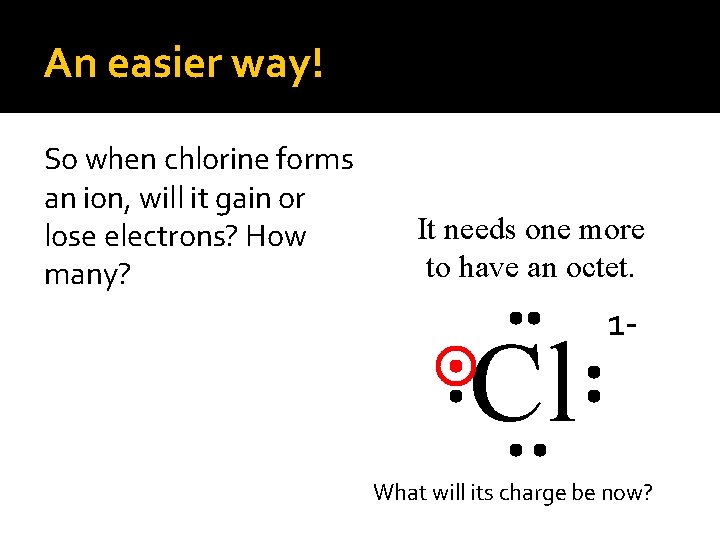
An easier way! So when chlorine forms an ion, will it gain or lose electrons? How many? It needs one more to have an octet. Cl 1 - What will its charge be now?
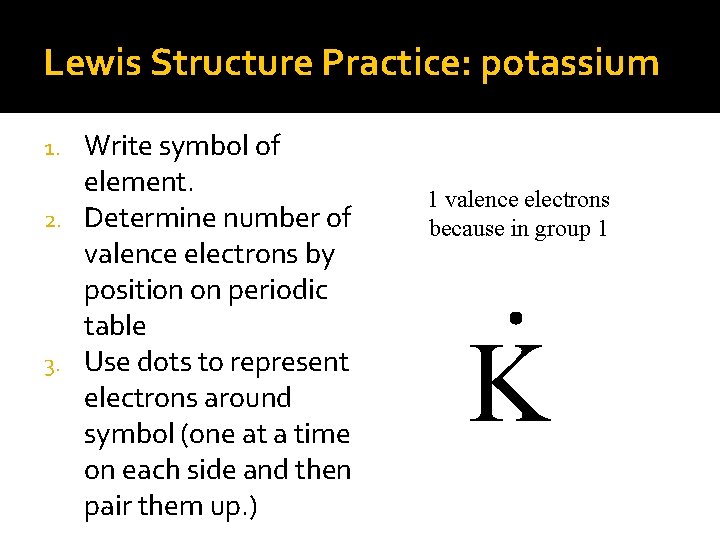
Lewis Structure Practice: potassium Write symbol of element. 2. Determine number of valence electrons by position on periodic table 3. Use dots to represent electrons around symbol (one at a time on each side and then pair them up. ) 1. 1 valence electrons because in group 1 K
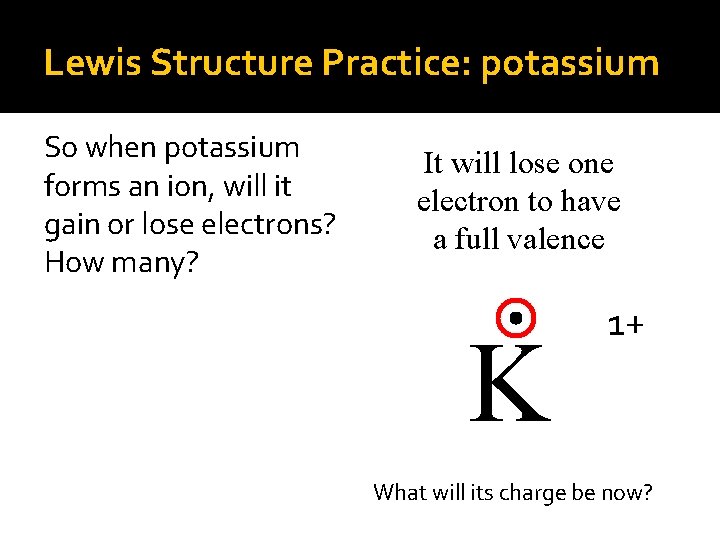
Lewis Structure Practice: potassium So when potassium forms an ion, will it gain or lose electrons? How many? It will lose one electron to have a full valence K 1+ What will its charge be now?
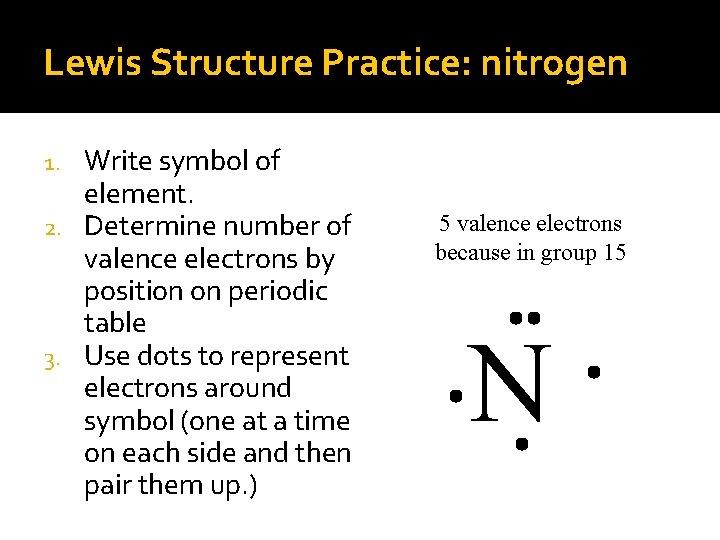
Lewis Structure Practice: nitrogen Write symbol of element. 2. Determine number of valence electrons by position on periodic table 3. Use dots to represent electrons around symbol (one at a time on each side and then pair them up. ) 1. 5 valence electrons because in group 15 N
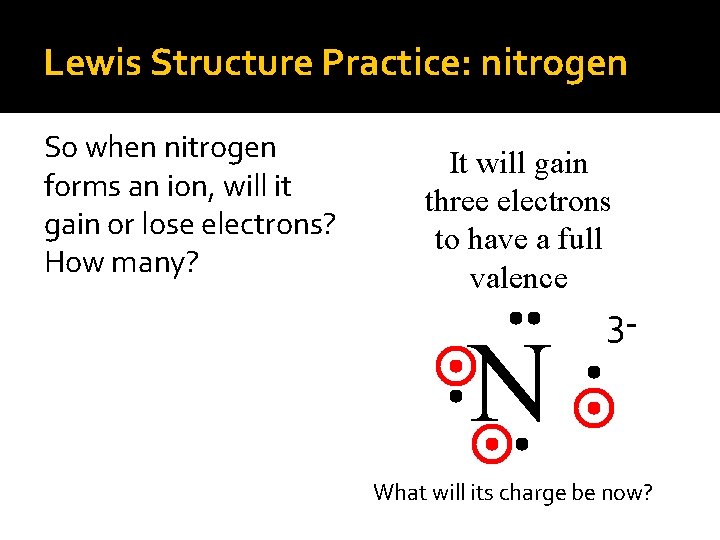
Lewis Structure Practice: nitrogen So when nitrogen forms an ion, will it gain or lose electrons? How many? It will gain three electrons to have a full valence N 3 - What will its charge be now?
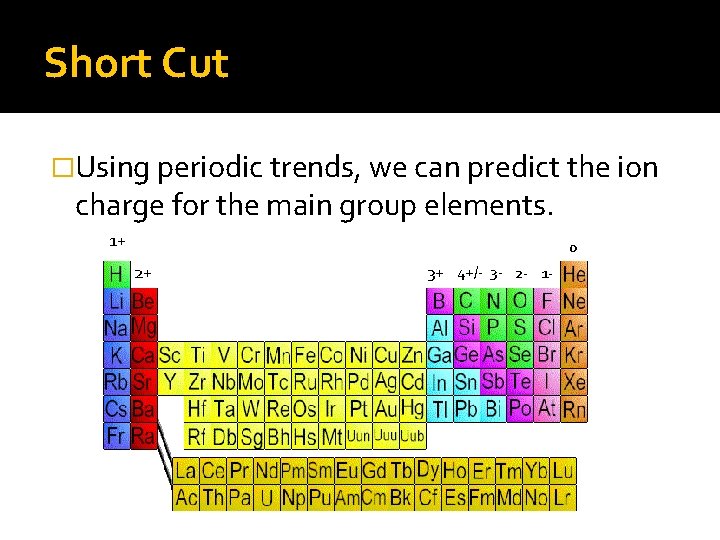
Short Cut �Using periodic trends, we can predict the ion charge for the main group elements. 1+ 0 2+ 3+ 4+/- 3 - 2 - 1 -
- Slides: 21