
ELECTRON COLLIDER RING CHROMATICITY COMPENSATION AND DYNAMIC APERTURE
- Slides: 17
ELECTRON COLLIDER RING CHROMATICITY COMPENSATION AND DYNAMIC APERTURE Yuri Nosochkov, Yunhai Cai (SLAC) Fanglei Lin, Vasiliy Morozov, Guohui Wei (JLab) Min-Huey Wang JLEIC Collaboration Meeting Fall 2016 Thomas Jefferson National Accelerator Facility Newport News, VA
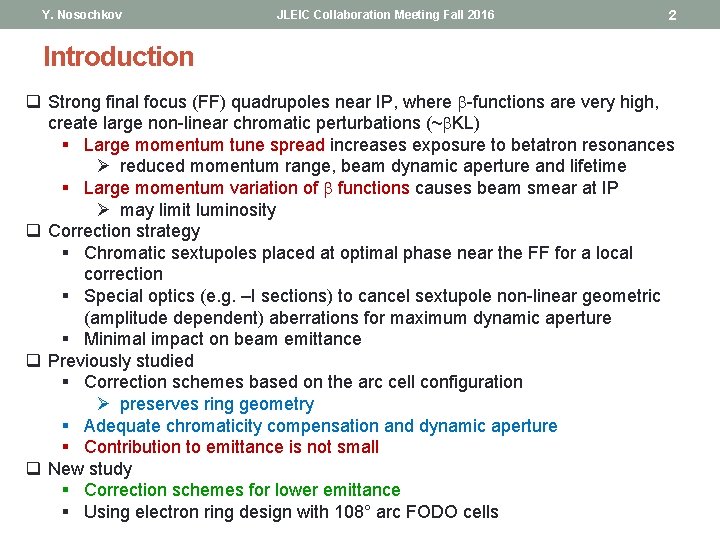
Y. Nosochkov JLEIC Collaboration Meeting Fall 2016 2 Introduction q Strong final focus (FF) quadrupoles near IP, where b-functions are very high, create large non-linear chromatic perturbations (~b. KL) § Large momentum tune spread increases exposure to betatron resonances Ø reduced momentum range, beam dynamic aperture and lifetime § Large momentum variation of b functions causes beam smear at IP Ø may limit luminosity q Correction strategy § Chromatic sextupoles placed at optimal phase near the FF for a local correction § Special optics (e. g. –I sections) to cancel sextupole non-linear geometric (amplitude dependent) aberrations for maximum dynamic aperture § Minimal impact on beam emittance q Previously studied § Correction schemes based on the arc cell configuration Ø preserves ring geometry § Adequate chromaticity compensation and dynamic aperture § Contribution to emittance is not small q New study § Correction schemes for lower emittance § Using electron ring design with 108° arc FODO cells
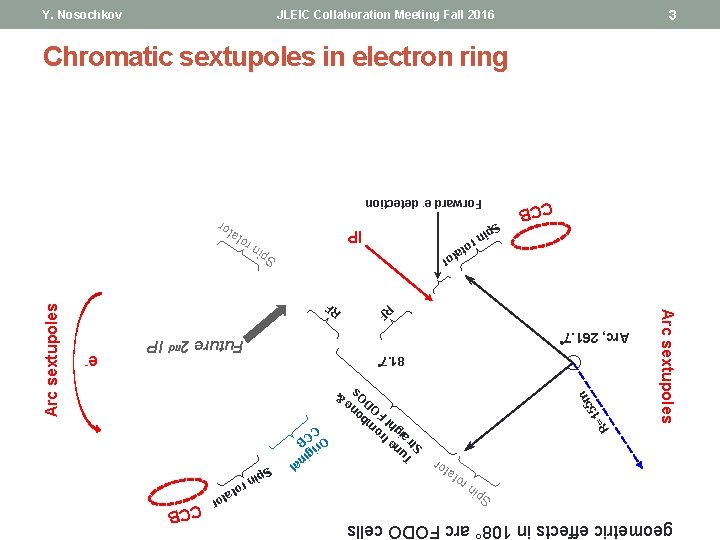
geometric effects in 108° arc FODO cells Sp in ro tat or 5 m 15 R= T St une r a ig trom h t FO bo DO ne s & al in ig Or CB C in Sp 81. 7 Sp or tat CCB e- RF S r pin r ota t to ta ro ro Future 2 nd IP Arc, 261. 7 RF in CCB Arc sextupoles IP or Forward e- detection Chromatic sextupoles in electron ring Y. Nosochkov 3 JLEIC Collaboration Meeting Fall 2016
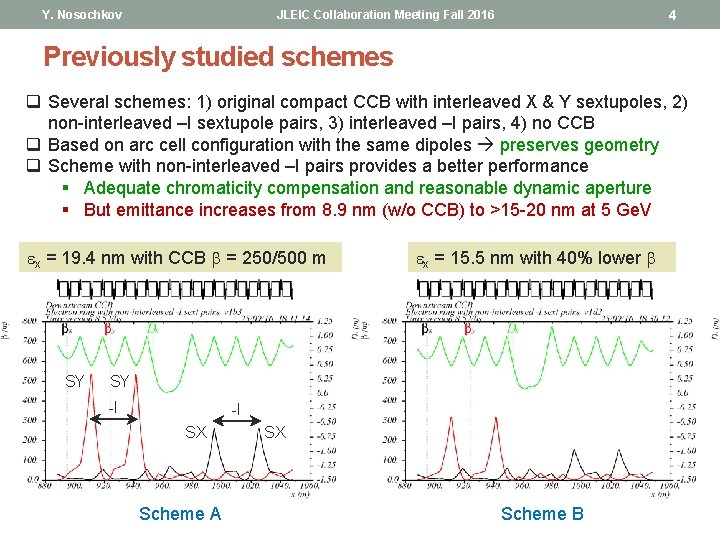
Y. Nosochkov 4 JLEIC Collaboration Meeting Fall 2016 Previously studied schemes q Several schemes: 1) original compact CCB with interleaved X & Y sextupoles, 2) non-interleaved –I sextupole pairs, 3) interleaved –I pairs, 4) no CCB q Based on arc cell configuration with the same dipoles preserves geometry q Scheme with non-interleaved –I pairs provides a better performance § Adequate chromaticity compensation and reasonable dynamic aperture § But emittance increases from 8. 9 nm (w/o CCB) to >15 -20 nm at 5 Ge. V ex = 19. 4 nm with CCB b = 250/500 m SY ex = 15. 5 nm with 40% lower b SY -I -I SX Scheme A SX Scheme B
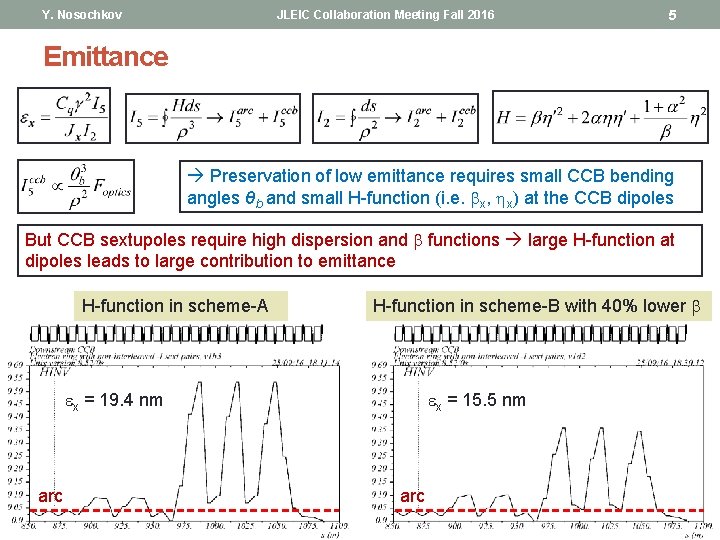
Y. Nosochkov JLEIC Collaboration Meeting Fall 2016 5 Emittance Preservation of low emittance requires small CCB bending angles θb and small H-function (i. e. bx, hx) at the CCB dipoles But CCB sextupoles require high dispersion and b functions large H-function at dipoles leads to large contribution to emittance H-function in scheme-A H-function in scheme-B with 40% lower b ex = 19. 4 nm arc ex = 15. 5 nm arc
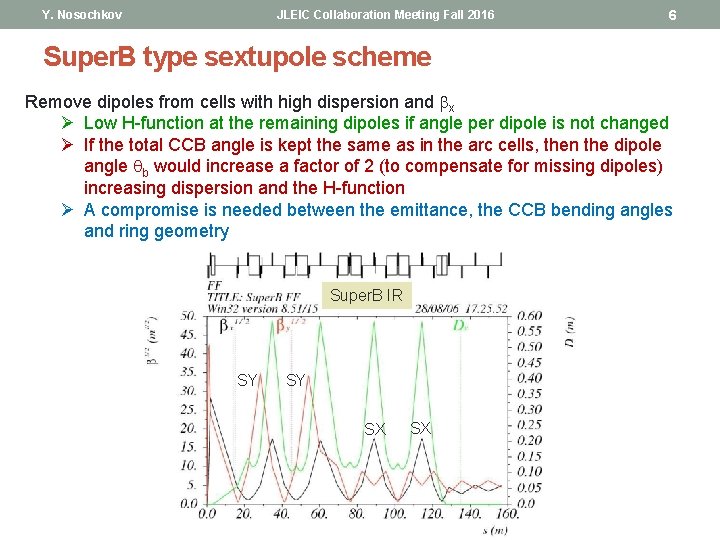
Y. Nosochkov JLEIC Collaboration Meeting Fall 2016 6 Super. B type sextupole scheme Remove dipoles from cells with high dispersion and bx Ø Low H-function at the remaining dipoles if angle per dipole is not changed Ø If the total CCB angle is kept the same as in the arc cells, then the dipole angle qb would increase a factor of 2 (to compensate for missing dipoles) increasing dispersion and the H-function Ø A compromise is needed between the emittance, the CCB bending angles and ring geometry Super. B IR SY SY SX SX
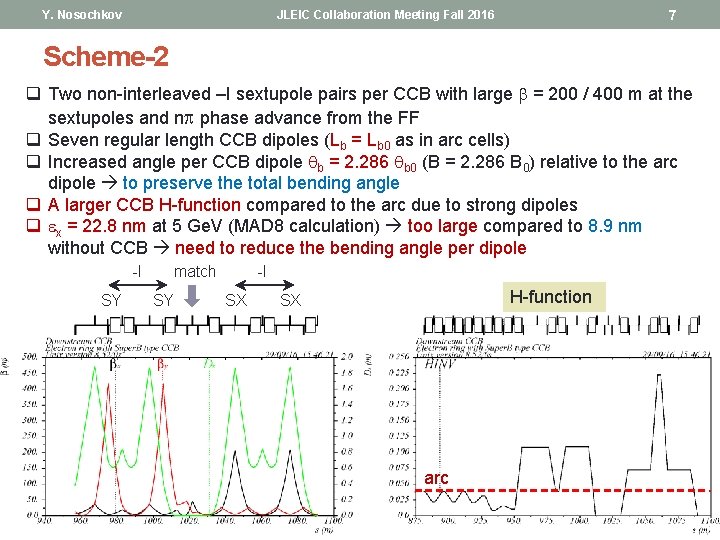
Y. Nosochkov 7 JLEIC Collaboration Meeting Fall 2016 Scheme-2 q Two non-interleaved –I sextupole pairs per CCB with large b = 200 / 400 m at the sextupoles and np phase advance from the FF q Seven regular length CCB dipoles (Lb = Lb 0 as in arc cells) q Increased angle per CCB dipole qb = 2. 286 qb 0 (B = 2. 286 B 0) relative to the arc dipole to preserve the total bending angle q A larger CCB H-function compared to the arc due to strong dipoles q ex = 22. 8 nm at 5 Ge. V (MAD 8 calculation) too large compared to 8. 9 nm without CCB need to reduce the bending angle per dipole -I SY match SY -I SX H-function SX arc
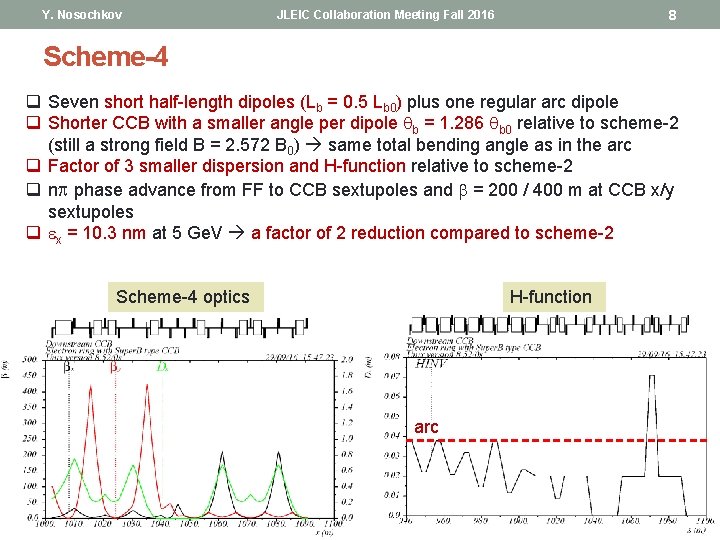
Y. Nosochkov 8 JLEIC Collaboration Meeting Fall 2016 Scheme-4 q Seven short half-length dipoles (Lb = 0. 5 Lb 0) plus one regular arc dipole q Shorter CCB with a smaller angle per dipole qb = 1. 286 qb 0 relative to scheme-2 (still a strong field B = 2. 572 B 0) same total bending angle as in the arc q Factor of 3 smaller dispersion and H-function relative to scheme-2 q np phase advance from FF to CCB sextupoles and b = 200 / 400 m at CCB x/y sextupoles q ex = 10. 3 nm at 5 Ge. V a factor of 2 reduction compared to scheme-2 Scheme-4 optics H-function arc
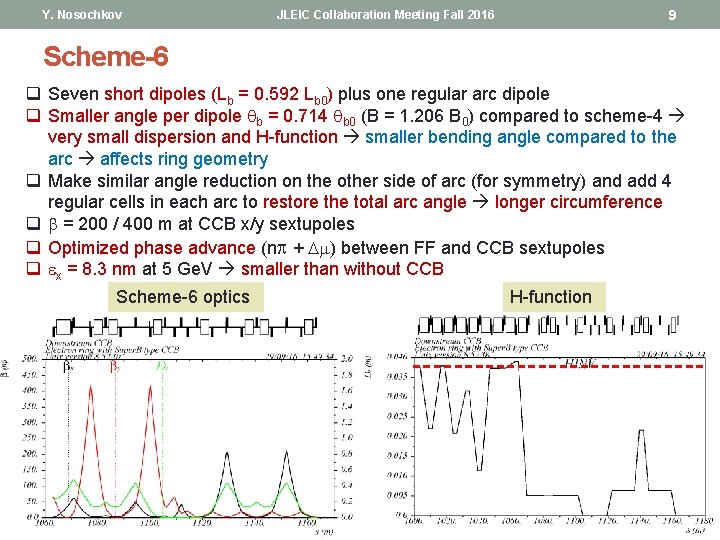
Y. Nosochkov JLEIC Collaboration Meeting Fall 2016 9 Scheme-6 q Seven short dipoles (Lb = 0. 592 Lb 0) plus one regular arc dipole q Smaller angle per dipole qb = 0. 714 qb 0 (B = 1. 206 B 0) compared to scheme-4 very small dispersion and H-function smaller bending angle compared to the arc affects ring geometry q Make similar angle reduction on the other side of arc (for symmetry) and add 4 regular cells in each arc to restore the total arc angle longer circumference q b = 200 / 400 m at CCB x/y sextupoles q Optimized phase advance (np + Dm) between FF and CCB sextupoles q ex = 8. 3 nm at 5 Ge. V smaller than without CCB Scheme-6 optics H-function
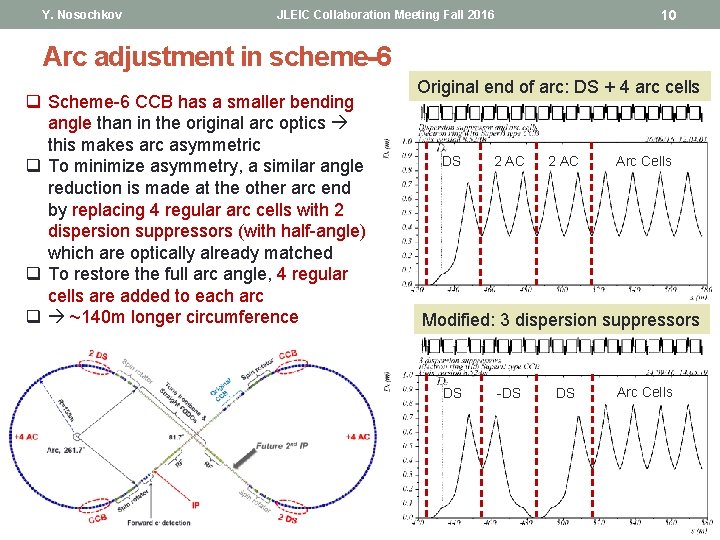
Y. Nosochkov 10 JLEIC Collaboration Meeting Fall 2016 Arc adjustment in scheme-6 q Scheme-6 CCB has a smaller bending angle than in the original arc optics this makes arc asymmetric q To minimize asymmetry, a similar angle reduction is made at the other arc end by replacing 4 regular arc cells with 2 dispersion suppressors (with half-angle) which are optically already matched q To restore the full arc angle, 4 regular cells are added to each arc q ~140 m longer circumference Original end of arc: DS + 4 arc cells DS 2 AC Arc Cells Modified: 3 dispersion suppressors DS -DS DS Arc Cells
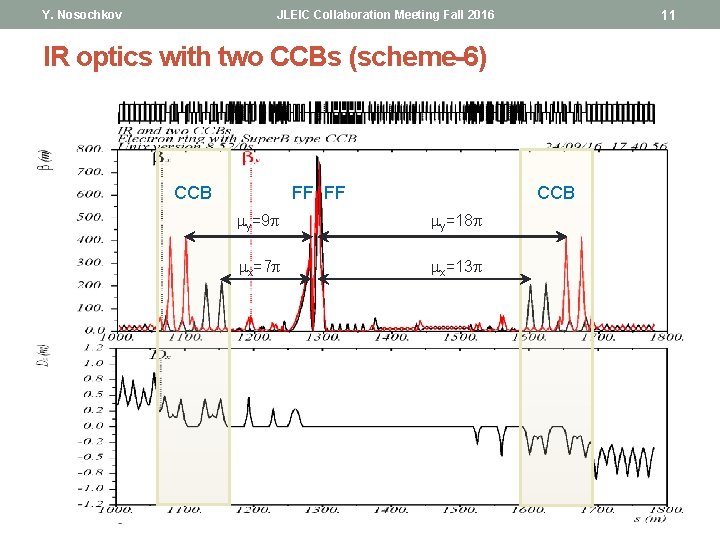
Y. Nosochkov 11 JLEIC Collaboration Meeting Fall 2016 IR optics with two CCBs (scheme-6) CCB FF FF CCB my=9 p my=18 p mx=7 p mx=13 p
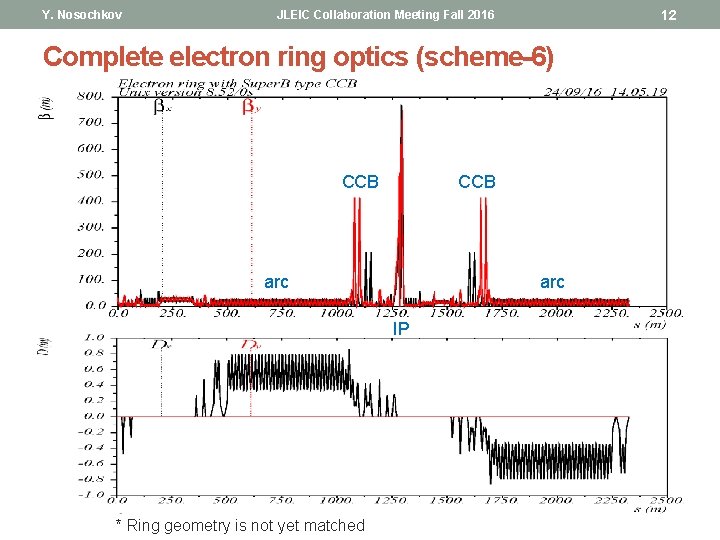
Y. Nosochkov 12 JLEIC Collaboration Meeting Fall 2016 Complete electron ring optics (scheme-6) CCB arc IP * Ring geometry is not yet matched
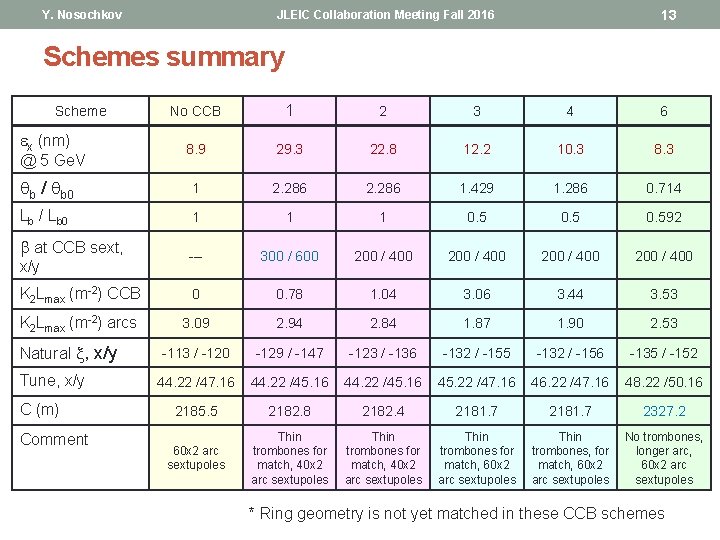
Y. Nosochkov 13 JLEIC Collaboration Meeting Fall 2016 Schemes summary No CCB 1 2 3 4 6 ex (nm) 8. 9 29. 3 22. 8 12. 2 10. 3 8. 3 qb / qb 0 1 2. 286 1. 429 1. 286 0. 714 Lb / Lb 0 1 1 1 0. 592 b at CCB sext, --- 300 / 600 200 / 400 K 2 Lmax (m-2) CCB 0 0. 78 1. 04 3. 06 3. 44 3. 53 K 2 Lmax (m-2) arcs 3. 09 2. 94 2. 84 1. 87 1. 90 2. 53 -113 / -120 -129 / -147 -123 / -136 -132 / -155 -132 / -156 -135 / -152 44. 22 /47. 16 44. 22 /45. 16 45. 22 /47. 16 46. 22 /47. 16 48. 22 /50. 16 2185. 5 2182. 8 2182. 4 2181. 7 2327. 2 60 x 2 arc sextupoles Thin trombones for match, 40 x 2 arc sextupoles Thin trombones for match, 60 x 2 arc sextupoles Thin trombones, for match, 60 x 2 arc sextupoles No trombones, longer arc, 60 x 2 arc sextupoles Scheme @ 5 Ge. V x/y Natural x, x/y Tune, x/y C (m) Comment * Ring geometry is not yet matched in these CCB schemes
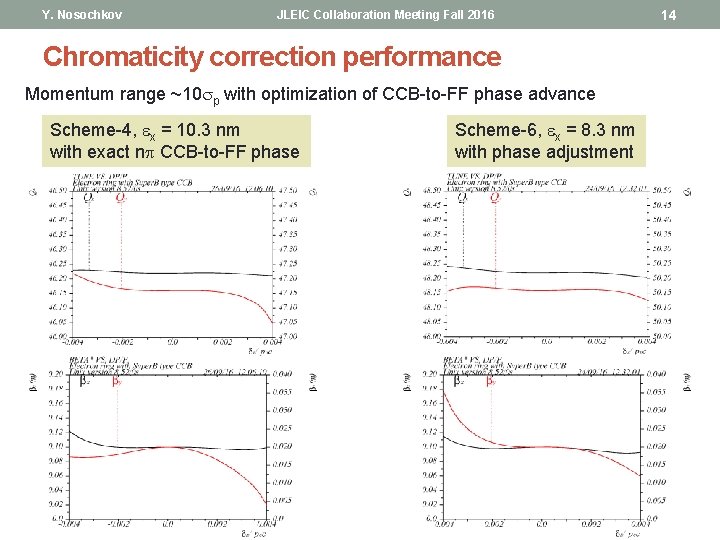
Y. Nosochkov JLEIC Collaboration Meeting Fall 2016 Chromaticity correction performance Momentum range ~10 sp with optimization of CCB-to-FF phase advance Scheme-4, ex = 10. 3 nm with exact np CCB-to-FF phase Scheme-6, ex = 8. 3 nm with phase adjustment 14
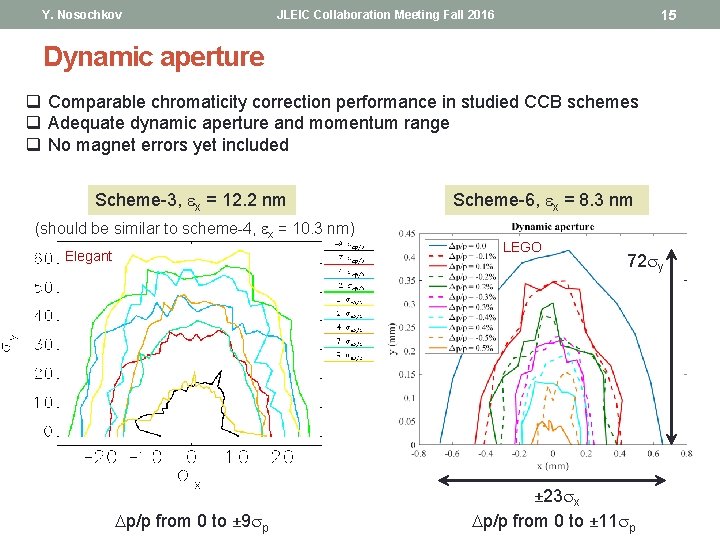
Y. Nosochkov 15 JLEIC Collaboration Meeting Fall 2016 Dynamic aperture q Comparable chromaticity correction performance in studied CCB schemes q Adequate dynamic aperture and momentum range q No magnet errors yet included Scheme-3, ex = 12. 2 nm (should be similar to scheme-4, ex = 10. 3 nm) Elegant Dp/p from 0 to ± 9 sp Scheme-6, ex = 8. 3 nm LEGO 72 sy ± 23 sx Dp/p from 0 to ± 11 sp
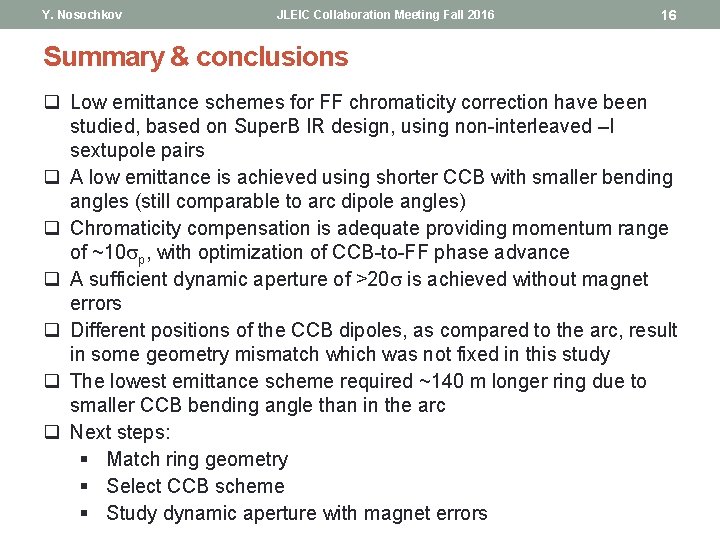
Y. Nosochkov JLEIC Collaboration Meeting Fall 2016 16 Summary & conclusions q Low emittance schemes for FF chromaticity correction have been studied, based on Super. B IR design, using non-interleaved –I sextupole pairs q A low emittance is achieved using shorter CCB with smaller bending angles (still comparable to arc dipole angles) q Chromaticity compensation is adequate providing momentum range of ~10 sp, with optimization of CCB-to-FF phase advance q A sufficient dynamic aperture of >20 s is achieved without magnet errors q Different positions of the CCB dipoles, as compared to the arc, result in some geometry mismatch which was not fixed in this study q The lowest emittance scheme required ~140 m longer ring due to smaller CCB bending angle than in the arc q Next steps: § Match ring geometry § Select CCB scheme § Study dynamic aperture with magnet errors
Y. Nosochkov JLEIC Collaboration Meeting Fall 2016 Thank you for your attention! 17