
Electron Cloud Studies for Tevatron and Main Injector
- Slides: 31
Electron Cloud Studies for Tevatron and Main Injector Xiaolong Zhang AD/Tevatron 6/5/2006 Xiaolong Zhang-FNAL, AD/Tevatron
In This Report … l What’s Electron Cloud and it’s Effects; l The impact on Main Injector Upgrades and the research activities at Accelerator Division; l Simulation methods, programs and results; l Future study plans. 6/5/2006 Xiaolong Zhang-FNAL, AD/Tevatron
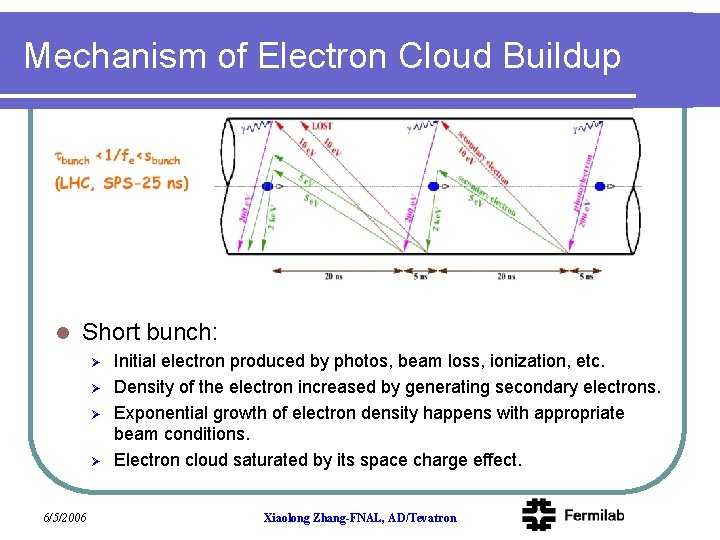
Mechanism of Electron Cloud Buildup l Short bunch: Ø Ø 6/5/2006 Initial electron produced by photos, beam loss, ionization, etc. Density of the electron increased by generating secondary electrons. Exponential growth of electron density happens with appropriate beam conditions. Electron cloud saturated by its space charge effect. Xiaolong Zhang-FNAL, AD/Tevatron
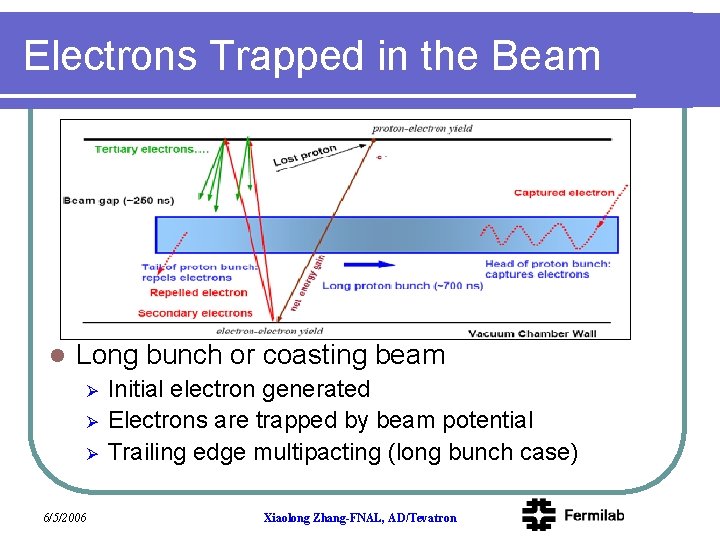
Electrons Trapped in the Beam l Long bunch or coasting beam Ø Ø Ø 6/5/2006 Initial electron generated Electrons are trapped by beam potential Trailing edge multipacting (long bunch case) Xiaolong Zhang-FNAL, AD/Tevatron
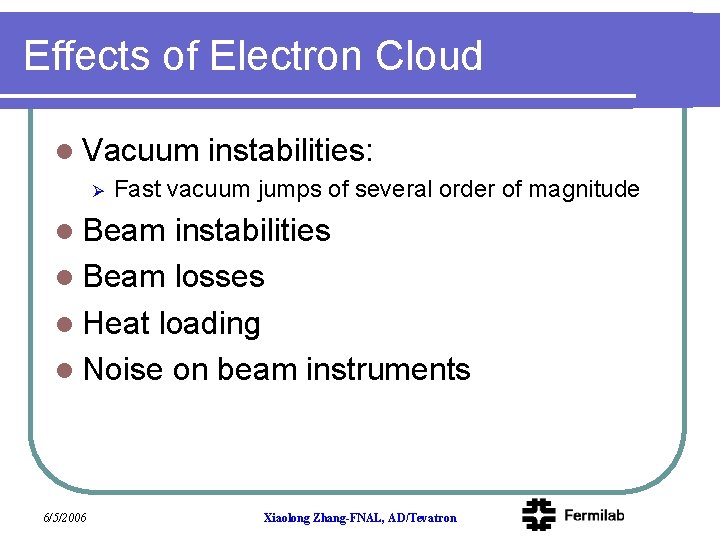
Effects of Electron Cloud l Vacuum Ø instabilities: Fast vacuum jumps of several order of magnitude l Beam instabilities l Beam losses l Heat loading l Noise on beam instruments 6/5/2006 Xiaolong Zhang-FNAL, AD/Tevatron
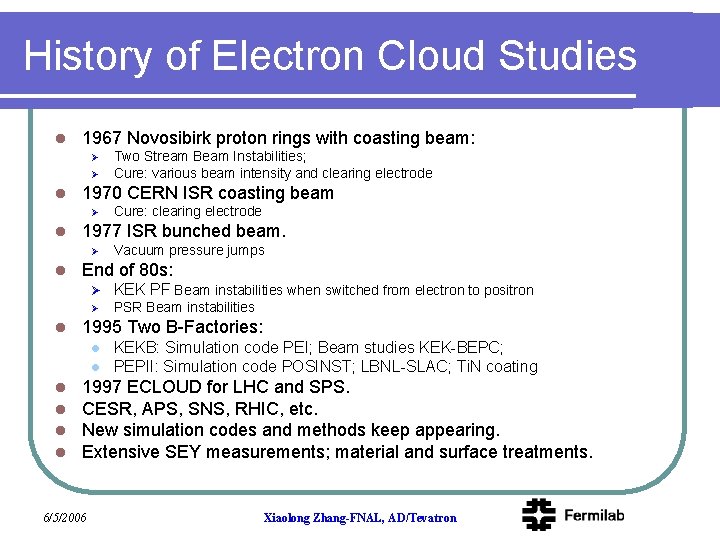
History of Electron Cloud Studies l 1967 Novosibirk proton rings with coasting beam: Ø Ø l 1970 CERN ISR coasting beam Ø l l Vacuum pressure jumps End of 80 s: Ø KEK PF Beam instabilities when switched from electron to positron Ø PSR Beam instabilities 1995 Two B-Factories: l l l Cure: clearing electrode 1977 ISR bunched beam. Ø l Two Stream Beam Instabilities; Cure: various beam intensity and clearing electrode KEKB: Simulation code PEI; Beam studies KEK-BEPC; PEPII: Simulation code POSINST; LBNL-SLAC; Ti. N coating 1997 ECLOUD for LHC and SPS. CESR, APS, SNS, RHIC, etc. New simulation codes and methods keep appearing. Extensive SEY measurements; material and surface treatments. 6/5/2006 Xiaolong Zhang-FNAL, AD/Tevatron
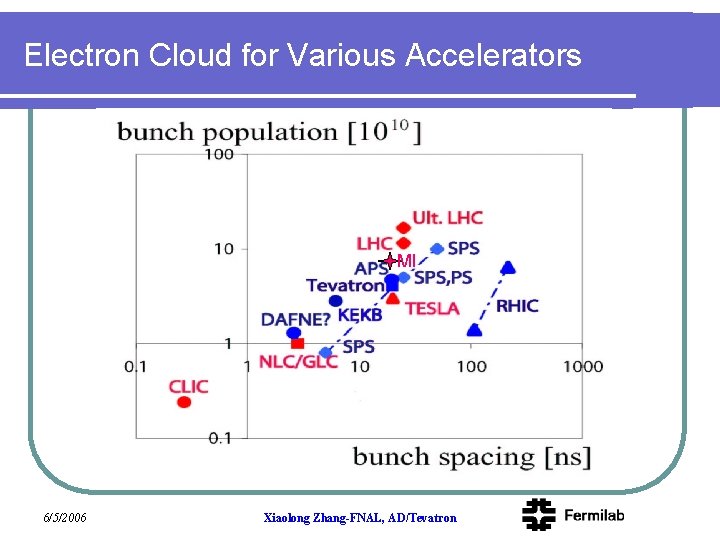
Electron Cloud for Various Accelerators MI 6/5/2006 Xiaolong Zhang-FNAL, AD/Tevatron
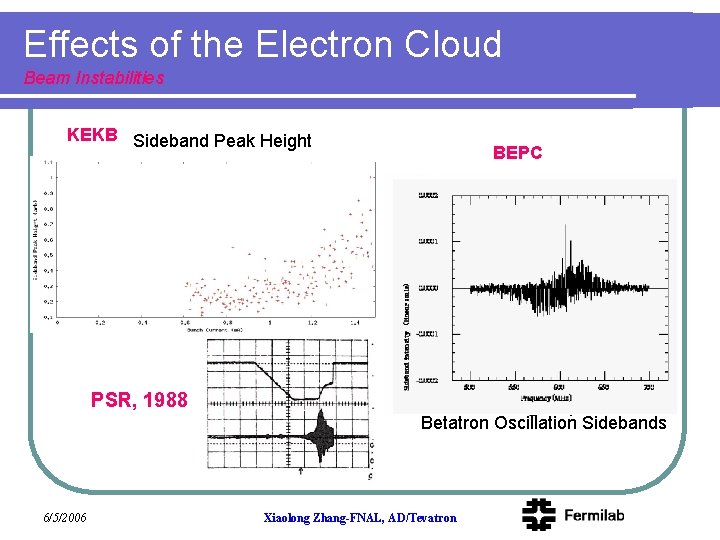
Effects of the Electron Cloud Beam Instabilities KEKB Sideband Peak Height BEPC PSR, 1988 Betatron Oscillation Sidebands 6/5/2006 Xiaolong Zhang-FNAL, AD/Tevatron
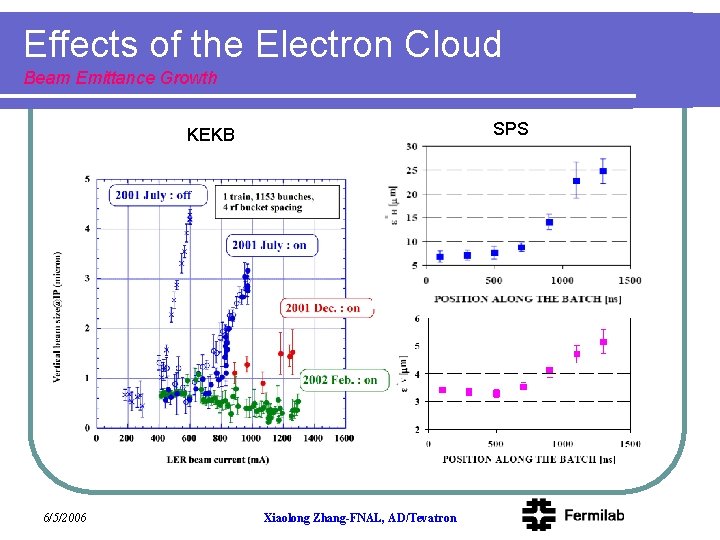
Effects of the Electron Cloud Beam Emittance Growth SPS KEKB 6/5/2006 Xiaolong Zhang-FNAL, AD/Tevatron
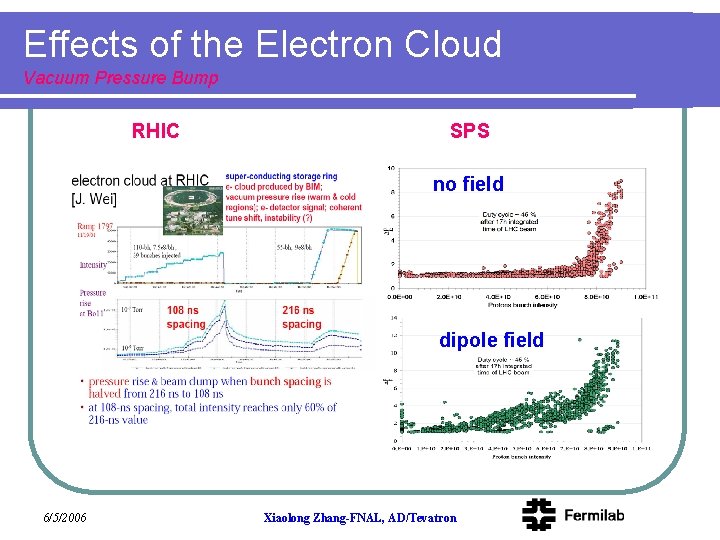
Effects of the Electron Cloud Vacuum Pressure Bump RHIC SPS no field dipole field 6/5/2006 Xiaolong Zhang-FNAL, AD/Tevatron
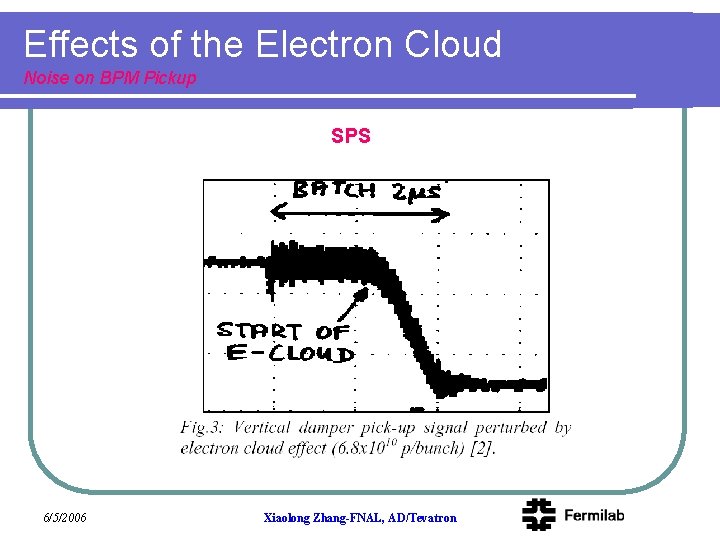
Effects of the Electron Cloud Noise on BPM Pickup SPS 6/5/2006 Xiaolong Zhang-FNAL, AD/Tevatron
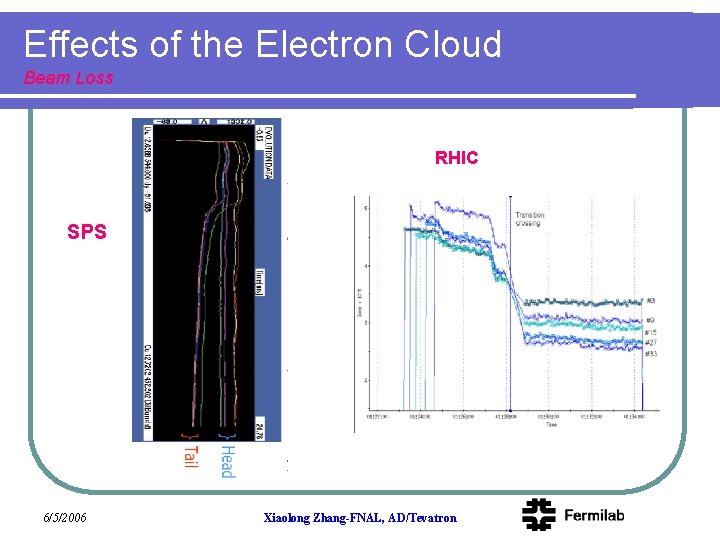
Effects of the Electron Cloud Beam Loss RHIC SPS 6/5/2006 Xiaolong Zhang-FNAL, AD/Tevatron
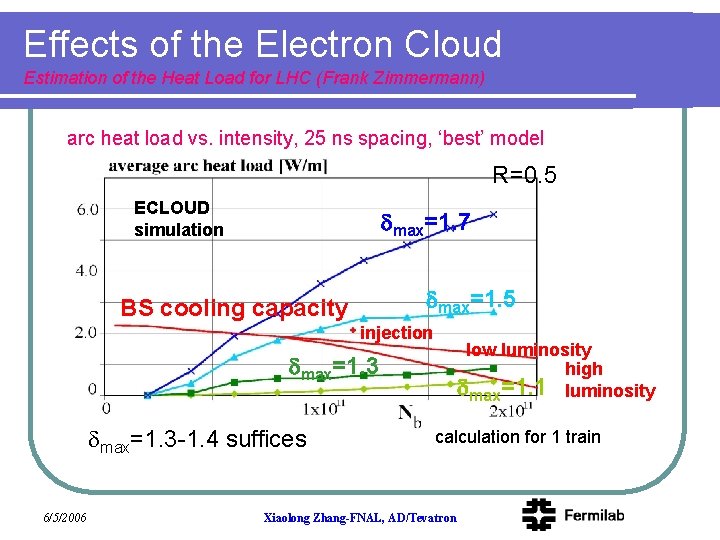
Effects of the Electron Cloud Estimation of the Heat Load for LHC (Frank Zimmermann) arc heat load vs. intensity, 25 ns spacing, ‘best’ model R=0. 5 ECLOUD simulation dmax=1. 7 dmax=1. 5 BS cooling capacity injection low luminosity high dmax=1. 1 luminosity dmax=1. 3 -1. 4 suffices 6/5/2006 calculation for 1 train Xiaolong Zhang-FNAL, AD/Tevatron
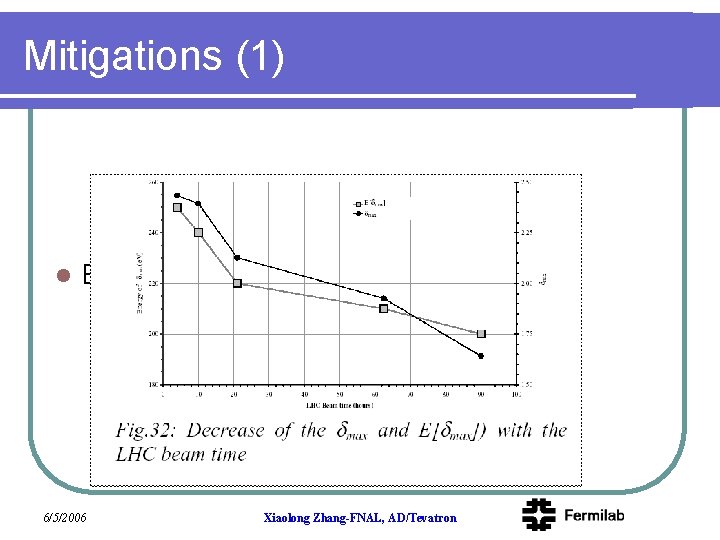
Mitigations (1) l Beam Scrubbing 6/5/2006 Xiaolong Zhang-FNAL, AD/Tevatron
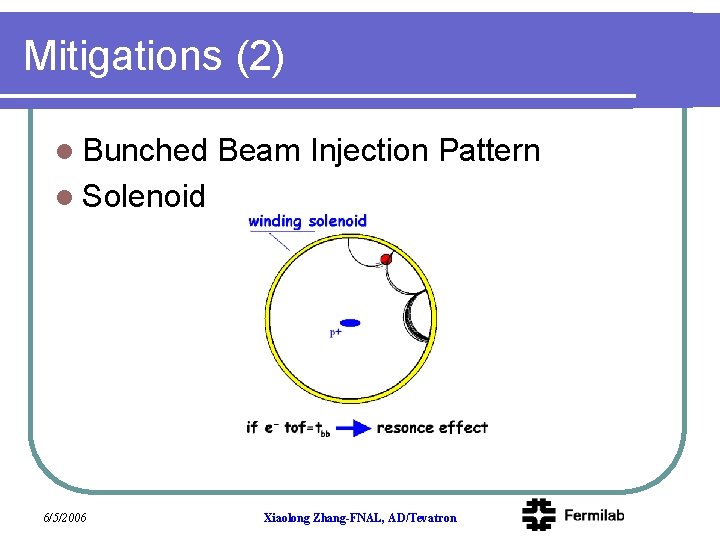
Mitigations (2) l Bunched Beam Injection Pattern l Solenoid 6/5/2006 Xiaolong Zhang-FNAL, AD/Tevatron
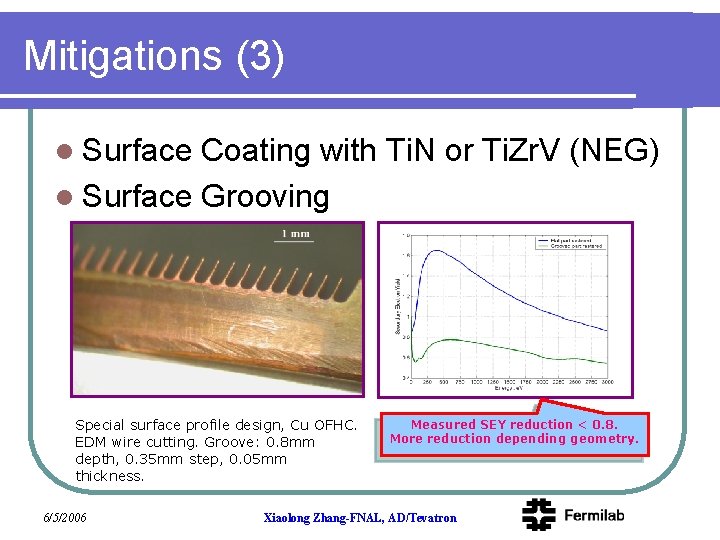
Mitigations (3) l Surface Coating with Ti. N or Ti. Zr. V (NEG) l Surface Grooving 1 mm Special surface profile design, Cu OFHC. EDM wire cutting. Groove: 0. 8 mm depth, 0. 35 mm step, 0. 05 mm thickness. 6/5/2006 Measured SEY reduction < 0. 8. More reduction depending geometry. Xiaolong Zhang-FNAL, AD/Tevatron
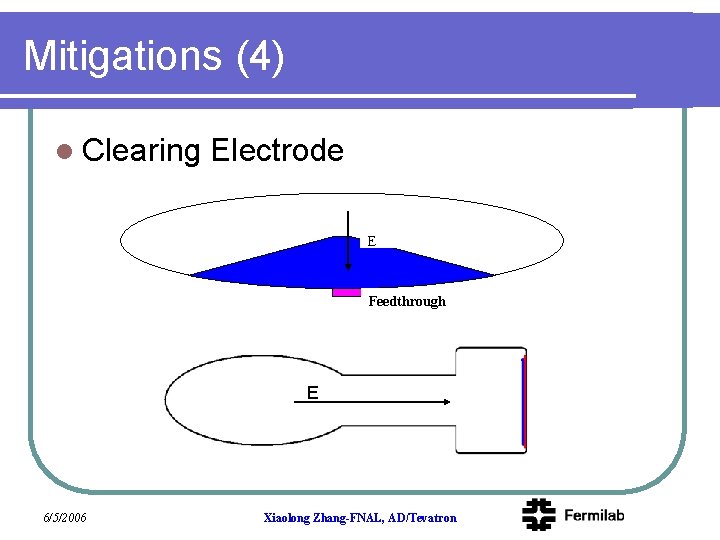
Mitigations (4) l Clearing Electrode E Feedthrough E 6/5/2006 Xiaolong Zhang-FNAL, AD/Tevatron
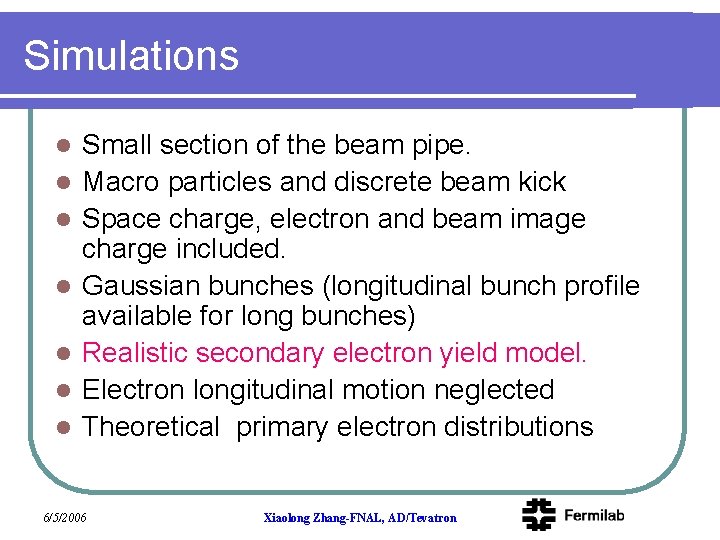
Simulations l l l l Small section of the beam pipe. Macro particles and discrete beam kick Space charge, electron and beam image charge included. Gaussian bunches (longitudinal bunch profile available for long bunches) Realistic secondary electron yield model. Electron longitudinal motion neglected Theoretical primary electron distributions 6/5/2006 Xiaolong Zhang-FNAL, AD/Tevatron
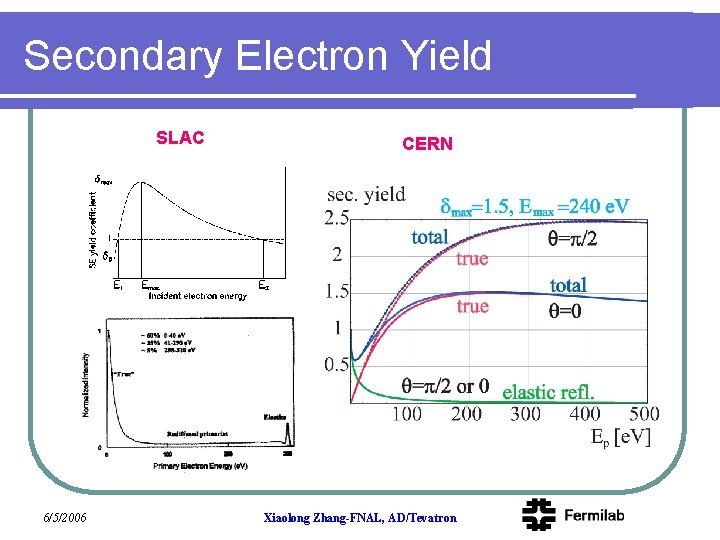
Secondary Electron Yield SLAC 6/5/2006 CERN Xiaolong Zhang-FNAL, AD/Tevatron
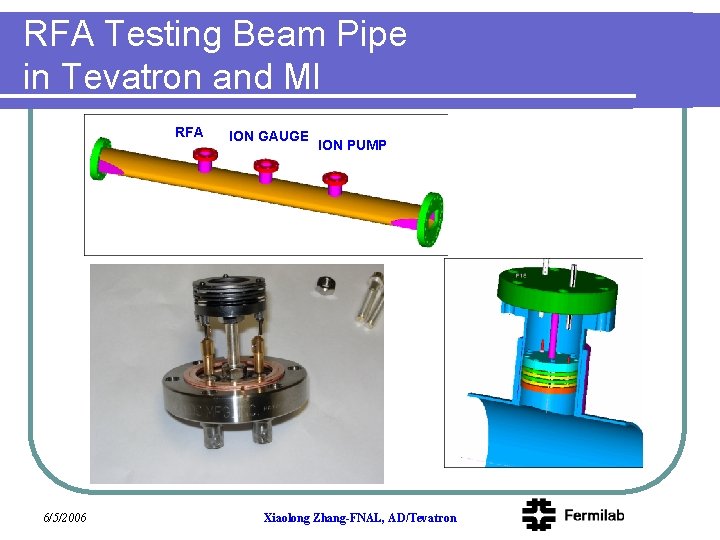
Activities at Accelerator Division l l l Initial observation of pressure rise at Tevatron with high intensity uncoalesced beam in Dec. 2002. Initiated by Weiren Chou and Francois Ostiguy for Proton Driver Study in April 2005. More beam studies at Tevatron and some observations at Main Injector Obtained simulation codes POSINST, ECLOUD, PEI, etc. Collaborations with LBNL, CERN, APS, BNL, SLAC, etc. Got 2 RFA electron detector as gifts from APS 6/5/2006 Xiaolong Zhang-FNAL, AD/Tevatron
RFA Testing Beam Pipe in Tevatron and MI RFA 6/5/2006 ION GAUGE ION PUMP Xiaolong Zhang-FNAL, AD/Tevatron
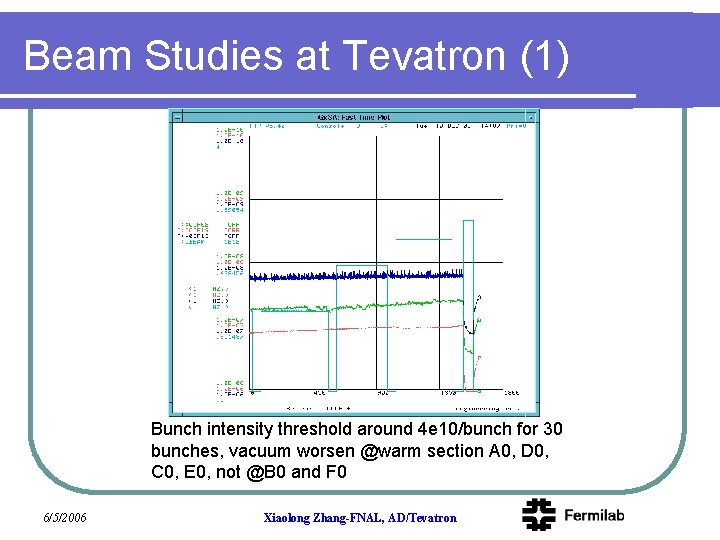
Beam Studies at Tevatron (1) Bunch intensity threshold around 4 e 10/bunch for 30 bunches, vacuum worsen @warm section A 0, D 0, C 0, E 0, not @B 0 and F 0 6/5/2006 Xiaolong Zhang-FNAL, AD/Tevatron
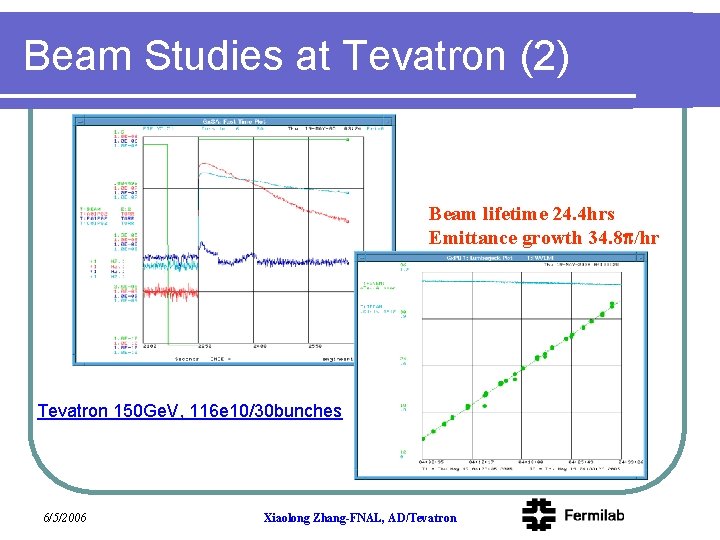
Beam Studies at Tevatron (2) Beam lifetime 24. 4 hrs Emittance growth 34. 8 /hr Tevatron 150 Ge. V, 116 e 10/30 bunches 6/5/2006 Xiaolong Zhang-FNAL, AD/Tevatron
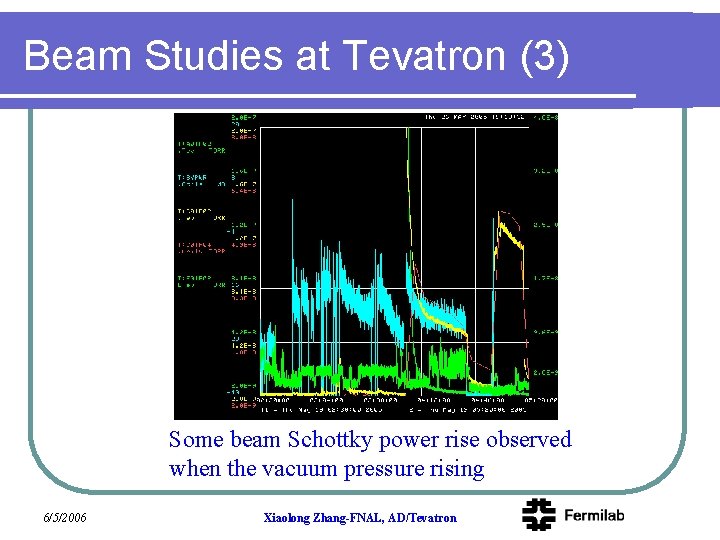
Beam Studies at Tevatron (3) Some beam Schottky power rise observed when the vacuum pressure rising 6/5/2006 Xiaolong Zhang-FNAL, AD/Tevatron
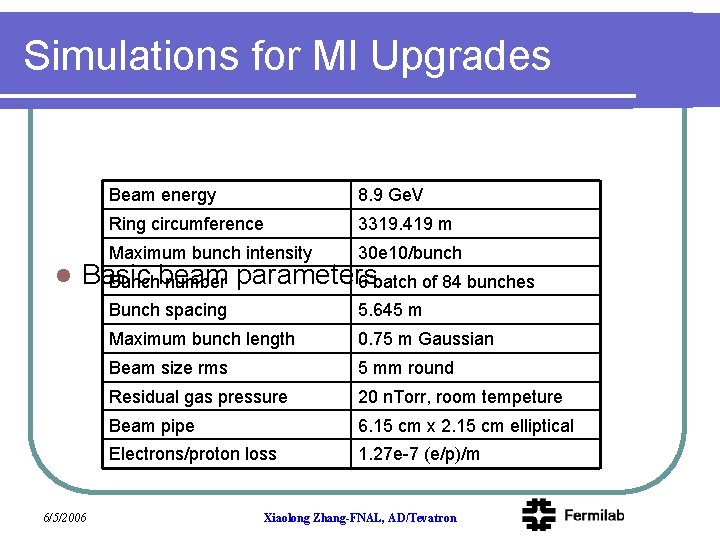
Simulations for MI Upgrades l Beam energy 8. 9 Ge. V Ring circumference 3319. 419 m Maximum bunch intensity 30 e 10/bunch Bunch spacing 5. 645 m Maximum bunch length 0. 75 m Gaussian Beam size rms 5 mm round Residual gas pressure 20 n. Torr, room tempeture Beam pipe 6. 15 cm x 2. 15 cm elliptical Electrons/proton loss 1. 27 e-7 (e/p)/m Basic Bunchbeam number parameters 6 batch of 84 bunches 6/5/2006 Xiaolong Zhang-FNAL, AD/Tevatron
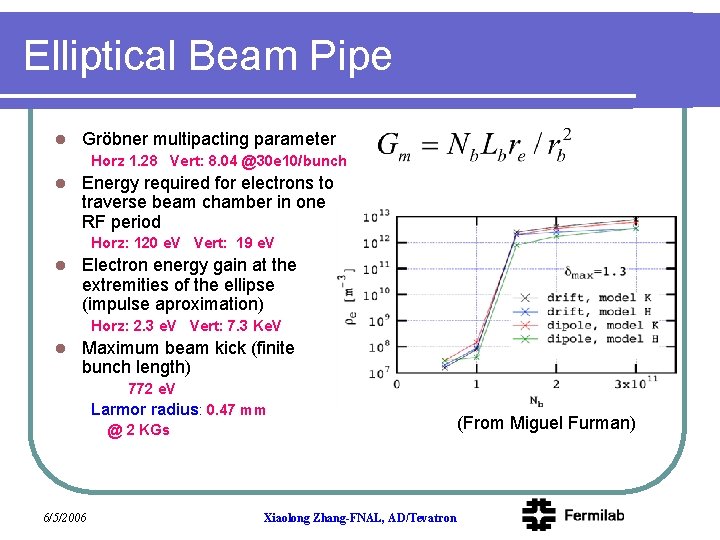
Elliptical Beam Pipe l Gröbner multipacting parameter Horz 1. 28 Vert: 8. 04 @30 e 10/bunch l Energy required for electrons to traverse beam chamber in one RF period Horz: 120 e. V Vert: 19 e. V l Electron energy gain at the extremities of the ellipse (impulse aproximation) Horz: 2. 3 e. V Vert: 7. 3 Ke. V l Maximum beam kick (finite bunch length) 772 e. V Larmor radius: 0. 47 mm @ 2 KGs 6/5/2006 Xiaolong Zhang-FNAL, AD/Tevatron (From Miguel Furman)
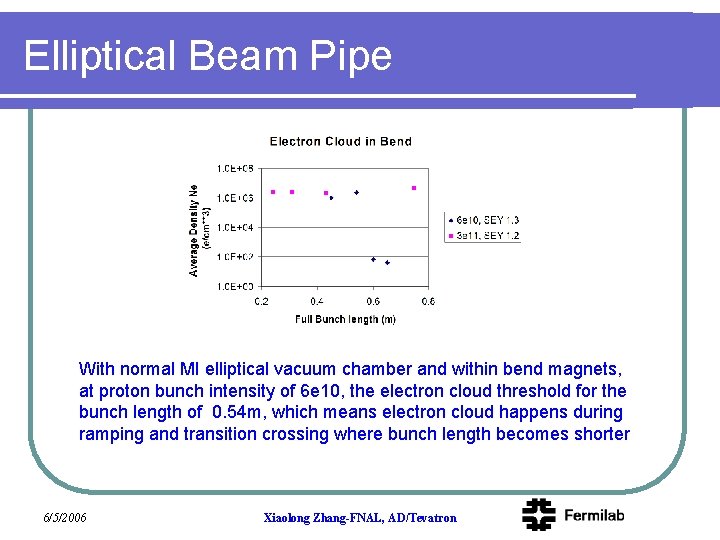
Elliptical Beam Pipe With normal MI elliptical vacuum chamber and within bend magnets, at proton bunch intensity of 6 e 10, the electron cloud threshold for the bunch length of 0. 54 m, which means electron cloud happens during ramping and transition crossing where bunch length becomes shorter 6/5/2006 Xiaolong Zhang-FNAL, AD/Tevatron
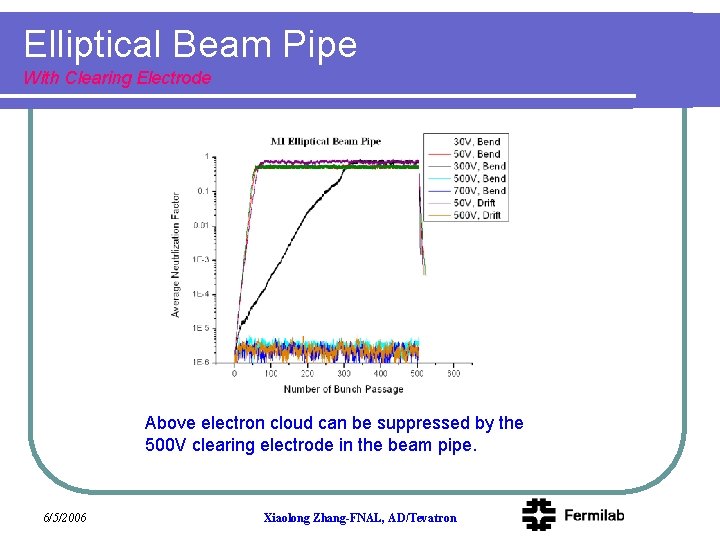
Elliptical Beam Pipe With Clearing Electrode Above electron cloud can be suppressed by the 500 V clearing electrode in the beam pipe. 6/5/2006 Xiaolong Zhang-FNAL, AD/Tevatron
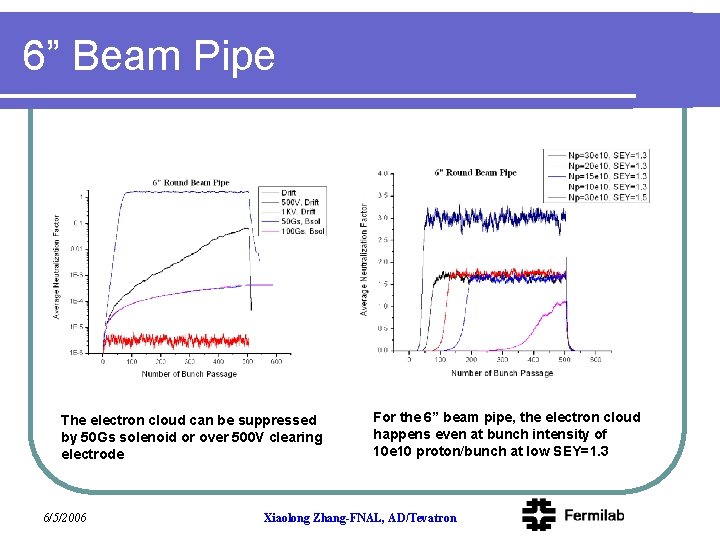
6” Beam Pipe The electron cloud can be suppressed by 50 Gs solenoid or over 500 V clearing electrode 6/5/2006 For the 6” beam pipe, the electron cloud happens even at bunch intensity of 10 e 10 proton/bunch at low SEY=1. 3 Xiaolong Zhang-FNAL, AD/Tevatron
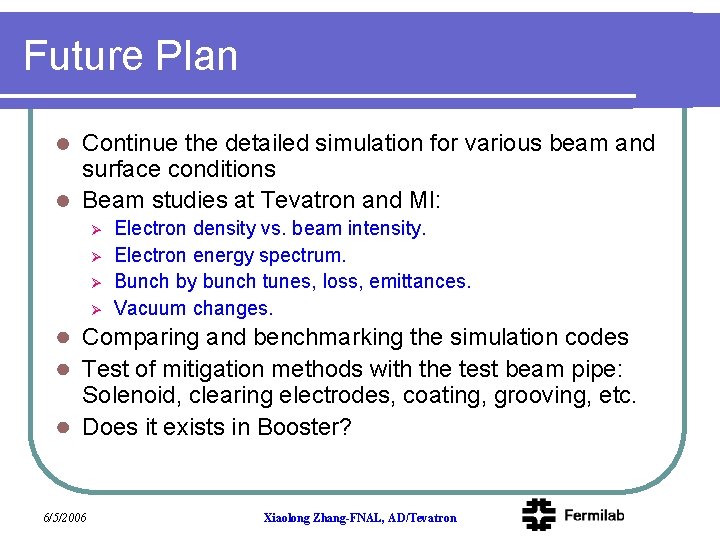
Future Plan Continue the detailed simulation for various beam and surface conditions l Beam studies at Tevatron and MI: l Ø Ø Electron density vs. beam intensity. Electron energy spectrum. Bunch by bunch tunes, loss, emittances. Vacuum changes. ● Comparing and benchmarking the simulation codes ● Test of mitigation methods with the test beam pipe: Solenoid, clearing electrodes, coating, grooving, etc. ● Does it exists in Booster? 6/5/2006 Xiaolong Zhang-FNAL, AD/Tevatron
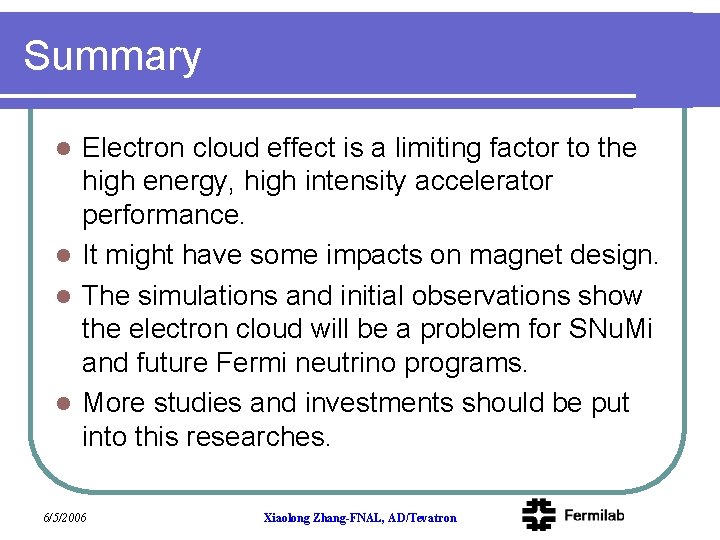
Summary Electron cloud effect is a limiting factor to the high energy, high intensity accelerator performance. l It might have some impacts on magnet design. l The simulations and initial observations show the electron cloud will be a problem for SNu. Mi and future Fermi neutrino programs. l More studies and investments should be put into this researches. l 6/5/2006 Xiaolong Zhang-FNAL, AD/Tevatron