
Electron Cloud Measurements and Plans Bob Zwaska September
Electron Cloud Measurements and Plans Bob Zwaska September 9, 2010 APC Seminar
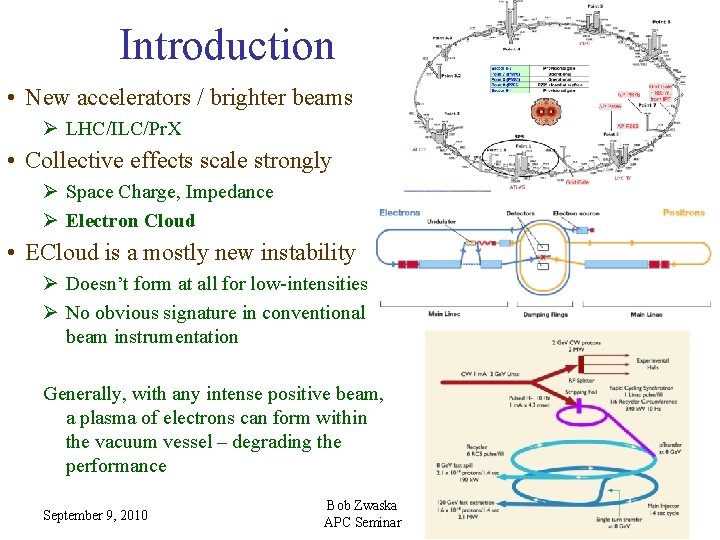
Introduction • New accelerators / brighter beams Ø LHC/ILC/Pr. X • Collective effects scale strongly Ø Space Charge, Impedance Ø Electron Cloud • ECloud is a mostly new instability Ø Doesn’t form at all for low-intensities Ø No obvious signature in conventional beam instrumentation Generally, with any intense positive beam, a plasma of electrons can form within the vacuum vessel – degrading the performance September 9, 2010 Bob Zwaska APC Seminar 2
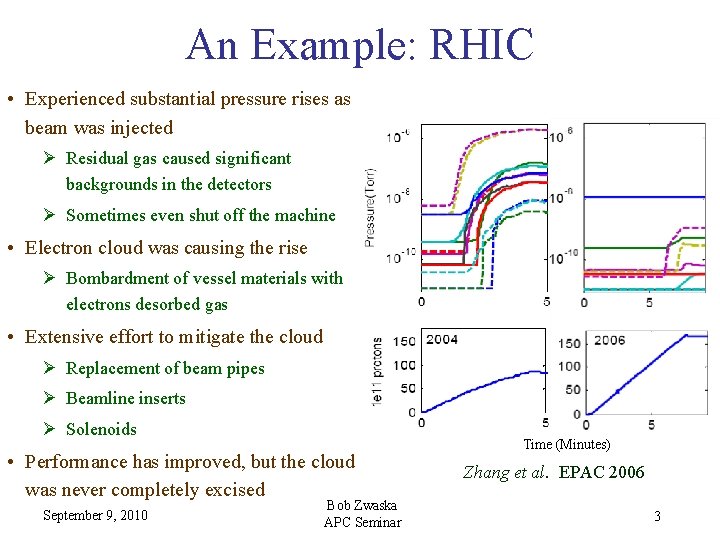
An Example: RHIC • Experienced substantial pressure rises as beam was injected Ø Residual gas caused significant backgrounds in the detectors Ø Sometimes even shut off the machine • Electron cloud was causing the rise Ø Bombardment of vessel materials with electrons desorbed gas • Extensive effort to mitigate the cloud Ø Replacement of beam pipes Ø Beamline inserts Ø Solenoids • Performance has improved, but the cloud was never completely excised September 9, 2010 Bob Zwaska APC Seminar Time (Minutes) Zhang et al. EPAC 2006 3
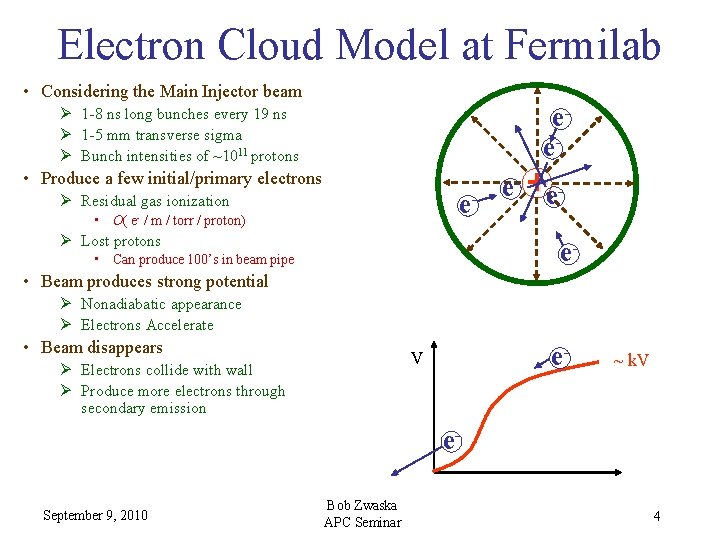
Electron Cloud Model at Fermilab • Considering the Main Injector beam ee- Ø 1 -8 ns long bunches every 19 ns Ø 1 -5 mm transverse sigma Ø Bunch intensities of ~1011 protons • Produce a few initial/primary electrons e- Ø Residual gas ionization • O( e- / m / torr / proton) Ø Lost protons e- +ee- • Can produce 100’s in beam pipe • Beam produces strong potential Ø Nonadiabatic appearance Ø Electrons Accelerate • Beam disappears e- V Ø Electrons collide with wall Ø Produce more electrons through secondary emission ~ k. V e. September 9, 2010 Bob Zwaska APC Seminar 4
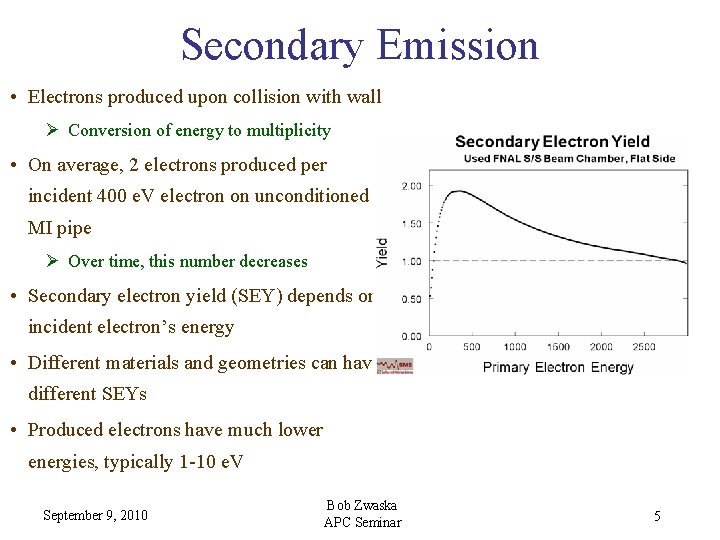
Secondary Emission • Electrons produced upon collision with wall Ø Conversion of energy to multiplicity • On average, 2 electrons produced per incident 400 e. V electron on unconditioned MI pipe Ø Over time, this number decreases • Secondary electron yield (SEY) depends on incident electron’s energy • Different materials and geometries can have different SEYs • Produced electrons have much lower energies, typically 1 -10 e. V September 9, 2010 Bob Zwaska APC Seminar 5
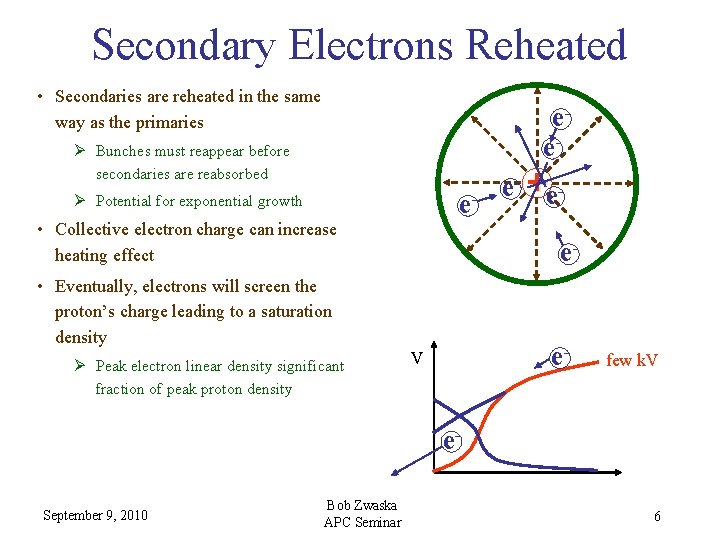
Secondary Electrons Reheated • Secondaries are reheated in the same way as the primaries ee- Ø Bunches must reappear before secondaries are reabsorbed e- Ø Potential for exponential growth • Collective electron charge can increase heating effect e- • Eventually, electrons will screen the proton’s charge leading to a saturation density Ø Peak electron linear density significant fraction of peak proton density e- +e- e- V few k. V e. September 9, 2010 Bob Zwaska APC Seminar 6
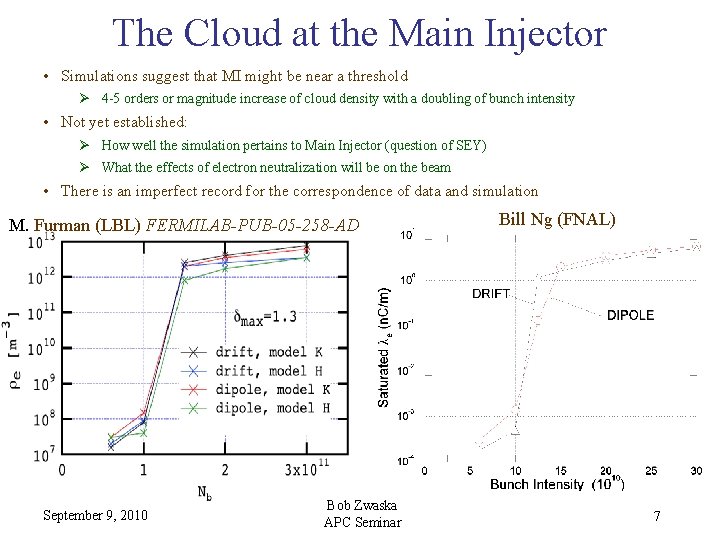
The Cloud at the Main Injector • Simulations suggest that MI might be near a threshold Ø 4 -5 orders or magnitude increase of cloud density with a doubling of bunch intensity • Not yet established: Ø How well the simulation pertains to Main Injector (question of SEY) Ø What the effects of electron neutralization will be on the beam • There is an imperfect record for the correspondence of data and simulation M. Furman (LBL) FERMILAB-PUB-05 -258 -AD September 9, 2010 Bob Zwaska APC Seminar Bill Ng (FNAL) 7
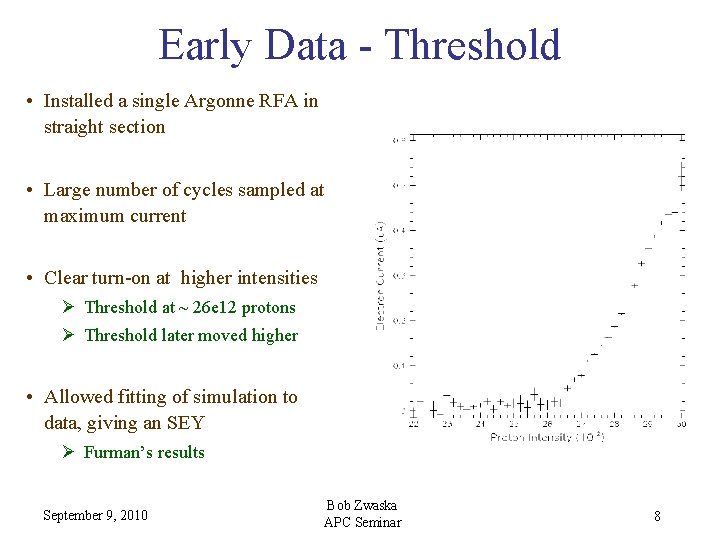
Early Data - Threshold • Installed a single Argonne RFA in straight section • Large number of cycles sampled at maximum current • Clear turn-on at higher intensities Ø Threshold at ~ 26 e 12 protons Ø Threshold later moved higher • Allowed fitting of simulation to data, giving an SEY Ø Furman’s results September 9, 2010 Bob Zwaska APC Seminar 8
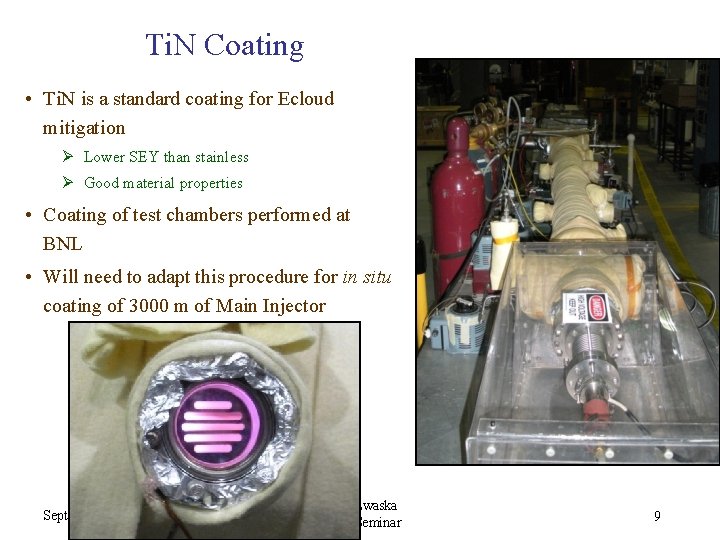
Ti. N Coating • Ti. N is a standard coating for Ecloud mitigation Ø Lower SEY than stainless Ø Good material properties • Coating of test chambers performed at BNL • Will need to adapt this procedure for in situ coating of 3000 m of Main Injector September 9, 2010 Bob Zwaska APC Seminar 9
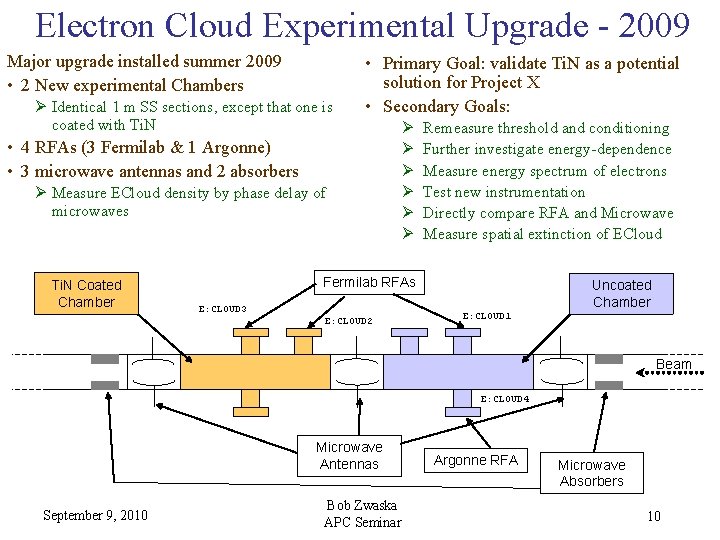
Electron Cloud Experimental Upgrade - 2009 Major upgrade installed summer 2009 • 2 New experimental Chambers Ø Identical 1 m SS sections, except that one is coated with Ti. N • Primary Goal: validate Ti. N as a potential solution for Project X • Secondary Goals: • 4 RFAs (3 Fermilab & 1 Argonne) • 3 microwave antennas and 2 absorbers Ø Measure ECloud density by phase delay of microwaves Ti. N Coated Chamber Ø Ø Ø Remeasure threshold and conditioning Further investigate energy-dependence Measure energy spectrum of electrons Test new instrumentation Directly compare RFA and Microwave Measure spatial extinction of ECloud Fermilab RFAs E: CLOUD 3 E: CLOUD 2 Uncoated Chamber E: CLOUD 1 Beam E: CLOUD 4 Microwave Antennas September 9, 2010 Bob Zwaska APC Seminar Argonne RFA Microwave Absorbers 10
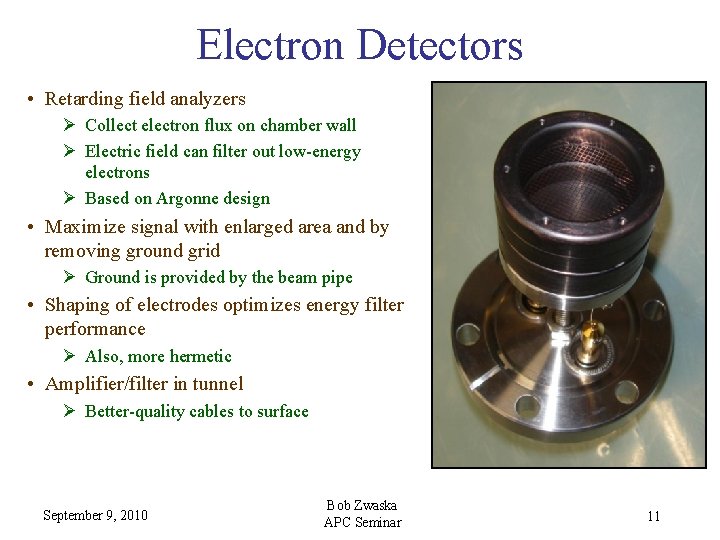
Electron Detectors • Retarding field analyzers Ø Collect electron flux on chamber wall Ø Electric field can filter out low-energy electrons Ø Based on Argonne design • Maximize signal with enlarged area and by removing ground grid Ø Ground is provided by the beam pipe • Shaping of electrodes optimizes energy filter performance Ø Also, more hermetic • Amplifier/filter in tunnel Ø Better-quality cables to surface September 9, 2010 Bob Zwaska APC Seminar 11

Early Data - 9/16/09: 12 e 12 on 6 -batch • • Uncoated (FNAL): 280 n. A Uncoated (ANL): 110 n. A Coated (5”): 25 n. A Coated (mid): 15 n. A • FNAL/ANL ≈ 2. 5 • Ti. N Uncoated/Coated ≈ 18 • Ratio may seem unremarkable, but it entirely depends on where you are with respect to a transition MI Cycle September 9, 2010 Bob Zwaska APC Seminar 12
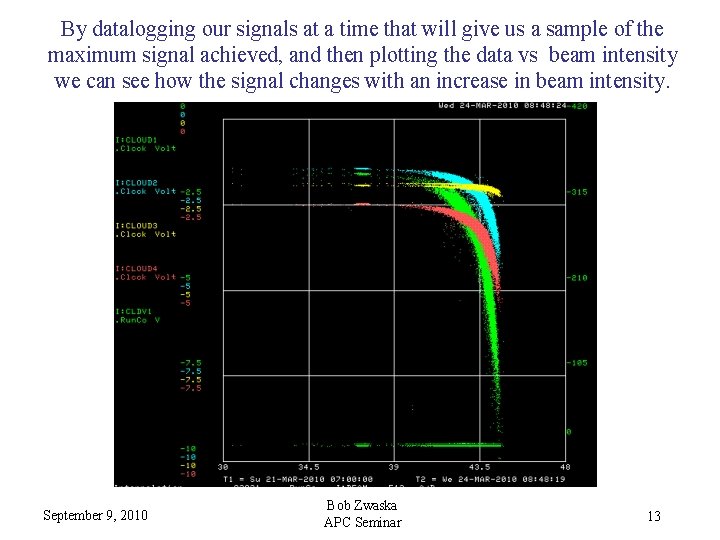
By datalogging our signals at a time that will give us a sample of the maximum signal achieved, and then plotting the data vs beam intensity we can see how the signal changes with an increase in beam intensity. September 9, 2010 Bob Zwaska APC Seminar 13
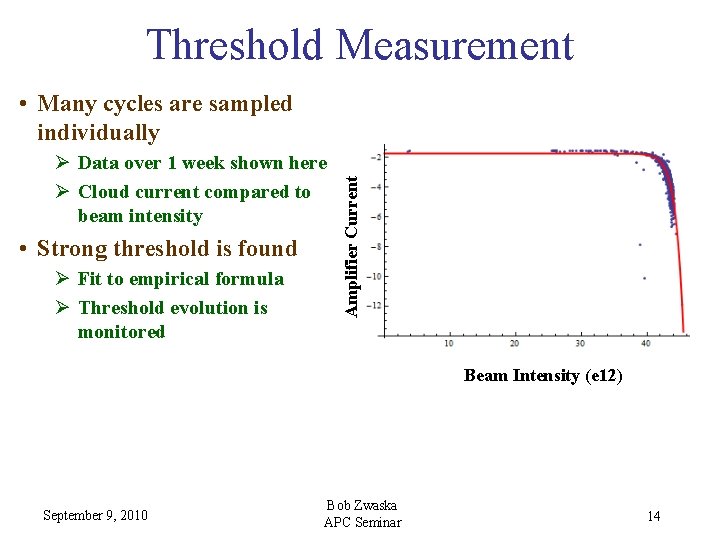
Threshold Measurement Ø Data over 1 week shown here Ø Cloud current compared to beam intensity • Strong threshold is found Ø Fit to empirical formula Ø Threshold evolution is monitored Amplifier Current • Many cycles are sampled individually Beam Intensity (e 12) September 9, 2010 Bob Zwaska APC Seminar 14
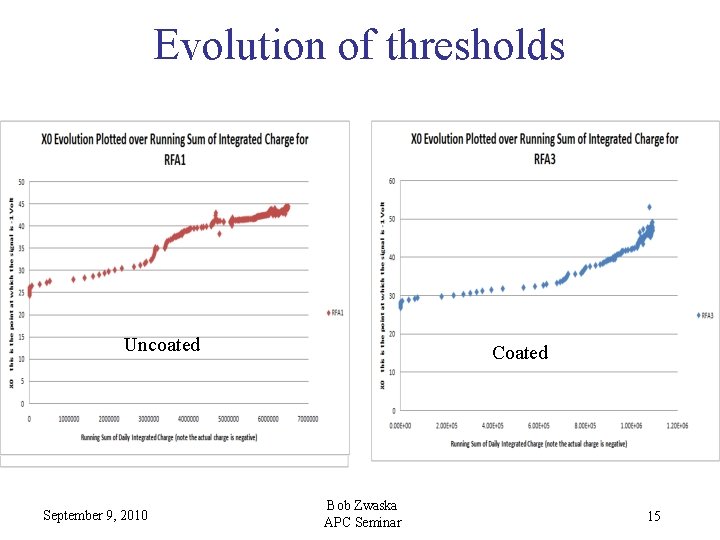
Evolution of thresholds Uncoated September 9, 2010 Coated Bob Zwaska APC Seminar 15
Carbon Pipe • CERN is very interested in amorphous carbon ØSee it as superior to Ti. N in not requiring as much conditioning • They built a chamber for us in short order and we installed it in MI this summer • Some early results here September 9, 2010 Bob Zwaska APC Seminar 16
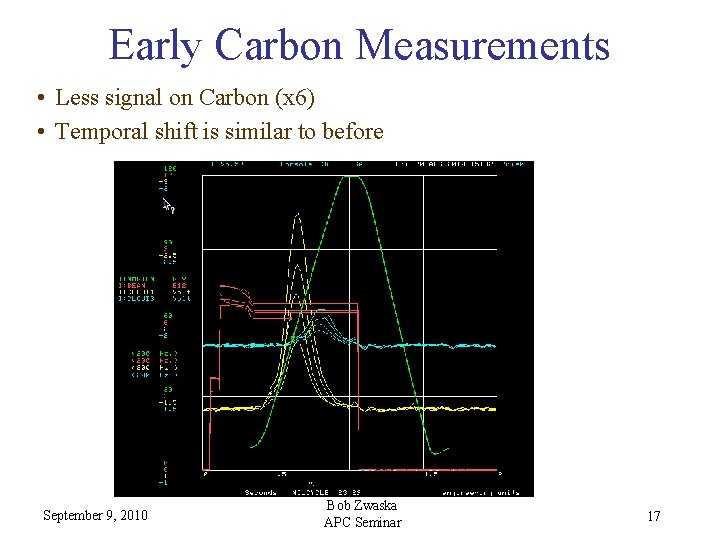
Early Carbon Measurements • Less signal on Carbon (x 6) • Temporal shift is similar to before September 9, 2010 Bob Zwaska APC Seminar 17
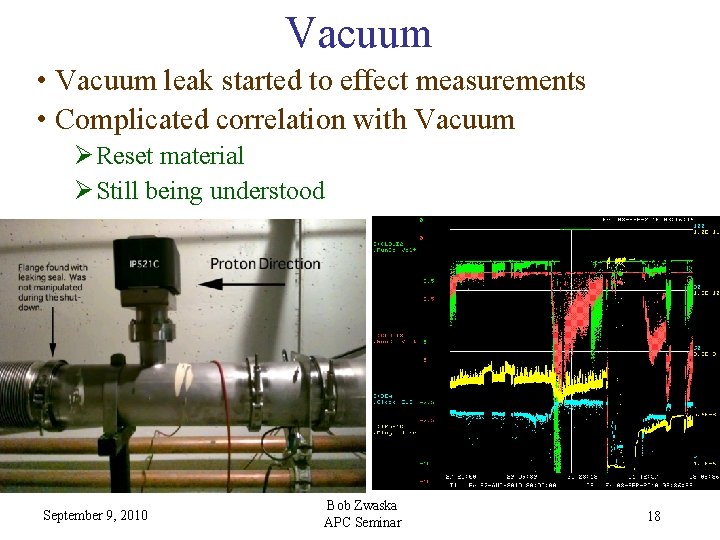
Vacuum • Vacuum leak started to effect measurements • Complicated correlation with Vacuum Ø Reset material Ø Still being understood September 9, 2010 Bob Zwaska APC Seminar 18
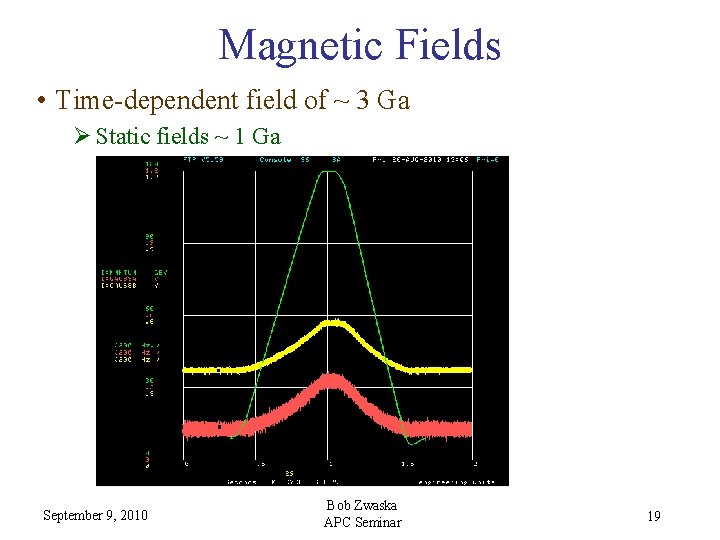
Magnetic Fields • Time-dependent field of ~ 3 Ga Ø Static fields ~ 1 Ga September 9, 2010 Bob Zwaska APC Seminar 19
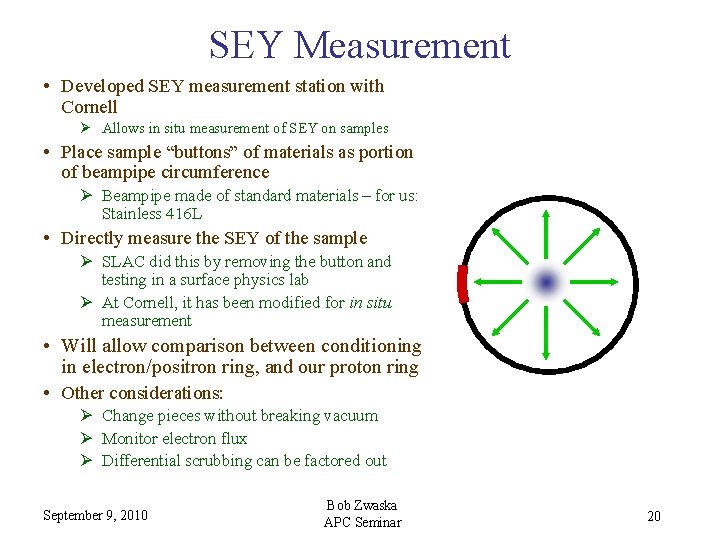
SEY Measurement • Developed SEY measurement station with Cornell Ø Allows in situ measurement of SEY on samples • Place sample “buttons” of materials as portion of beampipe circumference Ø Beampipe made of standard materials – for us: Stainless 416 L • Directly measure the SEY of the sample Ø SLAC did this by removing the button and testing in a surface physics lab Ø At Cornell, it has been modified for in situ measurement • Will allow comparison between conditioning in electron/positron ring, and our proton ring • Other considerations: Ø Change pieces without breaking vacuum Ø Monitor electron flux Ø Differential scrubbing can be factored out September 9, 2010 Bob Zwaska APC Seminar 20
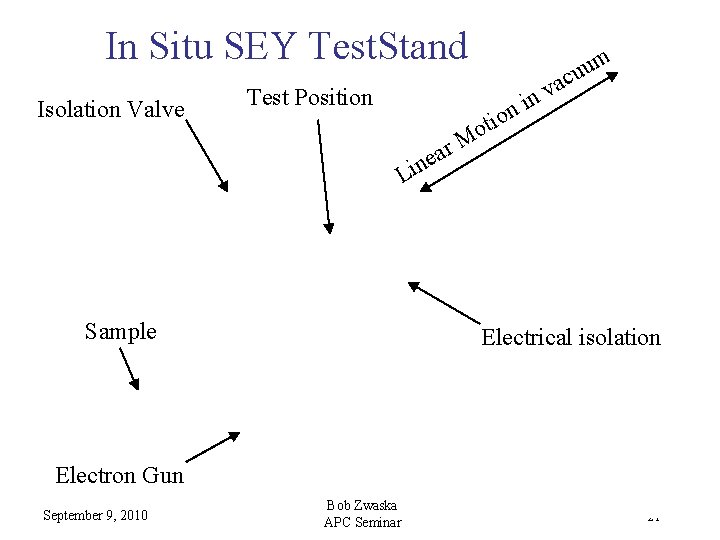
In Situ SEY Test. Stand Isolation Valve Test Position m n ni v u u c a o L Sample r a e in ti o M Electrical isolation Electron Gun September 9, 2010 Bob Zwaska APC Seminar 21
Outlook • Ti. N and Carbon have been tested with present MI intensities Ø Ti. N shows good conditioning over time with no obvious limit • Better than SS Ø Carbon, so far, appears similar to Ti. N Ø Measurements will be refined and continued • SEY Test Stand built with Cornell Ø Will be here at Fermilab this year and tested in lab Ø Plan to install in MI next year • Need to be confident in an approach for Project X Ø Ti. N appears to be an adequate approach • But, it is still rather expensive • Dipoles? Quads? Drifts? Recycler? RCS? Ø Simulations are needed • Too complicated for an analytical model • Don’t fully understand buildup or beam effects September 9, 2010 Bob Zwaska APC Seminar 22
Electron Cloud Measurements and Plans Bob Zwaska September 9, 2010 APC Seminar September 9, 2010 Bob Zwaska APC Seminar 23
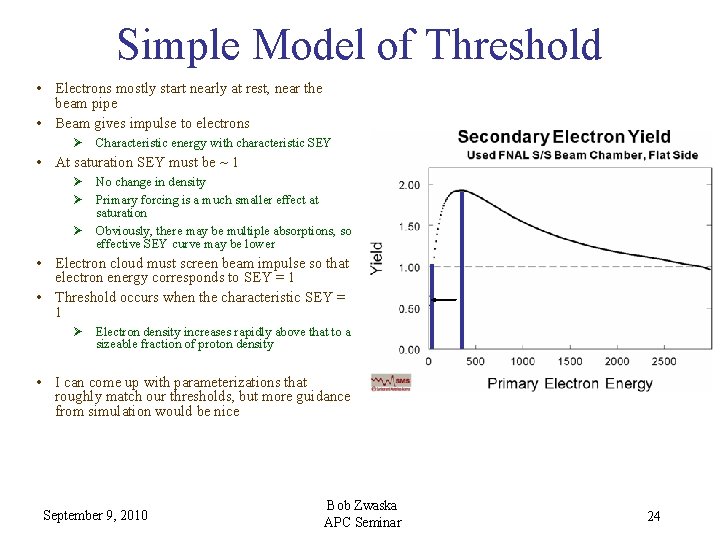
Simple Model of Threshold • Electrons mostly start nearly at rest, near the beam pipe • Beam gives impulse to electrons Ø Characteristic energy with characteristic SEY • At saturation SEY must be ~ 1 Ø No change in density Ø Primary forcing is a much smaller effect at saturation Ø Obviously, there may be multiple absorptions, so effective SEY curve may be lower • Electron cloud must screen beam impulse so that electron energy corresponds to SEY = 1 • Threshold occurs when the characteristic SEY = 1 Ø Electron density increases rapidly above that to a sizeable fraction of proton density • I can come up with parameterizations that roughly match our thresholds, but more guidance from simulation would be nice September 9, 2010 Bob Zwaska APC Seminar 24
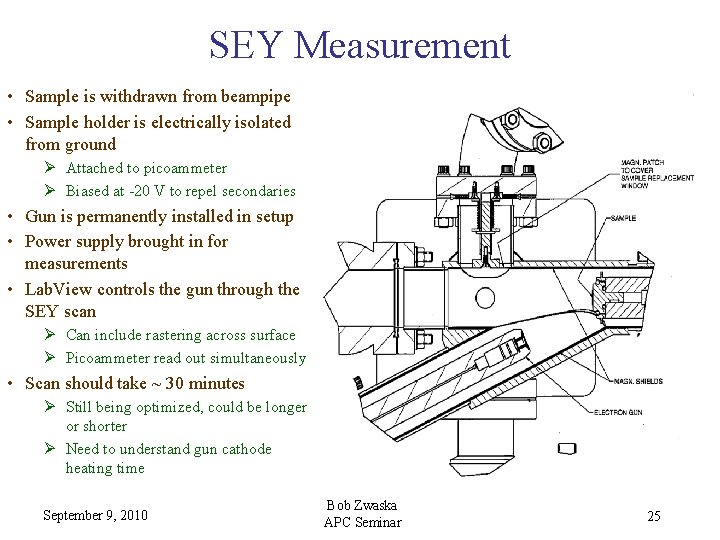
SEY Measurement • Sample is withdrawn from beampipe • Sample holder is electrically isolated from ground Ø Attached to picoammeter Ø Biased at -20 V to repel secondaries • Gun is permanently installed in setup • Power supply brought in for measurements • Lab. View controls the gun through the SEY scan Ø Can include rastering across surface Ø Picoammeter read out simultaneously • Scan should take ~ 30 minutes Ø Still being optimized, could be longer or shorter Ø Need to understand gun cathode heating time September 9, 2010 Bob Zwaska APC Seminar 25
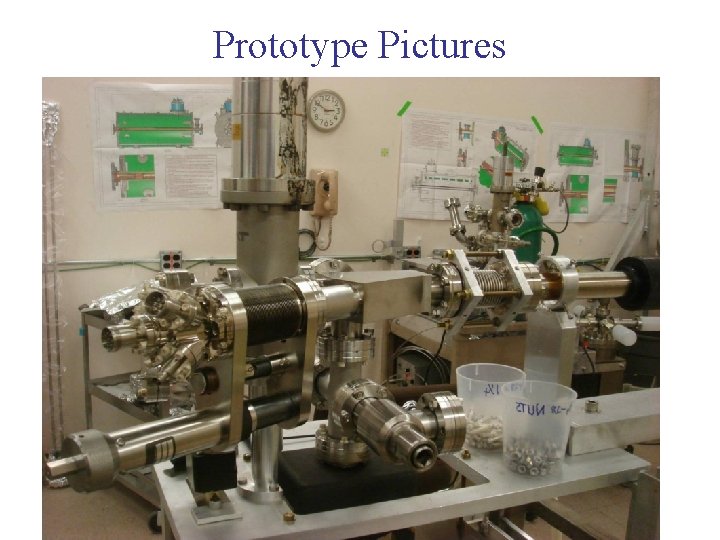
Prototype Pictures September 9, 2010 Bob Zwaska APC Seminar 26
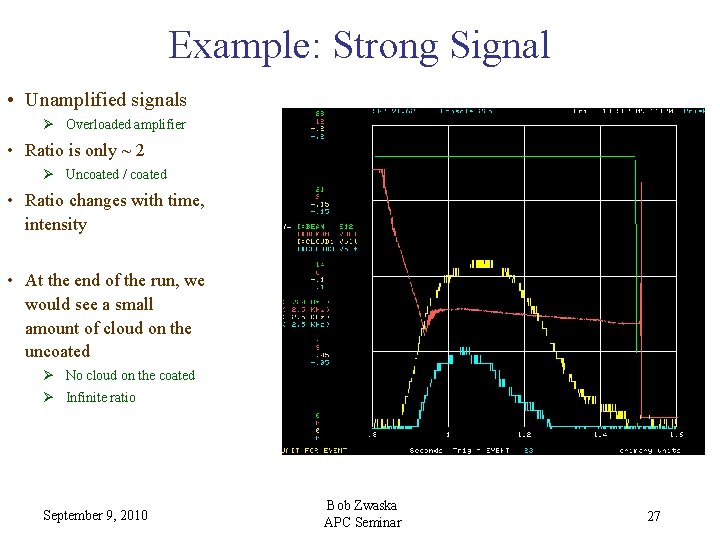
Example: Strong Signal • Unamplified signals Ø Overloaded amplifier • Ratio is only ~ 2 Ø Uncoated / coated • Ratio changes with time, intensity • At the end of the run, we would see a small amount of cloud on the uncoated Ø No cloud on the coated Ø Infinite ratio September 9, 2010 Bob Zwaska APC Seminar 27
- Slides: 27