
Electron and Ion Polarimetry for EIC Wolfgang Lorenzon
- Slides: 20
Electron and Ion Polarimetry for EIC Wolfgang Lorenzon (Michigan) Electron-Ion Collider Workshop Hampton University 20 May 2008 Thanks to Yousef Makdisi 1
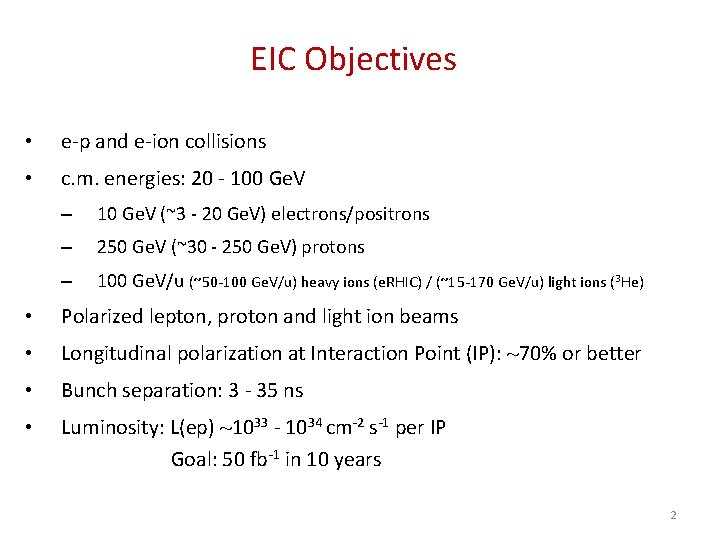
EIC Objectives • e-p and e-ion collisions • c. m. energies: 20 - 100 Ge. V – 10 Ge. V (~3 - 20 Ge. V) electrons/positrons – 250 Ge. V (~30 - 250 Ge. V) protons – 100 Ge. V/u (~50 -100 Ge. V/u) heavy ions (e. RHIC) / (~15 -170 Ge. V/u) light ions (3 He) • Polarized lepton, proton and light ion beams • Longitudinal polarization at Interaction Point (IP): ~70% or better • Bunch separation: 3 - 35 ns • Luminosity: L(ep) ~1033 - 1034 cm-2 s-1 per IP Goal: 50 fb-1 in 10 years 2
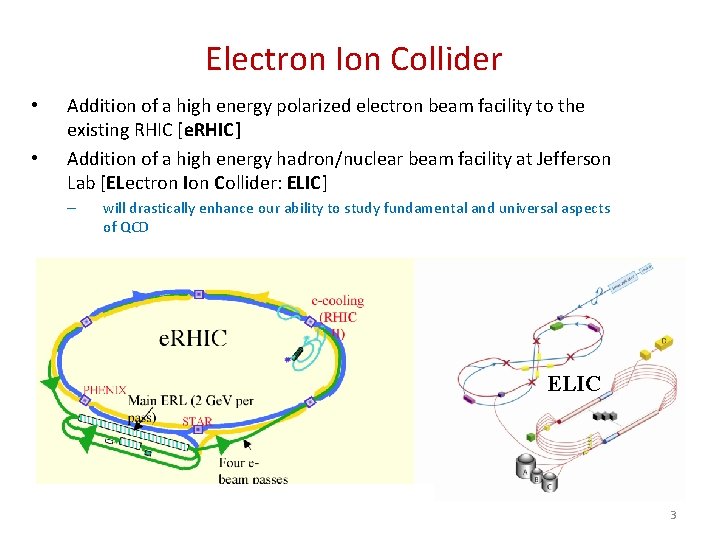
Electron Ion Collider • • Addition of a high energy polarized electron beam facility to the existing RHIC [e. RHIC] Addition of a high energy hadron/nuclear beam facility at Jefferson Lab [ELectron Ion Collider: ELIC] – will drastically enhance our ability to study fundamental and universal aspects of QCD ELIC 3
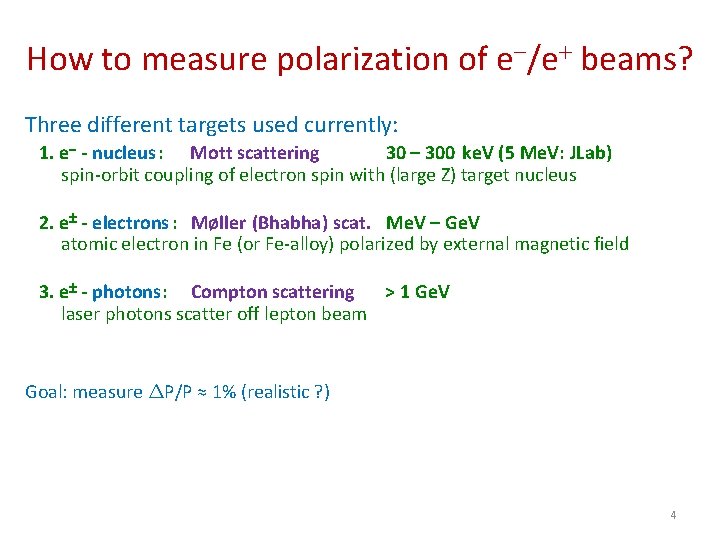
How to measure polarization of e-/e+ beams? Three different targets used currently: 1. e - - nucleus: Mott scattering 30 – 300 ke. V (5 Me. V: JLab) spin-orbit coupling of electron spin with (large Z) target nucleus 2. e - electrons : Møller (Bhabha) scat. Me. V – Ge. V atomic electron in Fe (or Fe-alloy) polarized by external magnetic field 3. e - photons: Compton scattering > 1 Ge. V laser photons scatter off lepton beam Goal: measure DP/P ≈ 1% (realistic ? ) 4
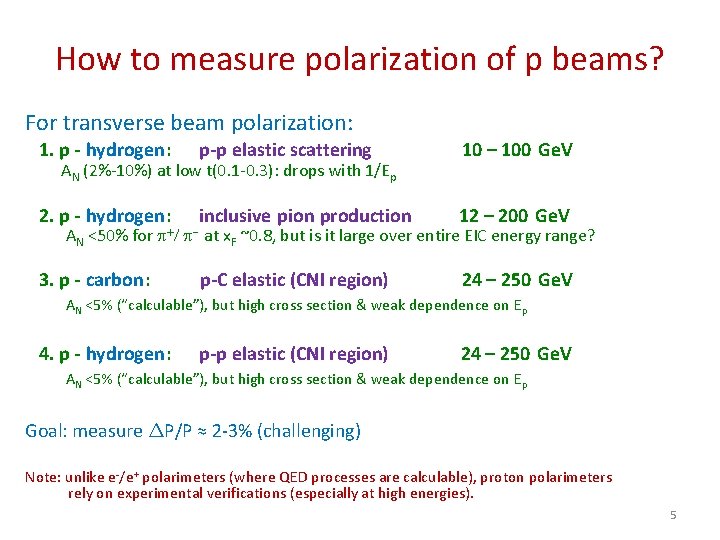
How to measure polarization of p beams? For transverse beam polarization: 1. p - hydrogen: p-p elastic scattering 10 – 100 Ge. V inclusive pion production 12 – 200 Ge. V p-C elastic (CNI region) 24 – 250 Ge. V AN (2%-10%) at low t(0. 1 -0. 3): drops with 1/Ep 2. p - hydrogen: AN <50% for p+/ 3. p - carbon: p- at x. F ~0. 8, but is it large over entire EIC energy range? AN <5% (“calculable”), but high cross section & weak dependence on Ep 4. p - hydrogen: p-p elastic (CNI region) 24 – 250 Ge. V AN <5% (“calculable”), but high cross section & weak dependence on Ep Goal: measure DP/P ≈ 2 -3% (challenging) Note: unlike e-/e+ polarimeters (where QED processes are calculable), proton polarimeters rely on experimental verifications (especially at high energies). 5
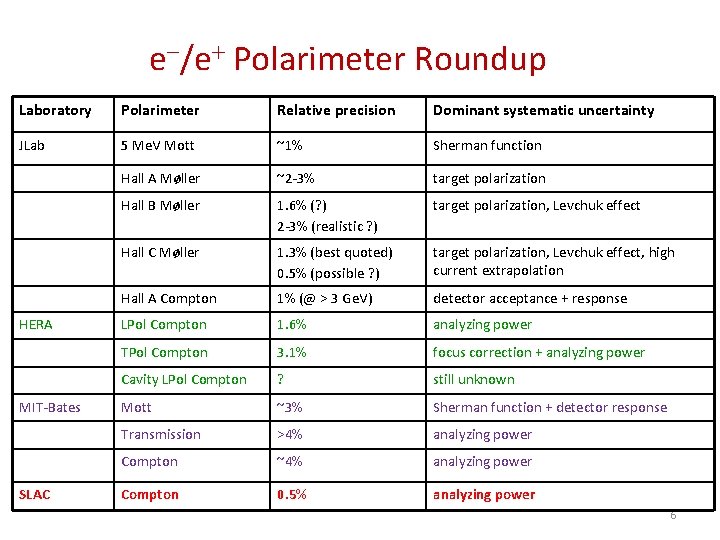
e-/e+ Polarimeter Roundup Laboratory Polarimeter Relative precision Dominant systematic uncertainty JLab 5 Me. V Mott ~1% Sherman function Hall A Møller ~2 -3% target polarization Hall B Møller 1. 6% (? ) 2 -3% (realistic ? ) target polarization, Levchuk effect Hall C Møller 1. 3% (best quoted) 0. 5% (possible ? ) target polarization, Levchuk effect, high current extrapolation Hall A Compton 1% (@ > 3 Ge. V) detector acceptance + response LPol Compton 1. 6% analyzing power TPol Compton 3. 1% focus correction + analyzing power Cavity LPol Compton ? still unknown Mott ~3% Sherman function + detector response Transmission >4% analyzing power Compton ~4% analyzing power Compton 0. 5% analyzing power HERA MIT-Bates SLAC 6
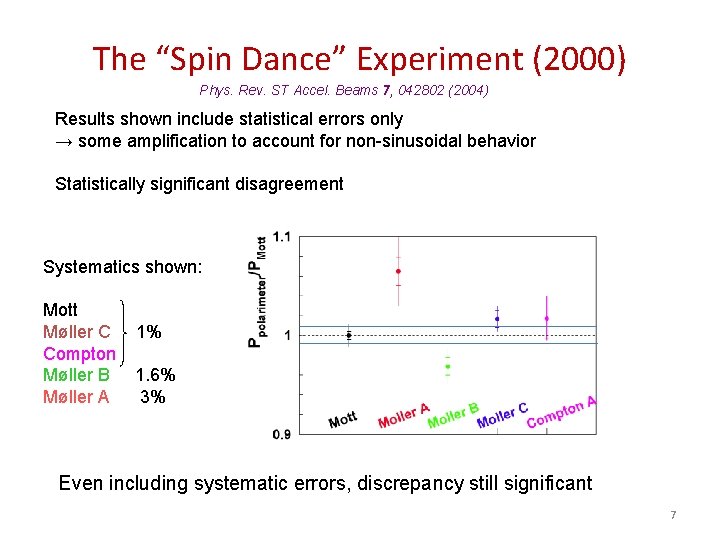
The “Spin Dance” Experiment (2000) Phys. Rev. ST Accel. Beams 7, 042802 (2004) Results shown include statistical errors only → some amplification to account for non-sinusoidal behavior Statistically significant disagreement Systematics shown: Mott Møller C Compton Møller B Møller A 1% 1. 6% 3% Even including systematic errors, discrepancy still significant 7
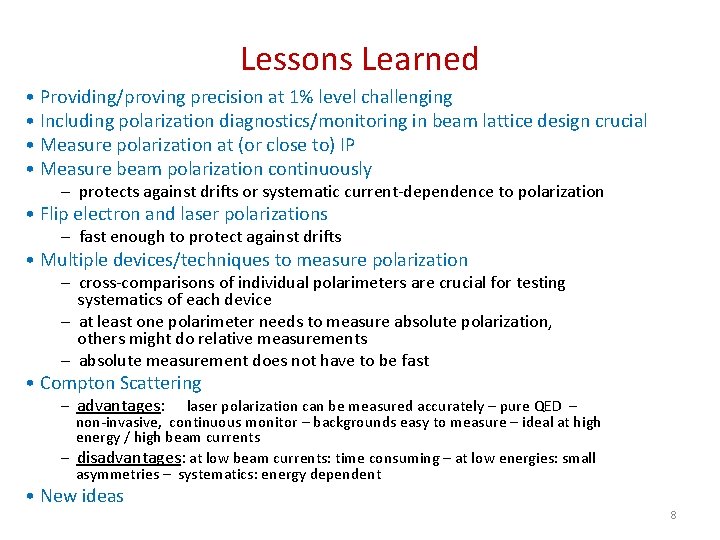
Lessons Learned • Providing/proving precision at 1% level challenging • Including polarization diagnostics/monitoring in beam lattice design crucial • Measure polarization at (or close to) IP • Measure beam polarization continuously – protects against drifts or systematic current-dependence to polarization • Flip electron and laser polarizations – fast enough to protect against drifts • Multiple devices/techniques to measure polarization – cross-comparisons of individual polarimeters are crucial for testing systematics of each device – at least one polarimeter needs to measure absolute polarization, others might do relative measurements – absolute measurement does not have to be fast • Compton Scattering – advantages: laser polarization can be measured accurately – pure QED – non-invasive, continuous monitor – backgrounds easy to measure – ideal at high energy / high beam currents – disadvantages: at low beam currents: time consuming – at low energies: small asymmetries – systematics: energy dependent • New ideas 8
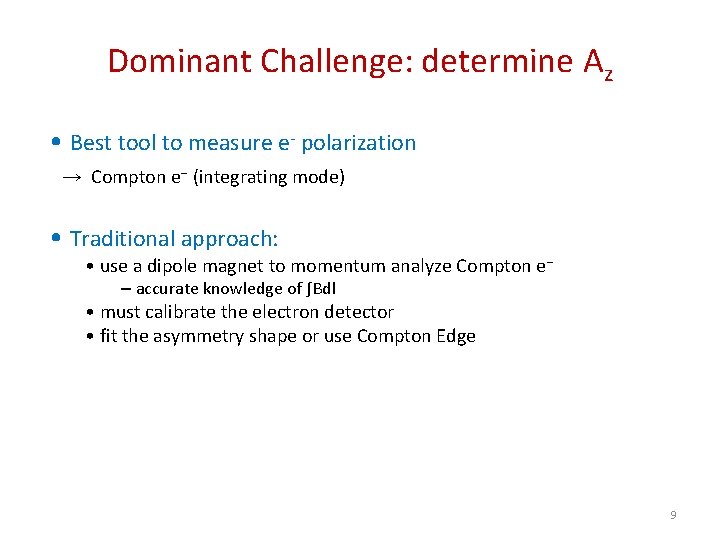
Dominant Challenge: determine Az • Best tool to measure e- polarization → Compton e- (integrating mode) • Traditional approach: • use a dipole magnet to momentum analyze Compton e– accurate knowledge of ∫Bdl • must calibrate the electron detector • fit the asymmetry shape or use Compton Edge 9
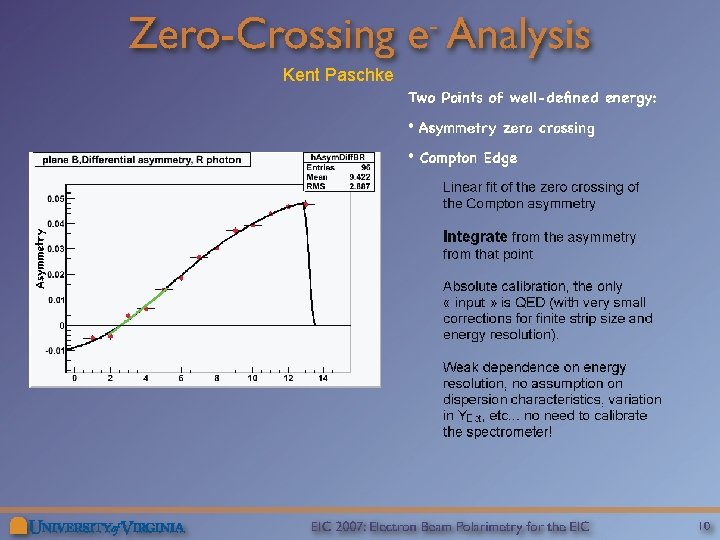
Electron Polarimetry Kent Paschke 10 9/14/2007 W. Lorenzon PSTP 2007
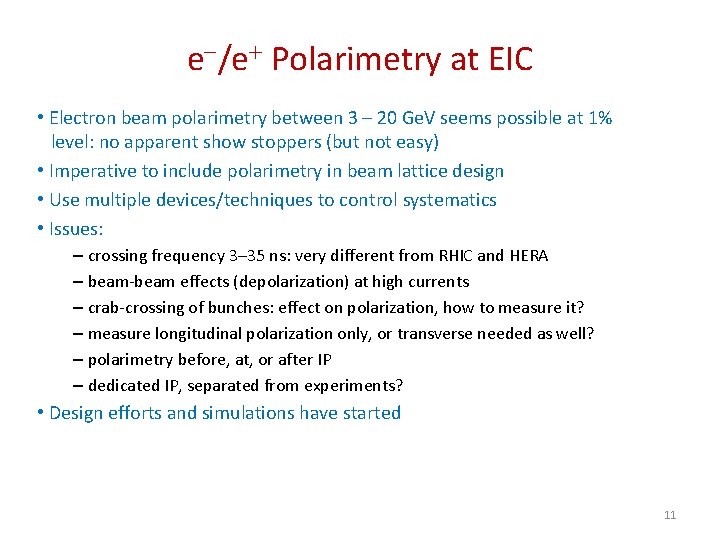
e-/e+ Polarimetry at EIC • Electron beam polarimetry between 3 – 20 Ge. V seems possible at 1% level: no apparent show stoppers (but not easy) • Imperative to include polarimetry in beam lattice design • Use multiple devices/techniques to control systematics • Issues: – crossing frequency 3– 35 ns: very different from RHIC and HERA – beam-beam effects (depolarization) at high currents – crab-crossing of bunches: effect on polarization, how to measure it? – measure longitudinal polarization only, or transverse needed as well? – polarimetry before, at, or after IP – dedicated IP, separated from experiments? • Design efforts and simulations have started 11
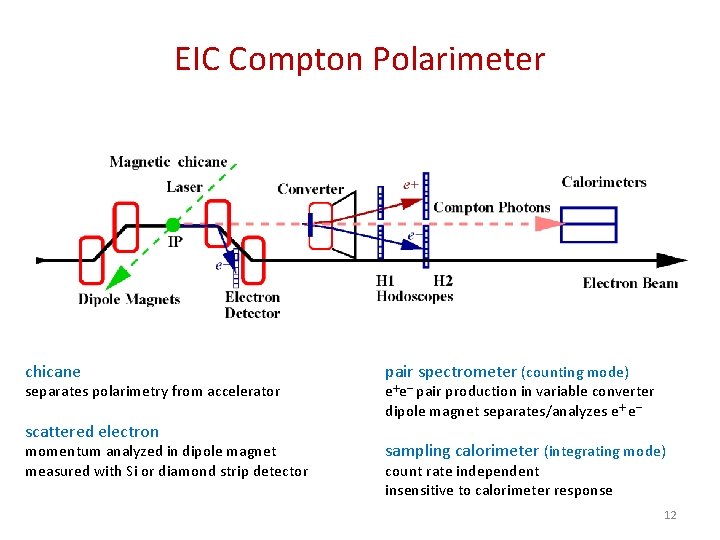
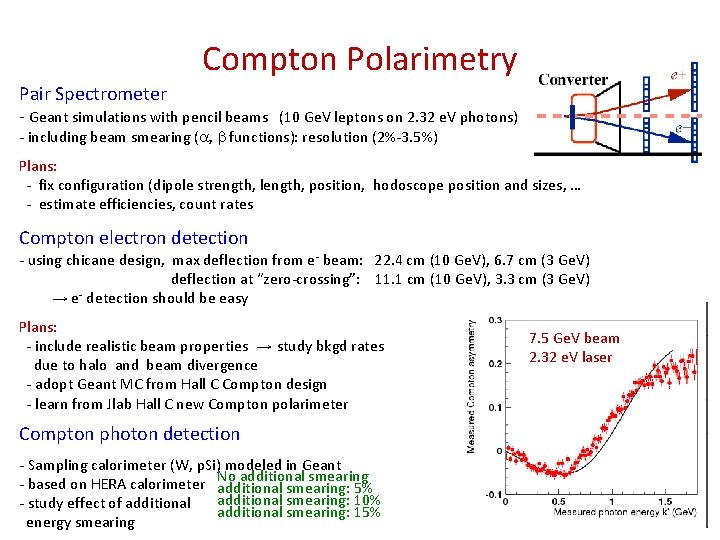
EIC Compton Polarimeter chicane separates polarimetry from accelerator scattered electron momentum analyzed in dipole magnet measured with Si or diamond strip detector pair spectrometer (counting mode) e+e- pair production in variable converter dipole magnet separates/analyzes e+ e- sampling calorimeter (integrating mode) count rate independent insensitive to calorimeter response 12
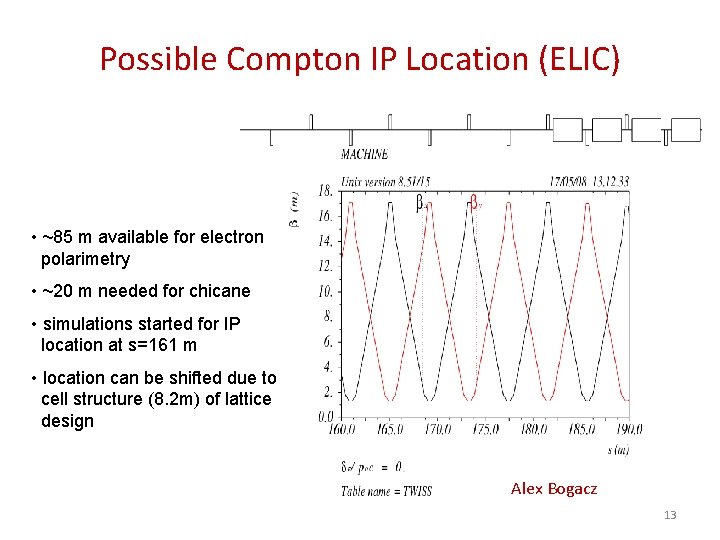
Possible Compton IP Location (ELIC) • ~85 m available for electron polarimetry • ~20 m needed for chicane • simulations started for IP location at s=161 m • location can be shifted due to cell structure (8. 2 m) of lattice design Alex Bogacz 13
Compton Polarimetry Pair Spectrometer - Geant simulations with pencil beams (10 Ge. V leptons on 2. 32 e. V photons) - including beam smearing (a, b functions): resolution (2%-3. 5%) Plans: - fix configuration (dipole strength, length, position, hodoscope position and sizes, … - estimate efficiencies, count rates Compton electron detection - using chicane design, max deflection from e- beam: 22. 4 cm (10 Ge. V), 6. 7 cm (3 Ge. V) deflection at “zero-crossing”: 11. 1 cm (10 Ge. V), 3. 3 cm (3 Ge. V) → e- detection should be easy Plans: - include realistic beam properties → study bkgd rates due to halo and beam divergence - adopt Geant MC from Hall C Compton design - learn from Jlab Hall C new Compton polarimeter 7. 5 Ge. V beam 2. 32 e. V laser Compton photon detection - Sampling calorimeter (W, p. Si) modeled in Geant additional smearing - based on HERA calorimeter No additional smearing: 5% additional smearing: 10% - study effect of additional smearing: 15% energy smearing 14
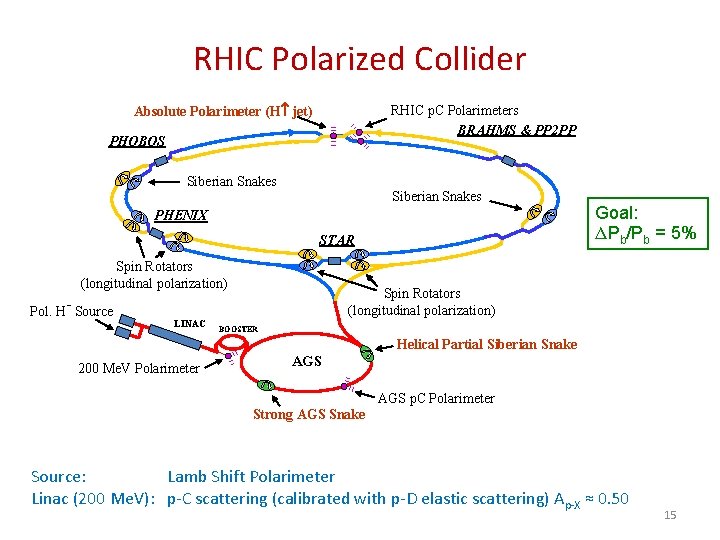
RHIC Polarized Collider RHIC p. C Polarimeters BRAHMS & PP 2 PP Absolute Polarimeter (H jet) PHOBOS Siberian Snakes PHENIX STAR Spin Rotators (longitudinal polarization) Pol. H Source LINAC Goal: DPb/Pb = 5% Spin Rotators (longitudinal polarization) BOOSTER Helical Partial Siberian Snake 200 Me. V Polarimeter AGS p. C Polarimeter Strong AGS Snake Source: Lamb Shift Polarimeter Linac (200 Me. V): p-C scattering (calibrated with p-D elastic scattering) Ap-X ≈ 0. 50 15
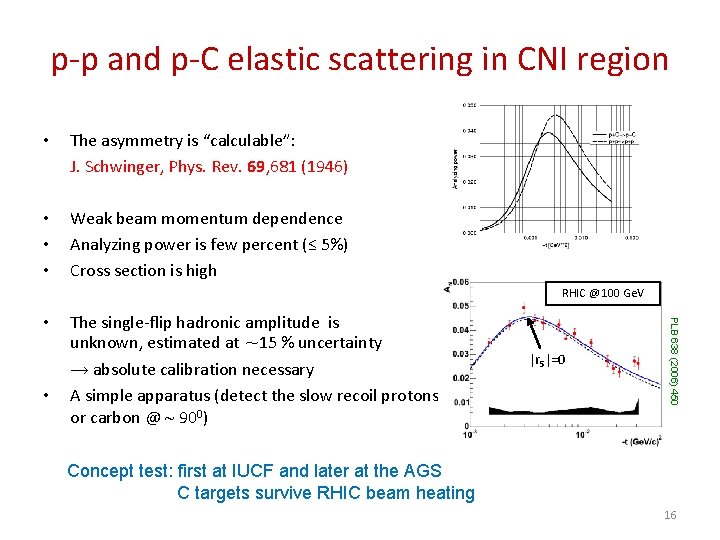
p-p and p-C elastic scattering in CNI region • The asymmetry is “calculable”: J. Schwinger, Phys. Rev. 69, 681 (1946) • • • Weak beam momentum dependence Analyzing power is few percent (≤ 5%) Cross section is high RHIC @ 100 Ge. V • The single-flip hadronic amplitude is unknown, estimated at ~15 % uncertainty → absolute calibration necessary A simple apparatus (detect the slow recoil protons or carbon @ ~ 900) |r 5|=0 PLB 638 (2006) 450 • Concept test: first at IUCF and later at the AGS C targets survive RHIC beam heating 16
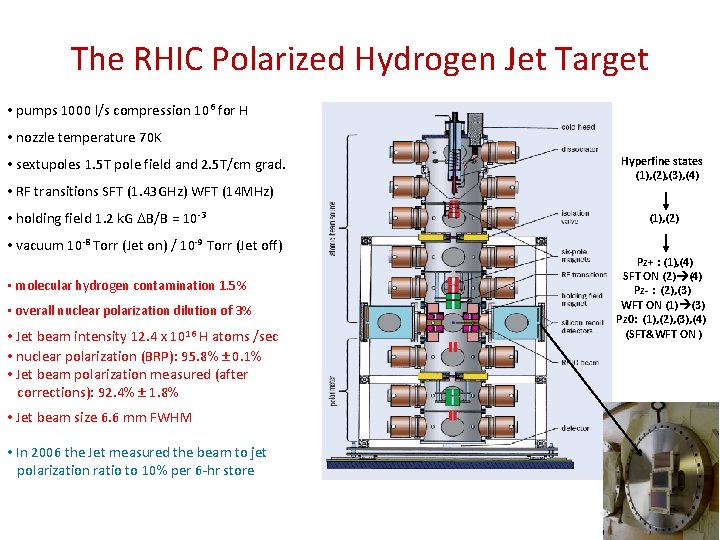
The RHIC Polarized Hydrogen Jet Target • pumps 1000 l/s compression 106 for H • nozzle temperature 70 K • sextupoles 1. 5 T pole field and 2. 5 T/cm grad. • RF transitions SFT (1. 43 GHz) WFT (14 MHz) • holding field 1. 2 k. G B/B = 10 -3 Hyperfine states (1), (2), (3), (4) (1), (2) • vacuum 10 -8 Torr (Jet on) / 10 -9 Torr (Jet off) • molecular hydrogen contamination 1. 5% • overall nuclear polarization dilution of 3% • Jet beam intensity 12. 4 x 10¹⁶ H atoms /sec • nuclear polarization (BRP): 95. 8% ± 0. 1% • Jet beam polarization measured (after corrections): 92. 4% ± 1. 8% • Jet beam size 6. 6 mm FWHM • In 2006 the Jet measured the beam to jet polarization ratio to 10% per 6 -hr store Pz+ : (1), (4) SFT ON (2) (4) Pz- : (2), (3) WFT ON (1) (3) Pz 0: (1), (2), (3), (4) (SFT&WFT ON )
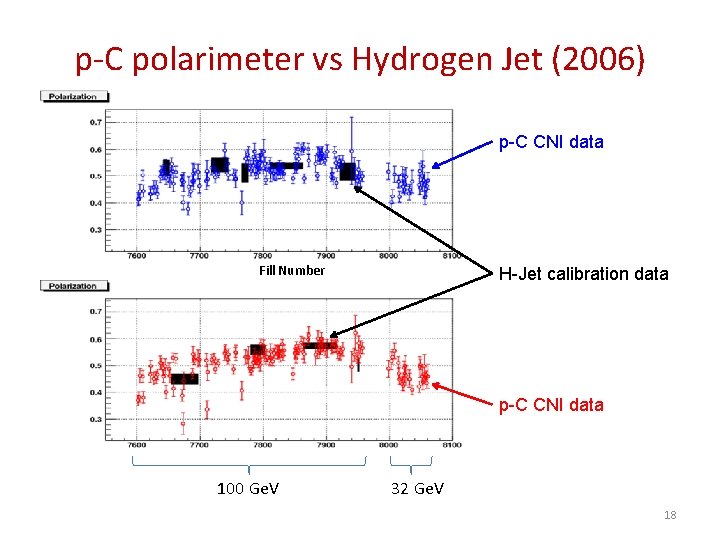
p-C polarimeter vs Hydrogen Jet (2006) p-C CNI data Fill Number H-Jet calibration data p-C CNI data 100 Ge. V 32 Ge. V 18
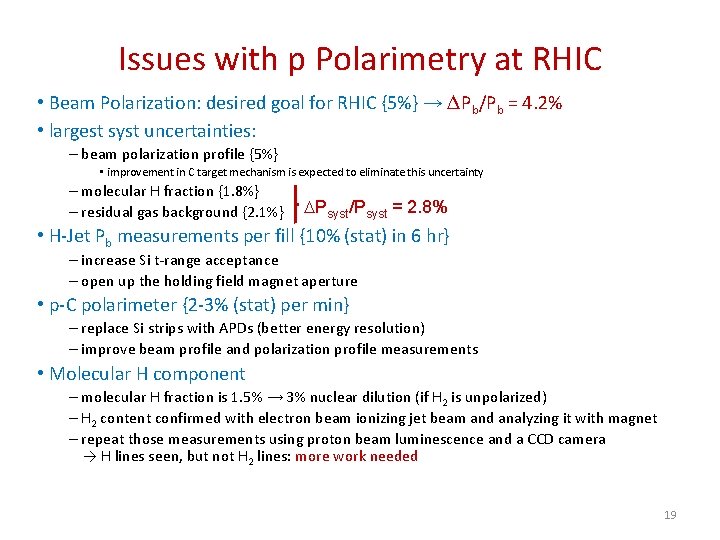
Issues with p Polarimetry at RHIC • Beam Polarization: desired goal for RHIC {5%} → DPb/Pb = 4. 2% • largest syst uncertainties: – beam polarization profile {5%} • improvement in C target mechanism is expected to eliminate this uncertainty – molecular H fraction {1. 8%} – residual gas background {2. 1%} Psyst/Psyst = 2. 8% • H-Jet Pb measurements per fill {10% (stat) in 6 hr} – increase Si t-range acceptance – open up the holding field magnet aperture • p-C polarimeter {2 -3% (stat) per min} – replace Si strips with APDs (better energy resolution) – improve beam profile and polarization profile measurements • Molecular H component – molecular H fraction is 1. 5% → 3% nuclear dilution (if H 2 is unpolarized) – H 2 content confirmed with electron beam ionizing jet beam and analyzing it with magnet – repeat those measurements using proton beam luminescence and a CCD camera → H lines seen, but not H 2 lines: more work needed 19
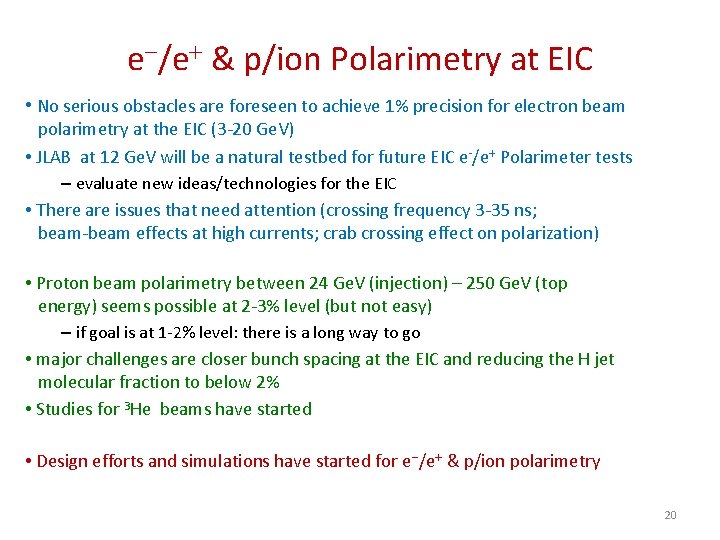
e-/e+ & p/ion Polarimetry at EIC • No serious obstacles are foreseen to achieve 1% precision for electron beam polarimetry at the EIC (3 -20 Ge. V) • JLAB at 12 Ge. V will be a natural testbed for future EIC e-/e+ Polarimeter tests – evaluate new ideas/technologies for the EIC • There are issues that need attention (crossing frequency 3 -35 ns; beam-beam effects at high currents; crab crossing effect on polarization) • Proton beam polarimetry between 24 Ge. V (injection) – 250 Ge. V (top energy) seems possible at 2 -3% level (but not easy) – if goal is at 1 -2% level: there is a long way to go • major challenges are closer bunch spacing at the EIC and reducing the H jet molecular fraction to below 2% • Studies for 3 He beams have started • Design efforts and simulations have started for e-/e+ & p/ion polarimetry 20