
Electromyography Myoelectric signals and their use in Controlling


- Slides: 22
Electromyography, Myoelectric signals and their use in Controlling Prosthetic Limbs Brian Kennedy
What Is Electromyography? • Electromyography is a procedure to test for electrical activity • Needles! • Solid, not hollow, so less pain • Contracting muscles
Why is EMG so Important? • • Used for a vast number of applications Diagnose Diseases Gives better insight into the human body Helps develop new prosthetic technologies
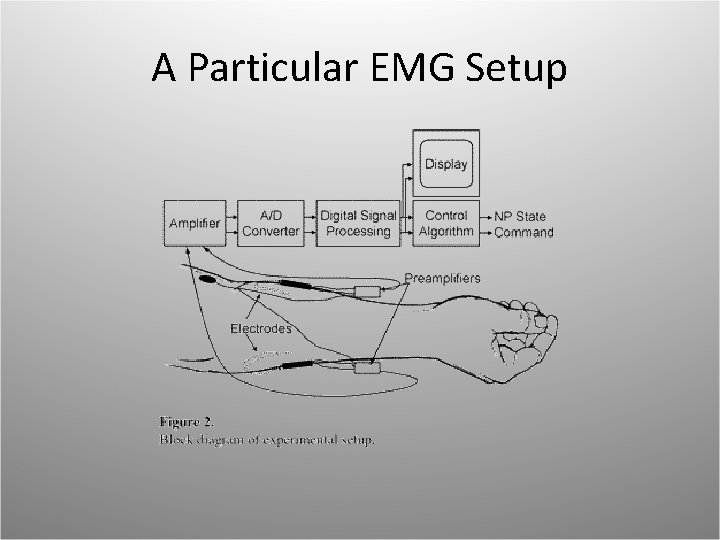
A Particular EMG Setup
How Muscles Work • Myosin and Actin are the main contributors to muscle contraction • Myosin grabs the actin and pulls to shorten the sarcomere • This shortening is the act of muscle contraction
Myoelectric Signals • Electric signals that make muscles contract • Much less electrical current in muscles than in your house • EMG is able to detect these signals • Signals are decoded and used for research
The “Phantom Limb” • Patients who have lost limb still “Feel” • Myoelectric signals still being produced • Research found that these signals could be tapped into
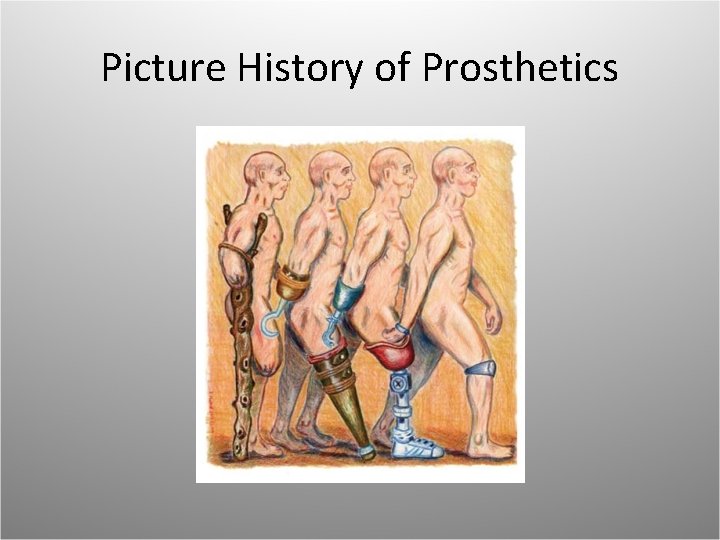
Progression of Traditional Prosthetics • • • Originating from the peg leg Growing to a simple mechanical bend Electricity added Grasping of simple objects with four fingers Individual finger control
Picture History of Prosthetics
Electric Switch Prosthetics • Require cables or straps to control • Body movement required to operate prostheses • For Example. . • Protraction pushed a switch to extend the arm • Retraction of the shoulder would hit another switch to flex the arm • Elevation opened up a hook-hand
Problems of Electric Switch Prosthetics • • Can be cumbersome to operate Simple grasping ability Normally not enough grip strength Simple motions do not mimic normal fluid human motion
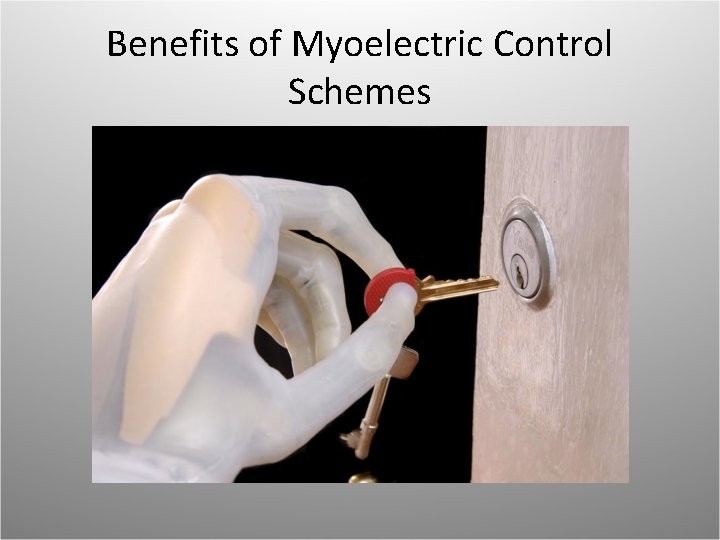
Benefits of Myoelectric Control Schemes
Why Use Myoelectric Controls? • Myoelectric controls give feedback to the prosthetic purely based on signals from your muscles • Does not require extra movement • More precise than electric switch
Disadvantages of a Myoelectric Control Scheme • Difficulty in determining strength • Non-invasive receiving methods don’t create accurate enough signals • Other muscle functions determine movement. Grip etc. . Not just Myoelectric signals
A Successful Myoelectric Prosthetic • The i-LIMB® by Touch Bionics™ • Uses Myoelectric controls to manipulate individual digits • Rotating thumb
But Wait, There’s More! • i-LIMB® solves the issue of grip strength • Individual Sensors for each finger • Knows when object has enough pressure applied for grip • Fingers lock into position
Fitting Into Society • Many owners of prosthetics feel like they don’t fit into society • Bulky prostheses and unnatural movement • Don’t act like actual human body parts • Anatomically out of place
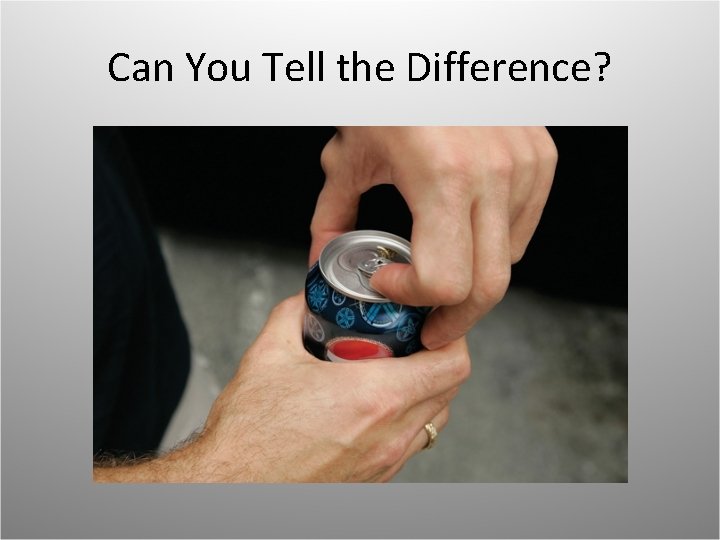
Solution to the Problem • The i-LIMB® rests in an anatomically natural position • Looks like the real finger structure of a human • Acts in very similar manner to a real human hand • Add LIVINGSKIN® to make it look just like real…
Can You Tell the Difference?
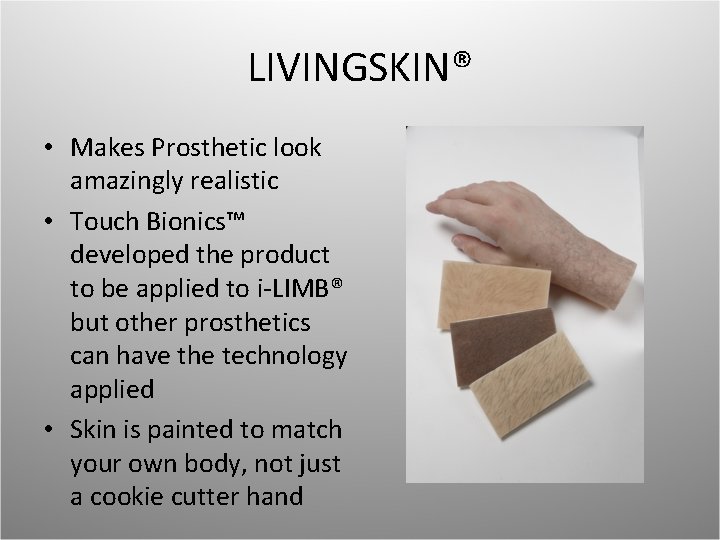
LIVINGSKIN® • Makes Prosthetic look amazingly realistic • Touch Bionics™ developed the product to be applied to i-LIMB® but other prosthetics can have the technology applied • Skin is painted to match your own body, not just a cookie cutter hand
LIVINGSKIN® • The Hand to the right has the LIVINGSKIN® applied • All skin types and colors are made to purely personal specifications • Hair is even painted on to maximize detail
Resources • • • "Electric Power in Upper Limb Prosthetics The Michigan Experience | ICIB Online Library, 1983 |. " ACPOC Association of Children's Prosthetic-Orthotic Clinics. Web. 10 Feb. 2010. <http: //www. acpoc. org/library/1983_04_001. asp>. "Electromyography (EMG). " Web. 08 Feb. 2010. <http: //www. emedicinehealth. com/electromyography_emg/article_em. htm>. "How. Stuff. Works "Contracting a Muscle"" Howstuffworks "Health" Web. 10 Feb. 2010. <http: //health. howstuffworks. com/muscle 2. htm>. "Myoelectric prosthesis -. " Wikipedia, the free encyclopedia. Web. 08 Feb. 2010. <http: //en. wikipedia. org/wiki/Myoelectric>. "Quantifying Pattern Recognition¿Based Myoelectric. . . [IEEE Trans Neural Syst Rehabil Eng. 2010] - Pub. Med result. " National Center for Biotechnology Information. Web. 08 Feb. 2010. <http: //www. ncbi. nlm. nih. gov/pubmed/20071269? itool=Entrez. System 2. PEntrez. Pubmed_Results. Panel. P ubmed_RVDoc. Sum&ordinalpos=2>. "Simulated neuroprosthesis state activation and hand-position control using myoelectric signals from wrist muscles. " Rehabilitation Research and Development Service Home Page. Web. 09 Feb. 2010. <http: //www. rehab. research. va. gov/jour/04/41/3 b/knutson. html>. "Surface electromyography and muscle force: limits. . . [ Clin Biomech (Bristol, Avon). 2009] - Pub. Med result. " National Center for Biotechnology Information. Web. 08 Feb. 2010. <http: //www. ncbi. nlm. nih. gov/pubmed/18849097? ordinalpos=1&itool=Entrez. System 2. PEntrez. Pubmed _Results. Panel. Pubmed_Single. Item. Supl. Pubmed_Discovery_RA&linkpos=5&log$= relatedreviews&logdbfrom=pub med>. Touch Bionics. Web. 08 Feb. 2010. <http: //www. touchbionics. com/i-LIMB/controls>. Touch Bionics. Web. 08 Feb. 2010. <http: //www. touchbionics. com/LIVINGSKIN>. "Welcome to IEEE Xplore 2. 0: Physiology and Mathematics of Myoelectric Signals. " IEEE Xplore: Guest Home Page. Web. 08 Feb. 2010. <http: //ieeexplore. ieee. org/xpl/freeabs_all. jsp? arnumbe