
Electromagnetism is one of the fundamental forces in

- Slides: 26
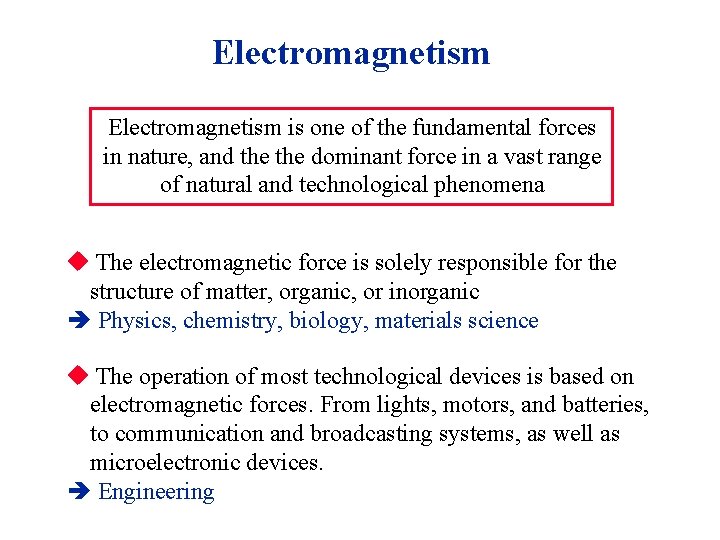
Electromagnetism is one of the fundamental forces in nature, and the dominant force in a vast range of natural and technological phenomena The electromagnetic force is solely responsible for the structure of matter, organic, or inorganic Physics, chemistry, biology, materials science The operation of most technological devices is based on electromagnetic forces. From lights, motors, and batteries, to communication and broadcasting systems, as well as microelectronic devices. Engineering
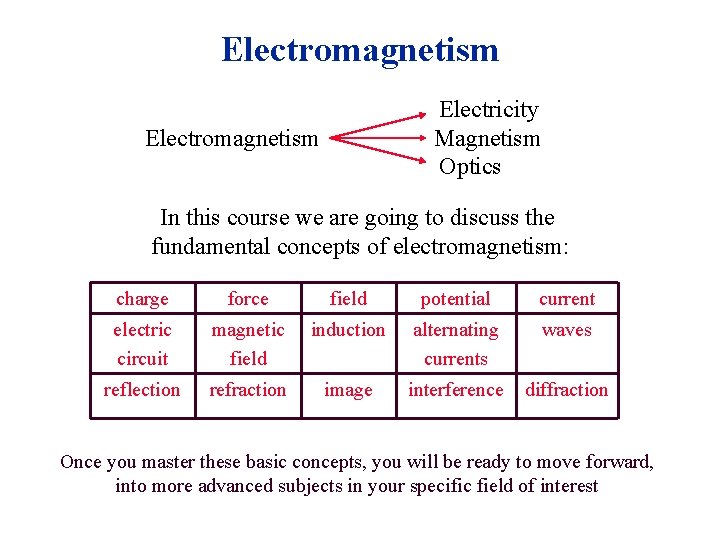
Electromagnetism Electricity Magnetism Optics Electromagnetism In this course we are going to discuss the fundamental concepts of electromagnetism: charge force field potential current electric circuit magnetic field induction alternating currents waves reflection refraction image interference diffraction Once you master these basic concepts, you will be ready to move forward, into more advanced subjects in your specific field of interest
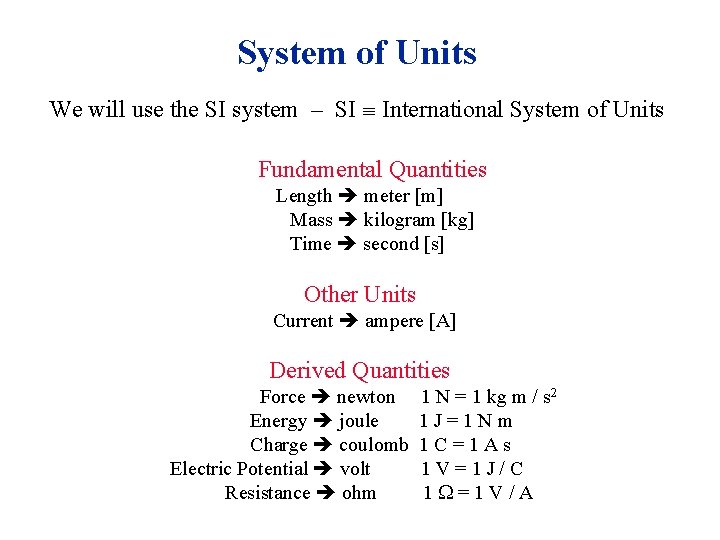
System of Units We will use the SI system – SI International System of Units Fundamental Quantities Length meter [m] Mass kilogram [kg] Time second [s] Other Units Current ampere [A] Derived Quantities Force newton Energy joule Charge coulomb Electric Potential volt Resistance ohm 1 N = 1 kg m / s 2 1 J=1 Nm 1 C=1 As 1 V=1 J/C 1 =1 V/A
Electrostatics Chapter 23
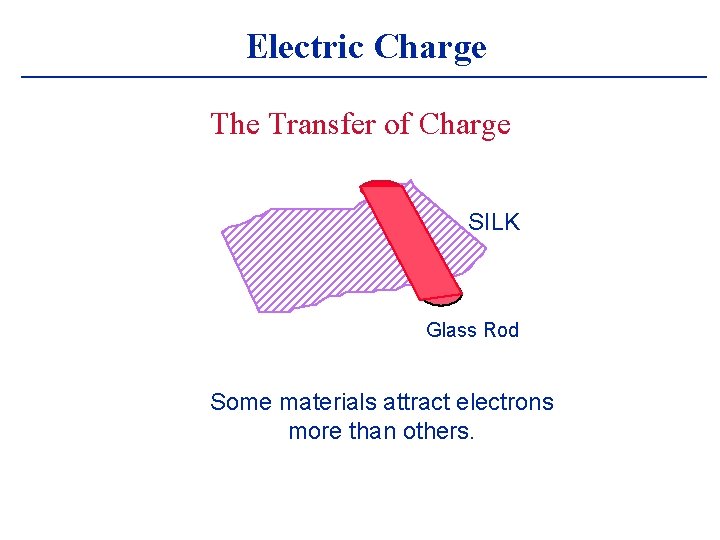
Electric Charge The Transfer of Charge SILK Glass Rod Some materials attract electrons more than others.
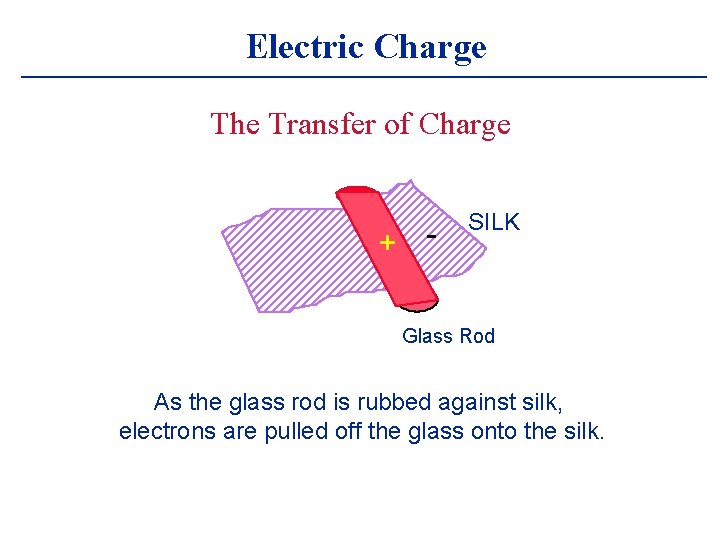
Electric Charge The Transfer of Charge + - SILK Glass Rod As the glass rod is rubbed against silk, electrons are pulled off the glass onto the silk.
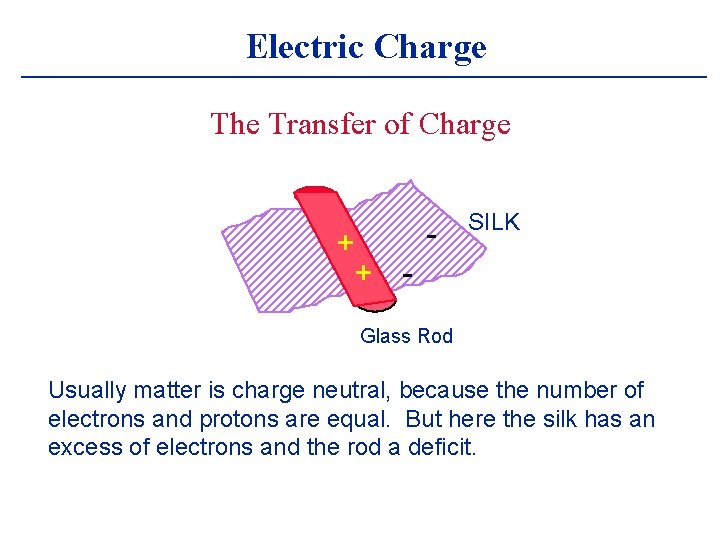
Electric Charge The Transfer of Charge + + - SILK Glass Rod Usually matter is charge neutral, because the number of electrons and protons are equal. But here the silk has an excess of electrons and the rod a deficit.
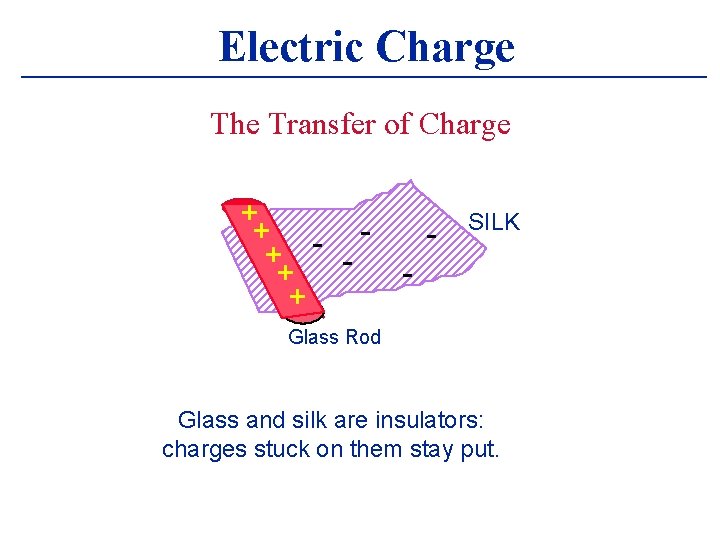
Electric Charge The Transfer of Charge + + - + + + SILK Glass Rod Glass and silk are insulators: charges stuck on them stay put.
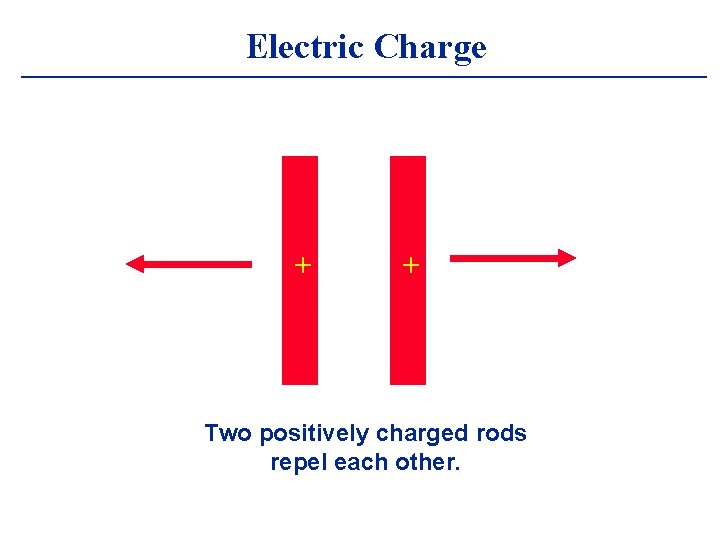
Electric Charge + + Two positively charged rods repel each other.
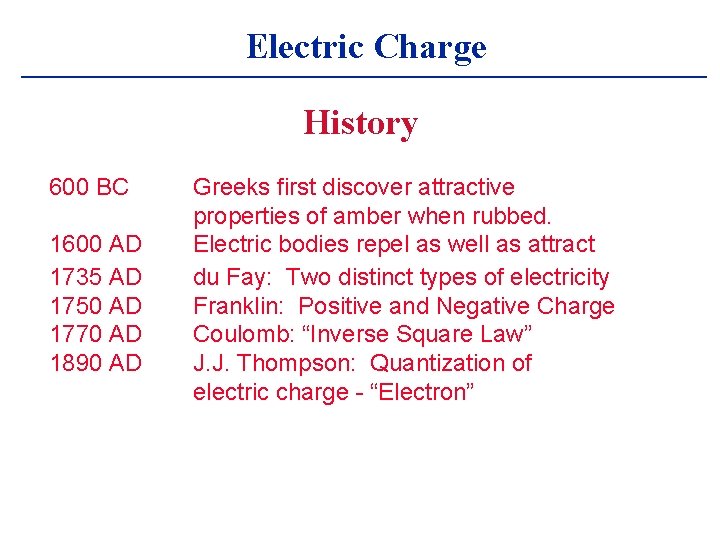
Electric Charge History 600 BC 1600 AD 1735 AD 1750 AD 1770 AD 1890 AD Greeks first discover attractive properties of amber when rubbed. Electric bodies repel as well as attract du Fay: Two distinct types of electricity Franklin: Positive and Negative Charge Coulomb: “Inverse Square Law” J. J. Thompson: Quantization of electric charge - “Electron”
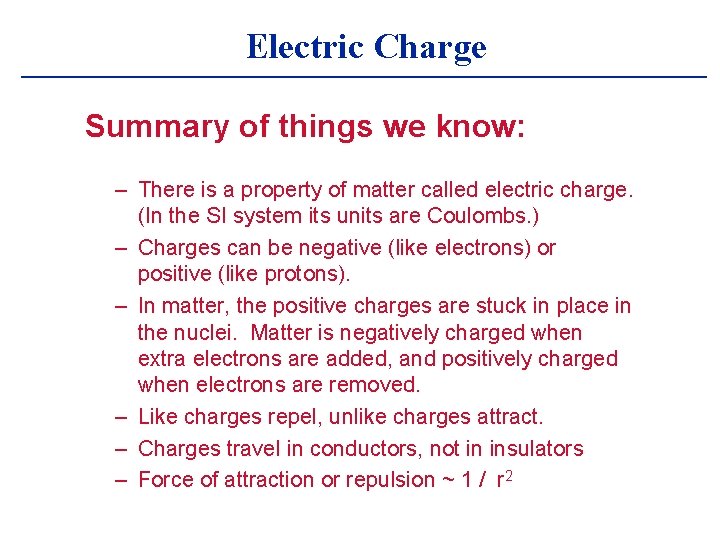
Electric Charge Summary of things we know: – There is a property of matter called electric charge. (In the SI system its units are Coulombs. ) – Charges can be negative (like electrons) or positive (like protons). – In matter, the positive charges are stuck in place in the nuclei. Matter is negatively charged when extra electrons are added, and positively charged when electrons are removed. – Like charges repel, unlike charges attract. – Charges travel in conductors, not in insulators – Force of attraction or repulsion ~ 1 / r 2
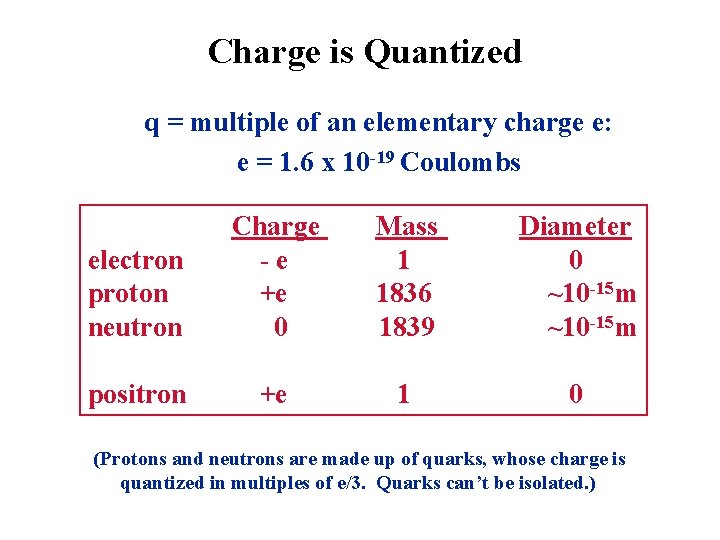
Charge is Quantized q = multiple of an elementary charge e: e = 1. 6 x 10 -19 Coulombs electron proton neutron Charge -e +e 0 Mass 1 1836 1839 Diameter 0 ~10 -15 m positron +e 1 0 (Protons and neutrons are made up of quarks, whose charge is quantized in multiples of e/3. Quarks can’t be isolated. )
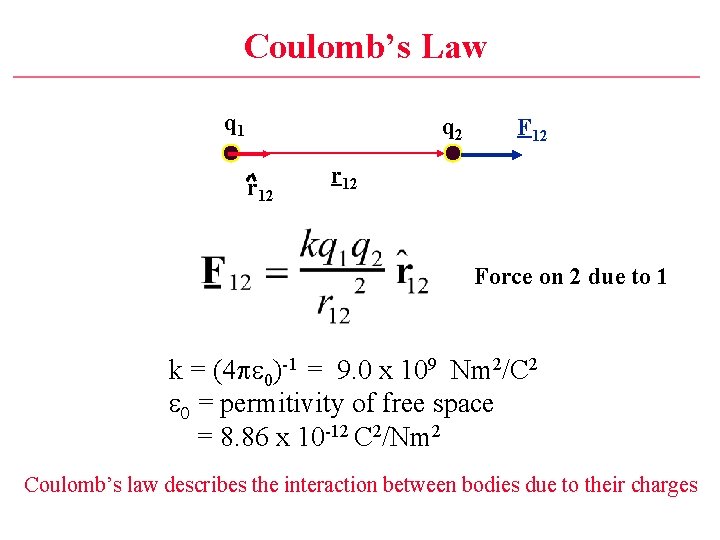
Coulomb’s Law q 1 q 2 r 12 F 12 r 12 Force on 2 due to 1 k = (4 pe 0)-1 = 9. 0 x 109 Nm 2/C 2 e 0 = permitivity of free space = 8. 86 x 10 -12 C 2/Nm 2 Coulomb’s law describes the interaction between bodies due to their charges
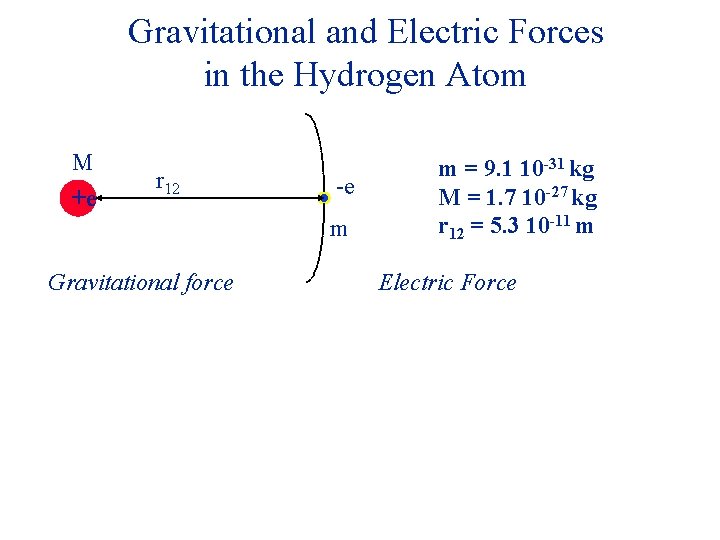
Gravitational and Electric Forces in the Hydrogen Atom M +e r 12 -e m Gravitational force m = 9. 1 10 -31 kg M = 1. 7 10 -27 kg r 12 = 5. 3 10 -11 m Electric Force
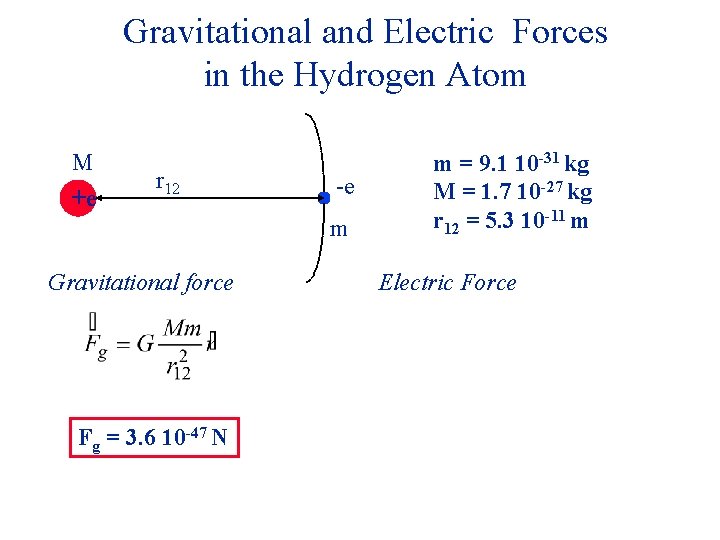
Gravitational and Electric Forces in the Hydrogen Atom M +e r 12 -e m Gravitational force Fg = 3. 6 10 -47 N m = 9. 1 10 -31 kg M = 1. 7 10 -27 kg r 12 = 5. 3 10 -11 m Electric Force
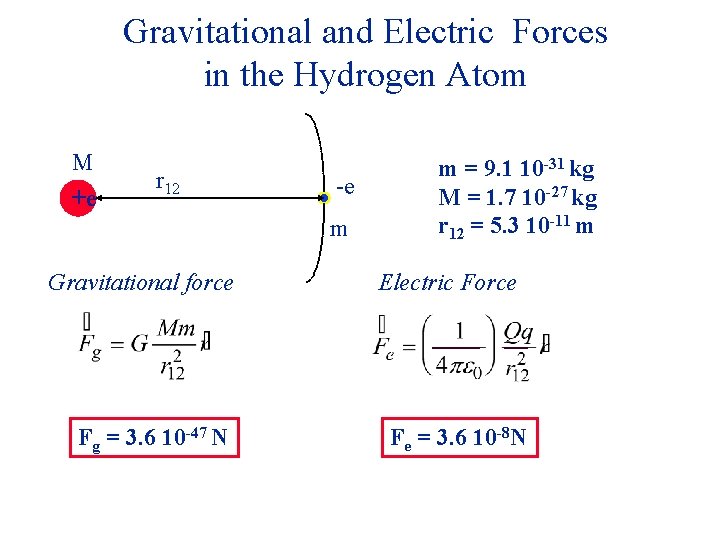
Gravitational and Electric Forces in the Hydrogen Atom M +e r 12 -e m Gravitational force Fg = 3. 6 10 -47 N m = 9. 1 10 -31 kg M = 1. 7 10 -27 kg r 12 = 5. 3 10 -11 m Electric Force Fe = 3. 6 10 -8 N
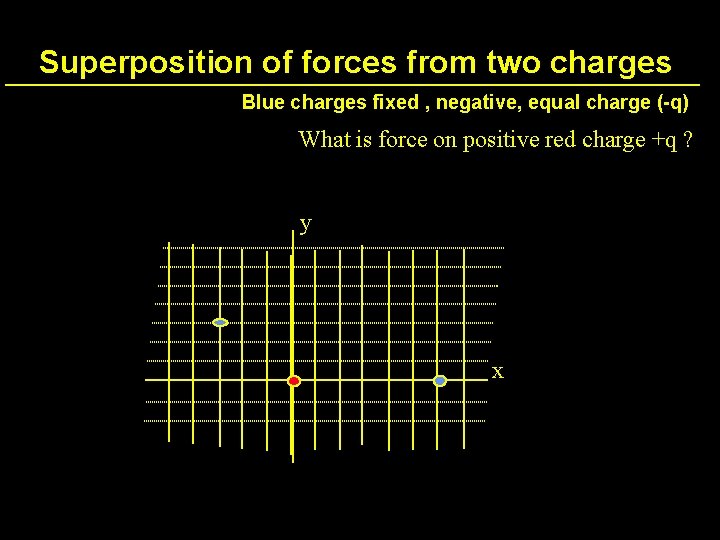
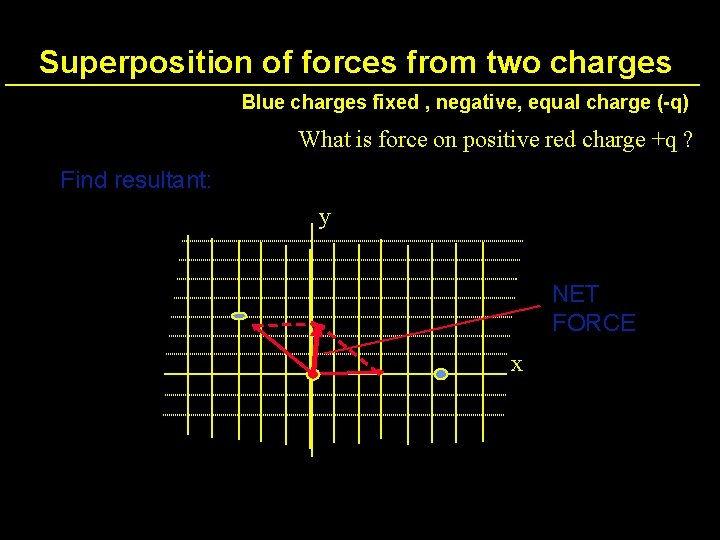
Superposition of forces from two charges Blue charges fixed , negative, equal charge (-q) What is force on positive red charge +q ? y x
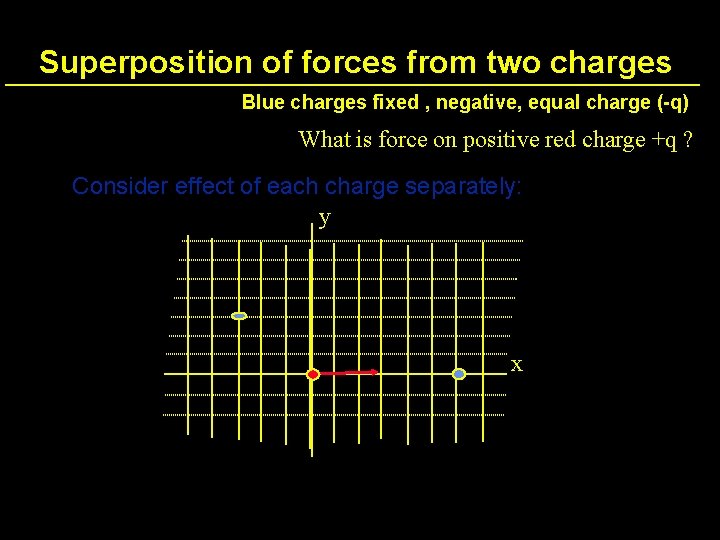
Superposition of forces from two charges Blue charges fixed , negative, equal charge (-q) What is force on positive red charge +q ? Consider effect of each charge separately: y x
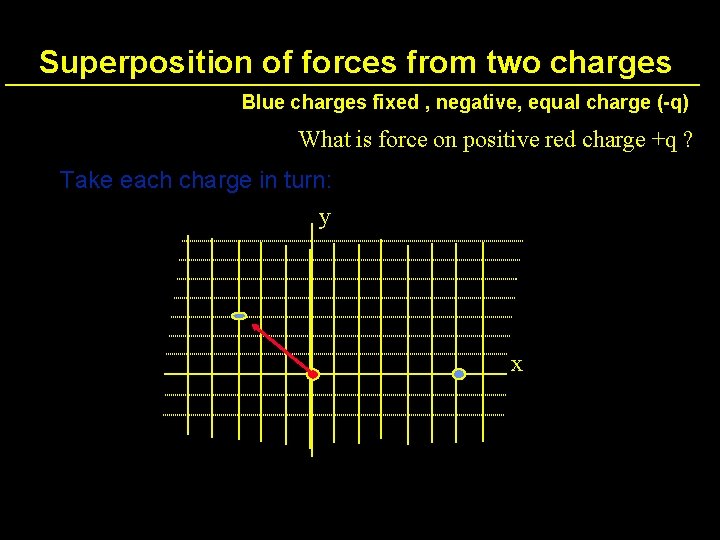
Superposition of forces from two charges Blue charges fixed , negative, equal charge (-q) What is force on positive red charge +q ? Take each charge in turn: y x
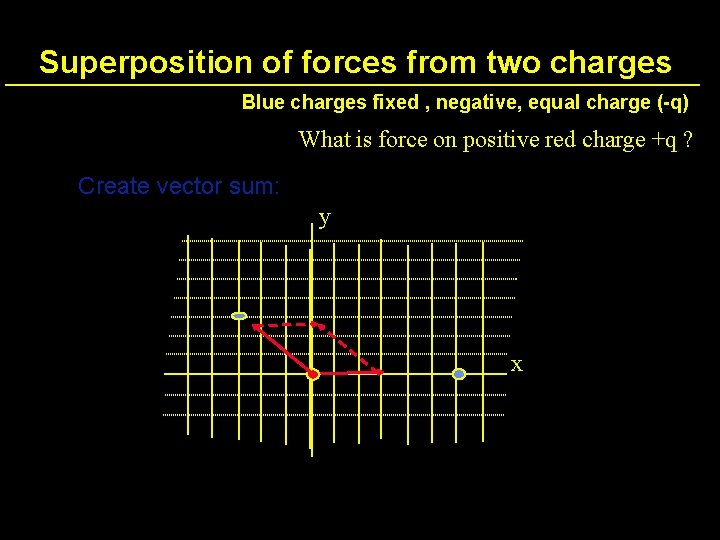
Superposition of forces from two charges Blue charges fixed , negative, equal charge (-q) What is force on positive red charge +q ? Create vector sum: y x
Superposition of forces from two charges Blue charges fixed , negative, equal charge (-q) What is force on positive red charge +q ? Find resultant: y NET FORCE x
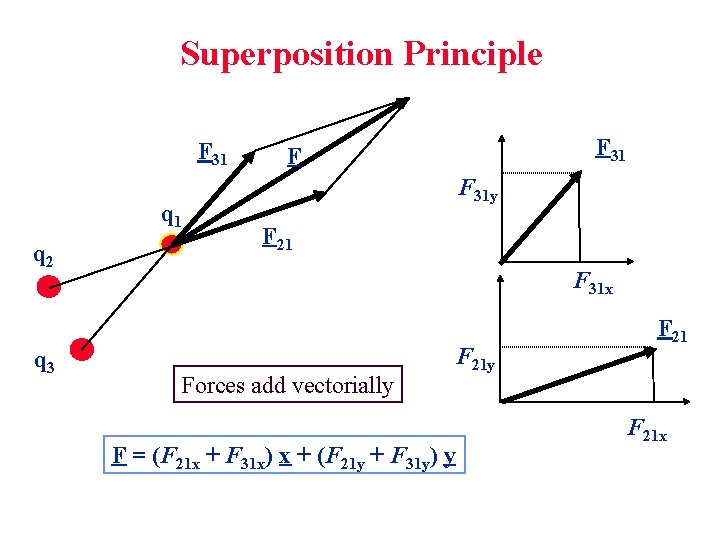
Superposition Principle F 31 q 2 q 3 F 31 F F 31 y F 21 F 31 x Forces add vectorially F 21 y F = (F 21 x + F 31 x) x + (F 21 y + F 31 y) y F 21 x
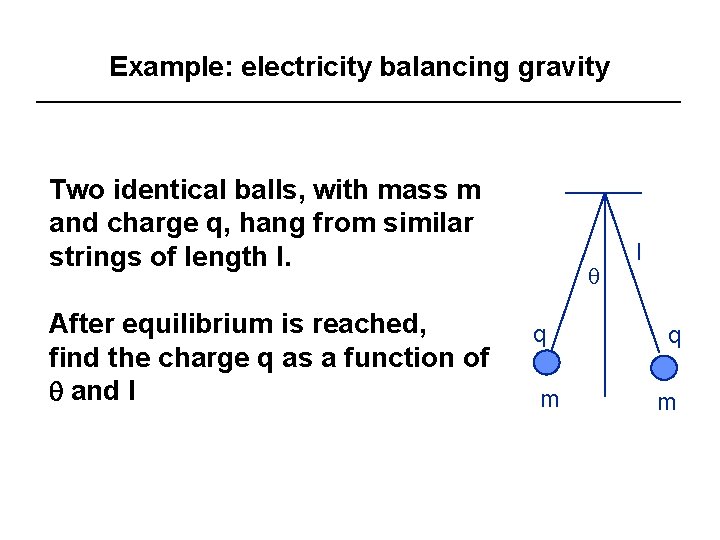
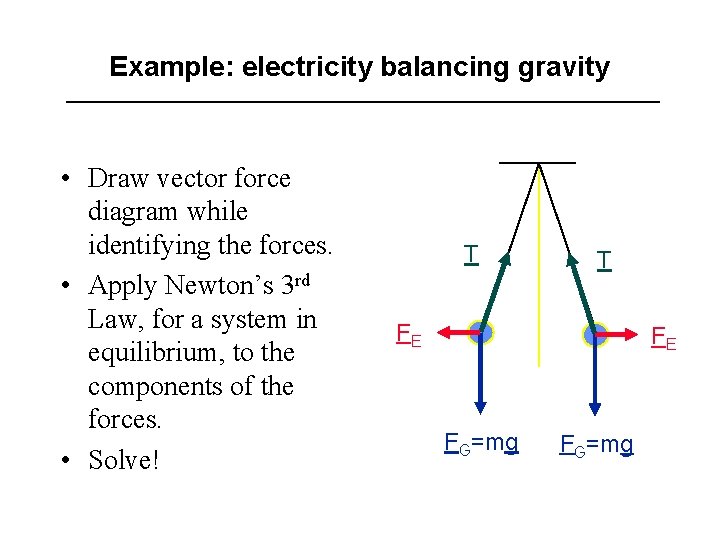
Example: electricity balancing gravity Two identical balls, with mass m and charge q, hang from similar strings of length l. After equilibrium is reached, find the charge q as a function of q and l q q m l q m
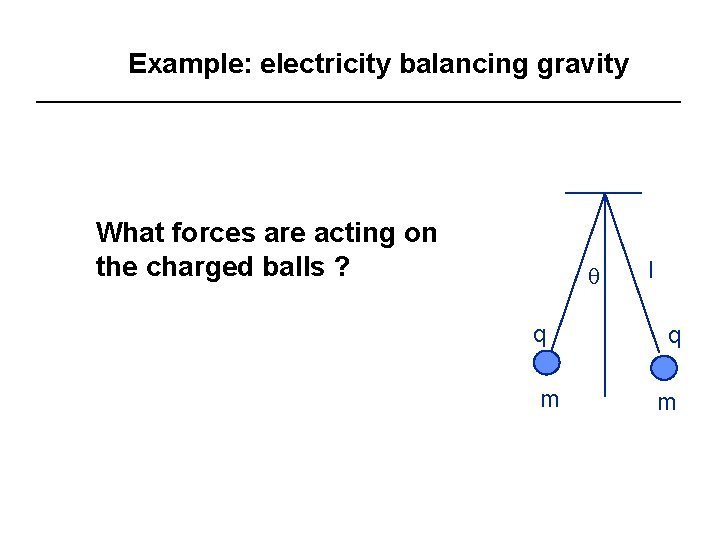
Example: electricity balancing gravity What forces are acting on the charged balls ? q q m l q m
Example: electricity balancing gravity • Draw vector force diagram while identifying the forces. • Apply Newton’s 3 rd Law, for a system in equilibrium, to the components of the forces. • Solve! T T FE FE FG=mg