
Electromagnetic waves Reflection Refraction and Interference Friday October
Electromagnetic waves: Reflection, Refraction and Interference Friday October 25, 2002 1
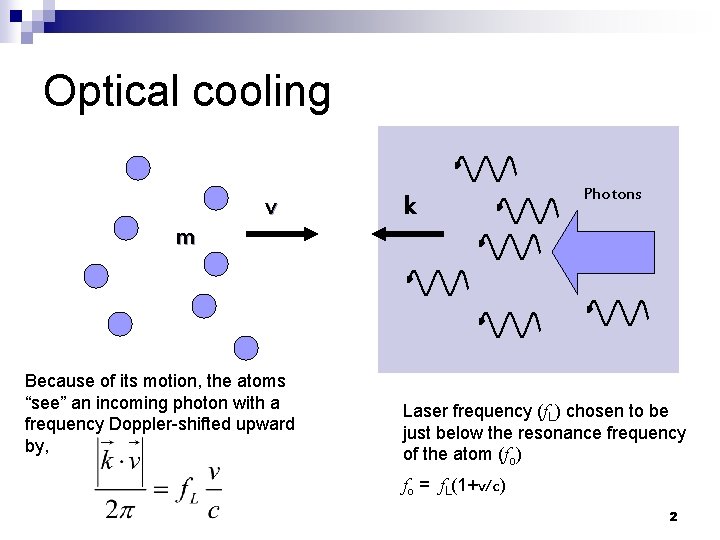
Optical cooling m v Because of its motion, the atoms “see” an incoming photon with a frequency Doppler-shifted upward by, k Photons Laser frequency (f. L) chosen to be just below the resonance frequency of the atom (fo) fo = f. L(1+v/c) 2
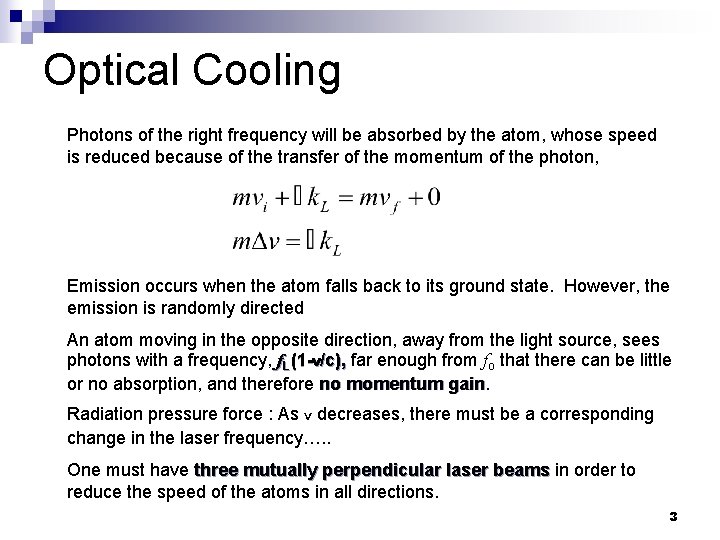
Optical Cooling Photons of the right frequency will be absorbed by the atom, whose speed is reduced because of the transfer of the momentum of the photon, Emission occurs when the atom falls back to its ground state. However, the emission is randomly directed An atom moving in the opposite direction, away from the light source, sees photons with a frequency, f. L(1 -v/c), far enough from fo that there can be little or no absorption, and therefore no momentum gain Radiation pressure force : As v decreases, there must be a corresponding change in the laser frequency…. . One must have three mutually perpendicular laser beams in order to reduce the speed of the atoms in all directions. 3
Reflection, Transmission and Interference of EM waves 4

Reflection and Transmission at an interface Normal Incidence – Two media characterized by v 1, v 2 incident transmitted reflected 1 2 5
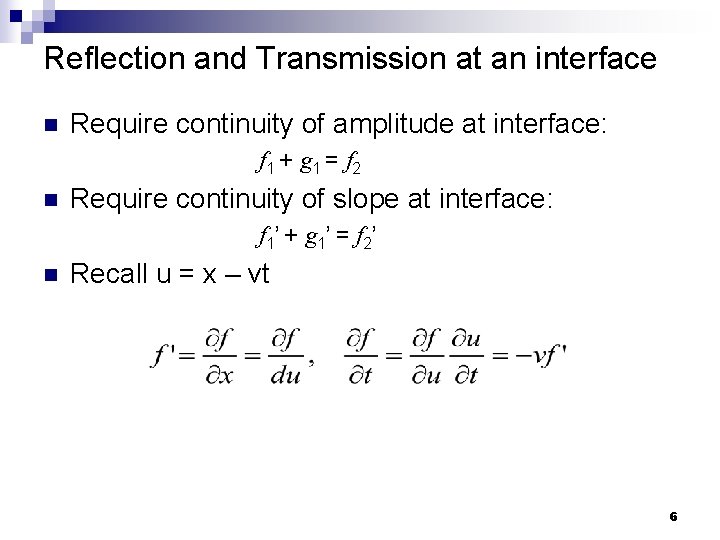
Reflection and Transmission at an interface n Require continuity of amplitude at interface: f 1 + g 1 = f 2 n Require continuity of slope at interface: f 1’ + g 1’ = f 2’ n Recall u = x – vt 6
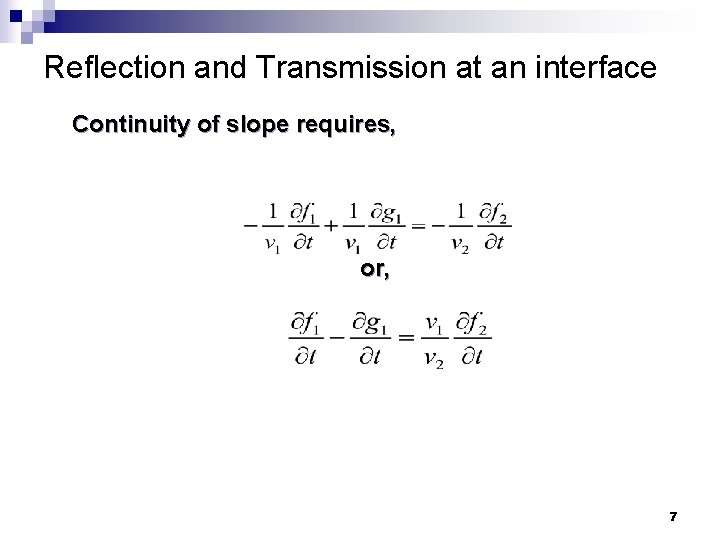
Reflection and Transmission at an interface Continuity of slope requires, or, 7
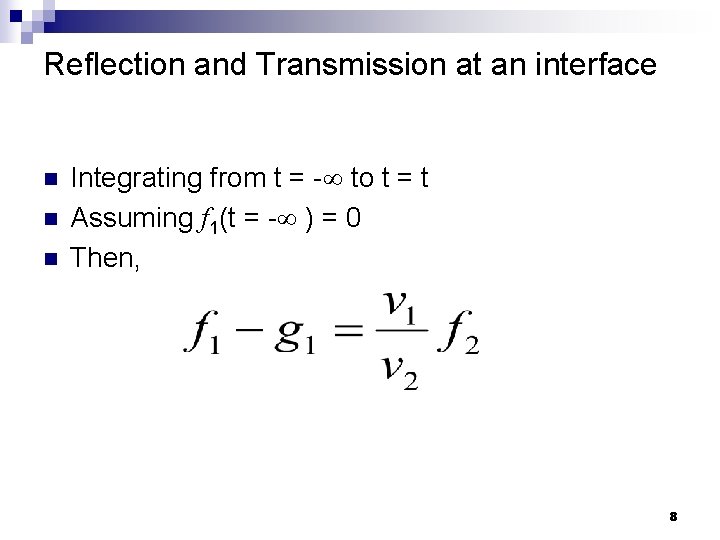
Reflection and Transmission at an interface n n n Integrating from t = - to t = t Assuming f 1(t = - ) = 0 Then, 8
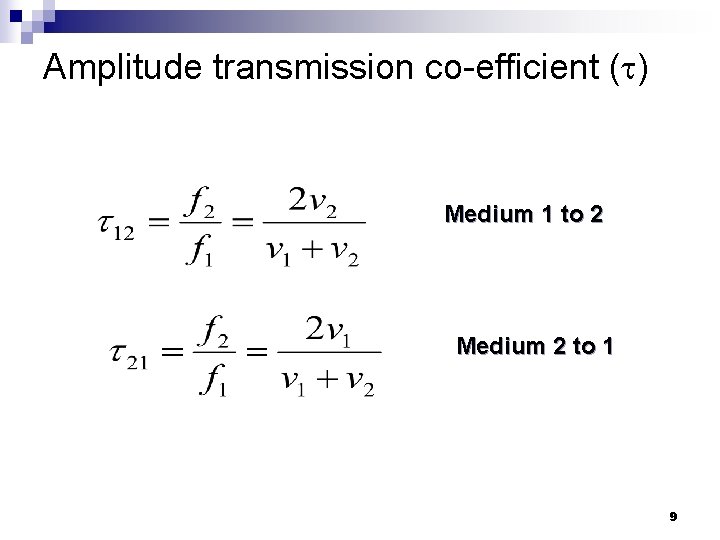
Amplitude transmission co-efficient ( ) Medium 1 to 2 Medium 2 to 1 9
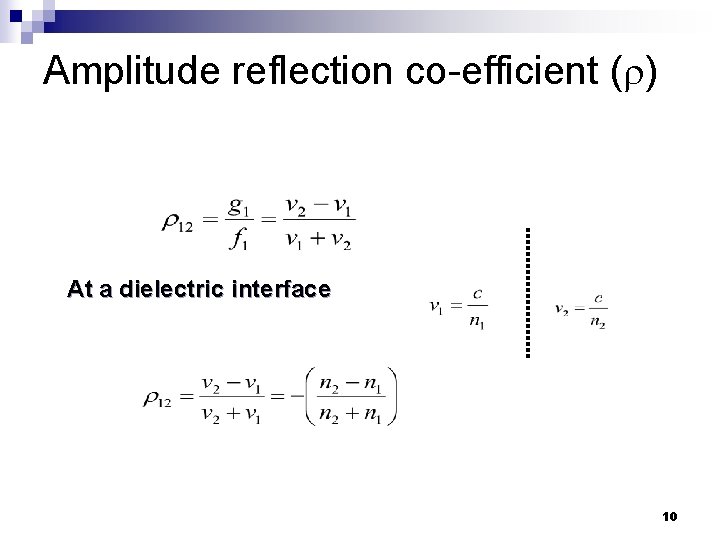
Amplitude reflection co-efficient ( ) At a dielectric interface 10
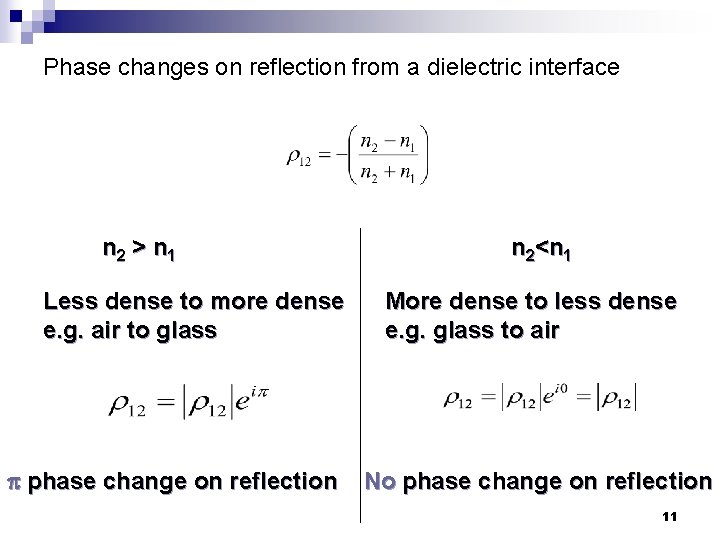
Phase changes on reflection from a dielectric interface n 2 > n 1 Less dense to more dense e. g. air to glass phase change on reflection n 2<n 1 More dense to less dense e. g. glass to air No phase change on reflection 11
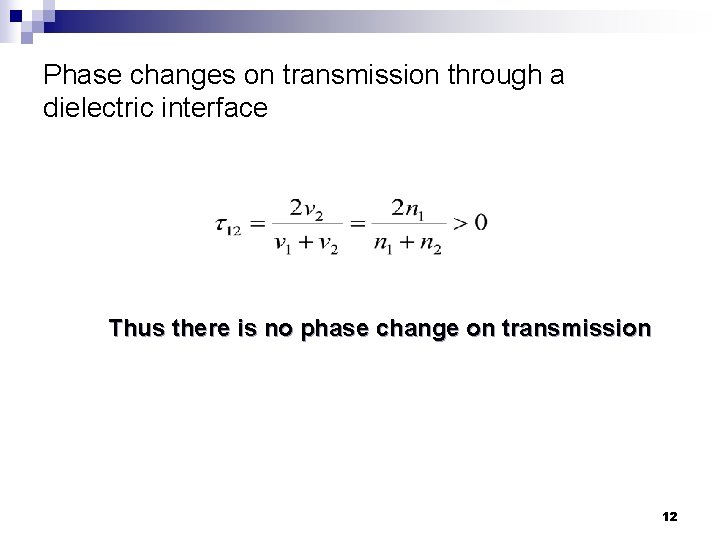
Phase changes on transmission through a dielectric interface Thus there is no phase change on transmission 12
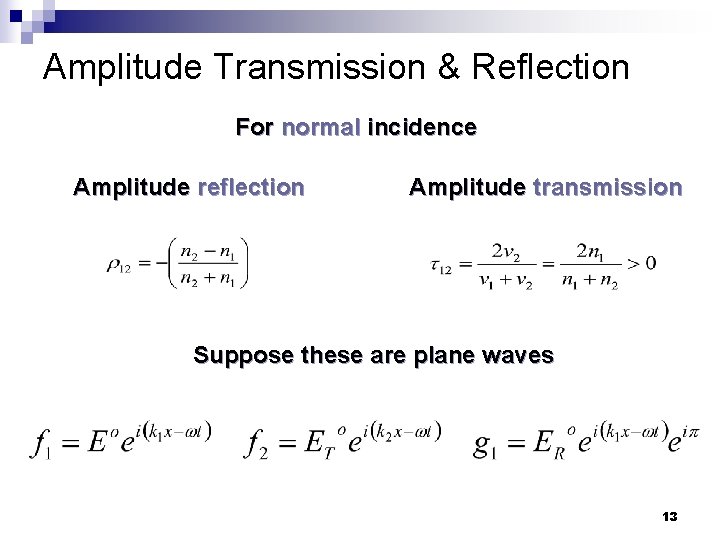
Amplitude Transmission & Reflection For normal incidence Amplitude reflection Amplitude transmission Suppose these are plane waves 13
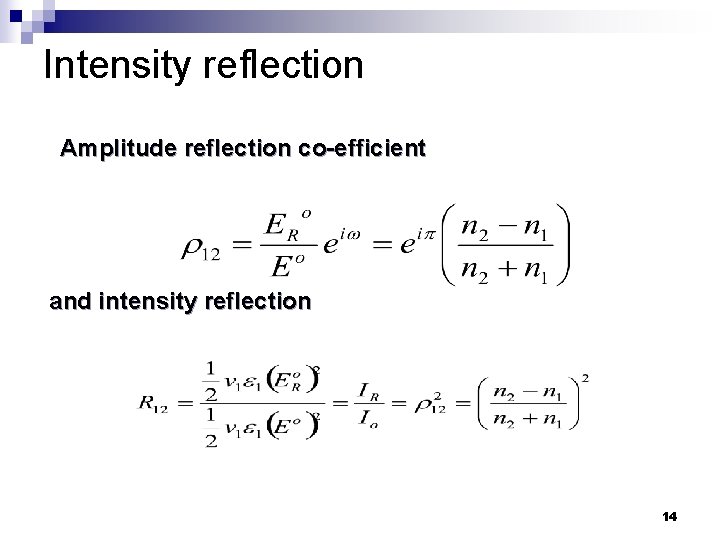
Intensity reflection Amplitude reflection co-efficient and intensity reflection 14
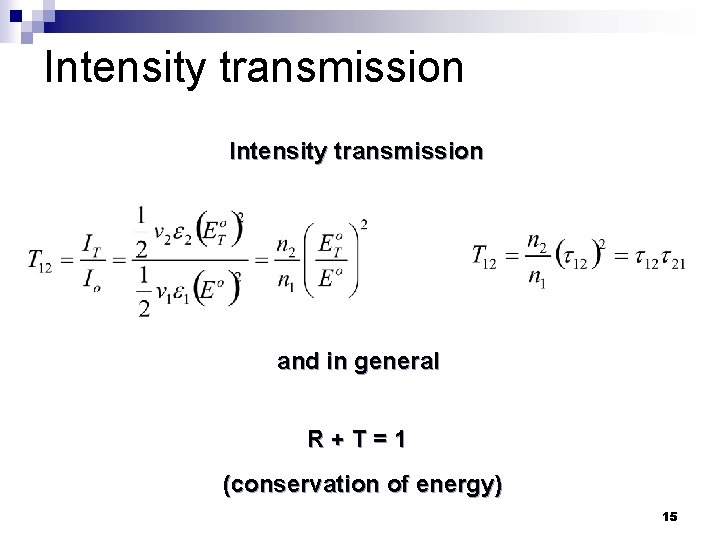
Intensity transmission and in general R+T=1 (conservation of energy) 15
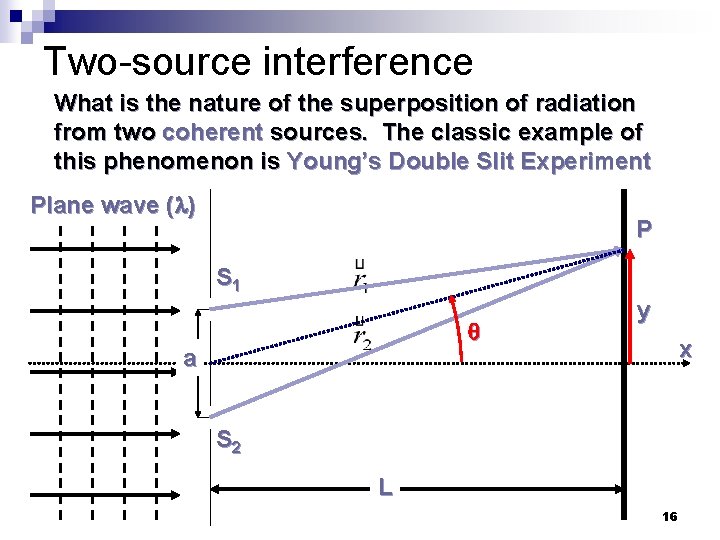
Two-source interference What is the nature of the superposition of radiation from two coherent sources. The classic example of this phenomenon is Young’s Double Slit Experiment Plane wave ( ) P S 1 a y x S 2 L 16
Young’s Double slit experiment Assumptions n n Monochromatic, plane wave Incident on slits (or pin hole), S 1, S 2 ¨ n n n separated by distance a (centre to centre) Observed on screen L >> a (L- meters, a – mm) Two sources (S 1 and S 2) are coherent and in phase (since same wave front produces both as all times) Assume slits are very narrow (width b ~ ) ¨ so radiation from each slit alone produces uniform illumination across the screen 17
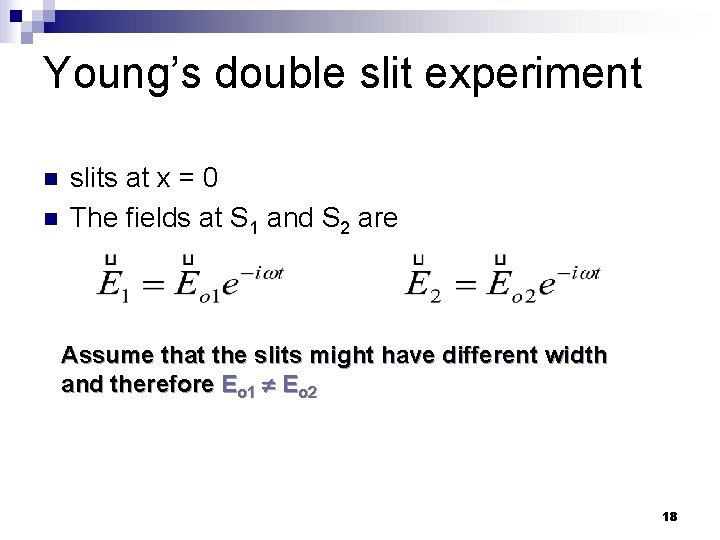
Young’s double slit experiment n n slits at x = 0 The fields at S 1 and S 2 are Assume that the slits might have different width and therefore Eo 1 Eo 2 18
Young’s double slit experiment What are the corresponding E-fields at P? Since L >> a ( small) we can put r = |r 1| = |r 2| We can also put |k 1| = |k 2| = 2 / (monochromatic source) 19
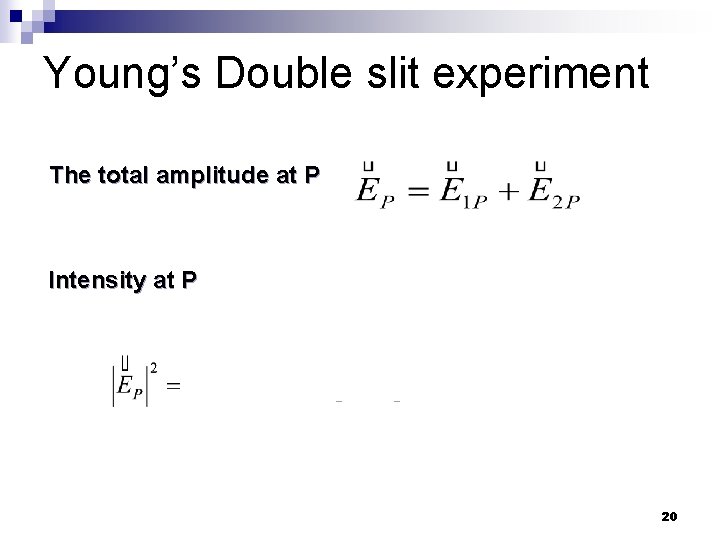
Young’s Double slit experiment The total amplitude at P Intensity at P 20
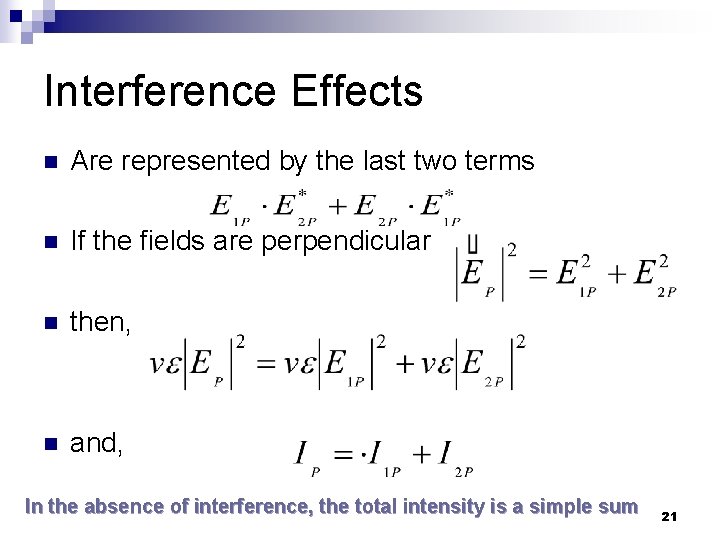
Interference Effects n Are represented by the last two terms n If the fields are perpendicular n then, n and, In the absence of interference, the total intensity is a simple sum 21
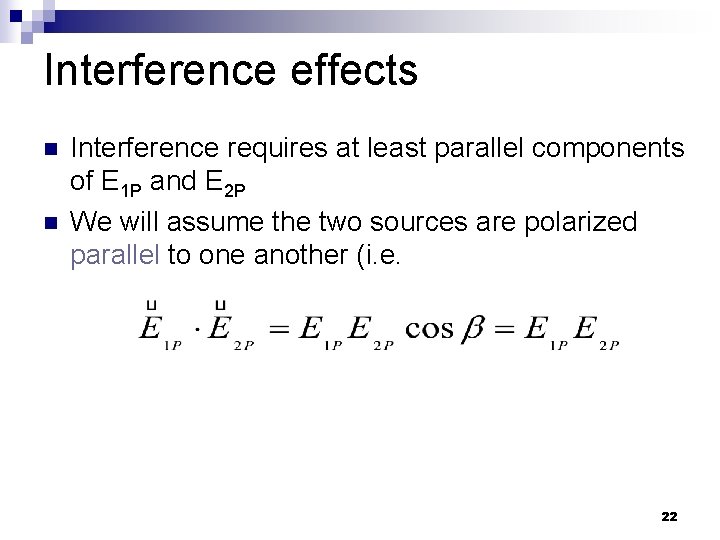
Interference effects n n Interference requires at least parallel components of E 1 P and E 2 P We will assume the two sources are polarized parallel to one another (i. e. 22
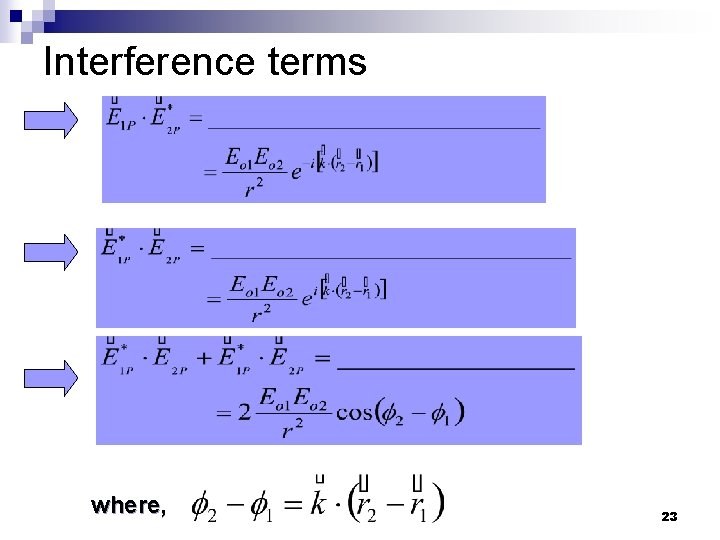
Interference terms where, 23
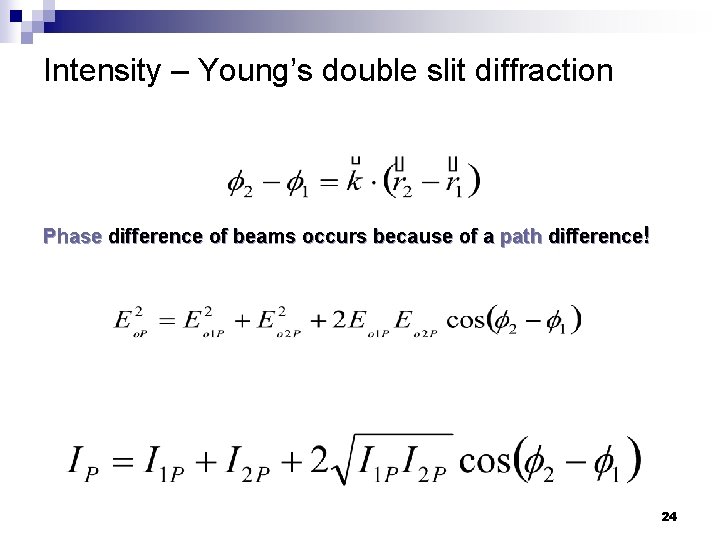
Intensity – Young’s double slit diffraction Phase difference of beams occurs because of a path difference! 24
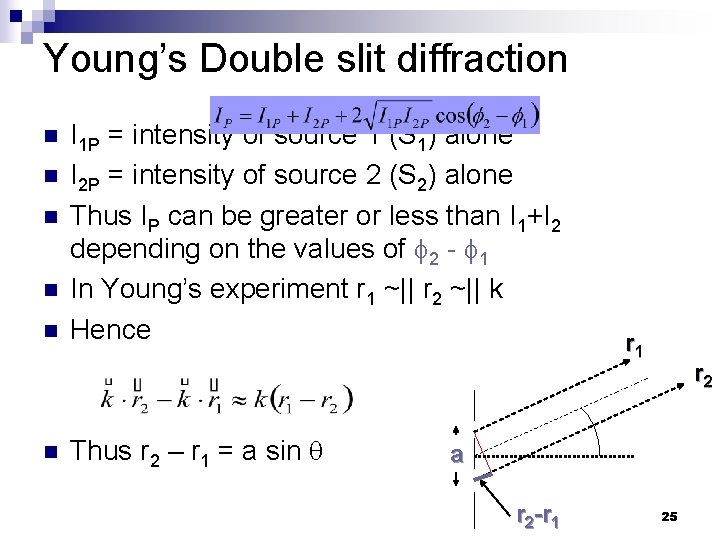
Young’s Double slit diffraction n I 1 P n n n = intensity of source 1 (S 1) alone I 2 P = intensity of source 2 (S 2) alone Thus IP can be greater or less than I 1+I 2 depending on the values of 2 - 1 In Young’s experiment r 1 ~|| r 2 ~|| k Hence Thus r 2 – r 1 = a sin r 1 r 2 a r 2 -r 1 25
- Slides: 25