
Electromagnetic Waves Produced by an Antenna When a
Electromagnetic Waves Produced by an Antenna • When a charged particle undergoes an acceleration, it radiates energy – If currents in an AC circuit change rapidly, some energy is lost in the form of EM waves – EM waves are radiated by any circuit carrying alternating current • An alternating voltage applied to the wires of an antenna forces the electric charge in the antenna to oscillate

EM Waves by an Antenna • Two rods are connected to an ac source, charges oscillate between the rods (a) • As oscillations continue, the rods become less charged, the field near the charges decreases and the field produced at t = 0 moves away from the rod (b) • The charges and field reverse (c) • The oscillations continue (d)

EM Waves by an Antenna • Because the oscillating charges in the rod produce a current, there is also a magnetic field generated • As the current changes, the magnetic field spreads out from the antenna
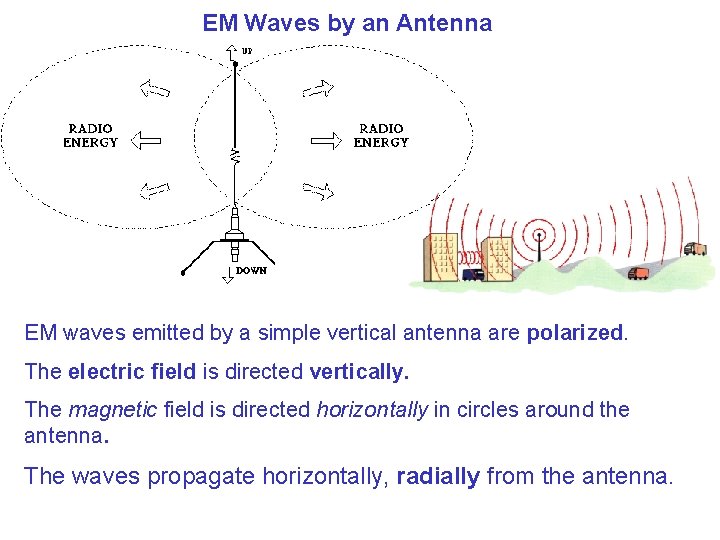
EM Waves by an Antenna EM waves emitted by a simple vertical antenna are polarized. The electric field is directed vertically. The magnetic field is directed horizontally in circles around the antenna. The waves propagate horizontally, radially from the antenna.
Geometrical optics. Ray approximation. Light is a kind of electromagnetic waves… And waves are difficult! In many cases, though, difficulties can be avoided and geometrical optics can be applied. It is based on the suggestion that Light travels in straight lines called rays. (Why do we suggest that btw? ) It is called ray approximation and it reduces optics to ray tracing and geometry. We do geometrical optics. A ray a is a line in the direction along which light energy is flowing. A laser beam (or a beam from your car’s headlight) is really a bundle of many parallel rays.
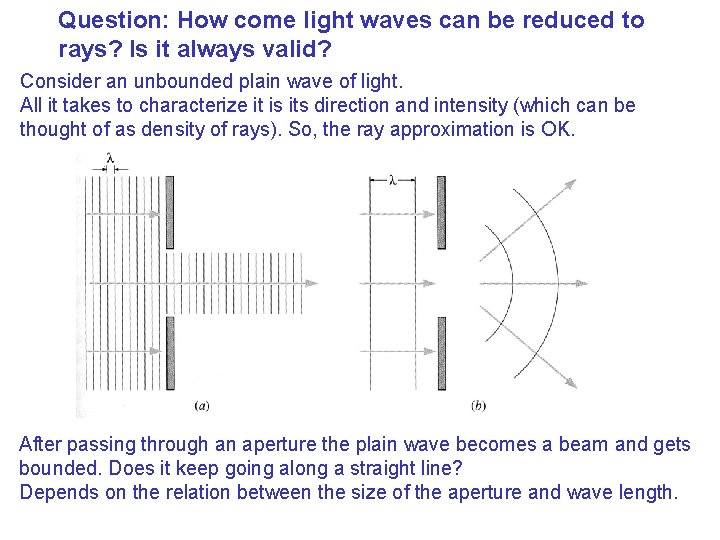
Question: How come light waves can be reduced to rays? Is it always valid? Consider an unbounded plain wave of light. All it takes to characterize it is its direction and intensity (which can be thought of as density of rays). So, the ray approximation is OK. After passing through an aperture the plain wave becomes a beam and gets bounded. Does it keep going along a straight line? Depends on the relation between the size of the aperture and wave length.
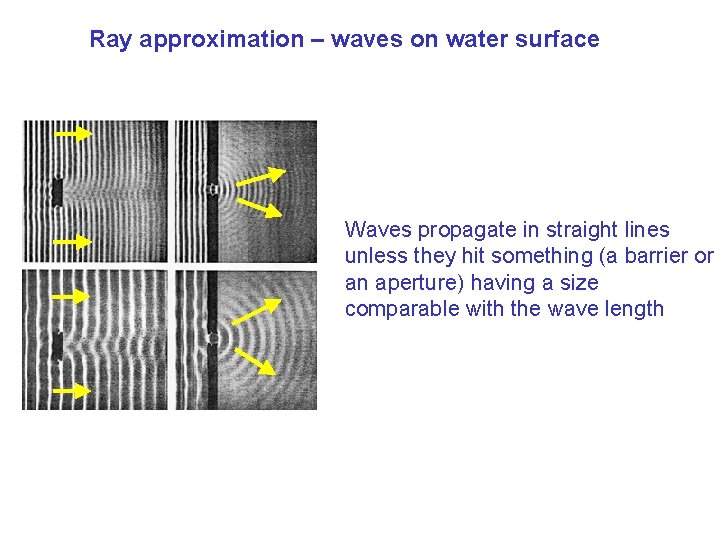
Ray approximation – waves on water surface Waves propagate in straight lines unless they hit something (a barrier or an aperture) having a size comparable with the wave length
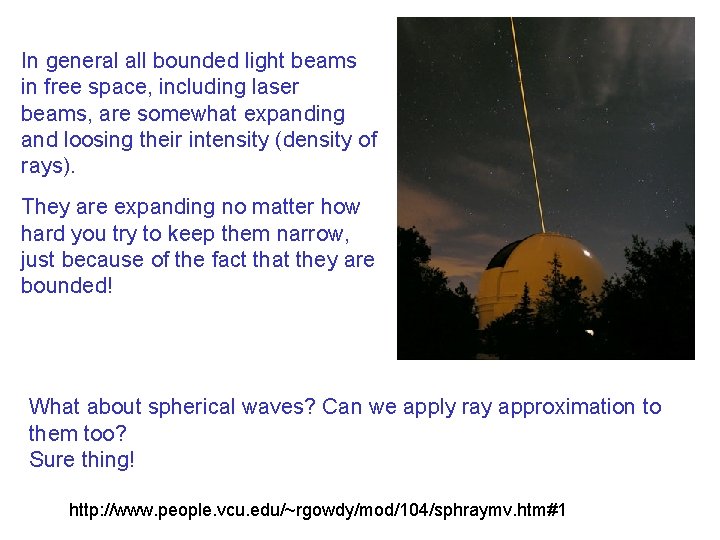
In general all bounded light beams in free space, including laser beams, are somewhat expanding and loosing their intensity (density of rays). They are expanding no matter how hard you try to keep them narrow, just because of the fact that they are bounded! What about spherical waves? Can we apply ray approximation to them too? Sure thing! http: //www. people. vcu. edu/~rgowdy/mod/104/sphraymv. htm#1
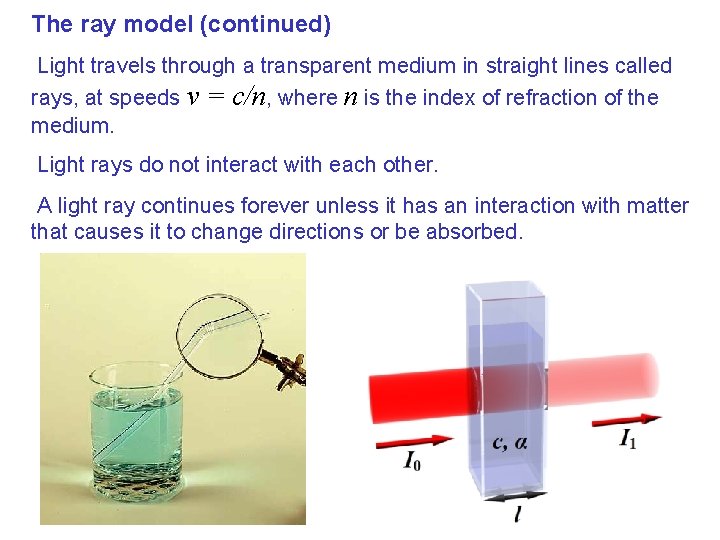
The ray model (continued) Light travels through a transparent medium in straight lines called rays, at speeds v = c/n, where n is the index of refraction of the medium. Light rays do not interact with each other. A light ray continues forever unless it has an interaction with matter that causes it to change directions or be absorbed.
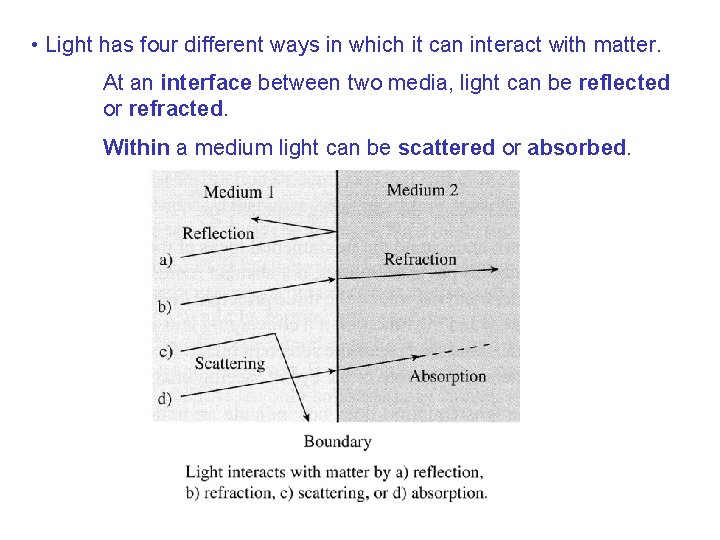
• Light has four different ways in which it can interact with matter. At an interface between two media, light can be reflected or refracted. Within a medium light can be scattered or absorbed.

Examples of using of the ray approximation: 1) A point source, a screen, and a 1 D and 2 D apertures between them. What is the shape of the image on the screen? Image of what is it? What does it size depend on? The shape of the image corresponds to the shape of the aperture; The image is an image of the aperture; Its size is proportional to the size of the aperture and to the ratio of distances

Examples of using of the ray approximation: 1) How do you get a point source? What does it mean, rays filling the aperture? What happens if we close a half of the aperture? 2) Two point sources, an aperture and a screen. Want kind of pattern on the screen do they produce? What about a line of point sources? 3) A line of point sources and a very small (pinhole) aperture. What kind of image will be on the screen? What happens if we cover a half of the aperture?
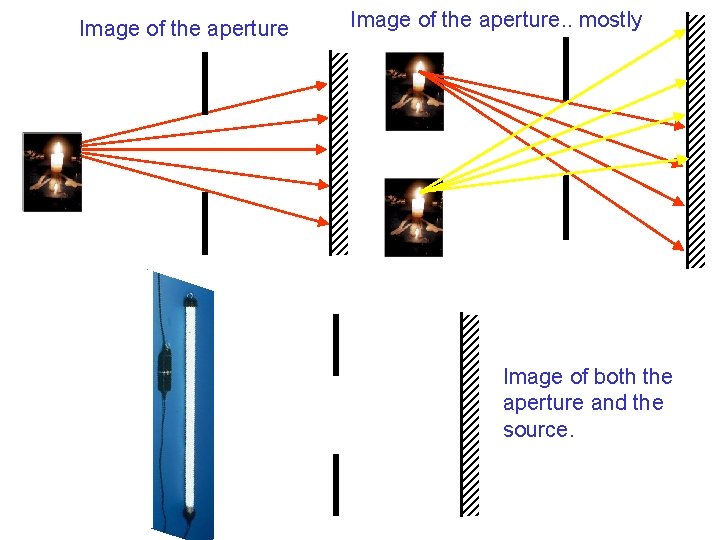
Image of the aperture. . mostly Image of both the aperture and the source.
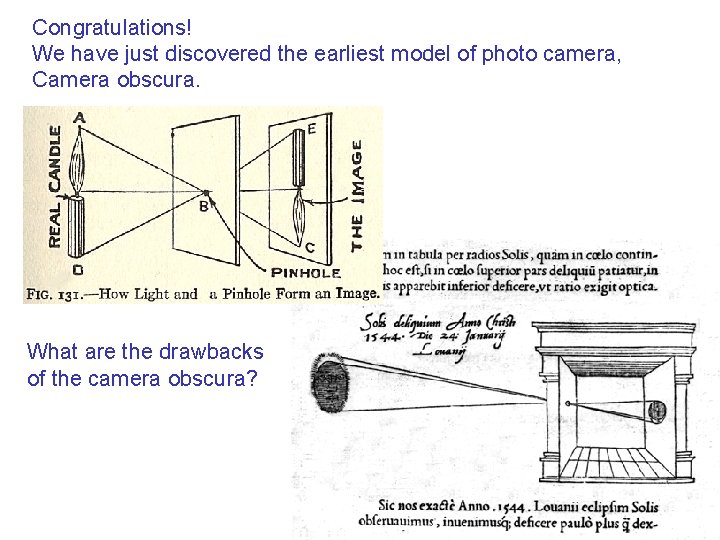
Congratulations! We have just discovered the earliest model of photo camera, Camera obscura. What are the drawbacks of the camera obscura?
- Slides: 14