
Electromagnetic waves Electromagnetic waves Transverse waves consisting of

- Slides: 10
Electromagnetic waves
Electromagnetic waves Transverse waves consisting of changing electric fields and changing magnetic fields. Carry energy from one place to another like mechanical waves Different from mechanical waves in how they are produced and how they travel. Can behave as a wave or as a particle
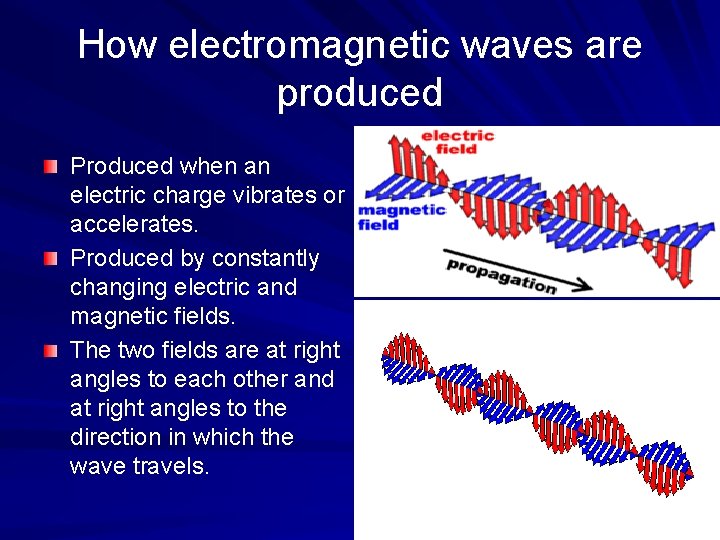
How electromagnetic waves are produced Produced when an electric charge vibrates or accelerates. Produced by constantly changing electric and magnetic fields. The two fields are at right angles to each other and at right angles to the direction in which the wave travels.
How they travel The magnetic and electric fields can regenerate each other, so they do not need a medium. Can travel through a vacuum (no air), empty space, or through matter. Energy transferred by electromagnetic waves is called electromagnetic radiation.
Michelson’s experiment First to measure the speed of light accurately. Used an 8 sided mirror rotating on the top of one mountain and a stationary mirror on the top of another mountain and shined a light at one face of the rotating mirror. By knowing how fast the mirror was rotating and the distance between the 2 mountains, he was able to calculate the speed of light Speed of light = 3. 00 X 108 m/s.
Wavelength and frequency In a vacuum, all electromagnetic waves travel at the same speed Differ in wavelength and frequency. Wavelength is inversely proportional to frequency. If wavelength goes up, frequency goes down. If wavelength goes down, frequency goes up.
Speed = wavelength X frequency Example – A radio station broadcasts a radio wave with a wavelength of 3. 0 m. What is the frequency of the wave? Speed = wavelength X frequency 3. 0 X 108 = 3. 0 m X frequency Frequency = 3. 0 X 108 3. 0 m Frequency = 1. 0 X 108 Hz (hertz)
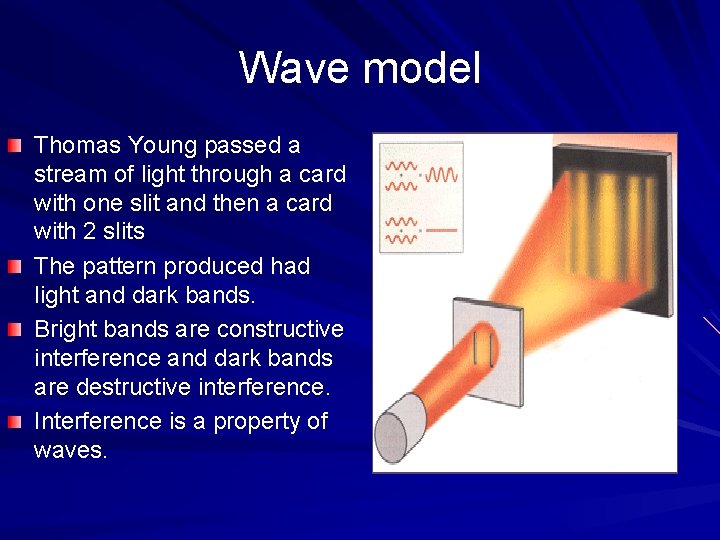
Wave model Thomas Young passed a stream of light through a card with one slit and then a card with 2 slits The pattern produced had light and dark bands. Bright bands are constructive interference and dark bands are destructive interference. Interference is a property of waves.
Particle model Blue light caused electrons to be emitted from substances while red light did not. Albert Einstein said that electromagnetic radiation consists of packets of energy called photons. A photon’s energy is proportional to its frequency. The higher the frequency, the more energy the photon’s have. Blue light has a higher frequency than red light and therefore has more energy
Intensity Photons travel outward from a light source in all directions. The further you are from the light source, the more spread out the photons are, and the light looks less bright (less intensity). As you get closer to the source, the photons spread out over a smaller area and the light looks brighter (high intensity).