
Electromagnetic Waves Background Notes Light what is it
Electromagnetic Waves
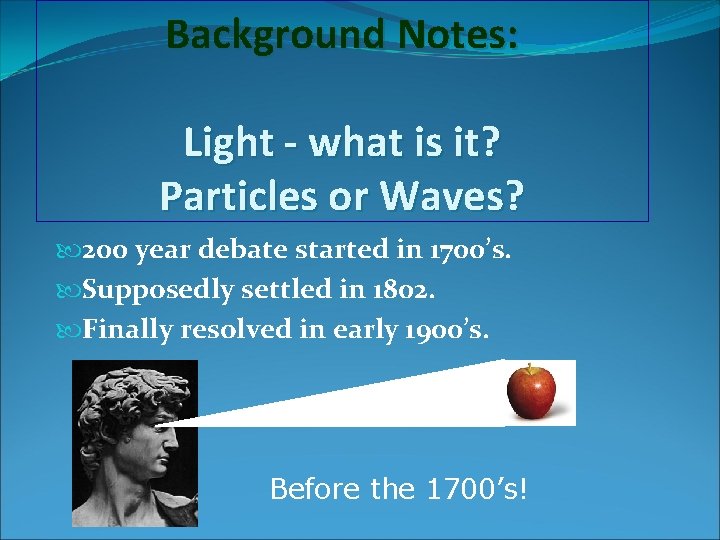
Background Notes: Light - what is it? Particles or Waves? 200 year debate started in 1700’s. Supposedly settled in 1802. Finally resolved in early 1900’s. Before the 1700’s!
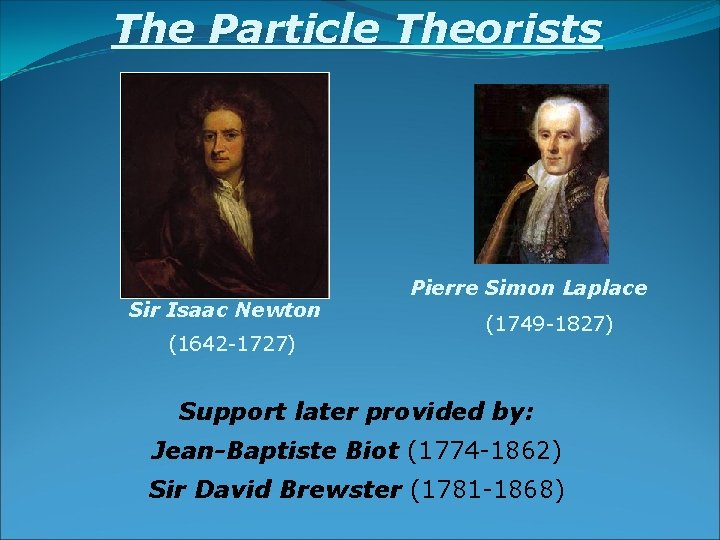
The Particle Theorists Sir Isaac Newton (1642 -1727) Pierre Simon Laplace (1749 -1827) Support later provided by: Jean-Baptiste Biot (1774 -1862) Sir David Brewster (1781 -1868)
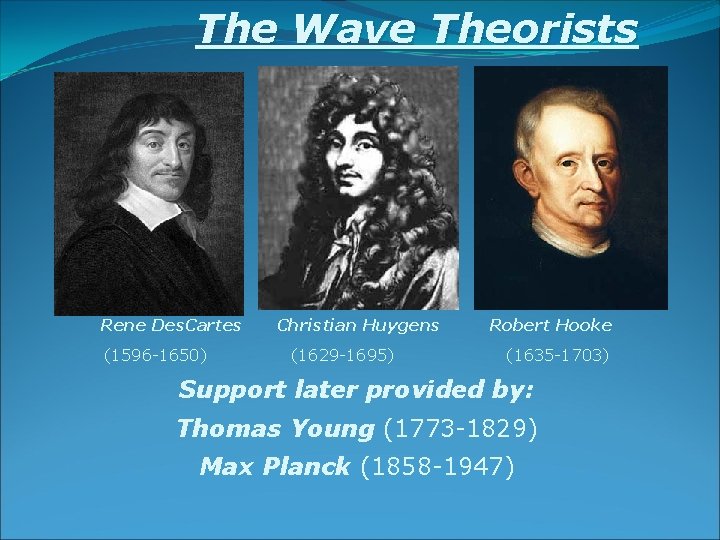
The Wave Theorists Rene Des. Cartes (1596 -1650) Christian Huygens (1629 -1695) Robert Hooke (1635 -1703) Support later provided by: Thomas Young (1773 -1829) Max Planck (1858 -1947)
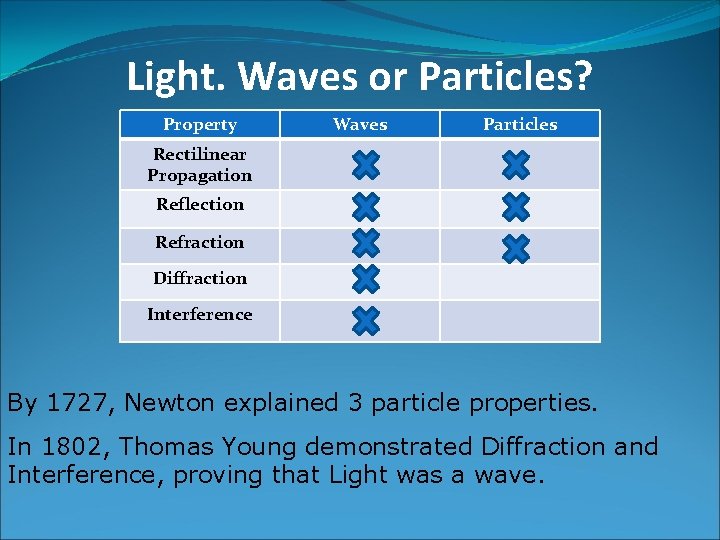
Light. Waves or Particles? Property Waves Particles Rectilinear Propagation Reflection Refraction Diffraction Interference By 1727, Newton explained 3 particle properties. In 1802, Thomas Young demonstrated Diffraction and Interference, proving that Light was a wave.

Thomas Young demonstrated diffraction and interference of light in 1802. Is this an example of chromatic aberration? And remember, “Blue bends best!”
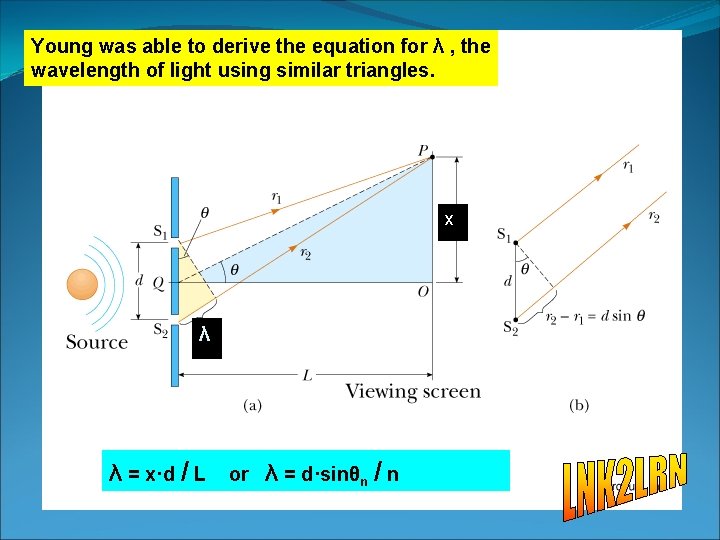
Young was able to derive the equation for λ , the wavelength of light using similar triangles. x λ λ = x·d / L or λ = d·sinθn / n

Today we know the wavelengths of the colors of visible light. Color Wavelength (nm) Violet 410 -440 Blue 440 -490 Green 490 -540 Yellow 540 -600 Orange 600 -630 Red 630 -770
Today: Visible Light Electromagnetic radiation that stimulates the retina of our eye. We see objects due to reflected light. Two types of objects: (1) Luminous - emit own light (ex. Sun) (2) Illuminated - reflect light (ex. Moon)
4 Classic Attempts to Measure Speed of Light Galileo (Italy) – Lanterns 1 mile apart, 1600 Roemer (Denmark) – Moons of Jupiter, light crossing Earth’s orbit, 1676 Fizeau (France)– Rotating Cogwheel chopping beam of light into pulses, 1849 Michelson (USA) – Rotating Octagonal mirror reflecting light, 1878
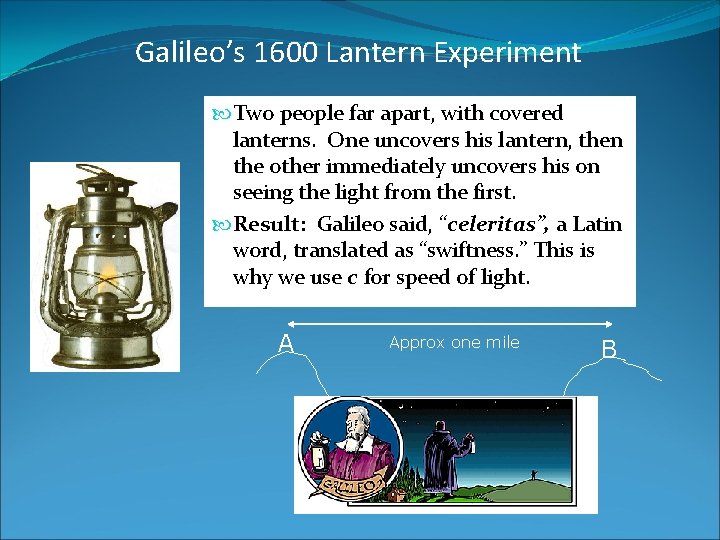
Galileo’s 1600 Lantern Experiment Two people far apart, with covered lanterns. One uncovers his lantern, then the other immediately uncovers his on seeing the light from the first. Result: Galileo said, “celeritas”, a Latin word, translated as “swiftness. ” This is why we use c for speed of light. A Approx one mile B
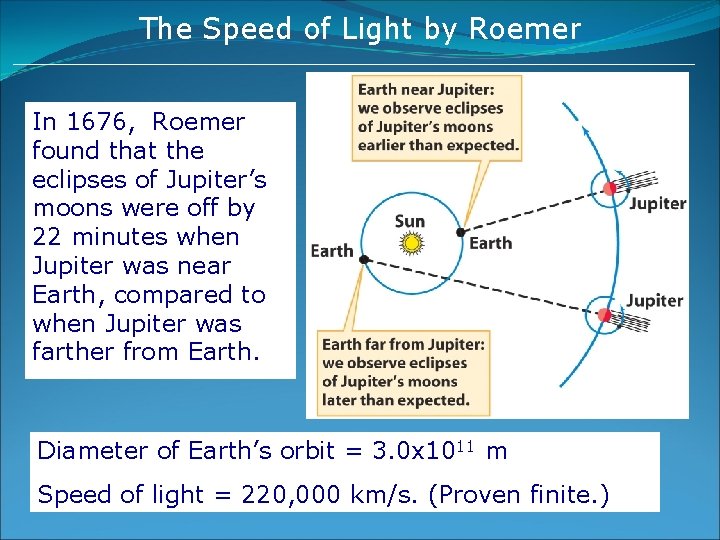
The Speed of Light by Roemer In 1676, Roemer found that the eclipses of Jupiter’s moons were off by 22 minutes when Jupiter was near Earth, compared to when Jupiter was farther from Earth. Diameter of Earth’s orbit = 3. 0 x 1011 m Speed of light = 220, 000 km/s. (Proven finite. )

Fizeau’s 1849 Cogwheel Experiment Highlights of Fizeau’s experiment: used a slit to produce a narrow beam of light travels through the spaces of a cogwheel reflects off of a mirror he adjusted the rotational speed of the cogwheel until the light passes through the next space on the wheel. Using this method, Fizeau determined that c = 315, 000 km/s.
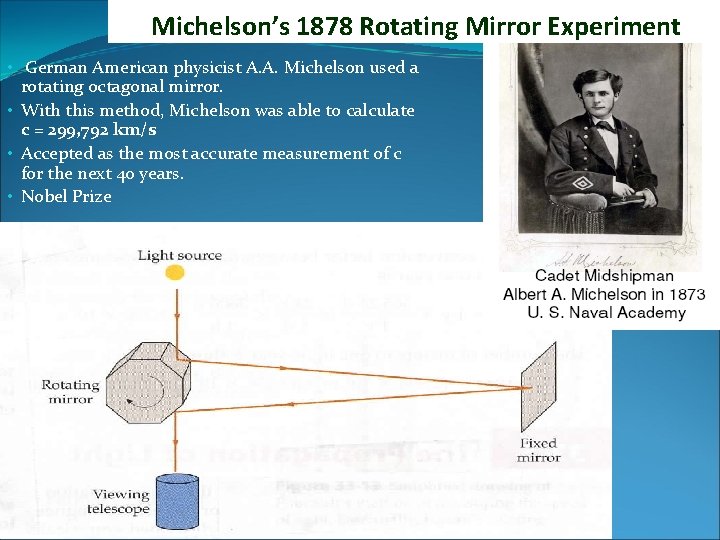
Michelson’s 1878 Rotating Mirror Experiment • German American physicist A. A. Michelson used a rotating octagonal mirror. • With this method, Michelson was able to calculate c = 299, 792 km/s • Accepted as the most accurate measurement of c for the next 40 years. • Nobel Prize Picture credit
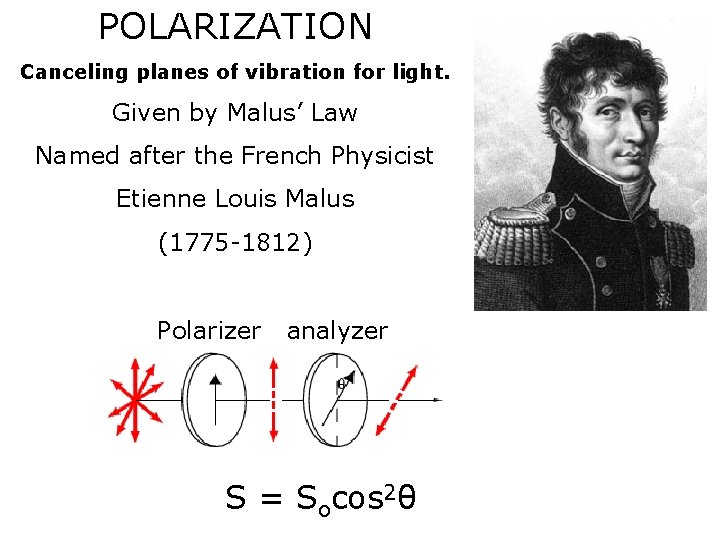
POLARIZATION Canceling planes of vibration for light. Given by Malus’ Law Named after the French Physicist Etienne Louis Malus (1775 -1812) Polarizer HI! analyzer So S S = Socos 2θ
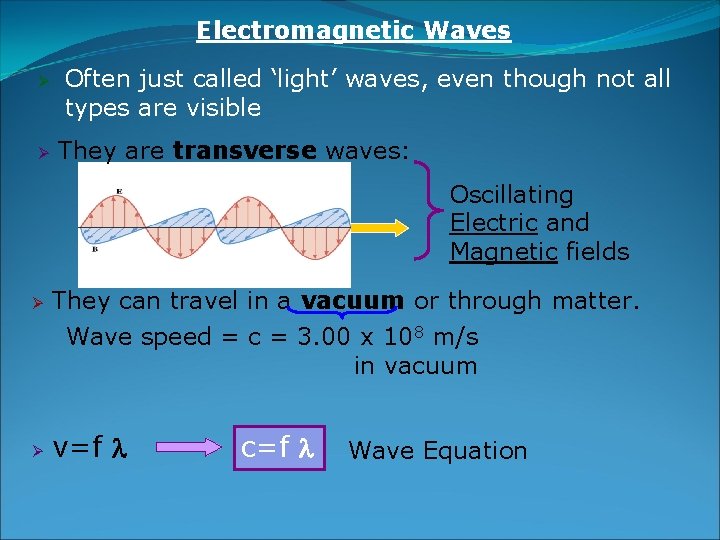
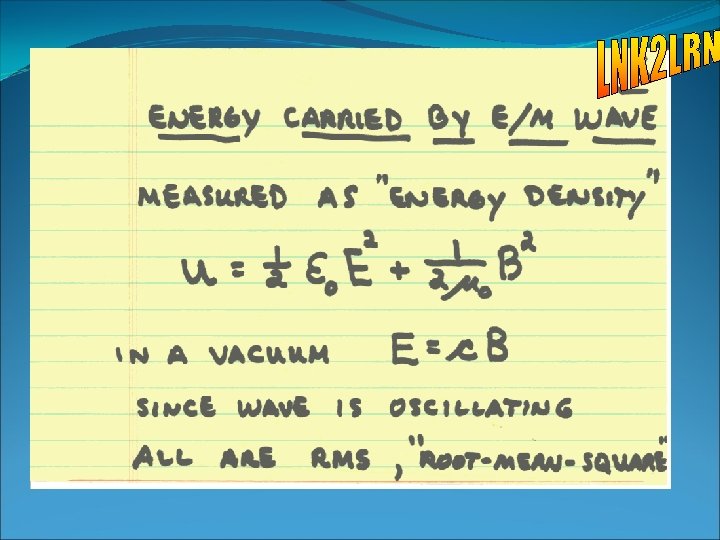
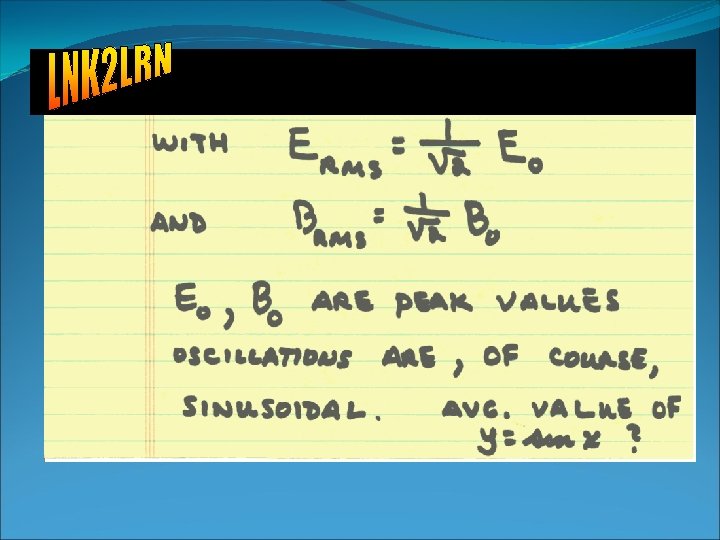
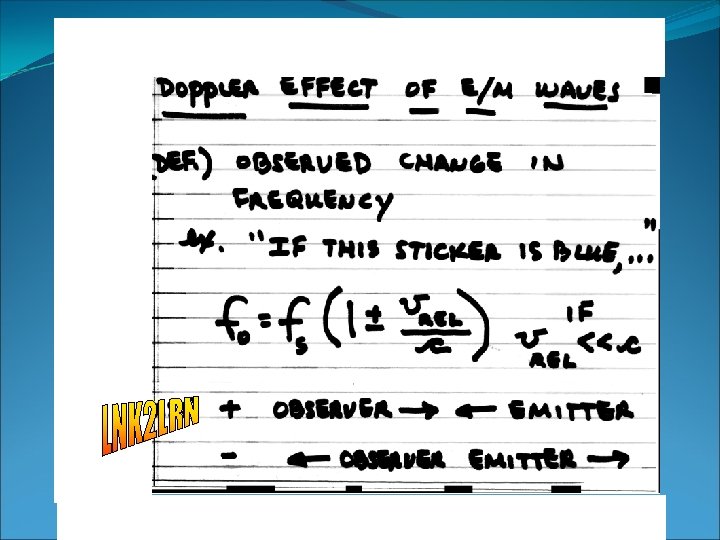
Electromagnetic Waves Ø Ø Often just called ‘light’ waves, even though not all types are visible They are transverse waves: Oscillating Electric and Magnetic fields Ø Ø They can travel in a vacuum or through matter. Wave speed = c = 3. 00 x 108 m/s in vacuum v=f c=f Wave Equation
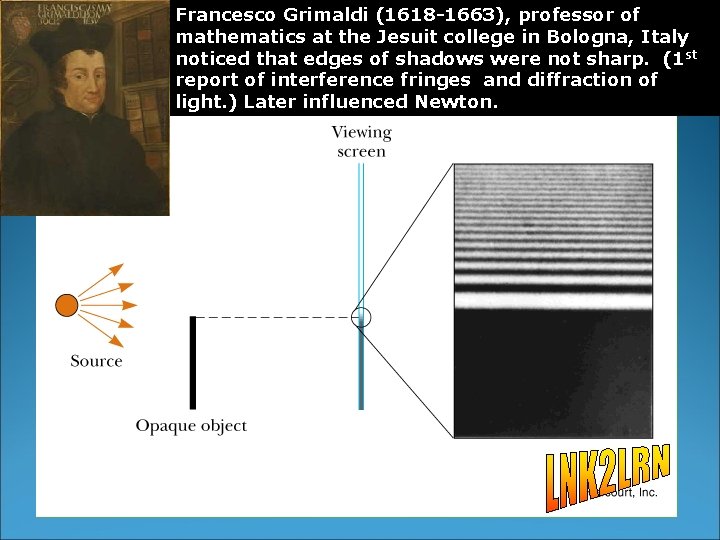
Francesco Grimaldi (1618 -1663), professor of mathematics at the Jesuit college in Bologna, Italy noticed that edges of shadows were not sharp. (1 st report of interference fringes and diffraction of light. ) Later influenced Newton.
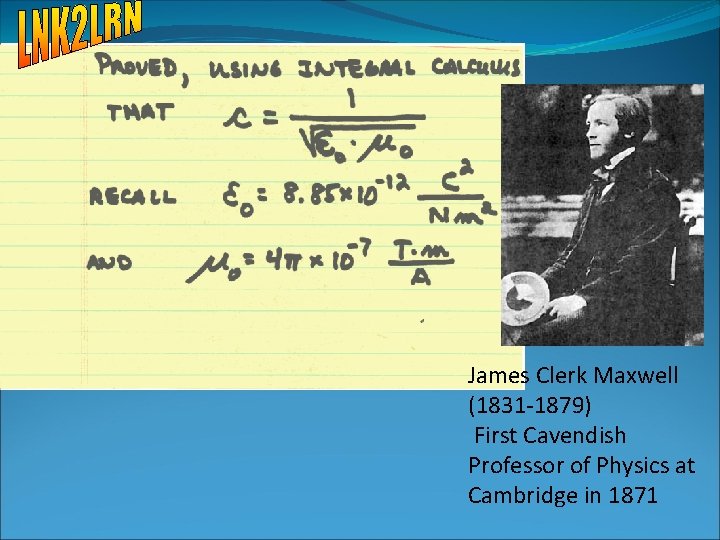
James Clerk Maxwell (1831 -1879) First Cavendish Professor of Physics at Cambridge in 1871
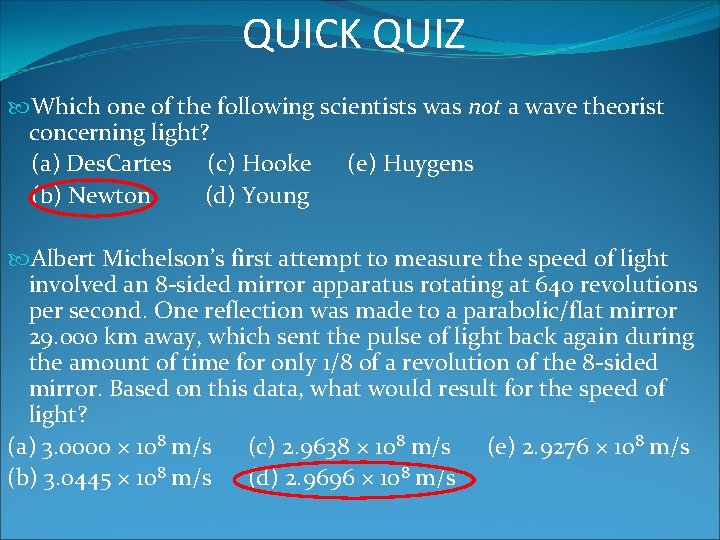
QUICK QUIZ Which one of the following scientists was not a wave theorist concerning light? (a) Des. Cartes (c) Hooke (e) Huygens (b) Newton (d) Young Albert Michelson’s first attempt to measure the speed of light involved an 8 -sided mirror apparatus rotating at 640 revolutions per second. One reflection was made to a parabolic/flat mirror 29. 000 km away, which sent the pulse of light back again during the amount of time for only 1/8 of a revolution of the 8 -sided mirror. Based on this data, what would result for the speed of light? (a) 3. 0000 × 108 m/s (c) 2. 9638 × 108 m/s (e) 2. 9276 × 108 m/s (b) 3. 0445 × 108 m/s (d) 2. 9696 × 108 m/s
The Electromagnetic Spectrum A range of light waves extending in wavelength from radio waves to gamma rays. Radio Waves - communication Microwaves - used to cook Infrared - heat Visible Light - detected by your eyes Ultraviolet - causes sunburn X-rays - penetrates tissue Gamma Rays – mutates cells
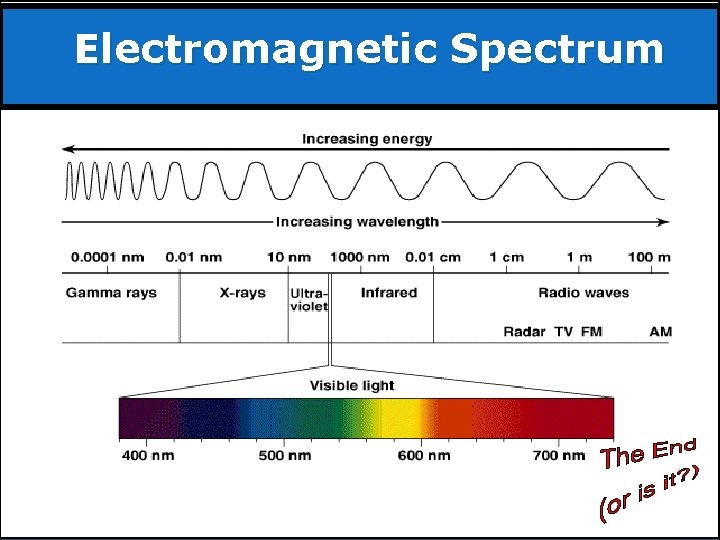
Electromagnetic Spectrum
- Slides: 27