
ELECTROMAGNETIC THEORY 4 th year Electronics Communications Electrical
- Slides: 27
ELECTROMAGNETIC THEORY 4 th year Electronics & Communications, Electrical Engineering Dept. , Minia University. Lect. 3 Lecturer: Dr. Emad Tammam
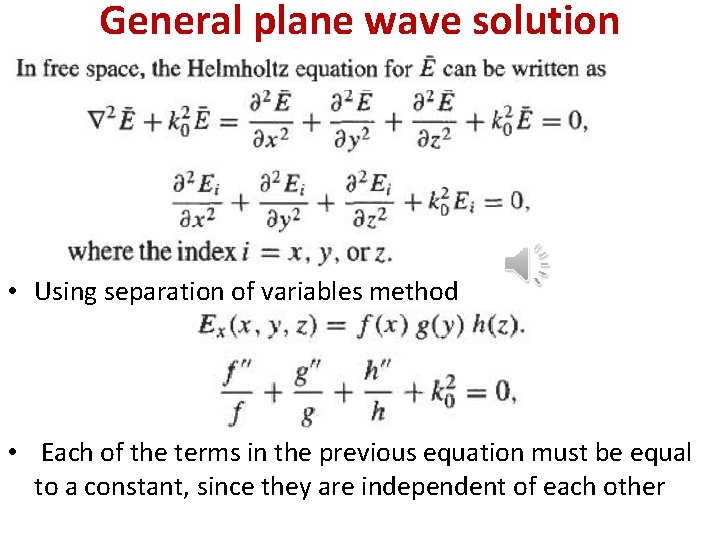
General plane wave solution • Using separation of variables method • Each of the terms in the previous equation must be equal to a constant, since they are independent of each other
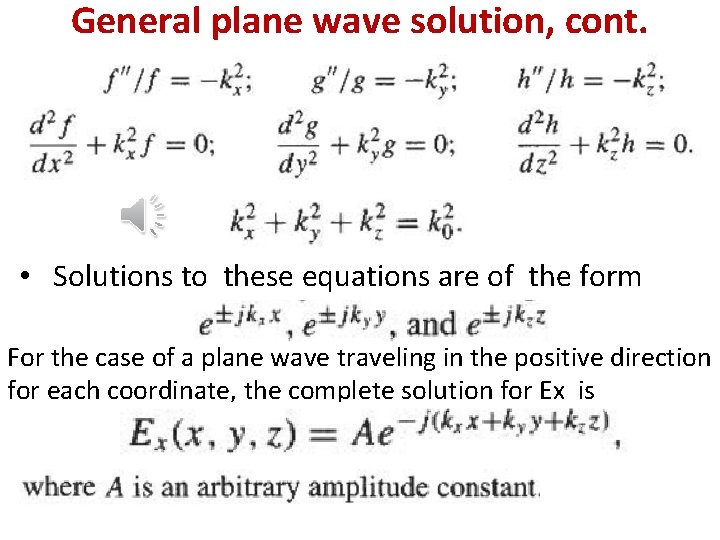
General plane wave solution, cont. • Solutions to these equations are of the form For the case of a plane wave traveling in the positive direction for each coordinate, the complete solution for Ex is
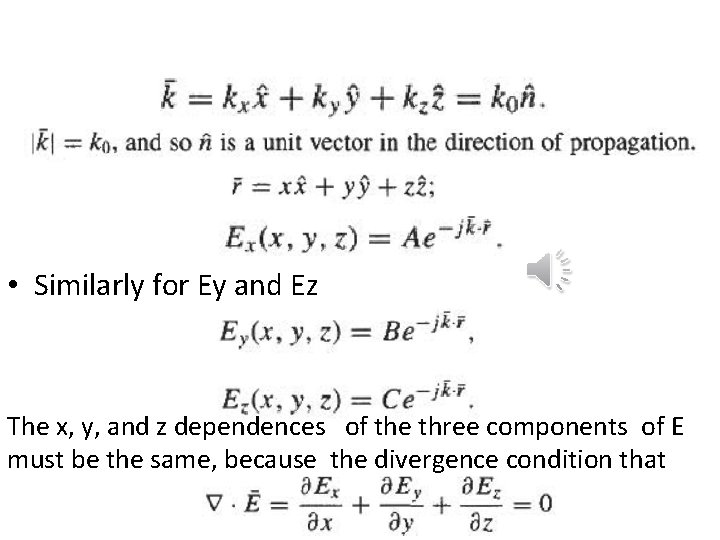
• Similarly for Ey and Ez The x, y, and z dependences of the three components of E must be the same, because the divergence condition that
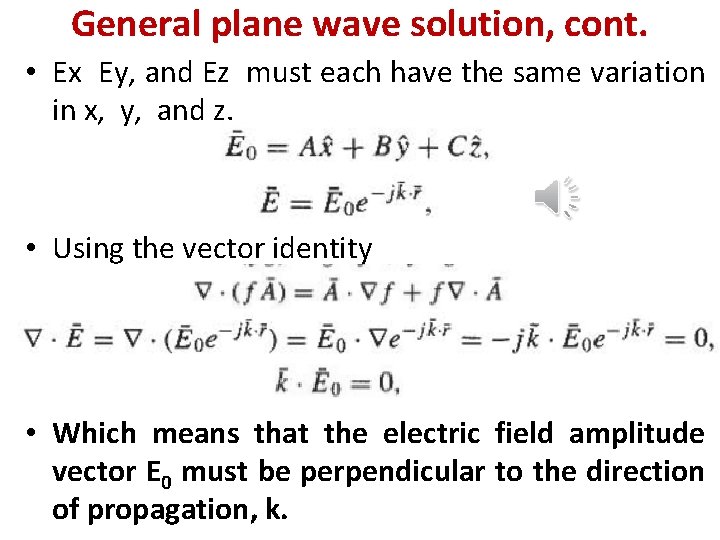
General plane wave solution, cont. • Ex Ey, and Ez must each have the same variation in x, y, and z. • Using the vector identity • Which means that the electric field amplitude vector E 0 must be perpendicular to the direction of propagation, k.
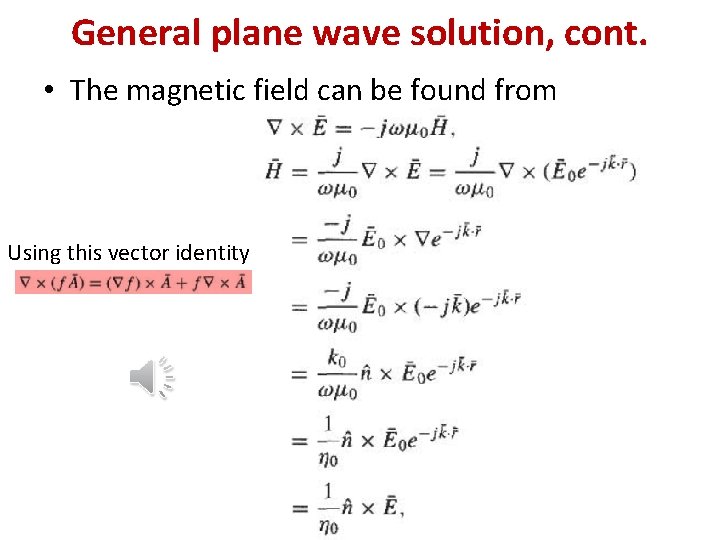
General plane wave solution, cont. • The magnetic field can be found from Using this vector identity
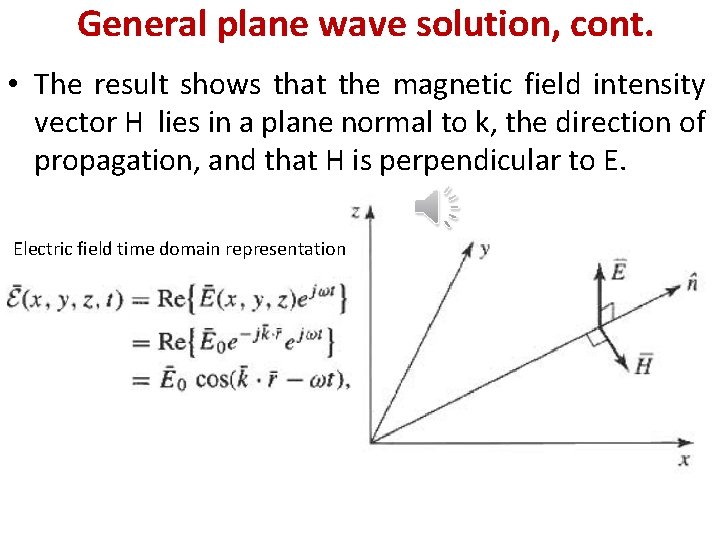
General plane wave solution, cont. • The result shows that the magnetic field intensity vector H lies in a plane normal to k, the direction of propagation, and that H is perpendicular to E. Electric field time domain representation
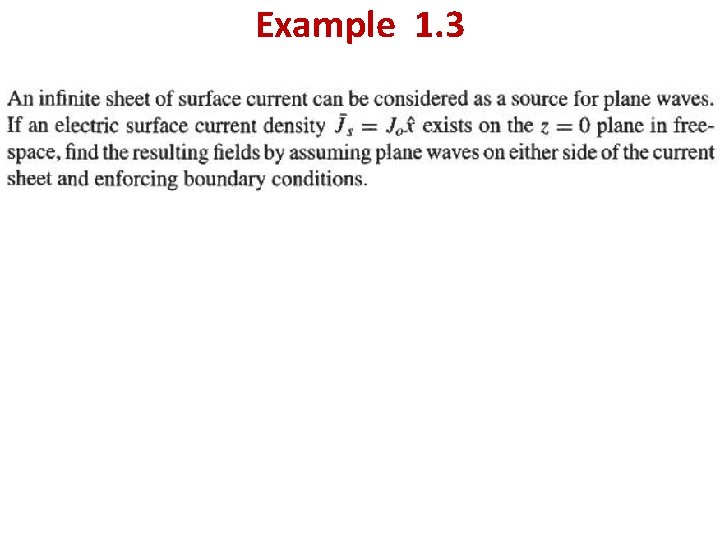
Example 1. 3
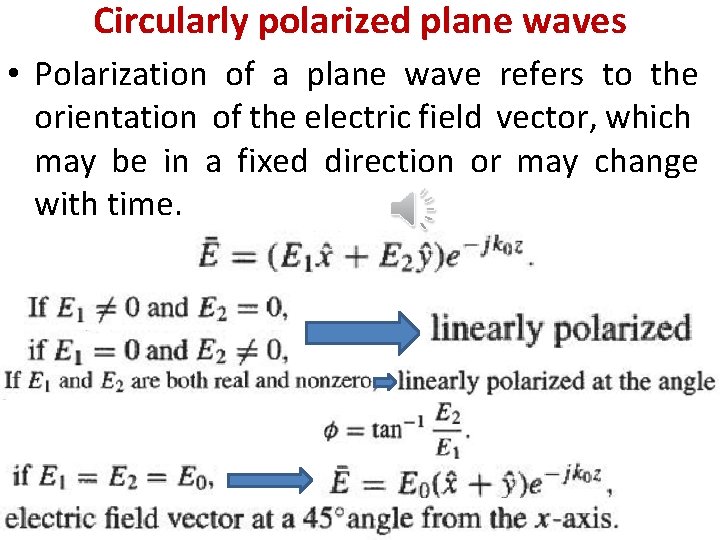
Circularly polarized plane waves • Polarization of a plane wave refers to the orientation of the electric field vector, which may be in a fixed direction or may change with time.
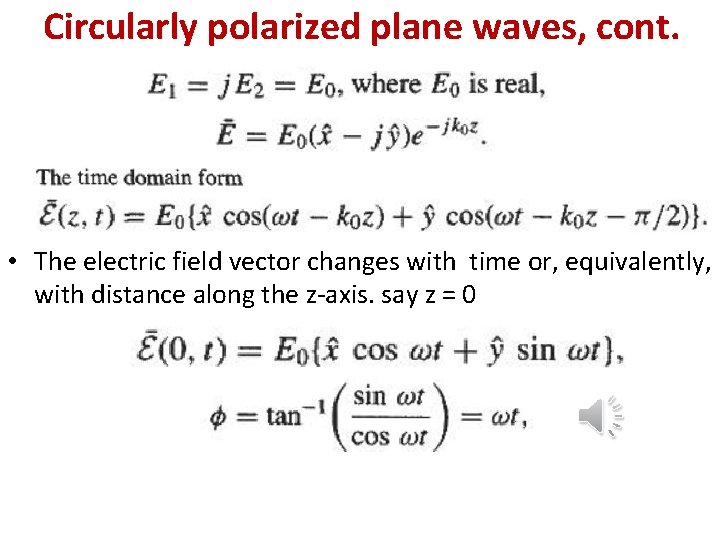
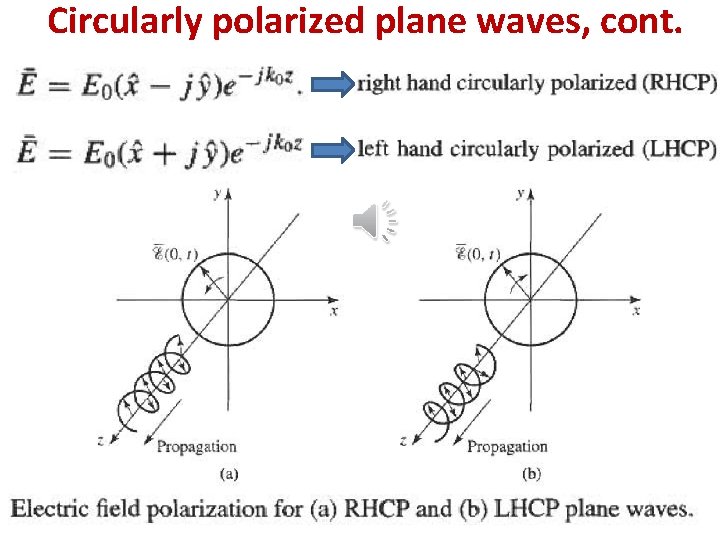
Circularly polarized plane waves, cont. • The electric field vector changes with time or, equivalently, with distance along the z-axis. say z = 0
Circularly polarized plane waves, cont.
Circularly polarized plane waves, cont.
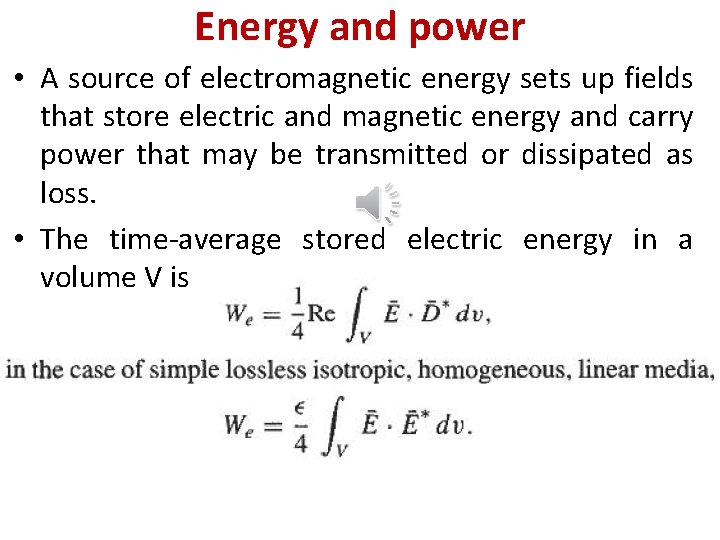
Energy and power • A source of electromagnetic energy sets up fields that store electric and magnetic energy and carry power that may be transmitted or dissipated as loss. • The time-average stored electric energy in a volume V is
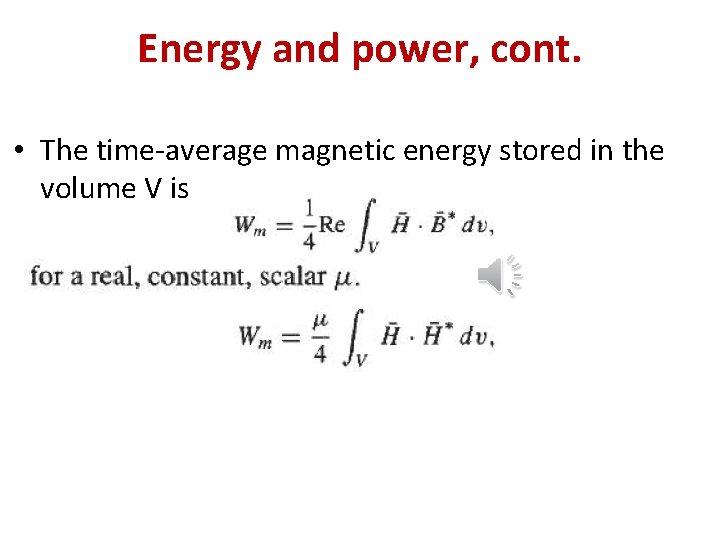
Energy and power, cont. • The time-average magnetic energy stored in the volume V is
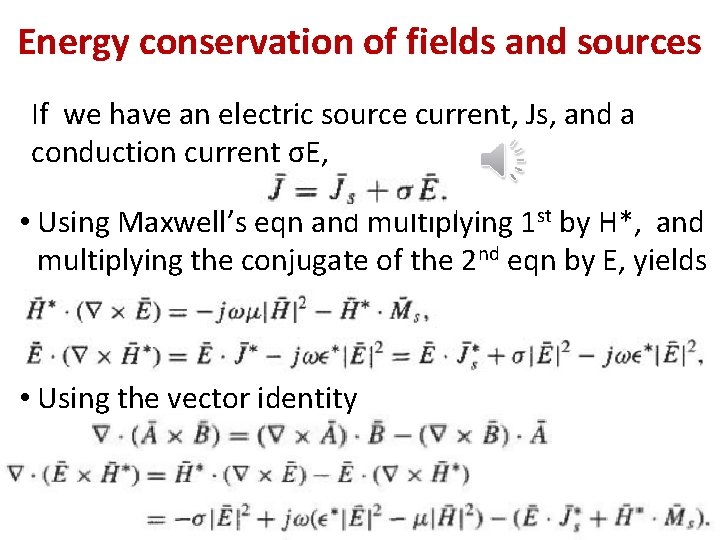
Energy conservation of fields and sources If we have an electric source current, Js, and a conduction current σE, • Using Maxwell’s eqn and multiplying 1 st by H*, and multiplying the conjugate of the 2 nd eqn by E, yields • Using the vector identity
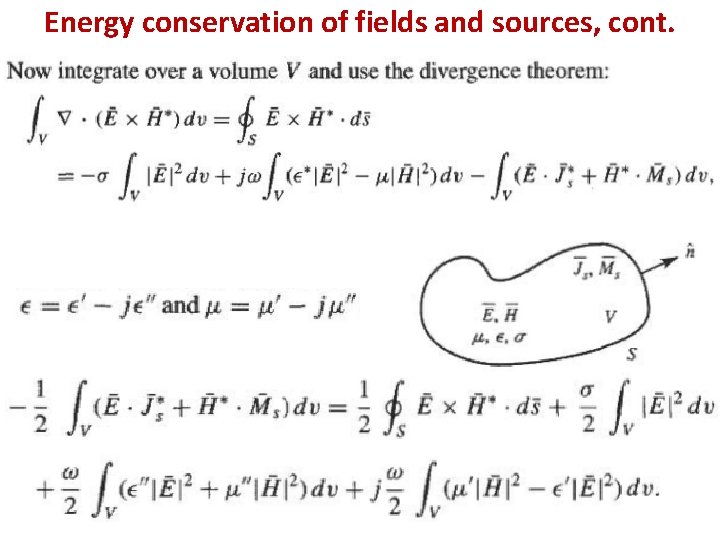
Energy conservation of fields and sources, cont.
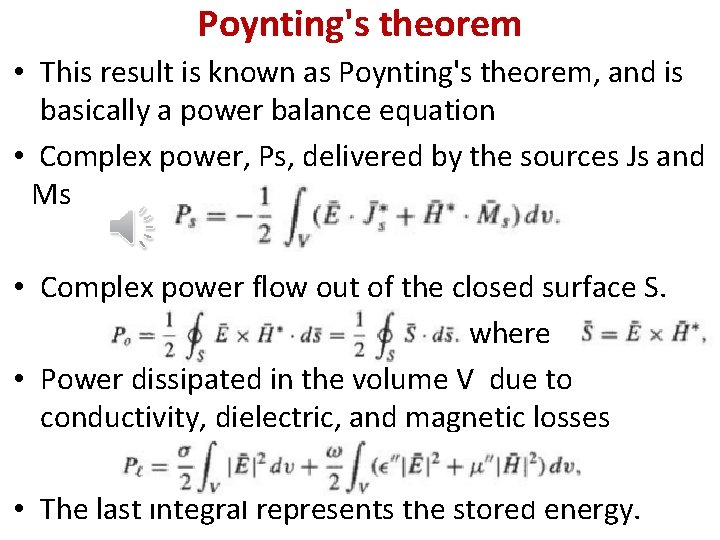
Poynting's theorem • This result is known as Poynting's theorem, and is basically a power balance equation • Complex power, Ps, delivered by the sources Js and Ms • Complex power flow out of the closed surface S. where • Power dissipated in the volume V due to conductivity, dielectric, and magnetic losses • The last integral represents the stored energy.
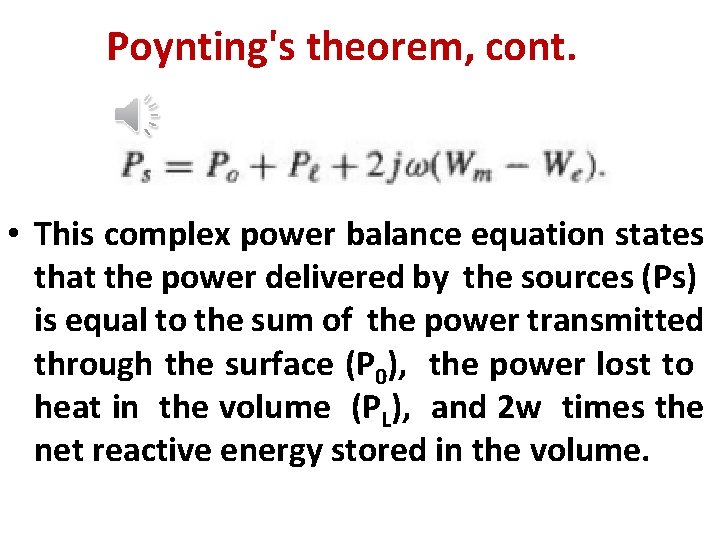
Poynting's theorem, cont. • This complex power balance equation states that the power delivered by the sources (Ps) is equal to the sum of the power transmitted through the surface (P 0), the power lost to heat in the volume (PL), and 2 w times the net reactive energy stored in the volume.
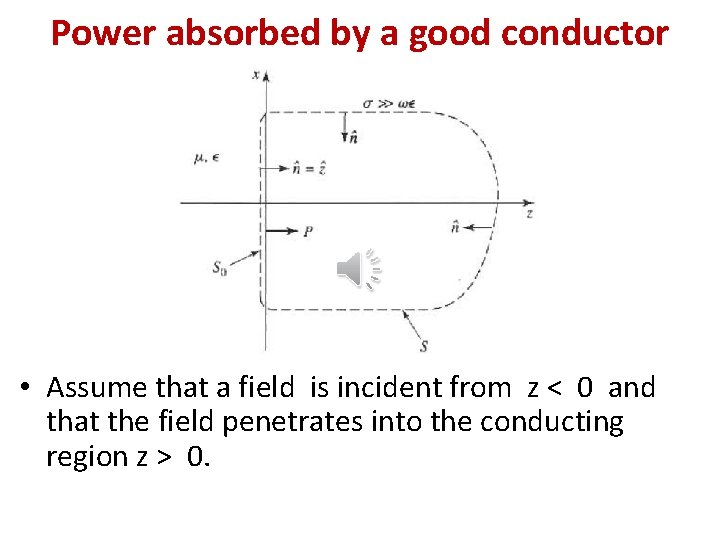
Power absorbed by a good conductor • Assume that a field is incident from z < 0 and that the field penetrates into the conducting region z > 0.
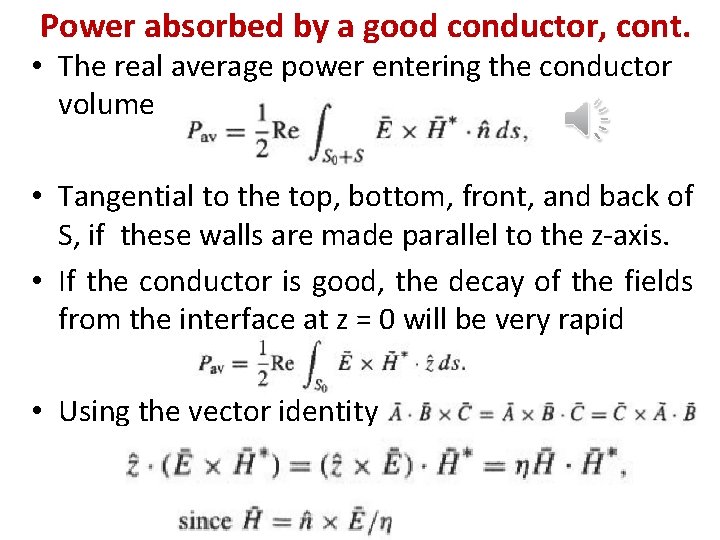
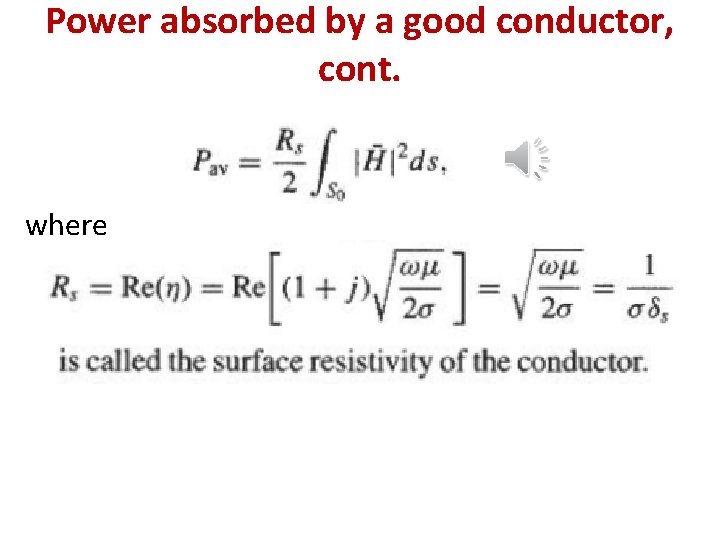
Power absorbed by a good conductor, cont. • The real average power entering the conductor volume • Tangential to the top, bottom, front, and back of S, if these walls are made parallel to the z-axis. • If the conductor is good, the decay of the fields from the interface at z = 0 will be very rapid • Using the vector identity
Power absorbed by a good conductor, cont. where
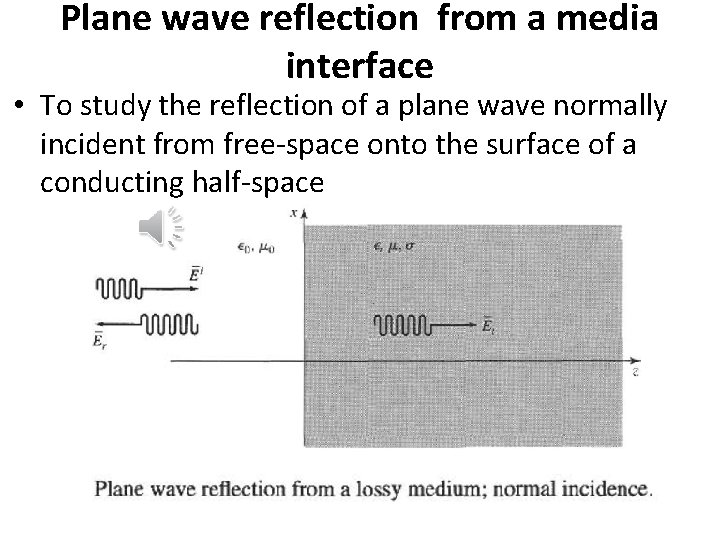
Plane wave reflection from a media interface • To study the reflection of a plane wave normally incident from free-space onto the surface of a conducting half-space
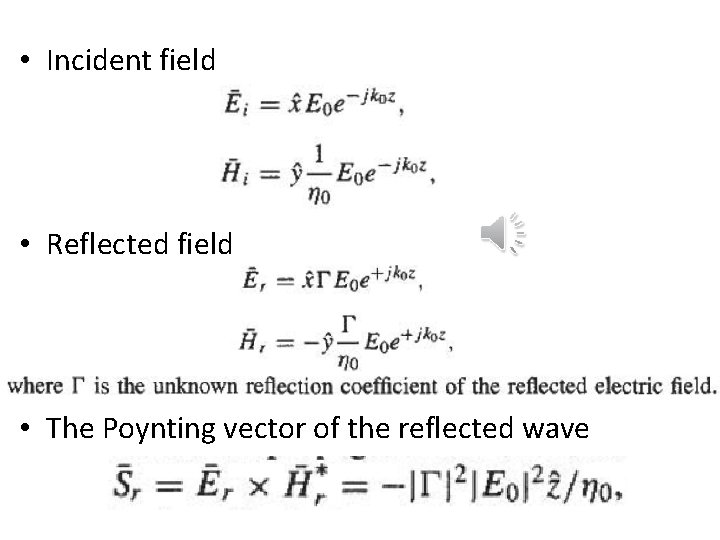
• Incident field • Reflected field • The Poynting vector of the reflected wave
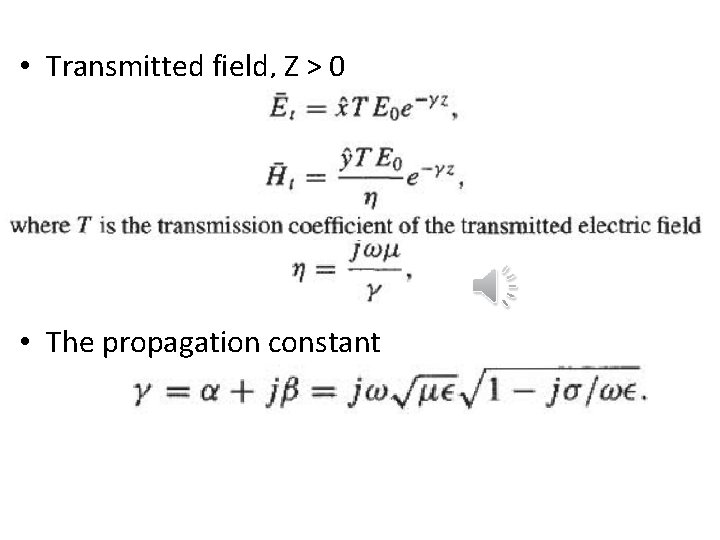
• Transmitted field, Z > 0 • The propagation constant
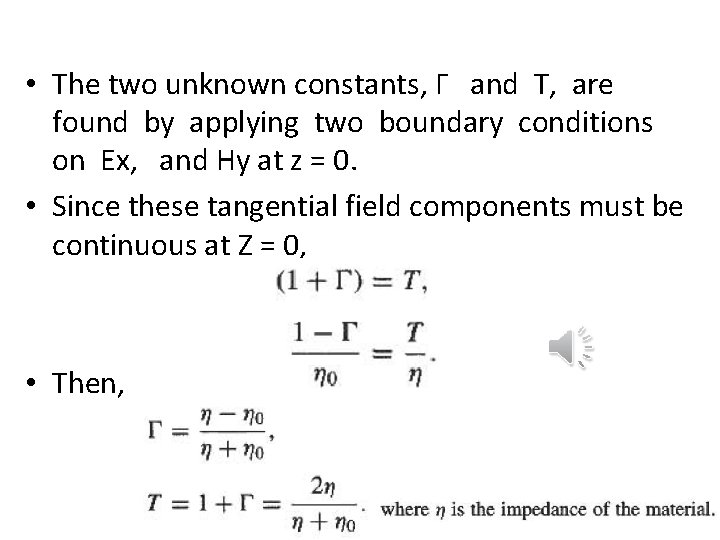
• The two unknown constants, Γ and T, are found by applying two boundary conditions on Ex, and Hy at z = 0. • Since these tangential field components must be continuous at Z = 0, • Then,
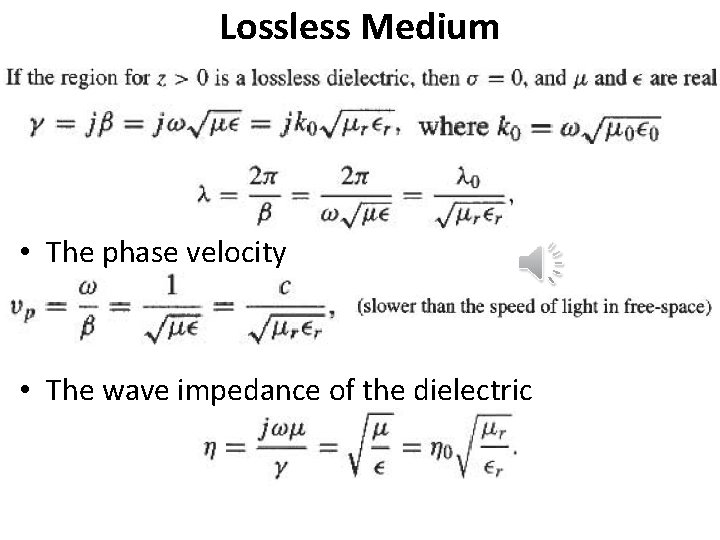
Lossless Medium • The phase velocity • The wave impedance of the dielectric
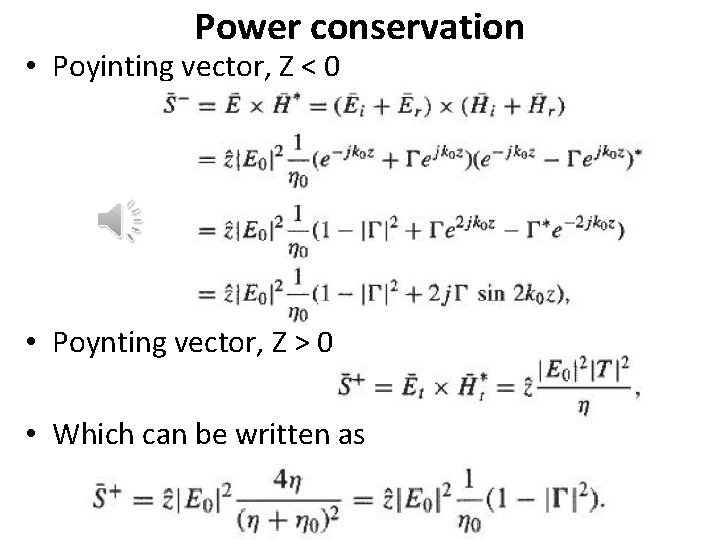
Power conservation • Poyinting vector, Z < 0 • Poynting vector, Z > 0 • Which can be written as