
ELECTROMAGNETIC SPECTRUM Chapter 13 LEARNING OBJECTIVES State that
ELECTROMAGNETIC SPECTRUM Chapter 13
LEARNING OBJECTIVES • State that all electromagnetic waves are transverse waves that travel with the same speed in vacuum and state the magnitude of this speed. • Describe the main components of the electromagnetic spectrum.
LEARNING OBJECTIVES • State examples of the use of the following components: • radio waves(eg. radio and television communication) • microwaves(eg. microwave oven and satellite television) • infra-red(eg. infra-red controllers and intruder alarms) • light(eg. optical fibres fro medical uses and telecommunications) • ultra-violet(eg. sunbeds and sterilisation) • X-rays(eg. radiological and engineering applications) • gamma rays(eg. medical treatment)
WHAT IS ELECTROMAGNETIC SPECTRUM? Click here for introduction video to electromagnetic spectrum
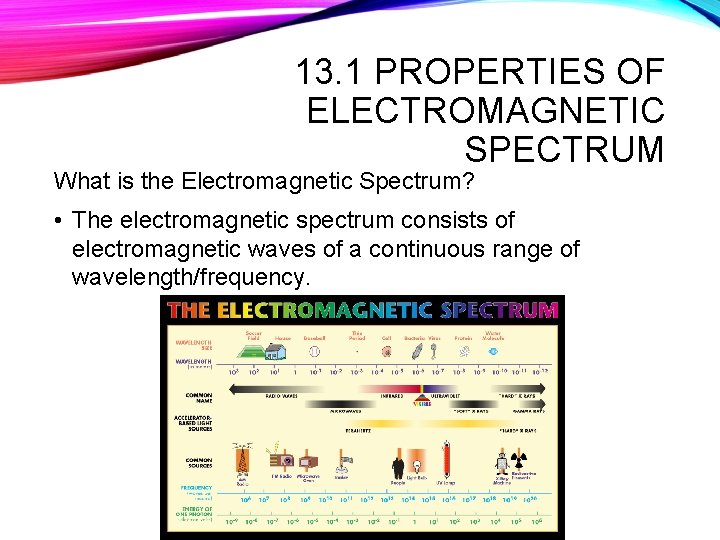
13. 1 PROPERTIES OF ELECTROMAGNETIC SPECTRUM What is the Electromagnetic Spectrum? • The electromagnetic spectrum consists of electromagnetic waves of a continuous range of wavelength/frequency.
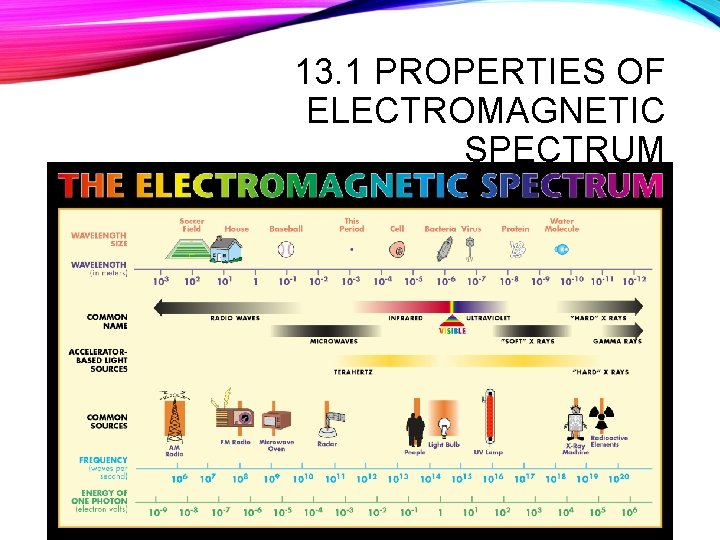
13. 1 PROPERTIES OF ELECTROMAGNETIC SPECTRUM
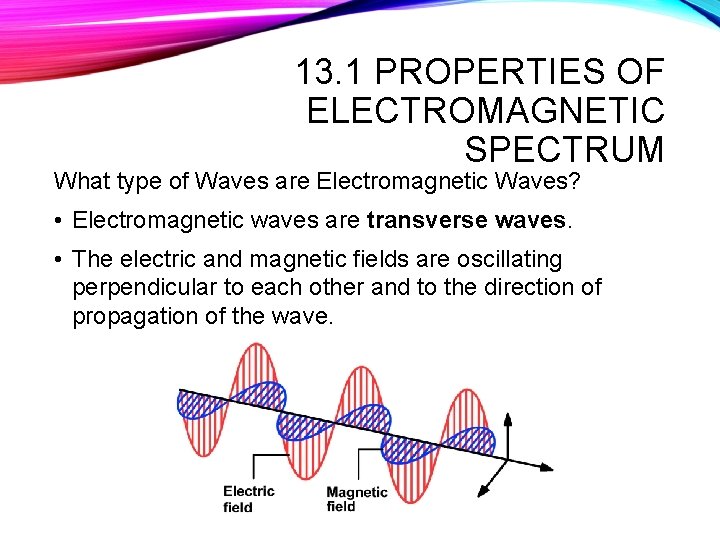
13. 1 PROPERTIES OF ELECTROMAGNETIC SPECTRUM What type of Waves are Electromagnetic Waves? • Electromagnetic waves are transverse waves. • The electric and magnetic fields are oscillating perpendicular to each other and to the direction of propagation of the wave.
13. 1 PROPERTIES OF ELECTROMAGNETIC SPECTRUM How do Electromagnetic waves propagate? • Electromagnetic waves transfer energy from one place to another without the need for a physical medium. • Electromagnetic waves travel at a speed of 108 m/s in vacuum. 3. 00 x • All electromagnetic waves obey the laws of reflection and refraction.
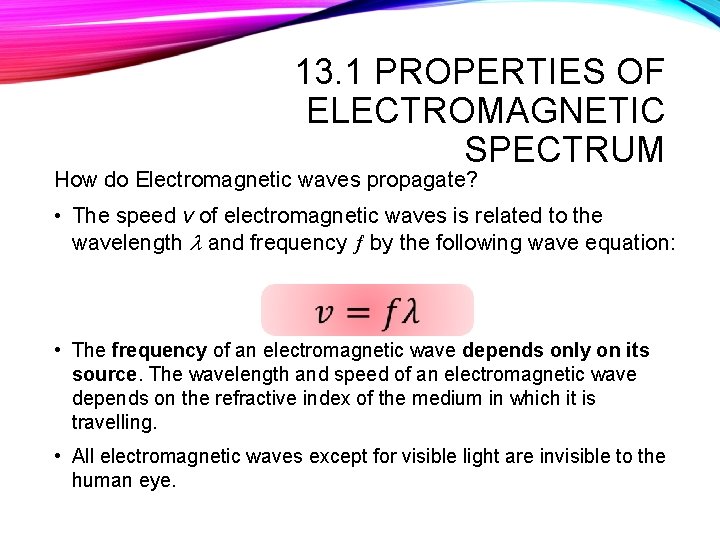
13. 1 PROPERTIES OF ELECTROMAGNETIC SPECTRUM How do Electromagnetic waves propagate? • The speed v of electromagnetic waves is related to the wavelength and frequency by the following wave equation: • The frequency of an electromagnetic wave depends only on its source. The wavelength and speed of an electromagnetic wave depends on the refractive index of the medium in which it is travelling. • All electromagnetic waves except for visible light are invisible to the human eye.
13. 2 COMPONENTS OF ELECTROMAGNETIC SPECTRUM
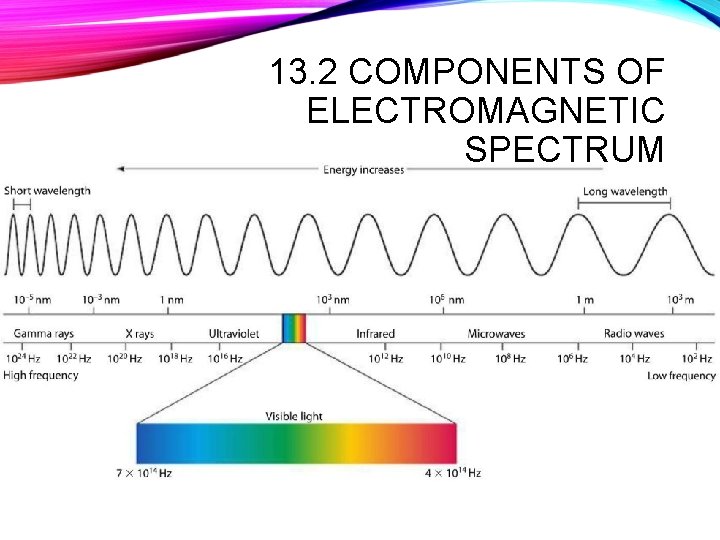
13. 2 COMPONENTS OF ELECTROMAGNETIC SPECTRUM • The electromagnetic spectrum is a continuous range of waves with extremely short wavelengths and high frequencies at one end and extremely long wavelengths and low frequencies at the other end. • The components of the electromagnetic spectrum are classified according to increasing wavelengths or frequencies. The frequencies determine the amount of energy and behaviour of the type of radiation.
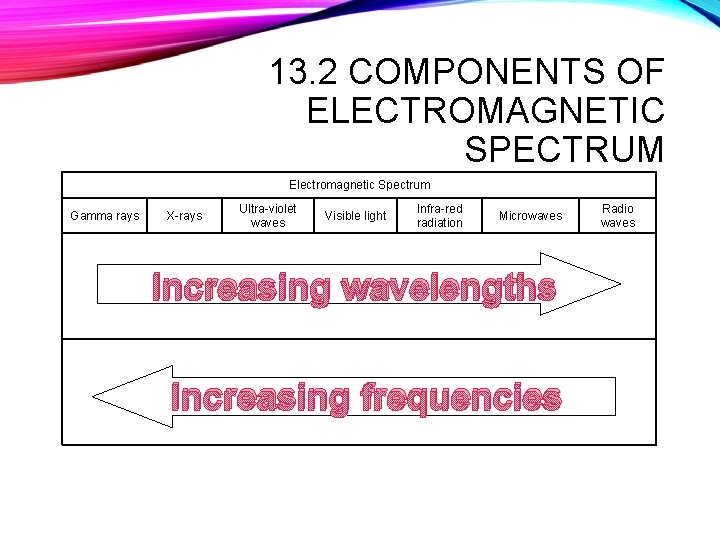
13. 2 COMPONENTS OF ELECTROMAGNETIC SPECTRUM Electromagnetic Spectrum Gamma rays X-rays Ultra-violet waves Visible light Infra-red radiation Microwaves Increasing wavelengths Increasing frequencies Radio waves
13. 2 COMPONENTS OF ELECTROMAGNETIC SPECTRUM How do you remember the order of the components of the electromagnetic spectrum? How about a singing a song to remember the order? (Click Here!)
13. 2 COMPONENTS OF ELECTROMAGNETIC SPECTRUM How do you remember the order of the components of the electromagnetic spectrum? Using Mnemonic
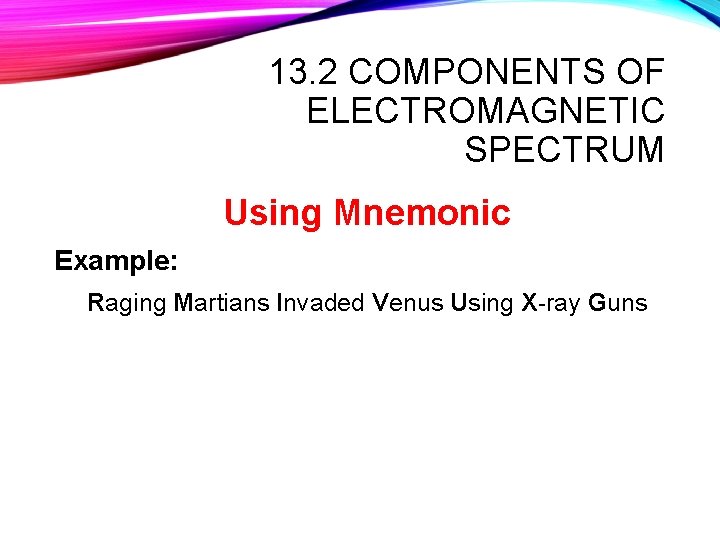
13. 2 COMPONENTS OF ELECTROMAGNETIC SPECTRUM Using Mnemonic Example: Raging Martians Invaded Venus Using X-ray Guns
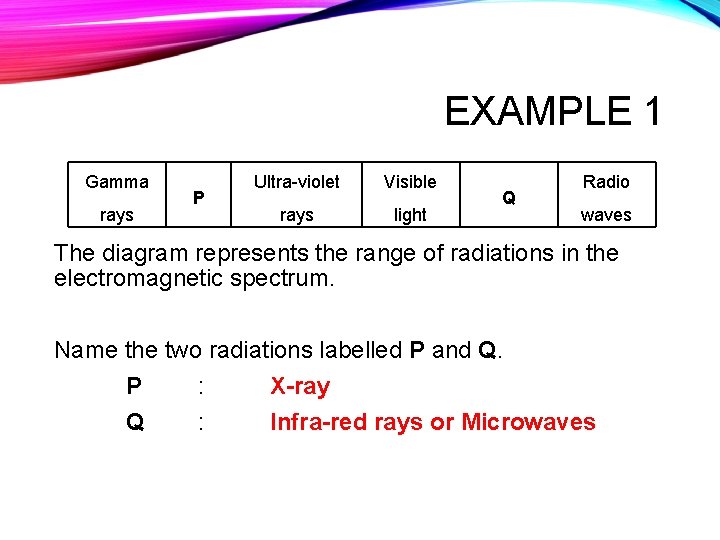
EXAMPLE 1 Gamma rays P Ultra-violet Visible rays light Q Radio waves The diagram represents the range of radiations in the electromagnetic spectrum. Name the two radiations labelled P and Q. P : X-ray Q : Infra-red rays or Microwaves
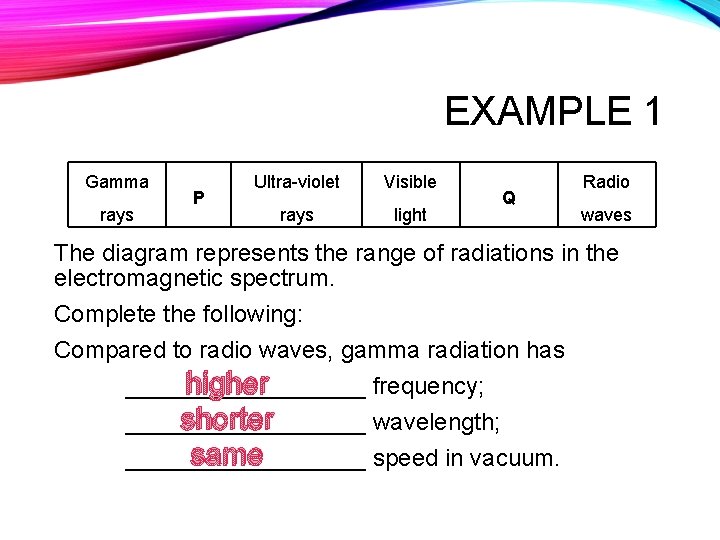
EXAMPLE 1 Gamma rays P Ultra-violet Visible rays light Q Radio waves The diagram represents the range of radiations in the electromagnetic spectrum. Complete the following: Compared to radio waves, gamma radiation has higher _________ frequency; shorter _________ wavelength; same _________ speed in vacuum.
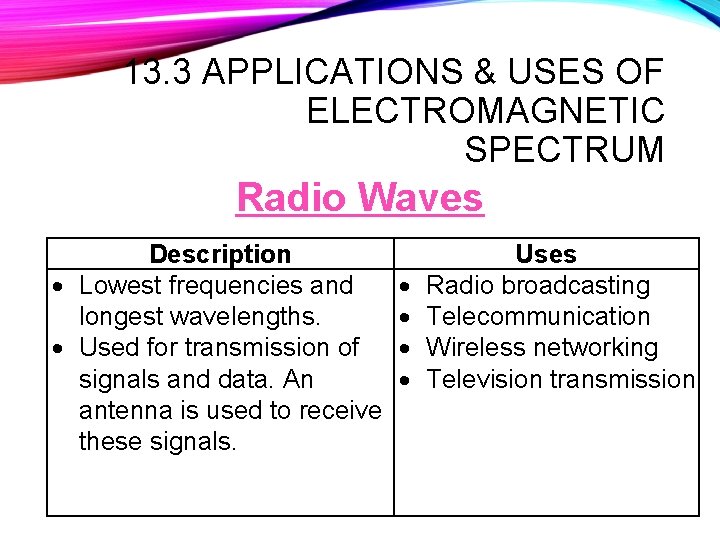
13. 3 APPLICATIONS & USES OF ELECTROMAGNETIC SPECTRUM Radio Waves Description Lowest frequencies and longest wavelengths. Used for transmission of signals and data. An antenna is used to receive these signals. Uses Radio broadcasting Telecommunication Wireless networking Television transmission
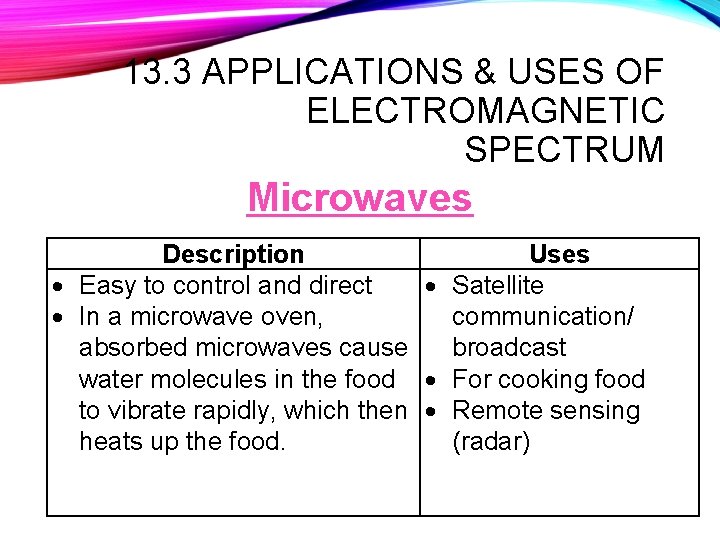
13. 3 APPLICATIONS & USES OF ELECTROMAGNETIC SPECTRUM Microwaves Description Uses Easy to control and direct Satellite In a microwave oven, communication/ absorbed microwaves cause broadcast water molecules in the food For cooking food to vibrate rapidly, which then Remote sensing heats up the food. (radar)
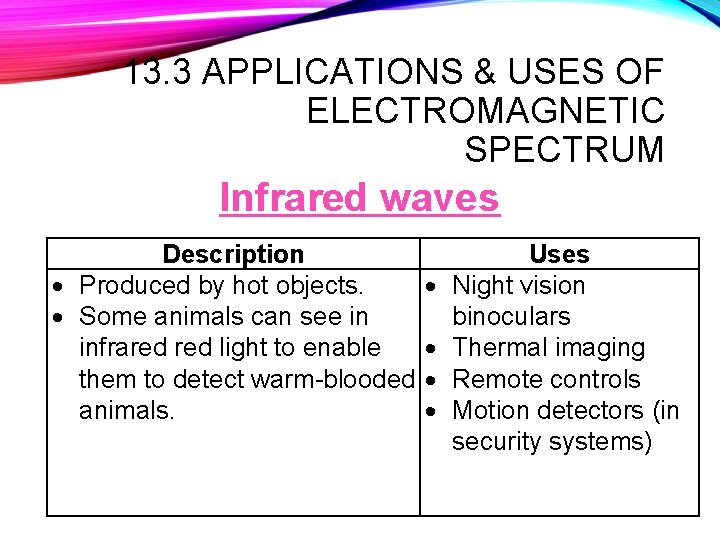
13. 3 APPLICATIONS & USES OF ELECTROMAGNETIC SPECTRUM Infrared waves Description Produced by hot objects. Some animals can see in infrared light to enable them to detect warm-blooded animals. Uses Night vision binoculars Thermal imaging Remote controls Motion detectors (in security systems)
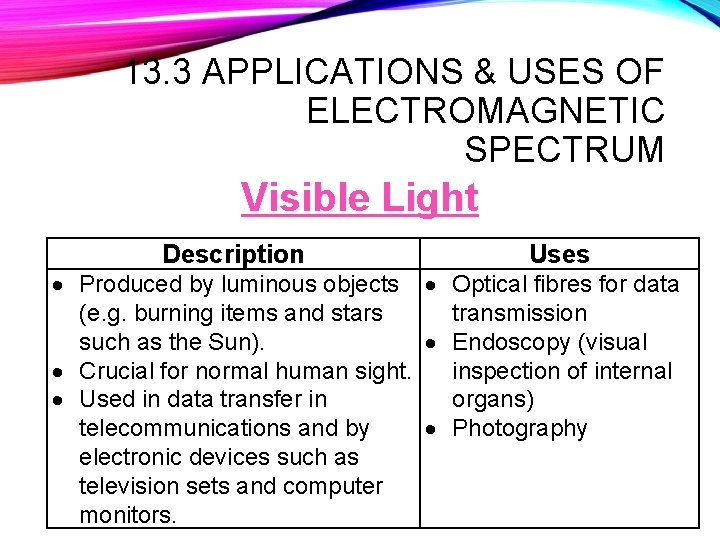
13. 3 APPLICATIONS & USES OF ELECTROMAGNETIC SPECTRUM Visible Light Description Uses Produced by luminous objects Optical fibres for data (e. g. burning items and stars transmission such as the Sun). Endoscopy (visual Crucial for normal human sight. inspection of internal Used in data transfer in organs) telecommunications and by Photography electronic devices such as television sets and computer monitors.
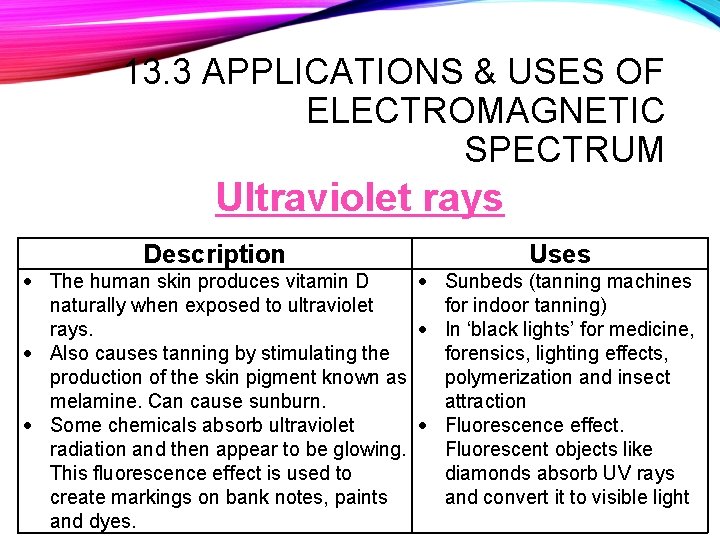
13. 3 APPLICATIONS & USES OF ELECTROMAGNETIC SPECTRUM Ultraviolet rays Description Uses The human skin produces vitamin D Sunbeds (tanning machines naturally when exposed to ultraviolet for indoor tanning) rays. In ‘black lights’ for medicine, Also causes tanning by stimulating the forensics, lighting effects, production of the skin pigment known as polymerization and insect melamine. Can cause sunburn. attraction Some chemicals absorb ultraviolet Fluorescence effect. radiation and then appear to be glowing. Fluorescent objects like This fluorescence effect is used to diamonds absorb UV rays create markings on bank notes, paints and convert it to visible light and dyes.
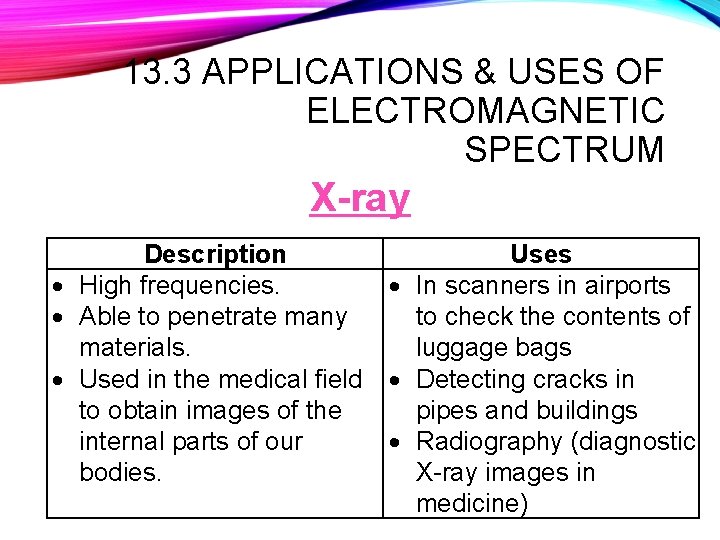
13. 3 APPLICATIONS & USES OF ELECTROMAGNETIC SPECTRUM X-ray Description High frequencies. Able to penetrate many materials. Used in the medical field to obtain images of the internal parts of our bodies. Uses In scanners in airports to check the contents of luggage bags Detecting cracks in pipes and buildings Radiography (diagnostic X-ray images in medicine)
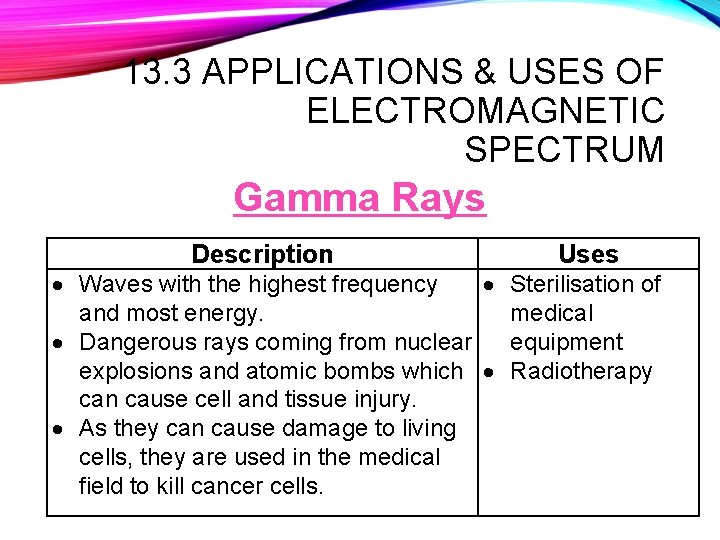
13. 3 APPLICATIONS & USES OF ELECTROMAGNETIC SPECTRUM Gamma Rays Description Uses Waves with the highest frequency Sterilisation of and most energy. medical Dangerous rays coming from nuclear equipment explosions and atomic bombs which Radiotherapy can cause cell and tissue injury. As they can cause damage to living cells, they are used in the medical field to kill cancer cells.
- Slides: 24