
Electromagnetic Radiation principle Applications And Used in Remote
- Slides: 1
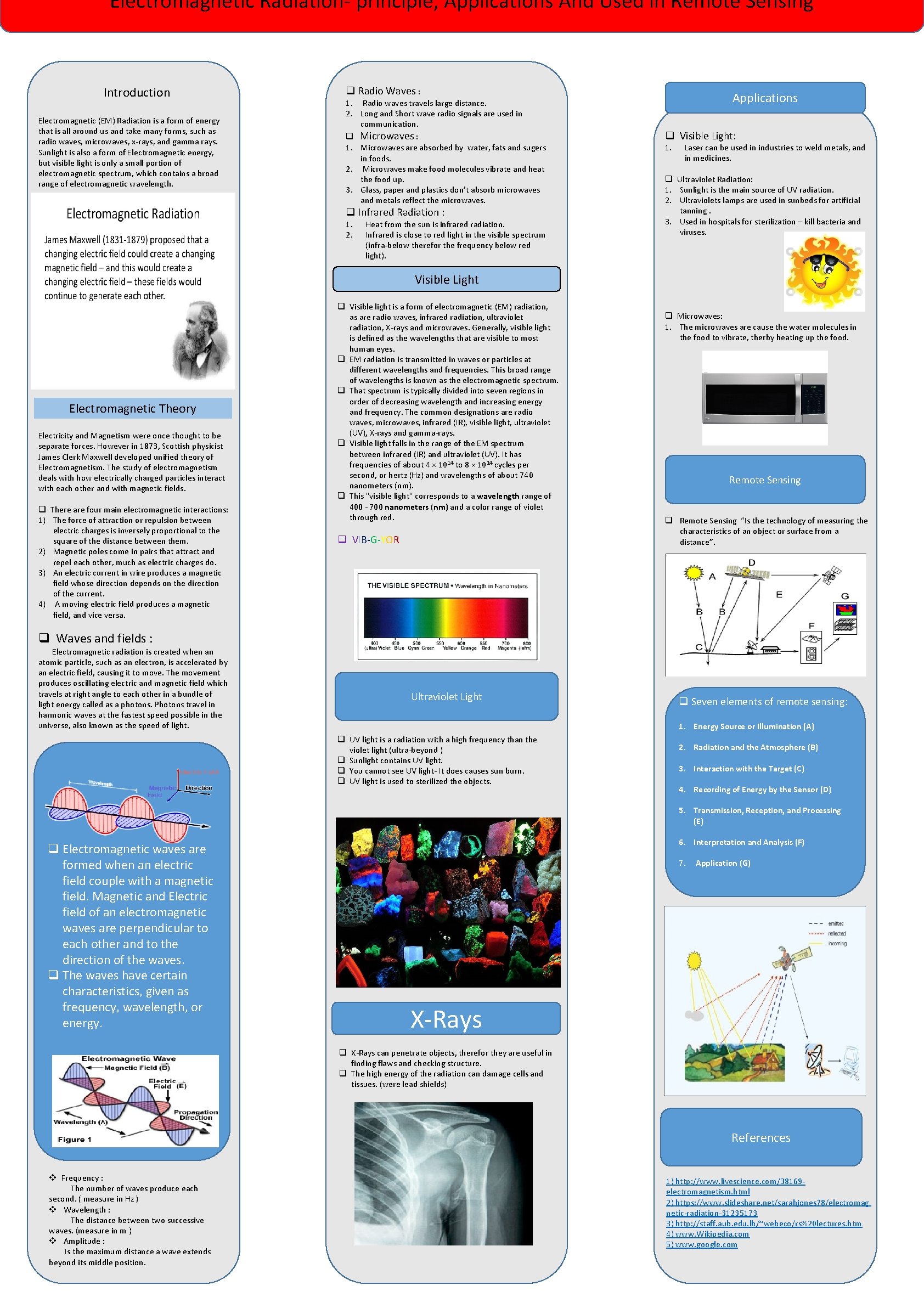
Electromagnetic Radiation- principle, Applications And Used in Remote Sensing Introduction Electromagnetic (EM) Radiation is a form of energy that is all around us and take many forms, such as radio waves, microwaves, x-rays, and gamma rays. Sunlight is also a form of Electromagnetic energy, but visible light is only a small portion of electromagnetic spectrum, which contains a broad range of electromagnetic wavelength. q Radio Waves : 1. Radio waves travels large distance. 2. Long and Short wave radio signals are used in communication. q Microwaves : 1. Microwaves are absorbed by water, fats and sugers in foods. 2. Microwaves make food molecules vibrate and heat the food up. 3. Glass, paper and plastics don’t absorb microwaves and metals reflect the microwaves. q Infrared Radiation : 1. 2. Heat from the sun is infrared radiation. Infrared is close to red light in the visible spectrum (infra-below therefor the frequency below red light). Applications q Visible Light: 1. Laser can be used in industries to weld metals, and in medicines. q Ultraviolet Radiation: 1. Sunlight is the main source of UV radiation. 2. Ultraviolets lamps are used in sunbeds for artificial tanning. 3. Used in hospitals for sterilization – kill bacteria and viruses. Visible Light Electromagnetic Theory Electricity and Magnetism were once thought to be separate forces. However in 1873, Scottish physicist James Clerk Maxwell developed unified theory of Electromagnetism. The study of electromagnetism deals with how electrically charged particles interact with each other and with magnetic fields. q There are four main electromagnetic interactions: 1) The force of attraction or repulsion between electric charges is inversely proportional to the square of the distance between them. 2) Magnetic poles come in pairs that attract and repel each other, much as electric charges do. 3) An electric current in wire produces a magnetic field whose direction depends on the direction of the current. 4) A moving electric field produces a magnetic field, and vice versa. q Visible light is a form of electromagnetic (EM) radiation, as are radio waves, infrared radiation, ultraviolet radiation, X-rays and microwaves. Generally, visible light is defined as the wavelengths that are visible to most human eyes. q EM radiation is transmitted in waves or particles at different wavelengths and frequencies. This broad range of wavelengths is known as the electromagnetic spectrum. q That spectrum is typically divided into seven regions in order of decreasing wavelength and increasing energy and frequency. The common designations are radio waves, microwaves, infrared (IR), visible light, ultraviolet (UV), X-rays and gamma-rays. q Visible light falls in the range of the EM spectrum between infrared (IR) and ultraviolet (UV). It has frequencies of about 4 × 10¹⁴ to 8 × 10¹⁴ cycles per second, or hertz (Hz) and wavelengths of about 740 nanometers (nm). q This "visible light" corresponds to a wavelength range of 400 - 700 nanometers (nm) and a color range of violet through red. q VIB-G-YOR q Microwaves: 1. The microwaves are cause the water molecules in the food to vibrate, therby heating up the food. Remote Sensing q Remote Sensing “Is the technology of measuring the characteristics of an object or surface from a distance”. q Waves and fields : Electromagnetic radiation is created when an atomic particle, such as an electron, is accelerated by an electric field, causing it to move. The movement produces oscillating electric and magnetic field which travels at right angle to each other in a bundle of light energy called as a photons. Photons travel in harmonic waves at the fastest speed possible in the universe, also known as the speed of light. Ultraviolet Light q Seven elements of remote sensing: 1. Energy Source or Illumination (A) q UV light is a radiation with a high frequency than the violet light (ultra-beyond ) q Sunlight contains UV light. q You cannot see UV light- It does causes sun burn. q UV light is used to sterilized the objects. 2. Radiation and the Atmosphere (B) 3. Interaction with the Target (C) 4. Recording of Energy by the Sensor (D) 5. Transmission, Reception, and Processing (E) q Electromagnetic waves are formed when an electric field couple with a magnetic field. Magnetic and Electric field of an electromagnetic waves are perpendicular to each other and to the direction of the waves. q The waves have certain characteristics, given as frequency, wavelength, or energy. 6. Interpretation and Analysis (F) 7. Application (G) X-Rays q X-Rays can penetrate objects, therefor they are useful in finding flaws and checking structure. q The high energy of the radiation can damage cells and tissues. (were lead shields) References v Frequency : The number of waves produce each second. ( measure in Hz ) v Wavelength : The distance between two successive waves. (measure in m ) v Amplitude : Is the maximum distance a wave extends beyond its middle position. 1) http: //www. livescience. com/38169 electromagnetism. html 2) https: //www. slideshare. net/sarahjones 78/electromag netic-radiation-31235173 3) http: //staff. aub. edu. lb/~webeco/rs%20 lectures. htm 4) www. Wikipedia. com 5) www. google. com