
Electromagnetic Fields EMF ECEg 2092 Debre Berhan University
Electromagnetic Fields (EMF) (ECEg 2092) Debre Berhan University Department of Electrical & Computer Engineering By Nahom A. March, 2016
1. Review of vectors 1. 1 Scalar and Vector Fields I. Introduction: § Electromagnetics (EM) is a branch of physics or electrical engineering in which electric and magnetic phenomena are studied. § EM devices include transformers, electric relays, radio/TV, telephone, electric motors, transmission lines, waveguides, antennas, optical fibers, radars, and lasers. § EM theory is essentially a study of some particular fields. § A field is a function that specifies a particular quantity everywhere in a region. § If the quantity is scalar (or vector), the field is said to be a scalar (or vector) field.
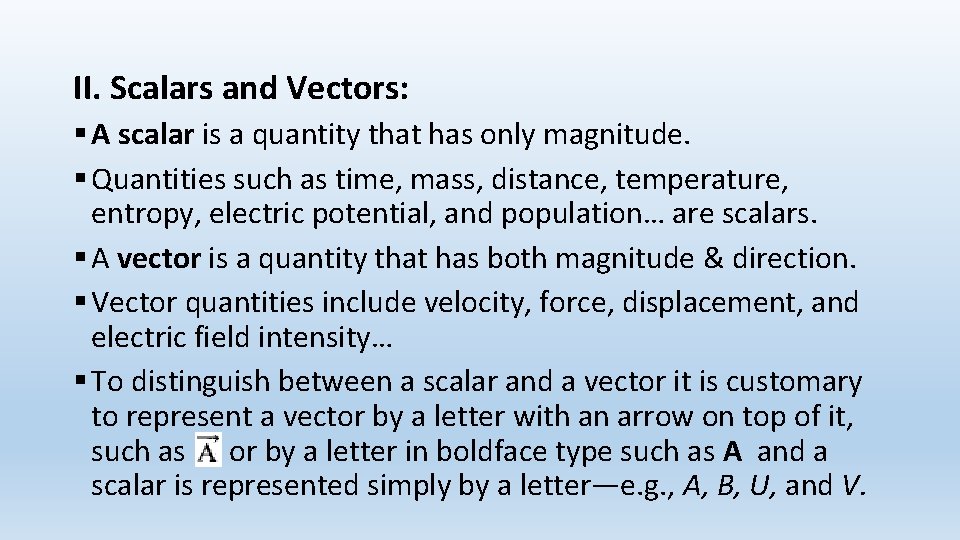
II. Scalars and Vectors: § A scalar is a quantity that has only magnitude. § Quantities such as time, mass, distance, temperature, entropy, electric potential, and population… are scalars. § A vector is a quantity that has both magnitude & direction. § Vector quantities include velocity, force, displacement, and electric field intensity… § To distinguish between a scalar and a vector it is customary to represent a vector by a letter with an arrow on top of it, such as or by a letter in boldface type such as A and a scalar is represented simply by a letter—e. g. , A, B, U, and V.
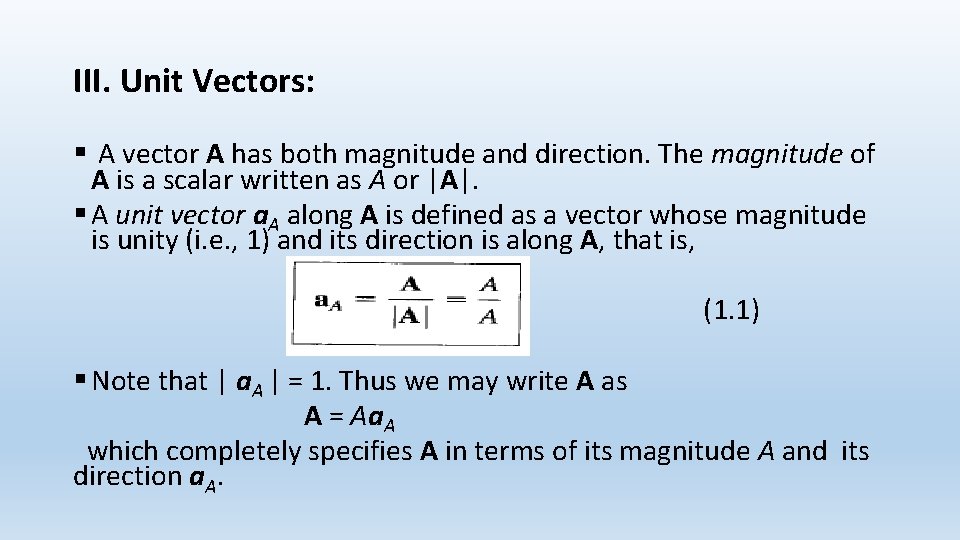
III. Unit Vectors: § A vector A has both magnitude and direction. The magnitude of A is a scalar written as A or |A|. § A unit vector a. A along A is defined as a vector whose magnitude is unity (i. e. , 1) and its direction is along A, that is, (1. 1) § Note that | a. A | = 1. Thus we may write A as A = Aa. A which completely specifies A in terms of its magnitude A and its direction a. A.
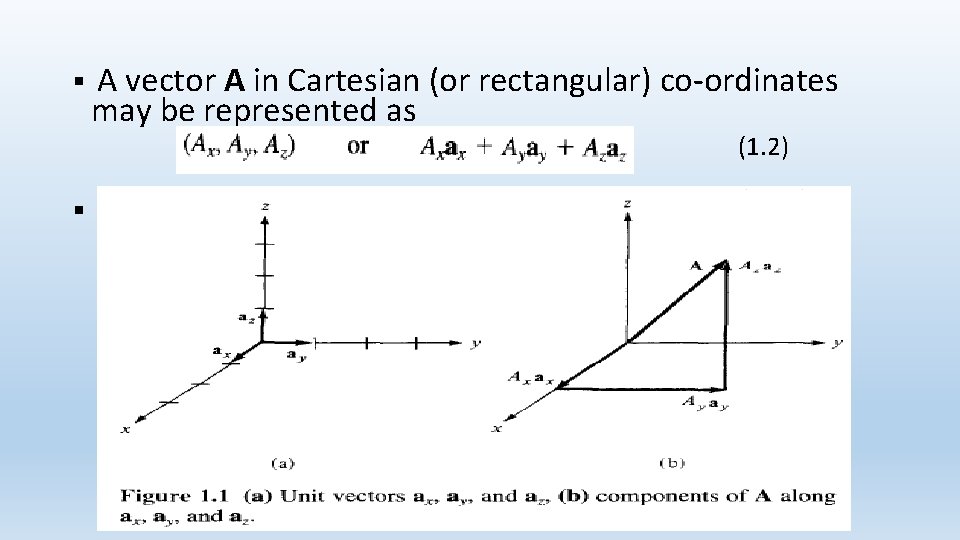
§ A vector A in Cartesian (or rectangular) co-ordinates may be represented as (1. 2) §
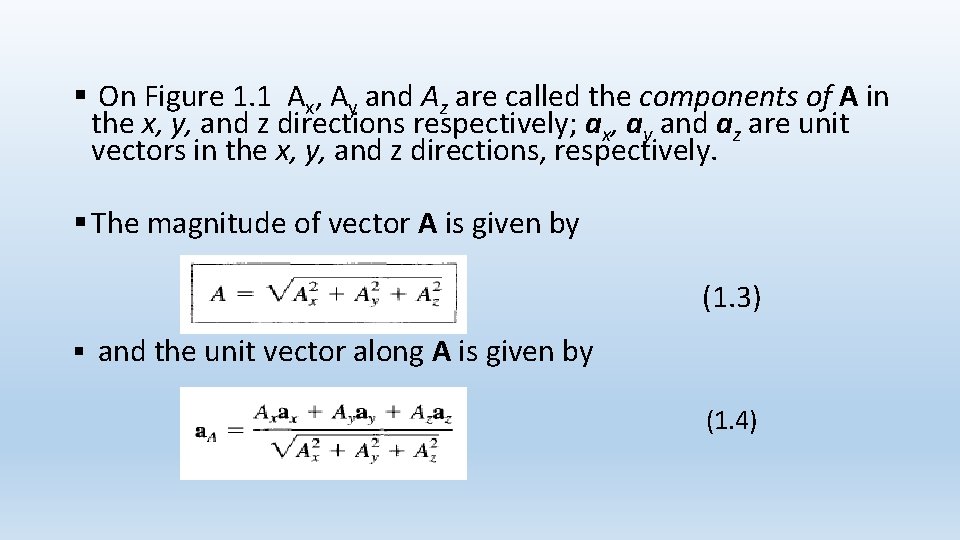
§ On Figure 1. 1 Ax, Ay and Az are called the components of A in the x, y, and z directions respectively; ax, ay and az are unit vectors in the x, y, and z directions, respectively. § The magnitude of vector A is given by (1. 3) § and the unit vector along A is given by (1. 4)
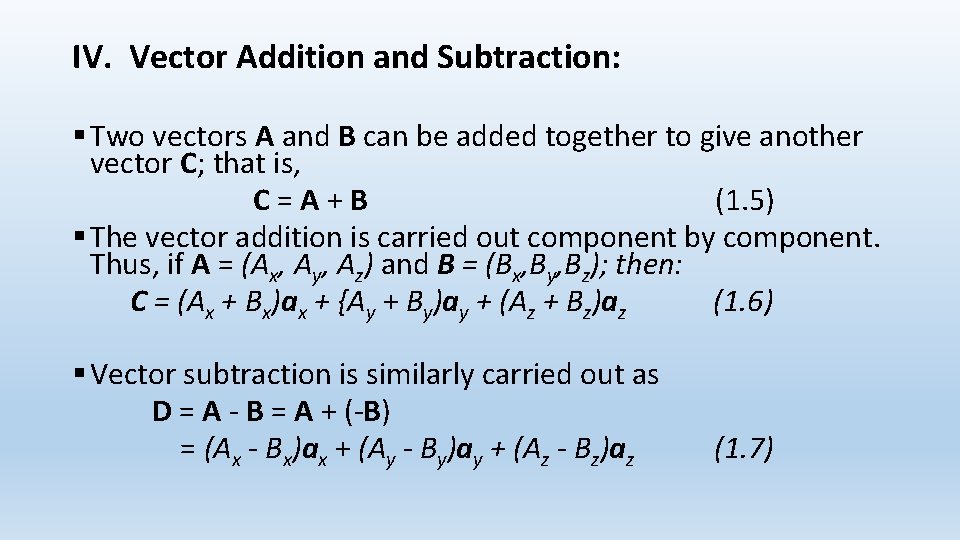
IV. Vector Addition and Subtraction: § Two vectors A and B can be added together to give another vector C; that is, C=A+B (1. 5) § The vector addition is carried out component by component. Thus, if A = (Ax, Ay, Az) and B = (Bx, By, Bz); then: C = (Ax + Bx)ax + {Ay + By)ay + (Az + Bz)az (1. 6) § Vector subtraction is similarly carried out as D = A - B = A + (-B) = (Ax - Bx)ax + (Ay - By)ay + (Az - Bz)az (1. 7)
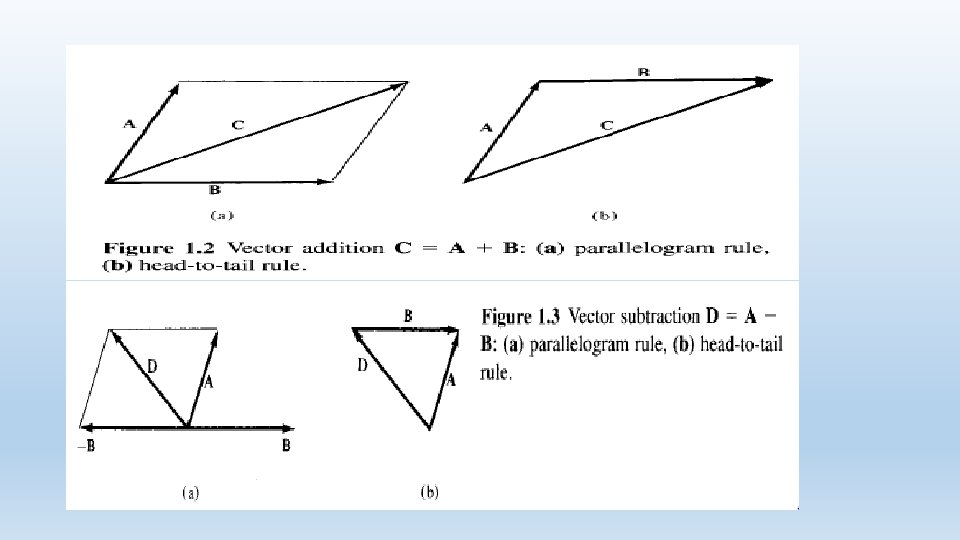
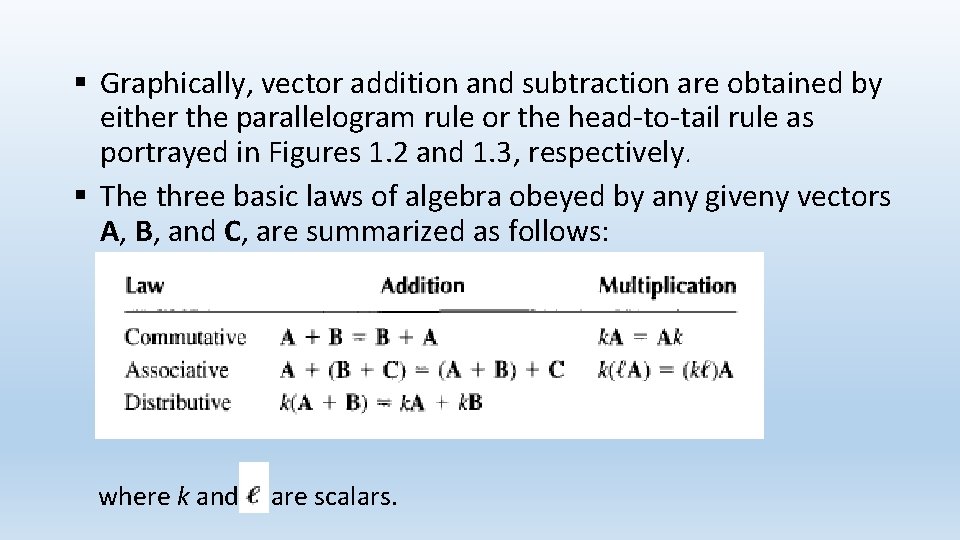
§ Graphically, vector addition and subtraction are obtained by either the parallelogram rule or the head-to-tail rule as portrayed in Figures 1. 2 and 1. 3, respectively. § The three basic laws of algebra obeyed by any giveny vectors A, B, and C, are summarized as follows: where k and are scalars.
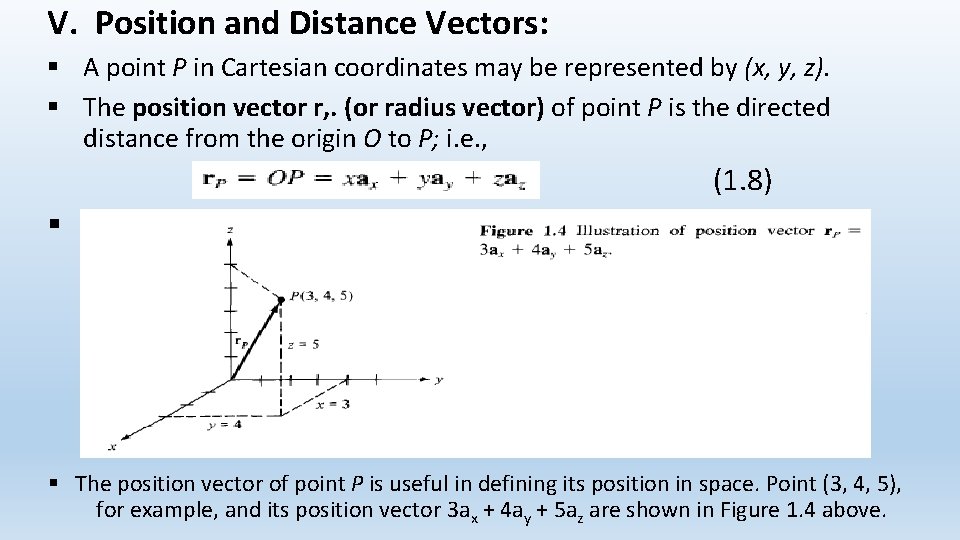
V. Position and Distance Vectors: § A point P in Cartesian coordinates may be represented by (x, y, z). § The position vector r, . (or radius vector) of point P is the directed distance from the origin O to P; i. e. , (1. 8) § § The position vector of point P is useful in defining its position in space. Point (3, 4, 5), for example, and its position vector 3 ax + 4 ay + 5 az are shown in Figure 1. 4 above.
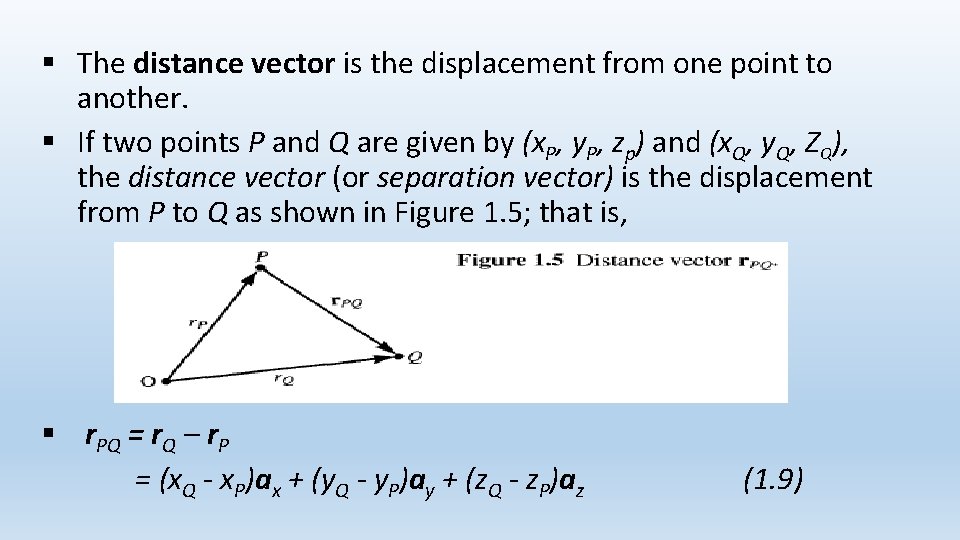
§ The distance vector is the displacement from one point to another. § If two points P and Q are given by (x. P, y. P, zp) and (x. Q, y. Q, ZQ), the distance vector (or separation vector) is the displacement from P to Q as shown in Figure 1. 5; that is, § r. PQ = r. Q – r. P = (x. Q - x. P)ax + (y. Q - y. P)ay + (z. Q - z. P)az (1. 9)
VI. Vector Multiplication: § There are two types of vector multiplication: 1. Scalar (or dot) product: A • B 2. Vector (or cross) product: A X B § Multiplication of three vectors A, B, and C can result in either: 3. Scalar triple product: A • (B X C) 4. Vector triple product: A X (B X C)
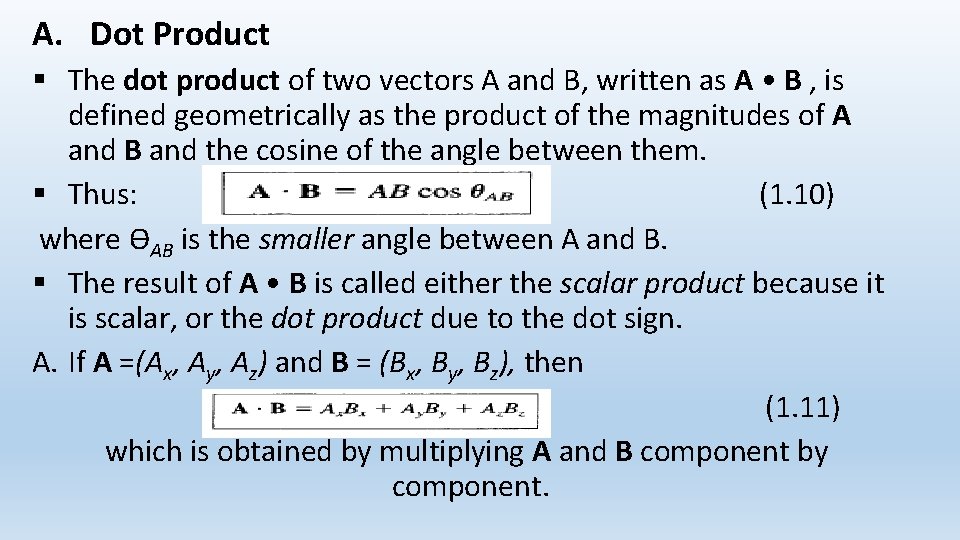
A. Dot Product § The dot product of two vectors A and B, written as A • B , is defined geometrically as the product of the magnitudes of A and B and the cosine of the angle between them. § Thus: (1. 10) where ƟAB is the smaller angle between A and B. § The result of A • B is called either the scalar product because it is scalar, or the dot product due to the dot sign. A. If A =(Ax, Ay, Az) and B = (Bx, By, Bz), then (1. 11) which is obtained by multiplying A and B component by component.
§ Two vectors A and B are said to be orthogonal (or perpendicular) with each other if A • B = 0. § Note that dot product obeys the following: (i) Commutative law: A • B = B • A (1. 12) (ii) Distributive law: A • (B + C) = A • B + A • C (1. 13) A • A = |A|2 = A 2 (1. 14) (iii) Also note that ax • ay = ay • az = az • ax = 0 (1. 15 a) ax • ax = ay • ay = az • az = 1 (1. 15 b)
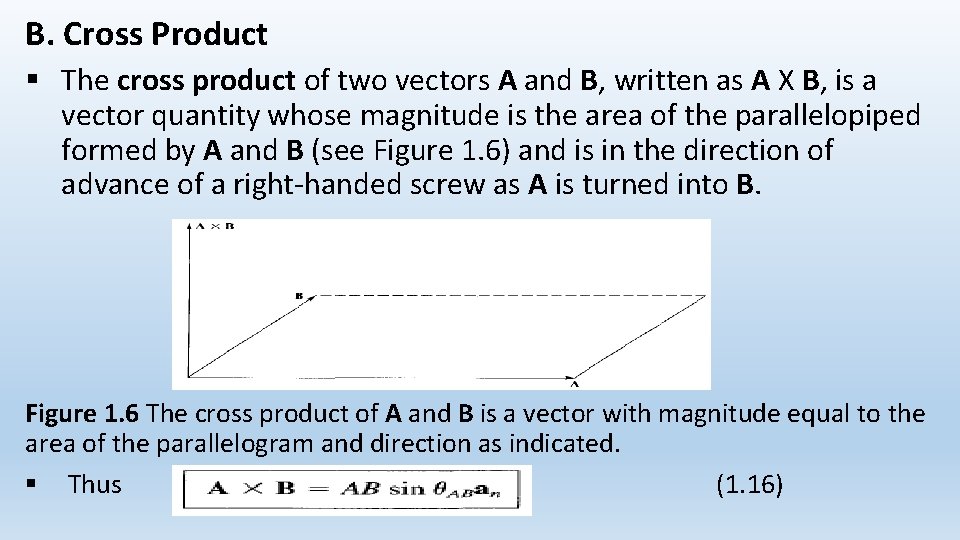
B. Cross Product § The cross product of two vectors A and B, written as A X B, is a vector quantity whose magnitude is the area of the parallelopiped formed by A and B (see Figure 1. 6) and is in the direction of advance of a right-handed screw as A is turned into B. Figure 1. 6 The cross product of A and B is a vector with magnitude equal to the area of the parallelogram and direction as indicated. § Thus (1. 16)
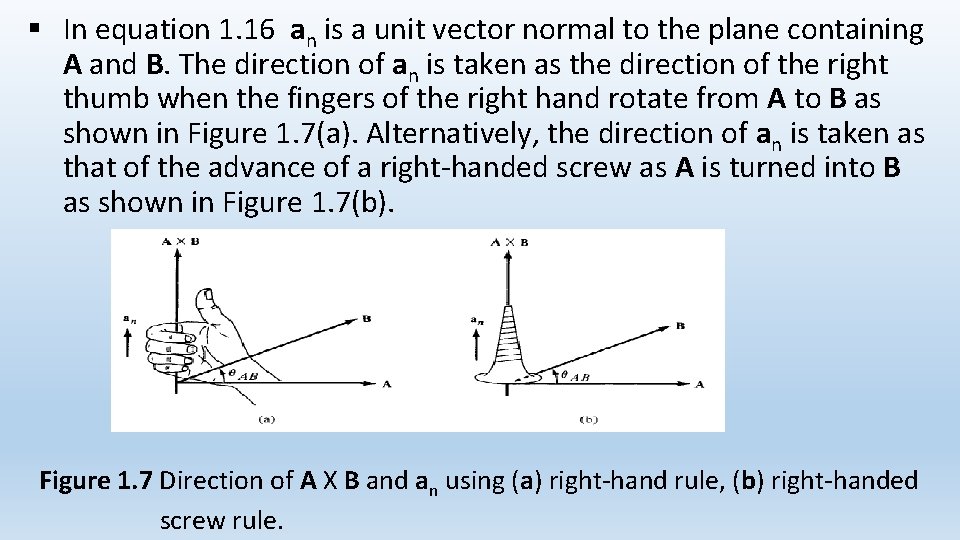
§ In equation 1. 16 an is a unit vector normal to the plane containing A and B. The direction of an is taken as the direction of the right thumb when the fingers of the right hand rotate from A to B as shown in Figure 1. 7(a). Alternatively, the direction of an is taken as that of the advance of a right-handed screw as A is turned into B as shown in Figure 1. 7(b). Figure 1. 7 Direction of A X B and an using (a) right-hand rule, (b) right-handed screw rule.
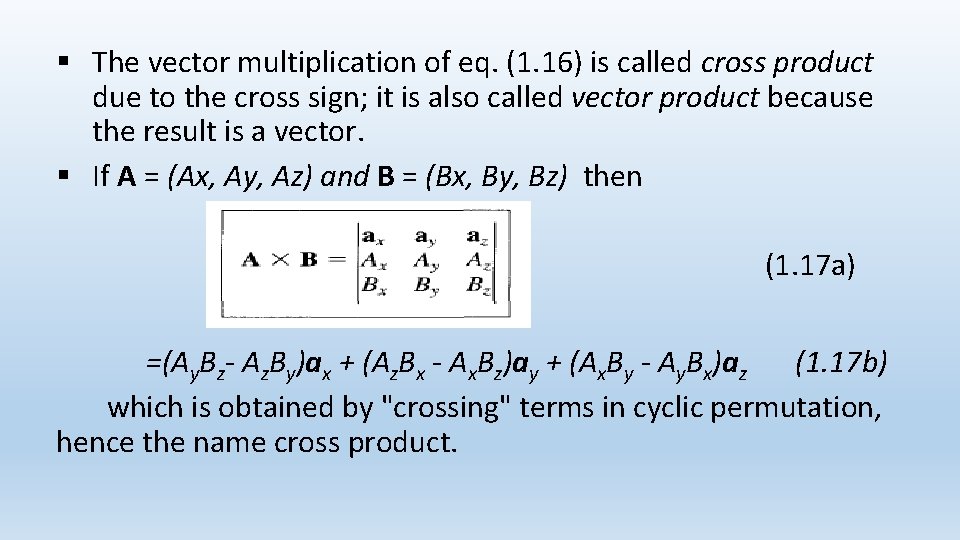
§ The vector multiplication of eq. (1. 16) is called cross product due to the cross sign; it is also called vector product because the result is a vector. § If A = (Ax, Ay, Az) and B = (Bx, By, Bz) then (1. 17 a) =(Ay. Bz- Az. By)ax + (Az. Bx - Ax. Bz)ay + (Ax. By - Ay. Bx)az (1. 17 b) which is obtained by "crossing" terms in cyclic permutation, hence the name cross product.
§ Note that the cross product has the following basic properties: (i) It is not commutative: AXB≠BXA (1. 18) It is anti-commutative: AXB=-BXA (1. 19) (i)(ii) It is not associative: (ii) A X (B X C) ≠ (A X B) X C (1. 20) • It is distributive: A X ( B + C) = A X B + A X C (i)(iv) A X A = 0 ; Also note that : (ii) ax X ay = az (iii) ay X az = a x (1. 21) (iv) az X ax = ay
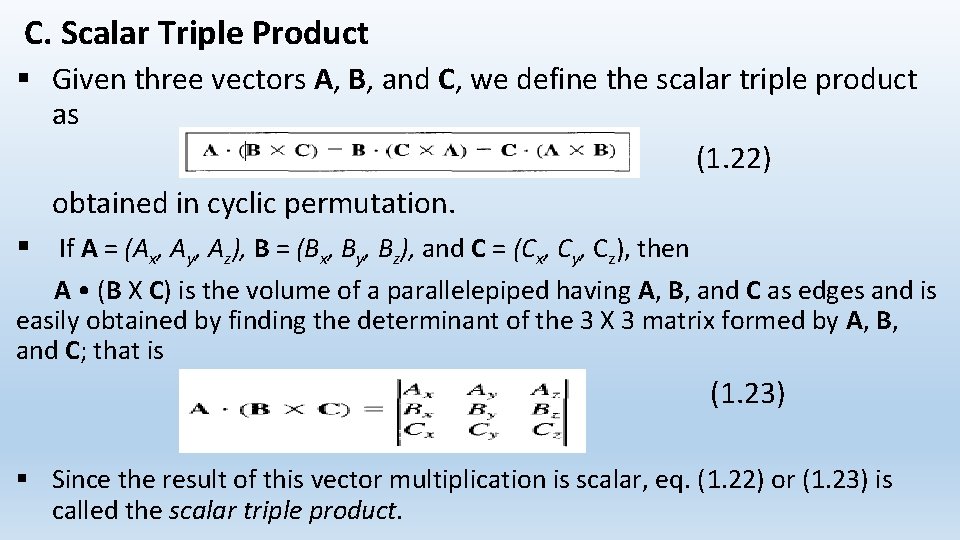
C. Scalar Triple Product § Given three vectors A, B, and C, we define the scalar triple product as (1. 22) obtained in cyclic permutation. § If A = (Ax, Ay, Az), B = (Bx, By, Bz), and C = (Cx, Cy, Cz), then A • (B X C) is the volume of a parallelepiped having A, B, and C as edges and is easily obtained by finding the determinant of the 3 X 3 matrix formed by A, B, and C; that is (1. 23) § Since the result of this vector multiplication is scalar, eq. (1. 22) or (1. 23) is called the scalar triple product.
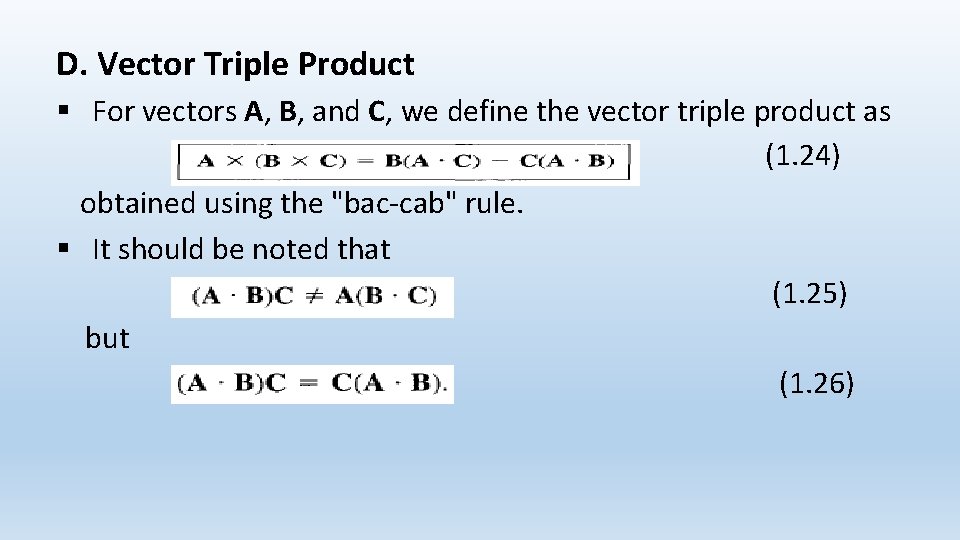
D. Vector Triple Product § For vectors A, B, and C, we define the vector triple product as (1. 24) obtained using the "bac-cab" rule. § It should be noted that (1. 25) but (1. 26)
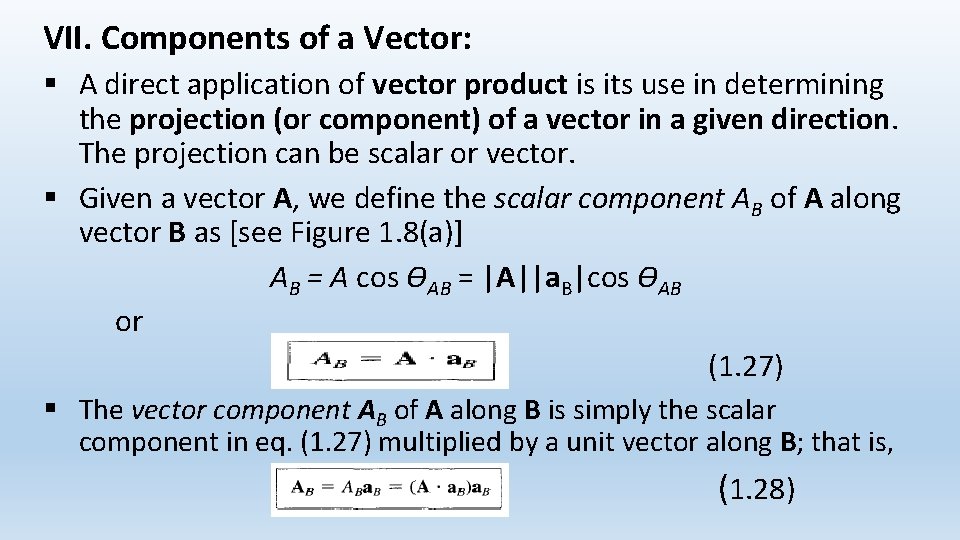
VII. Components of a Vector: § A direct application of vector product is its use in determining the projection (or component) of a vector in a given direction. The projection can be scalar or vector. § Given a vector A, we define the scalar component AB of A along vector B as [see Figure 1. 8(a)] AB = A cos ƟAB = |A||a. B|cos ƟAB or (1. 27) § The vector component AB of A along B is simply the scalar component in eq. (1. 27) multiplied by a unit vector along B; that is, (1. 28)
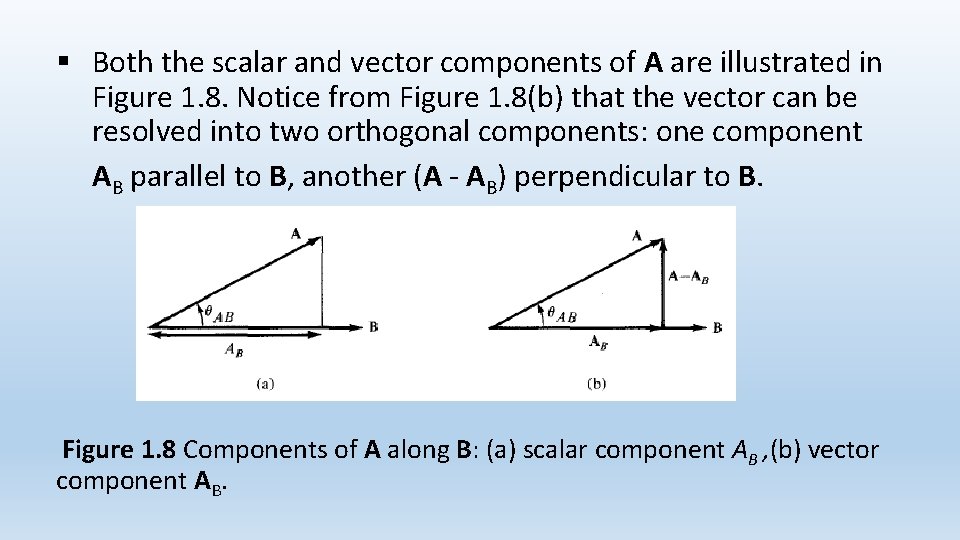
§ Both the scalar and vector components of A are illustrated in Figure 1. 8. Notice from Figure 1. 8(b) that the vector can be resolved into two orthogonal components: one component AB parallel to B, another (A - AB) perpendicular to B. Figure 1. 8 Components of A along B: (a) scalar component AB , (b) vector component AB.
I. § § § 1. 2 Coordinate Systems &Transformation Introduction A point or vector can be represented in any curvilinear coordinate system, which may be orthogonal or nonorthogonal. An orthogonal system is one in which the coordinates are mutually perpendicular. (preferable to non orthogonal b/c easy to work with) Examples of orthogonal coordinate systems include the Cartesian (or rectangular), the circular cylindrical, the spherical, the elliptic cylindrical, the parabolic cylindrical, the conical, the prolate spheroidal, the oblate spheroidal, and the ellipsoidal. A hard problem in one coordinate system may turn out to be easy in another system. (that is why we need different coordinate systems) Note that the concepts covered section 1. 1 and demonstrated in Cartesian coordinates are equally applicable to other systems of coordinates. (like finding dot and cross product of vectors)
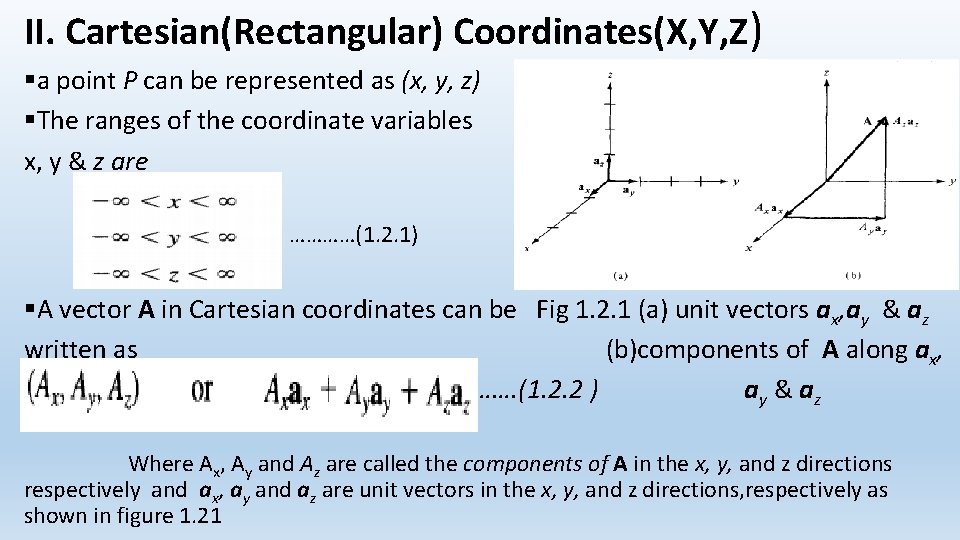
II. Cartesian(Rectangular) Coordinates(X, Y, Z) §a point P can be represented as (x, y, z) §The ranges of the coordinate variables x, y & z are …………(1. 2. 1) §A vector A in Cartesian coordinates can be Fig 1. 2. 1 (a) unit vectors ax, ay & az written as (b)components of A along ax, ……. (1. 2. 2 ) ay & az Where Ax, Ay and Az are called the components of A in the x, y, and z directions respectively and ax, ay and az are unit vectors in the x, y, and z directions, respectively as shown in figure 1. 21
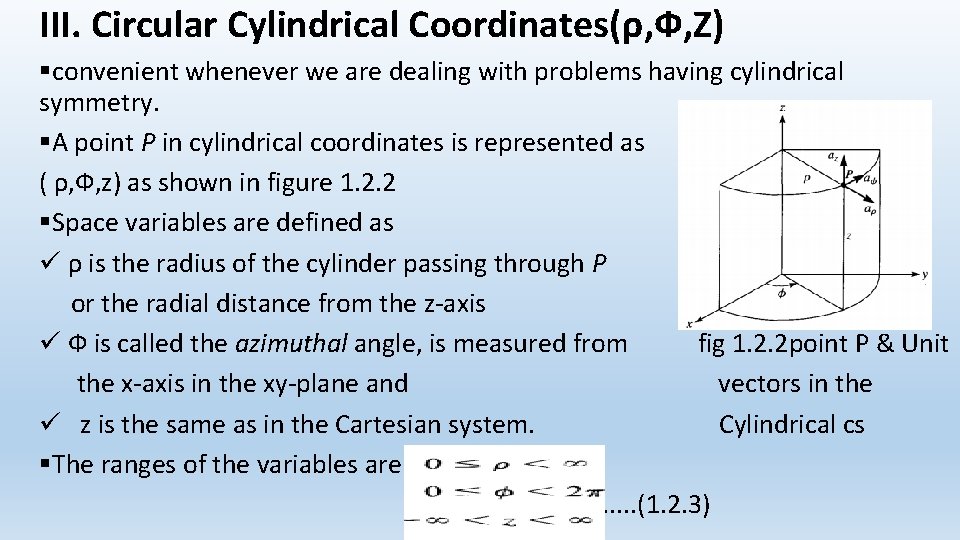
III. Circular Cylindrical Coordinates(ρ, Ф, Z) §convenient whenever we are dealing with problems having cylindrical symmetry. §A point P in cylindrical coordinates is represented as ( ρ, Ф, z) as shown in figure 1. 2. 2 §Space variables are defined as ü ρ is the radius of the cylinder passing through P or the radial distance from the z-axis ü Ф is called the azimuthal angle, is measured from fig 1. 2. 2 point P & Unit the x-axis in the xy-plane and vectors in the ü z is the same as in the Cartesian system. Cylindrical cs §The ranges of the variables are. . . (1. 2. 3)
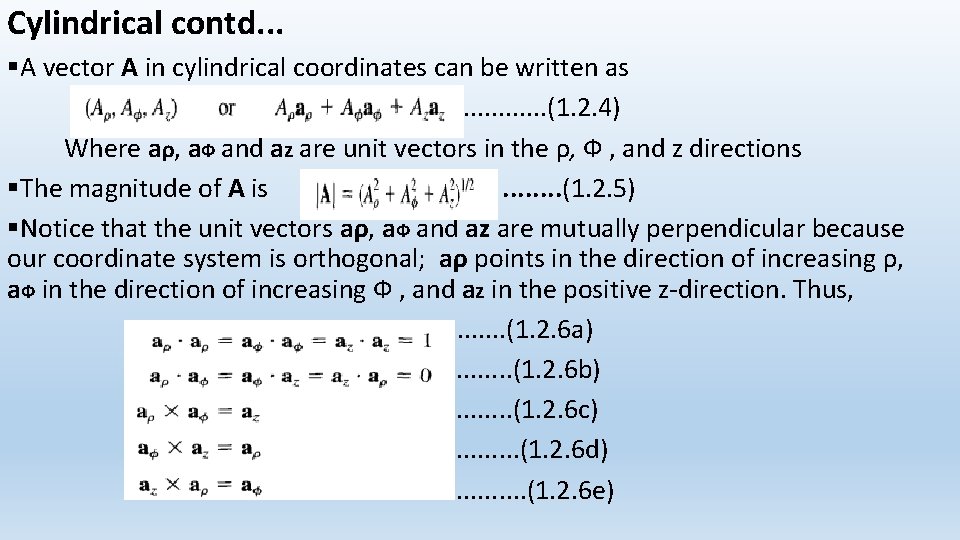
Cylindrical contd. . . §A vector A in cylindrical coordinates can be written as. . . (1. 2. 4) Where aρ, a. Ф and az are unit vectors in the ρ, Ф , and z directions §The magnitude of A is. . . . (1. 2. 5) §Notice that the unit vectors aρ, a. Ф and az are mutually perpendicular because our coordinate system is orthogonal; aρ points in the direction of increasing ρ, a. Ф in the direction of increasing Ф , and az in the positive z-direction. Thus, . . . . (1. 2. 6 a). . . . (1. 2. 6 b). . . . (1. 2. 6 c). . (1. 2. 6 d). . (1. 2. 6 e)
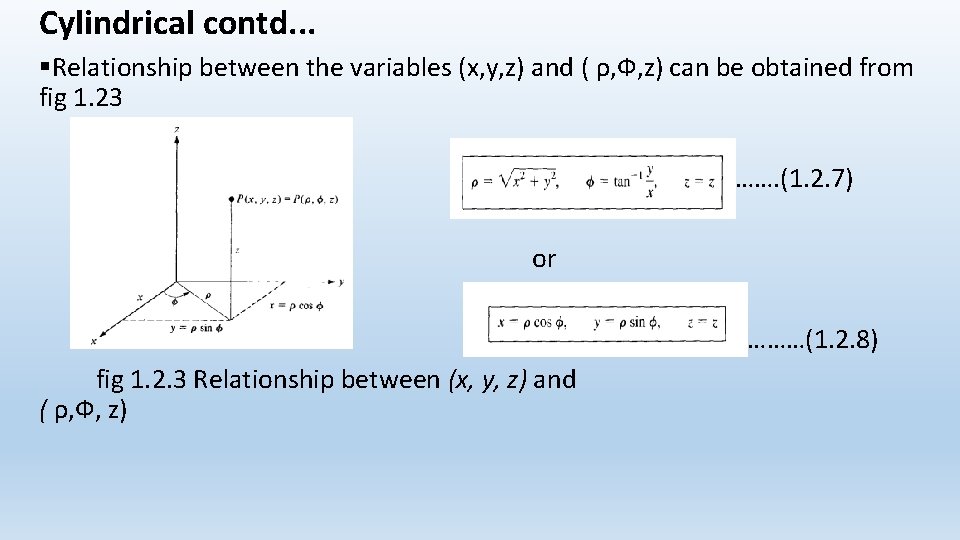
Cylindrical contd. . . §Relationship between the variables (x, y, z) and ( ρ, Ф, z) can be obtained from fig 1. 23 ……. (1. 2. 7) or ………(1. 2. 8) fig 1. 2. 3 Relationship between (x, y, z) and ( ρ, Ф, z)
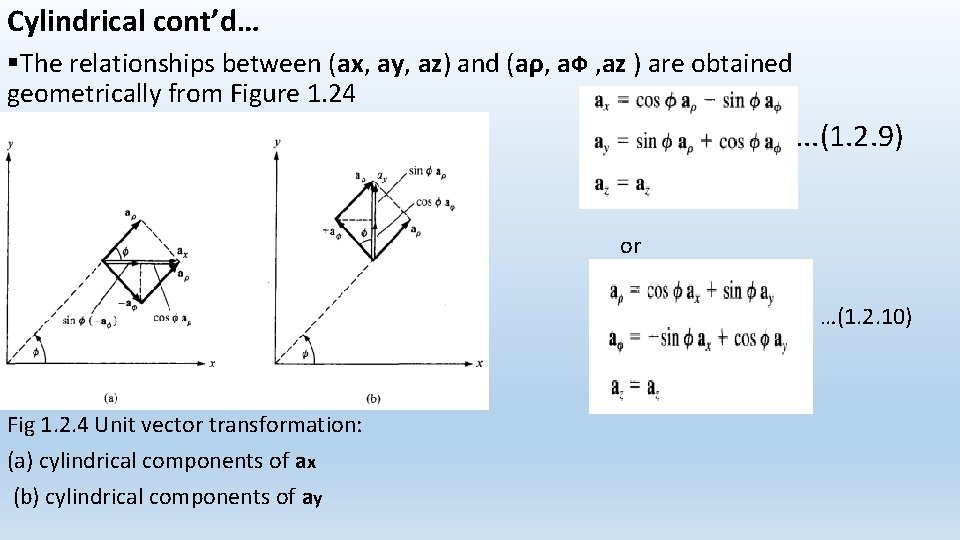
Cylindrical cont’d… §The relationships between (ax, ay, az) and (aρ, a. Ф , az ) are obtained geometrically from Figure 1. 24 . . . (1. 2. 9) or …(1. 2. 10) Fig 1. 2. 4 Unit vector transformation: (a) cylindrical components of ax (b) cylindrical components of ay
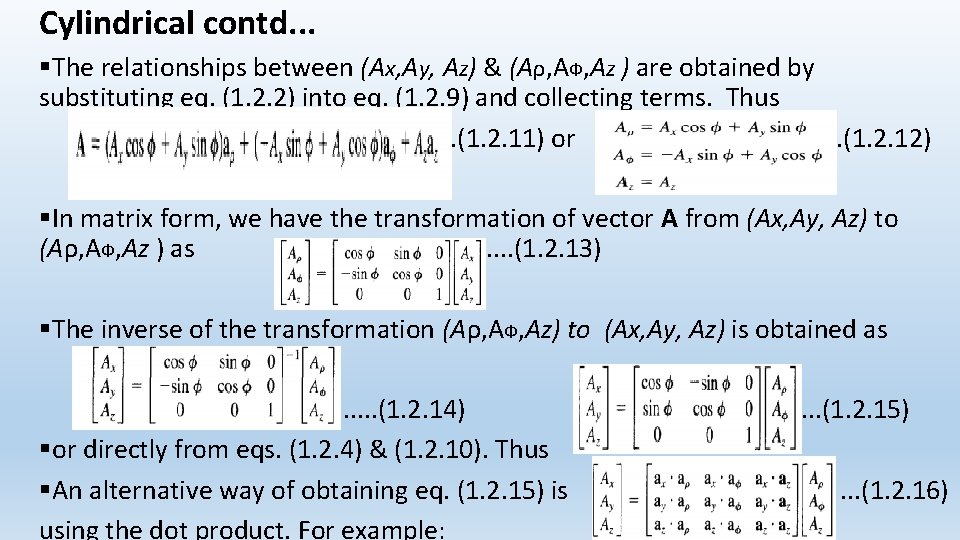
Cylindrical contd. . . §The relationships between (Ax, Ay, Az) & (Aρ, AФ, Az ) are obtained by substituting eq. (1. 2. 2) into eq. (1. 2. 9) and collecting terms. Thus. (1. 2. 11) or. . . (1. 2. 12) §In matrix form, we have the transformation of vector A from (Ax, Ay, Az) to (Aρ, AФ, Az ) as. . (1. 2. 13) §The inverse of the transformation (Aρ, AФ, Az) to (Ax, Ay, Az) is obtained as. . . (1. 2. 14) §or directly from eqs. (1. 2. 4) & (1. 2. 10). Thus §An alternative way of obtaining eq. (1. 2. 15) is using the dot product. For example: . . . (1. 2. 15). . . (1. 2. 16)
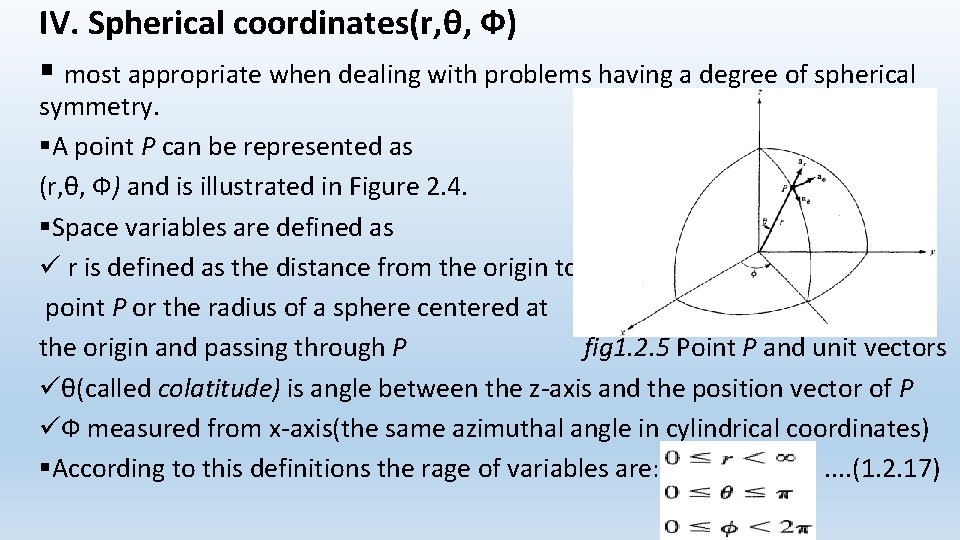
IV. Spherical coordinates(r, θ, Ф) § most appropriate when dealing with problems having a degree of spherical symmetry. §A point P can be represented as (r, θ, Ф) and is illustrated in Figure 2. 4. §Space variables are defined as ü r is defined as the distance from the origin to point P or the radius of a sphere centered at the origin and passing through P fig 1. 2. 5 Point P and unit vectors üθ(called colatitude) is angle between the z-axis and the position vector of P üФ measured from x-axis(the same azimuthal angle in cylindrical coordinates) §According to this definitions the rage of variables are: . . (1. 2. 17)
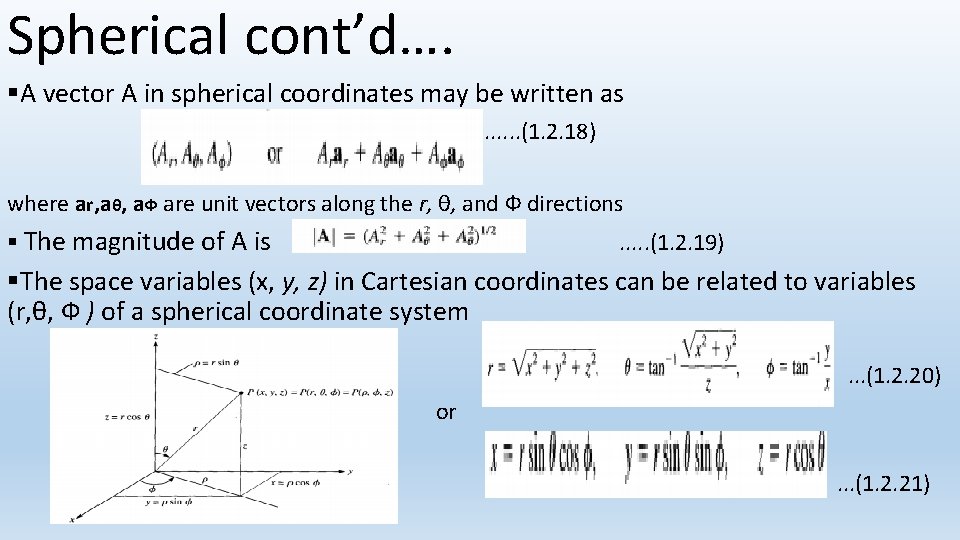
Spherical cont’d…. §A vector A in spherical coordinates may be written as. . . (1. 2. 18) where ar, aθ, a. Ф are unit vectors along the r, θ, and Ф directions § The magnitude of A is . . . (1. 2. 19) §The space variables (x, y, z) in Cartesian coordinates can be related to variables (r, θ, Ф ) of a spherical coordinate system. . . (1. 2. 20) or. . . (1. 2. 21)
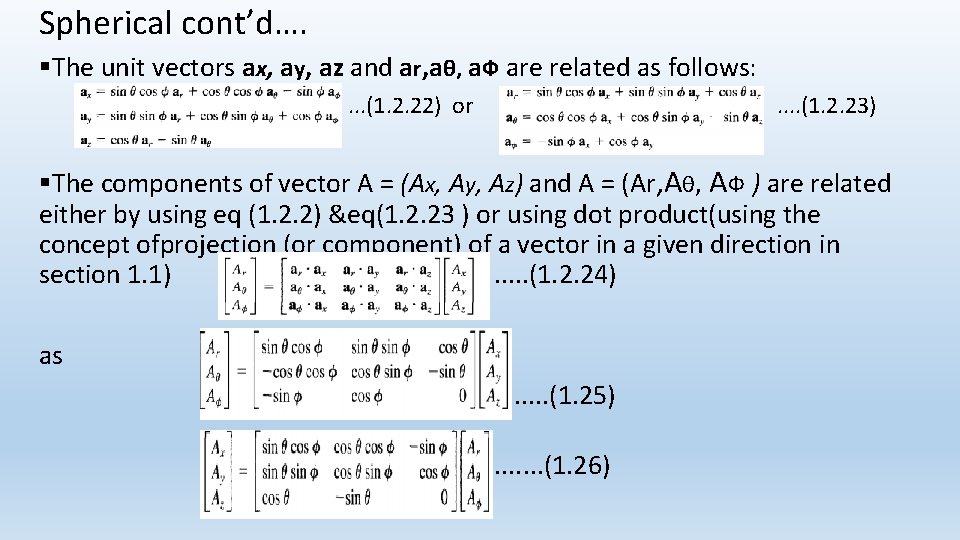
Spherical cont’d…. §The unit vectors ax, ay, az and ar, aθ, a. Ф are related as follows: . . . (1. 2. 22) or . . (1. 2. 23) §The components of vector A = (Ax, Ay, Az) and A = (Ar, Aθ, AФ ) are related either by using eq (1. 2. 2) &eq(1. 2. 23 ) or using dot product(using the concept ofprojection (or component) of a vector in a given direction in section 1. 1). . . (1. 2. 24) as. . . (1. 25). . . . (1. 26)
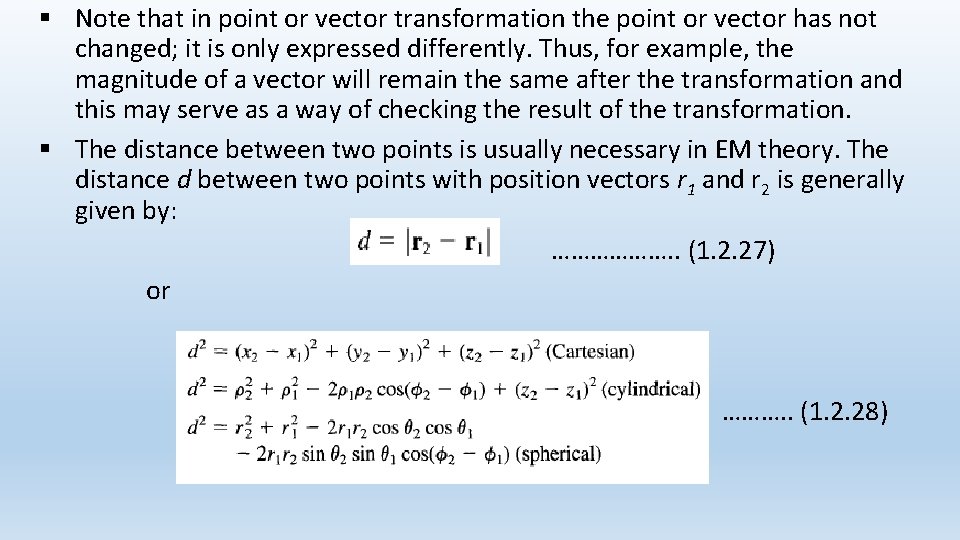
§ Note that in point or vector transformation the point or vector has not changed; it is only expressed differently. Thus, for example, the magnitude of a vector will remain the same after the transformation and this may serve as a way of checking the result of the transformation. § The distance between two points is usually necessary in EM theory. The distance d between two points with position vectors r 1 and r 2 is generally given by: ………………. . (1. 2. 27) or ………. . (1. 2. 28)
v. Constant Coordinate Surfaces: § Surfaces in Cartesian, cylindrical, or spherical coordinate systems are easily generated by keeping one of the coordinate variables constant and allowing the other two to vary. § In the Cartesian system, if we keep x constant and allow y and z to vary, an infinite plane is generated. Thus, we could have infinite planes x = constant y = constant …………… (1. 2. 29) z = constant which are perpendicular to the x-, y-, and z-axes, respectively, as shown in Figure 1. 2. 7. The intersection of two planes is a line. For example, x = constant, y = constant …………. . (1. 2. 30) is the line RPQ parallel to the z-axis.
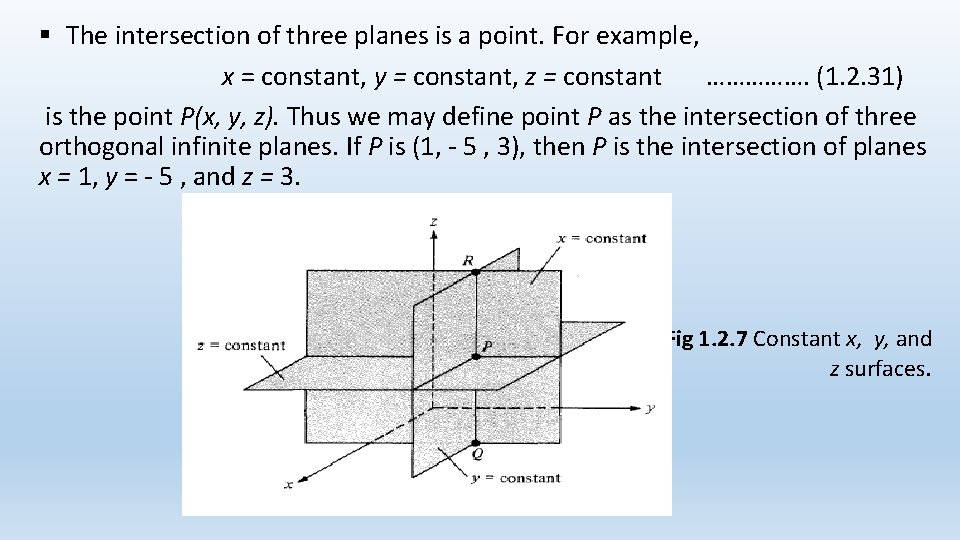
§ The intersection of three planes is a point. For example, x = constant, y = constant, z = constant ……………. (1. 2. 31) is the point P(x, y, z). Thus we may define point P as the intersection of three orthogonal infinite planes. If P is (1, - 5 , 3), then P is the intersection of planes x = 1, y = - 5 , and z = 3. Fig 1. 2. 7 Constant x, y, and z surfaces.
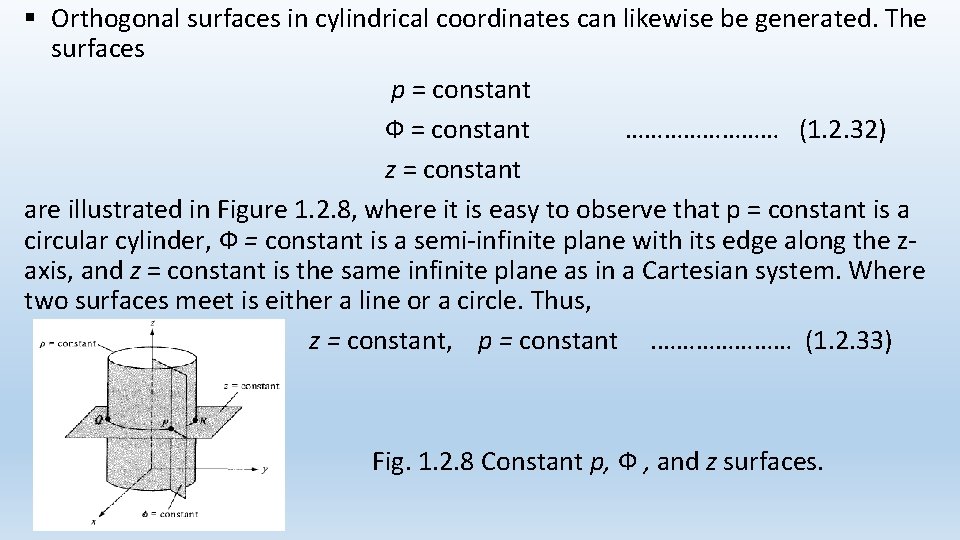
§ Orthogonal surfaces in cylindrical coordinates can likewise be generated. The surfaces p = constant Ф = constant ………… (1. 2. 32) z = constant are illustrated in Figure 1. 2. 8, where it is easy to observe that p = constant is a circular cylinder, Ф = constant is a semi-infinite plane with its edge along the zaxis, and z = constant is the same infinite plane as in a Cartesian system. Where two surfaces meet is either a line or a circle. Thus, z = constant, p = constant. ………………… (1. 2. 33) Fig. 1. 2. 8 Constant p, Ф , and z surfaces.
is a circle QPR of radius p, whereas z = constant, Ф = constant is a semiinfinite line. A point is an intersection of the three surfaces in eq. (1. 2. 32). Thus, p = 2, Ф = 60°, z = 5 …………… (1. 2. 34) is the point P(2, 60°, 5). § The orthogonal nature of the spherical coordinate system is evident by considering the three surfaces r = constant θ = constant …………………. . (1. 2. 35) Ф = constant which are shown in Figure 1. 2. 9, where we notice that r = constant is a sphere with its center at the origin; θ = constant is a circular cone with the zaxis as its axis and the origin as its vertex; Ф = constant is the semi-infinite plane as in a cylindrical system.
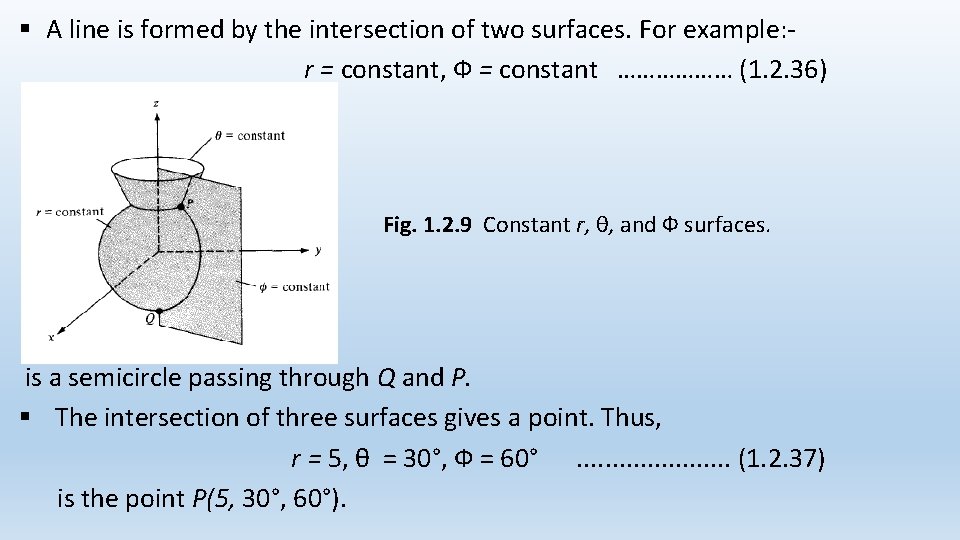
§ A line is formed by the intersection of two surfaces. For example: r = constant, Ф = constant ……………… (1. 2. 36) Fig. 1. 2. 9 Constant r, θ, and Ф surfaces. is a semicircle passing through Q and P. § The intersection of three surfaces gives a point. Thus, r = 5, θ = 30°, Ф = 60°. . . . . (1. 2. 37) is the point P(5, 30°, 60°).
Note: § We notice that in general, a point in three-dimensional space can be identified as the intersection of three mutually orthogonal surfaces. Also, a unit normal vector to the surface n = constant is ± an , where n is x, y, z, p, Ф, r, or θ. For example, to plane x = 5, a unit normal vector is ±ax and to plane Ф = 20°, a unit normal vector is a. Ф.
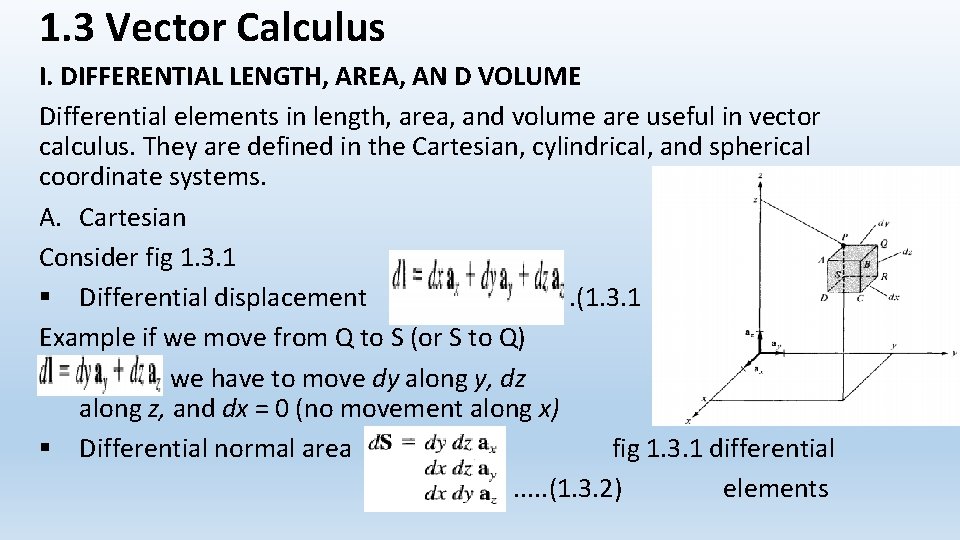
1. 3 Vector Calculus I. DIFFERENTIAL LENGTH, AREA, AN D VOLUME Differential elements in length, area, and volume are useful in vector calculus. They are defined in the Cartesian, cylindrical, and spherical coordinate systems. A. Cartesian Consider fig 1. 3. 1 § Differential displacement. (1. 3. 1 Example if we move from Q to S (or S to Q) becau se we have to move dy along y, dz along z, and dx = 0 (no movement along x) § Differential normal area fig 1. 3. 1 differential. . . (1. 3. 2) elements
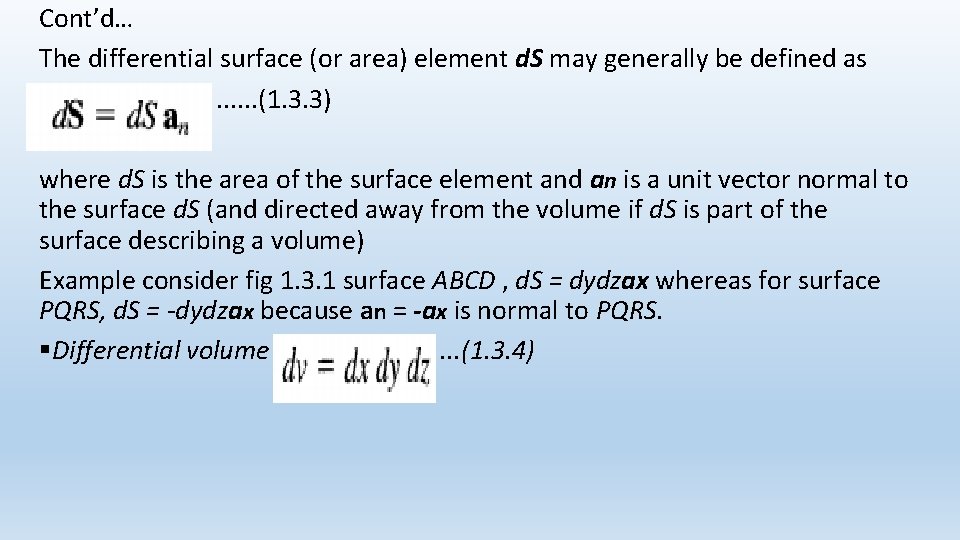
Cont’d… The differential surface (or area) element d. S may generally be defined as. . . (1. 3. 3) where d. S is the area of the surface element and an is a unit vector normal to the surface d. S (and directed away from the volume if d. S is part of the surface describing a volume) Example consider fig 1. 3. 1 surface ABCD , d. S = dydzax whereas for surface PQRS, d. S = -dydzax because an = -ax is normal to PQRS. §Differential volume. . . (1. 3. 4)
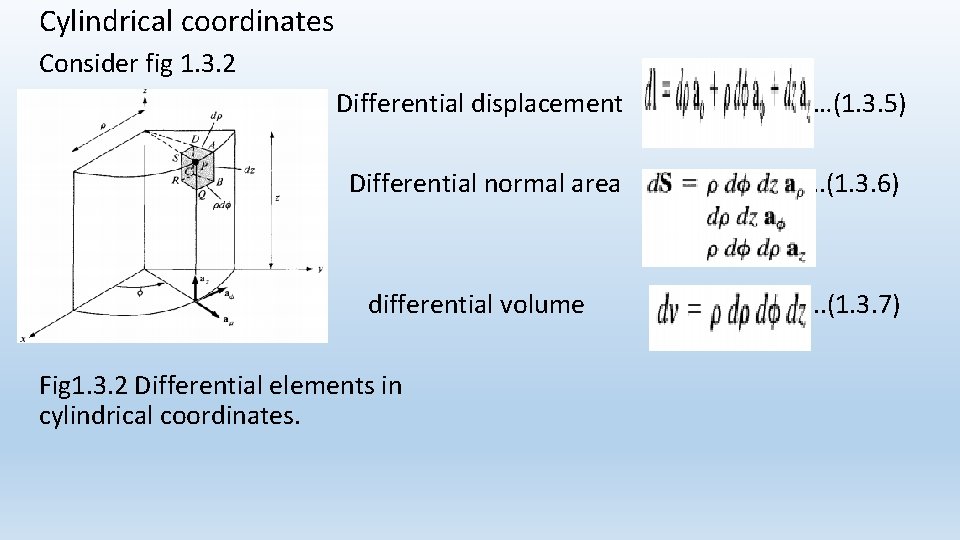
Cylindrical coordinates Consider fig 1. 3. 2 Differential displacement …(1. 3. 5) Differential normal area . . (1. 3. 6) differential volume Fig 1. 3. 2 Differential elements in cylindrical coordinates. . . (1. 3. 7)
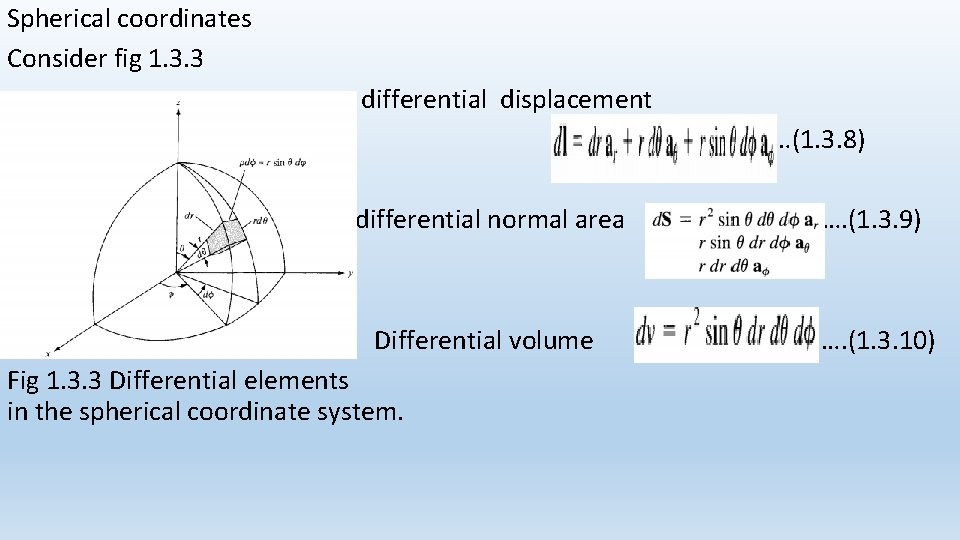
Spherical coordinates Consider fig 1. 3. 3 differential displacement …(1. 3. 8) differential normal area …. (1. 3. 9) Differential volume …. (1. 3. 10) Fig 1. 3. 3 Differential elements in the spherical coordinate system.
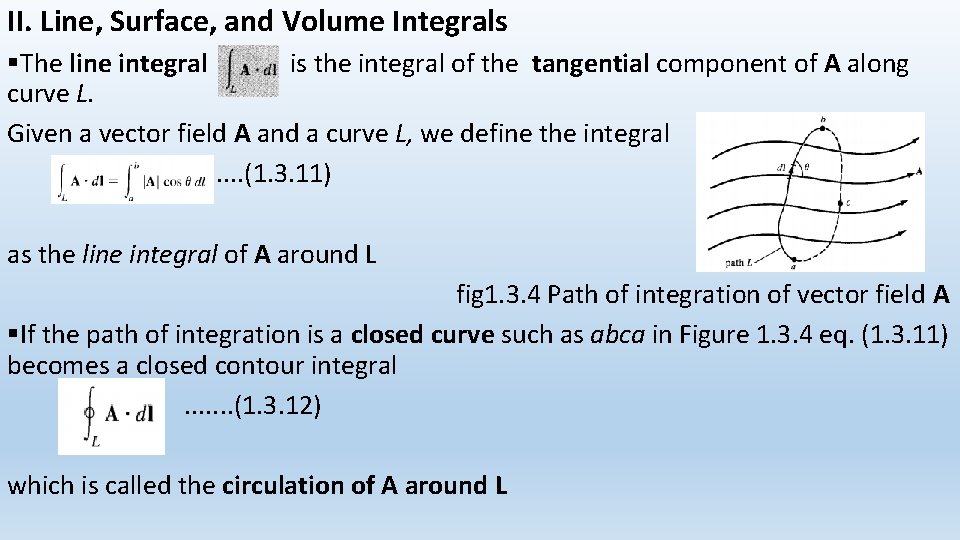
II. Line, Surface, and Volume Integrals §The line integral is the integral of the tangential component of A along curve L. Given a vector field A and a curve L, we define the integral. . (1. 3. 11) as the line integral of A around L fig 1. 3. 4 Path of integration of vector field A §If the path of integration is a closed curve such as abca in Figure 1. 3. 4 eq. (1. 3. 11) becomes a closed contour integral. . . . (1. 3. 12) which is called the circulation of A around L
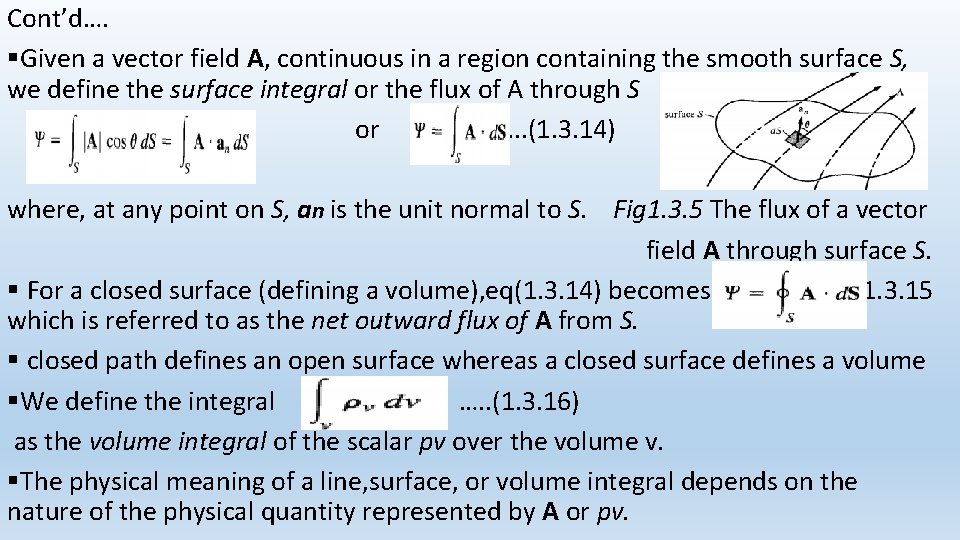
Cont’d…. §Given a vector field A, continuous in a region containing the smooth surface S, we define the surface integral or the flux of A through S or. . (1. 3. 14) where, at any point on S, an is the unit normal to S. Fig 1. 3. 5 The flux of a vector field A through surface S. § For a closed surface (defining a volume), eq(1. 3. 14) becomes 1. 3. 15 which is referred to as the net outward flux of A from S. § closed path defines an open surface whereas a closed surface defines a volume §We define the integral …. . (1. 3. 16) as the volume integral of the scalar pv over the volume v. §The physical meaning of a line, surface, or volume integral depends on the nature of the physical quantity represented by A or pv.
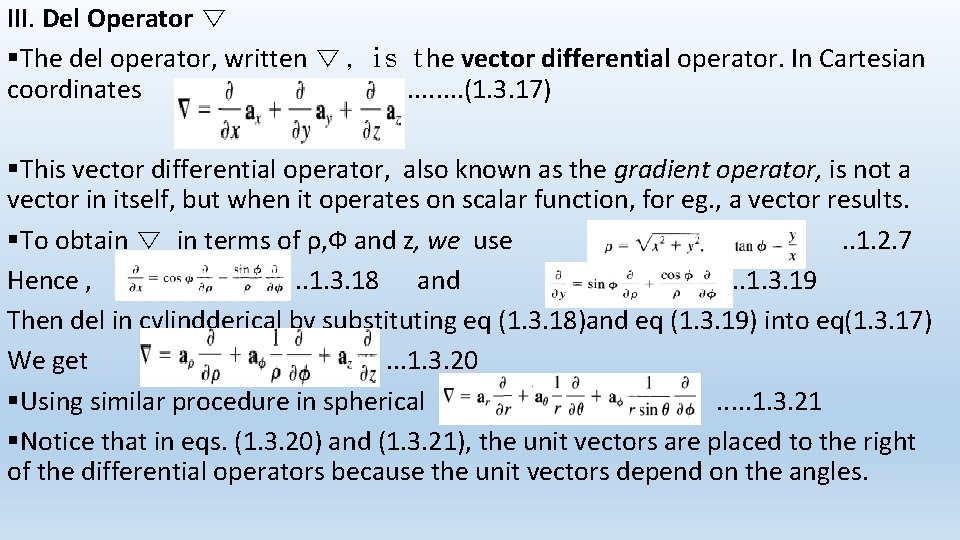
III. Del Operator ∇ §The del operator, written ∇, is the vector differential operator. In Cartesian coordinates. . . . (1. 3. 17) §This vector differential operator, also known as the gradient operator, is not a vector in itself, but when it operates on scalar function, for eg. , a vector results. §To obtain ∇ in terms of ρ, Ф and z, we use. . 1. 2. 7 Hence , . . 1. 3. 18 and. . 1. 3. 19 Then del in cylindderical by substituting eq (1. 3. 18)and eq (1. 3. 19) into eq(1. 3. 17) We get. . . 1. 3. 20 §Using similar procedure in spherical. . . 1. 3. 21 §Notice that in eqs. (1. 3. 20) and (1. 3. 21), the unit vectors are placed to the right of the differential operators because the unit vectors depend on the angles.
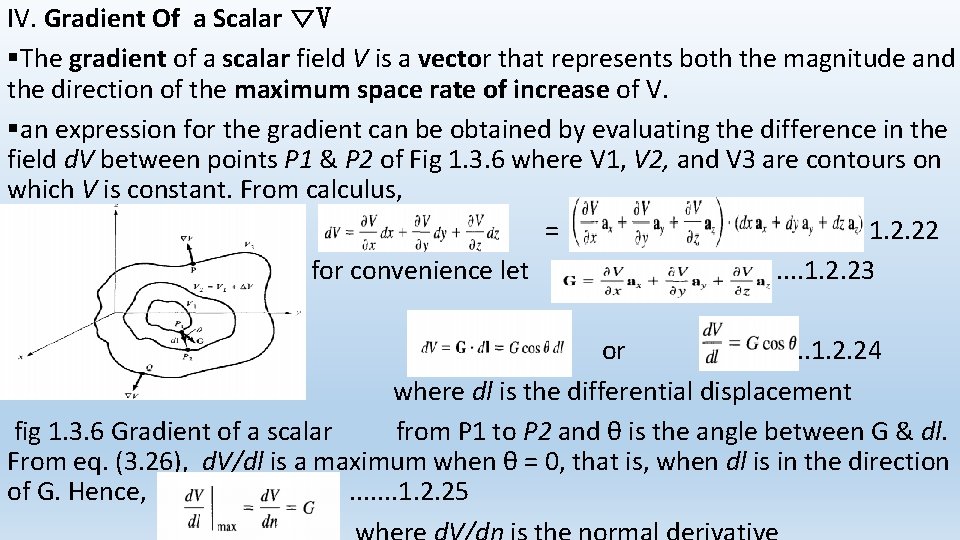
IV. Gradient Of a Scalar ∇V §The gradient of a scalar field V is a vector that represents both the magnitude and the direction of the maximum space rate of increase of V. §an expression for the gradient can be obtained by evaluating the difference in the field d. V between points P 1 & P 2 of Fig 1. 3. 6 where V 1, V 2, and V 3 are contours on which V is constant. From calculus, = 1. 2. 22 for convenience let. . 1. 2. 23 or. . 1. 2. 24 where dl is the differential displacement fig 1. 3. 6 Gradient of a scalar from P 1 to P 2 and θ is the angle between G & dl. From eq. (3. 26), d. V/dl is a maximum when θ = 0, that is, when dl is in the direction of G. Hence, . . . . 1. 2. 25
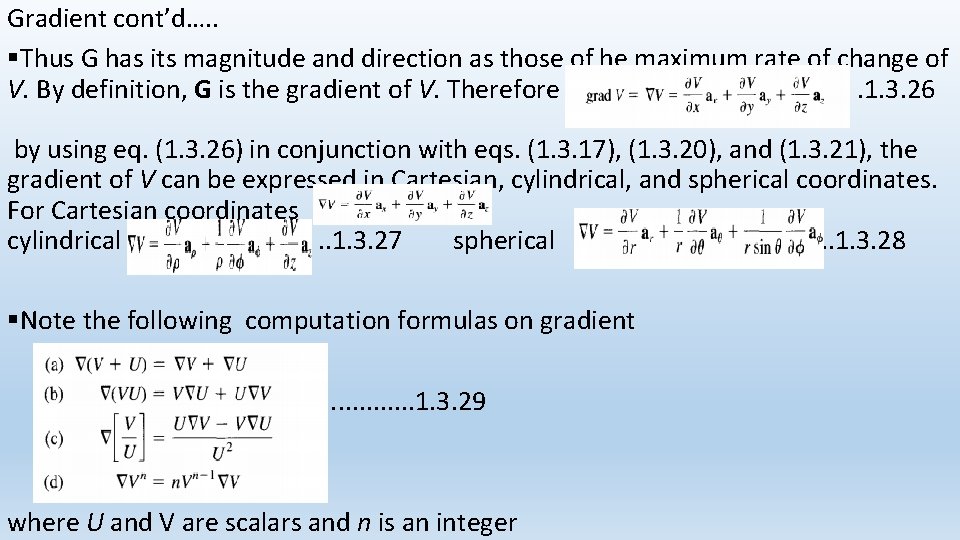
Gradient cont’d…. . §Thus G has its magnitude and direction as those of he maximum rate of change of V. By definition, G is the gradient of V. Therefore. 1. 3. 26 by using eq. (1. 3. 26) in conjunction with eqs. (1. 3. 17), (1. 3. 20), and (1. 3. 21), the gradient of V can be expressed in Cartesian, cylindrical, and spherical coordinates. For Cartesian coordinates cylindrical. . 1. 3. 27 spherical. . 1. 3. 28 §Note the following computation formulas on gradient. . . 1. 3. 29 where U and V are scalars and n is an integer
Gradient cont’d…. §Note the following properties of the gradient of a scalar field V: 1. Magnitude of ∇V equals the maximum rate of change in V per unit distance 2. ∇V points in the direction of the maximum rate of change in V. 3. ∇V at any point is perpendicular to the constant V surface that passes through that point (see points P and Q in Figure 1. 3. 6). 4. The projection (or component) of ∇V in the direction of a unit vector a is ∇V. a and is called the directional derivative of V along a. This is the rate of change of V in the direction of a. For example, d. V/dl in eq. (1. 3. 24) is the directional derivative of V along P 1 P 2 in Figure 1. 3. 6. Thus the gradient of a scalar function V provides us with both the direction in which V changes most rapidly and the magnitude of the maximum directional derivative of V. 5. If A = ∇V, V is said to be the scalar potential of A.
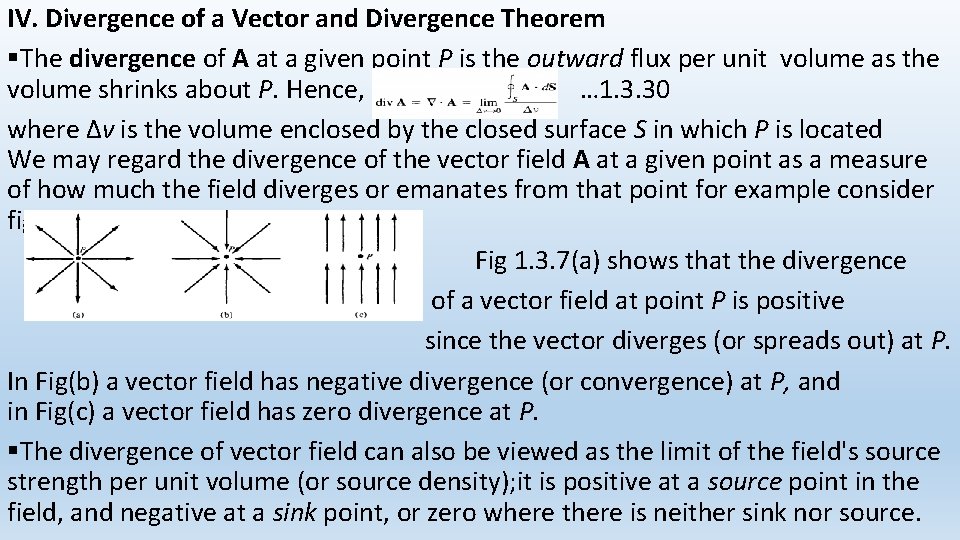
IV. Divergence of a Vector and Divergence Theorem §The divergence of A at a given point P is the outward flux per unit volume as the volume shrinks about P. Hence, … 1. 3. 30 where Δv is the volume enclosed by the closed surface S in which P is located We may regard the divergence of the vector field A at a given point as a measure of how much the field diverges or emanates from that point for example consider fig Fig 1. 3. 7(a) shows that the divergence of a vector field at point P is positive since the vector diverges (or spreads out) at P. In Fig(b) a vector field has negative divergence (or convergence) at P, and in Fig(c) a vector field has zero divergence at P. §The divergence of vector field can also be viewed as the limit of the field's source strength per unit volume (or source density); it is positive at a source point in the field, and negative at a sink point, or zero where there is neither sink nor source.
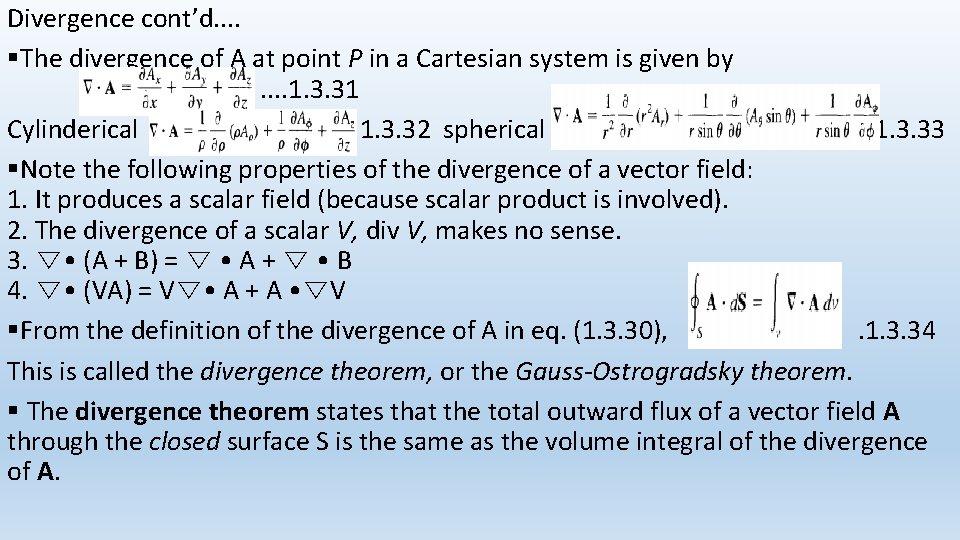
Divergence cont’d. . §The divergence of A at point P in a Cartesian system is given by. . 1. 3. 31 Cylinderical 1. 3. 32 spherical 1. 3. 33 §Note the following properties of the divergence of a vector field: 1. It produces a scalar field (because scalar product is involved). 2. The divergence of a scalar V, div V, makes no sense. 3. ∇ • (A + B) = ∇ • A + ∇ • B 4. ∇ • (VA) = V∇ • A + A • ∇V §From the definition of the divergence of A in eq. (1. 3. 30), . 1. 3. 34 This is called the divergence theorem, or the Gauss-Ostrogradsky theorem. § The divergence theorem states that the total outward flux of a vector field A through the closed surface S is the same as the volume integral of the divergence of A.
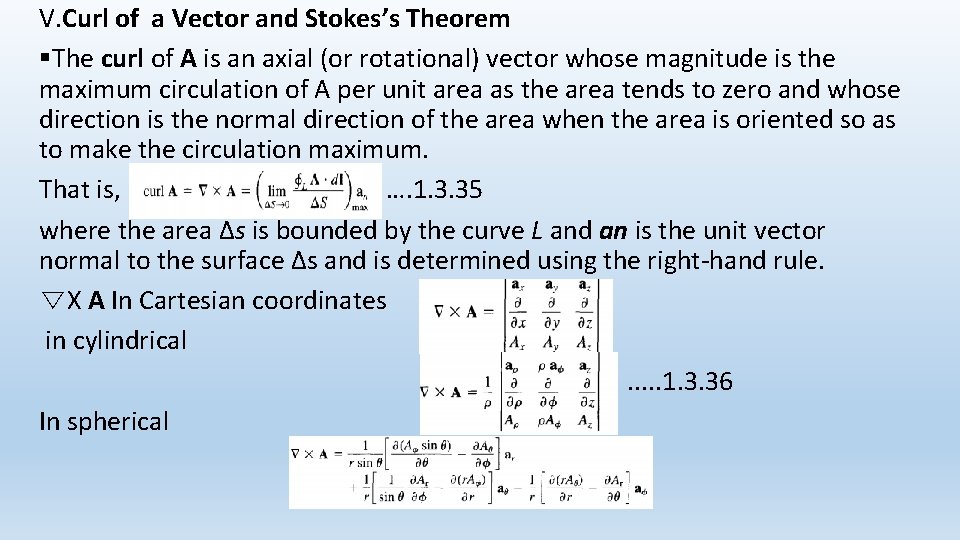
V. Curl of a Vector and Stokes’s Theorem §The curl of A is an axial (or rotational) vector whose magnitude is the maximum circulation of A per unit area as the area tends to zero and whose direction is the normal direction of the area when the area is oriented so as to make the circulation maximum. That is, …. 1. 3. 35 where the area Δs is bounded by the curve L and an is the unit vector normal to the surface Δs and is determined using the right-hand rule. ∇X A In Cartesian coordinates in cylindrical. . . 1. 3. 36 In spherical
Curl cont’d. . §Note the following properties of the curl: 1. The curl of a vector field is another vector field. 2. The curl of a scalar field V, ∇X V, makes no sense. 3. ∇X( A + B) = ∇X A + ∇X B 4. ∇X (A X B) = A(∇ • B) - B(∇ • A) + (B • ∇A - (A • ∇)B 5. ∇X (VA) = V∇X A + ∇V X A 6. The divergence of the curl of a vector field vanishes, that is, ∇ • (∇X A) = 0. 7. The curl of the gradient of a scalar field vanishes, that is, ∇X ∇V = 0. §The physical significance of curl of a vector field is evident in eq. (1. 3. 35) the curl provides the maximum value of the circulation of the field per unit area (or circulation density) and indicates the direction along which this maximum value occurs. §The curl of a vector field A at a point P may be regarded as a measure of the circulation or how much the field curls around P. For example, Fig. 1. 2. 8(a) shows that the curl of a vector field around P is directed out of the page. Fig(b) shows a
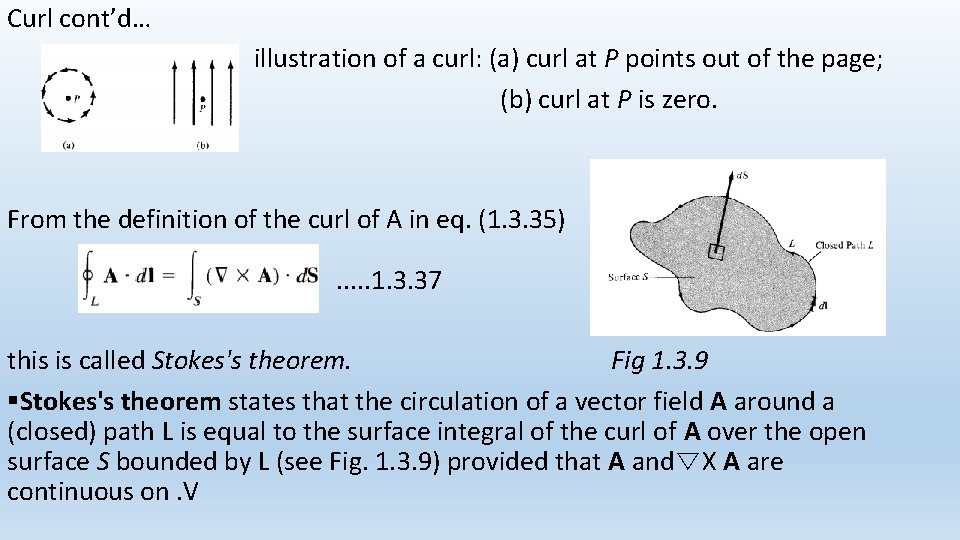
Curl cont’d… illustration of a curl: (a) curl at P points out of the page; (b) curl at P is zero. From the definition of the curl of A in eq. (1. 3. 35). . . 1. 3. 37 this is called Stokes's theorem. Fig 1. 3. 9 §Stokes's theorem states that the circulation of a vector field A around a (closed) path L is equal to the surface integral of the curl of A over the open surface S bounded by L (see Fig. 1. 3. 9) provided that A and∇X A are continuous on. V
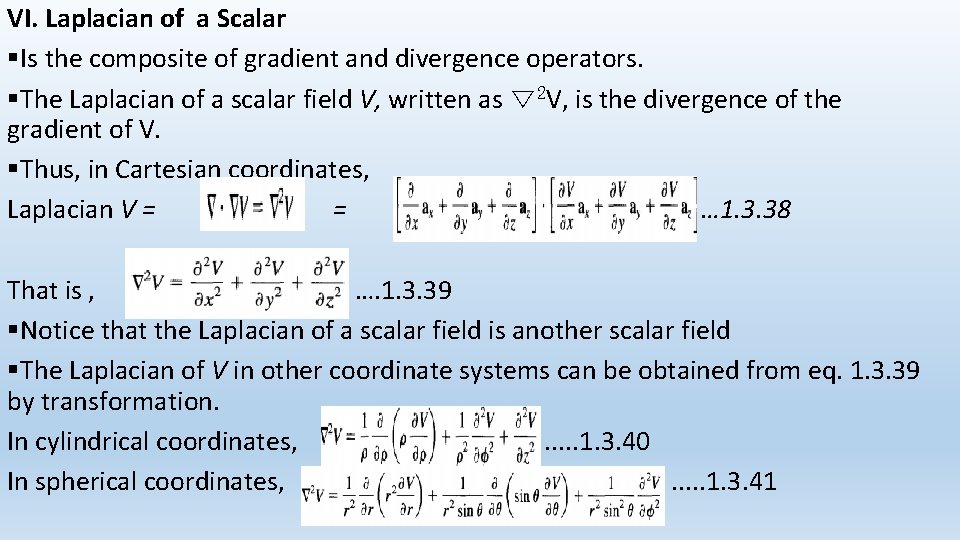
VI. Laplacian of a Scalar §Is the composite of gradient and divergence operators. §The Laplacian of a scalar field V, written as ∇2 V, is the divergence of the gradient of V. §Thus, in Cartesian coordinates, Laplacian V = = … 1. 3. 38 That is , …. 1. 3. 39 §Notice that the Laplacian of a scalar field is another scalar field §The Laplacian of V in other coordinate systems can be obtained from eq. 1. 3. 39 by transformation. In cylindrical coordinates, . . . 1. 3. 40 In spherical coordinates, . . . 1. 3. 41
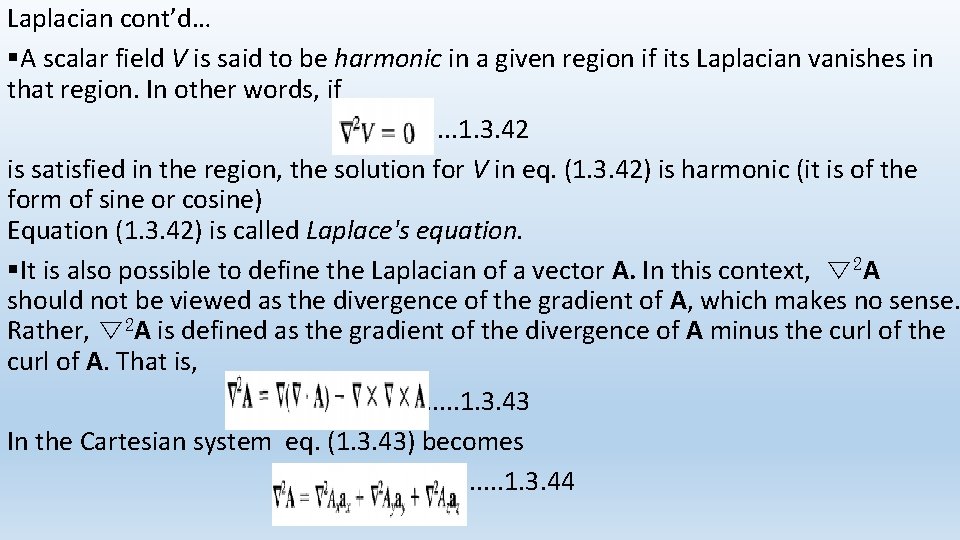
Laplacian cont’d… §A scalar field V is said to be harmonic in a given region if its Laplacian vanishes in that region. In other words, if. . . 1. 3. 42 is satisfied in the region, the solution for V in eq. (1. 3. 42) is harmonic (it is of the form of sine or cosine) Equation (1. 3. 42) is called Laplace's equation. §It is also possible to define the Laplacian of a vector A. In this context, ∇2 A should not be viewed as the divergence of the gradient of A, which makes no sense. Rather, ∇2 A is defined as the gradient of the divergence of A minus the curl of A. That is, . . . 1. 3. 43 In the Cartesian system eq. (1. 3. 43) becomes. . . 1. 3. 44
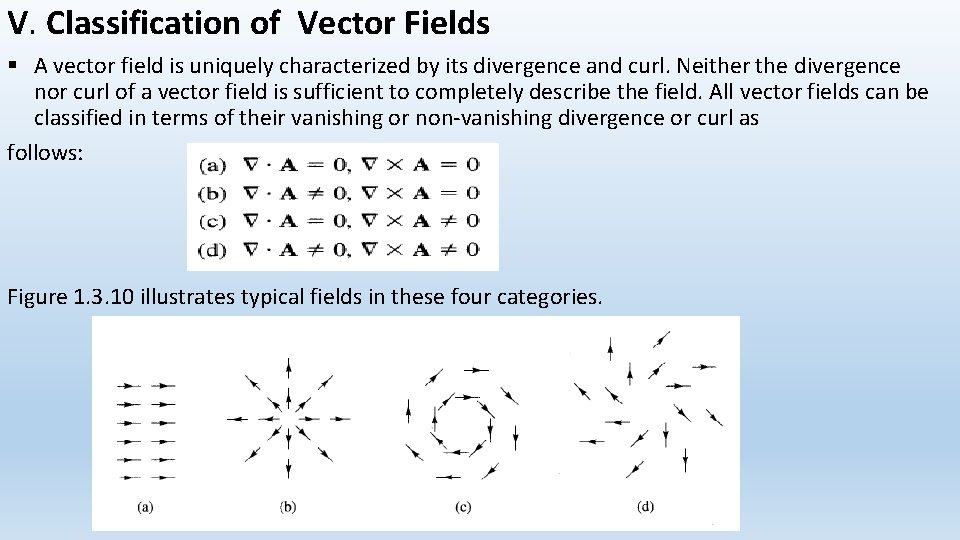
V. Classification of Vector Fields § A vector field is uniquely characterized by its divergence and curl. Neither the divergence nor curl of a vector field is sufficient to completely describe the field. All vector fields can be classified in terms of their vanishing or non-vanishing divergence or curl as follows: Figure 1. 3. 10 illustrates typical fields in these four categories.
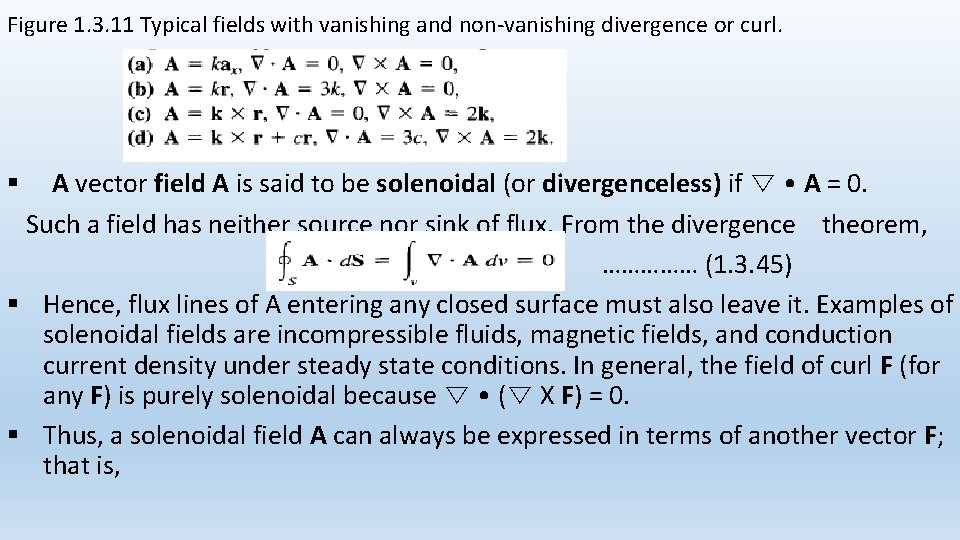
Figure 1. 3. 11 Typical fields with vanishing and non-vanishing divergence or curl. A vector field A is said to be solenoidal (or divergenceless) if ∇ • A = 0. Such a field has neither source nor sink of flux. From the divergence theorem, …………… (1. 3. 45) § Hence, flux lines of A entering any closed surface must also leave it. Examples of solenoidal fields are incompressible fluids, magnetic fields, and conduction current density under steady state conditions. In general, the field of curl F (for any F) is purely solenoidal because ∇ • (∇ X F) = 0. § Thus, a solenoidal field A can always be expressed in terms of another vector F; that is, §
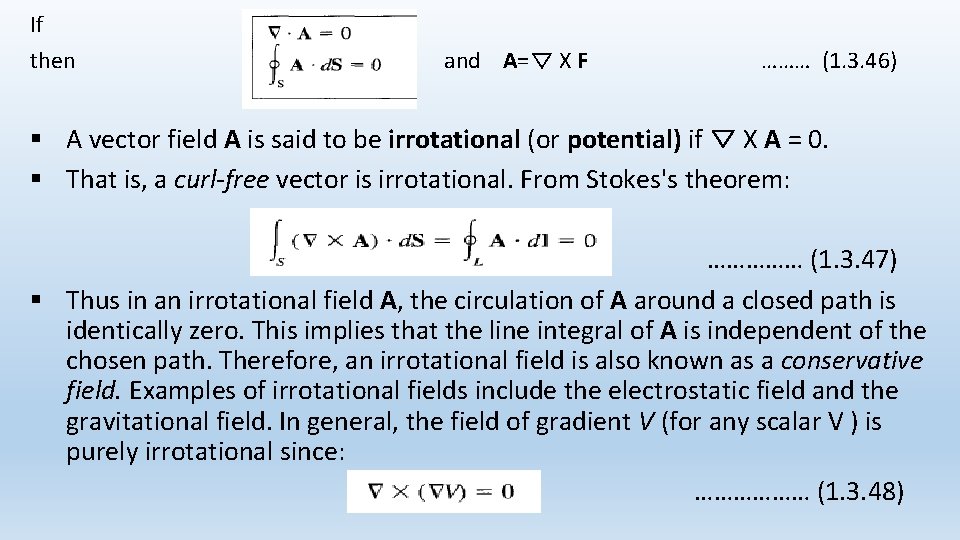
If then and A=∇ X F ……… (1. 3. 46) § A vector field A is said to be irrotational (or potential) if ∇ X A = 0. § That is, a curl-free vector is irrotational. From Stokes's theorem: …………… (1. 3. 47) § Thus in an irrotational field A, the circulation of A around a closed path is identically zero. This implies that the line integral of A is independent of the chosen path. Therefore, an irrotational field is also known as a conservative field. Examples of irrotational fields include the electrostatic field and the gravitational field. In general, the field of gradient V (for any scalar V ) is purely irrotational since: ……………… (1. 3. 48)
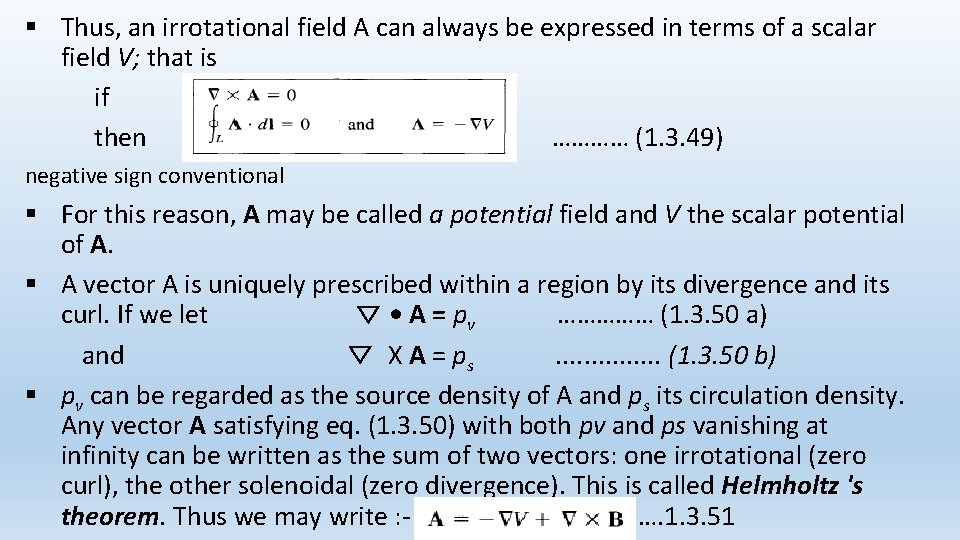
§ Thus, an irrotational field A can always be expressed in terms of a scalar field V; that is if then ………… (1. 3. 49) negative sign conventional § For this reason, A may be called a potential field and V the scalar potential of A. § A vector A is uniquely prescribed within a region by its divergence and its curl. If we let ∇ • A = pv …………… (1. 3. 50 a) and ∇ X A = ps. . . . (1. 3. 50 b) § pv can be regarded as the source density of A and ps its circulation density. Any vector A satisfying eq. (1. 3. 50) with both pv and ps vanishing at infinity can be written as the sum of two vectors: one irrotational (zero curl), the other solenoidal (zero divergence). This is called Helmholtz 's theorem. Thus we may write : …. 1. 3. 51
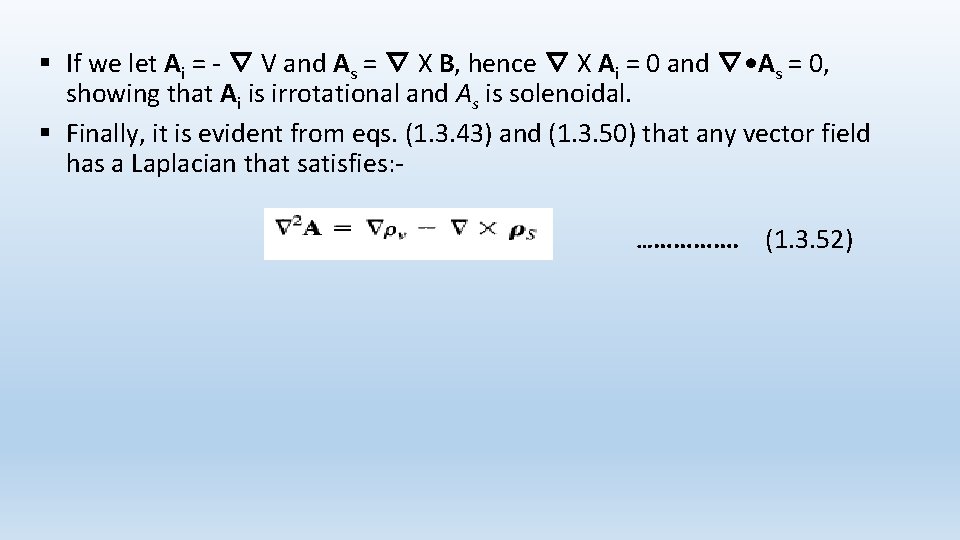
§ If we let Ai = - ∇ V and As = ∇ X B, hence ∇ X Ai = 0 and ∇ • As = 0, showing that Ai is irrotational and As is solenoidal. § Finally, it is evident from eqs. (1. 3. 43) and (1. 3. 50) that any vector field has a Laplacian that satisfies: ……………. (1. 3. 52)
End of Chapter 1
- Slides: 62