
ELECTROMAGNETIC FIELD THEORY The macroscopic laws of electromagnetism
- Slides: 22
ELECTROMAGNETIC FIELD THEORY The macroscopic laws of electromagnetism The laws of macroscopic theory of electromagnetism: - represent a set of mathematical equations coherent from the point of respecting the truth criteria, completeness and non-contradiction, - is a relation that connect the quantities which characterize the electromagnetic field and the electromagnetic state of the bodies in variable regime, gathering in a mathematical “shape” the electromagnetic field phenomenology. During the presentation of each law: - the statement and the comment of its mathematical formulation, - its physical significance and its most important consequences, firstly in variable regime, then in various particular regimes: - quasi-stationary regimes (in which the variations in time of some of the quantities are sufficiently slow so they can be neglected), - steady state (stationary) regimes (in which the quantities are time-invariant, but there are energy transformations) and - static regimes (which are stationary regimes without energy transformations).
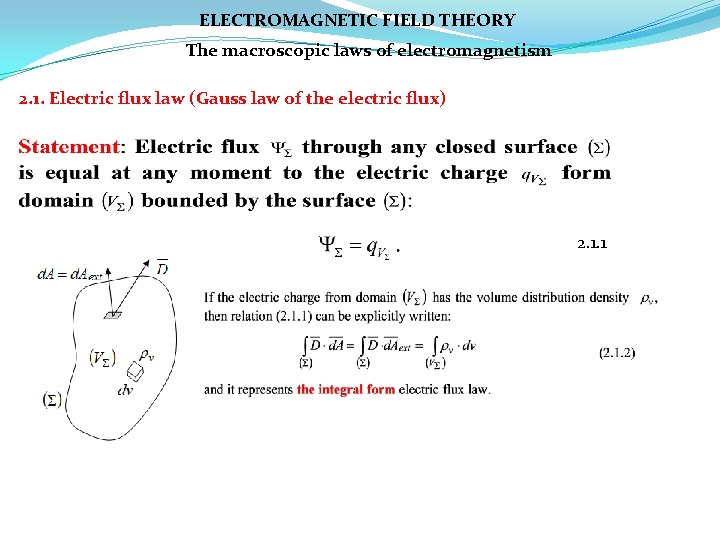
ELECTROMAGNETIC FIELD THEORY The macroscopic laws of electromagnetism 2. 1. Electric flux law (Gauss law of the electric flux) 2. 1. 1
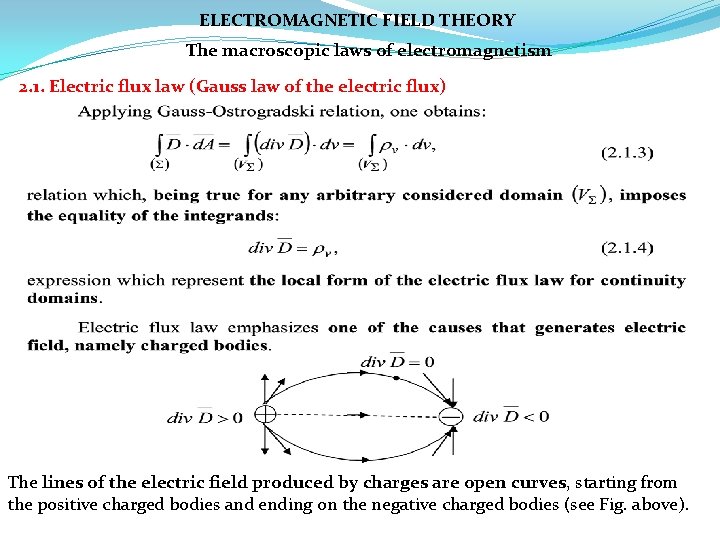
ELECTROMAGNETIC FIELD THEORY The macroscopic laws of electromagnetism 2. 1. Electric flux law (Gauss law of the electric flux) The lines of the electric field produced by charges are open curves, starting from the positive charged bodies and ending on the negative charged bodies (see Fig. above).
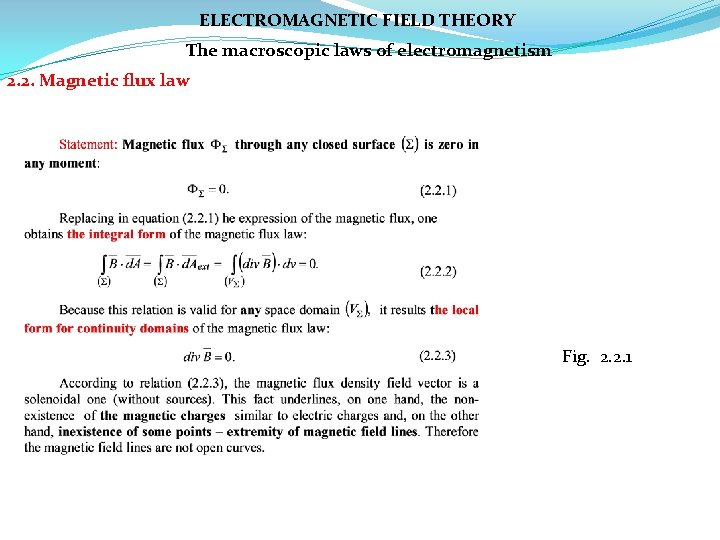
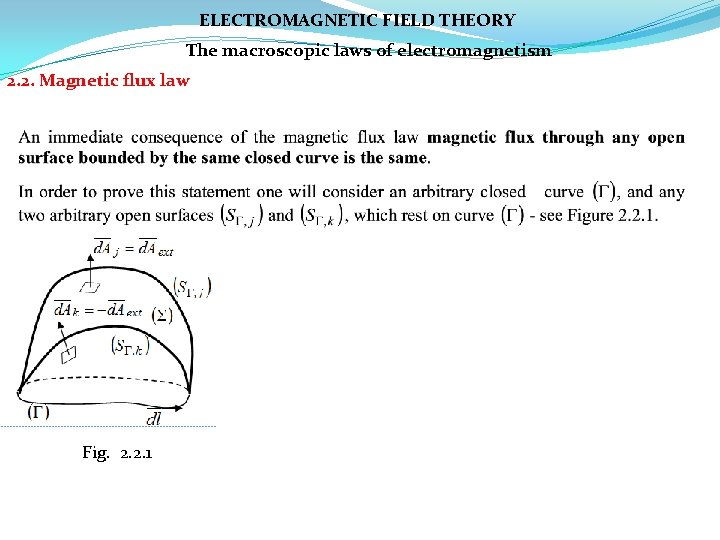
ELECTROMAGNETIC FIELD THEORY The macroscopic laws of electromagnetism 2. 2. Magnetic flux law Fig. 2. 2. 1
ELECTROMAGNETIC FIELD THEORY The macroscopic laws of electromagnetism 2. 2. Magnetic flux law Fig. 2. 2. 1
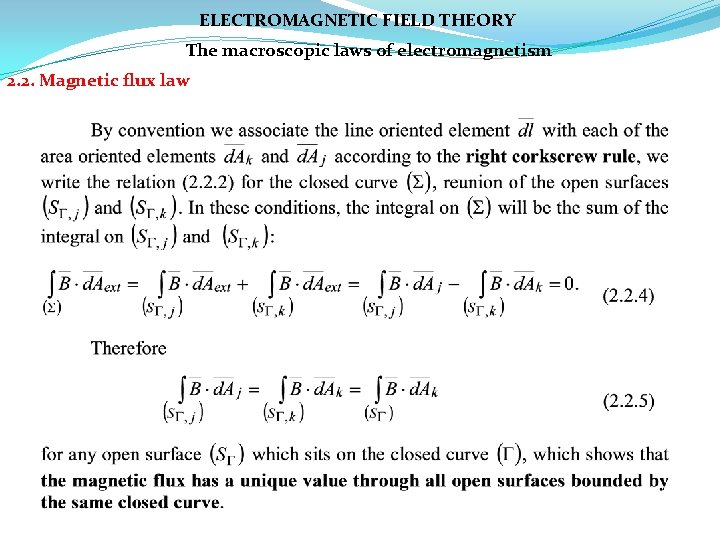
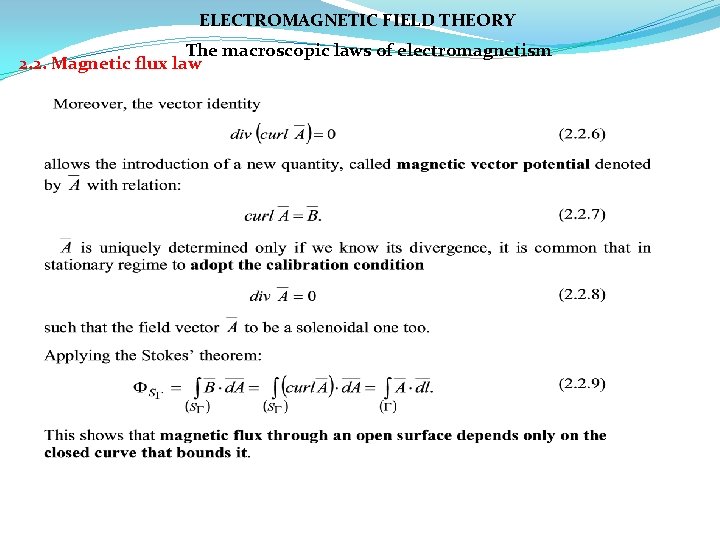
ELECTROMAGNETIC FIELD THEORY The macroscopic laws of electromagnetism 2. 2. Magnetic flux law
ELECTROMAGNETIC FIELD THEORY The macroscopic laws of electromagnetism 2. 2. Magnetic flux law
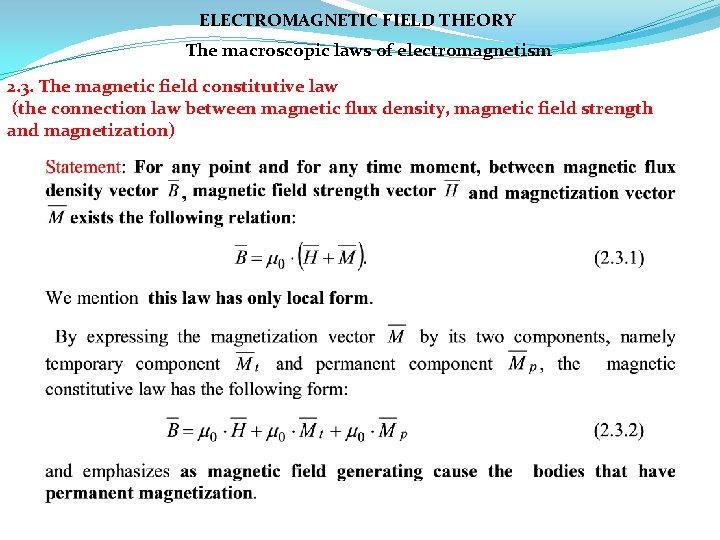
ELECTROMAGNETIC FIELD THEORY The macroscopic laws of electromagnetism 2. 3. The magnetic field constitutive law (the connection law between magnetic flux density, magnetic field strength and magnetization)
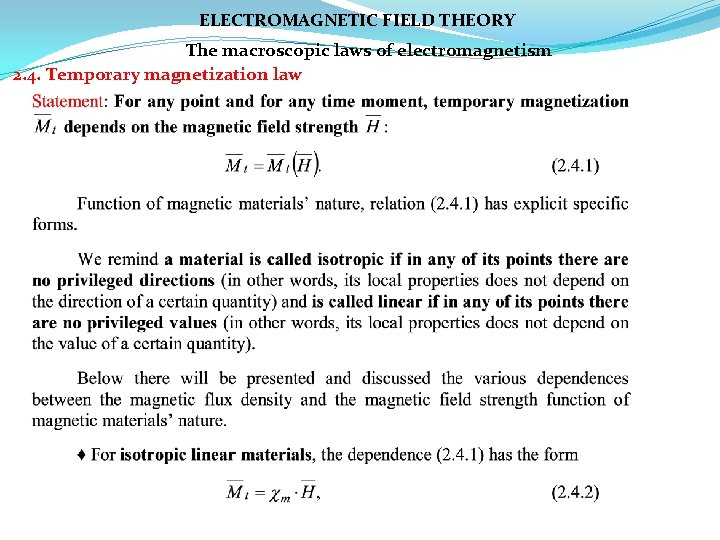
ELECTROMAGNETIC FIELD THEORY The macroscopic laws of electromagnetism 2. 4. Temporary magnetization law
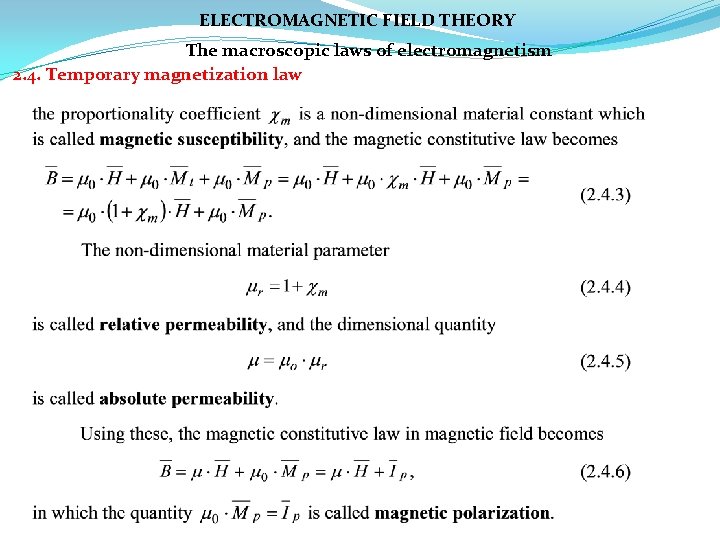
ELECTROMAGNETIC FIELD THEORY The macroscopic laws of electromagnetism 2. 4. Temporary magnetization law
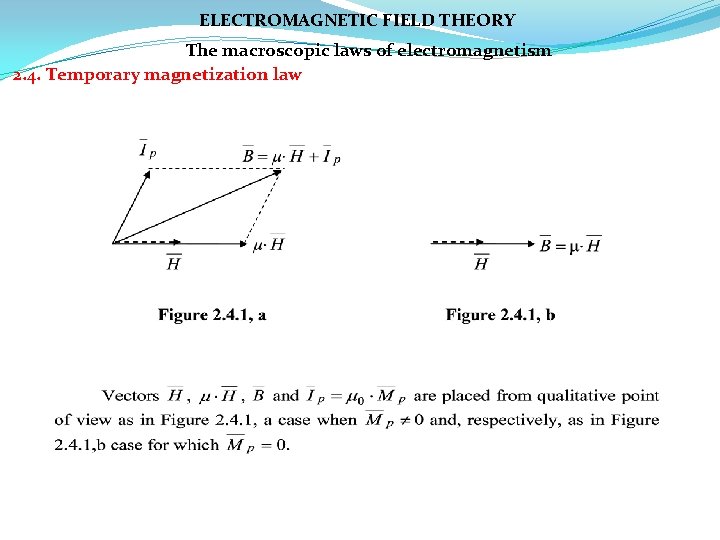
ELECTROMAGNETIC FIELD THEORY The macroscopic laws of electromagnetism 2. 4. Temporary magnetization law
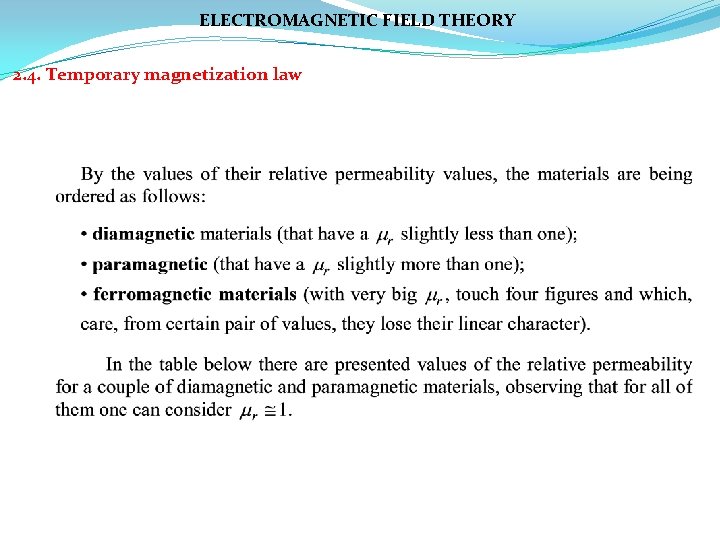
ELECTROMAGNETIC FIELD THEORY 2. 4. Temporary magnetization law
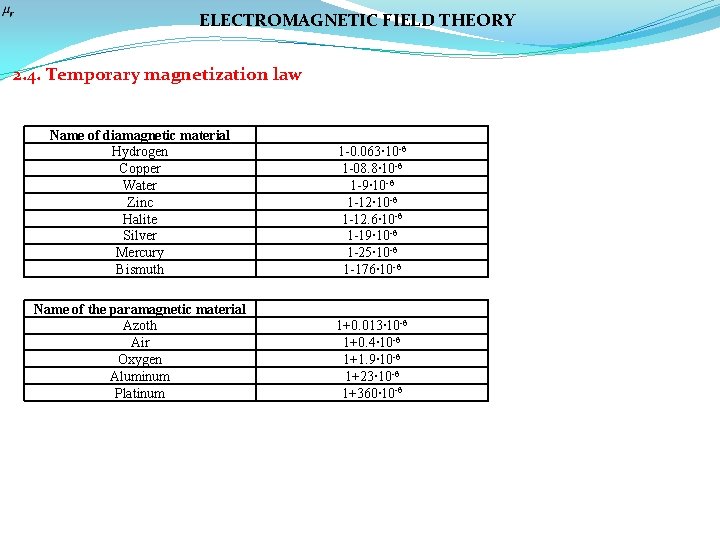
ELECTROMAGNETIC FIELD THEORY 2. 4. Temporary magnetization law Name of diamagnetic material Hydrogen Copper Water Zinc Halite Silver Mercury Bismuth 1 -0. 063∙ 10 -6 1 -08. 8∙ 10 -6 1 -9∙ 10 -6 1 -12. 6∙ 10 -6 1 -19∙ 10 -6 1 -25∙ 10 -6 1 -176∙ 10 -6 Name of the paramagnetic material Azoth Air Oxygen Aluminum Platinum 1+0. 013∙ 10 -6 1+0. 4∙ 10 -6 1+1. 9∙ 10 -6 1+23∙ 10 -6 1+360∙ 10 -6
ELECTROMAGNETIC FIELD THEORY 2. 4. Temporary magnetization law
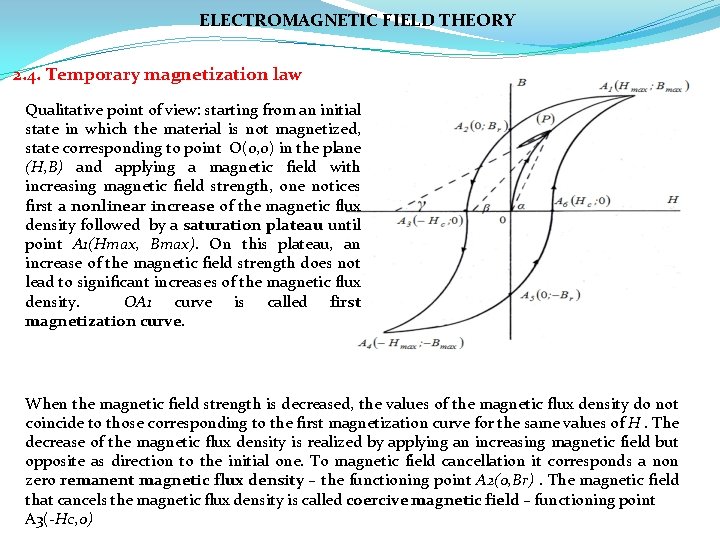
ELECTROMAGNETIC FIELD THEORY 2. 4. Temporary magnetization law Qualitative point of view: starting from an initial state in which the material is not magnetized, state corresponding to point O(0, 0) in the plane (H, B) and applying a magnetic field with increasing magnetic field strength, one notices first a nonlinear increase of the magnetic flux density followed by a saturation plateau until point A 1(Hmax, Bmax). On this plateau, an increase of the magnetic field strength does not lead to significant increases of the magnetic flux density. OA 1 curve is called first magnetization curve. When the magnetic field strength is decreased, the values of the magnetic flux density do not coincide to those corresponding to the first magnetization curve for the same values of H. The decrease of the magnetic flux density is realized by applying an increasing magnetic field but opposite as direction to the initial one. To magnetic field cancellation it corresponds a non zero remanent magnetic flux density – the functioning point A 2(0, Br). The magnetic field that cancels the magnetic flux density is called coercive magnetic field – functioning point A 3(-Hc, 0)
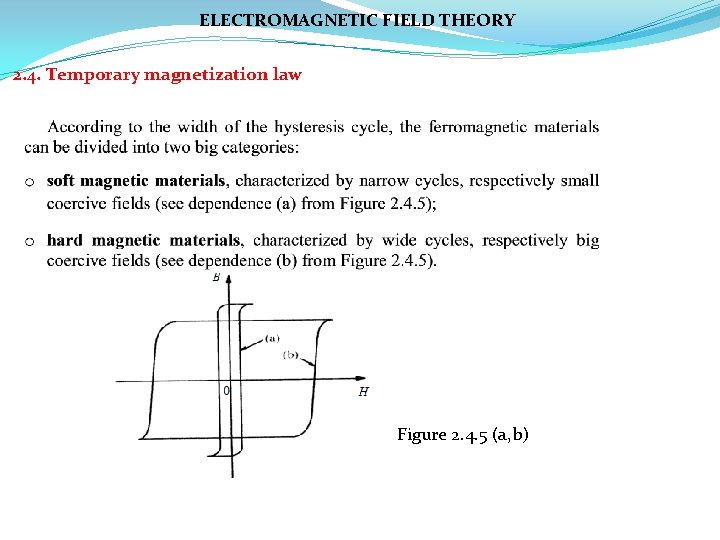
ELECTROMAGNETIC FIELD THEORY 2. 4. Temporary magnetization law Figure 2. 4. 5 (a, b)
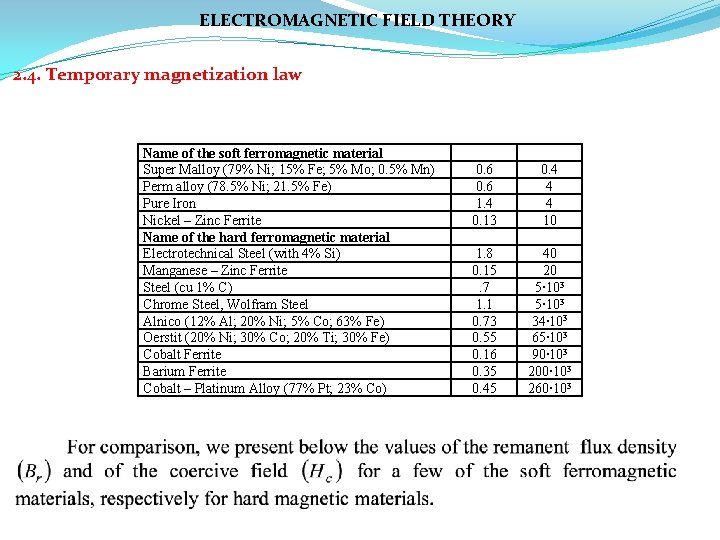
ELECTROMAGNETIC FIELD THEORY 2. 4. Temporary magnetization law Name of the soft ferromagnetic material Super Malloy (79% Ni; 15% Fe; 5% Mo; 0. 5% Mn) Perm alloy (78. 5% Ni; 21. 5% Fe) Pure Iron Nickel – Zinc Ferrite Name of the hard ferromagnetic material Electrotechnical Steel (with 4% Si) Manganese – Zinc Ferrite Steel (cu 1% C) Chrome Steel, Wolfram Steel Alnico (12% Al; 20% Ni; 5% Co; 63% Fe) Oerstit (20% Ni; 30% Co; 20% Ti; 30% Fe) Cobalt Ferrite Barium Ferrite Cobalt – Platinum Alloy (77% Pt; 23% Co) 0. 6 1. 4 0. 13 0. 4 4 4 10 1. 8 0. 15. 7 1. 1 0. 73 0. 55 0. 16 0. 35 0. 45 40 20 5∙ 103 34∙ 103 65∙ 103 90∙ 103 200∙ 103 260∙ 103
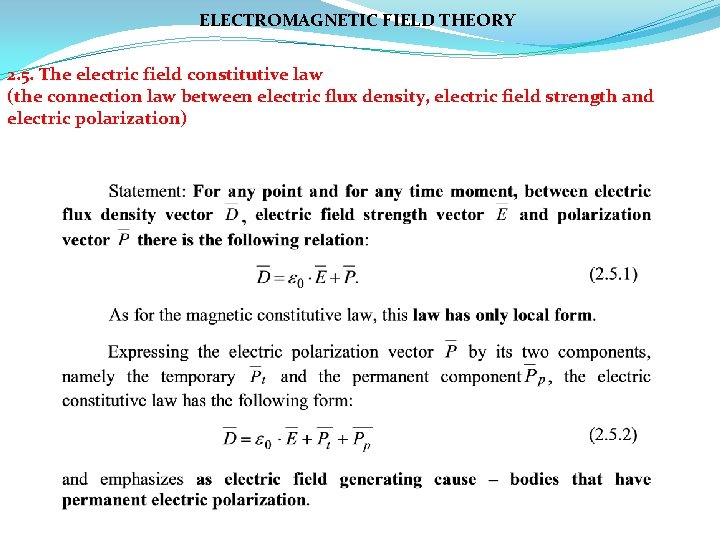
ELECTROMAGNETIC FIELD THEORY 2. 5. The electric field constitutive law (the connection law between electric flux density, electric field strength and electric polarization)
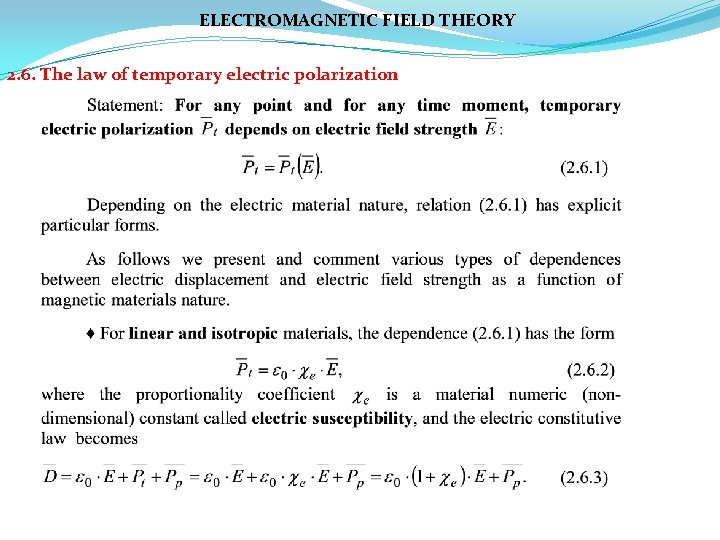
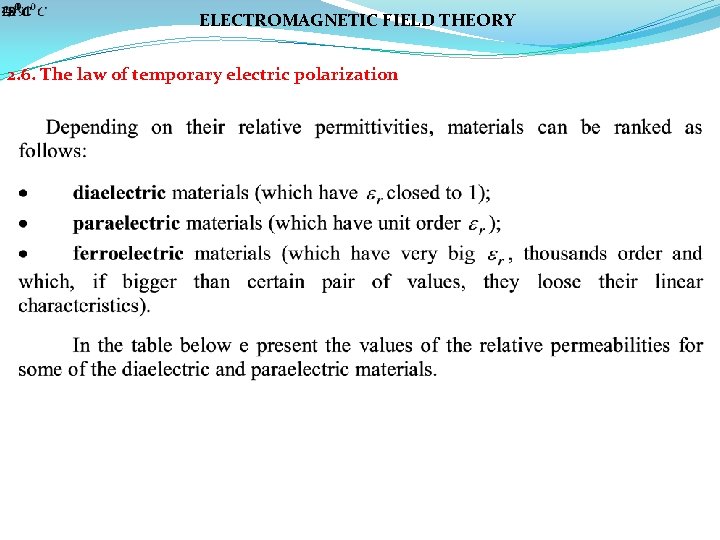
ELECTROMAGNETIC FIELD THEORY 2. 6. The law of temporary electric polarization
ELECTROMAGNETIC FIELD THEORY 2. 6. The law of temporary electric polarization
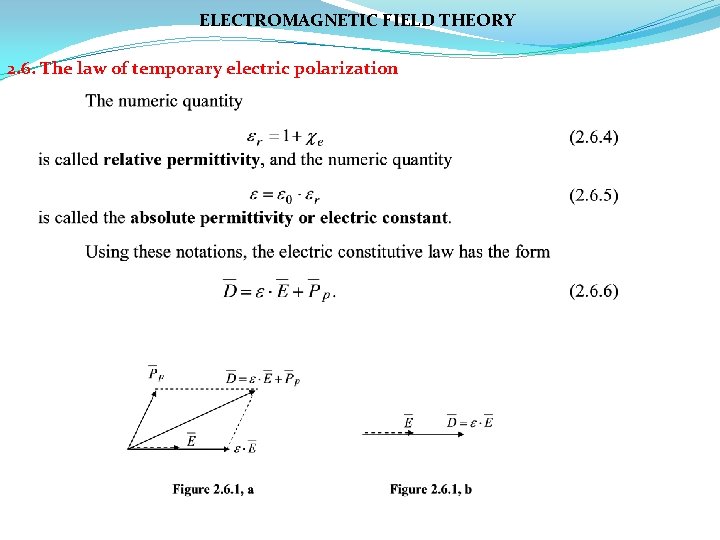
ELECTROMAGNETIC FIELD THEORY 2. 6. The law of temporary electric polarization
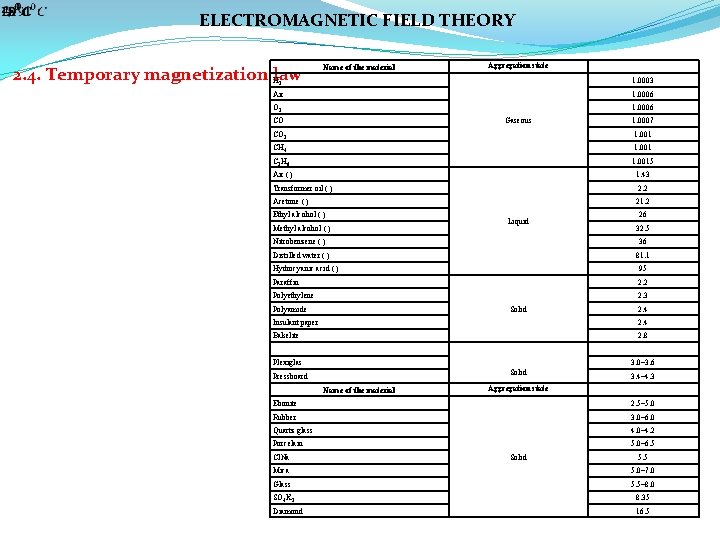
ELECTROMAGNETIC FIELD THEORY 2. 4. Temporary magnetization law H Name of the material Aggregation state 1. 0003 2 Air 1. 0006 O 2 1. 0006 CO Gaseous CO 2 1. 0007 1. 001 CH 4 1. 001 C 2 H 6 1. 0015 Air ( ) 1. 43 Transformer oil ( ) 2. 2 Acetone ( ) 21. 2 Ethyl alcohol ( ) Methyl alcohol ( ) Liquid 26 32. 5 Nitrobenzene ( ) 36 Distilled water ( ) 81. 1 Hydrocyanic acid ( ) 95 Paraffin 2. 2 Polyethylene 2. 3 Solid Polyamide 2. 4 Insulant paper 2. 4 Bakelite 2. 8 Plexiglas 3. 0÷ 3. 6 Solid Pressboard Name of the material 3. 4÷ 4. 3 Aggregation state Ebonite 2. 5÷ 5. 0 Rubber 3. 0÷ 6. 0 Quartz glass 4. 0÷ 4. 2 Porcelain Cl. Na 5. 0÷ 6. 5 Solid 5. 5 Mica 5. 0÷ 7. 0 Glass 5. 5÷ 8. 0 SO 4 K 2 8. 35 Diamond 16. 5