
Electromagnetic field enhancement and the potential application in
- Slides: 1
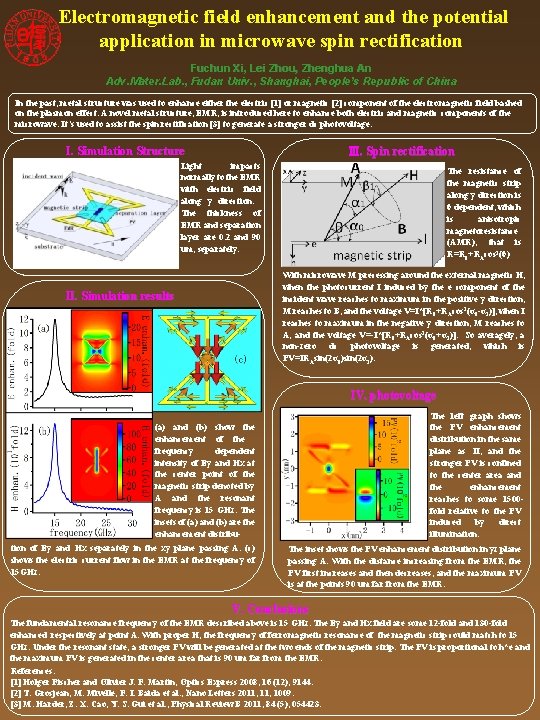
Electromagnetic field enhancement and the potential application in microwave spin rectification Fuchun Xi, Lei Zhou, Zhenghua An Adv. Mater. Lab. , Fudan Univ. , Shanghai, People’s Republic of China In the past, metal structure was used to enhance either the electric [1] or magnetic [2] component of the electromagnetic field bashed on the plasmon effect. A novel metal structure, EMR, is introduced here to enhance both electric and magnetic components of the microwave. It’s used to assist the spin rectification [3] to generate a stronger dc photovoltage. I. Simulation Structure Ⅲ. Spin rectification Light impacts normally to the EMR with electric field along y direction. The thickness of EMR and separation layer are 0. 2 and 90 um, separately. The resistance of the magnetic strip along y direction is θ dependent, which is anisotropic magnetoresistance (AMR), that is R=R 0+RAcos 2(θ) With microwave M precessing around the external magnetic H, when the photocurrent I induced by the e component of the incident wave reaches to maximum in the positive y direction, M reaches to B, and the voltage V=I*[R 0+RAcos 2(α 0 -α 1)], when I reaches to maximum in the negative y direction, M reaches to A, and the voltage V=-I*[R 0+RAcos 2(α 0+α 1)]. So averagely, a non-zero dc photovoltage is generated, which is PV=IRAsin(2α 0)sin(2α 1). II. Simulation results IV. photovoltage The left graph shows the PV enhancement distribution in the same plane as II, and the stronger PV is confined to the center area and the enhancement reaches to some 1500 fold relative to the PV induced by direct illumination. (a) and (b) show the enhancement of the frequency dependent intensity of Ey and Hx at the center point of the magnetic strip denoted by A and the resonant frequency is 15 GHz. The insets of (a) and (b) are the enhancement distribution of Ey and Hx separately in the xy plane passing A. (c) shows the electric current flow in the EMR at the frequency of 15 GHz. The inset shows the PV enhancement distribution in yz plane passing A. With the distance increasing from the EMR, the PV first increases and then decreases, and the maximum PV is at the points 90 um far from the EMR. V. Conclusions The fundamental resonance frequency of the EMR described above is 15 GHz. The Ey and Hx field are some 12 -fold and 130 -fold enhanced respectively at point A. With proper H, the frequency of ferromagnetic resonance of the magnetic strip could match to 15 GHz. Under the resonant state, a stronger PV will be generated at the two ends of the magnetic strip. The PV is proportional to h*e and the maximum PV is generated in the center area that is 90 um far from the EMR. References: [1] Holger Fischer and Olivier J. F. Martin, Optics Express 2008, 16 (12), 9144. [2] T. Grosjean, M. Mivelle, F. I. Baida et al. , Nano Letters 2011, 1009. [3] M. Harder, Z. X. Cao, Y. S. Gui et al. , Physical Review B 2011, 84 (5), 054423.