
Electromagnetic Compatibility of a DC Power Distribution System
Electromagnetic Compatibility of a DC Power Distribution System for the ATLAS Liquid Argon Calorimeter 11 th Workshop on Electronics for LHC and Future Experiments 12 -16 September 2005, Heidelberg, Germany G. BLANCHOT CERN, CH-1211 Geneva 23, Switzerland Georges. Blanchot@cern. ch LECC 2004 G. Blanchot, CERN
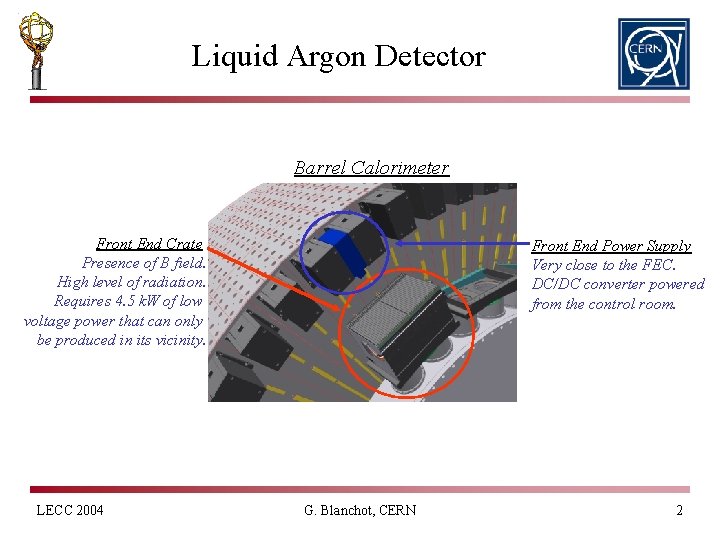
Liquid Argon Detector Barrel Calorimeter Front End Crate Presence of B field. High level of radiation. Requires 4. 5 k. W of low voltage power that can only be produced in its vicinity. LECC 2004 Front End Power Supply Very close to the FEC. DC/DC converter powered from the control room. G. Blanchot, CERN 2

Power Distribution Scheme 100 meters, shielded power cable Back End AC/DC Converter, delivers 280 VDC at 16 A max. ZO 1 ZS DC/DC AC/DC F 1(s) ZI 2 Vin Zo 1 = AC/DC converter output impedance. ZS = Cable impedance. ZI 2 = DC/DC converter input impedance. LECC 2004 Front-End Crate F 2(s) Front End DC/DC Converters, deliver all low voltages to the front end crate. G. Blanchot, CERN 3
Some EMC Issues § Stability When powering DC/DC converters from AC/DC converters over long distances, some instabilities can show up. The stability conditions are reviewed on the basis of specific measurements. § Noise Propagation Long power cables behave as transmission lines. The noise can be amplified or attenuated depending on the cable properties and the load conditions. Measurements are made to put in evidence resonance of noise currents. § Grounding Scheme Where to ground the shield of the power cable and consequences of floating the return line on the emitted noise. LECC 2004 G. Blanchot, CERN 4
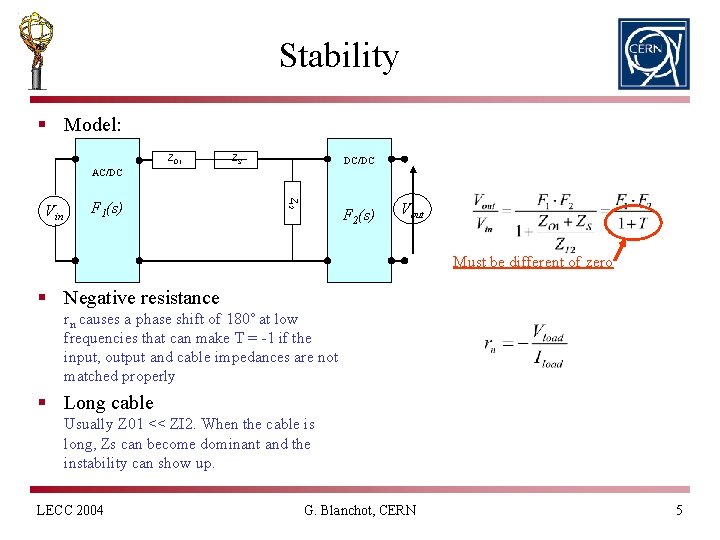
Stability § Model: ZO 1 ZS DC/DC AC/DC F 1(s) ZI 2 Vin F 2(s) Vout Must be different of zero § Negative resistance rn causes a phase shift of 180˚ at low frequencies that can make T = -1 if the input, output and cable impedances are not matched properly § Long cable Usually Z 01 << ZI 2. When the cable is long, Zs can become dominant and the instability can show up. LECC 2004 G. Blanchot, CERN 5
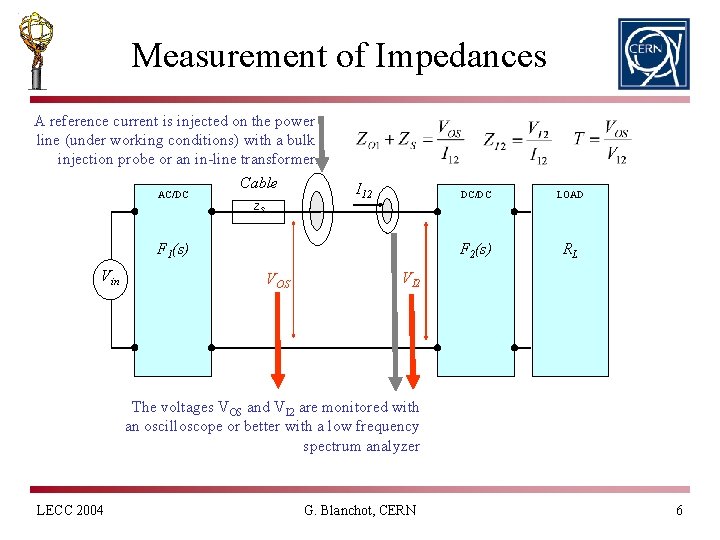
Measurement of Impedances A reference current is injected on the power line (under working conditions) with a bulk injection probe or an in-line transformer. AC/DC Cable I 12 DC/DC LOAD F 2(s) RL ZS F 1(s) Vin VOS VI 2 The voltages VOS and VI 2 are monitored with an oscilloscope or better with a low frequency spectrum analyzer LECC 2004 G. Blanchot, CERN 6
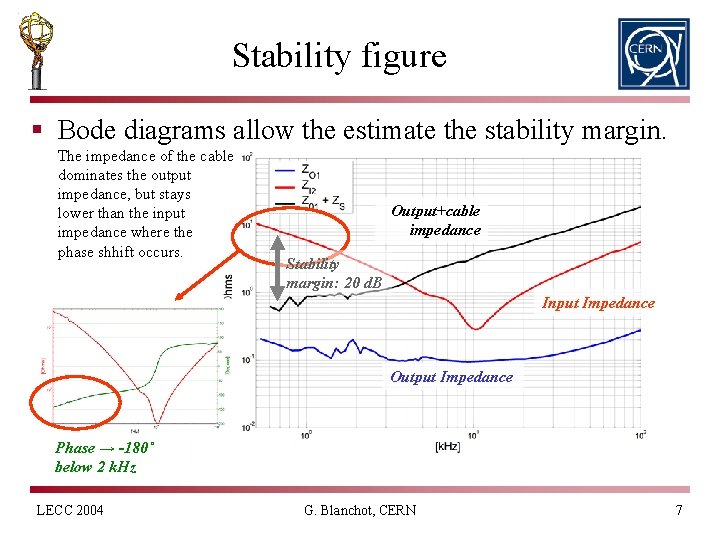
Stability figure § Bode diagrams allow the estimate the stability margin. The impedance of the cable dominates the output impedance, but stays lower than the input impedance where the phase shhift occurs. Output+cable impedance Stability margin: 20 d. B Input Impedance Output Impedance Phase → -180˚ below 2 k. Hz LECC 2004 G. Blanchot, CERN 7
![Stability figure § Nyquist Chart Full load Im[T] The plot of T(s) in the](http://slidetodoc.com/presentation_image_h/2ed9ba15706a7b4d57a9508b407efe6e/image-8.jpg "Stability figure § Nyquist Chart Full load Im[T] The plot of T(s) in the")
Stability figure § Nyquist Chart Full load Im[T] The plot of T(s) in the complex plane for increasing frequencies must not enclose the (-1, 0) point. The curves are a fucntion of the load applied. No load The system appears again stable at full load. Re[T] LECC 2004 G. Blanchot, CERN 8
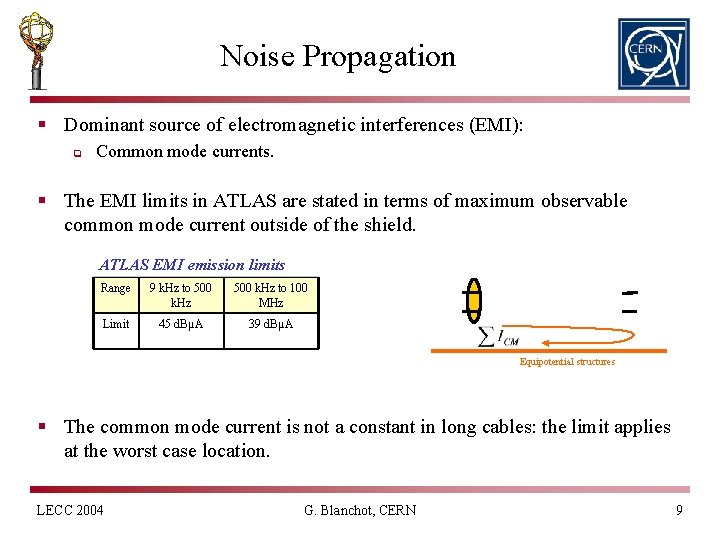
Noise Propagation § Dominant source of electromagnetic interferences (EMI): q Common mode currents. § The EMI limits in ATLAS are stated in terms of maximum observable common mode current outside of the shield. ATLAS EMI emission limits Range 9 k. Hz to 500 k. Hz to 100 MHz Limit 45 d. BμA 39 d. BμA Equipotential structures § The common mode current is not a constant in long cables: the limit applies at the worst case location. LECC 2004 G. Blanchot, CERN 9
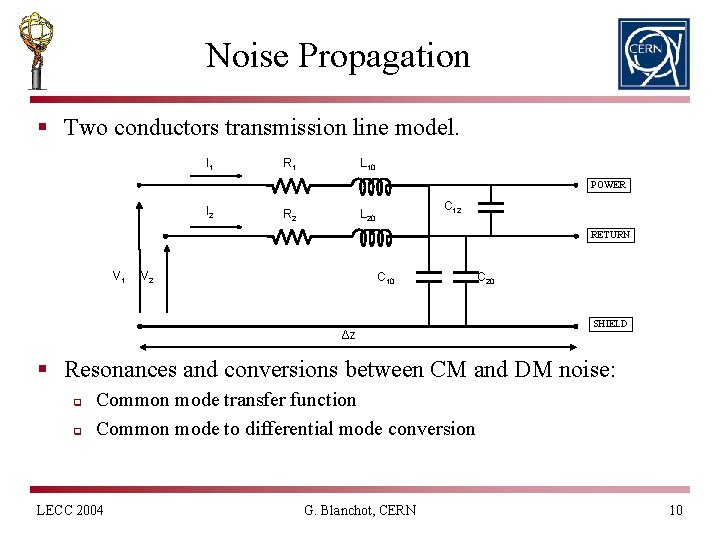
Noise Propagation § Two conductors transmission line model. I 1 R 1 L 10 POWER I 2 R 2 C 12 L 20 RETURN V 1 V 2 C 10 Δz C 20 SHIELD § Resonances and conversions between CM and DM noise: q q Common mode transfer function Common mode to differential mode conversion LECC 2004 G. Blanchot, CERN 10
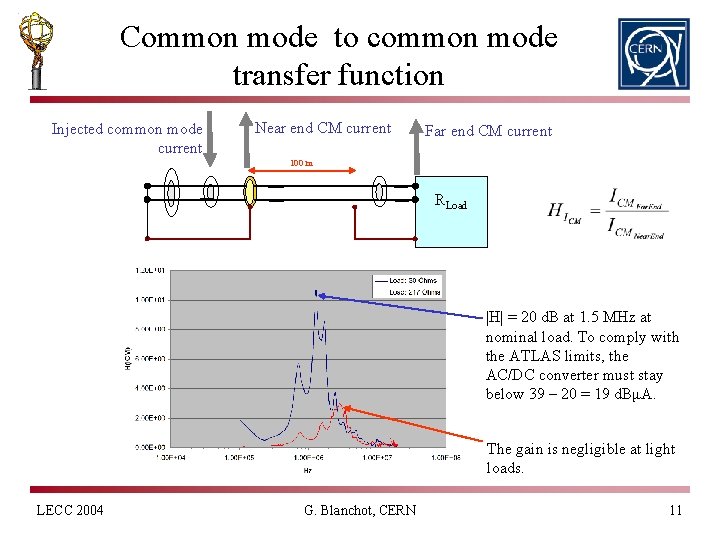
Common mode to common mode transfer function Injected common mode current Near end CM current Far end CM current 100 m RLoad |H| = 20 d. B at 1. 5 MHz at nominal load. To comply with the ATLAS limits, the AC/DC converter must stay below 39 – 20 = 19 d. BμA. The gain is negligible at light loads. LECC 2004 G. Blanchot, CERN 11
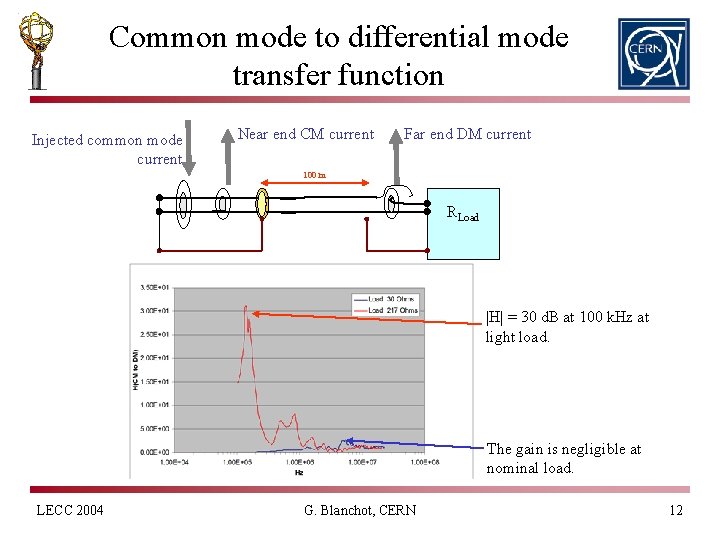
Common mode to differential mode transfer function Injected common mode current Near end CM current Far end DM current 100 m RLoad |H| = 30 d. B at 100 k. Hz at light load. The gain is negligible at nominal load. LECC 2004 G. Blanchot, CERN 12
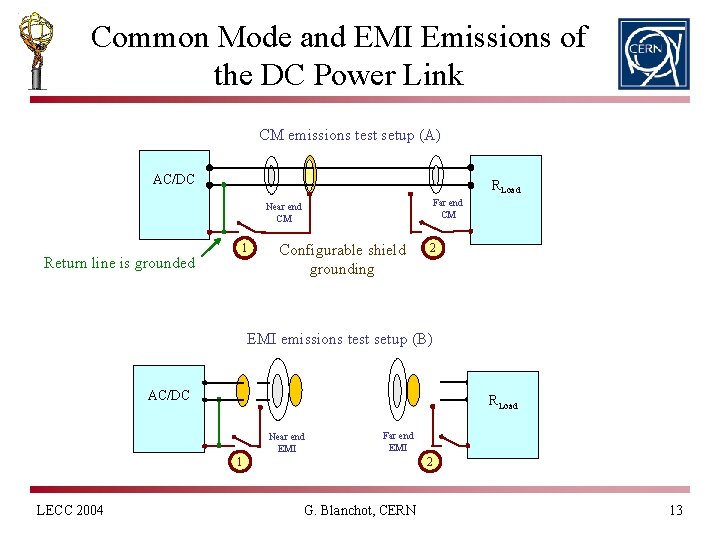
Common Mode and EMI Emissions of the DC Power Link CM emissions test setup (A) AC/DC RLoad Far end CM Near end CM Return line is grounded 1 Configurable shield grounding 2 EMI emissions test setup (B) AC/DC RLoad Near end EMI Far end EMI 1 LECC 2004 2 G. Blanchot, CERN 13
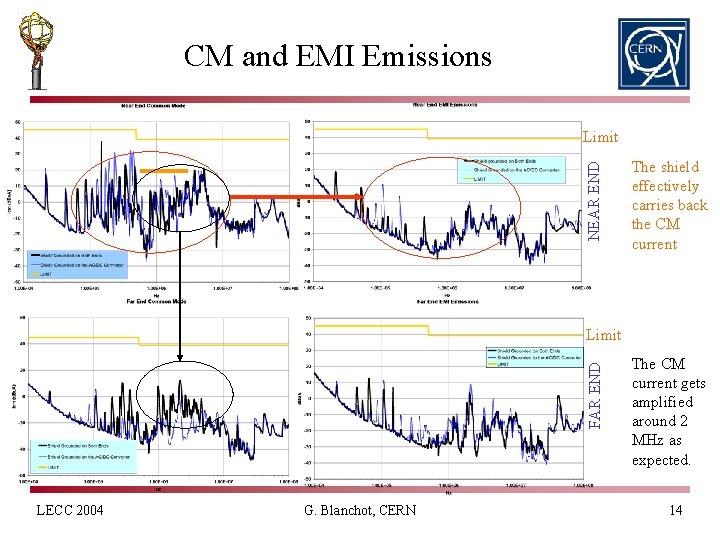
CM and EMI Emissions NEAR END Limit The shield effectively carries back the CM current FAR END Limit LECC 2004 G. Blanchot, CERN The CM current gets amplified around 2 MHz as expected. 14
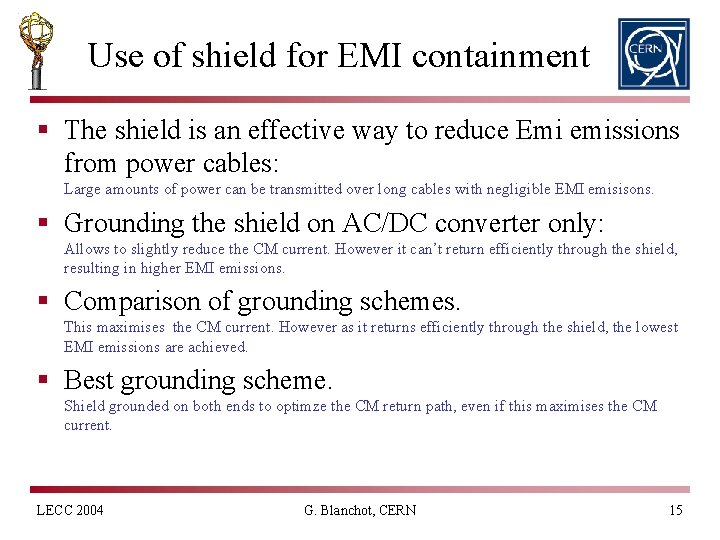
Use of shield for EMI containment § The shield is an effective way to reduce Emi emissions from power cables: Large amounts of power can be transmitted over long cables with negligible EMI emisisons. § Grounding the shield on AC/DC converter only: Allows to slightly reduce the CM current. However it can’t return efficiently through the shield, resulting in higher EMI emissions. § Comparison of grounding schemes. This maximises the CM current. However as it returns efficiently through the shield, the lowest EMI emissions are achieved. § Best grounding scheme. Shield grounded on both ends to optimze the CM return path, even if this maximises the CM current. LECC 2004 G. Blanchot, CERN 15
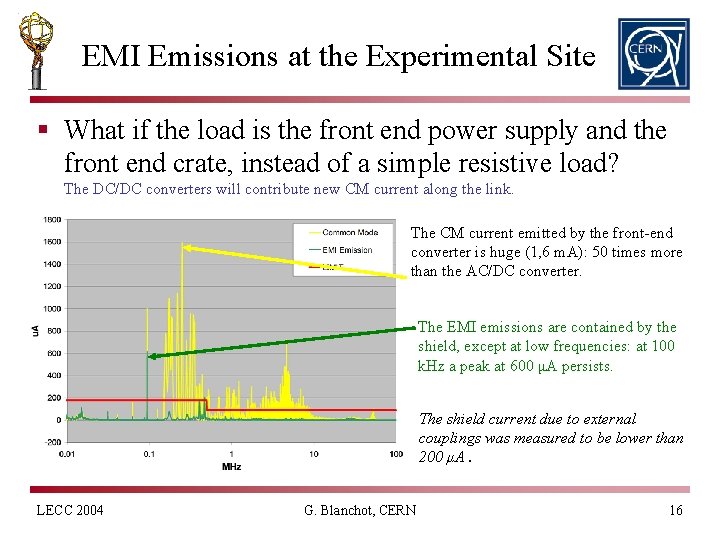
EMI Emissions at the Experimental Site § What if the load is the front end power supply and the front end crate, instead of a simple resistive load? The DC/DC converters will contribute new CM current along the link. The CM current emitted by the front-end converter is huge (1, 6 m. A): 50 times more than the AC/DC converter. The EMI emissions are contained by the shield, except at low frequencies: at 100 k. Hz a peak at 600 μA persists. The shield current due to external couplings was measured to be lower than 200 μA. LECC 2004 G. Blanchot, CERN 16
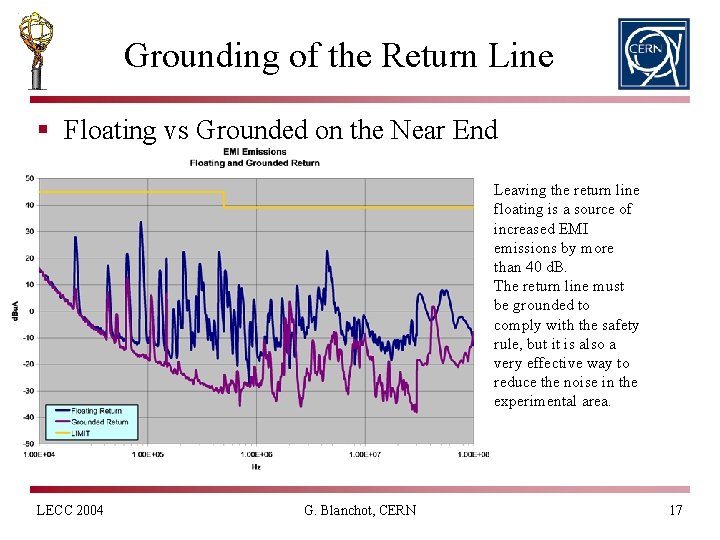
Grounding of the Return Line § Floating vs Grounded on the Near End Leaving the return line floating is a source of increased EMI emissions by more than 40 d. B. The return line must be grounded to comply with the safety rule, but it is also a very effective way to reduce the noise in the experimental area. LECC 2004 G. Blanchot, CERN 17
Conclusions § A stable, low noise power distribution was achieved for the Liquid Argon Detector. § The noise emitted by the AC/DC converter is within the ATLAS limits, except at 100 k. Hz with 600 μA with respect to the limit of 200 μA. § The front end converters are the dominant source of noise. § The use of a shielded power cable, grounded on both ends, is the most effective way to reduce the noise. § Grounding the return line is an effective way to reduce the EMI emissions. LECC 2004 G. Blanchot, CERN 18
- Slides: 18