
Electromagnetic Applications G 101 A MEASURING INSTRUMENTS Objectives

Electromagnetic Applications G 101 A MEASURING INSTRUMENTS
Objectives 2 At the conclusion of this topic, you should understand: - The moving coil and moving iron meter movements. - The function of shunt and multiplying resistors. - Factors affecting selection - Meter safety categories - Safe use and care of meters
Reference Electrical Trade Principles – Hampson and Hanssen: Section 1: pgs 47 – 51 & 53 3
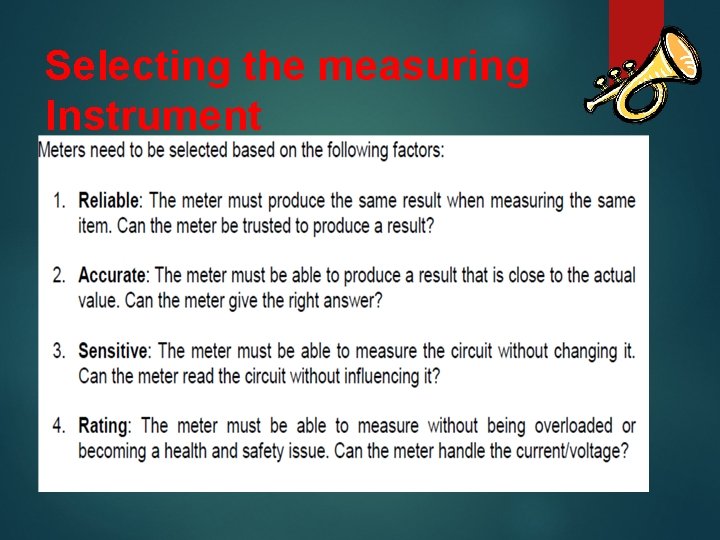
Selecting the measuring Instrument 4
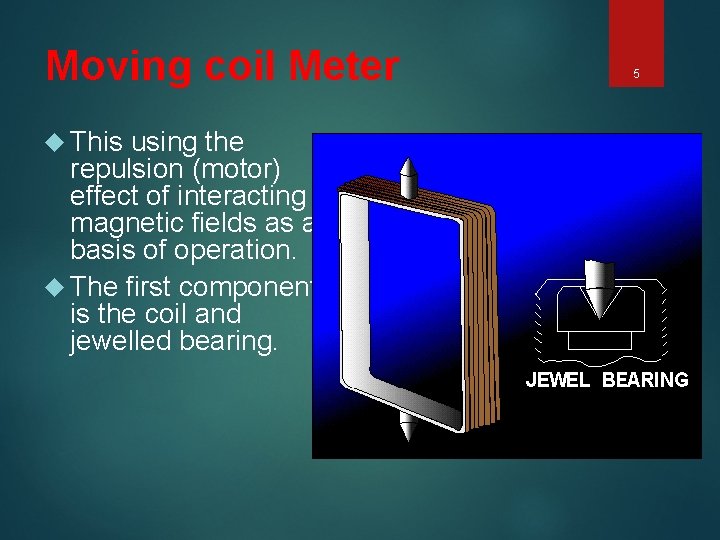
Moving coil Meter This using the repulsion (motor) effect of interacting magnetic fields as a basis of operation. The first component is the coil and jewelled bearing. 5

Moving coil Meter Next, how does the coil move back to zero once the coil current is removed? Enter - the hairspring. It also provides balancing force against the applied coil current. 6
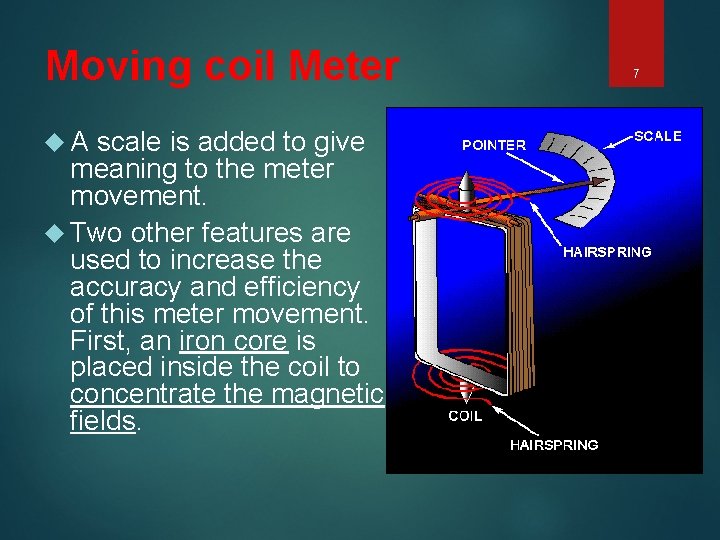
Moving coil Meter A scale is added to give meaning to the meter movement. Two other features are used to increase the accuracy and efficiency of this meter movement. First, an iron core is placed inside the coil to concentrate the magnetic fields. 7
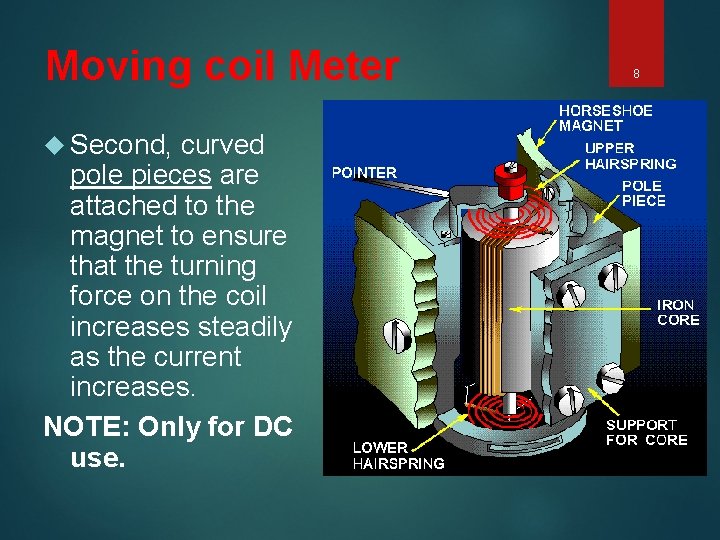
Moving coil Meter Second, curved pole pieces are attached to the magnet to ensure that the turning force on the coil increases steadily as the current increases. NOTE: Only for DC use. 8

Moving coil Meter 9
Moving Iron Meter 10 The moving iron vane movement is used mainly for AC & DC current and voltage. It operates on the principle of magnetic repulsion between like poles. The measured current flows through a field coil which produces a magnetic field proportional to the current. Suspended in this field are two iron vanes attached to a pointer. The two iron vanes consist of one fixed and one moveable vane. The magnetic field produced magnetizes the two iron vanes with the same polarity regardless of the direction of current through the coil.
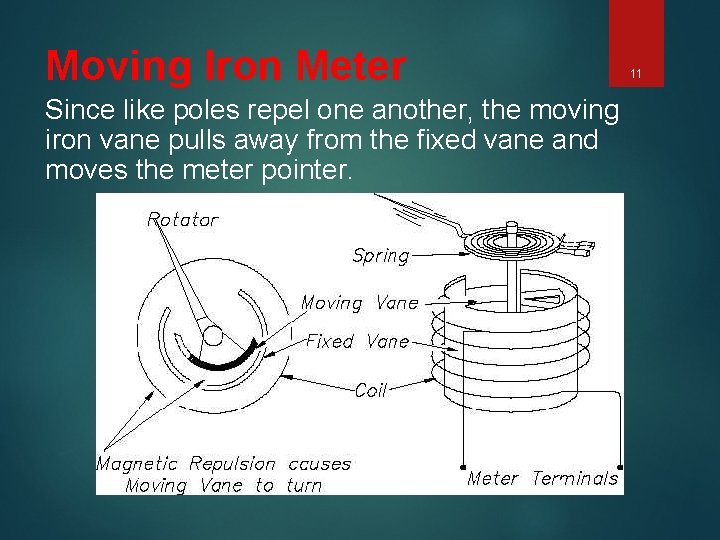
Moving Iron Meter Since like poles repel one another, the moving iron vane pulls away from the fixed vane and moves the meter pointer. 11
Analogue VS Digital 12 The choice is generally based on personal preference. Quality instruments of both types will have similar accuracy. Digital meter advantages include: easier to read; more features; more rugged. High impedance ie Ohm per volt rating usually greater than 10 M/Ohms per volt. Disadvantages: Cannot read “behind” resolution limit; not good for rate of change type measurement.

Analogue VS Digital Analogue 13 meter advantages include: Reading is not limited by digital resolution (can interpret between markings), good for rate of change type display. Disadvantages: Much more fragile than the digital meter (can easily damage jeweled bearing); harder to read; parallax error (use mirrored back to align pointer reflection and eliminate error).

Measuring Voltage A 14 number of precision resistors called multipliers make up the voltage section of an analogue multimeter. The ohm values of the resistors are designed to match the f. s. d of the meter movement with differing maximum voltages applied. The function of the multiplying resistors are to limit the current to the coil to no more than the f. s. d of the meter. Always check the leads are in the correct sockets. If in amps sockets you will cause a short circuit. Also measure in parallel across the component in question.
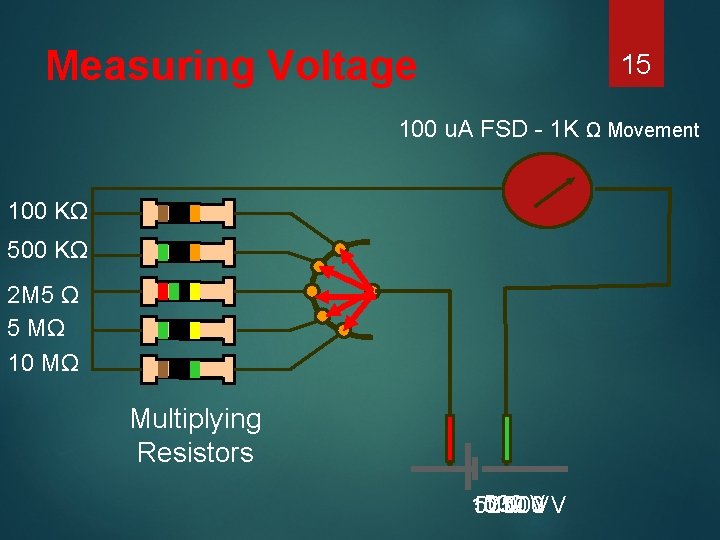
Measuring Voltage 15 100 u. A FSD - 1 K Ω Movement 100 KΩ 500 KΩ 2 M 5 Ω 5 MΩ 10 MΩ Multiplying Resistors 500 10 50 250 1000 VV V VV
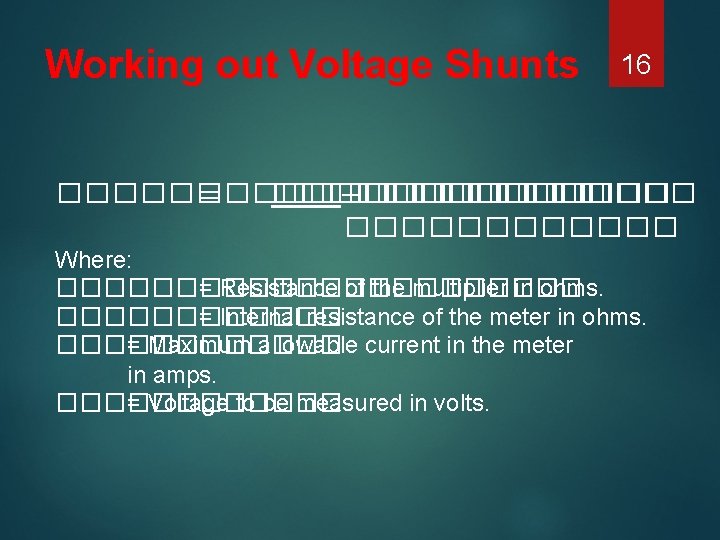
Working out Voltage Shunts 16 ����������� = ������ −������������ Where: ����������� = Resistance of the multiplier in ohms. ������ = Internal resistance of the meter in ohms. ������ = Maximum allowable current in the meter in amps. ������ = Voltage to be measured in volts.
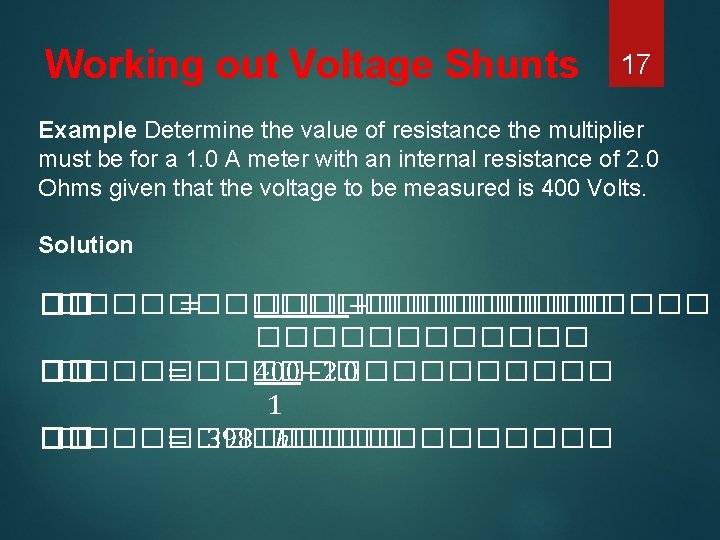
Working out Voltage Shunts 17 Example Determine the value of resistance the multiplier must be for a 1. 0 A meter with an internal resistance of 2. 0 Ohms given that the voltage to be measured is 400 Volts. Solution �� ���������� = ������ − ������������ �� ���������� = 400− 2. 0 1 �� ���������� = 398 �� ℎ����
Measuring Current 18 In the following diagram, the maximum current permitted through the meter’s coil is 100 A, any current above this value must bypass the coil. This is done by switching resistors (shunts) in parallel with the movement. The shunt provides an alternative path for all currents greater than the meter’s f. s. d Always measure in series with the component if measuring in parallel you will cause a short circuit.
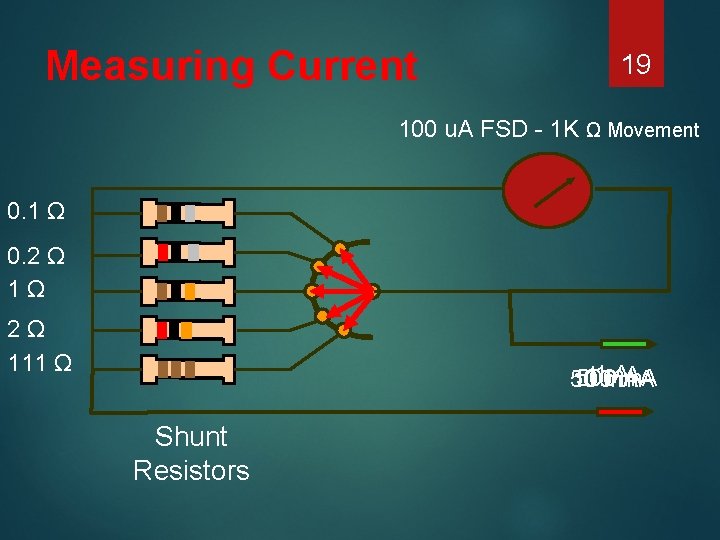
Measuring Current 19 100 u. A FSD - 1 K Ω Movement 0. 1 Ω 0. 2 Ω 1Ω 2Ω 111 Ω Am. A 11 m. A 500 m. A 50 100 Shunt Resistors
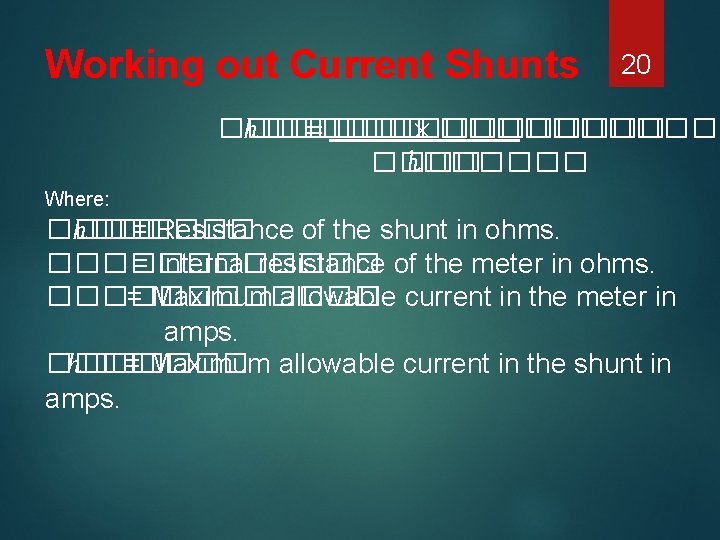
Working out Current Shunts 20 ���� ℎ������ = ������ × ������ ℎ������ Where: ���� ℎ������ = Resistance of the shunt in ohms. ������ = Internal resistance of the meter in ohms. ������ = Maximum allowable current in the meter in amps. ���� ℎ������ = Maximum allowable current in the shunt in amps.
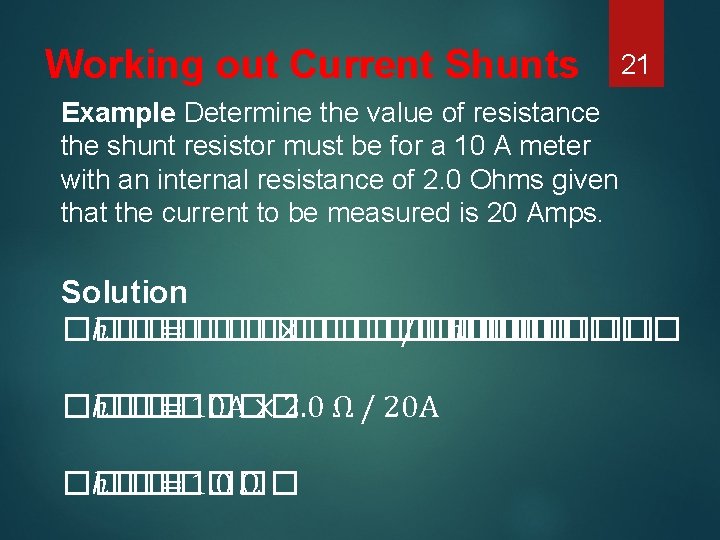
Working out Current Shunts 21 Example Determine the value of resistance the shunt resistor must be for a 10 A meter with an internal resistance of 2. 0 Ohms given that the current to be measured is 20 Amps. Solution ���� ℎ������ = ������ ×������ / ���� ℎ������ = 10 A × 2. 0 Ω / 20 A ���� ℎ������ = 1. 0 Ω
Measuring Resistance 22 Always re-check zero and adjust Ohms zero knob (for analogue meter) and in particular when changing resistance range. Always disconnect component from supply and isolate component from circuit. The range selector on the analogue meter acts as a multiplier to the measured reading.
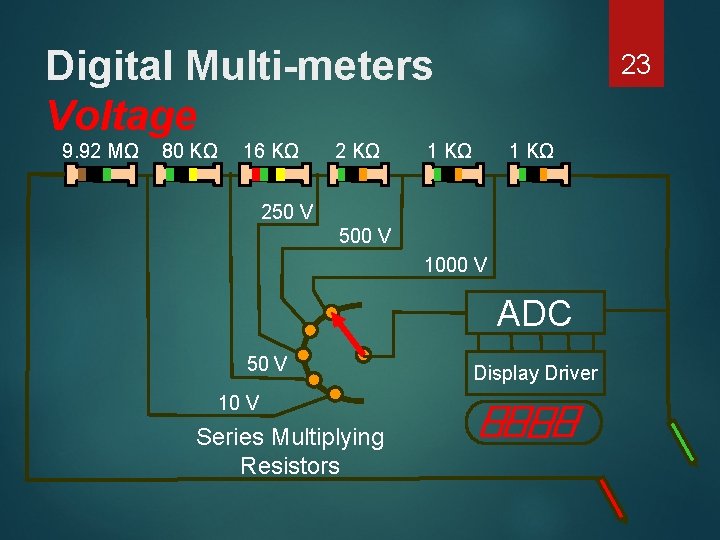
Digital Multi-meters Voltage 9. 92 MΩ 80 KΩ 16 KΩ 23 1 KΩ 250 V 500 V 1000 V ADC 50 V 10 V Series Multiplying Resistors Display Driver
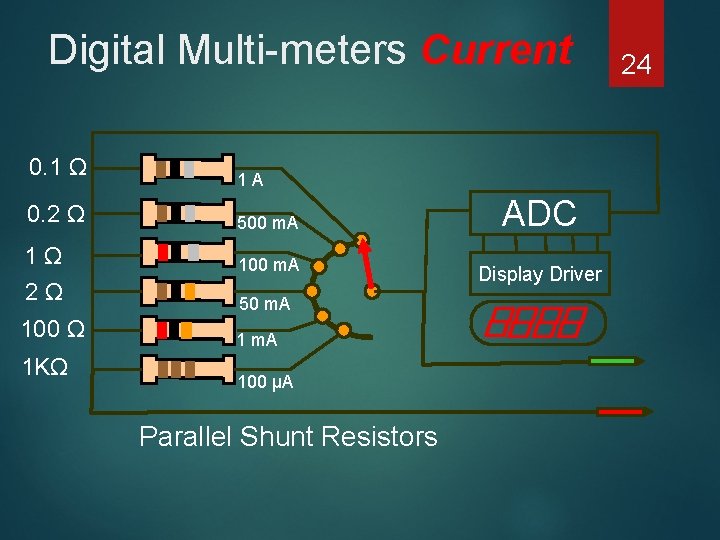
Digital Multi-meters Current 0. 1 Ω 1 A 0. 2 Ω 500 m. A 1Ω 100 m. A 2Ω 50 m. A 100 Ω 1 KΩ 1 m. A 100 μA Parallel Shunt Resistors ADC Display Driver 24
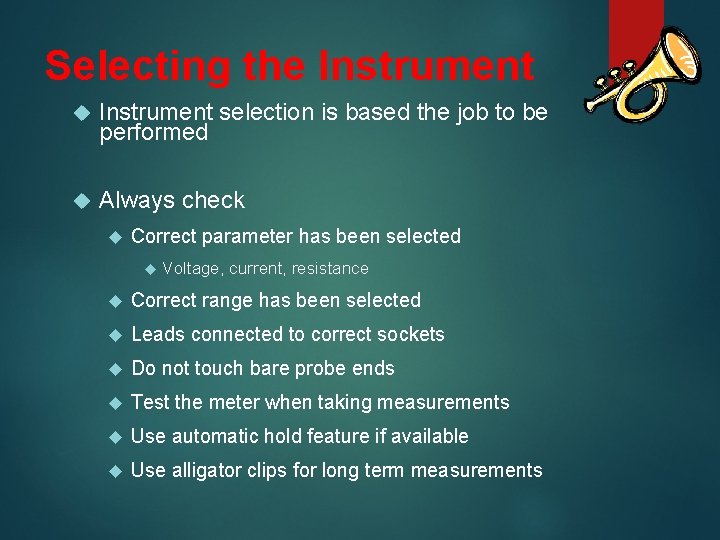
Selecting the Instrument selection is based the job to be performed Always check Correct parameter has been selected Voltage, current, resistance Correct range has been selected Leads connected to correct sockets Do not touch bare probe ends Test the meter when taking measurements Use automatic hold feature if available Use alligator clips for long term measurements 25
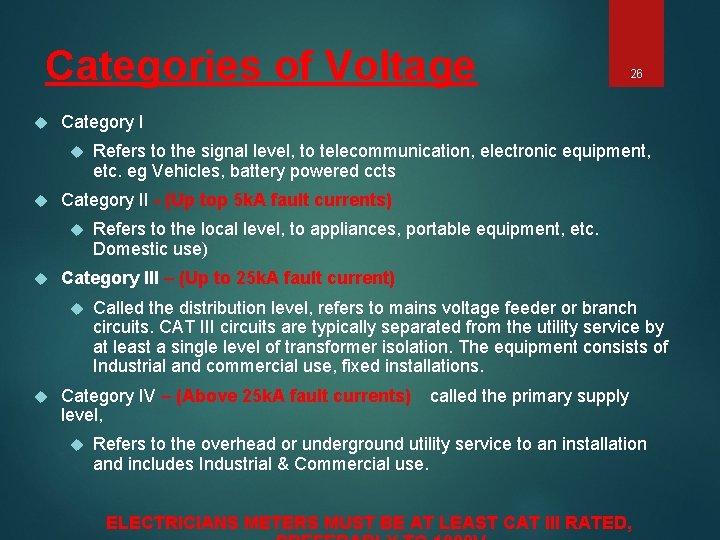
Categories of Voltage Category I Refers to the local level, to appliances, portable equipment, etc. Domestic use) Category III – (Up to 25 k. A fault current) Refers to the signal level, to telecommunication, electronic equipment, etc. eg Vehicles, battery powered ccts Category II - (Up top 5 k. A fault currents) 26 Called the distribution level, refers to mains voltage feeder or branch circuits. CAT III circuits are typically separated from the utility service by at least a single level of transformer isolation. The equipment consists of Industrial and commercial use, fixed installations. Category IV – (Above 25 k. A fault currents) level, called the primary supply Refers to the overhead or underground utility service to an installation and includes Industrial & Commercial use. ELECTRICIANS METERS MUST BE AT LEAST CAT III RATED,
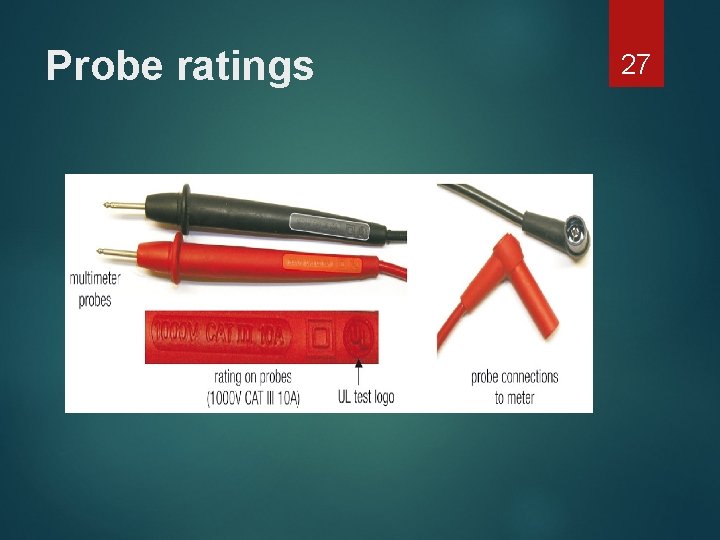
Probe ratings 27
What can go wrong? 28 Most accidents with measuring instruments are as a result of the user not connecting the instrument correctly. Especially for voltage measurement, you must ensure the leads are NOT PLACED into the Amp measuring sockets. (Arc flash potential).
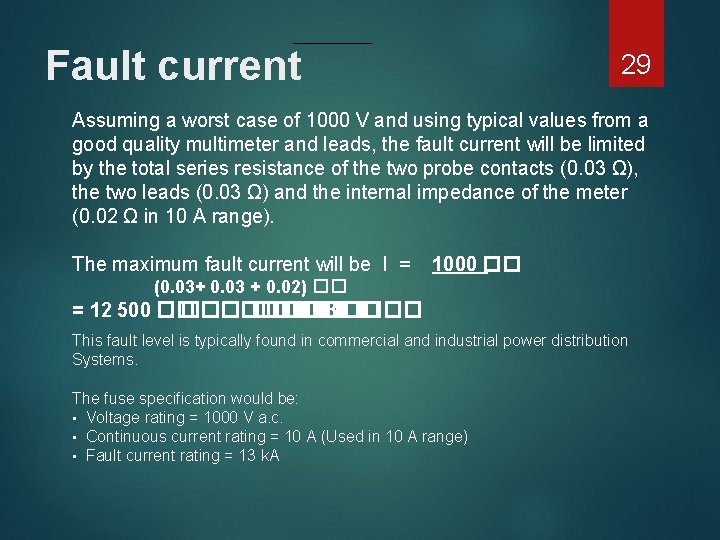
Fault current 29 Assuming a worst case of 1000 V and using typical values from a good quality multimeter and leads, the fault current will be limited by the total series resistance of the two probe contacts (0. 03 Ω), the two leads (0. 03 Ω) and the internal impedance of the meter (0. 02 Ω in 10 A range). The maximum fault current will be I = 1000 �� (0. 03+ 0. 03 + 0. 02) �� = 12 500 ��. ����� 13 ���� This fault level is typically found in commercial and industrial power distribution Systems. The fuse specification would be: • Voltage rating = 1000 V a. c. • Continuous current rating = 10 A (Used in 10 A range) • Fault current rating = 13 k. A
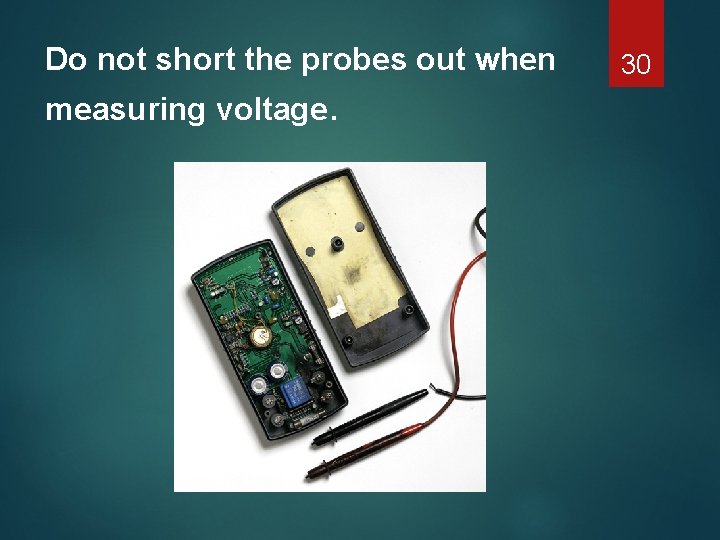
Do not short the probes out when measuring voltage. 30
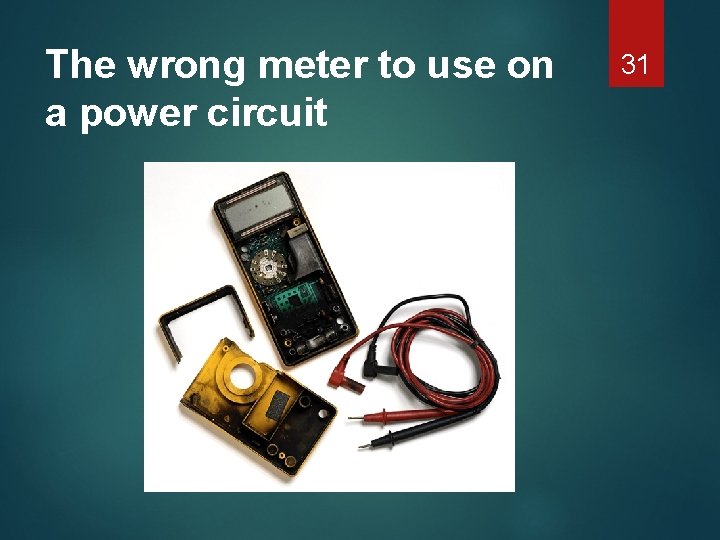
The wrong meter to use on a power circuit 31

The electrician suffered severe burn injuries. He has his fingerprints burned into the probes. 32
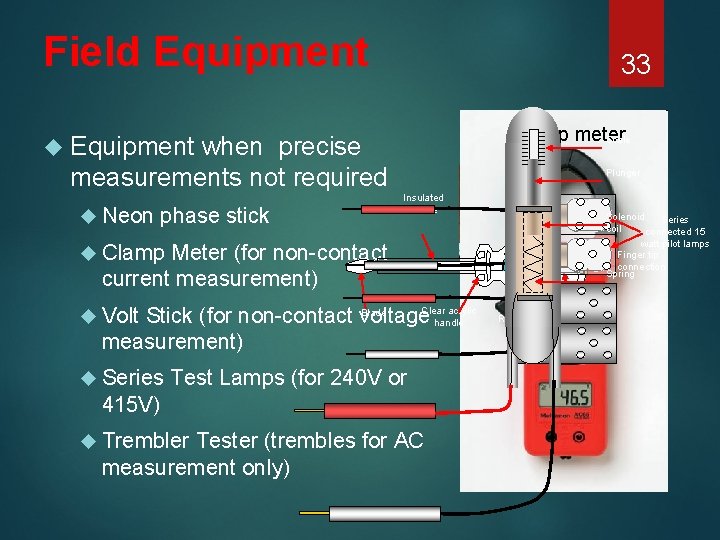
Field Equipment 33 Clamp meter Scale Equipment when precise measurements not required Neon phase stick Plunger Insulated sleeve Solenoid Series coil connected 15 watt pilot lamps Finger tip connection Spring Clamp Meter (for non-contact current measurement) Volt Clear acrylic Blade Stick (for non-contact voltage handle measurement) Series Test Lamps (for 240 V or 415 V) Trembler Tester (trembles for AC measurement only) Resistor Neon lamp

34 THE END
- Slides: 34