
ELECTROLYTIC CELLS QUANTITATIVE ELECTROLYSIS Bromfield AP Chemistry Thanks
ELECTROLYTIC CELLS & QUANTITATIVE ELECTROLYSIS Bromfield AP Chemistry Thanks to Maddy and Julia
OBJECTIVES • Differentiate between voltaic and electrolytic cells • Discuss electrolysis • Define electroplating • Master quantitative electrolysis
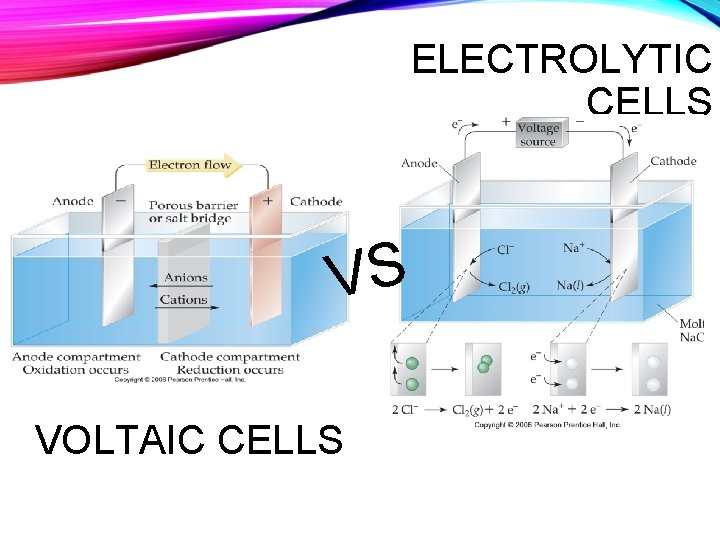
ELECTROLYTIC CELLS VS VOLTAIC CELLS
• Chemical energy is converted to electrical energy IN ELECTROLYTIC CELLS… • Electrical energy is vs… • The redox reaction is spontaneous with a positive vs… Ecell • The half cells are separated s… v by a salt bridge IN VOLTAIC CELLS… converted into chemical energy • Reactions Are NOT spontaneous. They need electrical energy to be supplied and have a negative Ecell • Electrodes are placed in the same container in a solution of molten electrolyte
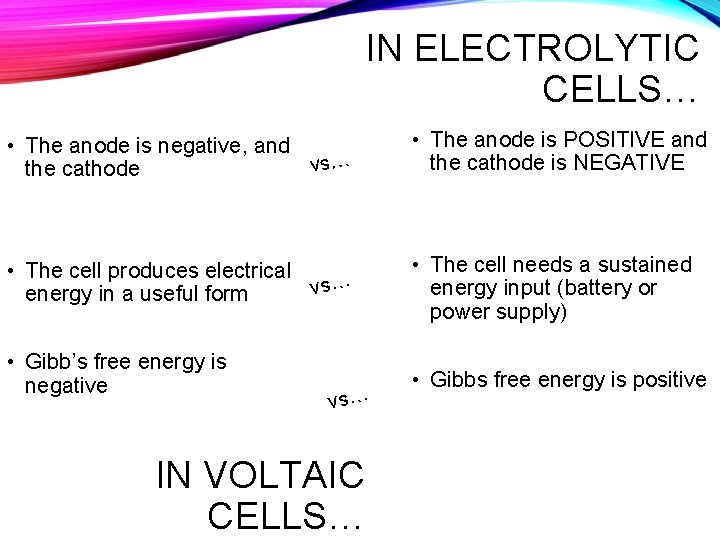
IN ELECTROLYTIC CELLS… • The anode is negative, and vs… the cathode • The anode is POSITIVE and the cathode is NEGATIVE • The cell produces electrical vs… energy in a useful form • The cell needs a sustained energy input (battery or power supply) • Gibb’s free energy is negative • Gibbs free energy is positive vs… IN VOLTAIC CELLS…

ELECTROLYSIS • Defined as the chemical decomposition that occurs when an electric current is passed through a liquid or solution of ions • The electrolysis of molten salts requires very high temperatures • Electrolysis of aqueous solutions is more complicated
ELECTRODES • Inert electrodes • Do not undergo any reaction • Serve as surface where oxidation and reduction occur • Ex: graphite, platinum electrodes • Active electrodes • Electrodes that participate in electrolysis process • Electroplating • Reaction writing with active electrodes DOES NOT appear on the AP exam
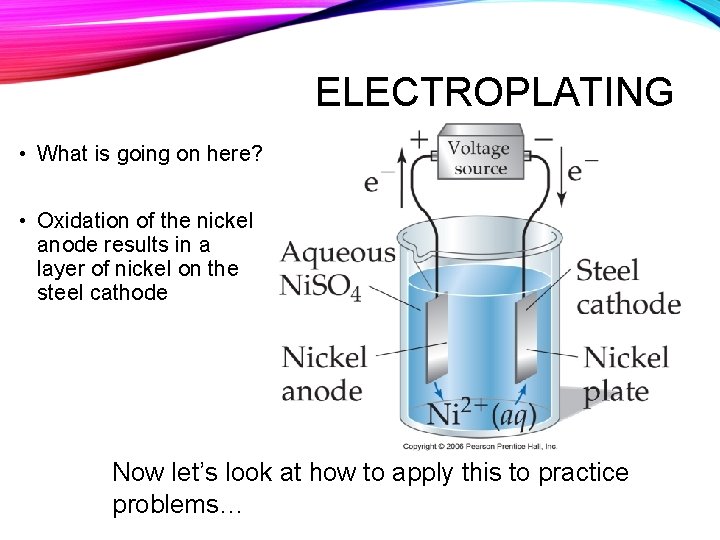
ELECTROPLATING • What is going on here? • Oxidation of the nickel anode results in a layer of nickel on the steel cathode Now let’s look at how to apply this to practice problems…
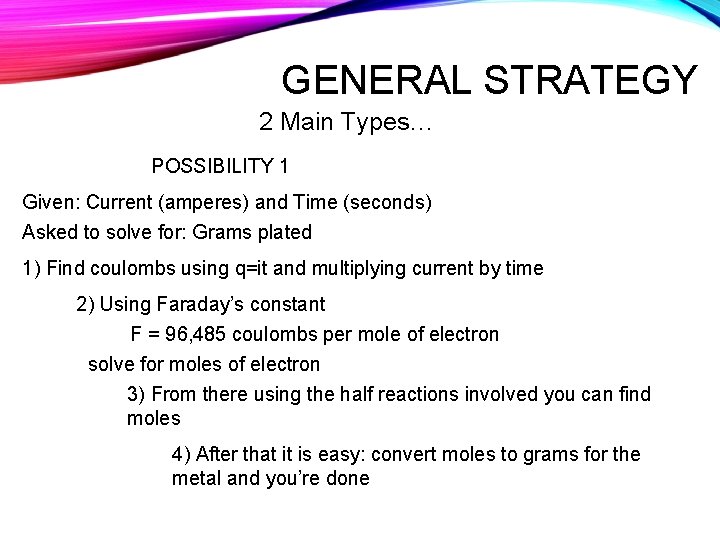
GENERAL STRATEGY 2 Main Types… POSSIBILITY 1 Given: Current (amperes) and Time (seconds) Asked to solve for: Grams plated 1) Find coulombs using q=it and multiplying current by time 2) Using Faraday’s constant F = 96, 485 coulombs per mole of electron solve for moles of electron 3) From there using the half reactions involved you can find moles 4) After that it is easy: convert moles to grams for the metal and you’re done
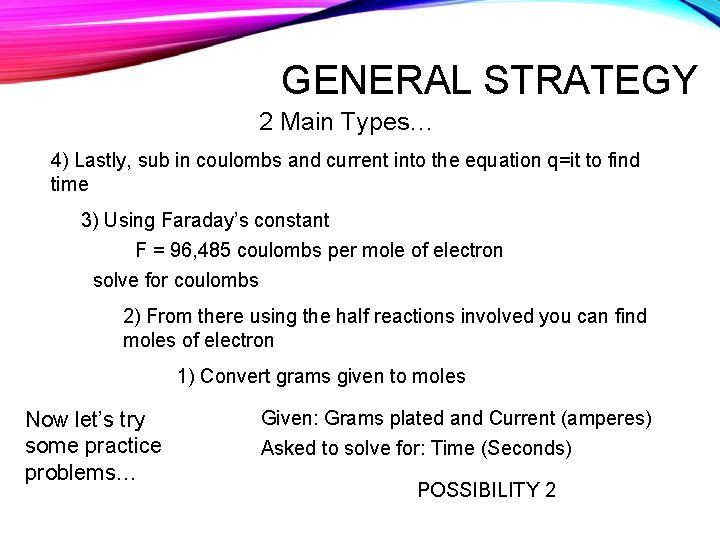
GENERAL STRATEGY 2 Main Types… 4) Lastly, sub in coulombs and current into the equation q=it to find time 3) Using Faraday’s constant F = 96, 485 coulombs per mole of electron solve for coulombs 2) From there using the half reactions involved you can find moles of electron 1) Convert grams given to moles Now let’s try some practice problems… Given: Grams plated and Current (amperes) Asked to solve for: Time (Seconds) POSSIBILITY 2
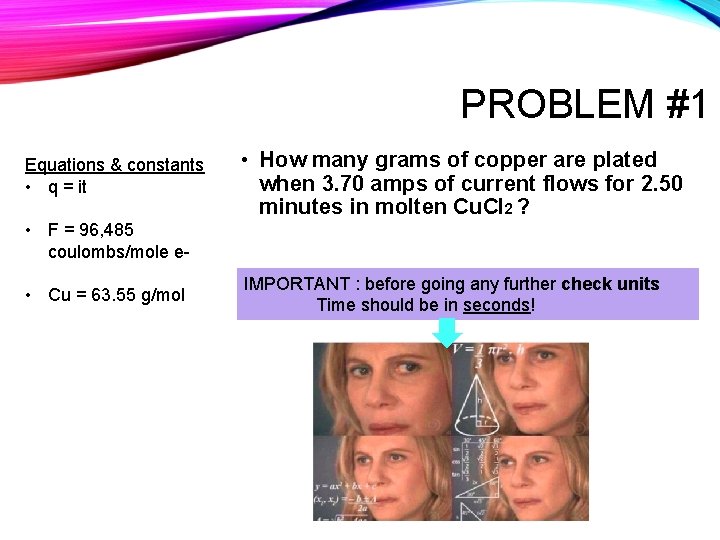
PROBLEM #1 Equations & constants • q = it • How many grams of copper are plated when 3. 70 amps of current flows for 2. 50 minutes in molten Cu. Cl 2 ? • F = 96, 485 coulombs/mole e • Cu = 63. 55 g/mol IMPORTANT : before going any further check units Time should be in seconds!
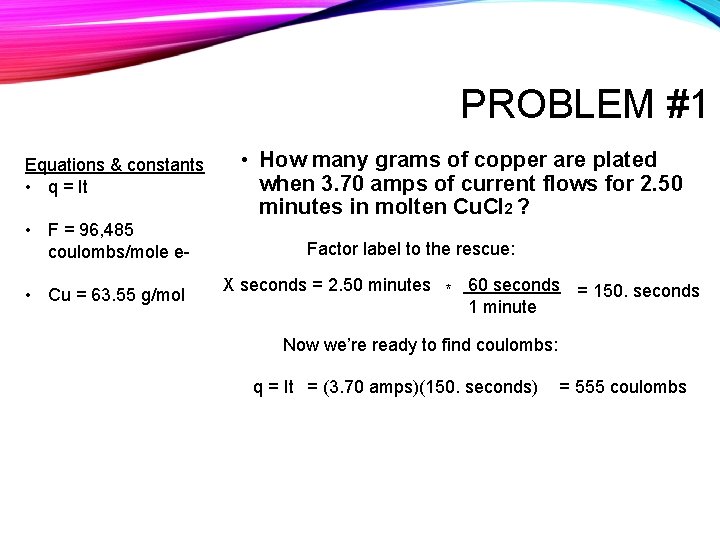
PROBLEM #1 Equations & constants • q = It • F = 96, 485 coulombs/mole e • Cu = 63. 55 g/mol • How many grams of copper are plated when 3. 70 amps of current flows for 2. 50 minutes in molten Cu. Cl 2 ? Factor label to the rescue: X seconds = 2. 50 minutes * 60 seconds = 150. seconds 1 minute Now we’re ready to find coulombs: q = It = (3. 70 amps)(150. seconds) = 555 coulombs
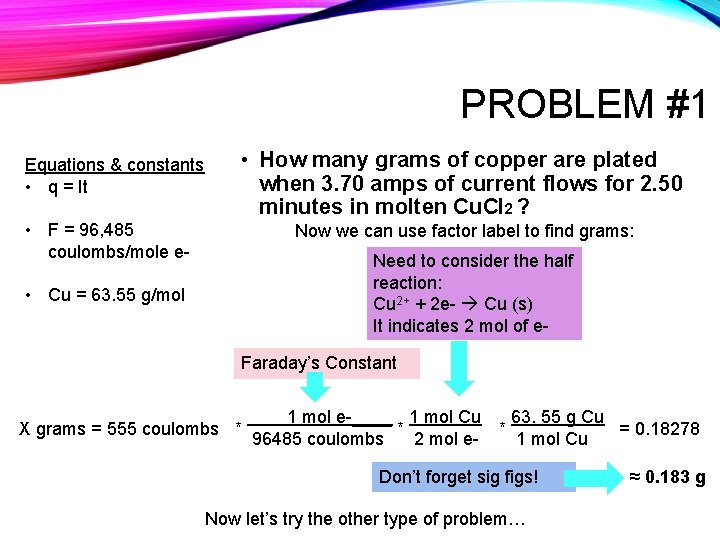
PROBLEM #1 Equations & constants • q = It • How many grams of copper are plated when 3. 70 amps of current flows for 2. 50 minutes in molten Cu. Cl 2 ? • F = 96, 485 coulombs/mole e- Now we can use factor label to find grams: Need to consider the half reaction: Cu 2+ + 2 e- Cu (s) It indicates 2 mol of e- • Cu = 63. 55 g/mol Faraday’s Constant X grams = 555 coulombs * 1 mol e-____ 1 mol Cu * 96485 coulombs 2 mol e- * 63. 55 g Cu = 0. 18278 1 mol Cu Don’t forget sig figs! Now let’s try the other type of problem… ≈ 0. 183 g
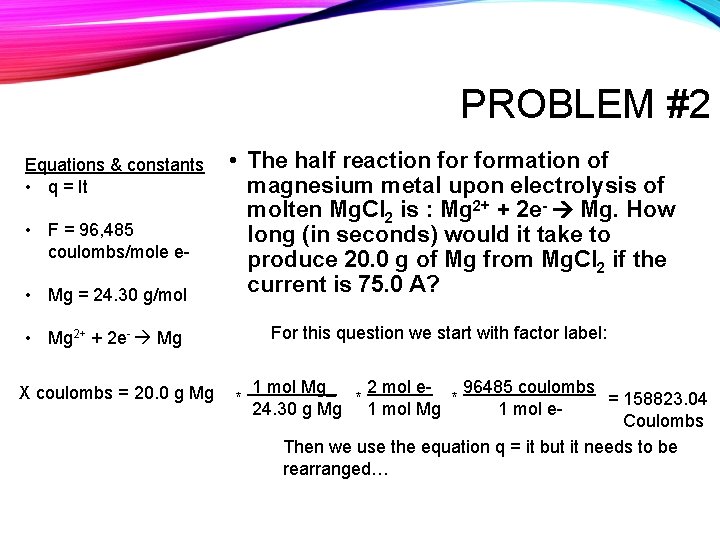
PROBLEM #2 Equations & constants • q = It • F = 96, 485 coulombs/mole e • Mg = 24. 30 g/mol • The half reaction formation of magnesium metal upon electrolysis of molten Mg. Cl 2 is : Mg 2+ + 2 e- Mg. How long (in seconds) would it take to produce 20. 0 g of Mg from Mg. Cl 2 if the current is 75. 0 A? For this question we start with factor label: • Mg 2+ + 2 e- Mg X coulombs = 20. 0 g Mg * 1 mol Mg_ 2 mol e 96485 coulombs * * = 158823. 04 24. 30 g Mg 1 mol e. Coulombs Then we use the equation q = it but it needs to be rearranged…
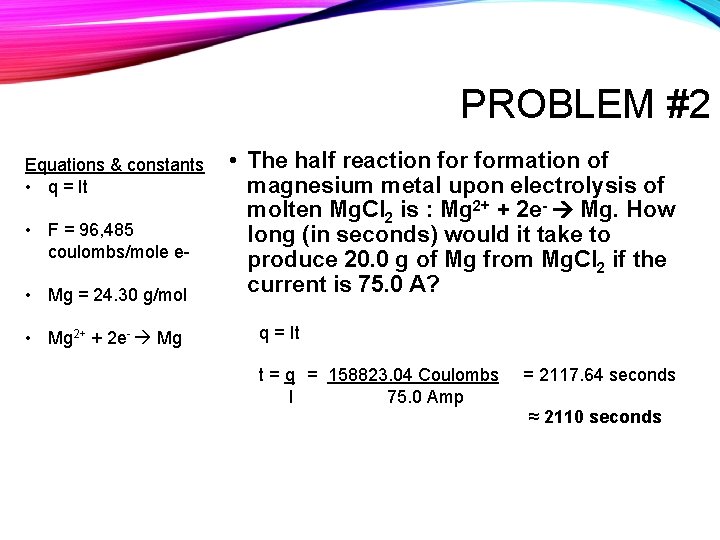
PROBLEM #2 Equations & constants • q = It • F = 96, 485 coulombs/mole e • Mg = 24. 30 g/mol • Mg 2+ + 2 e- Mg • The half reaction formation of magnesium metal upon electrolysis of molten Mg. Cl 2 is : Mg 2+ + 2 e- Mg. How long (in seconds) would it take to produce 20. 0 g of Mg from Mg. Cl 2 if the current is 75. 0 A? q = It t = q = 158823. 04 Coulombs I 75. 0 Amp = 2117. 64 seconds ≈ 2110 seconds

LOOKING FOR MORE PRACTICE? • Check out the online homework site #40 and try out a few until you get the hang of it! • http: //chemistry 2. csudh. edu/homework/starthwfaraday. html
- Slides: 16