
ELECTROLYTES AND NONELECTROLYTES ELECTROLYTES Definition and properties A
- Slides: 5
ELECTROLYTES AND NONELECTROLYTES
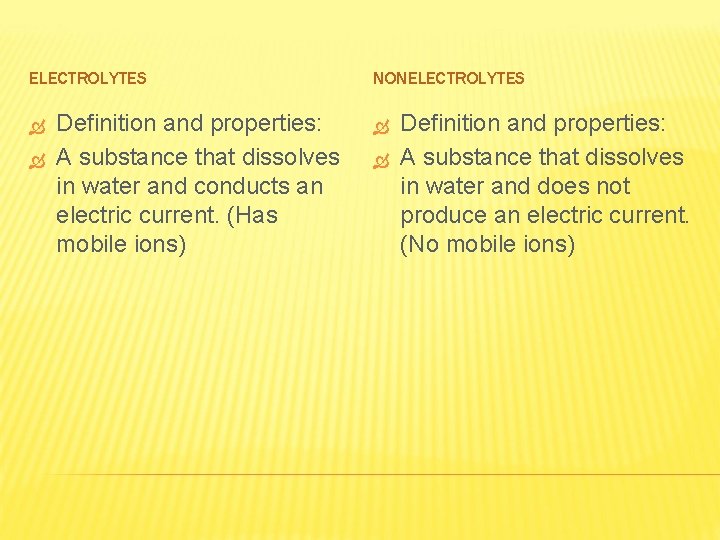
ELECTROLYTES Definition and properties: A substance that dissolves in water and conducts an electric current. (Has mobile ions) NONELECTROLYTES Definition and properties: A substance that dissolves in water and does not produce an electric current. (No mobile ions)
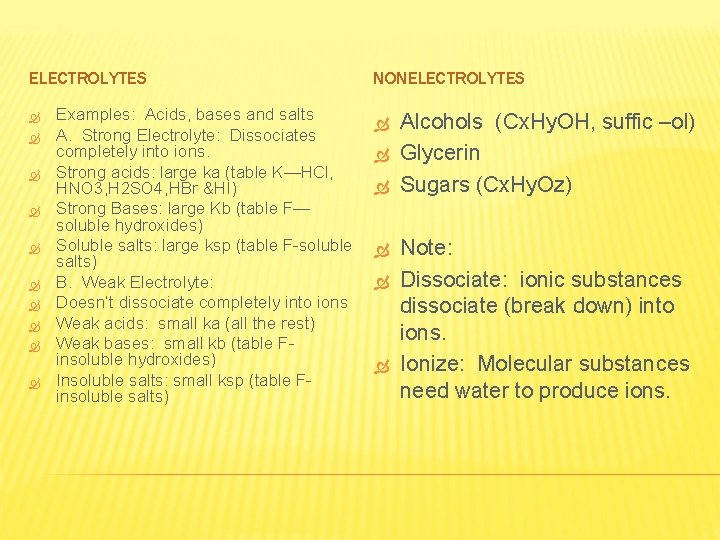
ELECTROLYTES Examples: Acids, bases and salts A. Strong Electrolyte: Dissociates completely into ions. Strong acids: large ka (table K—HCl, HNO 3, H 2 SO 4, HBr &HI) Strong Bases: large Kb (table F— soluble hydroxides) Soluble salts: large ksp (table F-soluble salts) B. Weak Electrolyte: Doesn’t dissociate completely into ions Weak acids: small ka (all the rest) Weak bases: small kb (table Finsoluble hydroxides) Insoluble salts: small ksp (table Finsoluble salts) NONELECTROLYTES Alcohols (Cx. Hy. OH, suffic –ol) Glycerin Sugars (Cx. Hy. Oz) Note: Dissociate: ionic substances dissociate (break down) into ions. Ionize: Molecular substances need water to produce ions.
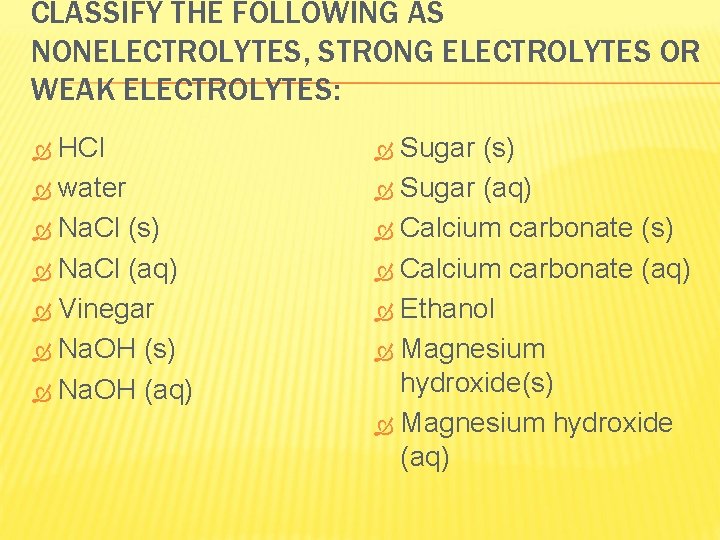
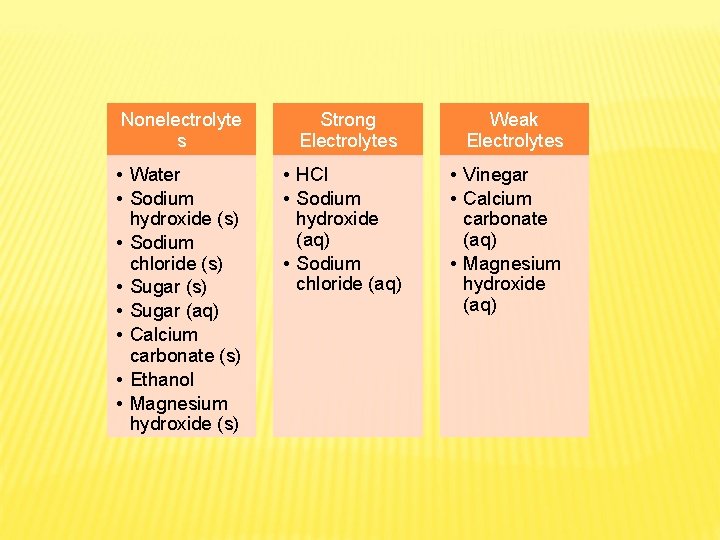
CLASSIFY THE FOLLOWING AS NONELECTROLYTES, STRONG ELECTROLYTES OR WEAK ELECTROLYTES: HCl water Na. Cl (s) Na. Cl (aq) Vinegar Na. OH (s) Na. OH (aq) Sugar (s) Sugar (aq) Calcium carbonate (s) Calcium carbonate (aq) Ethanol Magnesium hydroxide(s) Magnesium hydroxide (aq)
Nonelectrolyte s Strong Electrolytes Weak Electrolytes • Water • Sodium hydroxide (s) • Sodium chloride (s) • Sugar (aq) • Calcium carbonate (s) • Ethanol • Magnesium hydroxide (s) • HCl • Sodium hydroxide (aq) • Sodium chloride (aq) • Vinegar • Calcium carbonate (aq) • Magnesium hydroxide (aq)