
Electrolyte Solutions Milliequivalents Millimoles and Milliosmoles Yewande Dayo

- Slides: 28
Electrolyte Solutions: Milliequivalents, Millimoles and Milliosmoles Yewande Dayo Student Pharmacist
Objectives � Upon completion of this topic, students should be able to � Calculate the milliequivalent weight from an atomic or formula weight � Convert between milligrams and milliequivalents � Calculate problems involving millimoles and milliosmoles
Introduction � The molecules of chemical compounds may remain intact in solution or dissociate into ions � Substances that don’t dissociate are called nonelectrolytes (urea, dextrose) � Those with varying degrees of dissociation are called electrolytes (Na. Cl) � Electrolyte ions in blood plasma include cations (Na+, K+, Ca 2+, and Mg 2+) and anions (Cl-, HCO 3 -, HPO 42 -, SO 42 -)
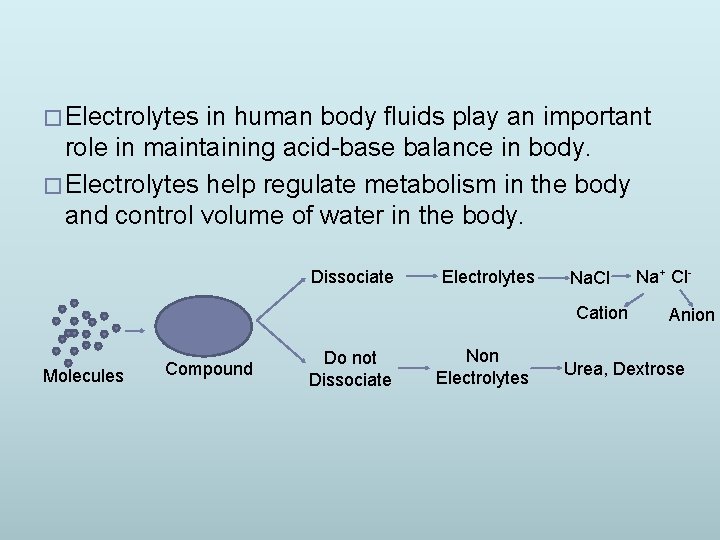
� Electrolytes in human body fluids play an important role in maintaining acid-base balance in body. � Electrolytes help regulate metabolism in the body and control volume of water in the body. Dissociate Electrolytes Na. Cl Cation Molecules Compound Do not Dissociate Non Electrolytes Na+ Cl. Anion Urea, Dextrose
Pharmaceutical Application � Electrolyte preparations are employed to treat fluid and electrolyte imbalances in the body. � Available as oral solutions, syrups, dry granules to be dissolved in water/juice, capsules, tablets and also intravenous infusions.
Milliequivalents �A chemical unit used by pharmacists, physicians, manufacturers and clinicians across USA to express electrolyte concentration in solution � Internationally, molar concentrations (mmol/L or µmol/L) are employed. � A m. Eq represents the total number of ionic charges in solution, while taking into account valence of the ions. � A m. Eq expresses the chemical activity of an electrolyte
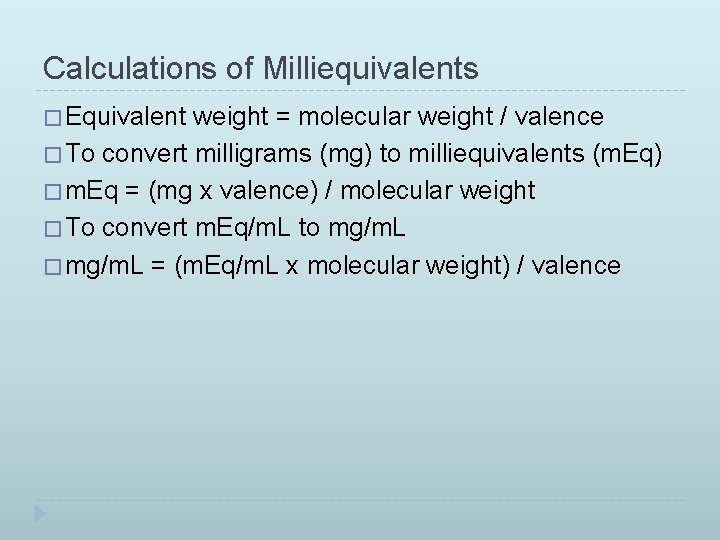
Calculations of Milliequivalents � Equivalent weight = molecular weight / valence � To convert milligrams (mg) to milliequivalents (m. Eq) � m. Eq = (mg x valence) / molecular weight � To convert m. Eq/m. L to mg/m. L � mg/m. L = (m. Eq/m. L x molecular weight) / valence
Example 1 � Convert g/mol) 8 m. Eq of potassium to mg (MW of K+ = 39
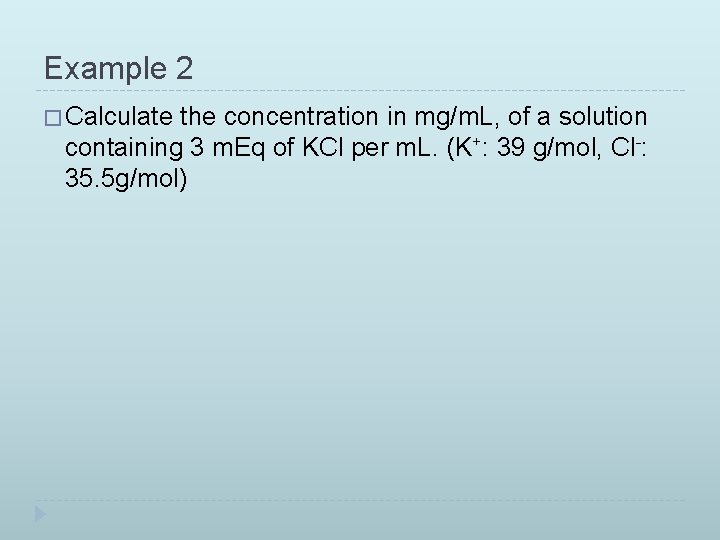
Example 2 � Calculate the concentration in mg/m. L, of a solution containing 3 m. Eq of KCl per m. L. (K+: 39 g/mol, Cl-: 35. 5 g/mol)
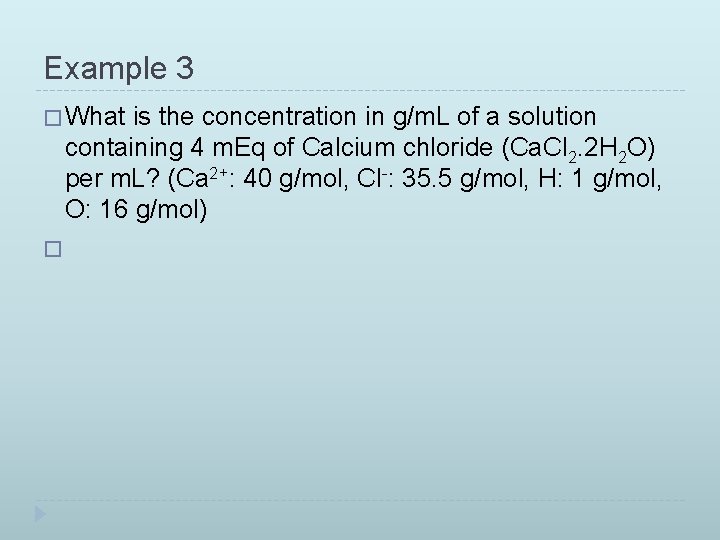
Example 3 � What is the concentration in g/m. L of a solution containing 4 m. Eq of Calcium chloride (Ca. Cl 2. 2 H 2 O) per m. L? (Ca 2+: 40 g/mol, Cl-: 35. 5 g/mol, H: 1 g/mol, O: 16 g/mol) �
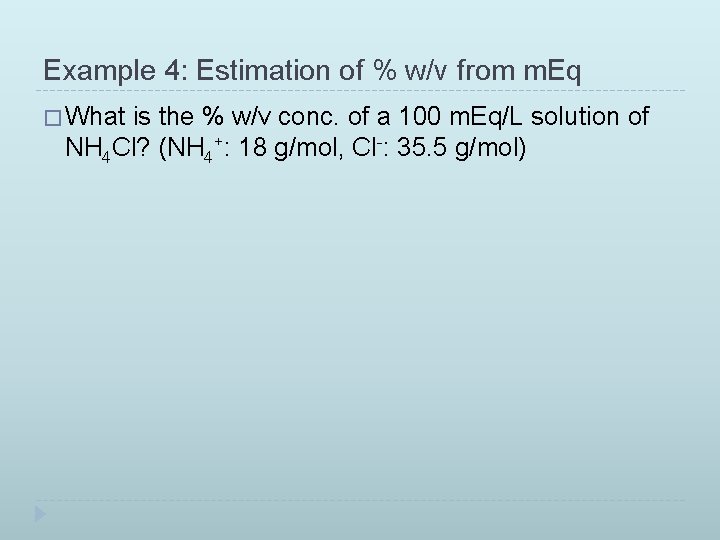
Example 4: Estimation of % w/v from m. Eq � What is the % w/v conc. of a 100 m. Eq/L solution of NH 4 Cl? (NH 4+: 18 g/mol, Cl-: 35. 5 g/mol)
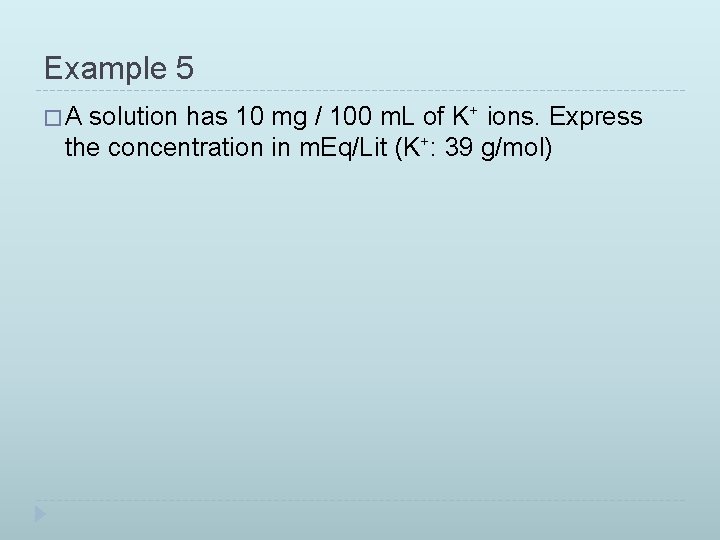
Example 5 �A solution has 10 mg / 100 m. L of K+ ions. Express the concentration in m. Eq/Lit (K+: 39 g/mol)
Example 6 �A solution contains 10 mg/100 m. L of Ca 2+ ions. Express the concentration in m. Eq/Lit (Ca 2+: 40 g/mol)
Example 7 �A mg 2+ ion level in plasma is found to be 2. 5 m. Eq/L. Express the conc. In mg (mg 2+: 24)
Example 8 � How many m. Eq of KCl is present in a 15 m. L dose of a 10% w/v KCl elixir?
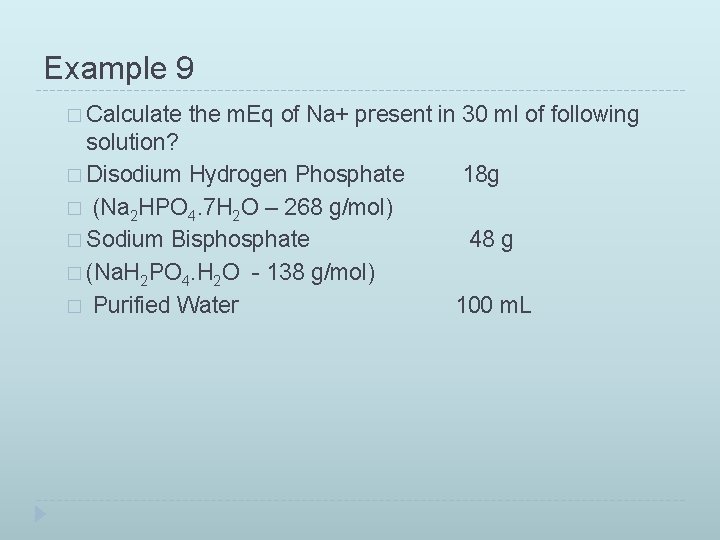
Example 9 � Calculate the m. Eq of Na+ present in 30 ml of following solution? � Disodium Hydrogen Phosphate � (Na 2 HPO 4. 7 H 2 O – 268 g/mol) � Sodium Bisphosphate � (Na. H 2 PO 4. H 2 O - 138 g/mol) � Purified Water 18 g 48 g 100 m. L
Example 10: Clinical Application �A person will receive 2 m. Eq of Na. Cl / kg of body weight. He weighs 132 lb. Calculate the ml of 0. 9% sterile Na. Cl that should be administered (Na+: 23 g/mol, Cl-: 35. 5 g/mol)
Millimoles and Micromoles �A mole is the molecular weight of substance in grams. � A millimole – one thousandth of a mole � A micromole – One millionth of a mole � SI expresses, electrolyte conc. in mmol/L � For monovalent species, the numeric values of the m. Eq and mmol are identical
Example 11 � How many mmol of monobasic sodium phosphate (m. w. 138 g/mol) are present in 100 g of the substance?
Example 12 � Calculate 96 g/mol) the weight in mg of 1 mmol of HPO 4 - ( m. w.
Example 13 � Convert plasma levels of 0. 5 µg/m. L of tobramycin (mw – 467. 52) to µmol/L?
Osmolarity � Osmotic pressure is important to biologic processes that involve the diffusion of solutes and the transfer of fluids through semi-permeable membranes � Osmotic pressure is proportional to the total number of particles in a solution � Unit of measurement is milliosmoles (m. Osmol)
Osmolarity � For non-electrolytes like dextrose, 1 mmol represents 1 mosmol � However for electrolytes, the total number of particles in solution depends on the degree of dissociation of a substance. � E. g. Assuming complete dissociation, 1 mmol Na. Cl represents 2 m. Osmol (Na+ + Cl-) of total particles � 1 mmol of Ca. Cl 2 represents 3 m. Osmol (Ca 2+ + 2 Cl-) � 1 mmol of sodium citrate (Na 3 C 6 H 5 O 7) represents 4 m. Osmol (3 Na+ + C 6 H 5 O 7 -) of total particles
� The milliosmolar value of the complete solution is equal to the sum of milliosmolar values of individual ions. � U. S. Pharmacopeia lists the following formula for calculation of ideal osmolar concentration: Wt. of substance (g/L) � m. Osmol/L = --------------- × No. of Species × 1000 � Mol. Wt (g/mol) �
Example 14 � Calculate of ideal osmolarity for 0. 9% Sodium Chloride Solution?
Osmolarity vs. Osmolality � Osmolarity -- “Milliosmoles of solute per liter of solution” � Osmolality – “Milliosmoles of solute per kilogram of solvent” � For dilute aqueous solutions – both terms are nearly identical � For more concentrated solutions – the two values are not identical � Pharmacist should make distinction between Osmolarity and Osmolality
Example 15 �A solution has 5% anhydrous dextrose in water for injection. Represent the concentration in mosmol/lit?
Example 16 �A solution contains 10 mg% of Ca 2+ ions. How many milliosmoles are present in 1 lit of solution?