
Electrolyte Balance Objectives 1 Physiology causes manifestations diagnosis

Electrolyte Balance.
Objectives : 1. Physiology, causes, manifestations, diagnosis and treatment of sodium imbalance. 2. Physiology, causes, manifestations, diagnosis and treatment of potassium imbalance.

Electrolyte composition of intracellular and extracellular fluids Plasma (mmol/L) Interstitial fluid (mmol/L) Intracellular Fluid (mmol/L) Na+ 142 144 10 K+ 4 4 160 Ca 2+ 2. 5 1. 5 PO 42 - 1. 0 57 HCO 3 - 26 30 8 Mg 2+ 1. 0 0. 5 13 cr 102 114 2 SO 42 - - 0. 5 10 3 4 3 16 0 55 Solute Organic acid Protein
The cell membrane acts as a barrier between intraand extra-celluar fluids, and the capillary wall separates plasma from the interstitium. Every compartment maintains osmotic pressure through an actively retained specific solute as follows: - Intracelluar K+ (pumped inwards by Na+/K-ATPase) - ECF : Na+. - Plasma : proteins (esp. albumin, impermeable through the normal endothelial barrier).

Clinical disorders of sodium balance
1. Hyponatraemia Symptomatic hyponatraemia is associated with a mortality of 1050%. Hyponatremia usually occurs as a result of altered water balance, making clinical assessment of body water the key to management. (normal s. Na conc. is 135 -145
Hyponatraemia can be caused either by shift of fluid from cells to the extracellular compartment (solute-driven), or by water ingestion in excess of the ability to excrete it. In the former setting, the osmolality of the body fluids is high. While in the latter, osmolality is low. The first step in assessment is to determine whether the hyponatraemia is due to a solutedriven shift of fluid out of cells or not.
1. Hyponatraemia due to a transcellular fluid shift When glucose (also mannitol or glycerol) concentration in the extracellular fluid increases, it will increase the tonicity in this compartment. This is rapidly corrected by water shift from cells into the extracellular compartment, thus decreasing extracellular [Na+], whilethe total osmolality of the body fluids will increase because a new solute has been added. However, in case of renal failure these agents
2. Hyponatraemia due to water ingestion in excess of losses Dilution of body fluids by water retention is the most common cause of hyponatraemia and is occurring in 2 % of inpatients. Dilutional hyponatraemia can occur in two ways: (a) ingestion of water at a rate in excess of the maximal excretory capacity of the kidney (Primary polydipsia) , or (b) ingestion of water in a setting in which water excretion by the kidney is impaired (Renal failure). Dilutional hyponatraemia is virtually always the

a) Primary polydipsia Compulsive water drinking, occurs in 60 % of inpatients with psychiatric disorders. Episodes of hyponatraemia are common. The causes of the polydipsia are multifactorial : ingestion of water in excess of the normal maximal excretion. medications that stimulate vasopressin release Nicotine is a stimulus for vasopressin release They may have some impairment of water excretion

Primary polydipsia can occur in patients with neurological injury (as multiple sclerosis, tuberculous meningitis, and sarcoidosis) but rarely develop hyponatraemia. The urine in patients with primary polydipsia is extremely dilute (urine specific gravity is typically less than 1. 005, and the urine osmolality is less than 150 mosmol/kg H 2 O). The hyponatraemia in these patients can be readily corrected in the short term by limiting fluid intake. Long-term management is more difficult.
Beer potomania and eldery people Severe hyponatraemia has been noted to occur in beer drinkers who chronically ingest as little as 5 L /day. It is associated with lack of other dietary intake (low solute) A similar scenario may occur in elderly individuals with very poor intake who drink about 3 to 4 liters of water daily. The urine is maximally dilute in these hyponatraemic patients and serum vasopressin is undetectable. Serum [Na+] rapidly returns to normal on
b) Renal failure A water-excreting defect exists in the anuric patient, and ingestion of water in excess will result in hyponatraemia.
Evaluation of hyponatraemia :
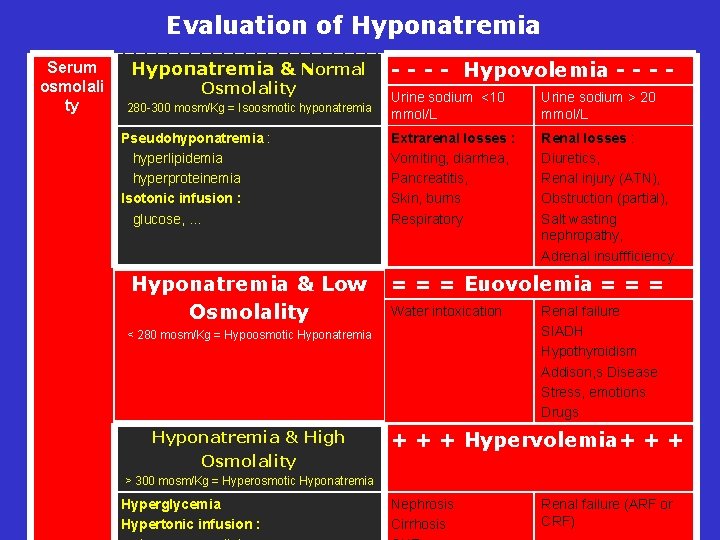
Evaluation of Hyponatremia Serum osmolali ty Hyponatremia & Normal Osmolality 280 -300 mosm/Kg = Isoosmotic hyponatremia Pseudohyponatremia : hyperlipidemia hyperproteinemia Isotonic infusion : glucose, … Hyponatremia & Low Osmolality - - Hypovolemia - - - Urine sodium <10 mmol/L Urine sodium > 20 mmol/L Extrarenal losses : Vomiting, diarrhea, Pancreatitis, Skin, burns Respiratory Renal losses : Diuretics, Renal injury (ATN), Obstruction (partial), Salt wasting nephropathy, Adrenal insuffficiency. = = = Euovolemia = = = Water intoxication < 280 mosm/Kg = Hypoosmotic Hyponatremia & High Osmolality Renal failure SIADH Hypothyroidism Addison, s Disease Stress, emotions Drugs + + + Hypervolemia+ + + > 300 mosm/Kg = Hyperosmotic Hyponatremia Hyperglycemia Hypertonic infusion : Nephrosis Cirrhosis Renal failure (ARF or CRF)
Once polydipsia or renal failure have been excluded as the cause of a dilutional hyponatraemia, the remaining causes can best be evaluated by assessing the extracellular fluid volume of the patient. The causes of hyponatraemiacan be categorized into three groups : I. In states with extracellular fluid volume depletion. II. In oedematous states. III. In euvolaemic states.
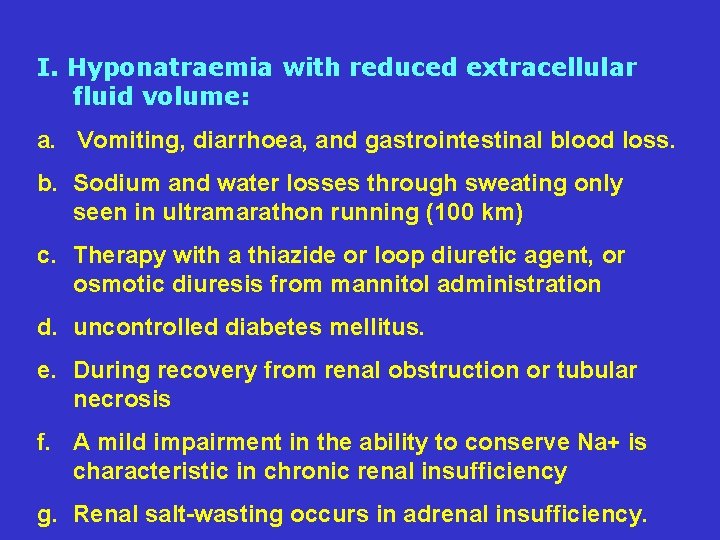
I. Hyponatraemia with reduced extracellular fluid volume: a. Vomiting, diarrhoea, and gastrointestinal blood loss. b. Sodium and water losses through sweating only seen in ultramarathon running (100 km) c. Therapy with a thiazide or loop diuretic agent, or osmotic diuresis from mannitol administration d. uncontrolled diabetes mellitus. e. During recovery from renal obstruction or tubular necrosis f. A mild impairment in the ability to conserve Na+ is characteristic in chronic renal insufficiency g. Renal salt-wasting occurs in adrenal insufficiency.
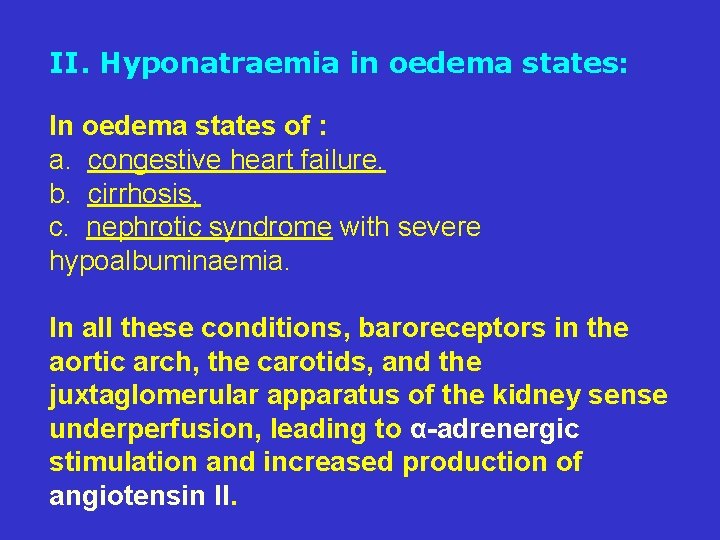
II. Hyponatraemia in oedema states: In oedema states of : a. congestive heart failure. b. cirrhosis, c. nephrotic syndrome with severe hypoalbuminaemia. In all these conditions, baroreceptors in the aortic arch, the carotids, and the juxtaglomerular apparatus of the kidney sense underperfusion, leading to α-adrenergic stimulation and increased production of angiotensin II.
In patients who develop hyponatraemia, vasopressin release, presumably due to decreased perfusion of the hypothalamus, is a hallmark feature. Reduced perfusion of the hypothalamus also stimulates thirst, ensuring sufficient water intake to sustain the hyponatraemia.
III. Hyponatraemia in apparent euvolaemic states: Euvolaemic hyponatraemia occurs in : a) syndrome of inappropriate ADH secretion (SIADH): In addition to tumours, the syndrome is seen in a variety of pulmonary and central nervous system disorders. In these disorders, vasopressin release is presumed to be stimulated by neuro-endocrine factors. Hyponatraemic patients with SIADH are
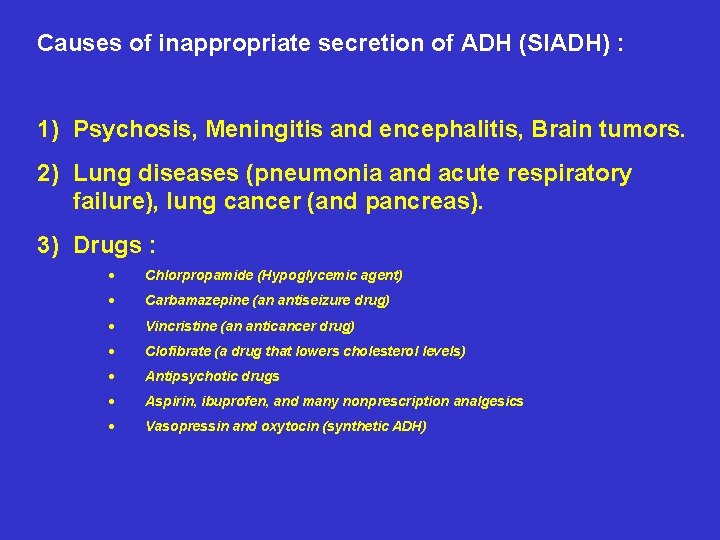
Causes of inappropriate secretion of ADH (SIADH) : 1) Psychosis, Meningitis and encephalitis, Brain tumors. 2) Lung diseases (pneumonia and acute respiratory failure), lung cancer (and pancreas). 3) Drugs : Chlorpropamide (Hypoglycemic agent) Carbamazepine (an antiseizure drug) Vincristine (an anticancer drug) Clofibrate (a drug that lowers cholesterol levels) Antipsychotic drugs Aspirin, ibuprofen, and many nonprescription analgesics Vasopressin and oxytocin (synthetic ADH)
b) Adrenal insufficiency Salt wasting in uncontrolled Addison’s disease can lead to volume depletion, limiting water excretion, but euvolaemic hyponatraemia, due to abnormal vasopressin secretion, also occurs. c) Hypothyroidism Withdrawal of thyroid replacement therapy in patients with hypothyroidism impairs the ability to excrete a water load. In the majority, vasopressin release occurs despite hypotonicity.
Signs and symptoms of hyponatraemia: Dilutional hyponatraemia produces central nervous system dysfunction manifested by headache, nausea, and vomiting, progressing to confusion and disorientation, lethargy, coma, seizures, and respiratory arrest. Generally, patients with a serum [Na+] of 125 mmol/l or greater are asymptomatic. Conversely, most patients with serum [Na+] less than 120 mmol/l have significant signs and symptoms of central nervous system dysfunction due in large part to cerebral oedema, produced by water entry into the brain
Treatment of dilutional hyponatraemia: 1. Except in patients with extracellular fluid volume depletion, fluid restriction is recommended. 2. If hyponatraemia is accompanied by mental status changes, or if the serum [Na+] is less than 120 mmol/l, Isotonic saline (0. 9%) administration is recommended. If it is acute, rapid correction is advocated using IV hypertonic saline (3%). But, be cautious in patients with congestive heart failure or cirrhosis. 3. Treat the potential causes of syndrome of inappropriate secretion of antidiuretic
4. Individuals with SIADH or some forms of drug-induced hyponatraemia: use frusemide or bumetanide to reduce extracellular fluid volume. 5. Lithium carbonate and demeclocycline can be used in those who cannot tolerate fluid restriction.
2. Hypernatremia Is a blood sodium concentration above 145 meq / liter. The blood sodium concentration generally rises abnormally high when water loss exceeds sodium loss, usually when a person drinks too little water. A high blood sodium concentration implies that a person either does not feel thirsty when he should, or he is thirsty but can not obtain enough water to drink.
Causes of hypernatremia : 1. Head trauma or neurosurgery involving the pituitary 2. Disorders of other electrolytes (high calcium levels and low potassium levels) 3. Use of drugs such as lithium, demeclocycline, or diuretics 4. Excess water losses (diarrhea, vomiting, fever, excessive sweating) 5. Diabetes insipidus 6. Limited access to water in eldery bedridden or demented (especially in combination with any of the other causes)
Symptoms As with hyponatremia, the major symptoms of hypernatremia result from brain dysfunction. Severe hypernatremia can lead to confusion, muscle twitching, seizures, coma, and death.
Treatment 1. In all but the most mild cases, hypotonic fluid is given intravenously. Blood tests are performed every few hours to help determine when enough fluid has been given. The blood sodium concentration is reduced very slowly, because correcting the condition too rapidly can cause permanent brain damage. 2. Treating the underlying cause once identified. For example, if a person has diabetes insipidus, give ADH.
Potassium Balance

Potassium has major roles in cell metabolism and in nerve and muscle cell function. Unlike sodium, most of the body potassium is located inside cells. The concentration of potassium in the blood must be maintained within a narrow range. A potassium concentration that is too high or too low can have serious consequences, such as an abnormal heart rhythm or cardiac arrest.
Dietary Sources of Potassium supplements Salt substitutes (potassium chloride) Bananas Tomatoes Oranges Melons Potatoes and sweet potatoes Spinach, turnip greens, collard greens, kale, and other green leafy vegetables Most peas and beans
Potassium balance is achieved by matching the amount of potassium taken in through food with the amount excreted. Although some potassium is lost through the GIT, most of the potassium leaves the body in the urine. Normally, the kidneys adjust the excretion of potassium to match changes in dietary intake. Some drugs and certain conditions cause potassium to move into or out of cells, also greatly affecting the potassium concentration in the blood.
Hypokalemia Is a blood potassium concentration below 3. 8 meq / liter. Potassium may be lost in the urine due to the use of diuretics or excess potassium loss through the GIT (vomiting, diarrhea, laxative use, or colon polyps). Since many foods contain potassium, hypokalemia rarely is caused by too little intake.
R Cushing's syndrome, there is excess corticosteroid hormones secretion including aldosterone that causes excess potassium loss from the kidneys. The kidneys also excrete excessive potassium in people who eat large amounts of licorice or chew certain types of tobacco. R People with Liddle's syndrome, Bartter's syndrome, and Fanconi's syndrome are born with rare defects in the mechanism for conserving potassium in the kidneys. R Insulin and drugs for asthma (albuterol, terbutaline, and theophylline) increase potassium shift into cells resulting in hypokalemia.
Symptoms Mild decreases in the blood potassium concentration usually cause no symptoms. A more severe deficiency (levels below 3. 0 meq / liter) can cause muscle weakness, twitches, and even muscle paralysis. The heart may develop abnormal rhythms, especially in people with heart disease, particularly in those taking digoxin.
Treatment Potassium usually can be replaced relatively easily by eating foods rich in potassium or by taking oral (potassium chloride), given in small doses several times a day because it irritate the gastrointestinal tract. When potassium deficiency is severe, potassium can be given intravenously by infusion. This is done cautiously and slowly, in the hospital.
Hyperkalemia Is a blood potassium concentration higher than 5. 0 meq / liter. A potassium concentration above 5. 5 meq / liter begins to affect the heart's electrical conducting system. If concentration continues to rise, the heart rhythm becomes abnormal and the heart may arrest.
Hyperkalemia occurs when the kidneys can not excrete enough potassium q The most common cause of mild hyperkalemia is the use of drugs that block the renal excretion of potassium, such as triamterene, spironolactone, and angiotensin converting enzyme inhibitors. q Hyperkalemia can also be caused by Addison's disease is becoming an increasingly common cause of hyperkalemia, as more people with AIDS develop problems with their adrenal glands. q Renal failure can result in severe hyperkalemia. q In crush injury, severe burn, or overdoses of cocaine, there is muscle breakdown with rapid influx of potassium into blood that overwhelm the kidneys' excretion ability resulting
Symptoms Mild hyperkalemia causes few or no symptoms. Occasionally, symptoms such as irregular palpitations due to irregular heart beats occur. Electrocardiographic changes can be seen. Immediate treatment is essential when the blood potassium concentration rises above 5 meq / liter in someone with poor kidney function or above 6 meq / liter in someone with normal kidney function.
q Potassium can be removed through gastrointestinal tract by inducing diarrhea and by swallowing a preparation that contains a potassiumadsorbing resin. So, the potassium leaves the body in the stool. q If the person's kidneys are functioning, a diuretic can be given to increase potassium excretion. q When treatment is needed even more rapidly, the person may be given an intravenous solution containing calcium, glucose, or insulin. Calcium protects the heart from the effects of high potassium, for only few minutes. Glucose and insulin shift potassium to inside the cells, thus lowering the blood potassium concentration.

Thank You
- Slides: 43