
ELECTRODISCHARGE MACHINING Classification of NTM processes Mechanical Abrasive
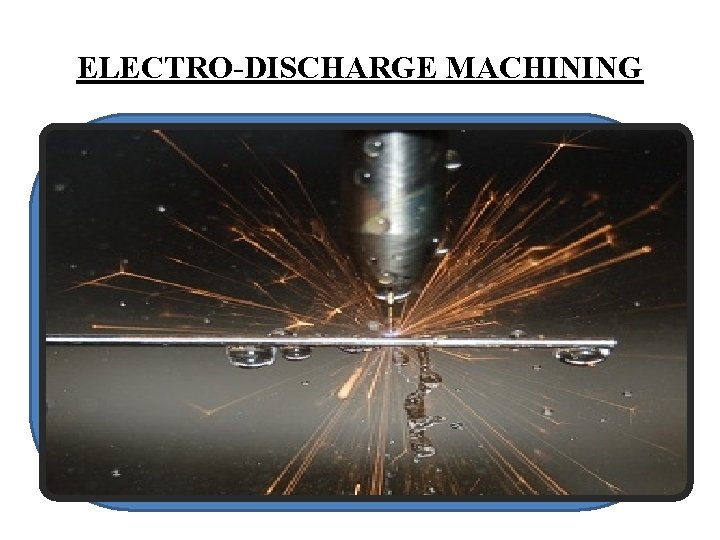
ELECTRO-DISCHARGE MACHINING Classification of NTM processes Ø Mechanical • Abrasive jet machining (AJM) • Ultrasonic Machining (USM) • Wtaer jet maching (WJM) • Abrasive water jet machining (AWJM) Ø Processes Electrochemical Processes • Electrochemical Machining (ECM) • Electro jet Drilling (EJD) • Electro chemical Grinding (ECG) Ø Electro thermal processes • Electro-discharge Machining (EDM) • Electron Beam Machining (EBM) • Laser Jet Machining (LJM)
Electro-discharge Machining - Process Square tool and we need to make a square hole. Tool and job emerged in a dielectric Fluid typically kerosine is used as a dielectric fluid. Tool and w/p connected with G(electrical generator). Generator generates wave forms. So, with time voltage has to be applied between tool an work piece. Once again current will vary in trapezoidal manner. Once we apply the voltage there would be sparking. Because of thermal energy of the spark there would be gradual machining on the work piece and tool has to be lowered to get a square hole machining.
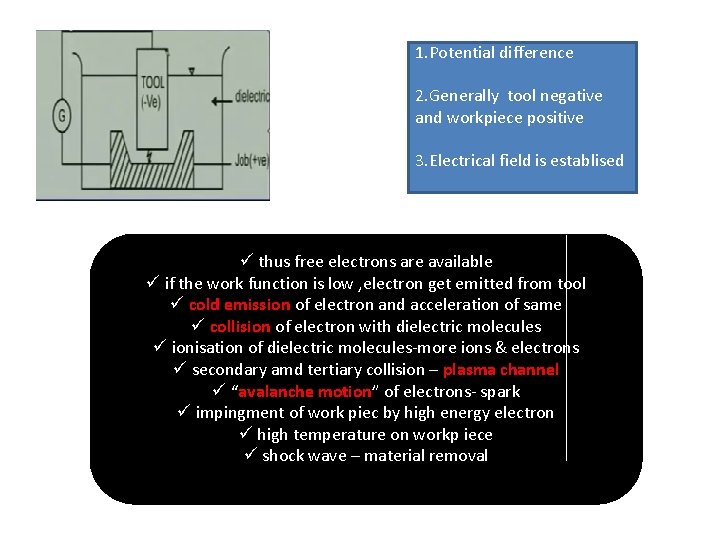
1. Potential difference 2. Generally tool negative and workpiece positive 3. Electrical field is establised ü thus free electrons are available ü if the work function is low , electron get emitted from tool ü cold emission of electron and acceleration of same ü collision of electron with dielectric molecules ü ionisation of dielectric molecules-more ions & electrons ü secondary amd tertiary collision – plasma channel ü “avalanche motion” of electrons- spark ü impingment of work piec by high energy electron ü high temperature on workp iece ü shock wave – material removal
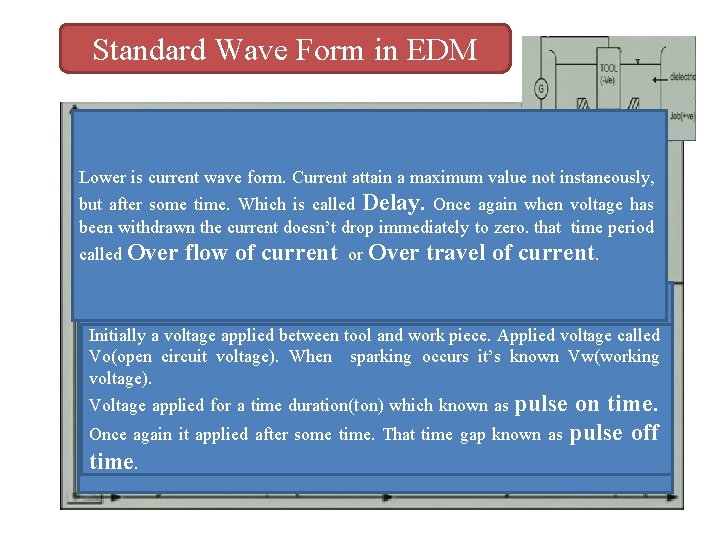
Standard Wave Form in EDM vw Lower is current wave form. Current attain a maximum value not instaneously, t but after some time. Which is called Delay. off Once again when voltage has on v withdrawn the current doesn’t drop immediately to zero. that time period been t called Over flow of current or Over travel of current. time Initially a voltage applied between tool and work piece. Applied voltage called I delay Vo(open circuit voltage). When sparking occurs it’s known Vw(working We do not apply voltage continuously, we apply voltage step by step. Because voltage). we do not want an Arc. we want a spark. That’s why we get a rectangular wave overflow Voltage applied for a time duration( which. Ioknown pulse on time. forms, rather than aton) continuous wave as form. Once again it applied after some time. That time gap known as time. pulse off
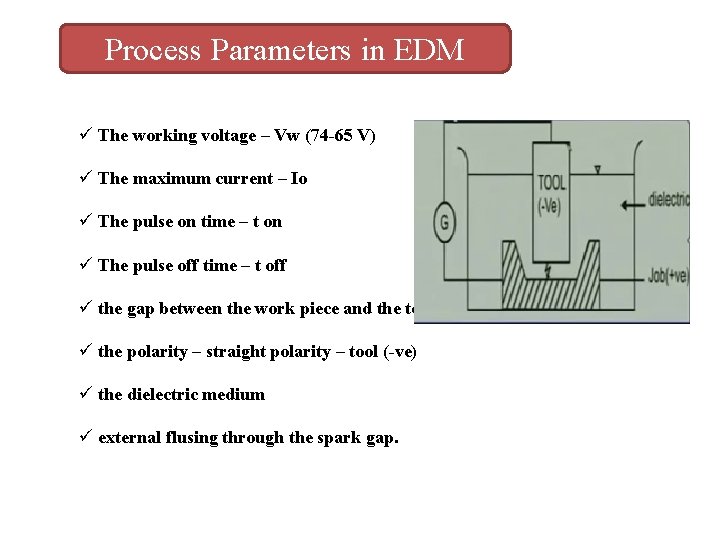
Process Parameters in EDM ü The working voltage – Vw (74 -65 V) ü The maximum current – Io ü The pulse on time – t on ü The pulse off time – t off ü the gap between the work piece and the tool- spark gap – δ ü the polarity – straight polarity – tool (-ve) ü the dielectric medium ü external flusing through the spark gap.
Characteristics of EDM Ø the process can be used to machine any work material if it is electrically conductive Ø material removal depends on mainly thermal properties of the work material rather than its strength, hardness etc. Ø in EDM there is a physical tool and geometry of the tool is the positive impression of the hole or geometric feature to be machined Ø the tool has to be electrically conductive as well. The tool wear once again depends on thermal properties of the tool material. Ø rapid heating and cooling and local high temperature leads to surface hardening which may be desirable in some applications.
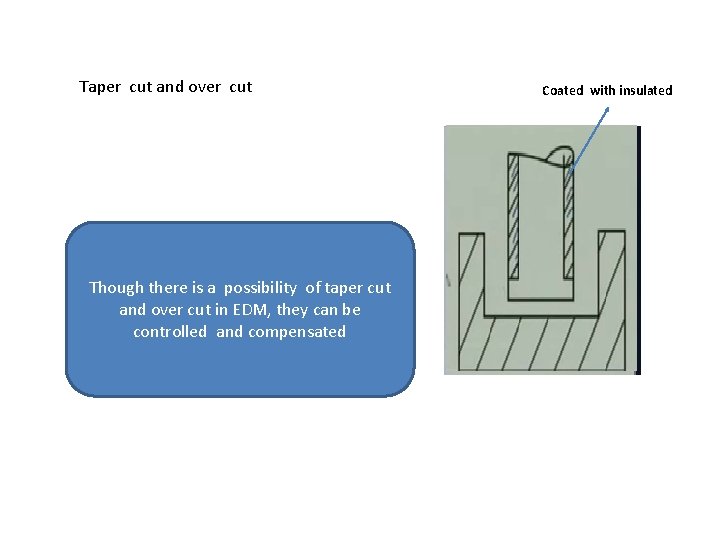
Taper cut and over cut Coated with insulated Over cut Though there is a possibility of taper cut and over cut in EDM, they can be controlled and compensated Taper cut
DIELECTRIC ØMaterical removal mainly occurs due to thermal evaporation and melting. As thermal processing required to be carried out in absence of oxygen so that the process can be controlled and oxidation avoided. ØOxidation often leads to poor surface conductivity of the work piece hindering further machining(spark will not be stable, total efficiency of the spark cannot be utilized). ØHence, dielectric fluid should provide an oxygen free machining environment. ØMoreover, during sparking it should be thermally resistant as well. ØTap water cannot be usd as it ionises too early and thus breakdown due to presence of salts as impurities occur. ØDielectric medium is generally flushed around the spark zone
Tool material ü electrode not undergo much tool wear when it is impinged by positive ions. ü localised temperature rise has to be less by tailoring or properly choosing its properties ü or even when temperature increases there would be less melting ü further, the tool should be easily workable as intricate shaped geometric features are machined in EDM. ü high electrical conductivity – electrons Are cold emitted more easily and there is less bulk electrical heating. ü high melting point. ü easy manufacturability & ccost-cheap Ø graphite ØElectrolytic oxygen free copper ØTellurium copper – 99% cu +0. 5% tellurium Ø brass
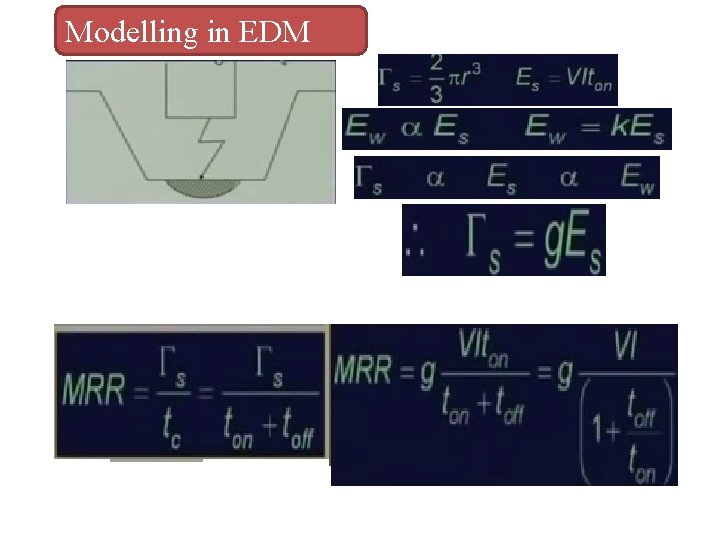
Modelling in EDM
Advantages of EDM Conventional EDM machines can be progrmmed for vertical machining, orbital, directional, helical, conical, rotational, spin and indexing machining cycles. This versatility gives Electrical Discharge Machines many advantages over conventional machine tools. ü Any material that is electrically conductive can be cut using the EDM process. ü Complex dies sections and molds can be produced accurately, faster, and at lower costs. ü The EDM process is burr-free. ü Thin fragile sections such as webs or fins can be easily machined without deforming the part.
Disadvantages of EDM include: ü The slow rate of material removal. ü The additional time and cost used for creating electrodes for ram/sinker EDM. ü Reproducing sharp corners on the work piece is difficult due to electrode wear. ü "Overcut" is formed. ü Excessive tool wear occurs during machining.
Wire-Cut EDM The wire-cut EDM is a discharge machine that uses CNC movement to produce the desired contour or shape. It does not require a special shaped electrode, instead it uses a continuous-traveling vertical wire under tension as the electrode. The electrode in wire-cut EDM is about as thick as a small diameter needle whose path is controlled by the machine computer to produce the shape required.
Thank you
- Slides: 14